


The original 5×5 in Durata: Reg Park, three weeks in
Reg Park won Mr Universe three times in the 1950s and 60s, trained a young Arnold Schwarzenegger, and left behind the routine that every 5×5 since has been a variation of. It is almost aggressively simple: one full-body workout, five compound lifts, five sets of five, done three times a week. Finish all your sets and the weight goes up next time. That is the entire program.
Simple is not the same as easy, and this walkthrough follows three weeks of it in the app, nine sessions. The squat carries the story, because it is the lift that runs out of road first. Every weight, rep and estimate below is engine output from that run, including the two sessions where the squat did not go up.
Finding it
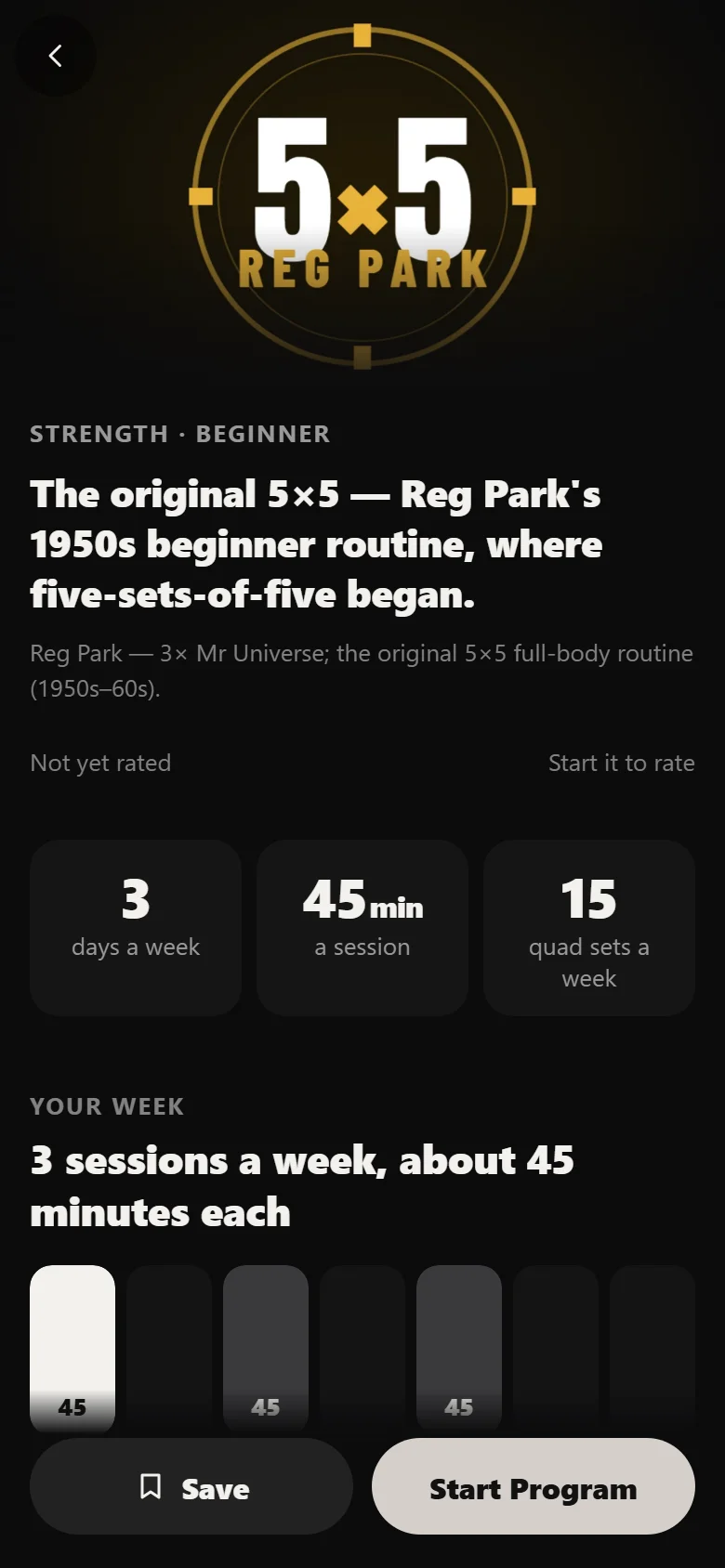
In Discover, Reg Park 5×5 sits on the Strength shelf, marked Beginner, at three days a week. Search finds it by name, or Filter narrows the shelves by level and days a week. Tap the cover for a quick look, then View Program for the full page.
It is the first step of the app's linear-progression track, the one that eventually hands you over to a more complicated program when this one stops working.
The program page shows the week before you commit. There is not much week to show: the same session, three times, with the progression rule sitting on every lift.
One workout, three times a week
There is no A day and B day here. That came later, with the routines this one inspired. Reg Park's version is a single full-body session you repeat on Monday, Wednesday and Friday: squat, bench press, overhead press and barbell row for five sets of five each, plus deadlifts.
Two things about how the app runs it are worth knowing up front, because both are deliberate departures from the 1950s text. The five sets listed are the working sets: classically the first few sets of a 5×5 ramp up to the top weight, and the app's warm-up calculator inserts that ramp for you rather than it eating into your five. And the deadlift is trimmed to one heavy set of five per session, because five sets of five deadlifts three times a week is more than almost anyone recovers from, whatever the original said.
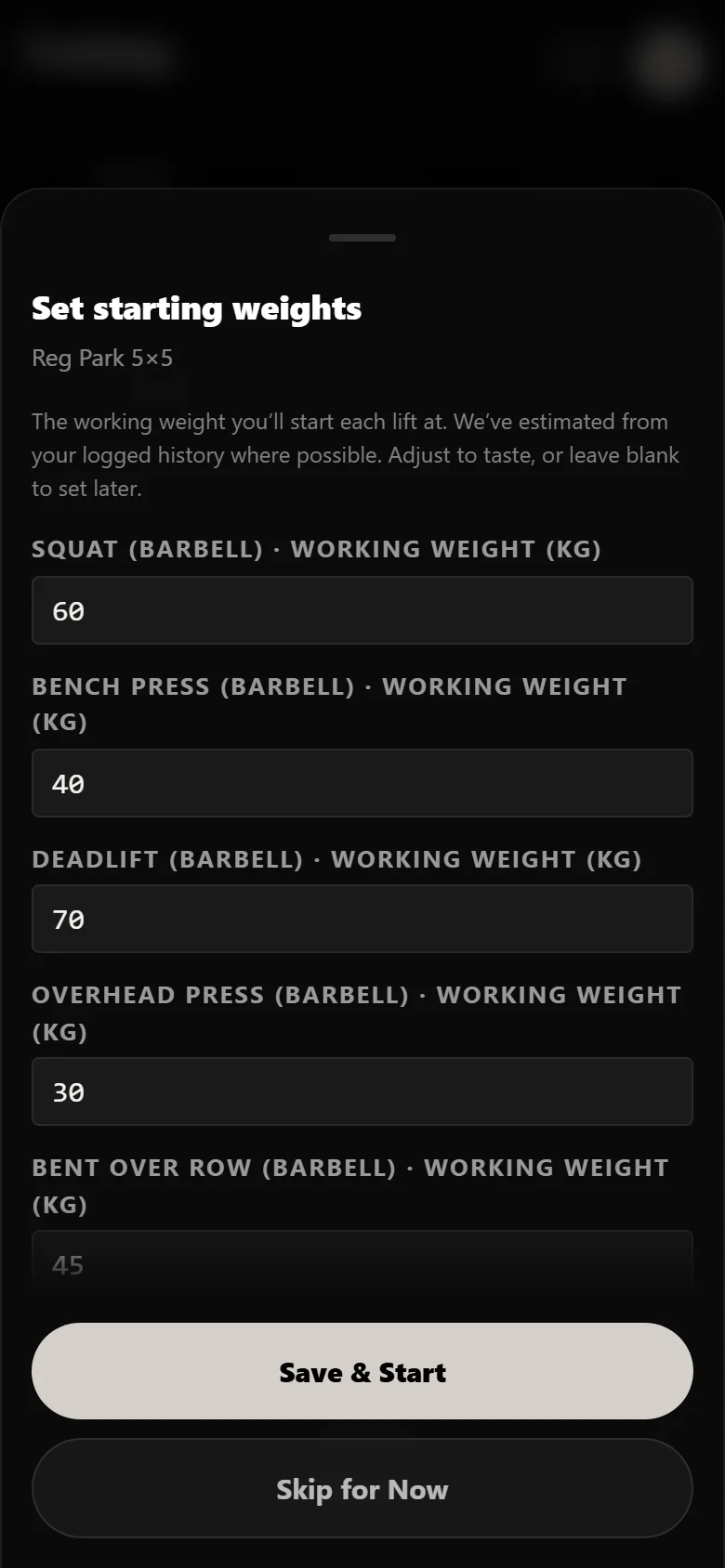
Setup asks for one working weight per lift and nothing else. No training maxes, no percentages, no test session: 60 kg on the squat, 70 kg on the deadlift, 45 kg on the row, 40 kg on the bench and 30 kg on the press on this run. Start light is not advice here so much as instruction, because with weight going on three times a week you will reach heavy soon enough.
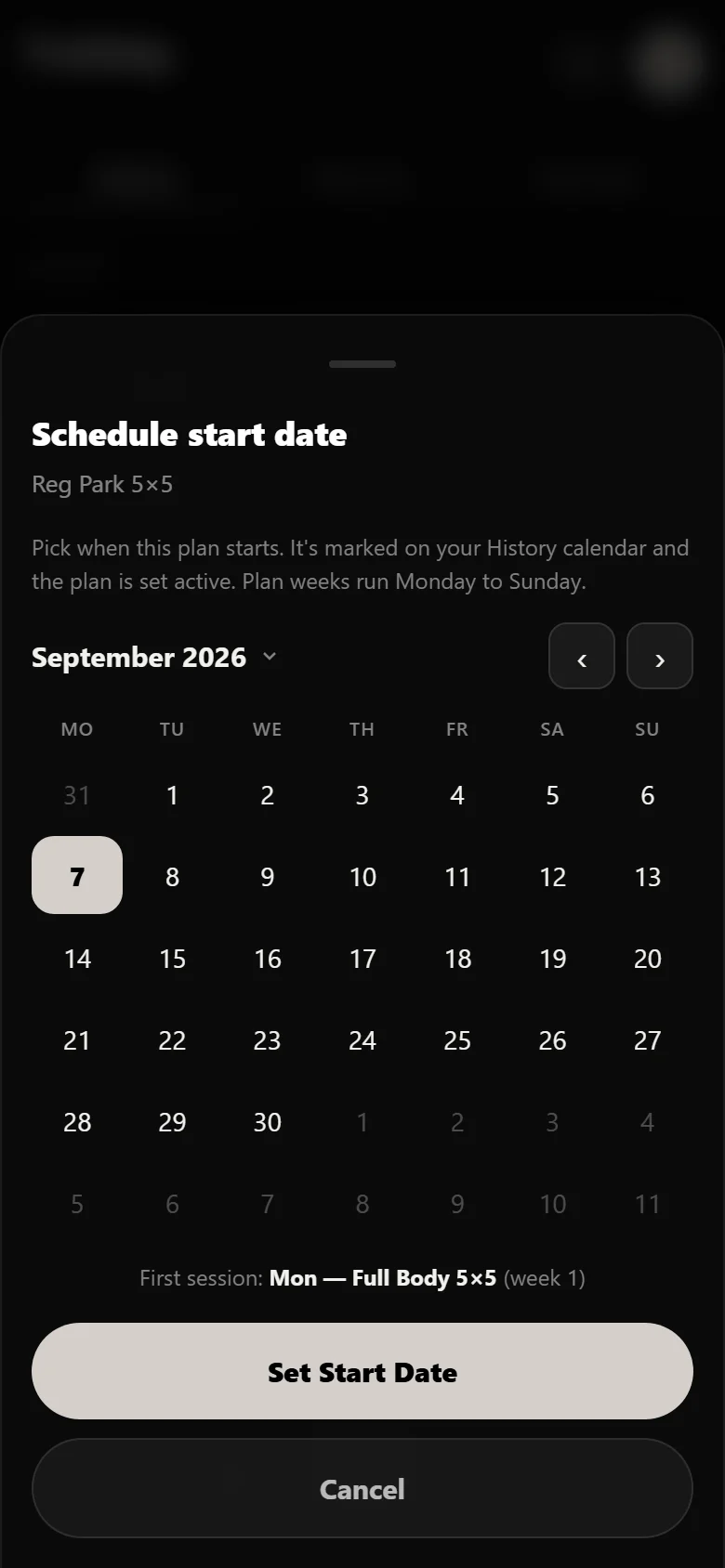
Pick a start date and the sessions land on the History calendar from there. The program is a repeating weekly template, so it runs until you stop it or it stops working.
The rule: finish everything, add weight
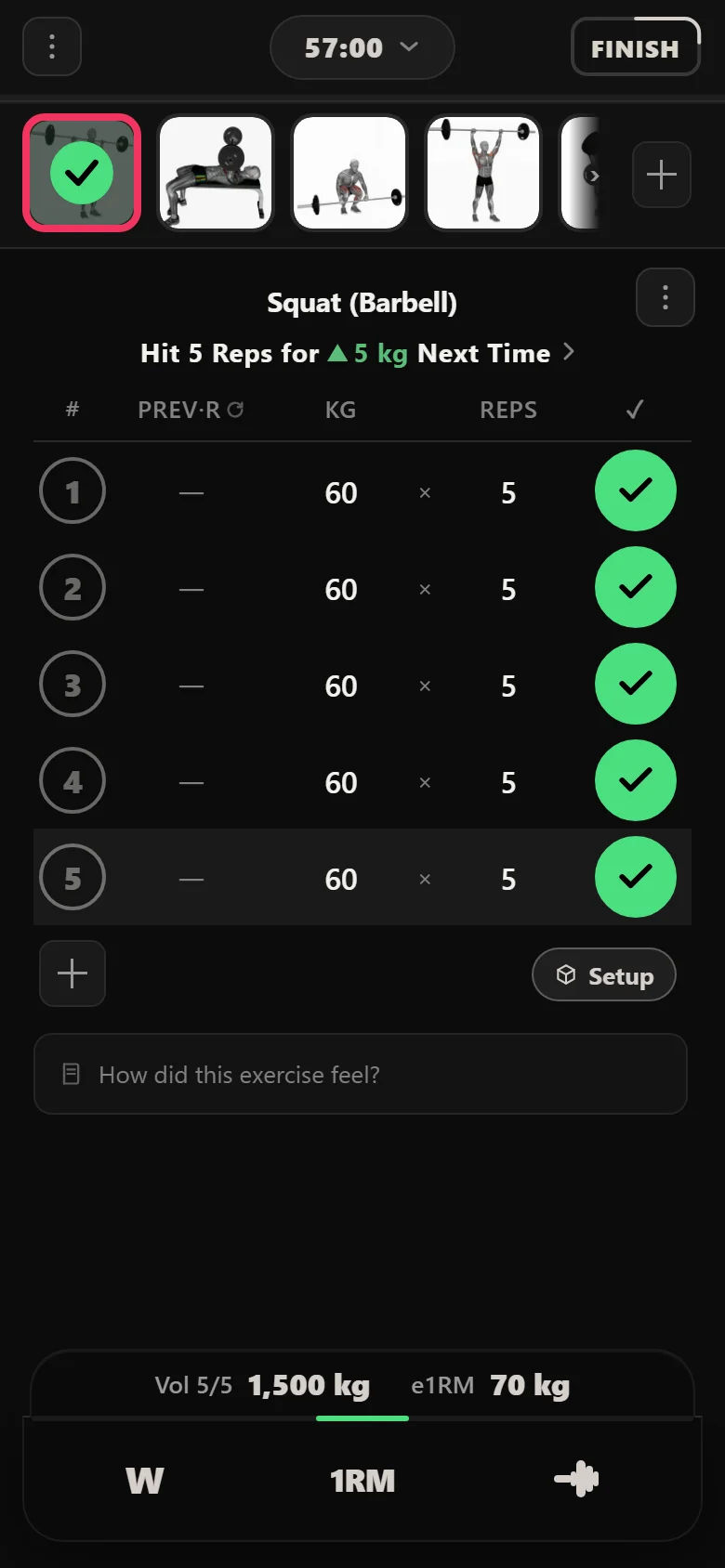
Every lift in this program runs the same rule, and it is the oldest one in strength training. Complete all five sets of five and the weight goes up next session, 5 kg on the squat and deadlift, 2.5 kg on the bench, press and row. Miss a single working set and the weight stays where it is.
The word that matters is session, not week. Most programs move a lift once a week; this one moves it three times, which is why a beginner can add 15 kg to a squat in a fortnight and why the whole thing has a shelf life measured in months rather than years. The app puts the next weight on screen before you get there, so the only decision left is whether you finish the sets.
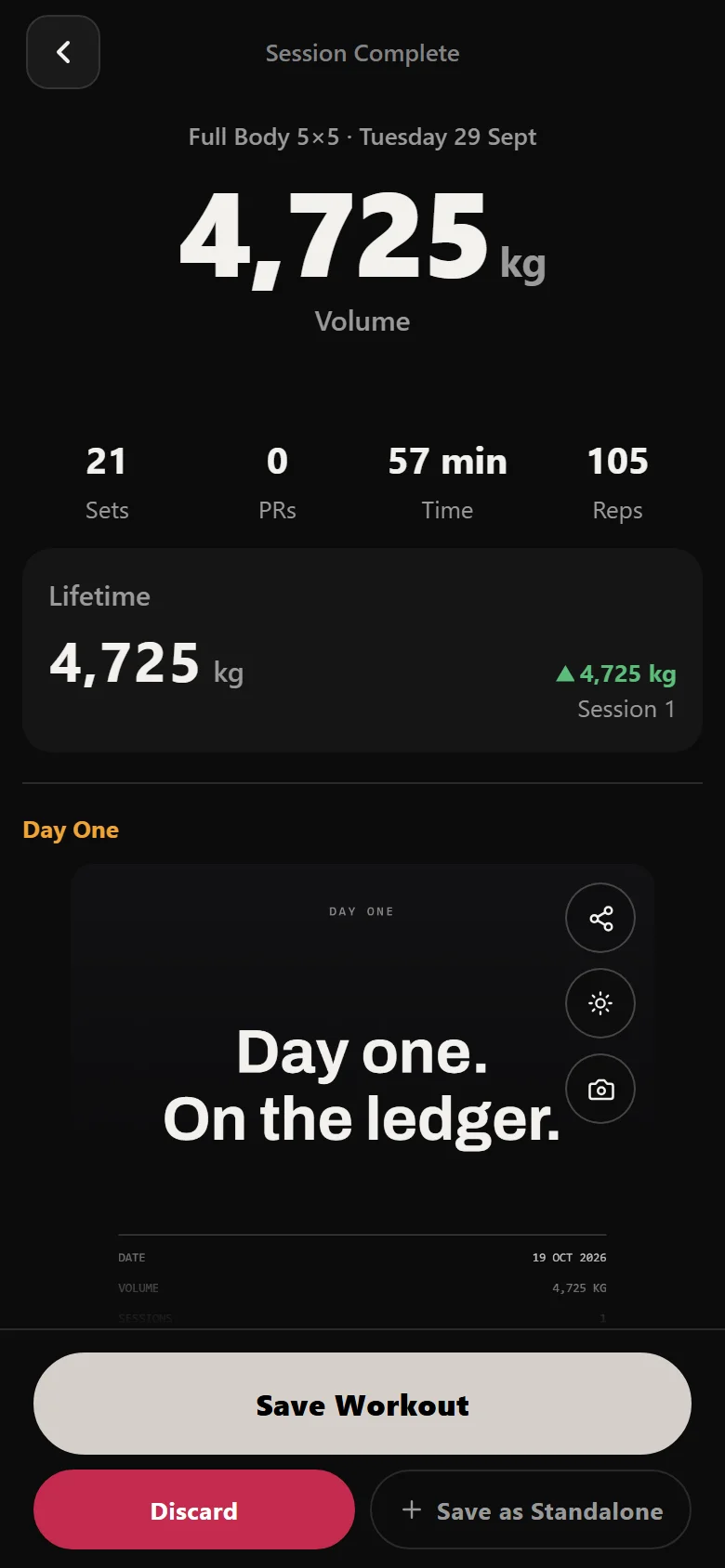
It also tallies the session as you go. Twenty-one sets, a hundred and five reps and 4725 kg moved on a single full-body day is a lot of work for a routine that fits on an index card.
Five kilos, three times a week
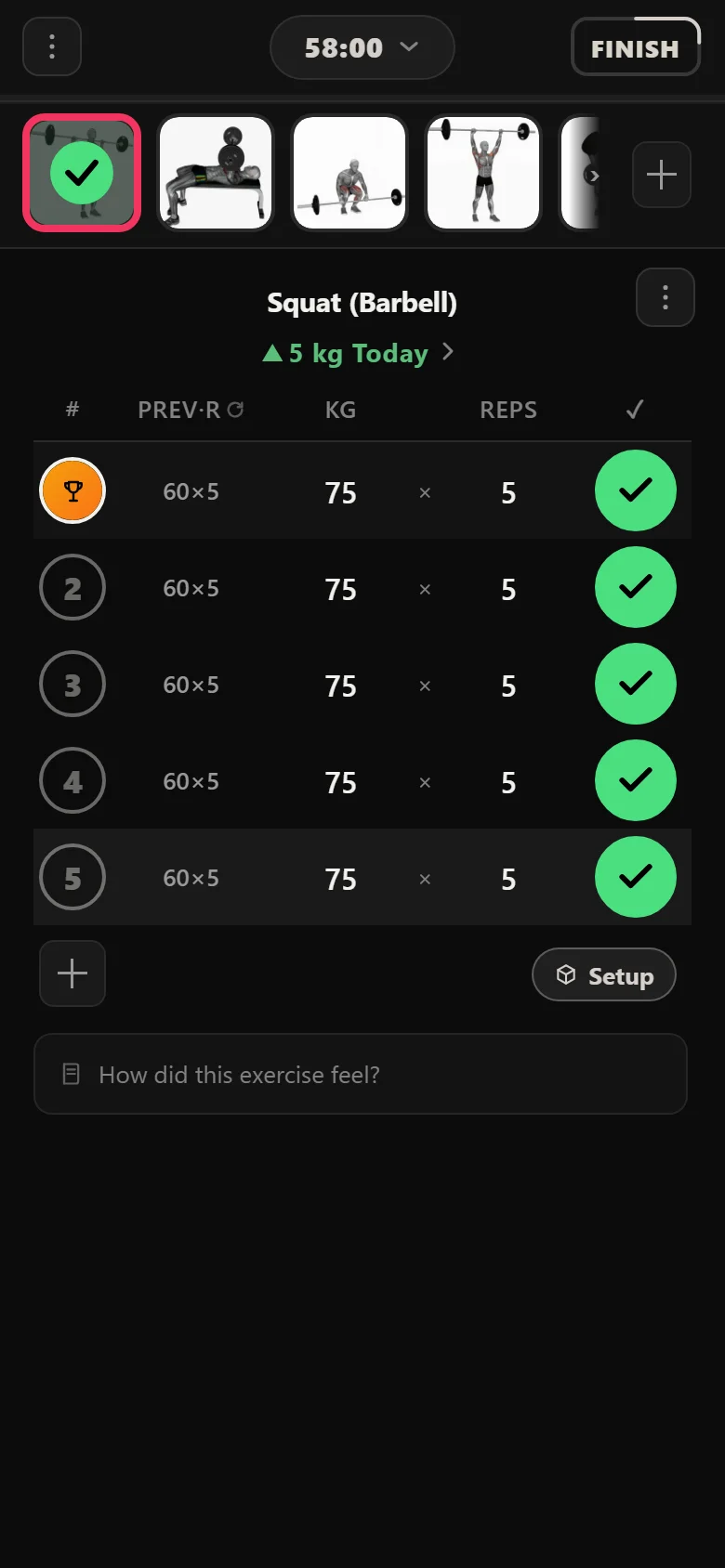
The first fortnight is exactly as advertised. 60 kg, 65, 70, 75, four sessions and four increases. Every other lift is doing the same thing at 2.5 kg a session, which adds up faster than it sounds.
This is the part of a linear program that feels like cheating, and it is also the part that ends. Adding 5 kg to a squat three times a week is 15 kg a week, and nobody's squat grows at 15 kg a week for long. What matters is what the program does on the day it stops.
80 kg bites, and the app holds instead of cutting
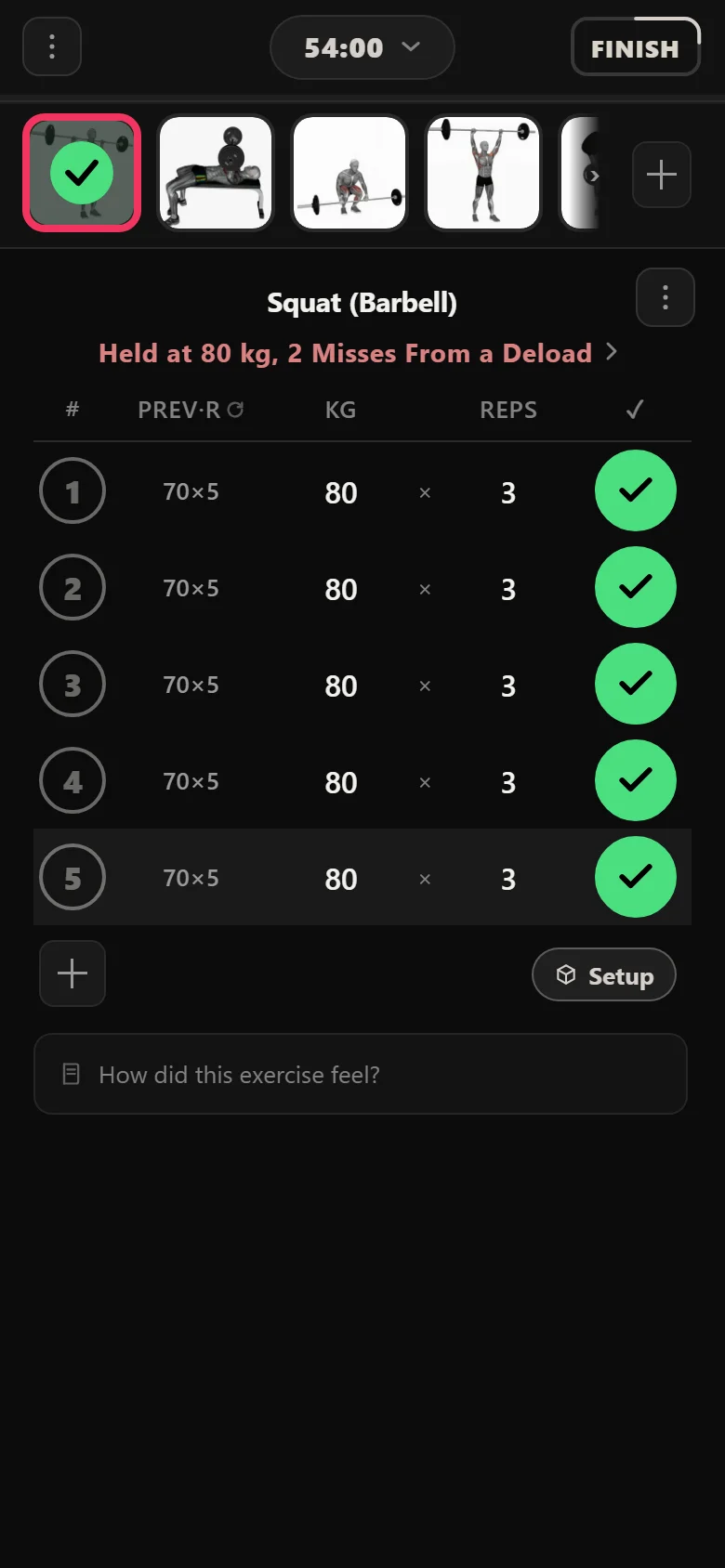
Session five puts 80 kg on the bar and the fifth set does not happen: three reps instead of five. Missing any working set is a failed session, so the weight does not move. Come back on Wednesday, try 80 kg again, and miss it again.
Here is where this program differs from the ones that descend from it, and it is worth being precise about. Two misses in a row on the same weight does not trigger a deload here. The rule allows three before it cuts anything, so after two failed attempts the app has done nothing except refuse to add weight. No 10% cut, no reset, no restart. Just 80 kg again on Friday.
The rule chip is a button, and this is when to press it. Tap it and the app lays out its case: the sets from this exact slot's own history, the weight it is judging, and the law it is applying. It is not reading your best-ever squat or an average, it is reading what you did at 80 kg in this program, and it is telling you why the number on screen has not changed.
There is a real design opinion in that. Three attempts at a weight is a lot of rope, and a beginner usually needs it: the first miss is often a bad night's sleep rather than a genuine ceiling. Handing you the same 80 kg a third time is the program betting that you will get it, and on this run it was right.
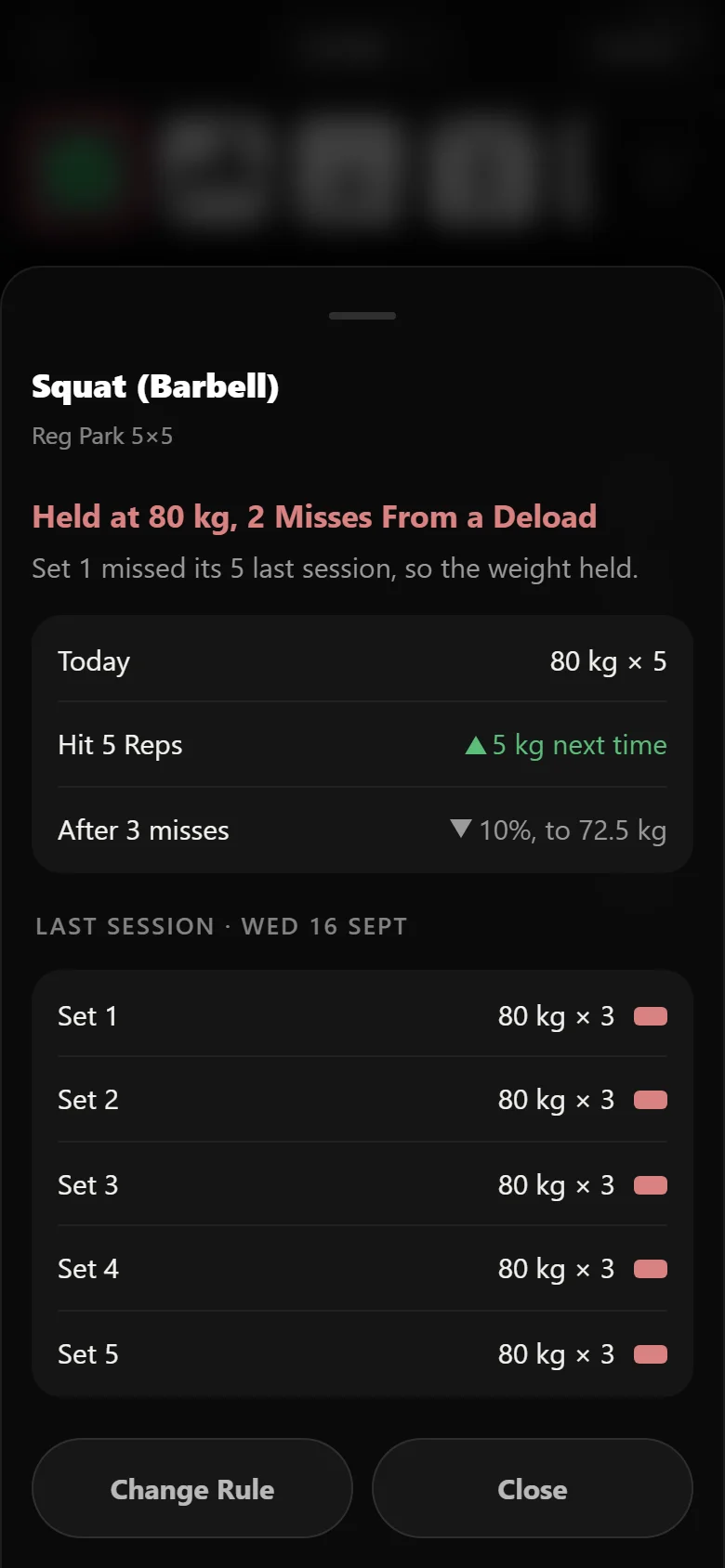
Third time, and straight back to climbing
The third attempt at 80 kg goes. All five sets, and the program does what it always does with a completed session: adds weight. 85 kg next, then 90 kg, and the block ends with 95 kg loaded for the session after.
So the arc has a flat stretch in the middle rather than a step down. Nine sessions, one weight held twice, and 30 kg added to the squat in three weeks. That is what the rule is designed to produce, and it is worth contrasting with a program that cuts you 10% after two misses: this one costs you a week and keeps your position, that one costs you the position and buys you a run-up. Both are defensible. They are just different bets, and the app runs whichever one the program you chose actually specifies.
Squat (Barbell): weight on the bar, every session
- 60S1 Session 1
- 65S2 Session 2
- 70S3 Session 3
- 75S4 Session 4
- 80S5 Session 5 — miss 1
- 80S6 Session 6 — miss 2, held
- 80S7 Session 7 — cleared
- 85S8 Session 8
- 90S9 Session 9
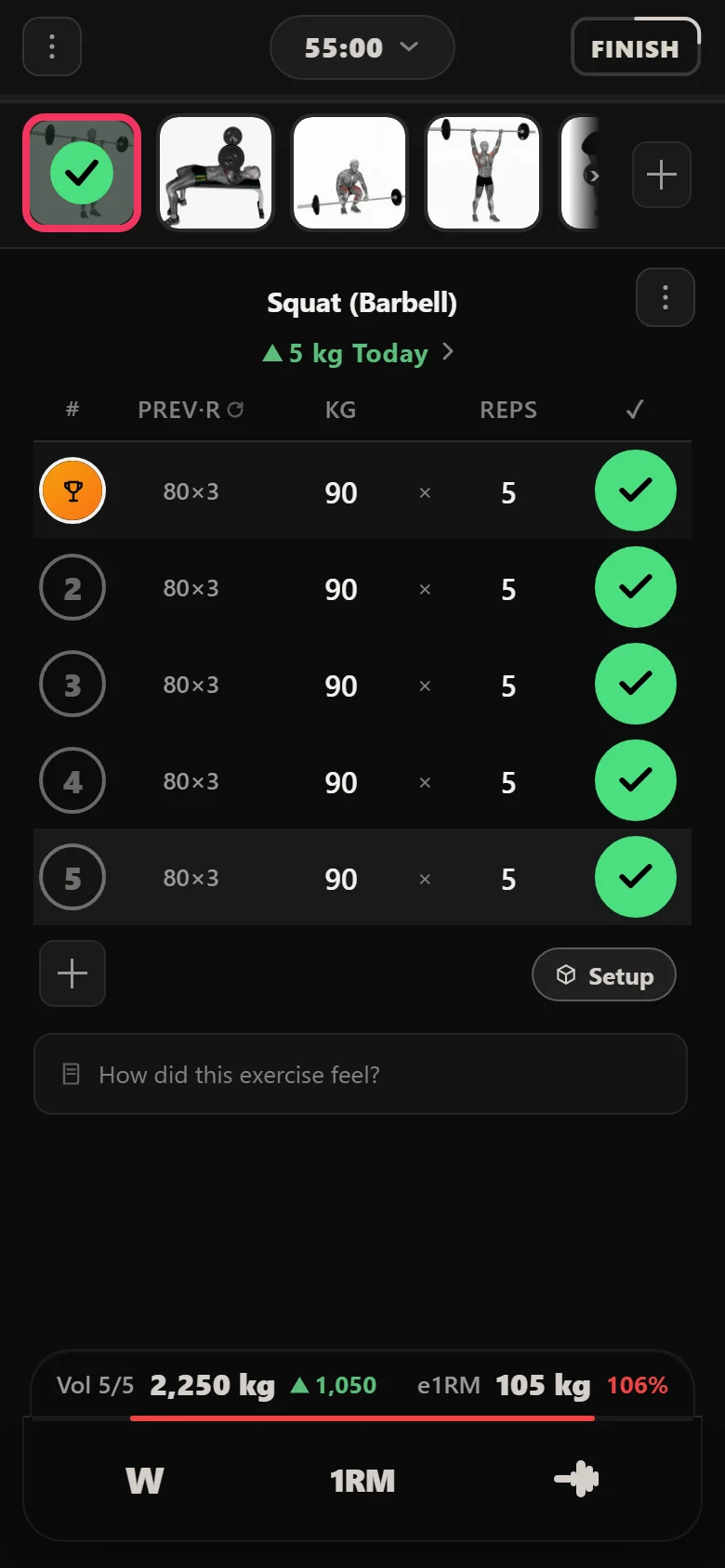
Three weeks from above
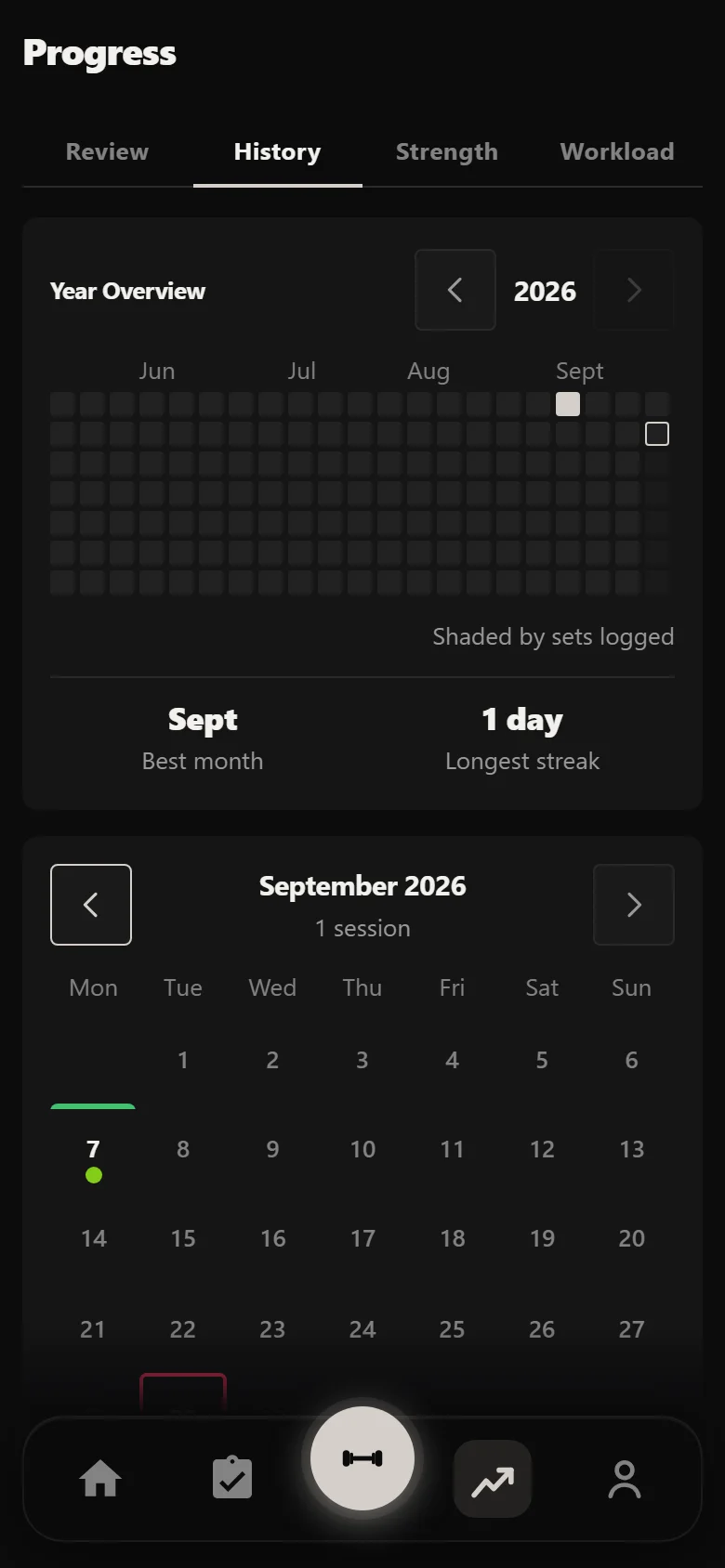
Nine sessions fill three weeks of the calendar, three a week, each one 21 sets of the same five lifts. The squat's estimated 1RM chart shows the shape of the block plainly: a climb, a flat stretch through the two held sessions, then a climb again, drawn off 45 sets of squatting.
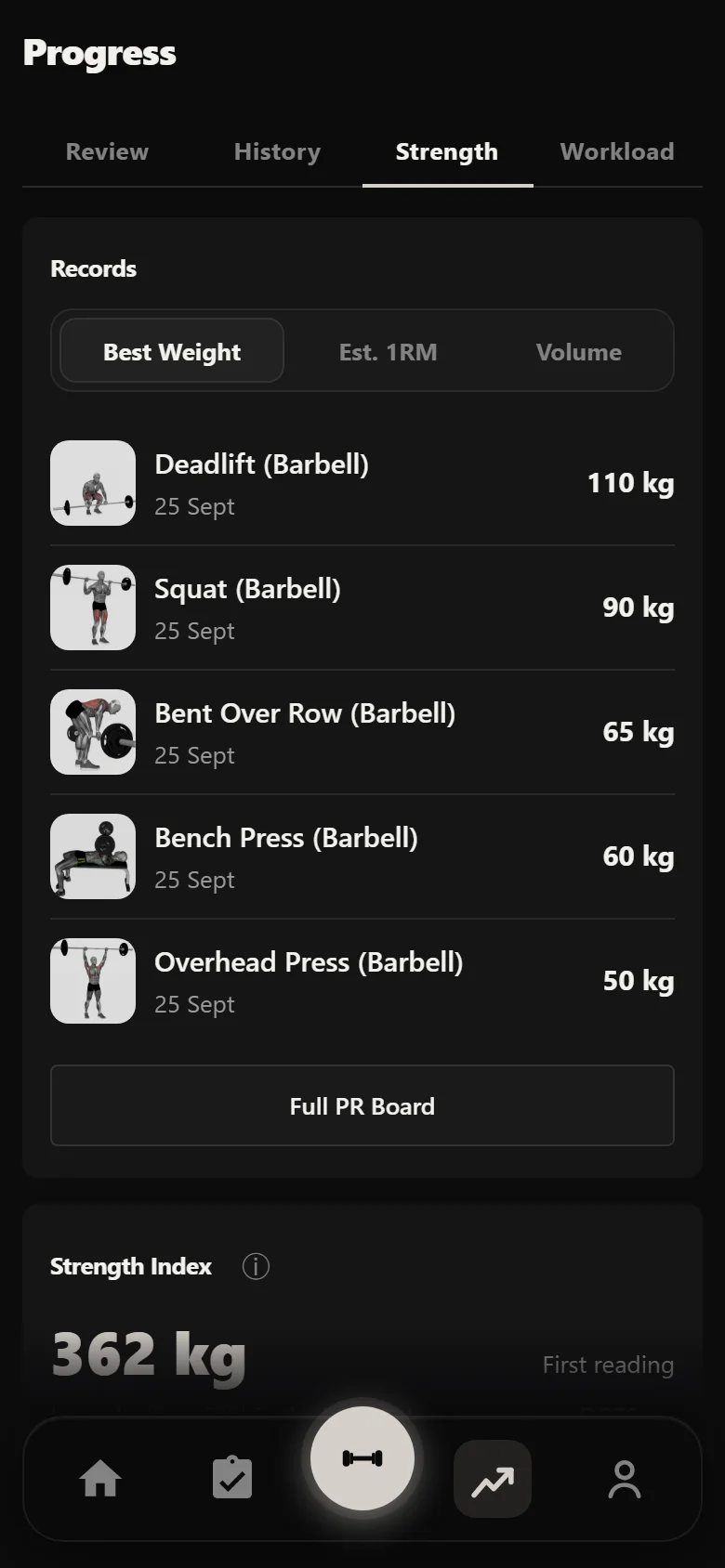
The Strength tab lists the records by best weight, deadlift 110 kg, squat 90 kg, then 65, 60 and 50 kg, and adds the four main lifts' estimates into a 362 kg Strength Index: the deadlift at 128.3 kg, the squat at 105 kg, the bench at 70 kg and the press at 58.3 kg. On a full-body program run three times a week, the weekly volume climbs steeply, which is the honest reason this routine stops working after a few months rather than a few years.
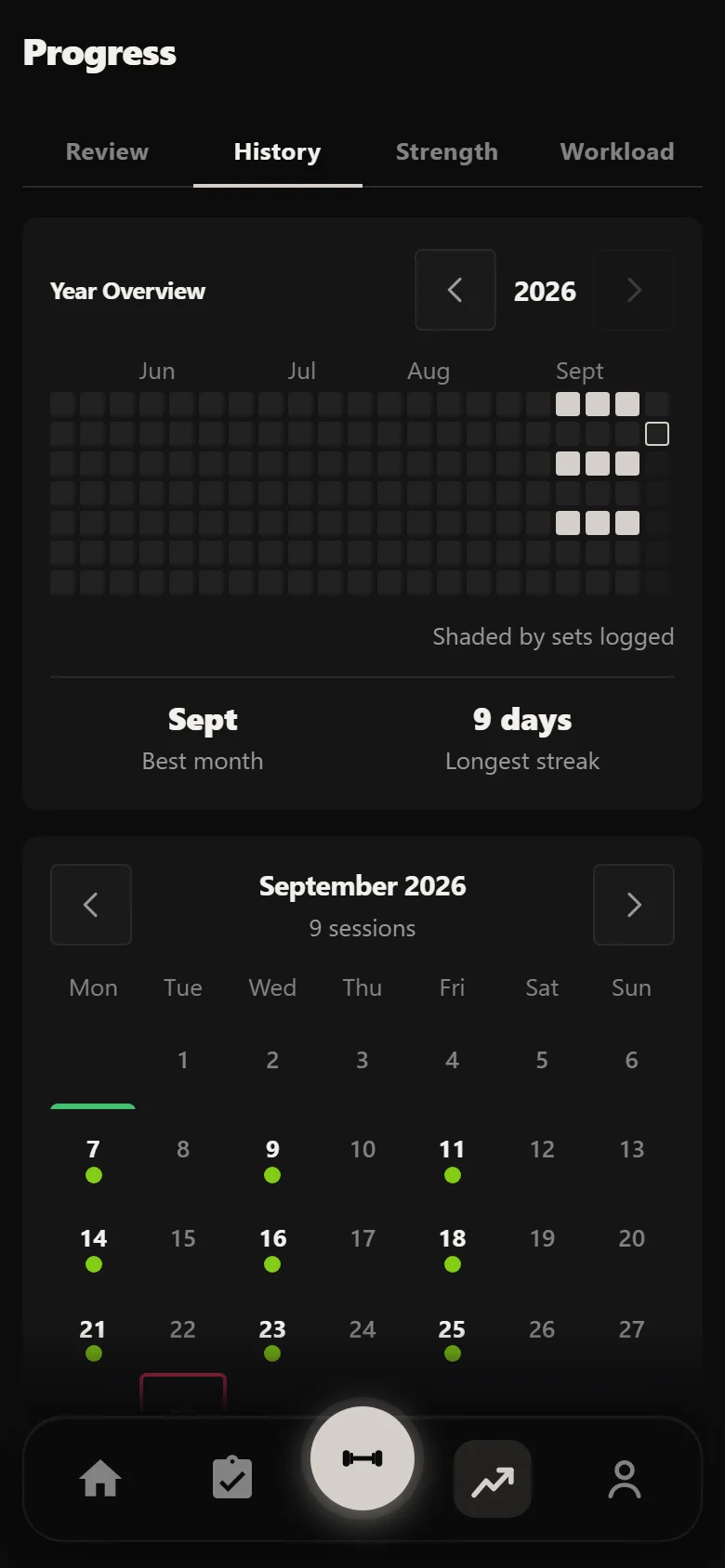
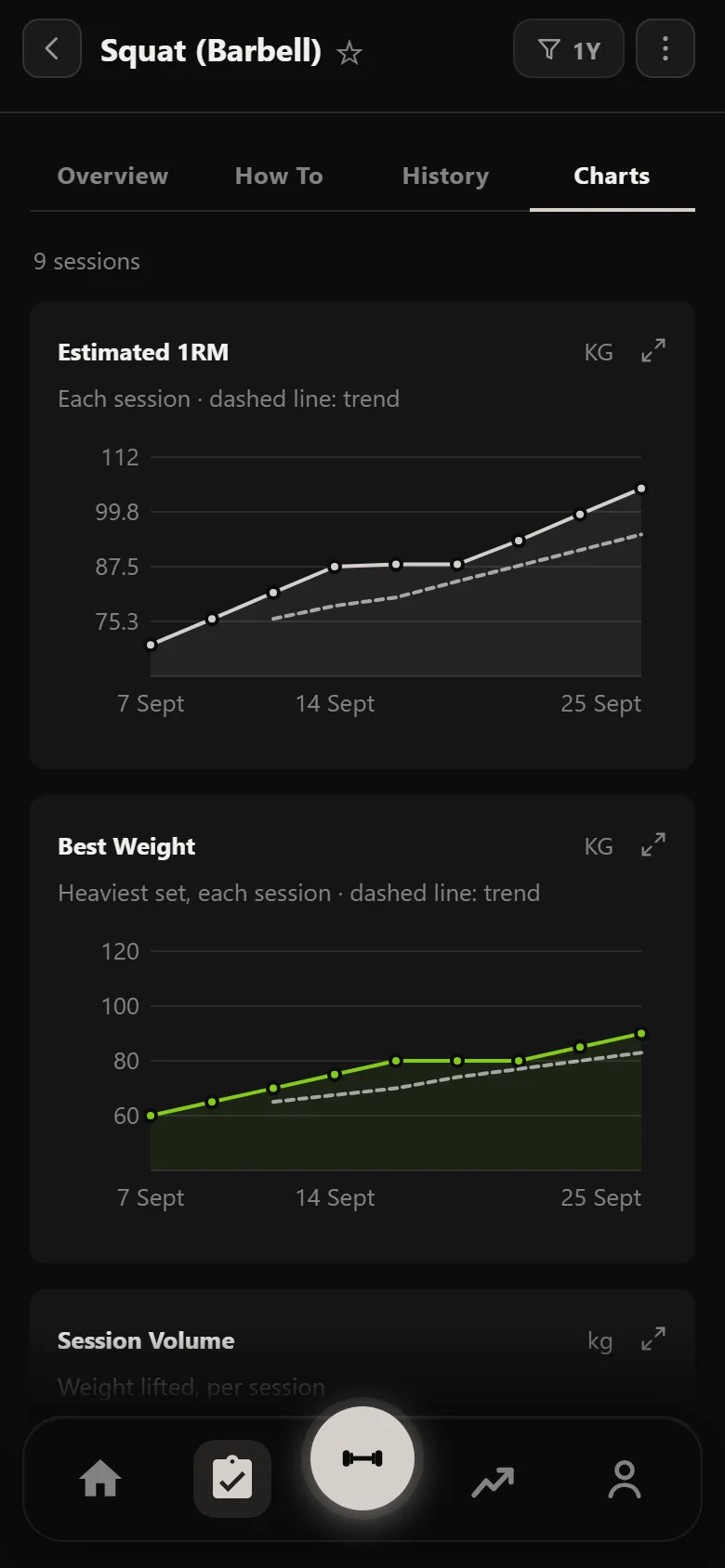
The payoff: everything moved
Three weeks, nine sessions, and every one of the five lifts is heavier than it started. The squat went 60 kg to 90 kg with 95 kg waiting. The deadlift went 70 kg to 115 kg. The bench went 40 kg to 62.5 kg, the press 30 kg to 52.5 kg, the row 45 kg to 67.5 kg. On a beginner's first block that is what success looks like, and it is why this routine outlived its author.
None of those numbers were worked out by hand, and none of them were nudged along. The two sessions where the squat did not move are on the chart exactly as they happened, because a progress chart that only goes up is not tracking anything.
The squat, start to finish: 60 kg to 90 kg in nine sessions, with 95 kg on the card for next time and the estimate at 105 kg. Two of those nine sessions added nothing, and the program was right to hold.
Common questions
What is Reg Park 5×5?
The original five-sets-of-five routine, from the British bodybuilder and three-time Mr Universe Reg Park in the 1950s and 60s. One full-body workout repeated three times a week: squat, bench press, overhead press and barbell row for five sets of five, plus heavy deadlifts. Add weight every session you complete all your sets. Nearly every 5×5 program since is a variation of it.
How is it different from StrongLifts or Madcow?
Those came later and split the work up. StrongLifts alternates an A and B session; Madcow moves progression to a weekly cycle with light, medium and heavy days. Reg Park's version does neither: the same full-body session three times a week, adding weight every single time you finish it. It is the simplest and the fastest-moving of the three, and the first to run out of road.
What happens when I miss a set?
The weight is held, not cut. Miss any of your working sets and the app leaves the same weight on the bar for next session. Only after three failed attempts does it cut the weight by 10% and restart the climb. On the run shown here the squat missed 80 kg twice, was held both times, and cleared it on the third attempt, so no deload ever happened.
Why is the deadlift only one set?
Because five sets of five deadlifts three times a week is more volume than most people recover from, whatever the 1950s original prescribed. Durata runs the deadlift as one heavy top set of five per session and keeps the full 5×5 for the other four lifts.
Where are the warm-up sets?
The classic 5×5 ramps the first sets up to the working weight. Durata's warm-up calculator inserts those warm-up sets for you, so the five sets listed in the program are all working sets at the working weight. You get the ramp without it eating into your five.
How long does this program last?
Months, not years. Adding 5 kg to a squat three times a week is 15 kg a week, and that ends for everyone. When holds turn into repeated deloads, that is the routine telling you to move to something with a weekly cycle. Durata's linear-progression track starts here and hands you on when the time comes.
Is Durata free?
Yes. Durata is free to use, with the full program catalogue, automatic progression maths, deload rules, rest timers and PR tracking. Everything in this walkthrough is in the app.
Put it into practice
Durata is free to use — 50 proven programs, automatic progression, rest timers and PR tracking, all on your phone.