


Learning the lifts: an Olympic weightlifting block, session by session
The two competition lifts don't respond to the same treatment as a squat. You can grind a squat; you cannot grind a snatch. Miss the position and the bar simply isn't going overhead, no matter how strong you are. So an Olympic block trains them often, in short sets, with small jumps, and keeps the reps low enough that every one is a technical rep.
That makes for an unusual progression to watch. The competition lifts creep upward while the back squat underneath them behaves like a normal strength lift: climbing, stalling, and taking a deload. This run is an intermediate's, with a 60 kg snatch and a 100 kg squat, three sessions a week for five weeks. Every weight below was computed by the app.
Finding the program
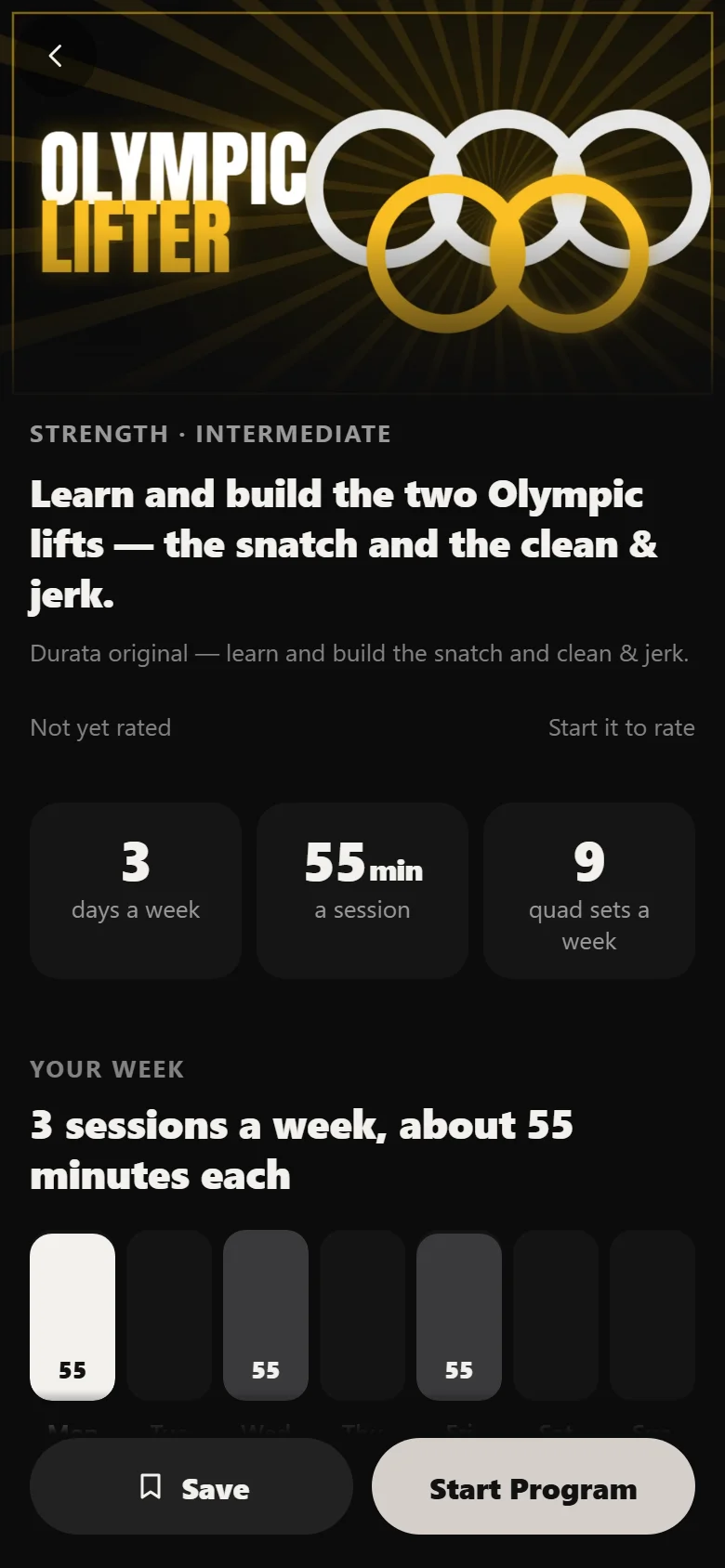
Olympic weightlifting is not what most training apps are built around. In Discover, Olympic Lifter sits on the Strength shelf, marked Intermediate, at three days a week. Search finds it by name, or Filter narrows the shelves by level and days a week. Tap the cover for a quick look, then View Program for the full page.
Three sessions, and what's in them
The week is three full-body sessions. Two of them open with the snatch and the clean & jerk, five doubles each, then a back squat, with clean pulls behind it on one day and overhead squats and good mornings on the other. The middle session is the power variations, a push press and a front squat. So the classic lifts and the back squat each come up twice a week, on either side of a power day.
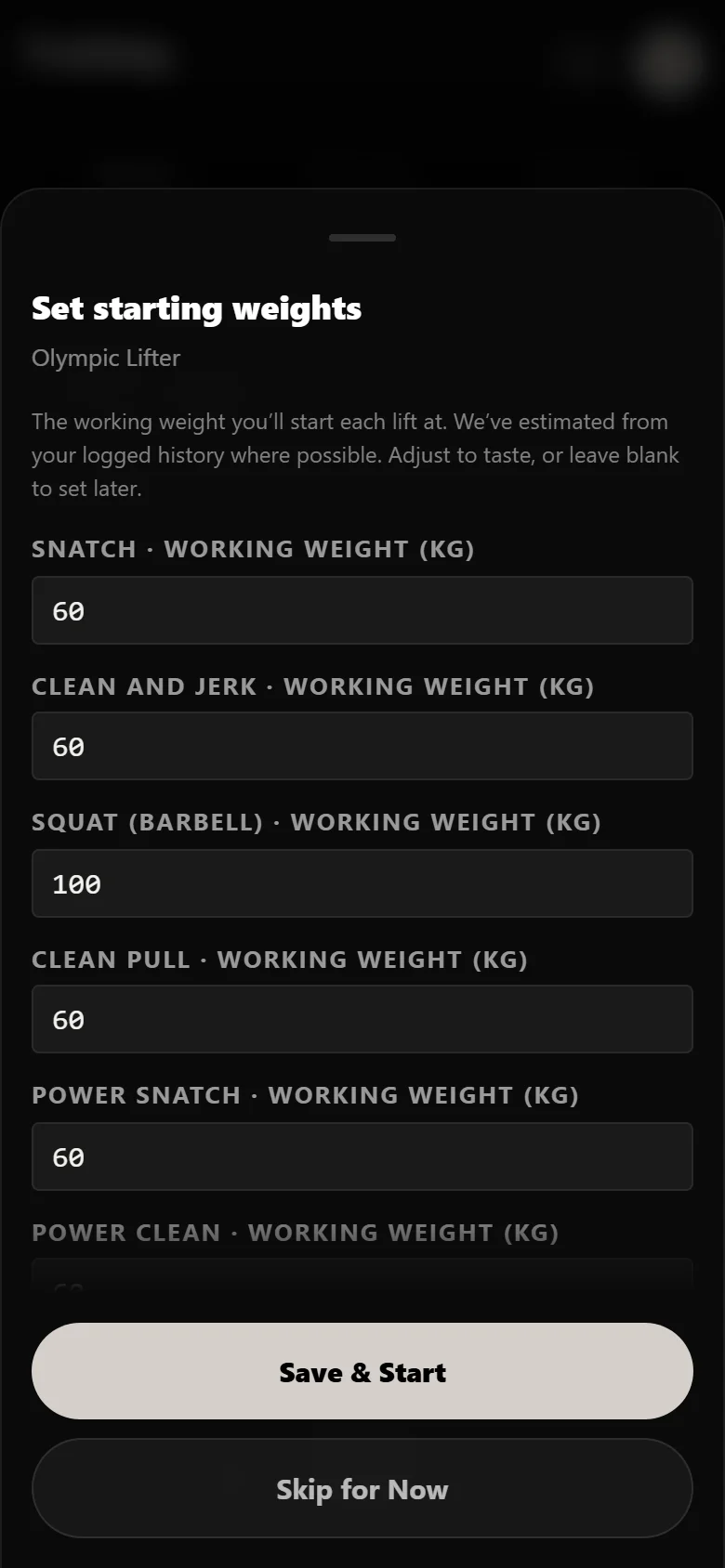
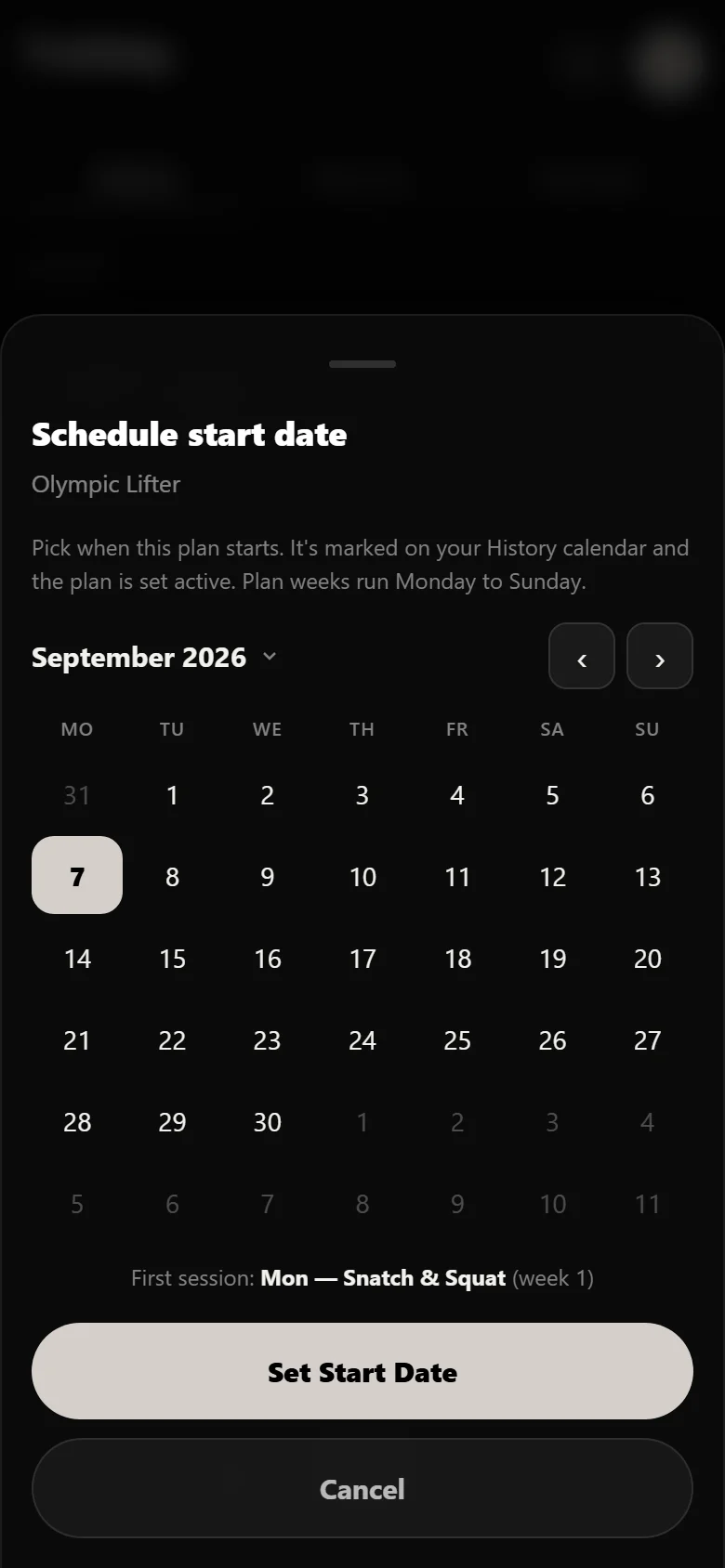
Setup asks for a working weight per lift, no training maxes. This run starts at 60 kg on the snatch and clean & jerk, 100 kg on the back squat and 80 kg on the front squat — a realistic intermediate spread, where the squat is comfortably heavier than the lifts it supports. Then you pick a start date and the cycle's sessions land on the calendar.
The smallest jump your plates allow
The snatch and clean & jerk run on a microload rule: make your doubles and the app adds 1 kg. That's deliberate. A missed snatch isn't a productive hard rep the way a missed squat is; it's a breakdown in position, and repeating it rehearses the wrong pattern.
There's a catch worth knowing, and the app is honest about it on screen. Weight Rounding defaults to 2.5 kg, and a 1 kg increase can't be loaded on a 2.5 kg grid. Rather than stalling the lift at the same weight forever, the engine forces one full rounding step, so the real jump becomes 2.5 kg. If you own micro-plates, set Weight Rounding to 1 kg or half a kilo in Settings and you get the true microload the program intends.
At the default rounding, then, the classic lifts climbed 2.5 kg on each of their ten appearances: 60 kg to 85 kg across the block. Both lifts run the same rule from the same starting weight here, so they moved in step. The front squat, on the ordinary lower-body rule, went 80 kg to 105 kg. Unspectacular per session; substantial over five weeks.
The squat is the lift that stalls
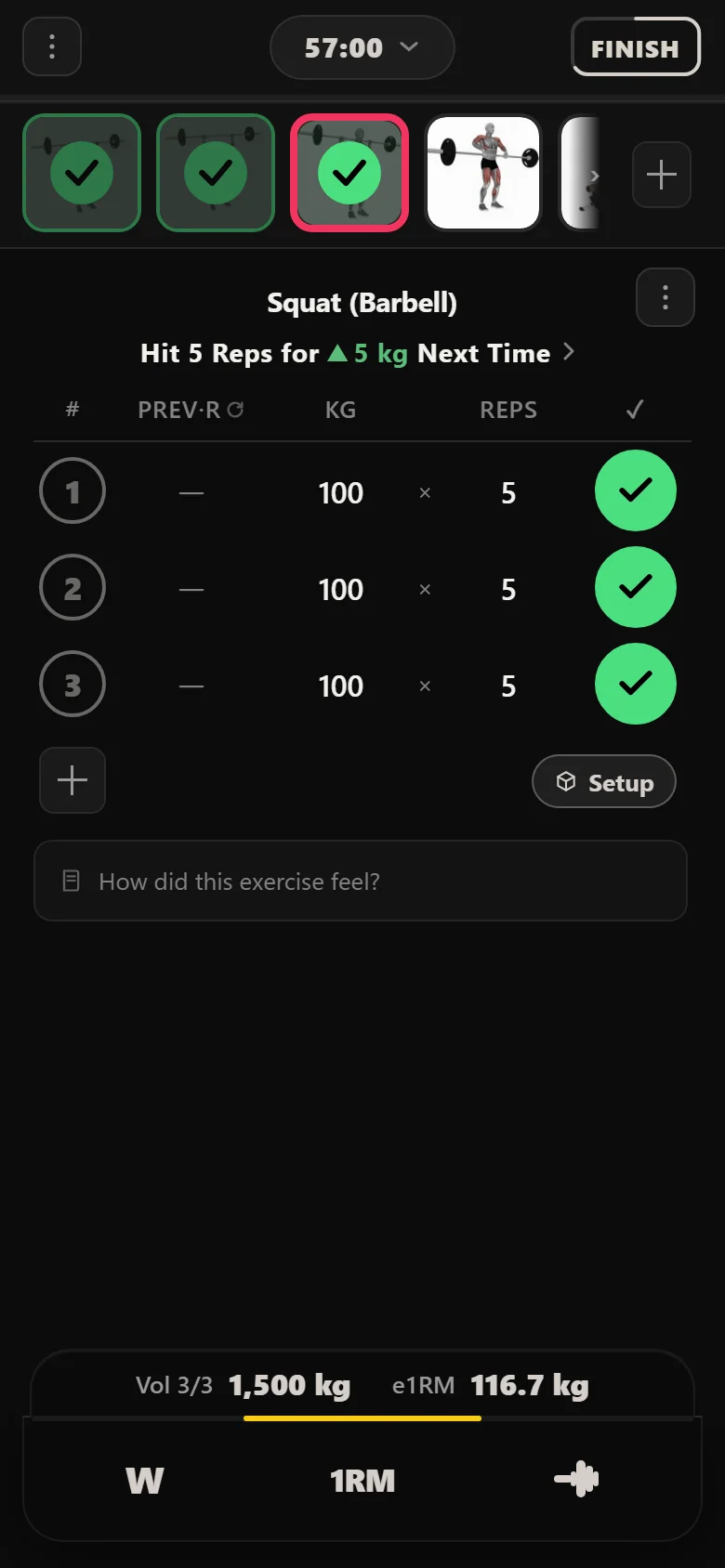
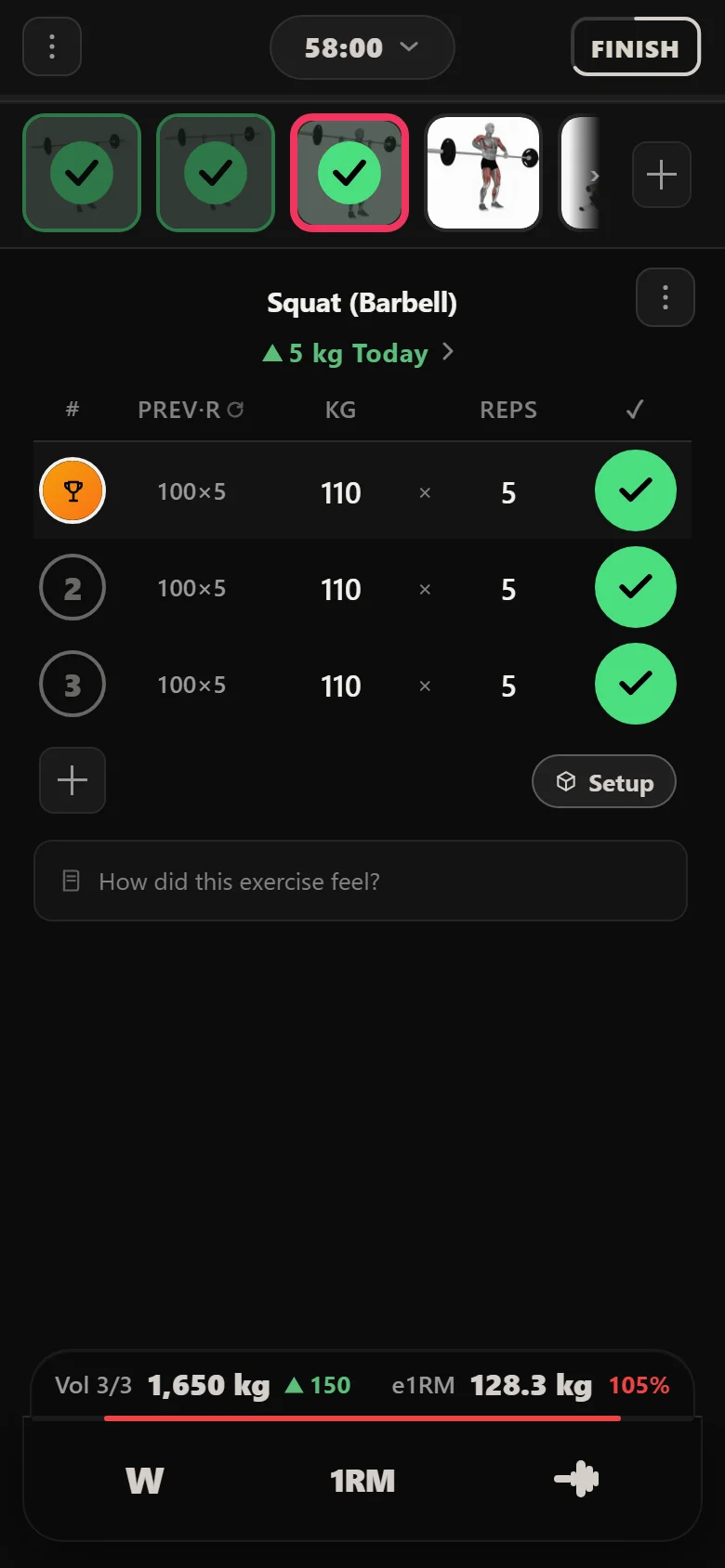
Underneath the technique work, the back squat behaves like any other strength lift, and it's the one that runs out of road. It opens at 100 kg with its rule on screen: complete every prescribed set and 5 kg goes on for next time. Four sessions in it's at 110 kg, with an estimated max of 128.3 kg.
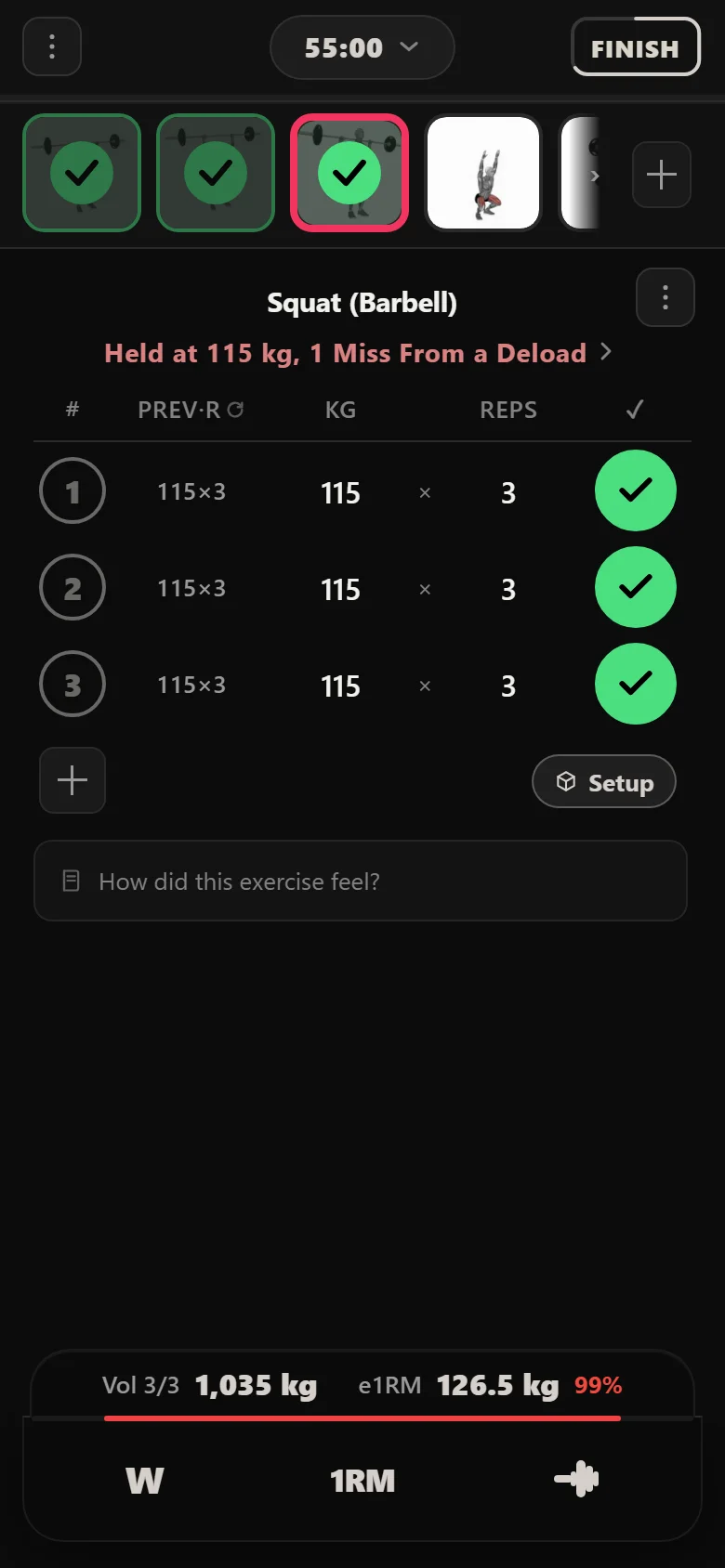
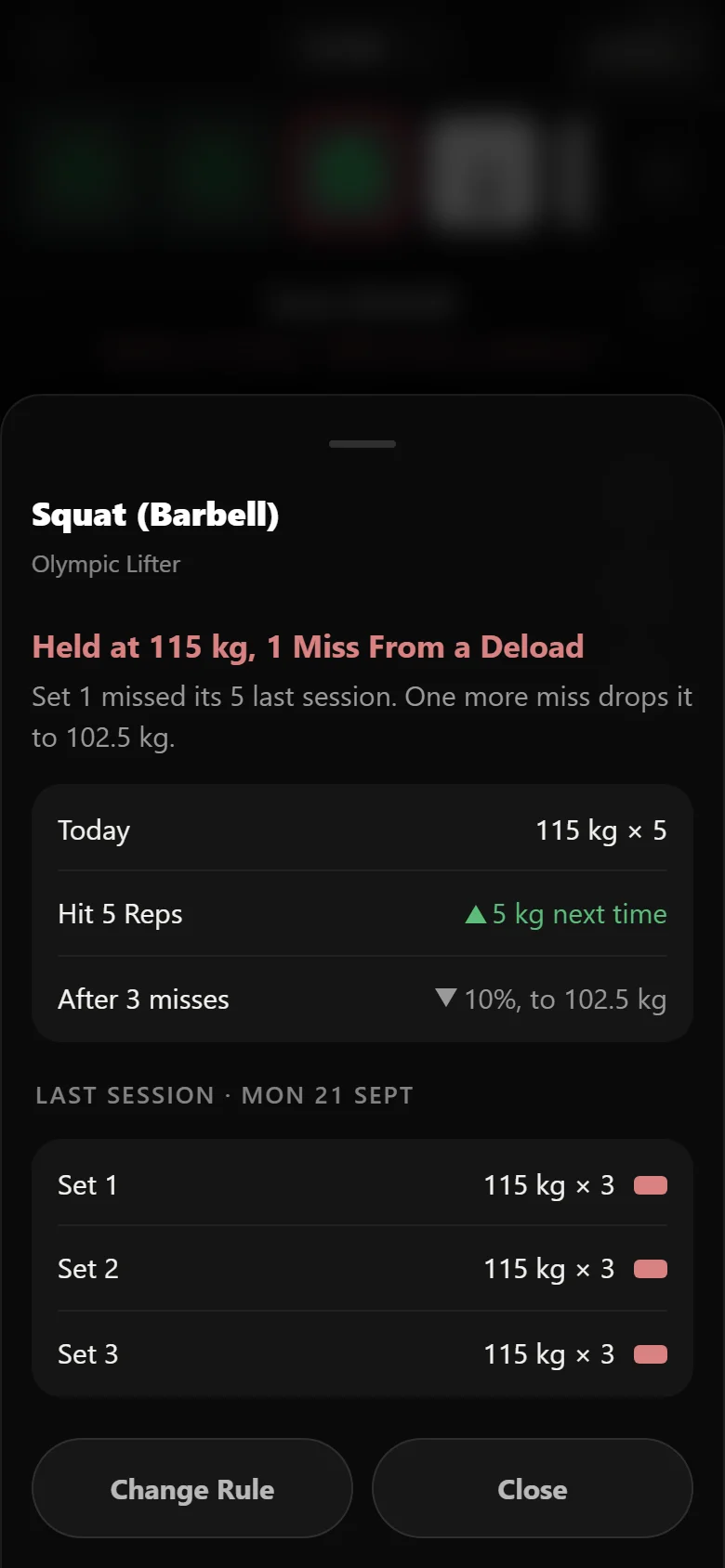
Then 115 kg bites. The working sets come up short at three reps, and because missing any working set is a failed session, the app holds the weight rather than pushing it.
Back squat: weight on the bar, per session (twice a week, fifteen sessions)
- 100S1 Session 1
- 105S3 Session 3
- 110S4 Session 4
- 115S6 Session 6 — reps fall short: weight held
- 115S7 Session 7
- 115S9 Session 9 — third miss trips the deload
- 102.5S10 Session 10 — 10% cut applied automatically
- 107.5S12 Session 12
- 112.5S13 Session 13
- 117.5S15 Session 15 — past the weight that stalled it
Why it did that
The rule chip is a button. Tap it and the app shows its case: the evidence from this exact slot's own history, and the law it's judging that evidence against. Two misses recorded at 115 kg, a third pending, and the rule that says three misses at a weight cuts it by 10%.
That matters more on an Olympic program than on a simple linear one, because the lifts fail differently. The competition lifts are limited by technique, speed and mobility; the squat is limited by strength. They stall on different timescales for different reasons, so the app judges each lift on its own rule rather than marking the whole session good or bad.
The cut, and the rebuild
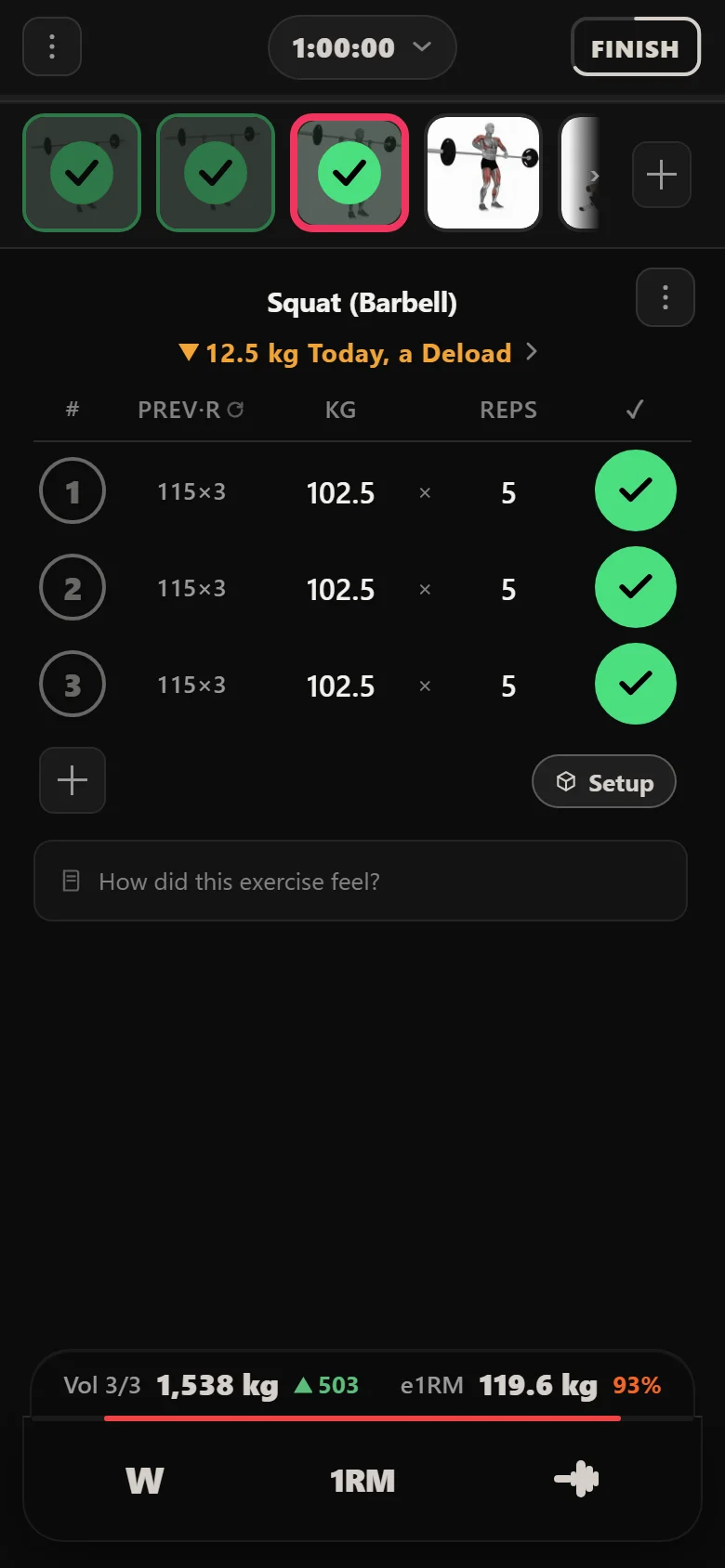
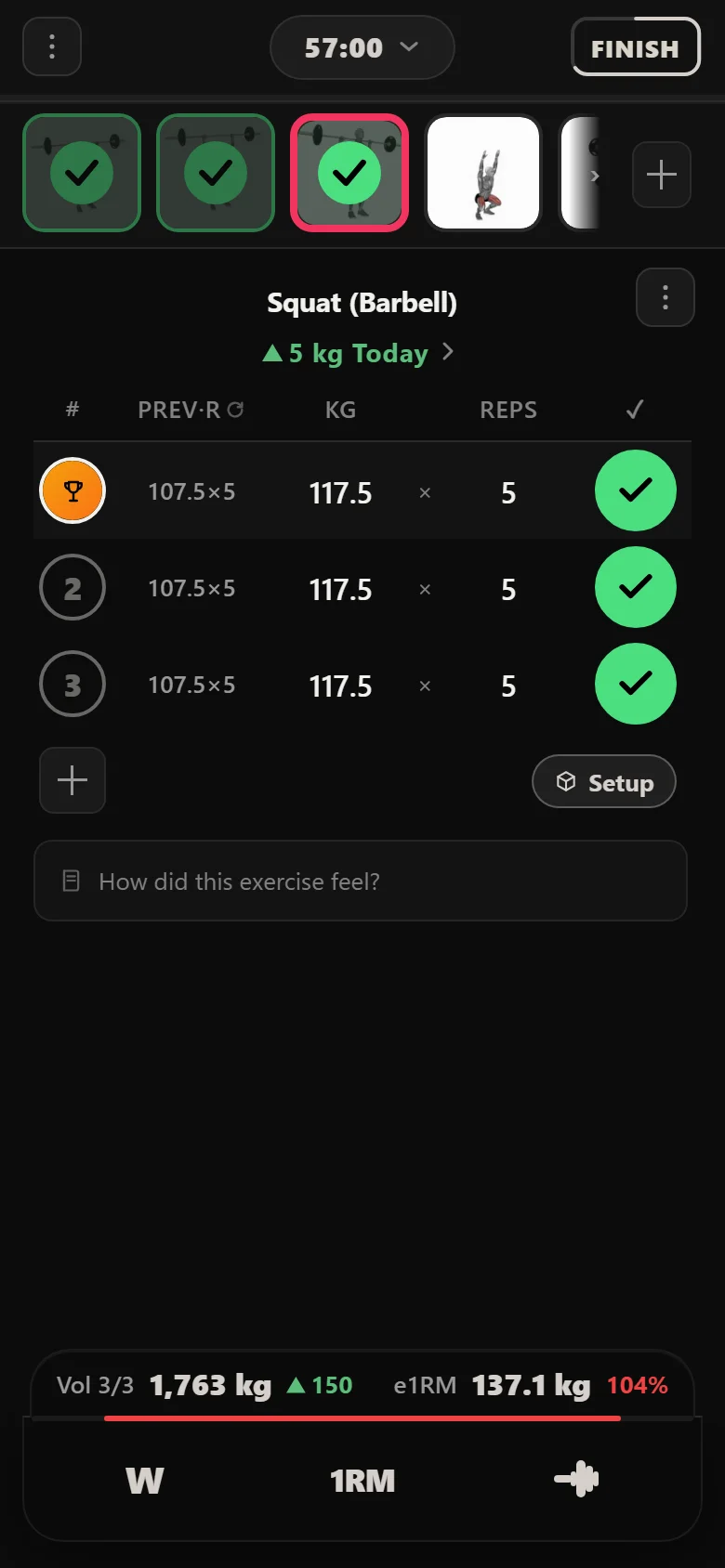
Three misses trip the rule, so the engine drops the squat 10%, from 115 kg to 102.5 kg, and the climb restarts from there: 107.5, 112.5, and then 117.5 kg — above the weight that stopped the first run. You didn't calculate any of it or decide any of it. The program did.
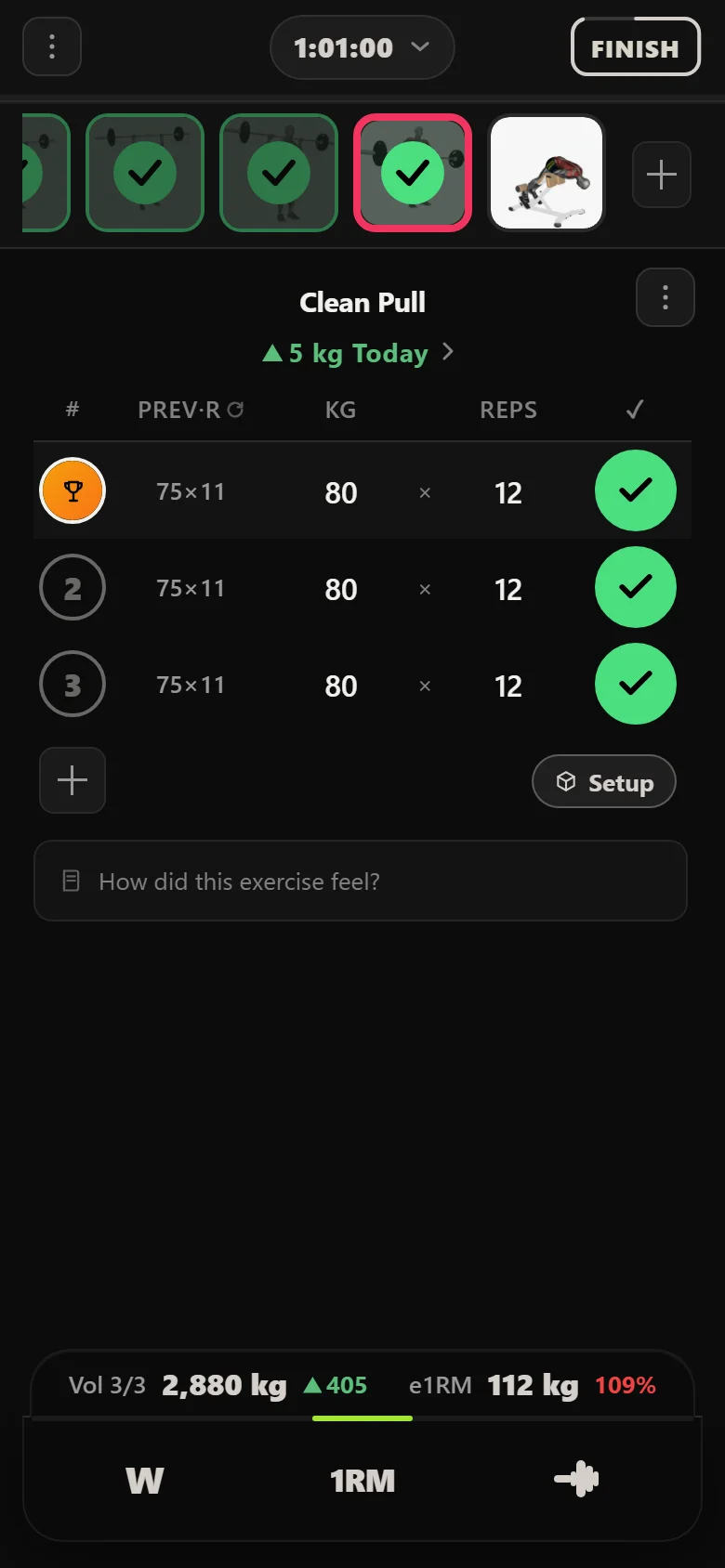
The accessory work runs the opposite way round. The clean pull's chip spells out its rule in plain words: hit four reps and 5 kg goes on. You climb the 3–4 rep range session by session, and once every set reaches four, the weight rises and the reps reset to three. Two kinds of progression in the same session, each with its own rule visible while you train.
Five weeks later
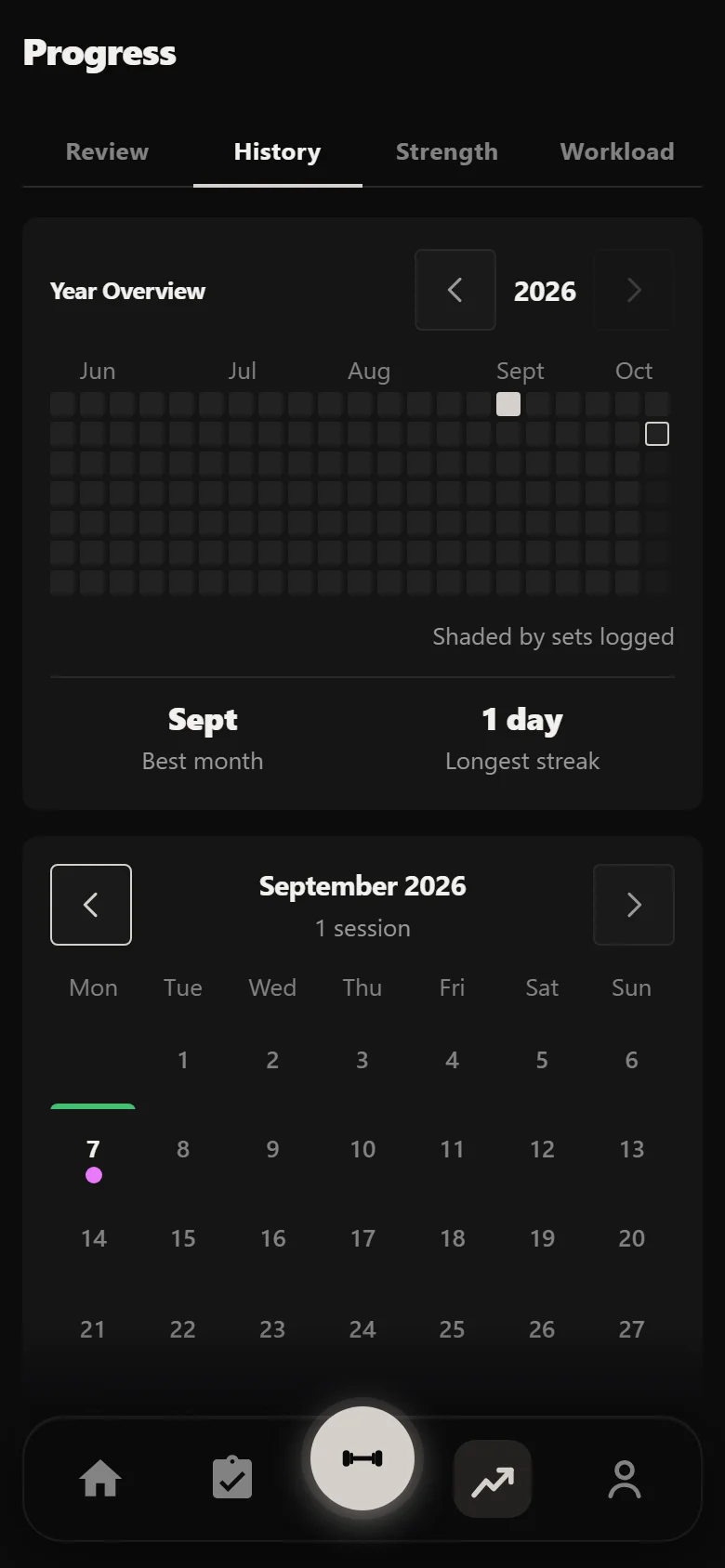
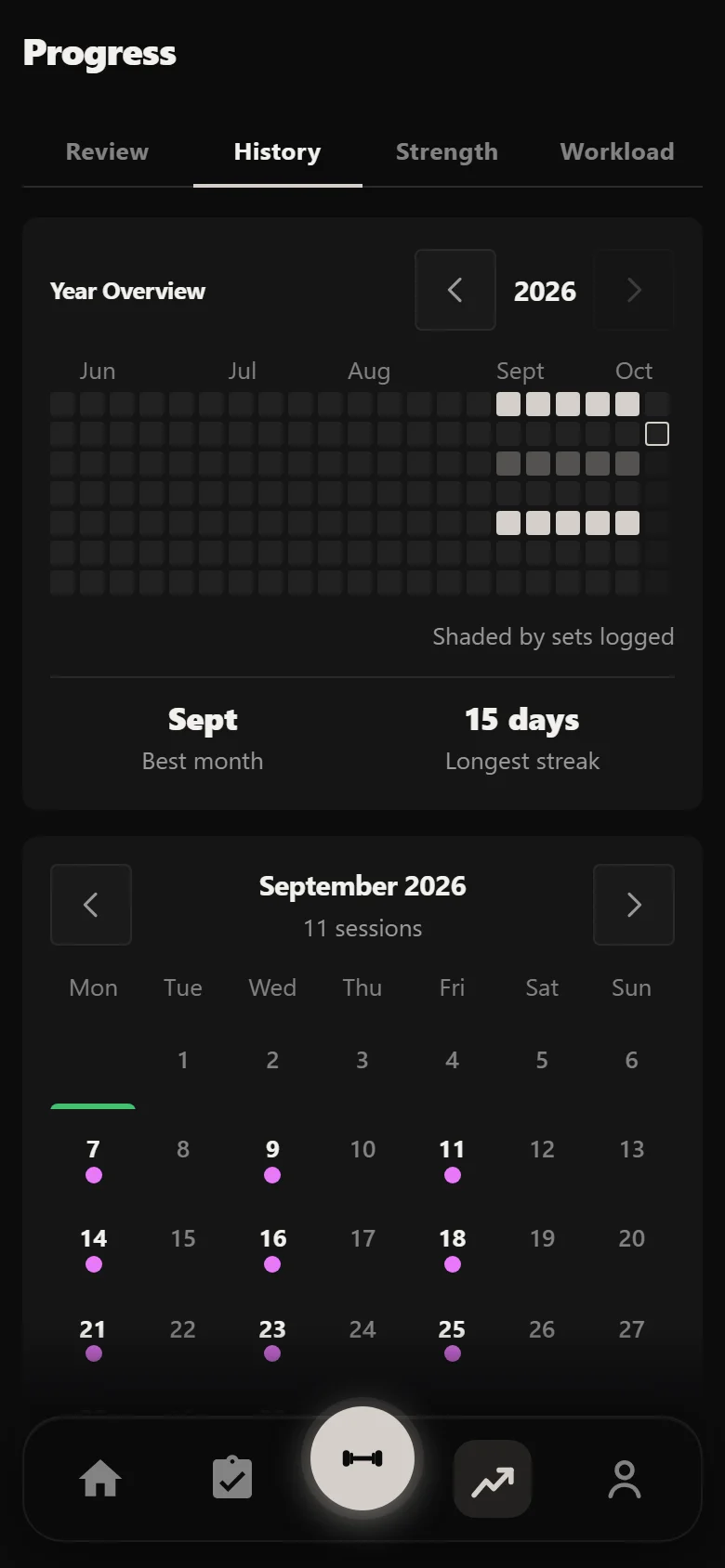
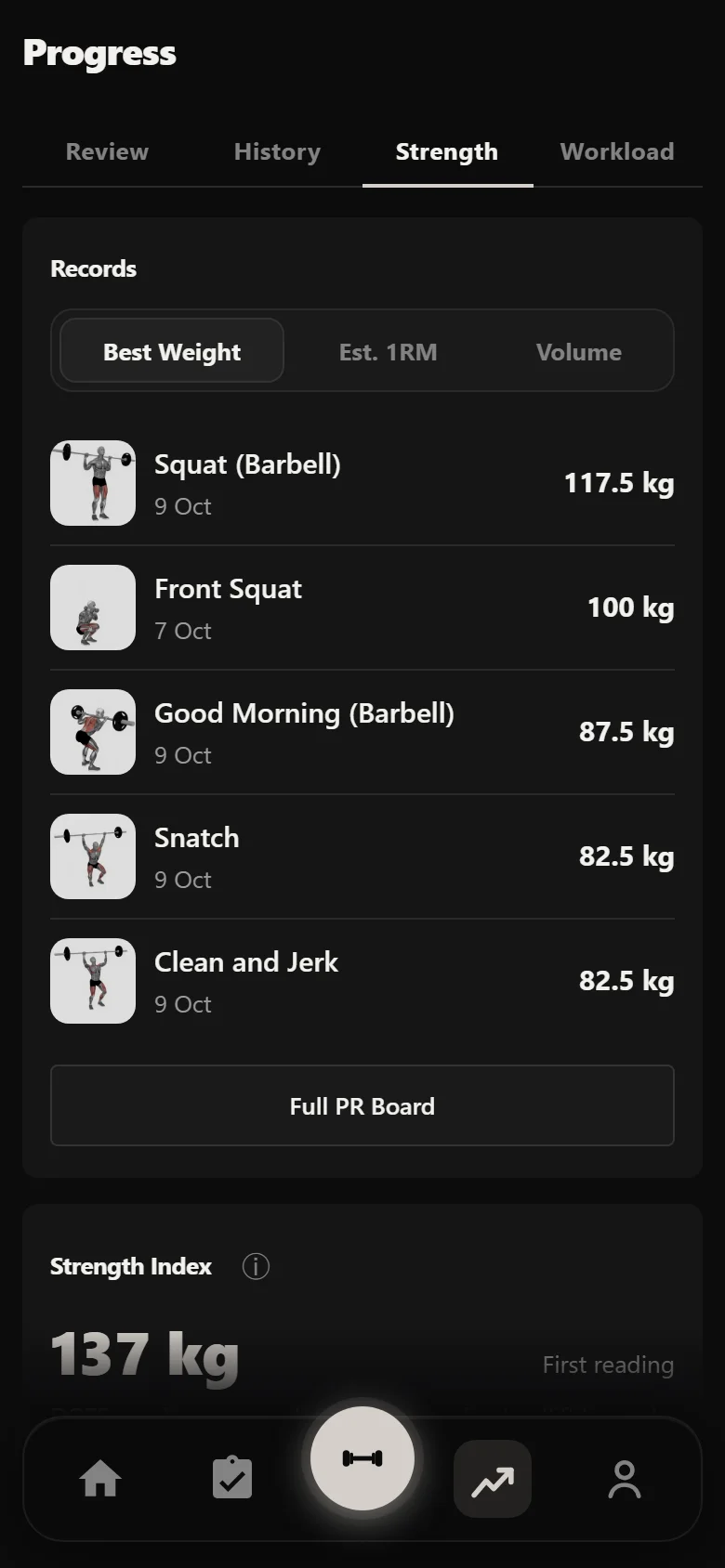
Fifteen sessions on the calendar in one view: the climb, the stall, the deload and the rebuild. The strength view turns the same block into an estimated one-rep max per lift alongside weekly volume.
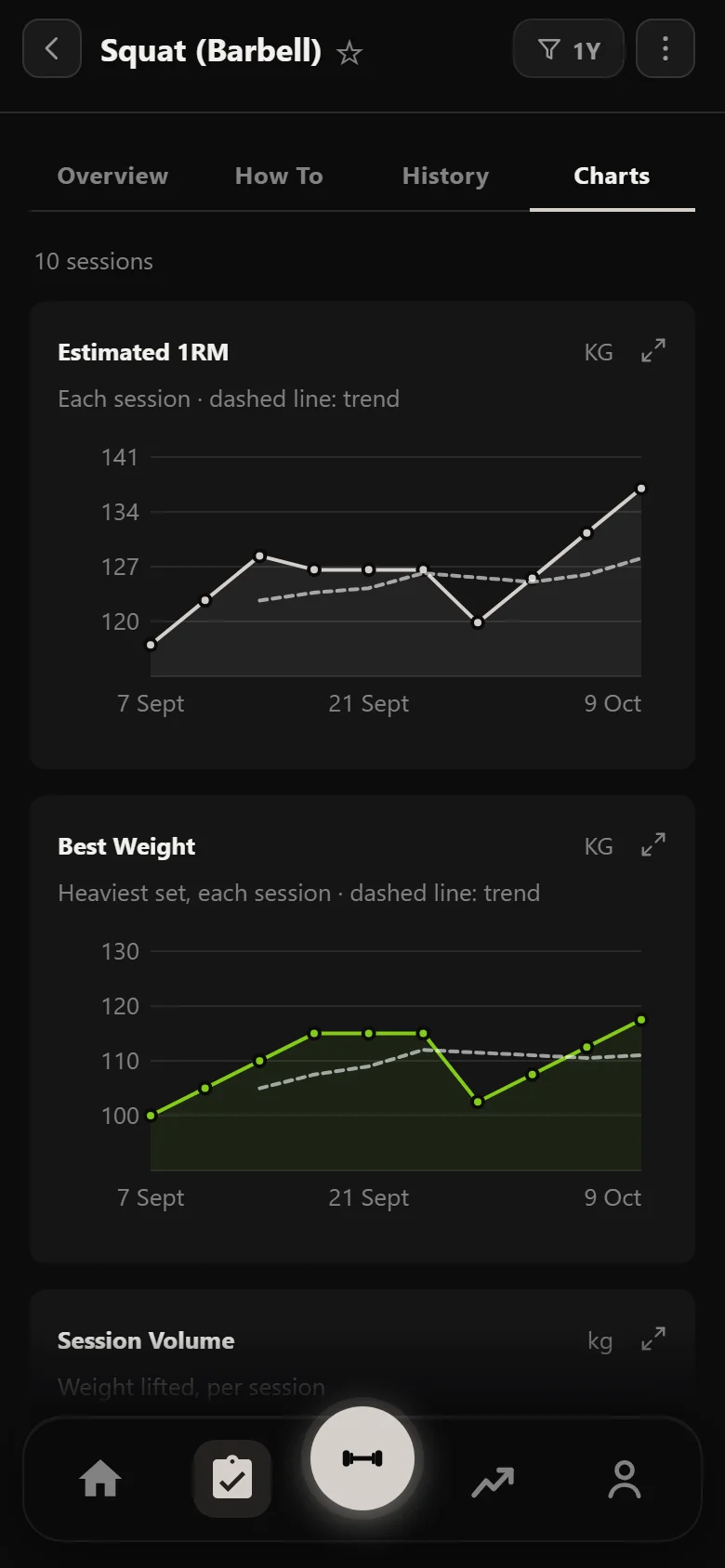
The squat's own estimated 1RM chart is the one that shows the shape of the block: climbing, flattening through the stall, dipping at the deload, then climbing past where it stopped. The competition lifts trend upward beside it without drama. Two different kinds of progress in one block, tracked separately.
The payoff: past the ceiling
The squat is the lift that had a bad month, and it's still the lift that finished ahead. It opened the block at 100 kg, ran into a wall at 115, gave up three sessions to that wall, took a cut to 102.5 kg — and closed the block making 117.5 kg, with 122.5 kg stored for the next session. The deload didn't cost the block. It set up the climb that carried the lift past the ceiling that beat it.
Meanwhile the snatch and clean & jerk went 60 kg to 85 kg without a single stall, because they were never pushed to the point of one. That's the trade an Olympic program makes on purpose, and it's why the two halves of the session are judged by different rules.
The back squat, start to finish: 100 kg on session one to 117.5 kg on session fifteen, having stalled three times at 115 kg and been cut to 102.5 kg on the way.
Common questions
Why such small jumps on the snatch and clean & jerk?
Because they're technique lifts. A missed snatch isn't a productive hard rep the way a missed squat is. It's a breakdown in position, and repeating it rehearses the wrong pattern. The program adds 1 kg on a made set of doubles, so every rep stays technically sound, which is what actually builds the lift.
My snatch went up 2.5 kg, not 1 kg. Why?
Weight Rounding. The rule asks for 1 kg, but if your rounding is set to the 2.5 kg default the app can't load 1 kg, so rather than leaving the lift stuck at the same weight forever it forces one full rounding step. Set Weight Rounding to 1 kg or half a kilo in Settings › Workout Defaults and you'll get the true microload.
Why is the squat heavier than the competition lifts?
It should be. The snatch and clean & jerk are limited by technique, speed and mobility long before they're limited by leg strength, so a lifter squats far more than they snatch. Here the squat starts at 100 kg against a 60 kg snatch, which is a normal intermediate spread.
Why did the squat deload but the Olympic lifts didn't?
Because they failed differently. The squat ran out of strength and missed its reps three sessions running, which trips the program's deload. The competition lifts were climbing in small steps and never hit that wall inside this block. Each lift carries its own rule and the app judges them independently rather than calling the whole session good or bad.
Do I need a coach to run this?
For the competition lifts, coaching or at least video review helps enormously. The app tracks the load, not your positions. What it removes is the bookkeeping: what to lift, when it goes up, and when to back off.
Is Durata free?
Yes. Durata is free to use, with the full program catalogue, automatic progression maths, rest timers and PR tracking. Everything in this walkthrough is in the app.
Put it into practice
Durata is free to use — 50 proven programs, automatic progression, rest timers and PR tracking, all on your phone.