


PHUL in Durata: two rules, one program, six weeks
PHUL splits your week into two power days and two hypertrophy days: heavy triples and fives on the big lifts, then eight to twelve reps on the same muscles a few days later. That means it needs two different progression rules running at the same time, on the same lifts, in the same week, and keeping them straight by hand is where most people give up on it.
So this walkthrough follows six weeks of it in the app, twenty-four sessions. The squat carries the story: it climbs on the power day, hits a weight it cannot hold, gets held there, and then takes an automatic cut and rebuilds. Every weight, rep and estimate below is engine output from the drive. Nothing was typed in and nothing was tidied up afterwards.
Finding it
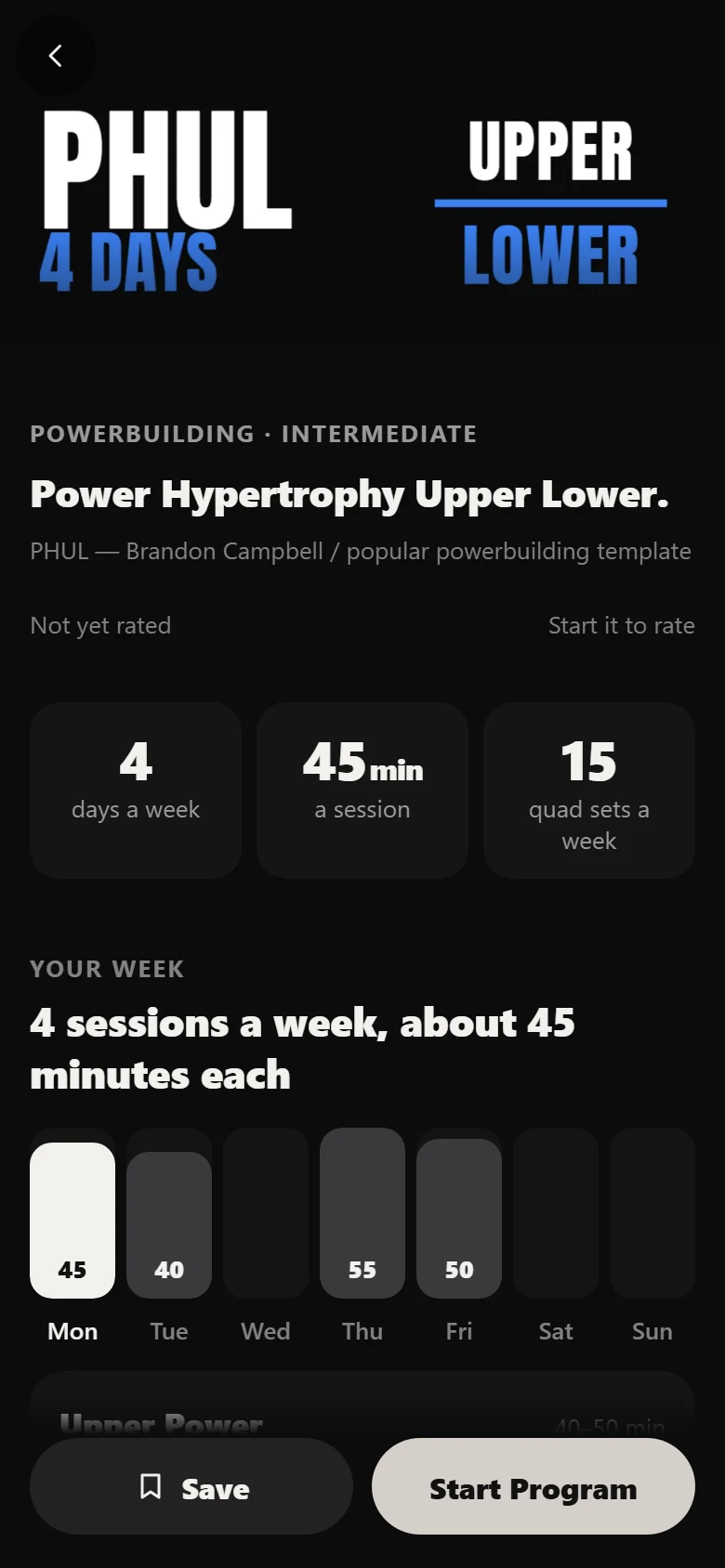
In Discover, PHUL sits on the Powerbuilding shelf, marked Intermediate, at four days a week. Search finds it by name, or Filter narrows the shelves by level and days a week. Tap the cover for a quick look, then View Program for the full page.
It is the classic answer to wanting both strength and size without running two programs.
The program page lays out the week before you commit to anything: Upper Power, Lower Power, Upper Hypertrophy, Lower Hypertrophy. Every muscle group is trained twice a week, once heavy and once for volume.
Four days, two jobs
Upper Power is the barbell bench, a barbell row, the overhead press and arm work. Lower Power is the squat and the deadlift, then leg press, leg curls and calves. The two hypertrophy days come back to the same muscles with lighter weights and more reps: incline bench, flyes, cable rows, dumbbell rows and lateral raises upstairs, front squats, lunges, extensions and curls downstairs.
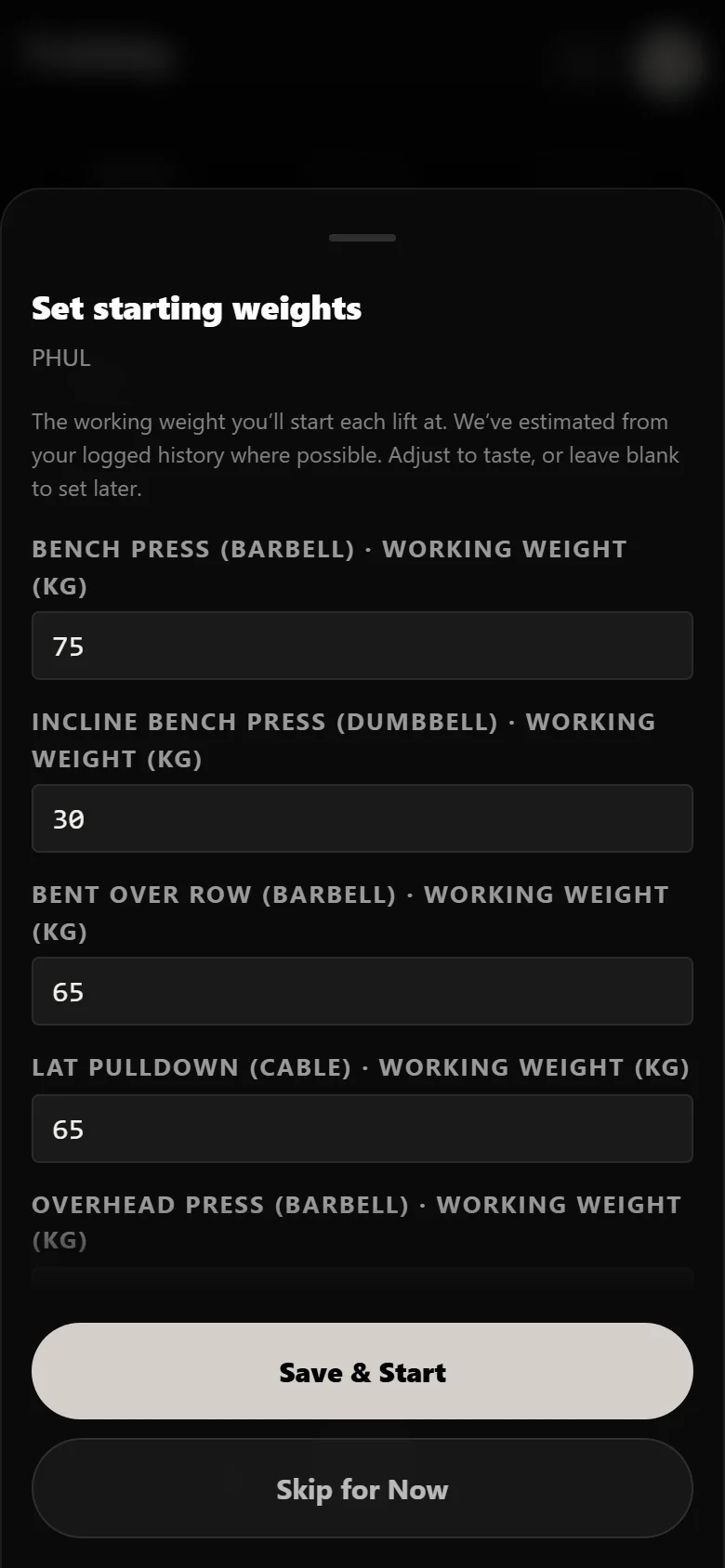
There are no training maxes to work out. Every lift starts from a working weight you can currently handle, so the start sheet asks for one number per lift, 100 kg on the squat and 75 kg on the bench on this run, and the app takes it from there.
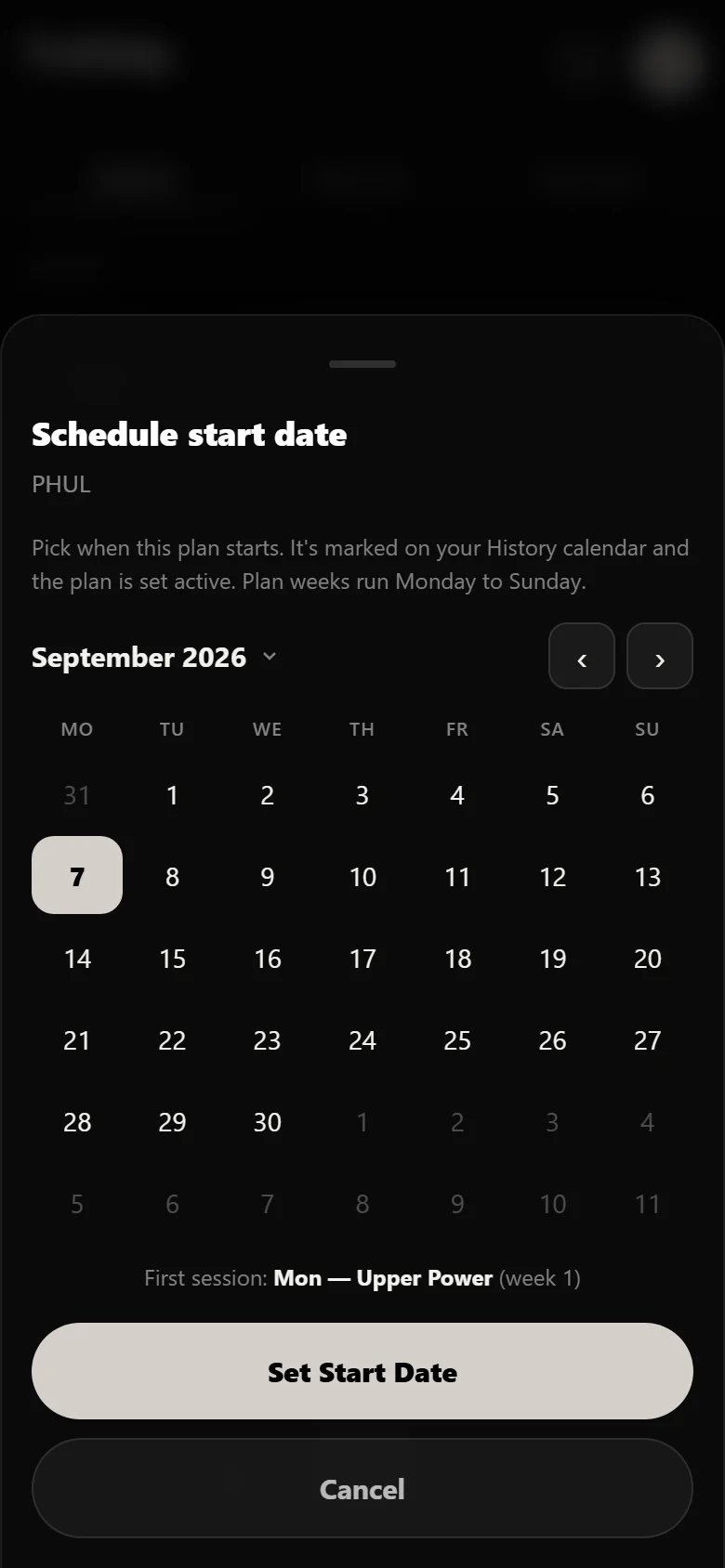
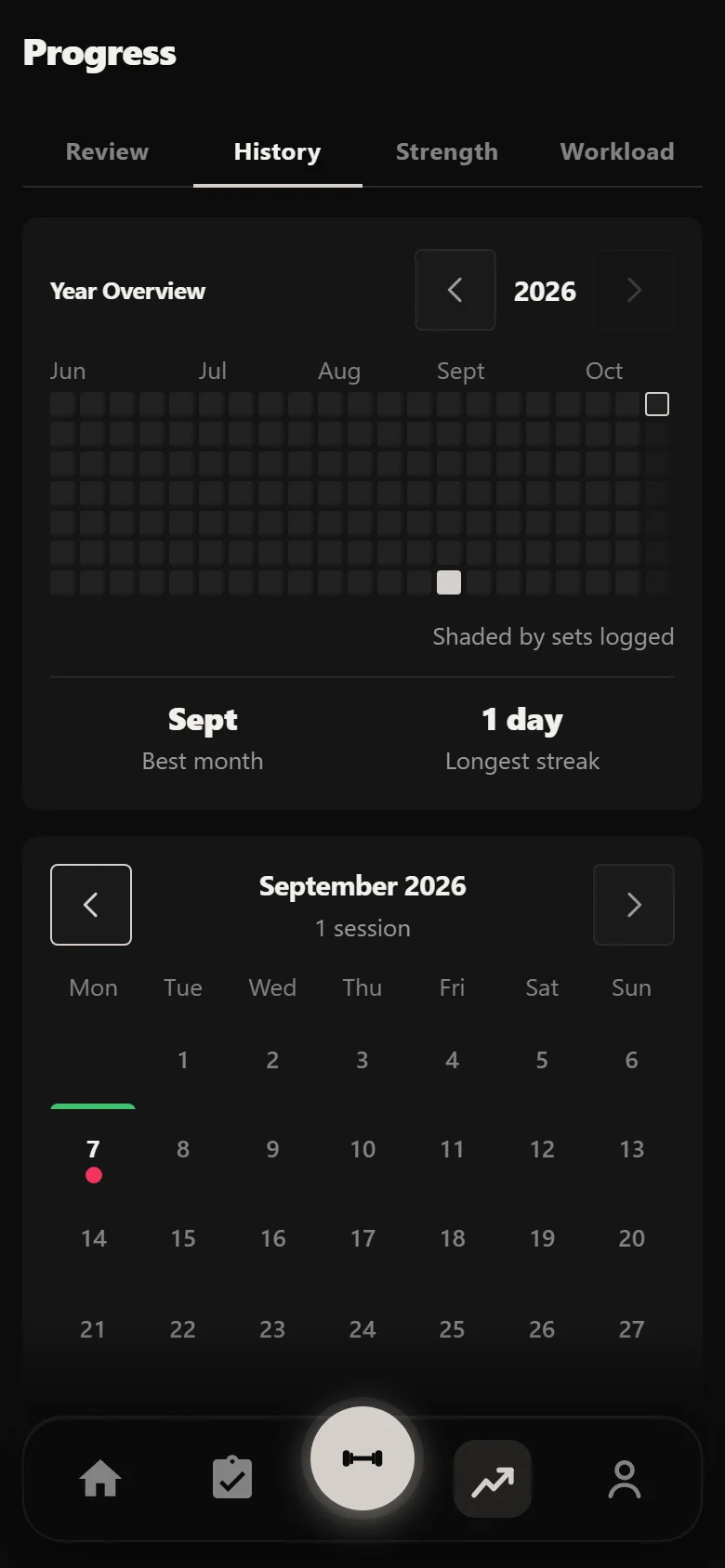
Pick a start date and the whole cycle's session dates flow from it onto the History calendar. PHUL is a repeating weekly template rather than a fixed-length block, so it runs until you stop it.
Two rules, running at once
This is the part that makes PHUL awkward on paper and easy in the app. The power lifts and the hypertrophy lifts progress differently, and the app runs both without you tracking either.
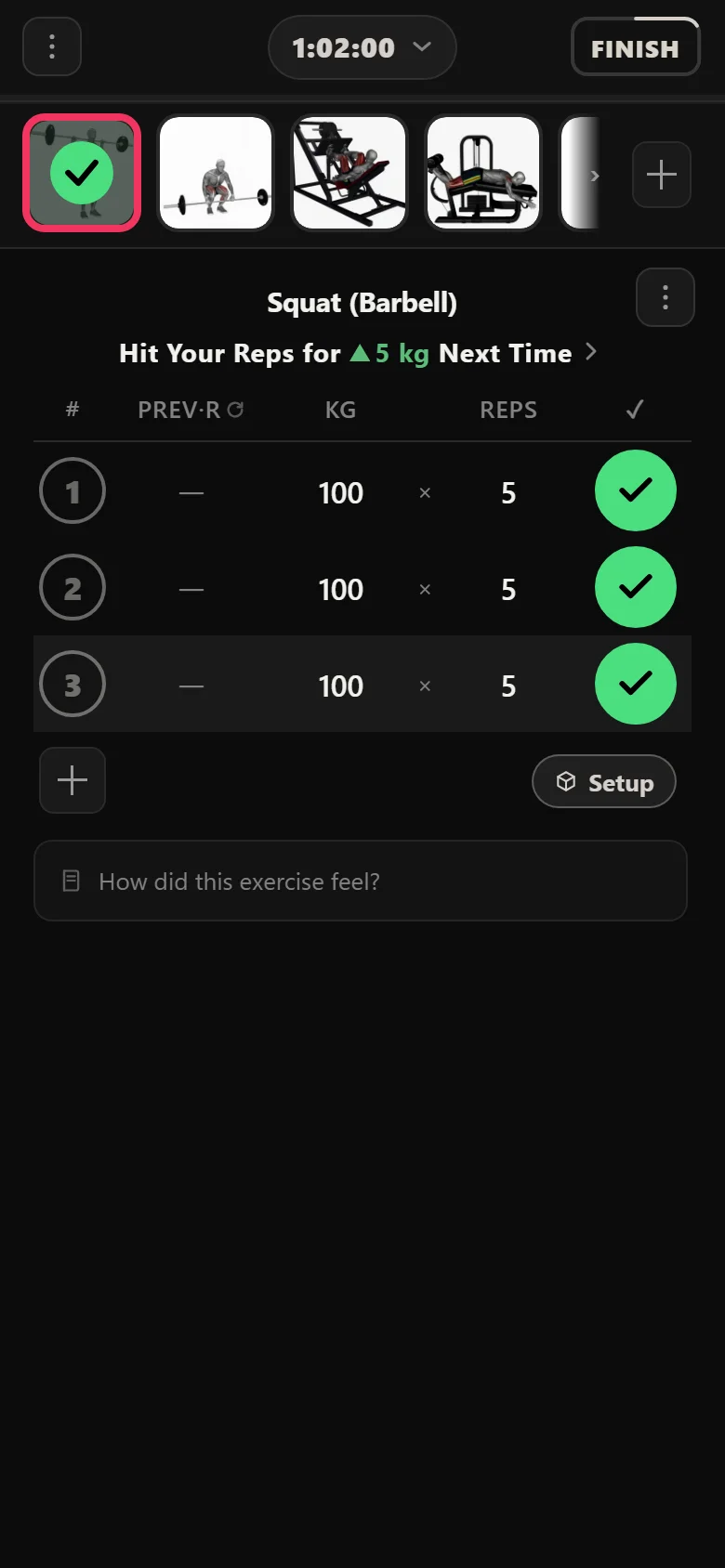
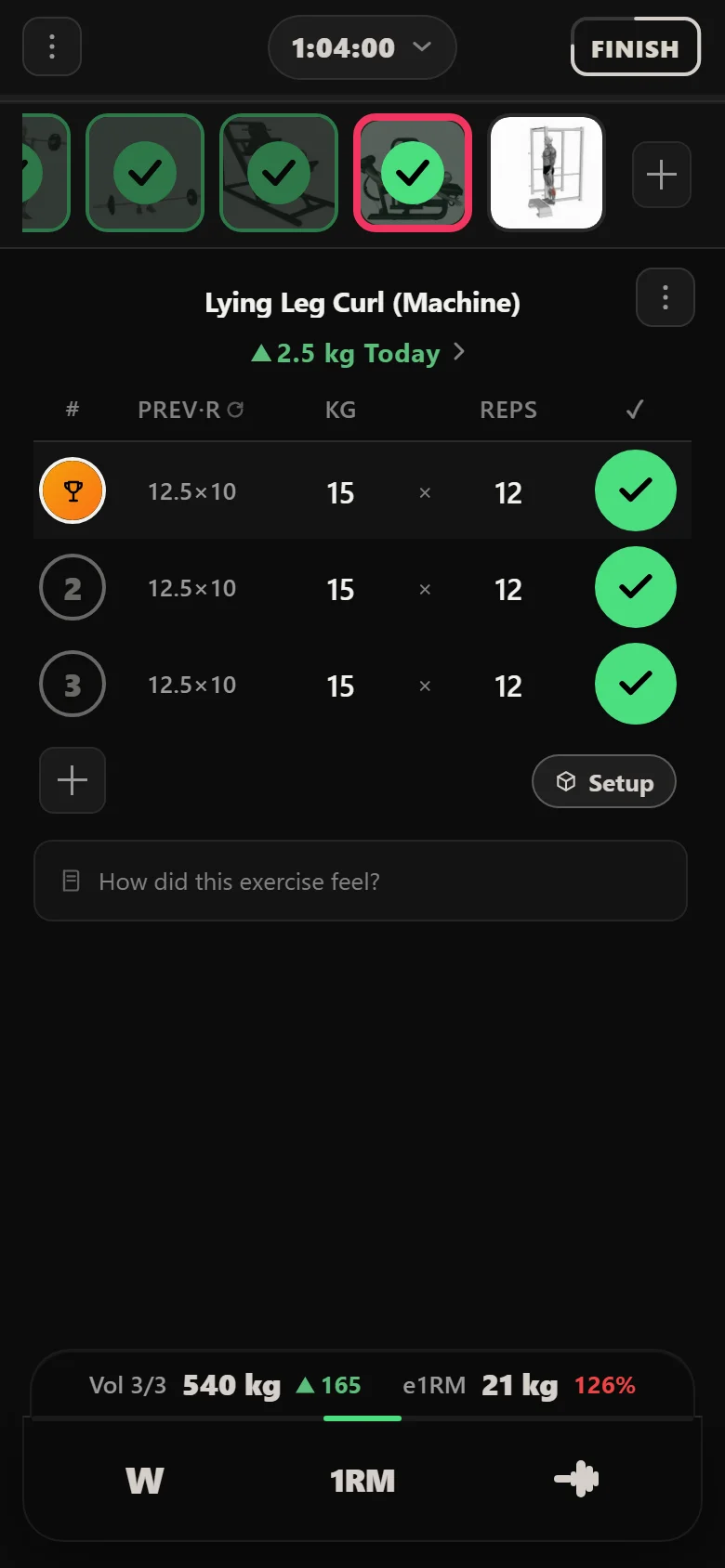
On the power days the big lifts are linear. Three sets of 3–5 reps, and when you get 5 on all of them the weight goes up next session: 5 kg on the squat and deadlift, 2.5 kg on the upper-body lifts. Miss the target and the weight is held, not pushed. Miss twice in a row and the rule cuts it 10% and restarts the climb from there.
On the hypertrophy days everything runs double progression instead. The rule chip spells it out on the exercise: climb the rep range session by session, and once every set reaches the top of the range the weight goes up and the reps reset to the bottom. No percentages, no maths, and no need to remember which lift is on which rule.
Each lift also carries its rule where you train, on a chip you can tap. That matters in a program where the same muscle is trained under two different schemes in the same week.
The climb, while it lasts
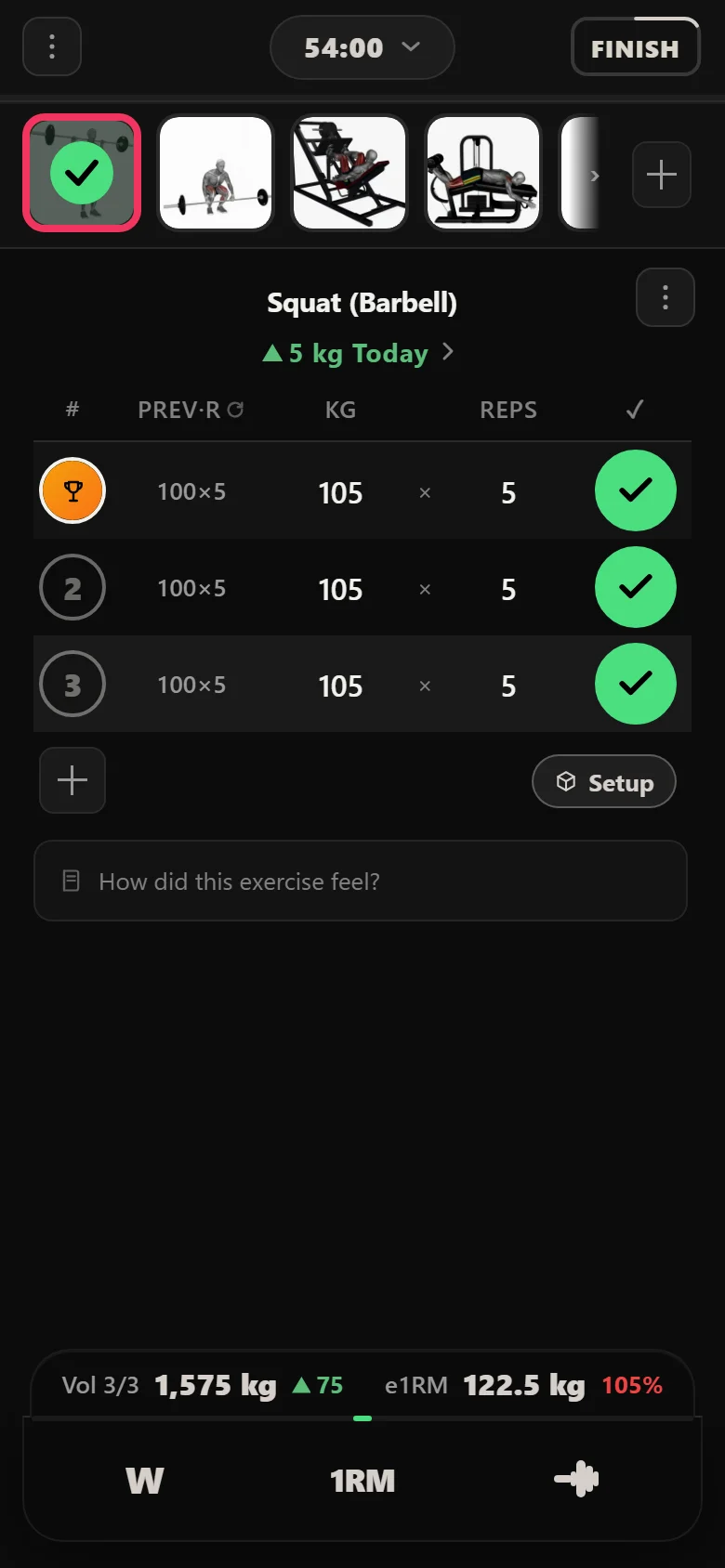
The squat comes round once a week on Lower Power, so the linear climb is weekly: 100 kg, then 105 kg, then 110 kg. Five kilos a week is a fast climb, and that is the honest appeal of linear progression. It works, and then it stops working, and a good program has an answer for the second part.
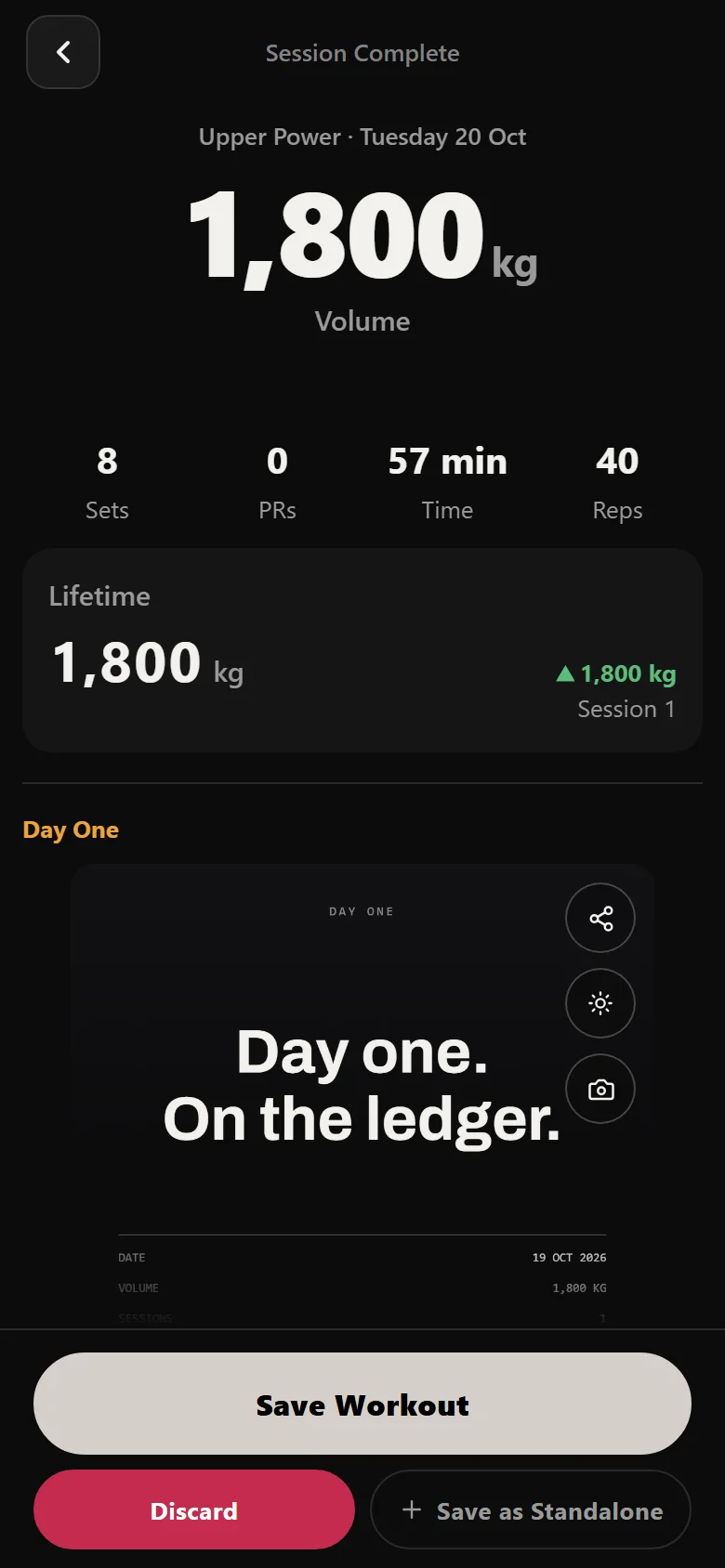
The estimate on the exercise moves with it, up to 122.5 kg on the second squat session. The session tallies itself when you finish, every set, the reps and the volume moved.
110 kg bites
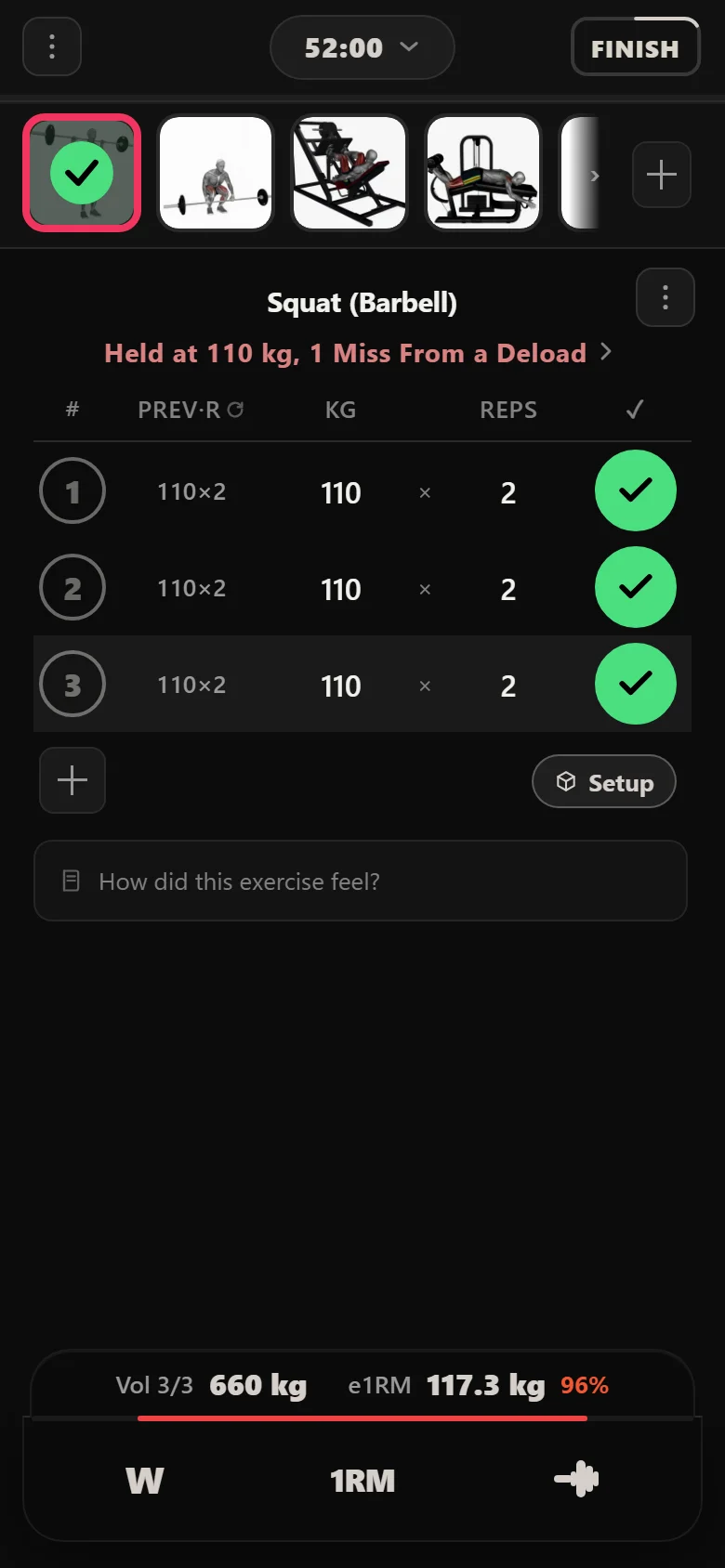
Then 110 kg goes on the bar and the reps are not there: two on the working sets instead of five. In a linear program that is a failed session, so the app holds the weight rather than pushing it. Come back the following week, miss it again, and now there are two misses on the same weight.
The rule chip is a button, and this is when it earns its place. Tap it and the app shows its case: the evidence from this exact slot's own history, and the rule it is judging that history against. One miss is banked; a second at this weight and the rule cuts it by 10%.
That is worth reading carefully, because it is the difference between a program and a spreadsheet. The app is not guessing from your best-ever squat or from some rolling average; it is reading the sets logged in this slot, in this program, and applying the rule that this program carries.
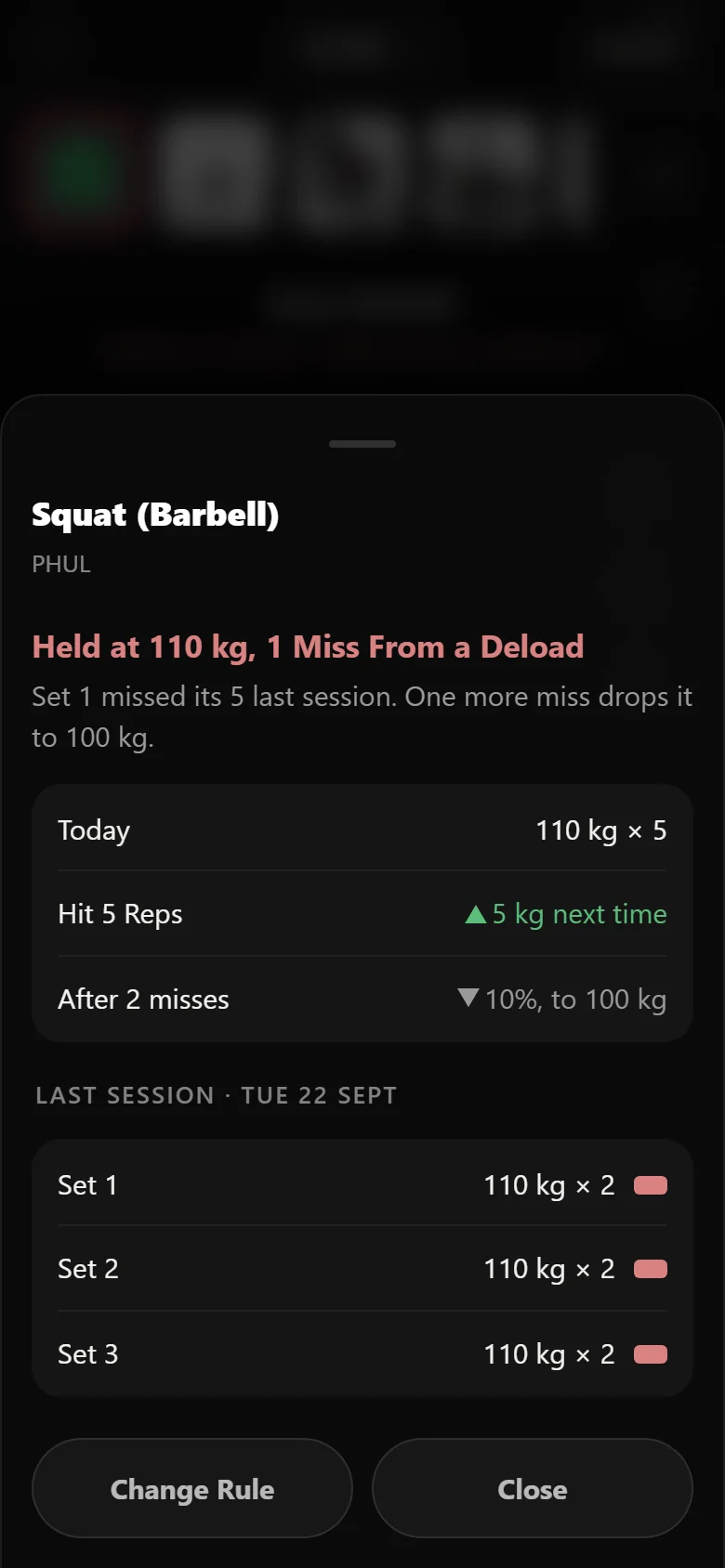
The app backs you off, then rebuilds
The second miss trips the rule and the engine cuts the squat 10%, from 110 kg down to 100 kg. You did not calculate it, decide it, or have to be honest with yourself about it at the end of a bad session. The program did it.
Then the climb restarts from there and the next appearance is back at 105 kg, with 110 kg waiting again. That is the whole point of the deload: you get a run at the weight that beat you, with a couple of easier sessions behind you rather than a third grinding failure.
Six weeks in, the squat has been to 110 kg, been cut, and is on its way back at 105 kg. The block ends mid-rebuild, which is what six weeks of an honest linear program usually looks like.
Squat (Barbell): weight on the bar, per weekly Lower Power session
- 100S2 Session 2
- 105S6 Session 6
- 110S10 Session 10 — miss 1
- 110S14 Session 14 — miss 2
- 100S18 Session 18 — cut 10%
- 105S22 Session 22
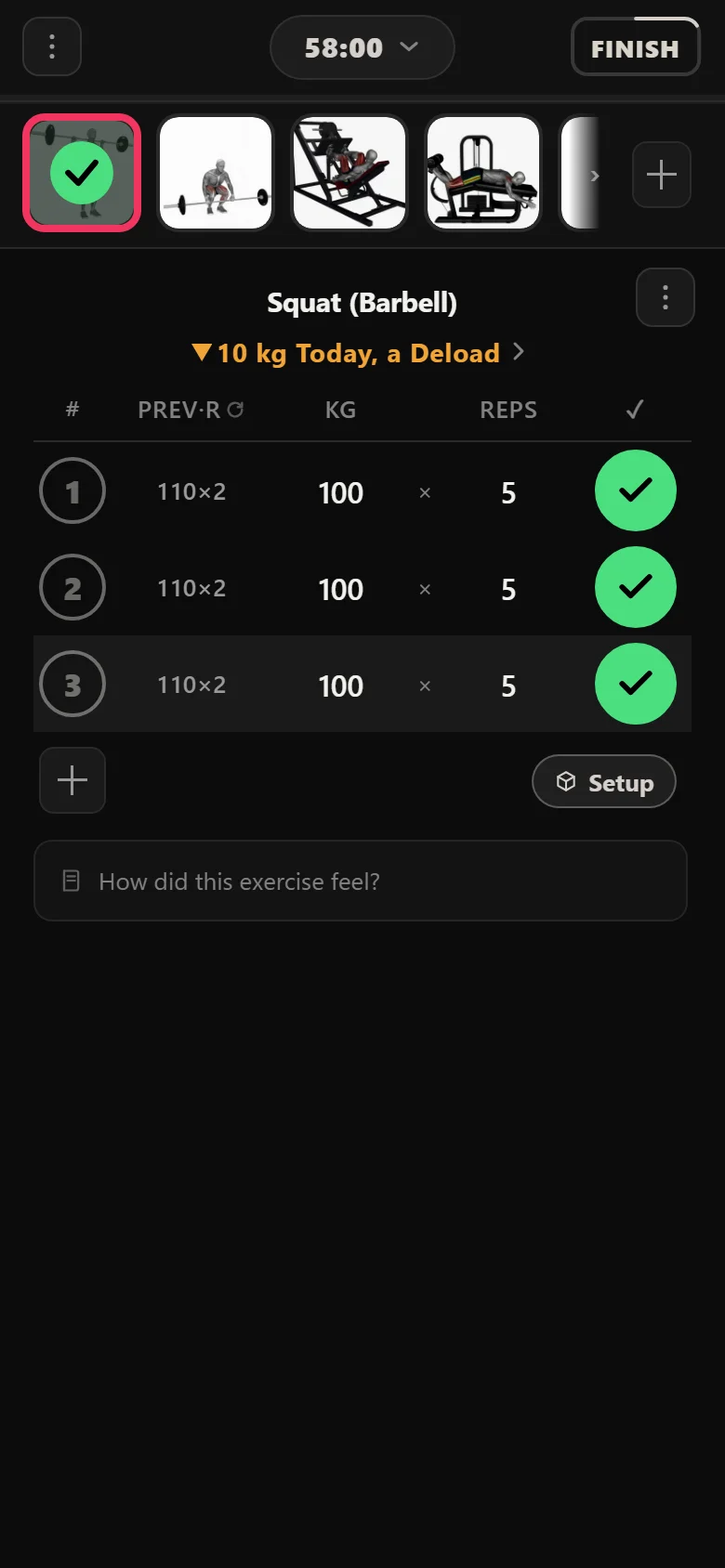
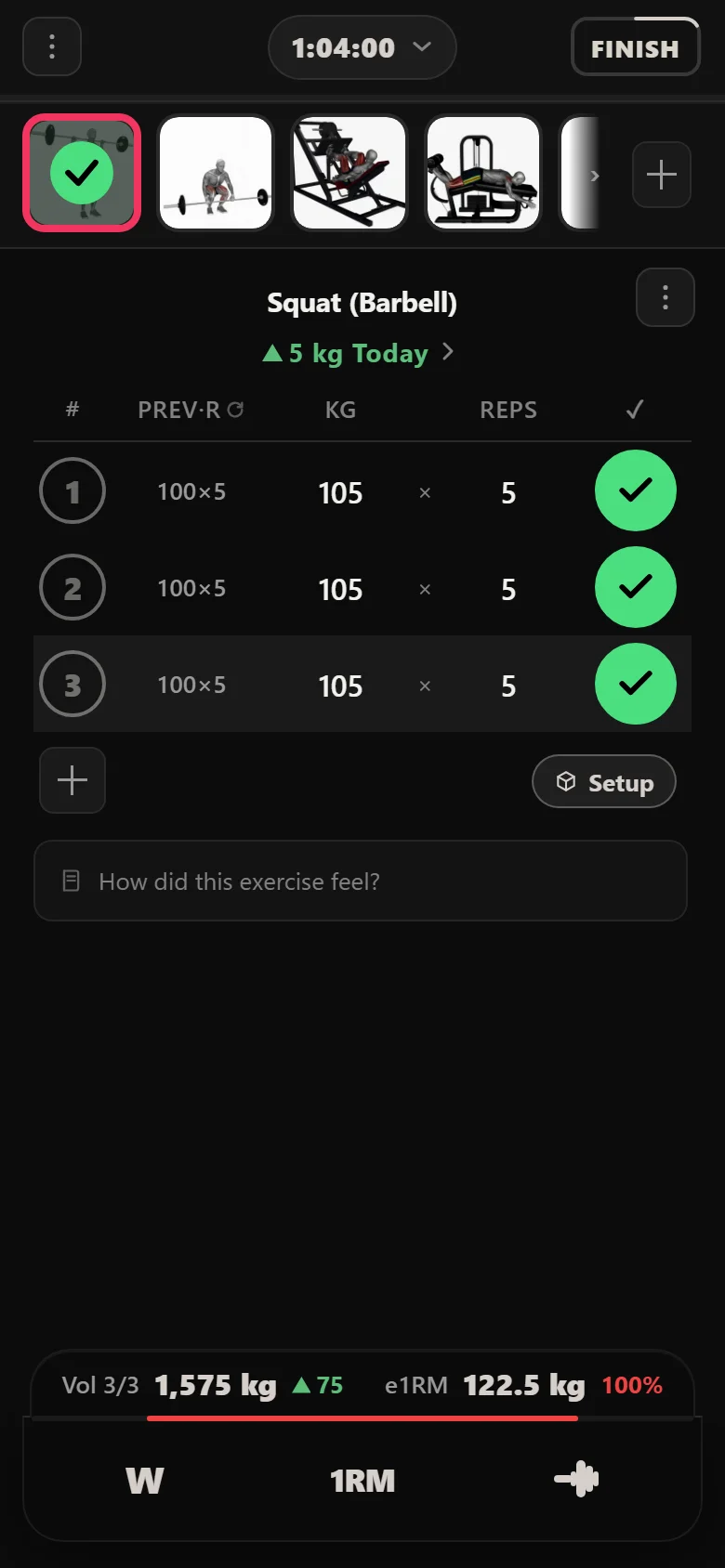
Six weeks from above
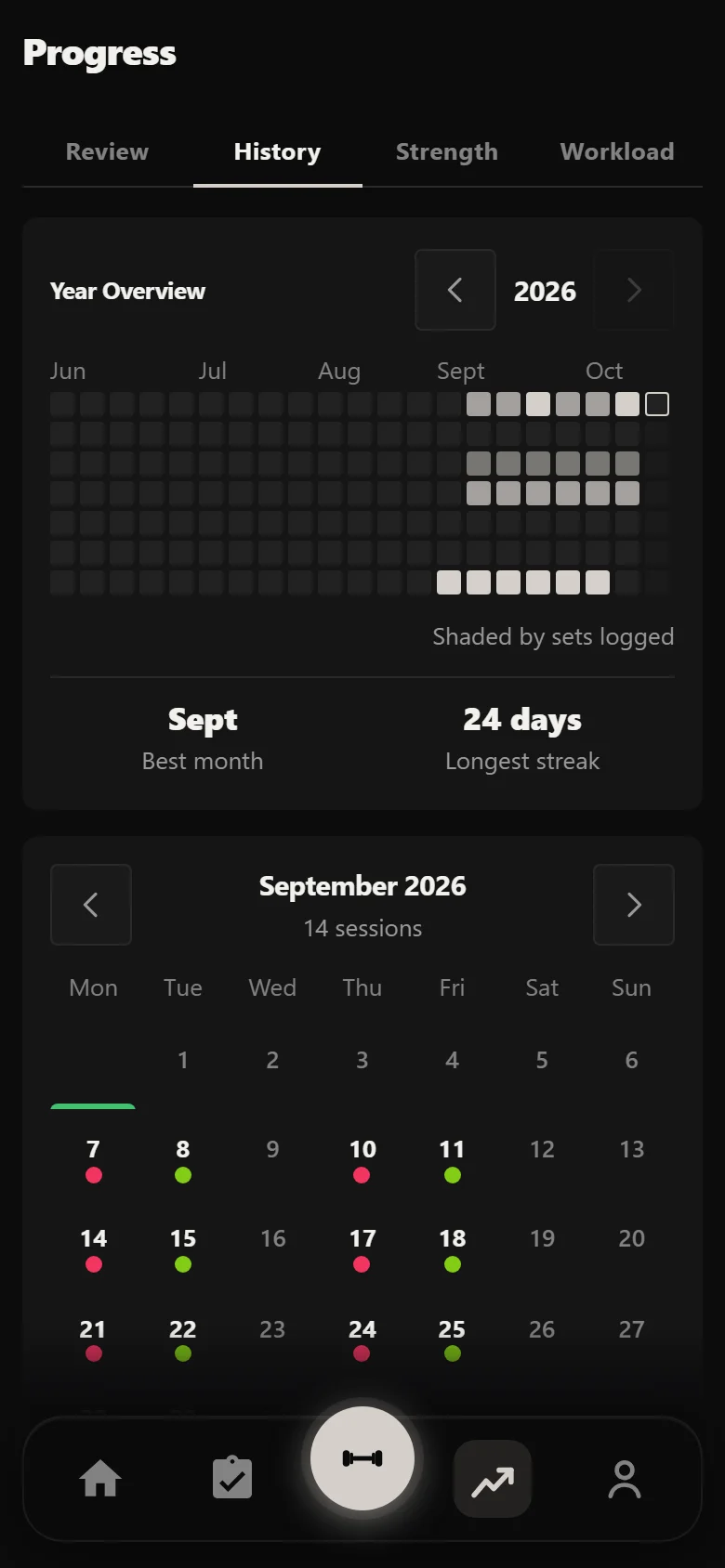
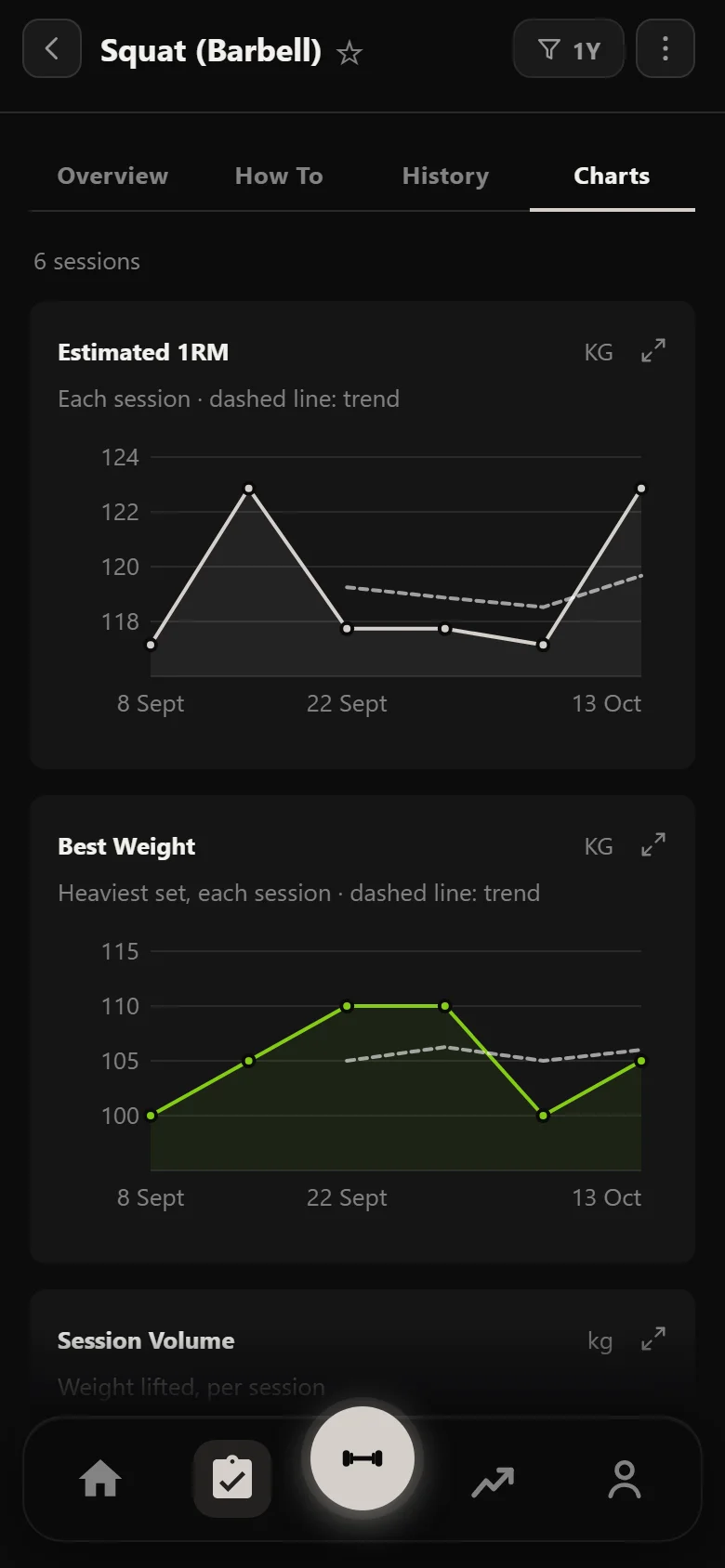
Twenty-four sessions across six weeks fill the History calendar, four days a week with the power and hypertrophy days alternating. The squat's own estimated 1RM chart is the shape of the story: climbing, flattening through the stall, dipping at the deload, then climbing again.
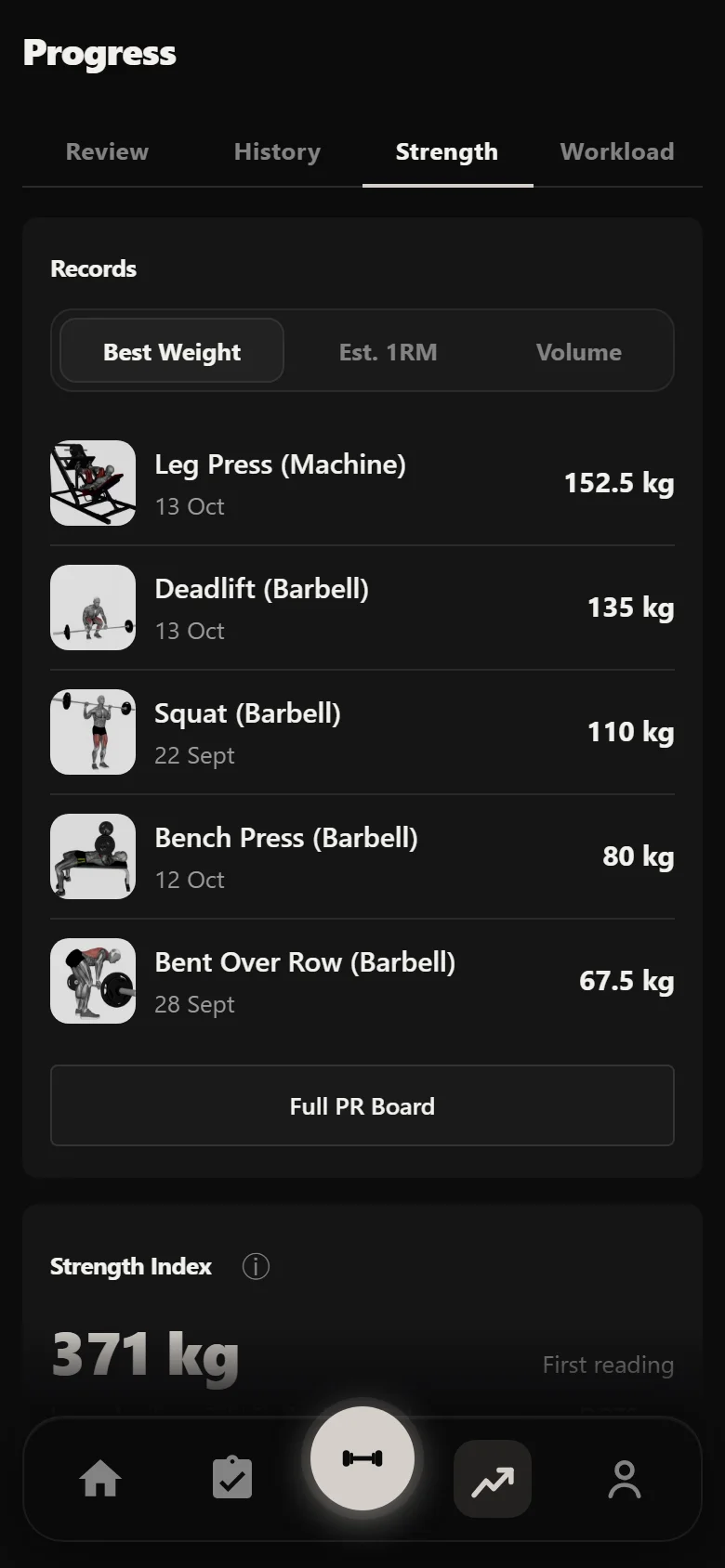
The strength view ranks the lifts by estimate, the squat's 122.5 kg above the deadlift, and the bench at 90.7 kg, with weekly volume alongside. The lifts that moved over the six weeks are visible next to the ones that did not: the bench went 75 kg to 80, the barbell row 65 kg to 70, the barbell curl 7.5 kg to 10, and the leg curl on the power day climbed 7.5 kg to 17.5. The deadlift held at 130 kg the whole way, which is normal for a lift trained heavy once a week.
The payoff: a ceiling found, and a route past it
Six weeks of PHUL did not just add 5 kg to a squat. It found the weight the squat could not hold, proved it twice, cut it without being asked, and set up the second run at it. That is the useful output of a linear block, and it is the part a spreadsheet makes you do to yourself.
Meanwhile the hypertrophy days were adding reps and weight on their own rule the whole time, on the same muscles, in the same week, with no bookkeeping from you. Two rules, one program, and the only thing you had to bring was the effort.
The squat, start to finish: 100 kg to a 110 kg ceiling, two misses there, an automatic 10% cut, and the rebuild back at 105 kg with the estimate at 122.5 kg.
Common questions
What is PHUL?
Power Hypertrophy Upper Lower: a four-day intermediate powerbuilding split. Two power days train the big lifts in the 3–5 rep range for strength, and two hypertrophy days come back to the same muscles in the 8–12 range for size. Every muscle group is trained twice a week.
How do the two progression rules work together?
The power lifts run linear progression. Hit 5 reps on all your sets and the weight goes up next session, 5 kg on the squat and deadlift and 2.5 kg on the upper-body lifts. The hypertrophy lifts run double progression: climb the rep range, and when every set tops it out the weight goes up and the reps reset. Durata runs both at once and shows the rule on each exercise, so there is nothing to track.
What happens when I stall on a power lift?
The weight is held rather than pushed. Miss the same weight twice in a row and the app cuts it by 10% and restarts the climb, which is what happened to the squat on this run: 110 kg missed twice, cut to 100 kg, and back to 105 kg the following week. Tap the rule chip on the exercise and it shows you the evidence it used and the rule it applied.
Why is the same lift on two different rules?
Because PHUL trains it twice a week for two different reasons. The leg curl on the power day sits in a 6–10 range and the one on the hypertrophy day in 10–15, and Durata tracks each slot's weight and progression separately. Adding weight on one does not touch the other.
Is six weeks enough for PHUL?
PHUL is a repeating weekly template rather than a fixed-length block, so it runs until you stop it. Six weeks is about how long it takes for the first real stall to show up on a big lift, which is when the deload rule earns its keep. Keep going and the pattern repeats at a higher weight.
Is Durata free?
Yes. Durata is free to use, with the full program catalogue, automatic progression maths, deload rules, rest timers and PR tracking. Everything in this walkthrough is in the app.
Put it into practice
Durata is free to use — 50 proven programs, automatic progression, rest timers and PR tracking, all on your phone.