


5/3/1 Boring But Big in Durata: where the progress actually happens
5/3/1 asks you to be patient in a way most programs do not. Inside a four-week cycle nothing improves. You work 5s, then 3s, then a heavy single-plus week, then you deload, and the estimated max you finish the cycle on is roughly the one you started it with. The improvement is booked at the cycle boundary, when the training max is reviewed and everything downstream of it moves at once.
This run drove the whole thing in the app: 64 sessions, 16 weeks, four complete cycles of 5/3/1: Boring But Big, with the 5×10 back-off sets on the same lift after every main session. The squat (barbell) opened its first wave at 120 kg off a 140 kg training max and finished the block at 147.5 kg, and all four main lifts came out of the block on a higher training max than they went in on. Every weight below was computed by the engine from a percentage; none of it was typed in.
Finding the program
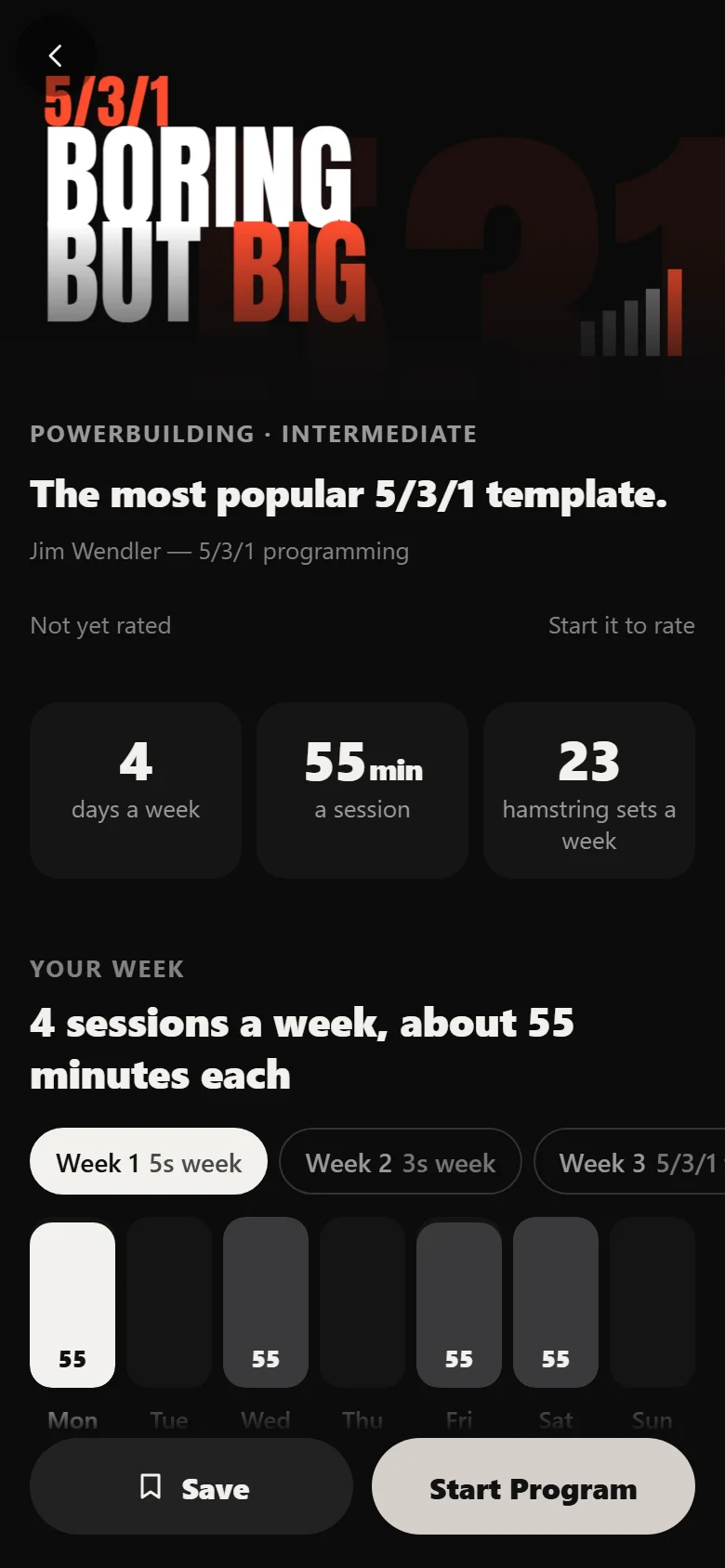
In Discover, 5/3/1: Boring But Big sits on the Powerbuilding shelf, marked Intermediate, at four days a week. Search finds it by name, or Filter narrows the shelves by level and days a week. Tap the cover for a quick look, then View Program for the full page.
The program page lays out what you are agreeing to. Four days a week, one main lift each, four-week cycles that repeat. Squat on day one, overhead press, deadlift and bench across the rest of the week. After the three main working sets on each day, the same lift comes back for five sets of ten at half the training max, and then each session finishes with three assistance lifts for five sets of ten or more.
What you set, and what the app works out
5/3/1 runs on training maxes rather than on the weights themselves. You give the app one number per main lift, deliberately under your true max, and from then on every prescribed weight in the program is a percentage of it. Nothing else about the main lifts is yours to decide: not the jumps, not the back-off weights, not the deload.
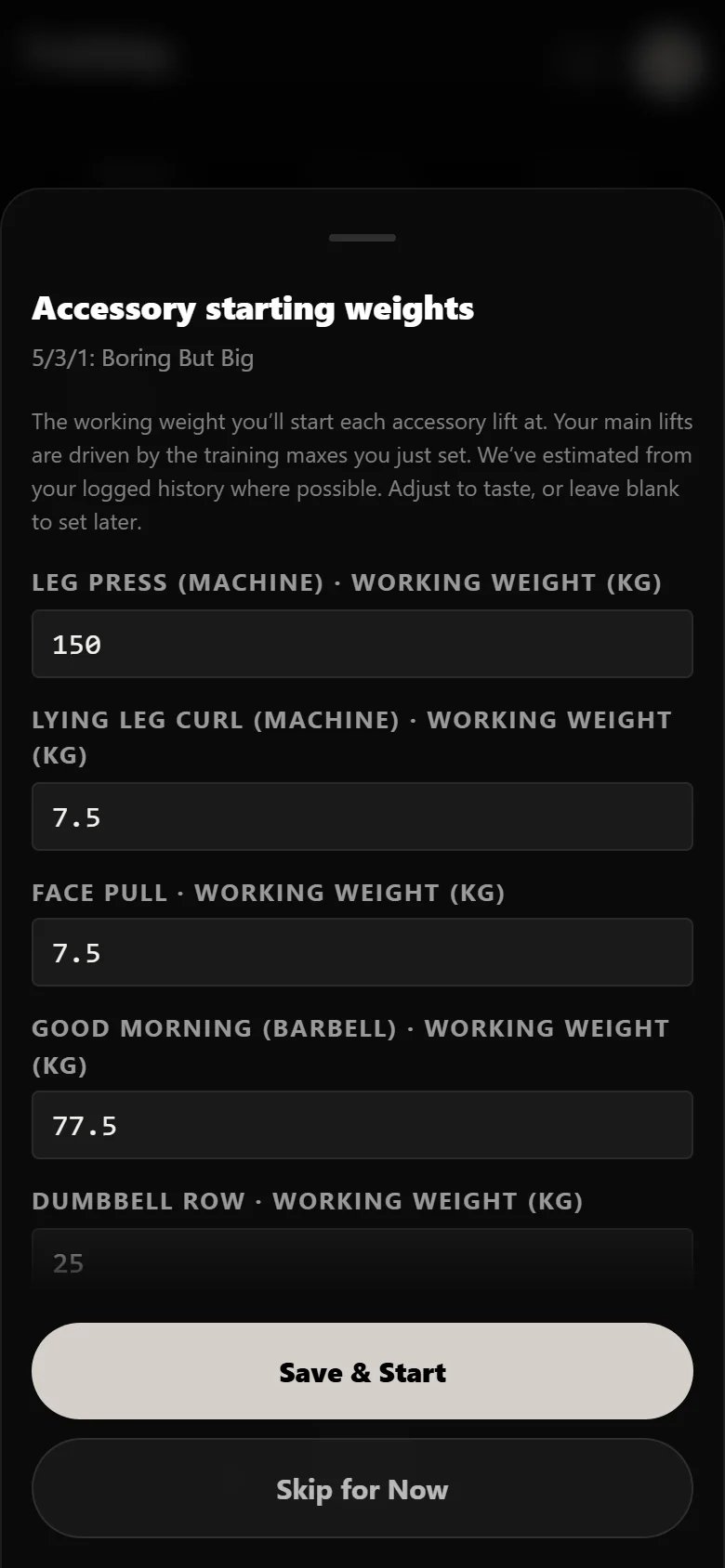
The assistance work is the part that does carry its own weights, so the same setup sheet asks for those separately. On this run the good morning opened at 77.5 kg and the machine work at the numbers a first session would set. Those lifts progress on their own rules, independent of the wave.
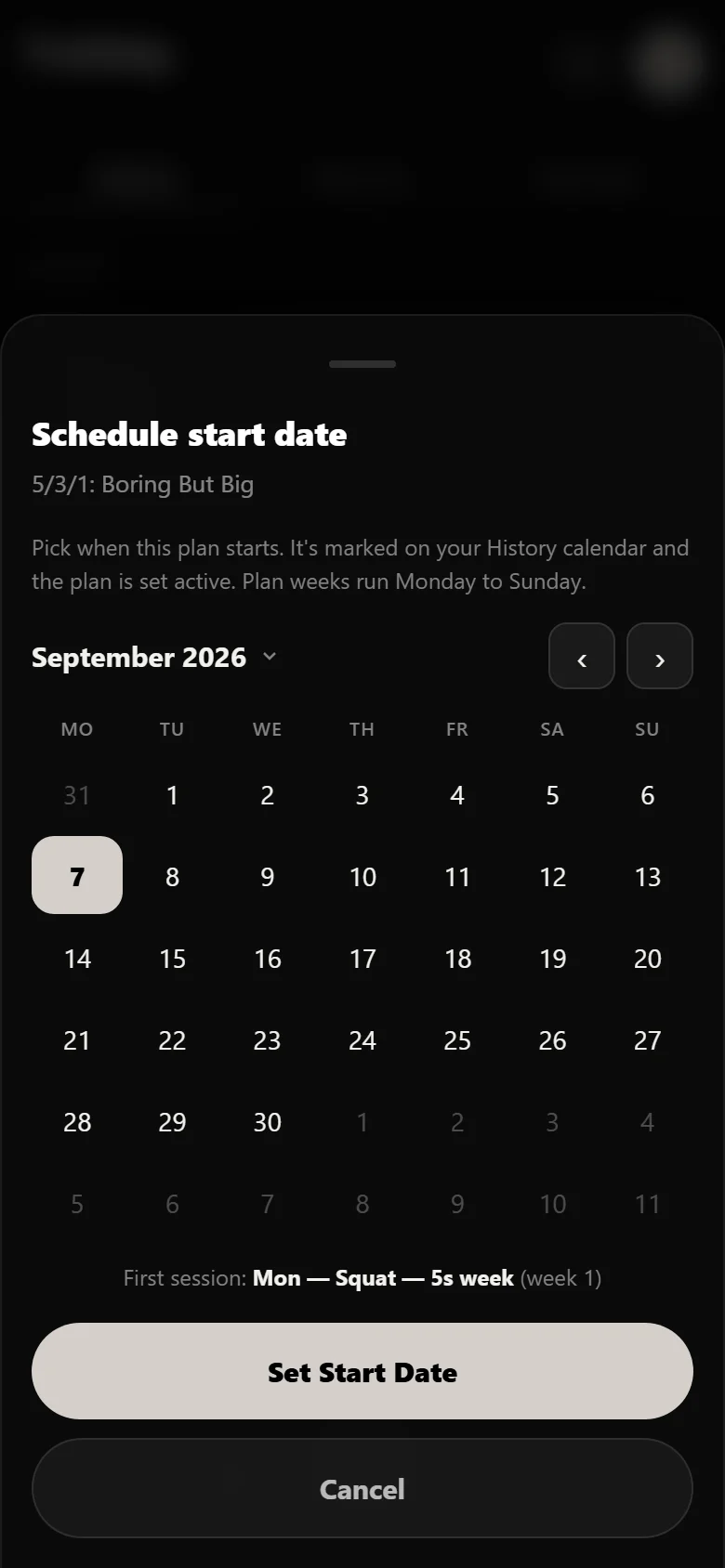
Then a start date puts sixteen weeks of sessions on the calendar in one move. Four cycles, four weeks each, dated from that point, which is why the article below counts sessions and cycles rather than weeks.
Week one: 5s, and then fifty more reps
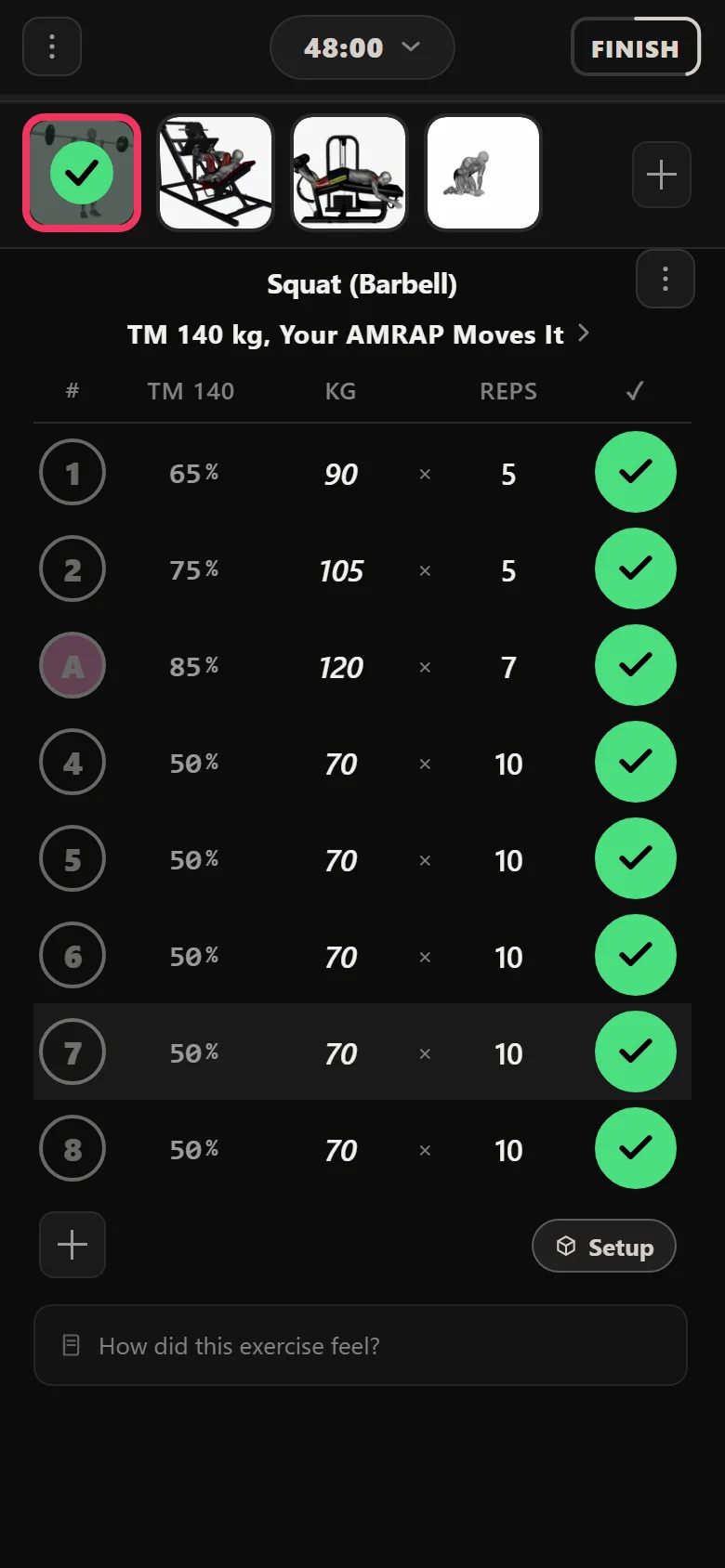
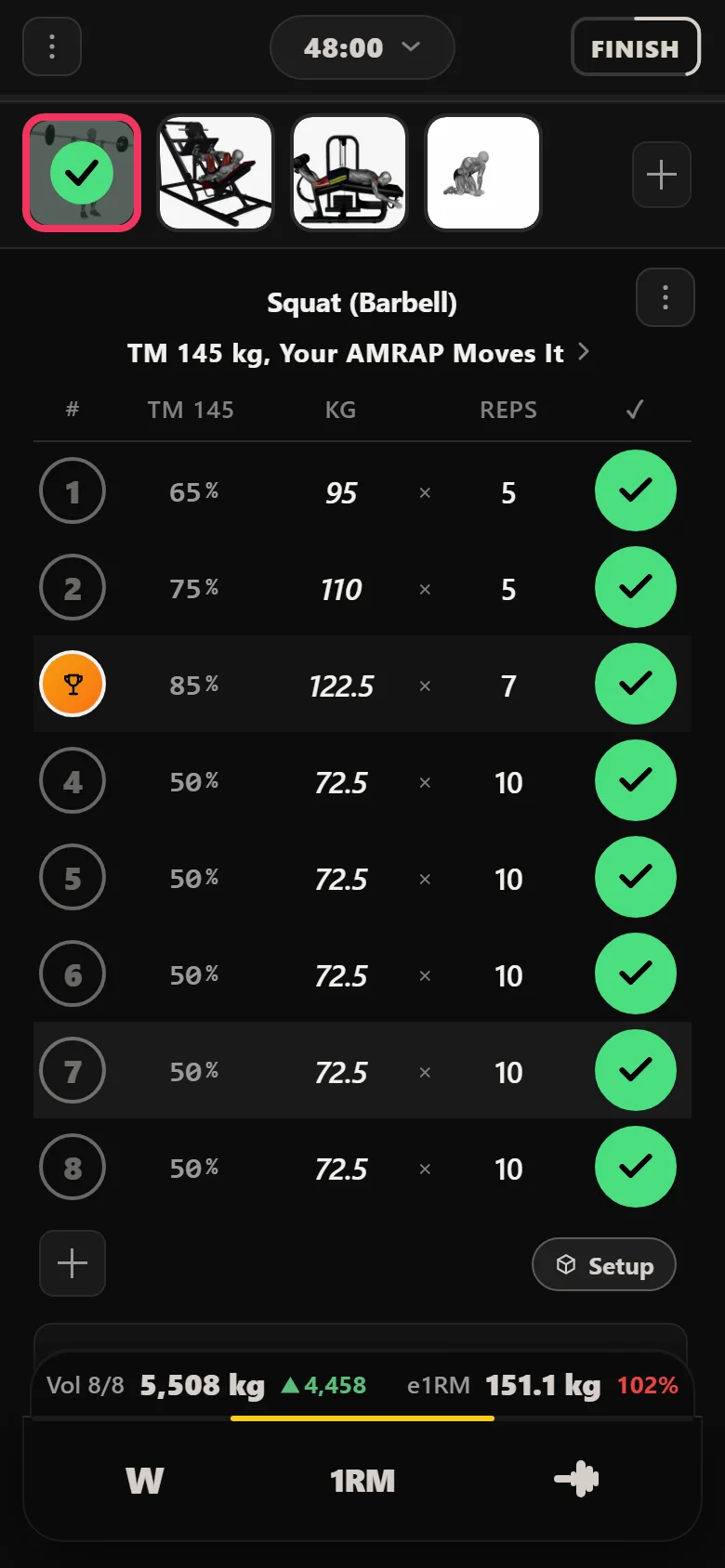
The first squat session opens the wave at 120 kg, which is a percentage of the 140 kg training max rather than a weight anybody chose. Three working sets, the last one a rep-out, and the app shows the training max it is working from at the top of the exercise so the percentage is never a mystery.
Then the Boring But Big part begins. The same lift comes back for five sets of ten at half the training max, which on this session is a much lighter bar and a great deal more work. That is the whole design: 5/3/1 supplies the strength stimulus in three sets, and the 5×10 supplies the size stimulus underneath it, on the same movement, off the same number.
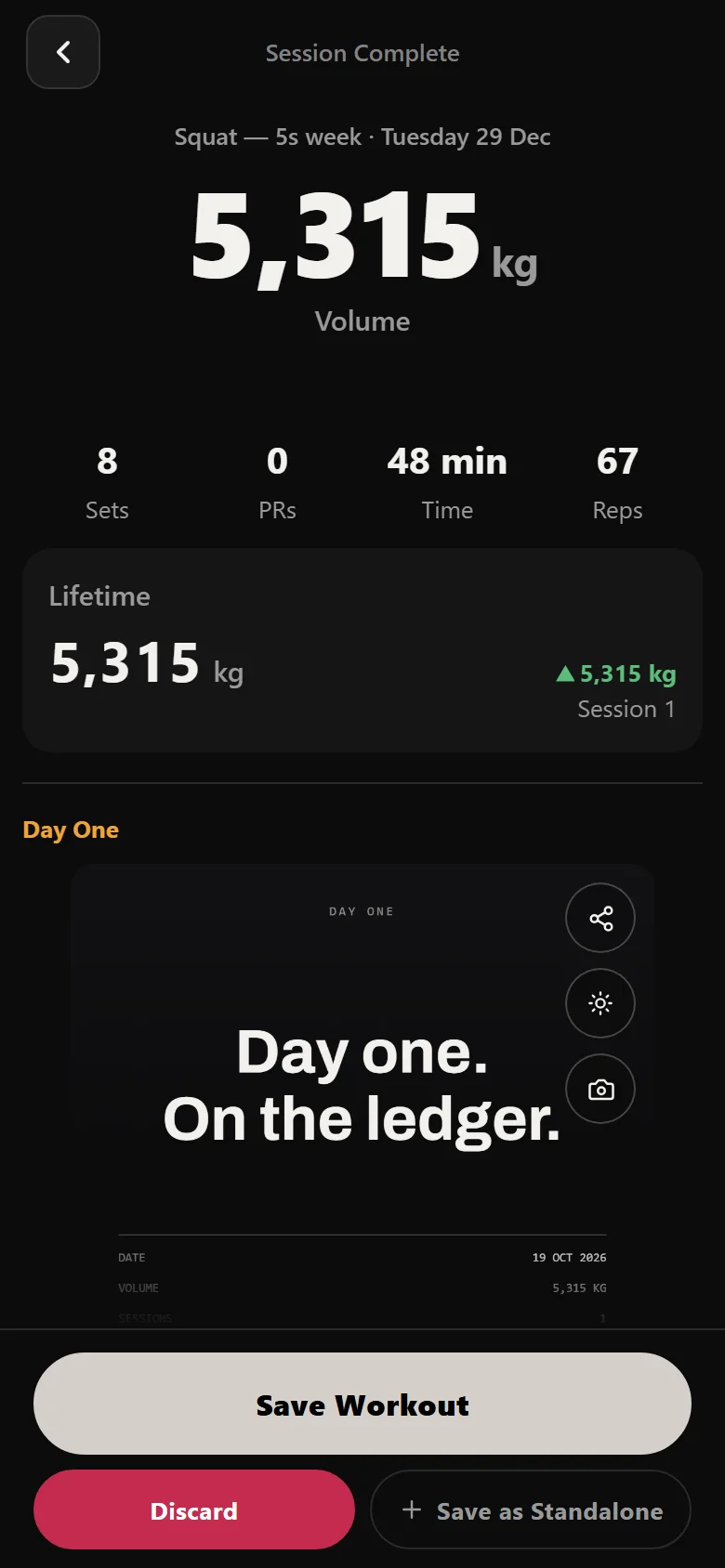
The session-complete screen shows what that adds up to. Eight sets on the main lift, 67 reps, and 5315 kg of total volume before the assistance work is counted. It is a lot of tonnage for a program whose heavy portion is three sets long.
The heavy week, then the week that looks like a mistake
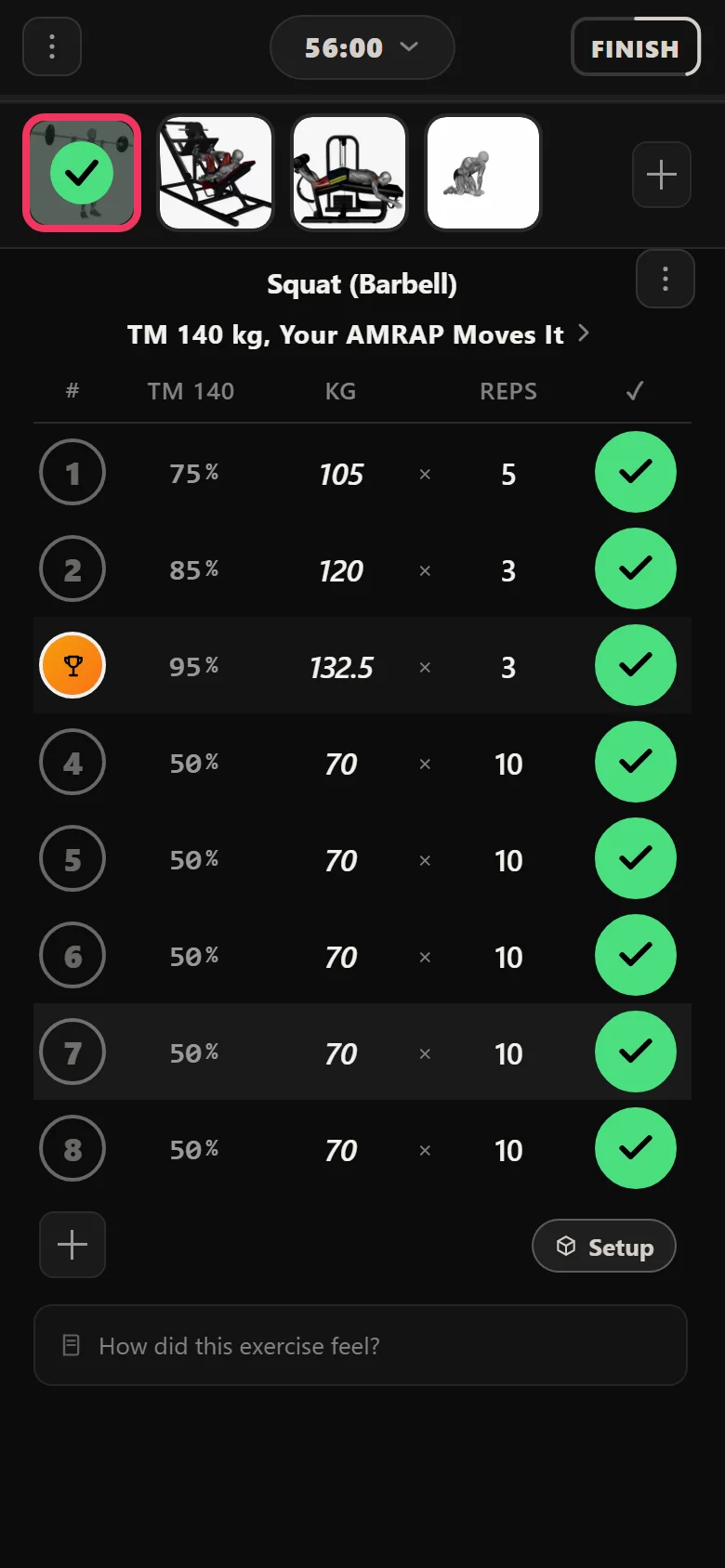
Week three is the top of the wave. The squat runs 132.5 kg on its last working set, ninety-five percent of the training max, for a prescribed single and as many more as you have. This is the only week in the cycle where the program asks a real question, and the answer to it is what the next cycle is built on.
Week four is the part people delete from their own spreadsheets. The bar drops back to warm-up territory, the reps are fixed, and there is no rep-out anywhere in the session. It looks like a wasted week and it is the reason the next one works. Durata prescribes it in full rather than marking it optional, because the cycle's arithmetic assumes it happened.
At the end of that week the training max is reviewed. The heavy week's rep-out is what decides it: clear the prescribed reps and the review adds weight, miss them and the number holds. On this program the squat and the deadlift are set to move 5 kg a cycle and the two pressing lifts 2.5 kg, because a five-kilo jump means something different on a squat than it does on an overhead press.
The review: one number, and the whole cycle moves
Cycle two opens on the reviewed training max, and the session on screen is the same session as before with a heavier bar: the identical percentages, the identical rep scheme, 122.5 kg where the first cycle put 120 kg. Nothing in the program changed. One number underneath it did.
Because the Boring But Big sets are half of that same training max, they move with it. There is no second setting for the back-off weight and no separate decision to make about it. Raise the training max and the heavy triple, the rep-out and all fifty back-off reps all step up together, which is precisely why 5/3/1 is written in percentages rather than in weights.
Four cycles later the training max has gone from 140 kg to 160 kg, and the top set of the heavy week has followed it from 132.5 kg to 147.5 kg. The strip below is every heavy appearance of the squat across the block, three per cycle, deload weeks omitted because they carry no rep-out and no verdict.
The squat is the lift this run followed set by set, but the review is not a squat event. It runs on all four main lifts at the same boundary, off each one's own heavy week, and the block's record has all four moving: the squat from 140 kg to 160 kg and the deadlift from 180 kg to 200 kg, the bench from 100 kg to 110 kg and the overhead press from 60 kg to 70 kg. Two lifts on the bigger jump, two on the smaller one, four separate verdicts, one schedule.
Squat (Barbell): top working set, cycle by cycle
- 120S1 Session 1 — cycle 1, 5s
- 125S5 Session 5
- 132.5S9 Session 9
- 122.5S17 Session 17 — cycle 2
- 130S21 Session 21
- 137.5S25 Session 25
- 127.5S33 Session 33 — cycle 3
- 135S37 Session 37
- 142.5S41 Session 41
- 132.5S49 Session 49 — cycle 4
- 140S53 Session 53
- 147.5S57 Session 57 — last heavy week
Inside the cycle, nothing improves
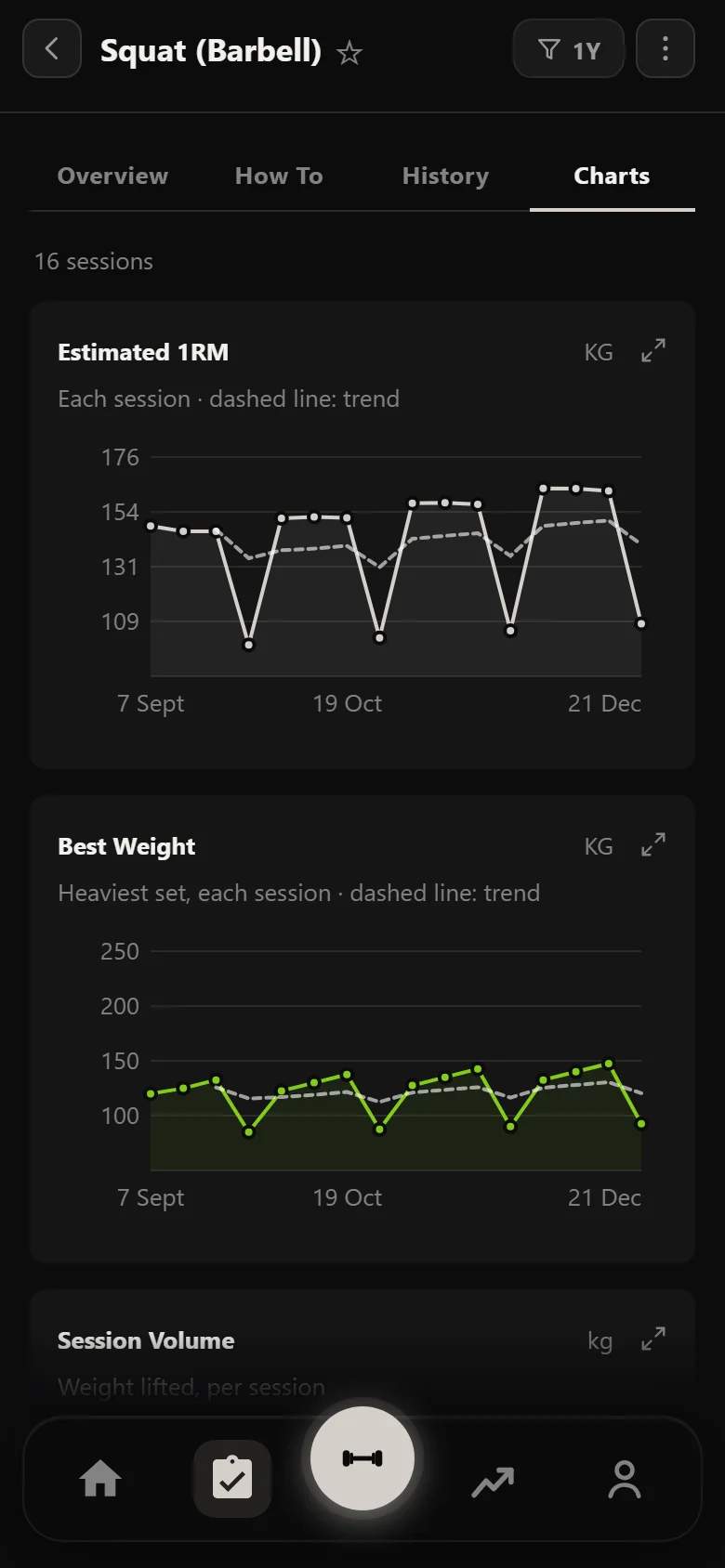
The estimated one-rep max chart is the clearest thing this drive produced, and it is not a flattering line. Inside every cycle it is flat. The first cycle's three working weeks estimate a little under 150, then a shade under that, then a shade under that again, because the reps drop as the bar gets heavier and the two roughly cancel. The same is true of cycle two, cycle three and cycle four.
The steps are all at the boundaries. Each review raises the training max, the next cycle's percentages resolve higher, and the estimate jumps to a new flat stretch. Across the whole block that estimate climbs to 163.4 kg, and essentially all of that movement happened in the four moments between cycles rather than in the forty-eight sessions inside them.
This is worth seeing rather than being told. A lifter watching a single cycle in isolation sees no progress at all and concludes the program is not working, which is the single most common reason people abandon 5/3/1 in month one. The chart makes the actual shape visible: four flat plateaus, each one higher than the last.
Sixteen weeks, seen from the outside
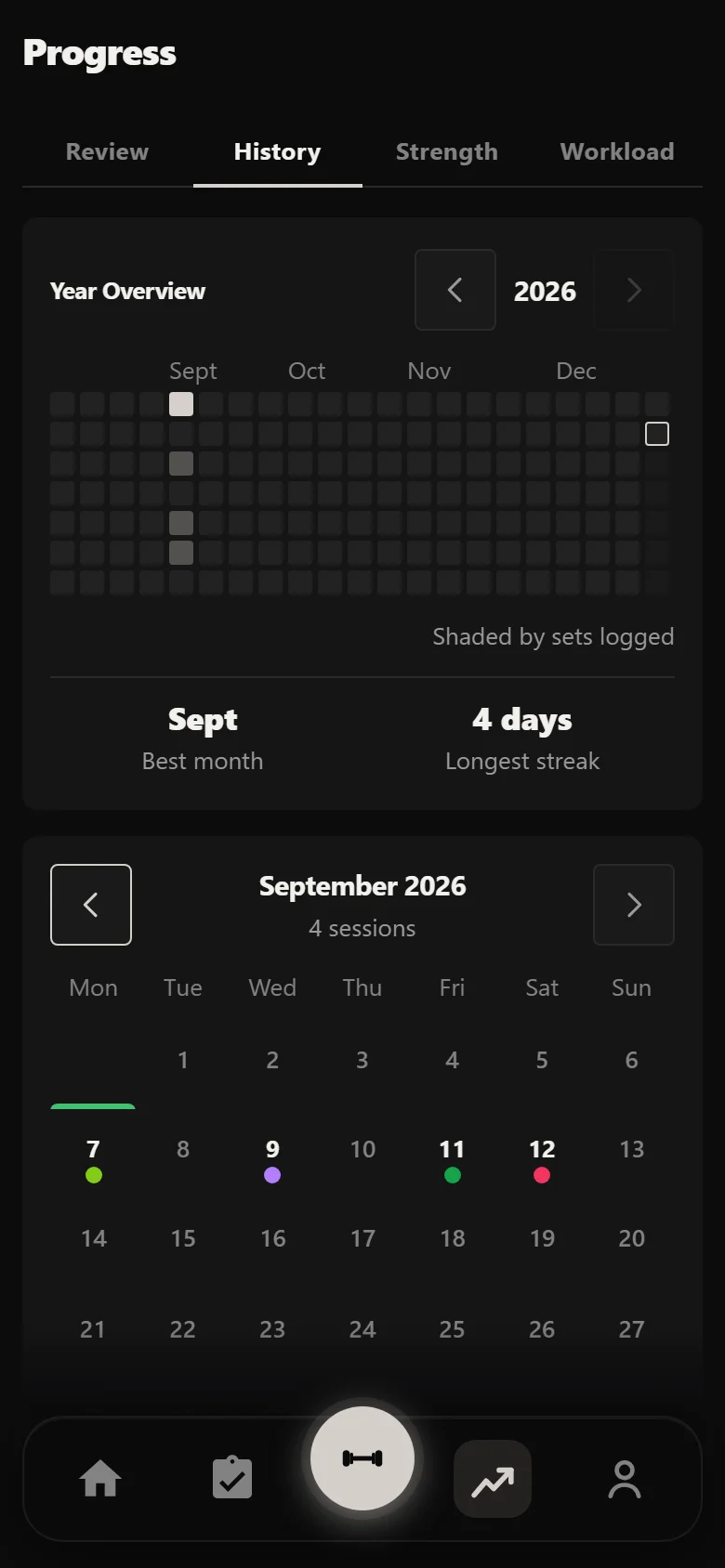
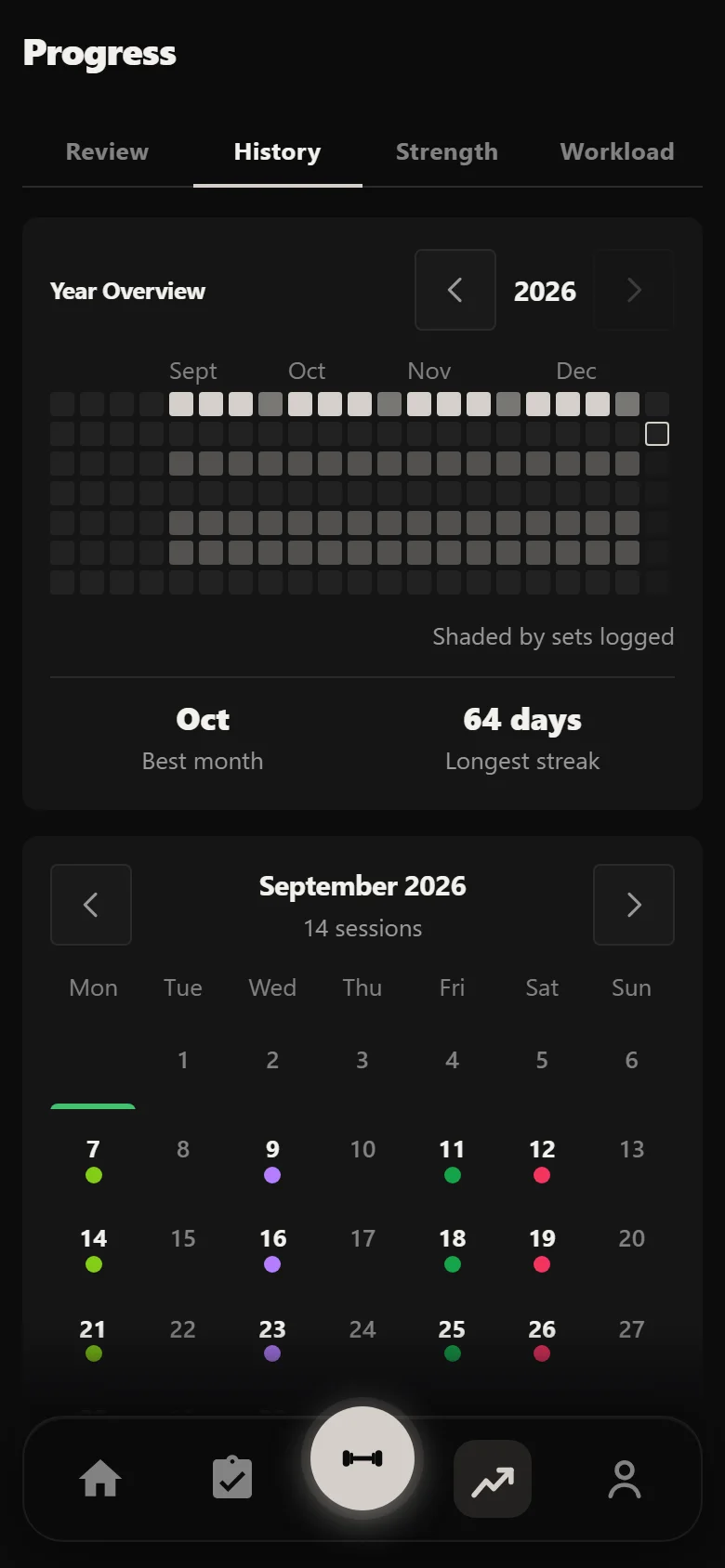
The History calendar holds the whole block: 64 sessions across four identical-looking cycles, each one a copy of the last on a heavier bar. Four days a week is a real commitment and the calendar is the honest record of whether it happened.
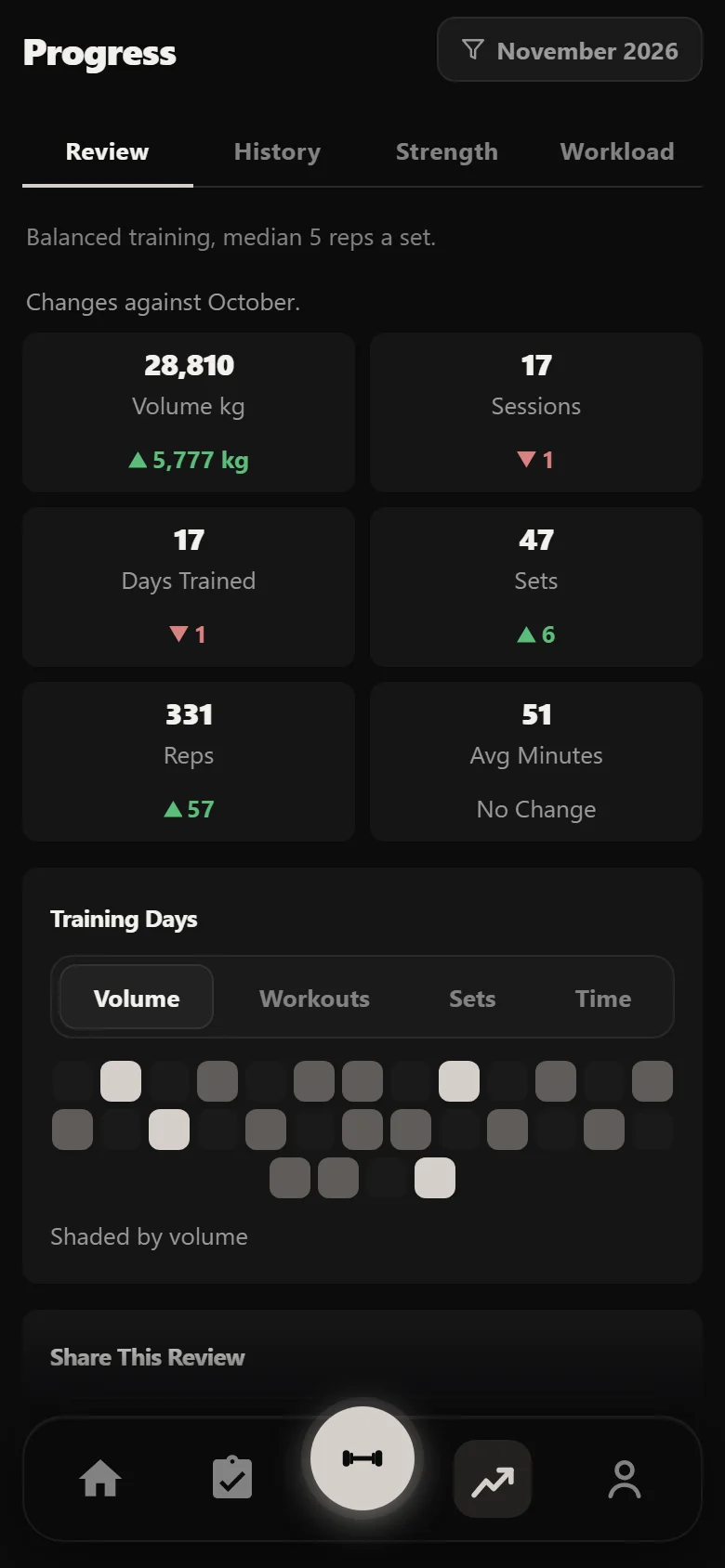
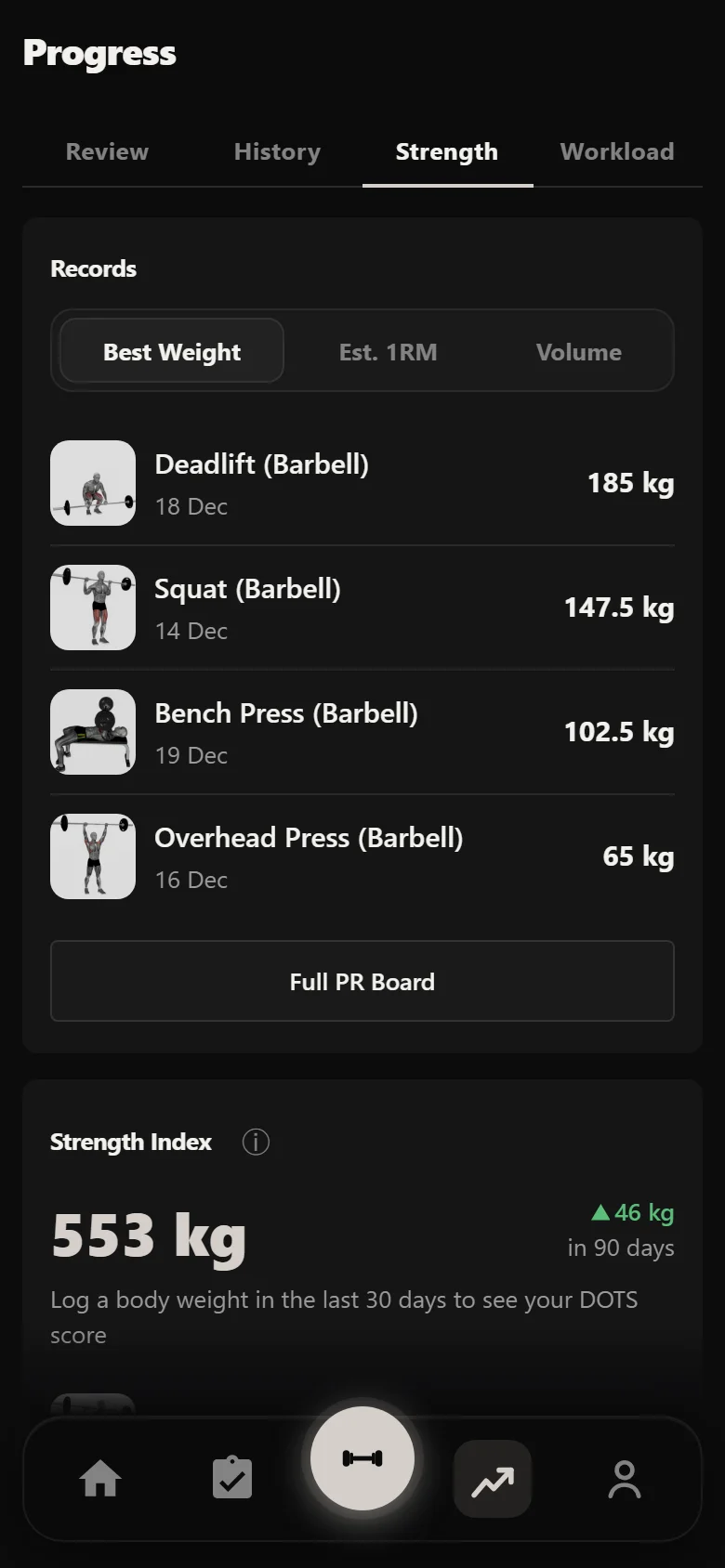
The Review tab totals each month, and the totals are what the Boring But Big template is famous for: November alone came to 28,810 kg across 47 sets and 331 reps. The Strength tab adds the four main lifts' estimates into one Strength Index, 553 kg by the end, so the whole block reads as one number instead of four separate histories.
The payoff: the same session, sixteen weeks apart
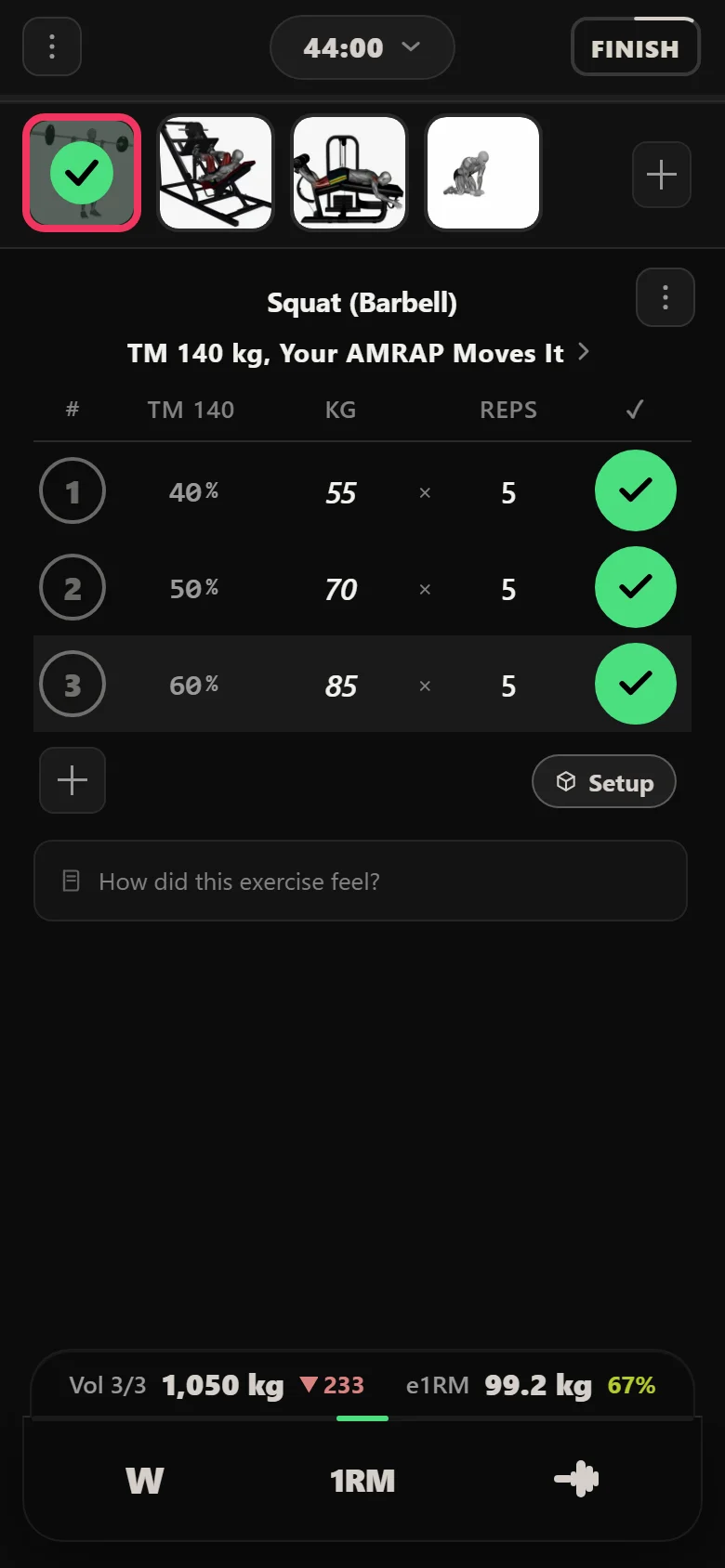
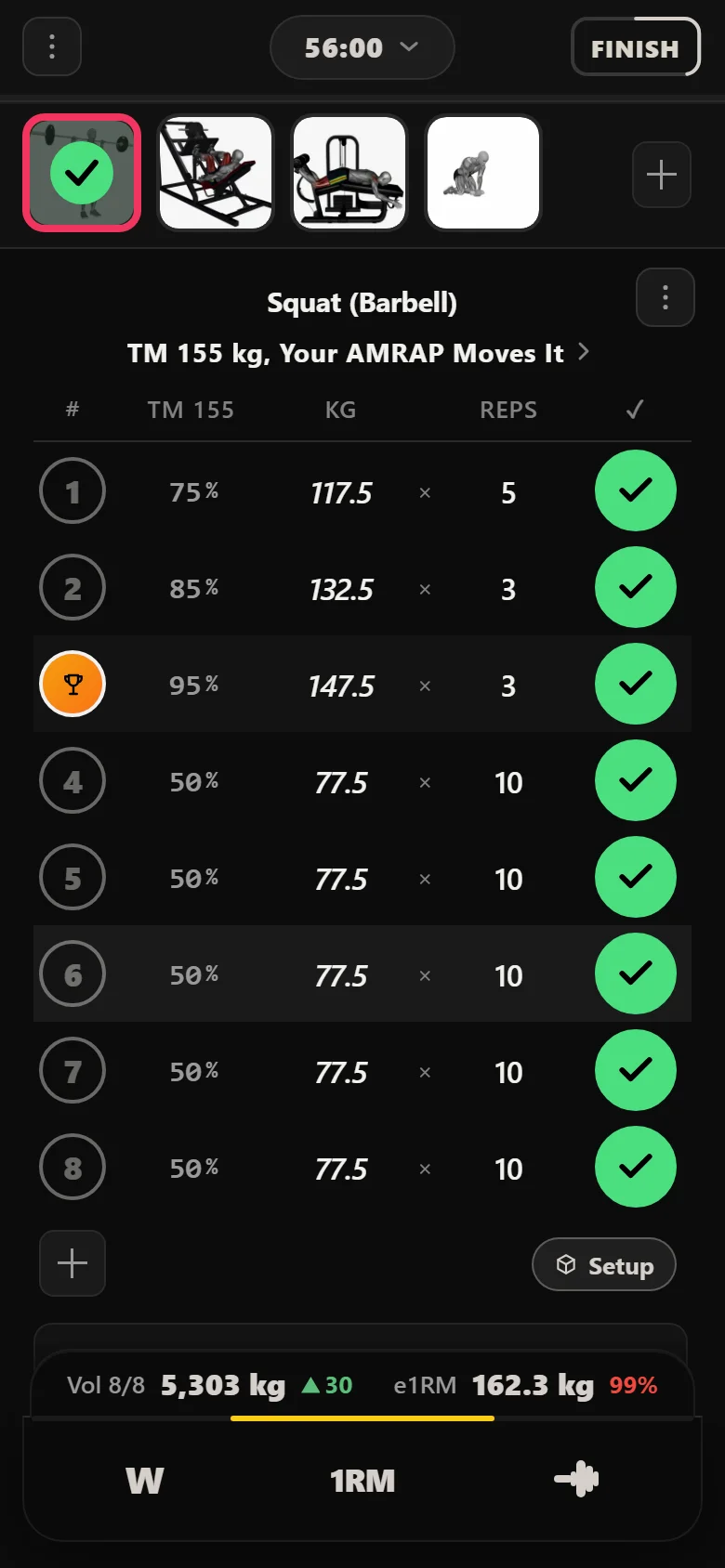
Two screenshots of the same lift on the same screen, both of them a heavy 5/3/1 squat session. The first is the opening week of cycle one; the second is the last heavy week of cycle four. The set scheme is identical, the percentages are identical, and the bar is 27.5 kg heavier because four training-max reviews said it could be.
120 kg to 147.5 kg across four cycles, with every weight in between resolved from a training max the app reviewed on schedule.
Common questions
What is 5/3/1: Boring But Big?
Jim Wendler's 5/3/1 with the Boring But Big supplemental template on top. Four days a week, one main lift per day, working in four-week cycles: a 5s week, a 3s week, a heavy 5/3/1 week and a deload. After the three main working sets you repeat the same lift for five sets of ten at half your training max, then finish with three assistance lifts for five sets of ten or more.
What is a training max and why is mine lower than my real max?
It is the number every prescribed percentage is calculated from, and it is deliberately set below what you can actually lift. That is what keeps the working weights repeatable for a whole cycle and keeps the rep-out sets honest. In Durata you set it once per lift and the app calculates every weight in the program from it.
Why does nothing improve inside a cycle?
Because it is not meant to. The three working weeks get heavier while the prescribed reps drop, so the estimated max stays roughly level. Progress is booked at the review between cycles: the training max goes up, every percentage under it resolves higher, and the next cycle starts on a heavier bar. On this run the squat's estimate sat a little under 150 for all of cycle one and finished the block at 163.4 kg, almost entirely in steps taken at the four boundaries.
Can I skip the deload week?
You can, and the cycle's arithmetic assumes you did not. The deload is the fourth week of a four-week cycle and it carries no rep-out set, so it never affects the training-max review. Durata prescribes it as a normal session rather than as an optional one, which is the practical difference between a program you follow and a program you edit.
How much does the training max go up each cycle?
On this program the squat and deadlift are set to 5 kg a cycle and the bench and overhead press to 2.5 kg, and the increase is earned on that lift's own heavy-week rep-out rather than granted automatically. Over the four cycles in this run the squat went from 140 kg to 160 kg, the deadlift from 180 kg to 200 kg, the bench from 100 kg to 110 kg and the overhead press from 60 kg to 70 kg.
Is Durata free?
Yes. Durata is free to use, with the full program catalogue, automatic percentage maths, rest timers and PR tracking. Everything in this walkthrough is in the app.
Put it into practice
Durata is free to use — 50 proven programs, automatic progression, rest timers and PR tracking, all on your phone.