


5/3/1 Triumvirate in Durata: four lifts, four training maxes, no decisions
Triumvirate is 5/3/1 with the arguments removed. One main lift a day on the standard wave, then three assistance movements, always the same three, always five sets of ten or more. There is no template to pick, no auto-regulation to interpret and no weekly decision to get wrong. The program's whole proposition is that you turn up four times a week for sixteen weeks and the only thing that changes is the number on the bar.
This run drove all of it: 64 sessions, four complete cycles, every weight resolved by the engine from a training max. By the end all four main lifts had moved. The squat went from a 140 kg training max to 160 kg and the deadlift from 180 kg to 200 kg, while the bench went 100 kg to 110 kg and the overhead press 60 kg to 70 kg, at half the rate, because a five-kilo jump means something very different on a press than it does on a pull.
Finding the program
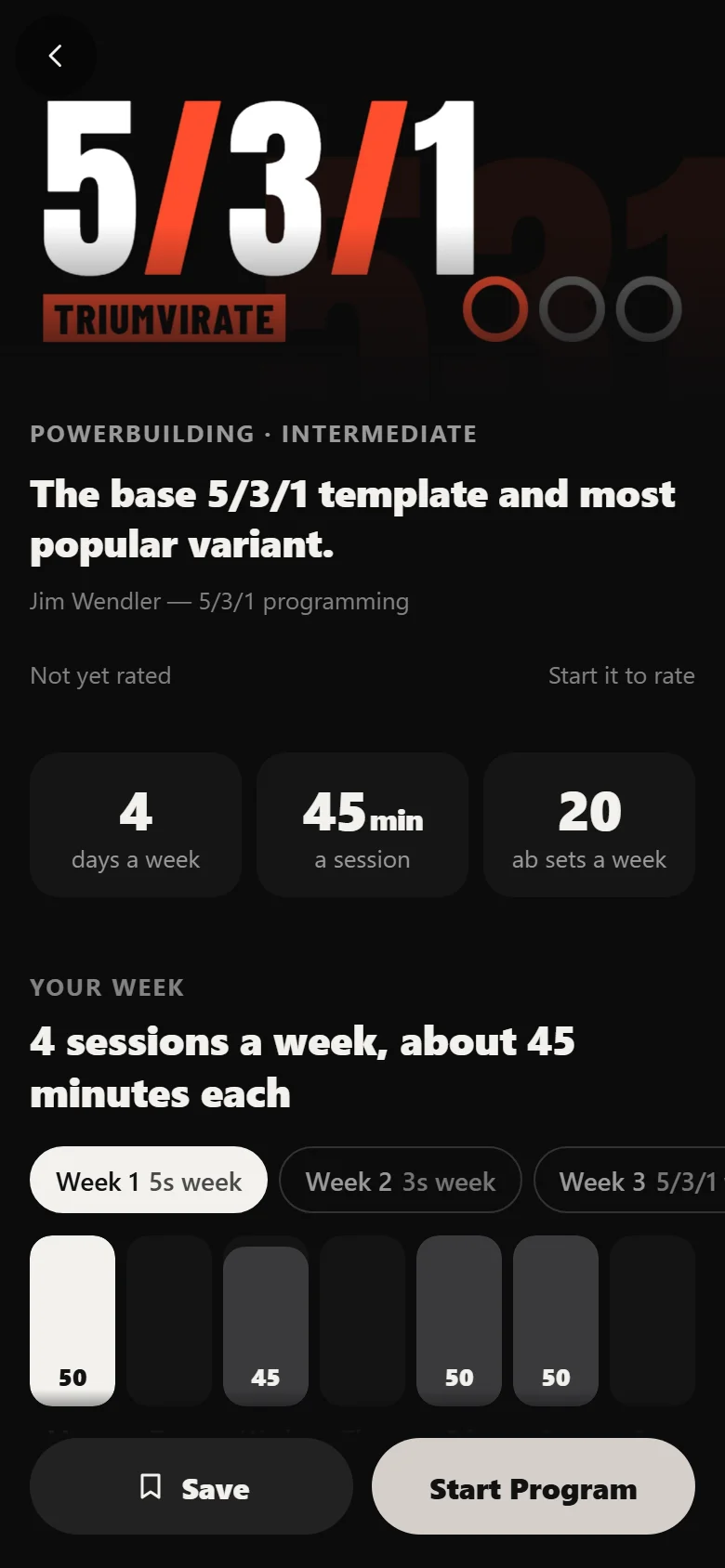
In Discover, 5/3/1 Triumvirate sits on the Powerbuilding shelf, marked Intermediate, at four days a week. Search finds it by name, or Filter narrows the shelves by level and days a week. Tap the cover for a quick look, then View Program for the full page.
The program page lays the whole thing out. Four days: squat, overhead press, deadlift, bench, each with the same four-week wave of 5s, 3s, a heavy 5/3/1 week and a deload. Under each main lift sit three assistance exercises at five sets of ten or more, and they never change either. Reading that page is the last time you have to think about the structure.
Four training maxes, and the assistance weights
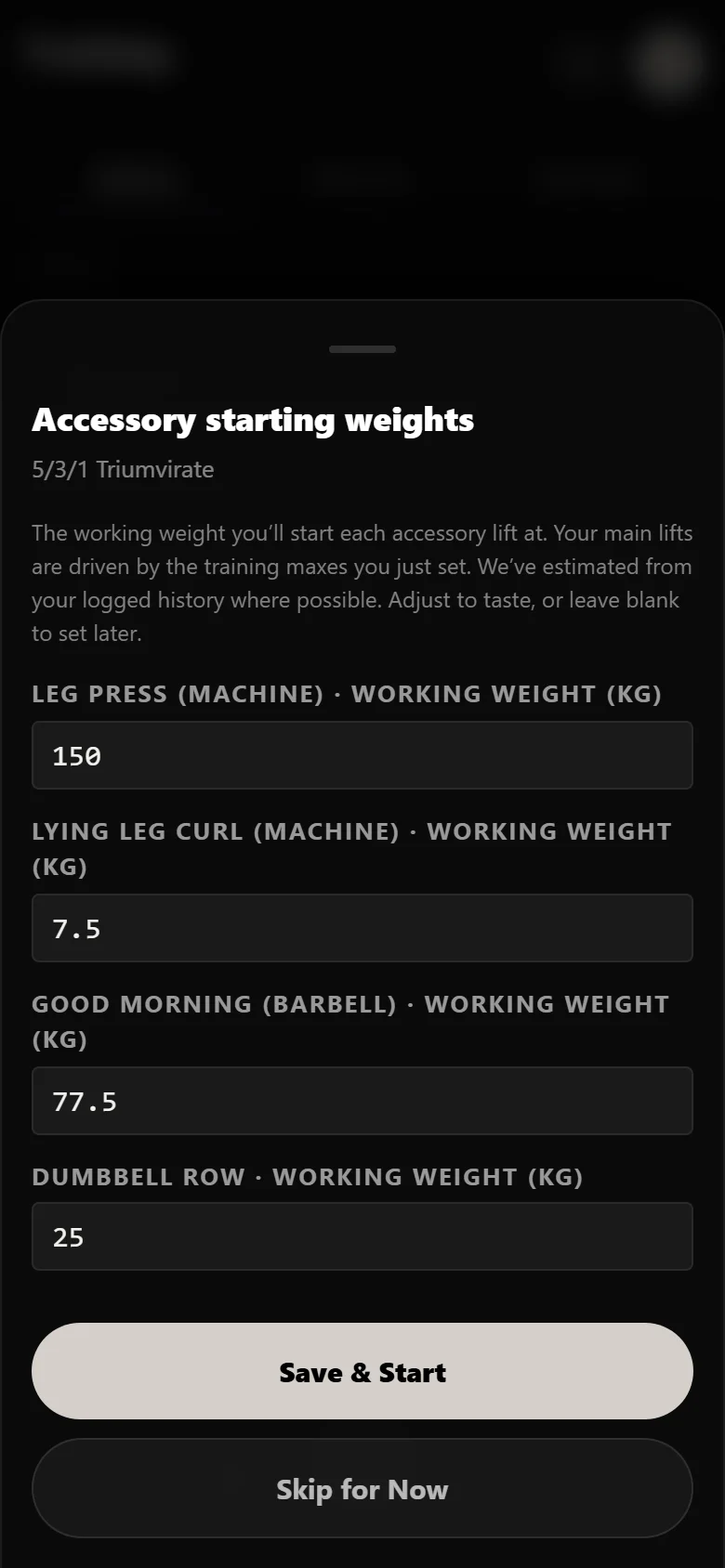
The main lifts run on training maxes, so setup asks for one number each on the squat, bench, deadlift and overhead press. Every percentage in the program resolves from those four numbers, and after that nothing about the main work is a decision: not the working weights, not the deload, not the size of the jump between cycles.
The assistance work is different, because five sets of ten on a leg press is not a percentage of anything. Those lifts carry their own working weights, set once at the start, and the good morning on this run opened at 77.5 kg. They sit on their own rules and are deliberately not the point of the program.
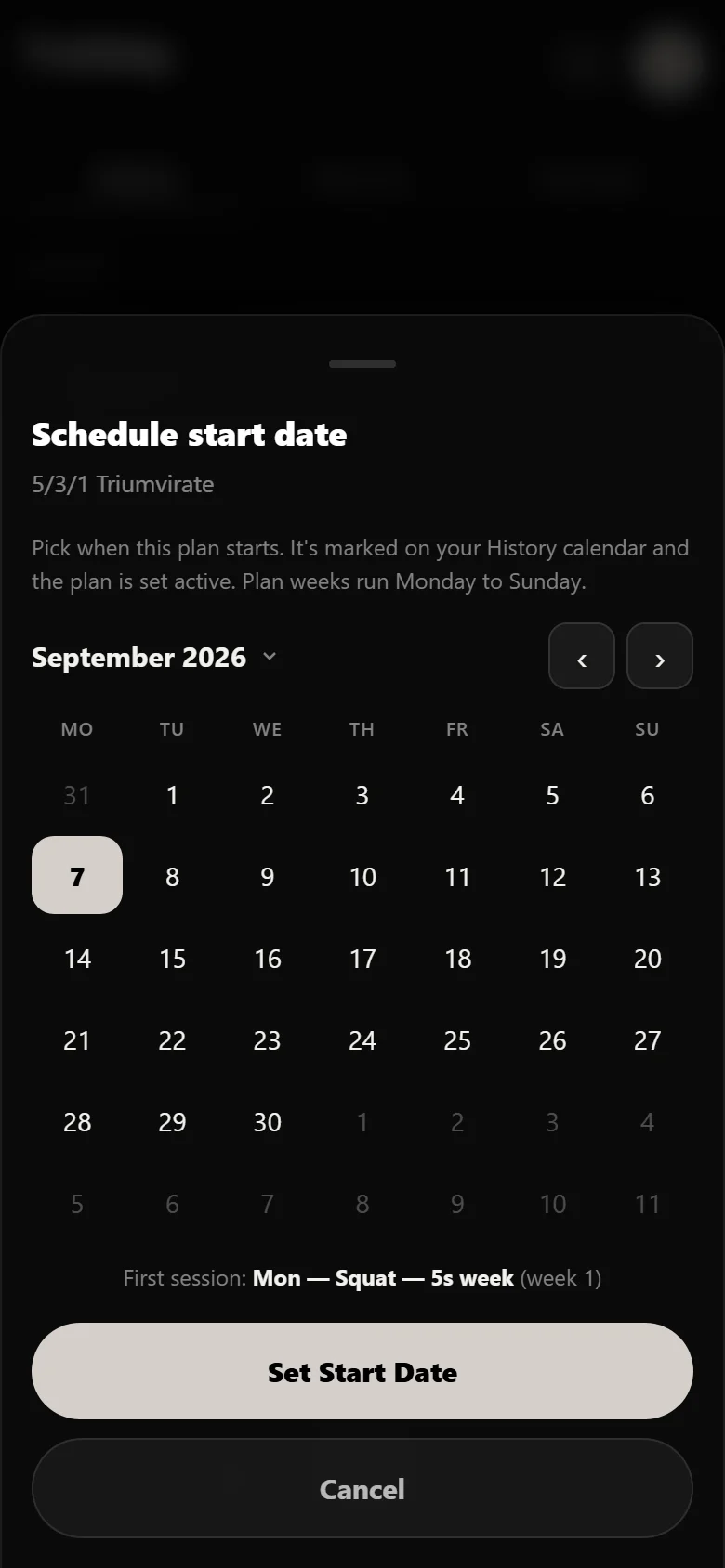
A start date puts all sixteen weeks on the calendar at once. Four days a week, four-week cycles, and the whole block dated from that one choice, which is why the article below counts sessions and cycles rather than weeks.
Week one: three working sets, and then you leave
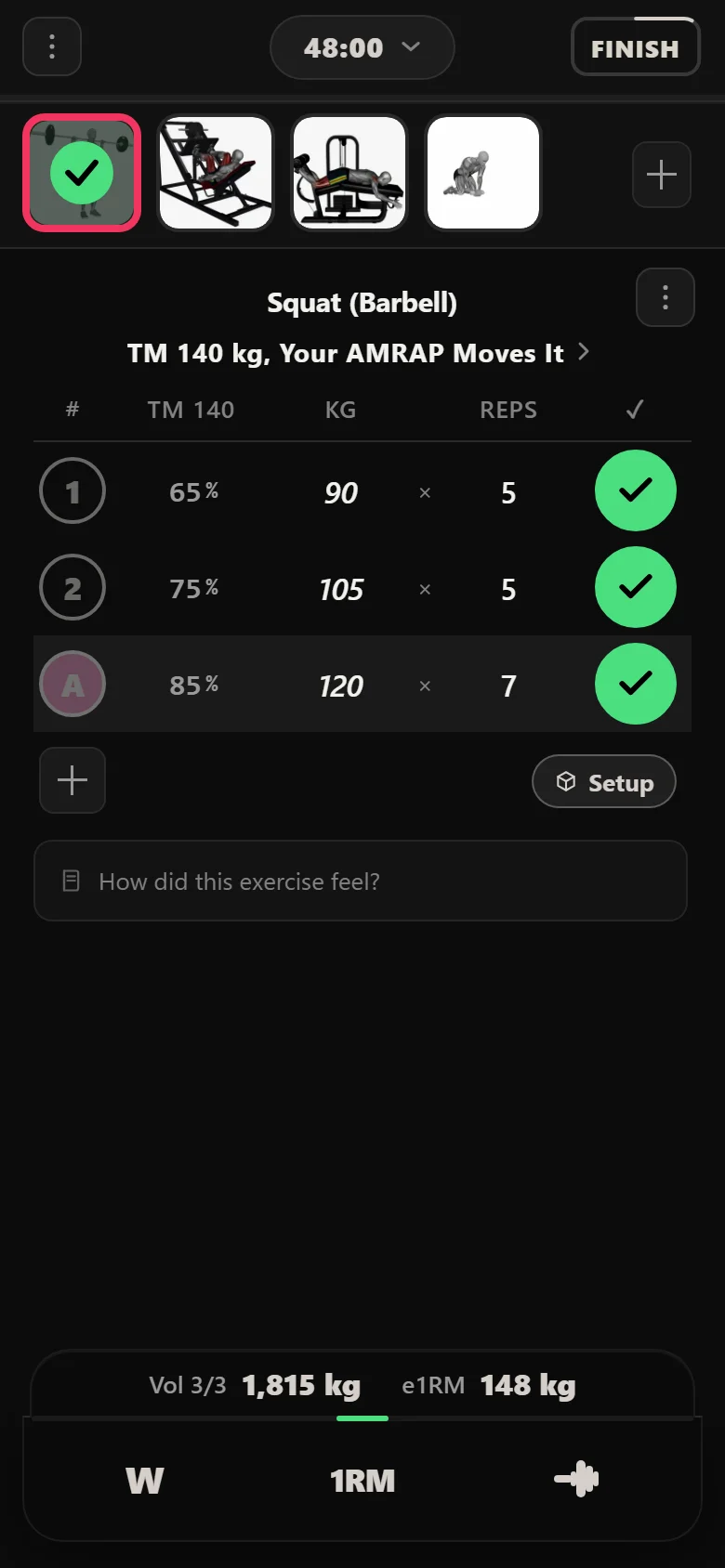
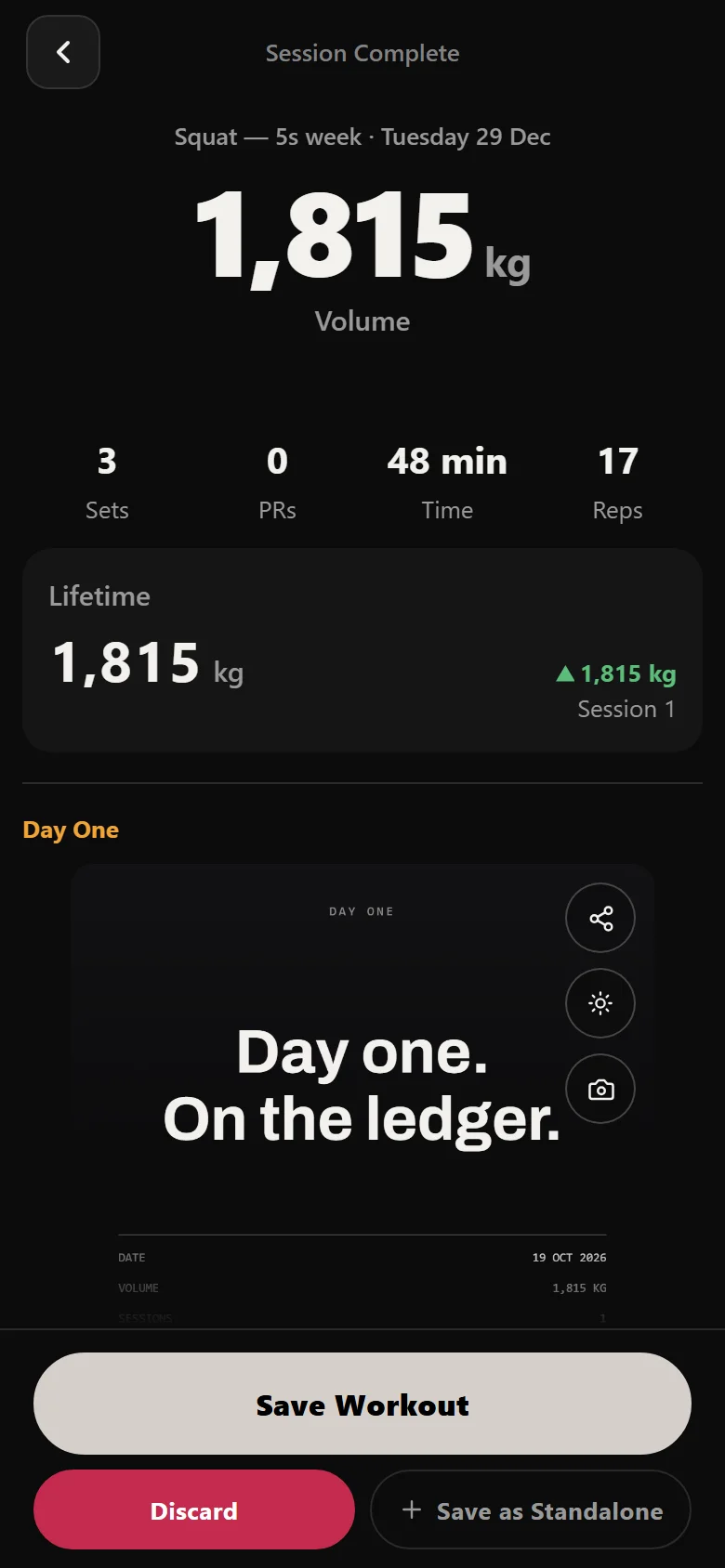
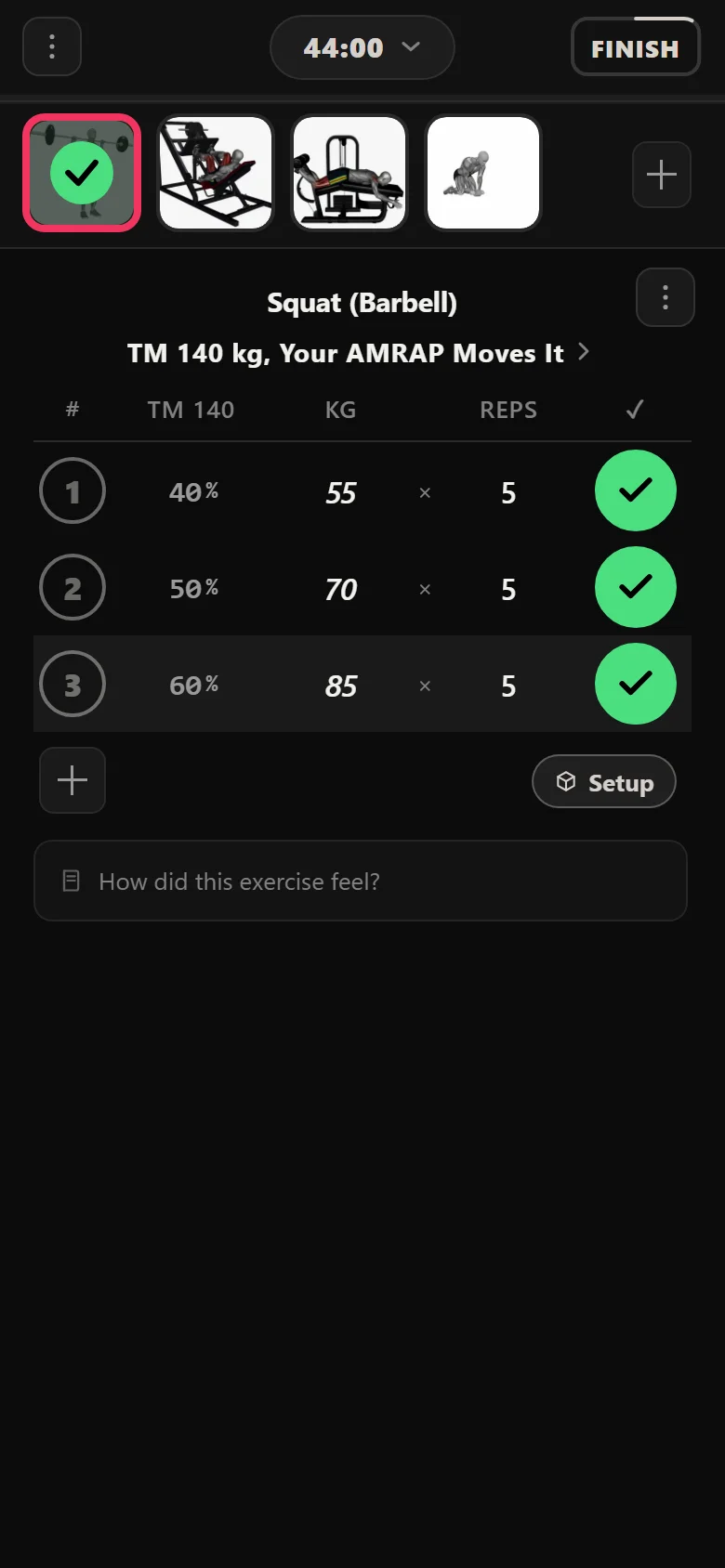
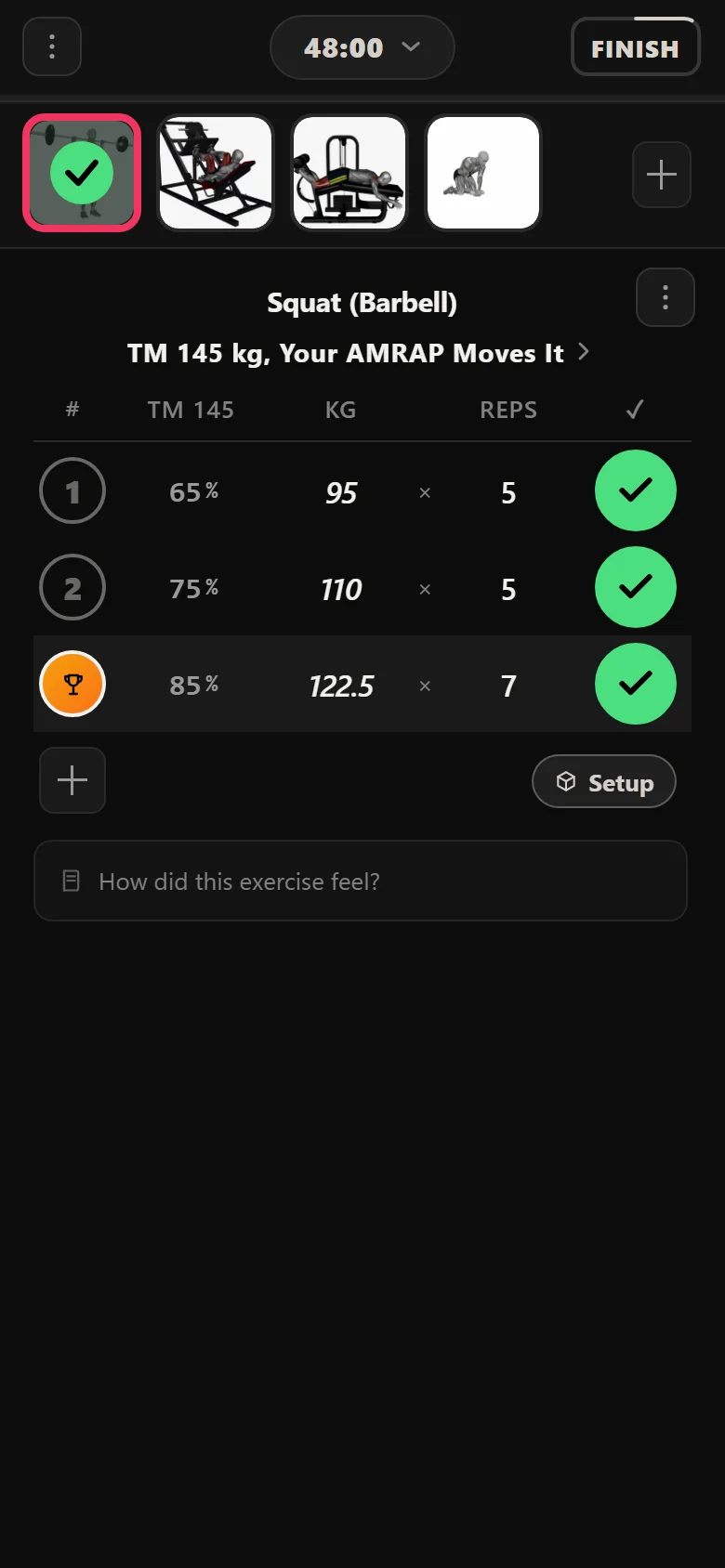
The opening squat session is three working sets at 120 kg, the last one taken for as many reps as you have, off a 140 kg training max. That is the entire heavy portion of the day. People coming from a five-by-five find it disconcertingly short, and the shortness is the design: the wave asks for quality on three sets, not for accumulation.
The app shows the training max at the top of the lift, so the percentage is visible rather than implied. You are never in the position of typing a number and hoping it is the right one, and you never have to remember what week of the cycle you are in.
The session tallies at 1815 kg across three sets on the main lift before the assistance work. Then the three fixed movements come in, five sets of ten each, and the day is done. That contrast, a very short heavy block on top of a large fixed volume block, is the shape of every session in the program.
The week that counts, and the week that pays for it
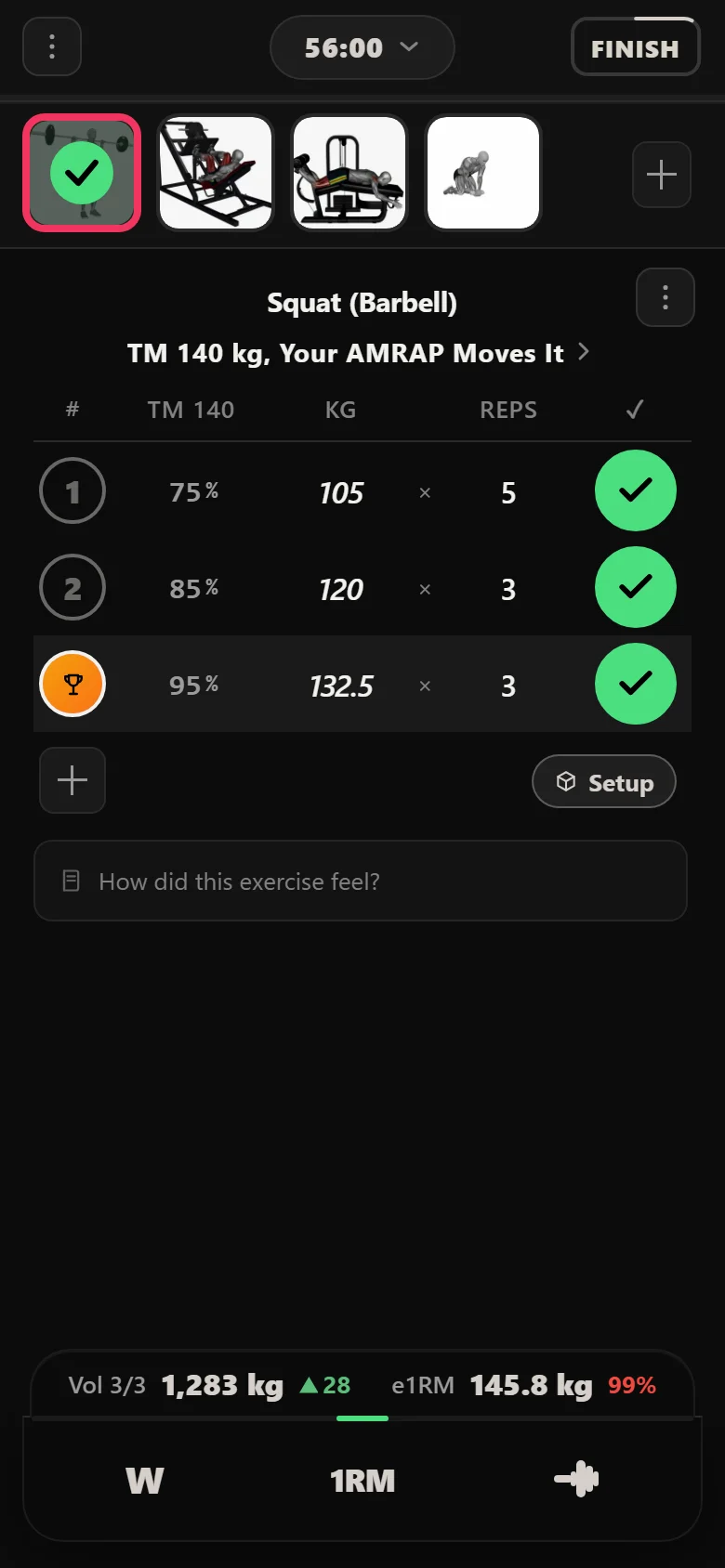
Week three is the only week in the cycle that asks a question. The squat's last working set is 132.5 kg at ninety-five percent, prescribed as a single with as many more as you can manage, and what you do on that set is the entire input the program takes from you for four weeks.
Week four takes the bar back to warm-up territory with no rep-out anywhere in it. It is the week people delete, and it is load-bearing: the review at the end of it assumes the week happened. Durata prescribes it as a normal session rather than marking it optional, because a program that lets you skip its own recovery week is not really the program any more.
At the end of week four the training max is reviewed, and whether it moves depends on the heavy week's rep-out. Clear the prescribed reps and the review adds weight; fall short and the number holds until you earn it. Nothing about that decision requires you to be honest with yourself after the fact, because the logged set already said what happened.
The review, and the same wave on a heavier bar
Cycle two opens on the reviewed number: 122.5 kg where cycle one opened at 120 kg, off a 145 kg training max instead of 140 kg. The session is otherwise identical. Same three sets, same percentages, same rep scheme, same assistance work. Only the number underneath it changed, and everything downstream of that number moved with it in one step.
Four cycles in, the squat's heavy-week top set has gone from 132.5 kg to 147.5 kg and its training max from 140 kg to 160 kg. The strip below is every working week of the block, twelve appearances across four cycles, deload weeks omitted because they carry no top set and no verdict.
Read down the strip and the pattern is a staircase rather than a climb. Inside each cycle the weight rises and the reps fall, which is the wave doing its job. Between cycles the whole staircase shifts up, which is the review doing its job. The two are separate mechanisms and the strip shows them separately.
Squat (Barbell): top working set, cycle by cycle
- 120S1 Session 1 — cycle 1, 5s
- 125S5 Session 5
- 132.5S9 Session 9
- 122.5S17 Session 17 — cycle 2
- 130S21 Session 21
- 137.5S25 Session 25
- 127.5S33 Session 33 — cycle 3
- 135S37 Session 37
- 142.5S41 Session 41
- 132.5S49 Session 49 — cycle 4
- 140S53 Session 53
- 147.5S57 Session 57 — last heavy week
Four lifts, two rates, one schedule
The squat is the lift this article follows, but it is one of four and the others were running their own reviews on their own days the whole time. By the end of the block every one of them had moved. The squat's training max finished at 160 kg and the deadlift's at 200 kg, both climbing 5 kg a cycle. The bench finished at 110 kg and the overhead press at 70 kg, both climbing 2.5 kg a cycle.
That split is deliberate and it is set per program rather than per lift type. Adding five kilos to a deadlift every four weeks is a modest ask; adding five kilos to an overhead press every four weeks is a way to stall it inside a year. Durata carries the rule for each lift from the program's own definition, so the presses advance at half the rate of the pulls without anybody configuring it.
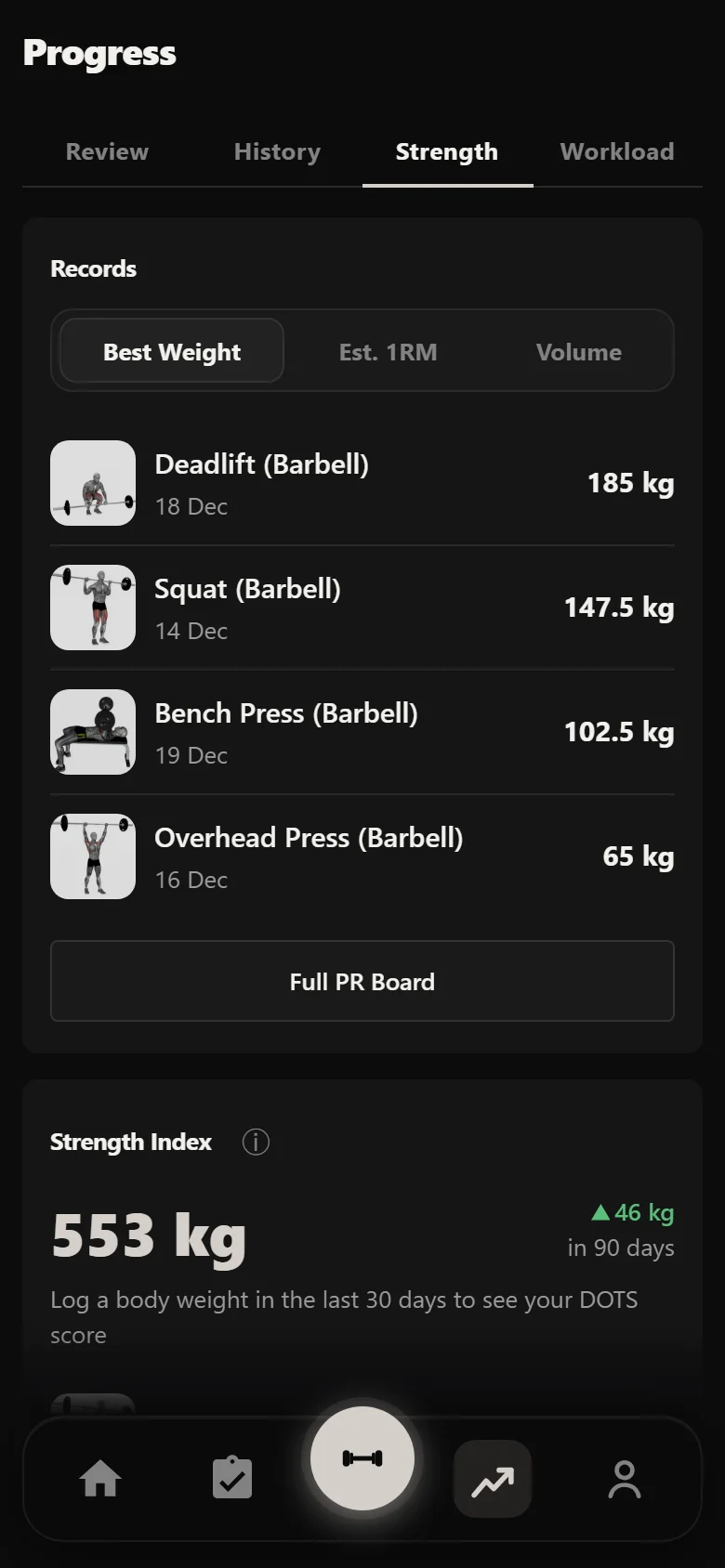
The Strength tab shows the same story as records rather than as training maxes: a 185 kg deadlift, a 147.5 kg squat, a 102.5 kg bench and a 65 kg press, each a best weight beaten during the block. Under them the Strength Index adds up the estimated maxes, 553 kg and up 46 kg in 90 days: the deadlift at 204.2 kg, the squat at 163.4 kg, the bench at 114.1 kg and the press at 71.5 kg.
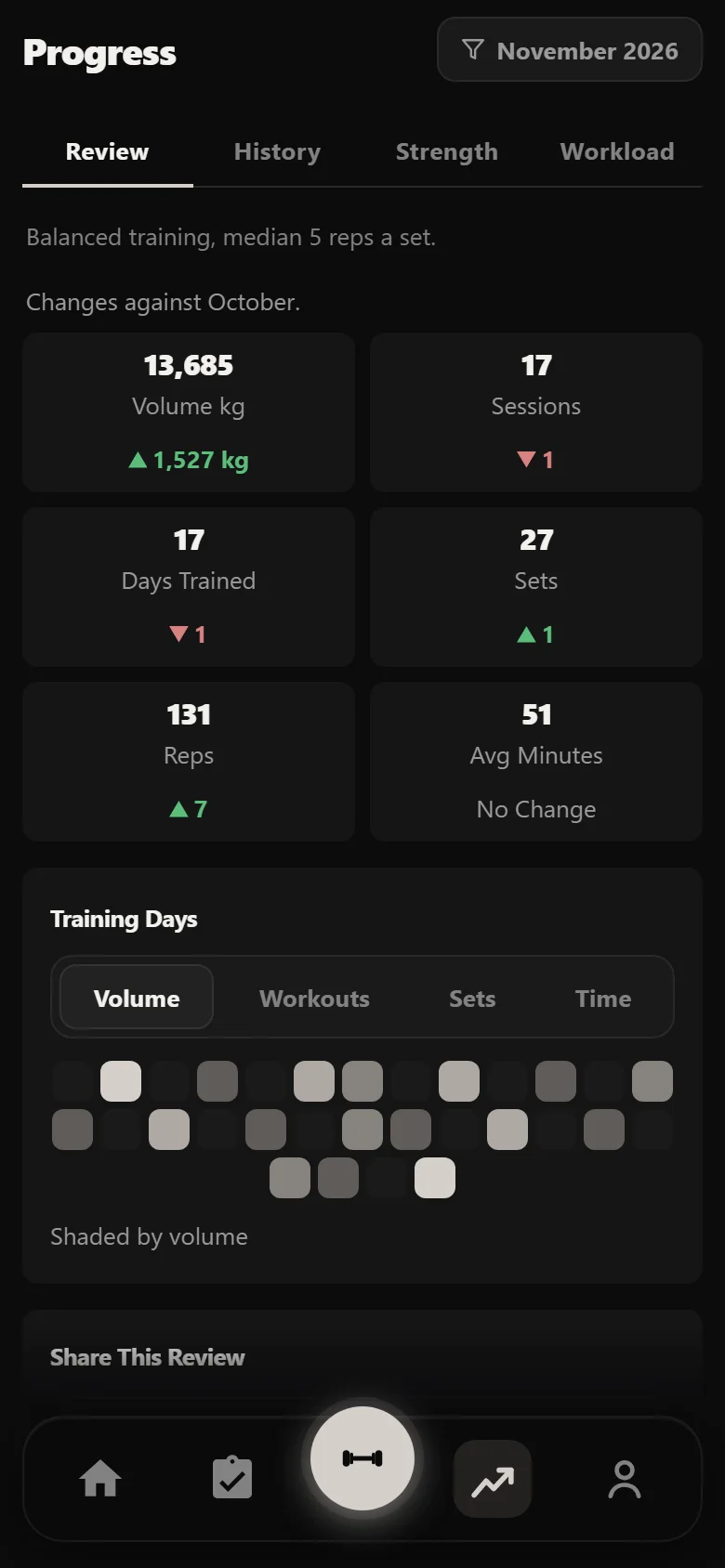
Sixteen weeks, seen from the outside
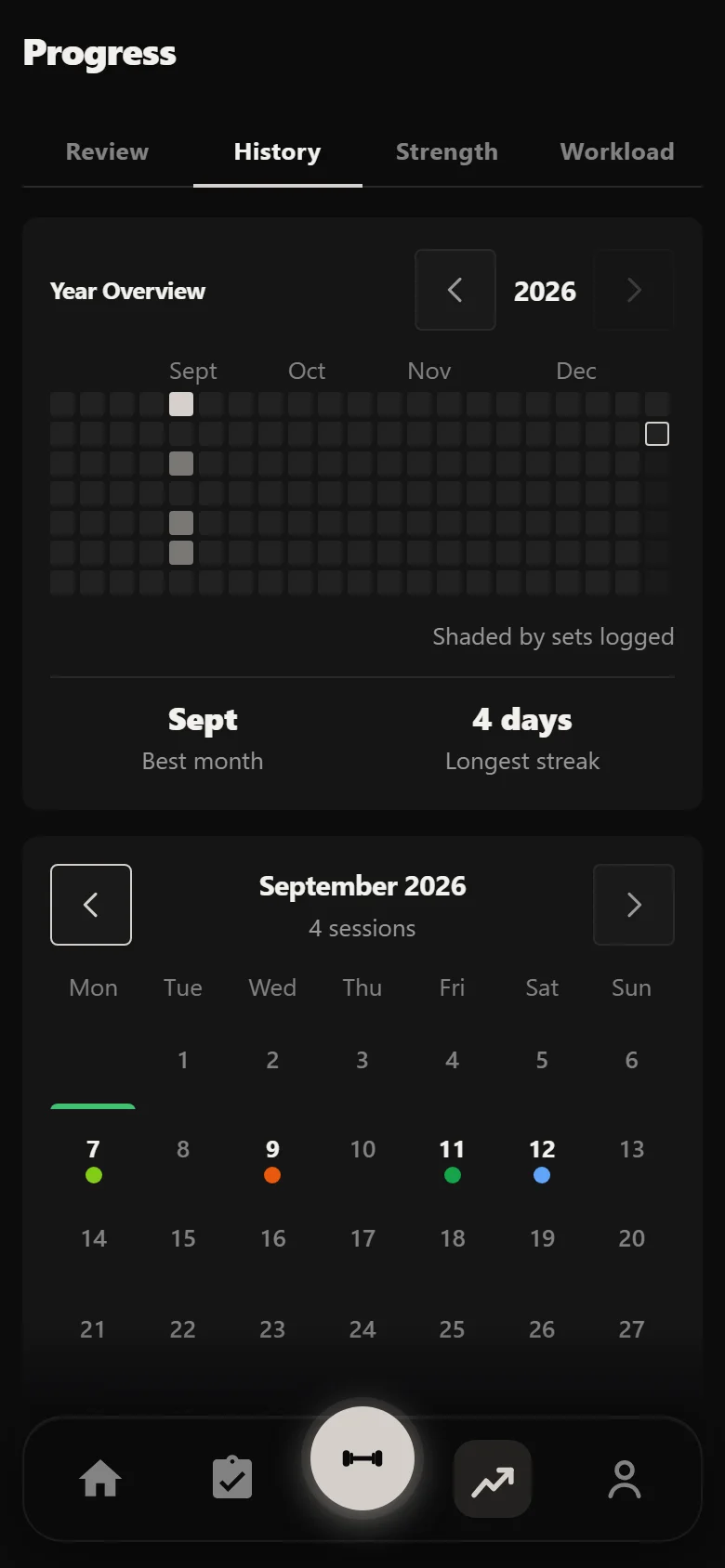
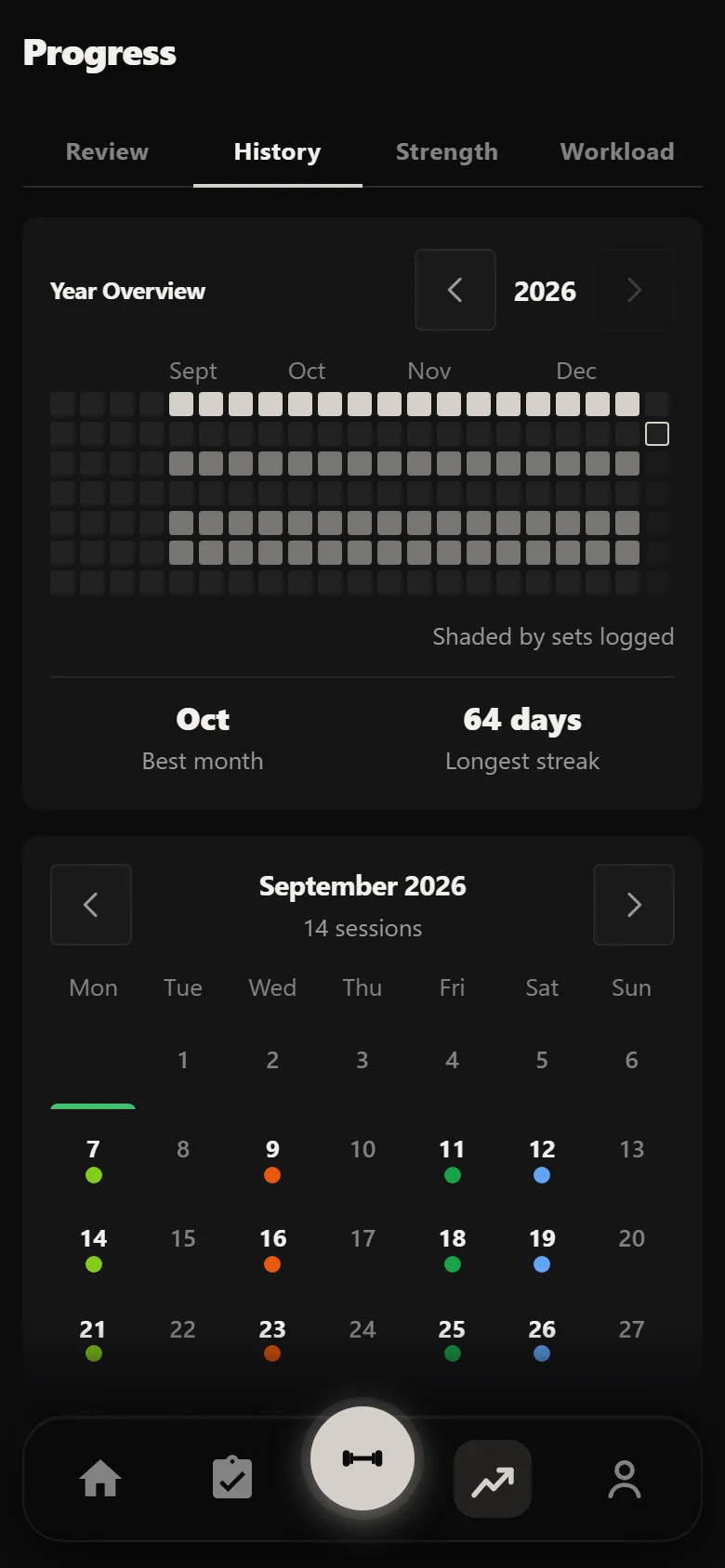
The History calendar holds all 64 sessions. Four cycles that look identical from a distance, which is the honest picture of what running this program feels like, and the reason it survives contact with real life better than programs that need weekly interpretation.
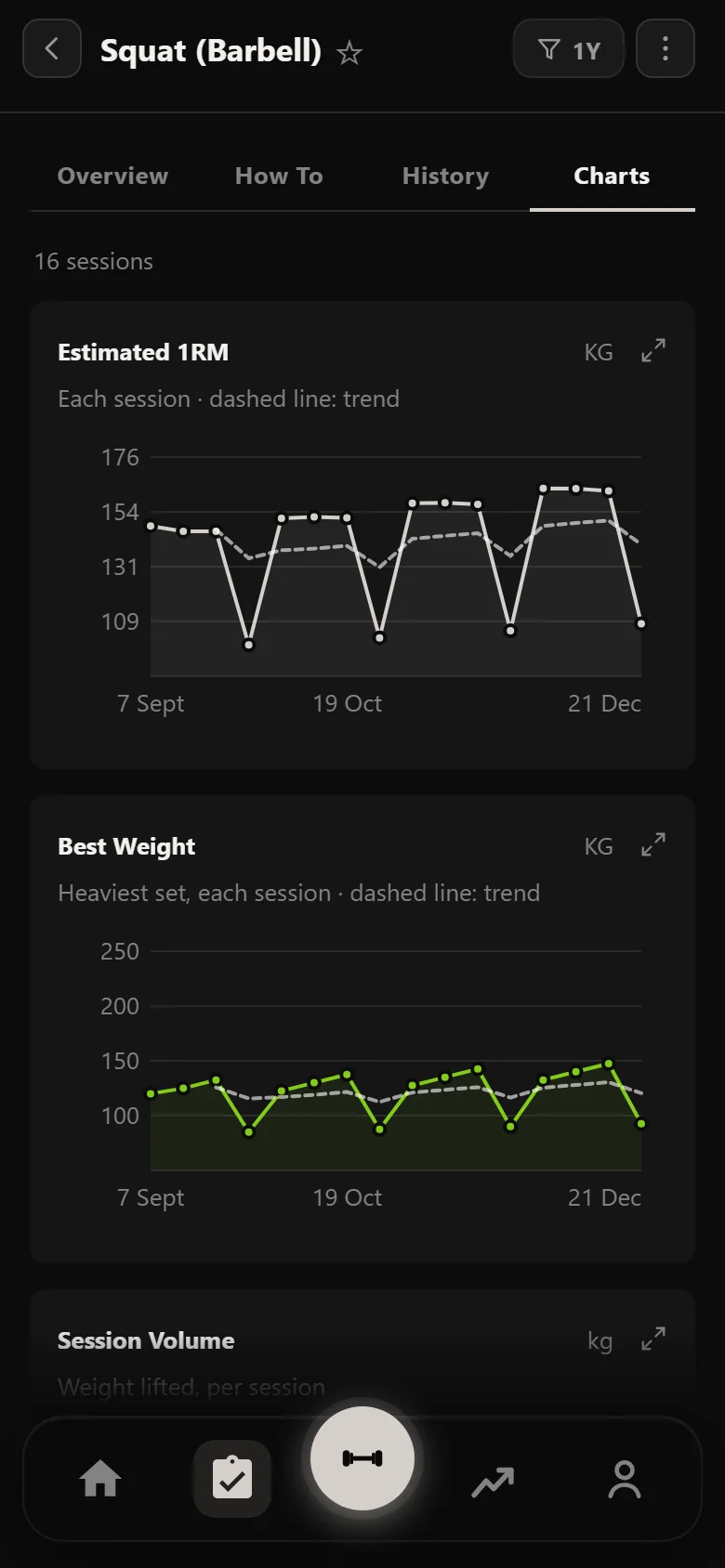
The squat's estimated one-rep max chart is the other half of it. Inside a cycle the line is close to flat, because heavier bars and fewer reps roughly cancel out. The steps happen at the reviews. If you have ever abandoned 5/3/1 four weeks in because nothing seemed to be happening, this chart is the answer: nothing is supposed to happen inside a cycle.
The payoff: the same session, sixteen weeks apart
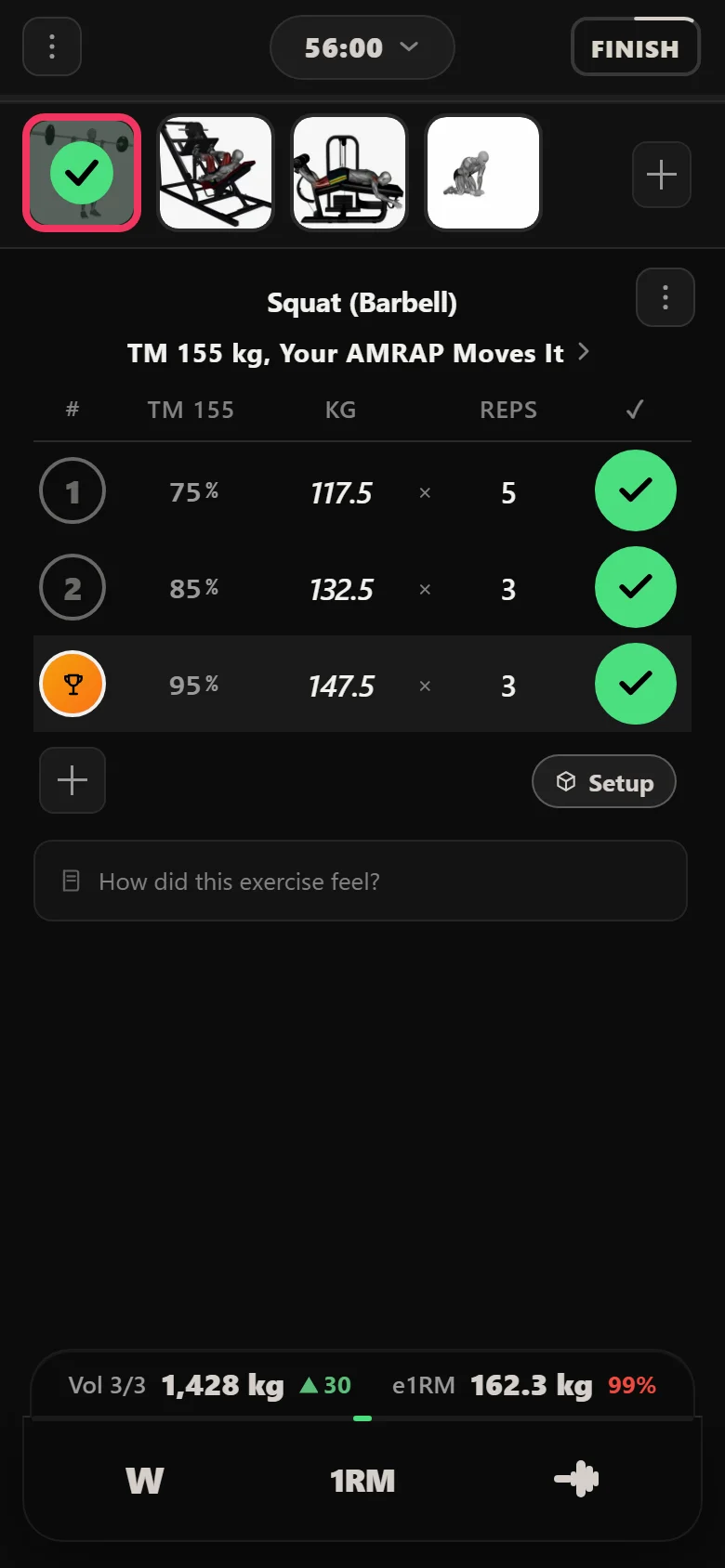
Two screenshots of the same squat session on the same screen: the opening week of cycle one, and the heavy week of cycle four. Same three sets, same percentages, same program, and 27.5 kg more on the bar because four reviews said it had been earned.
120 kg to 147.5 kg across four cycles, with the training max moving from 140 kg to 160 kg underneath it.
Common questions
What is 5/3/1 Triumvirate?
Jim Wendler's base 5/3/1 template. Four days a week, one main lift per day on the four-week wave of 5s, 3s, a heavy 5/3/1 week and a deload, with three assistance movements underneath each main lift at five sets of ten or more in Durata's version, the same three every week.
How is it different from Boring But Big?
Both run the same 5/3/1 wave on the same four-week cycle. Boring But Big adds five sets of ten on the main lift itself at half the training max, which makes the session much longer and much more fatiguing. Triumvirate keeps the main lift to its three working sets and puts the volume into separate assistance movements instead.
Why does my overhead press go up more slowly than my squat?
Because the program says so, and Durata carries that per lift. On this template the squat and deadlift training maxes advance 5 kg a cycle and the bench and overhead press 2.5 kg a cycle. Over the four cycles in this run that took the squat from 140 kg to 160 kg and the press from 60 kg to 70 kg, which is the right relative rate for the lifts involved.
Do I have to do the assistance work?
It is the template. The three assistance movements at five sets of ten are what the main lift's three working sets are not doing, and dropping them leaves you doing about nine hard sets a week. Durata prescribes them as part of the session rather than as an optional block.
What happens if I miss the reps on the heavy week?
The training max holds instead of advancing. The rep-out on the heavy week is the only input the review takes, so a short set means the next cycle repeats the same number rather than building on one you did not earn. Nothing else about the cycle changes.
Is Durata free?
Yes. Durata is free to use, with the full program catalogue, automatic percentage maths, rest timers and PR tracking. Everything in this walkthrough is in the app.
Put it into practice
Durata is free to use — 50 proven programs, automatic progression, rest timers and PR tracking, all on your phone.