


Juggernaut Method 2.0 in Durata: four waves, one number each
Juggernaut Method 2.0 is a sixteen-week block built out of four four-week waves: Tens, Eights, Fives, then Threes. Each wave runs Accumulation, Intensification, Realization and Deload, and every prescribed weight is a percentage of one training max per lift. The unusual part is when that max moves. It does not creep up weekly. It holds still for the whole wave, so all four weeks resolve off one fixed number, and then it moves exactly once, on the realization week, sized by how far past the rep standard the last set went.
That makes it a program you cannot judge from a few sessions. Every weight, rep and estimate below was computed by the real engine on a live drive of all sixteen weeks, sixty-four sessions, four lifts on training maxes and a run of assistance work behind each one. The squat opens off a 140 kg max.
Starting the program
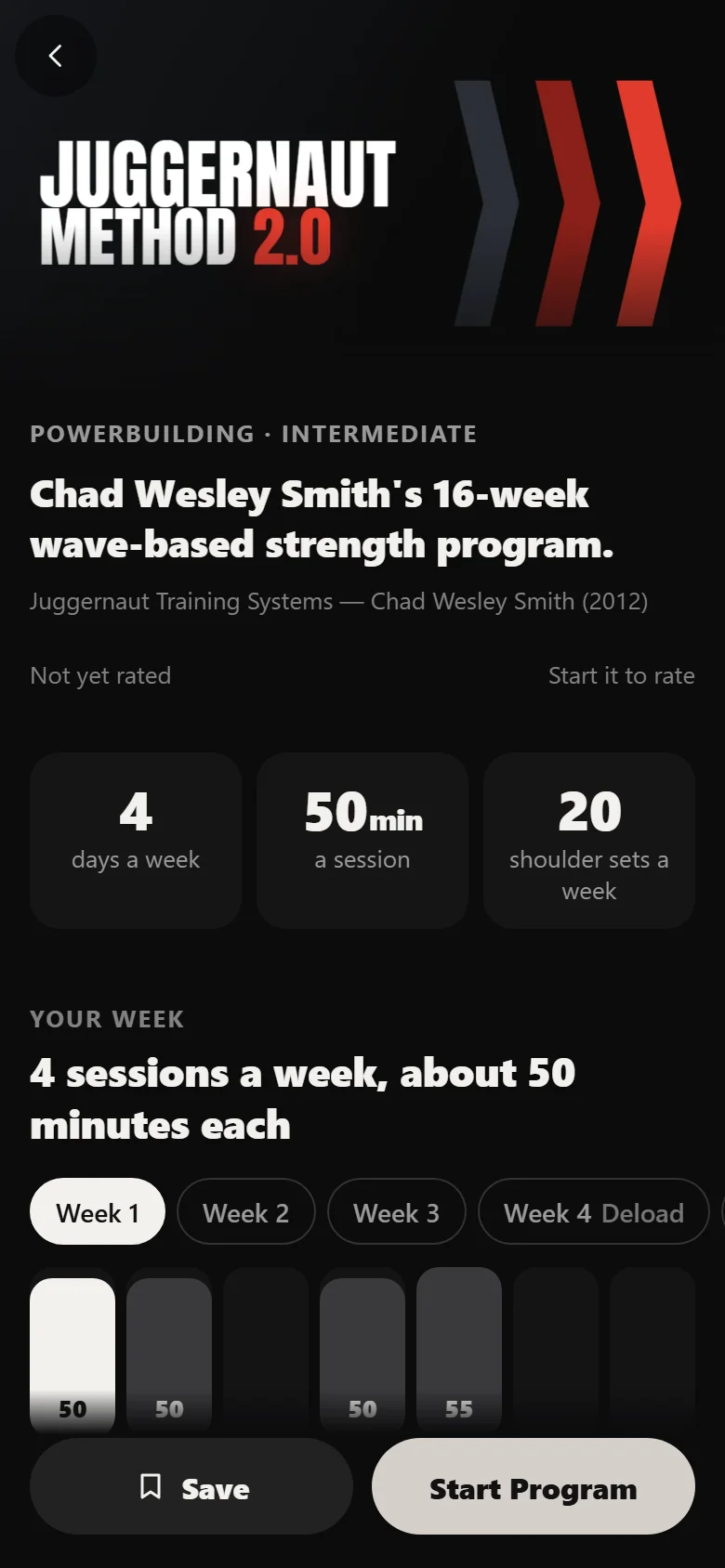
In Discover, Juggernaut Method 2.0 sits on the Powerbuilding shelf, marked Intermediate, at four days a week. Search finds it by name, or Filter narrows the shelves by level and days a week. Tap the cover for a quick look, then View Program for the full page.
It is a long strength block with real periodisation in it, rather than a week that repeats forever.
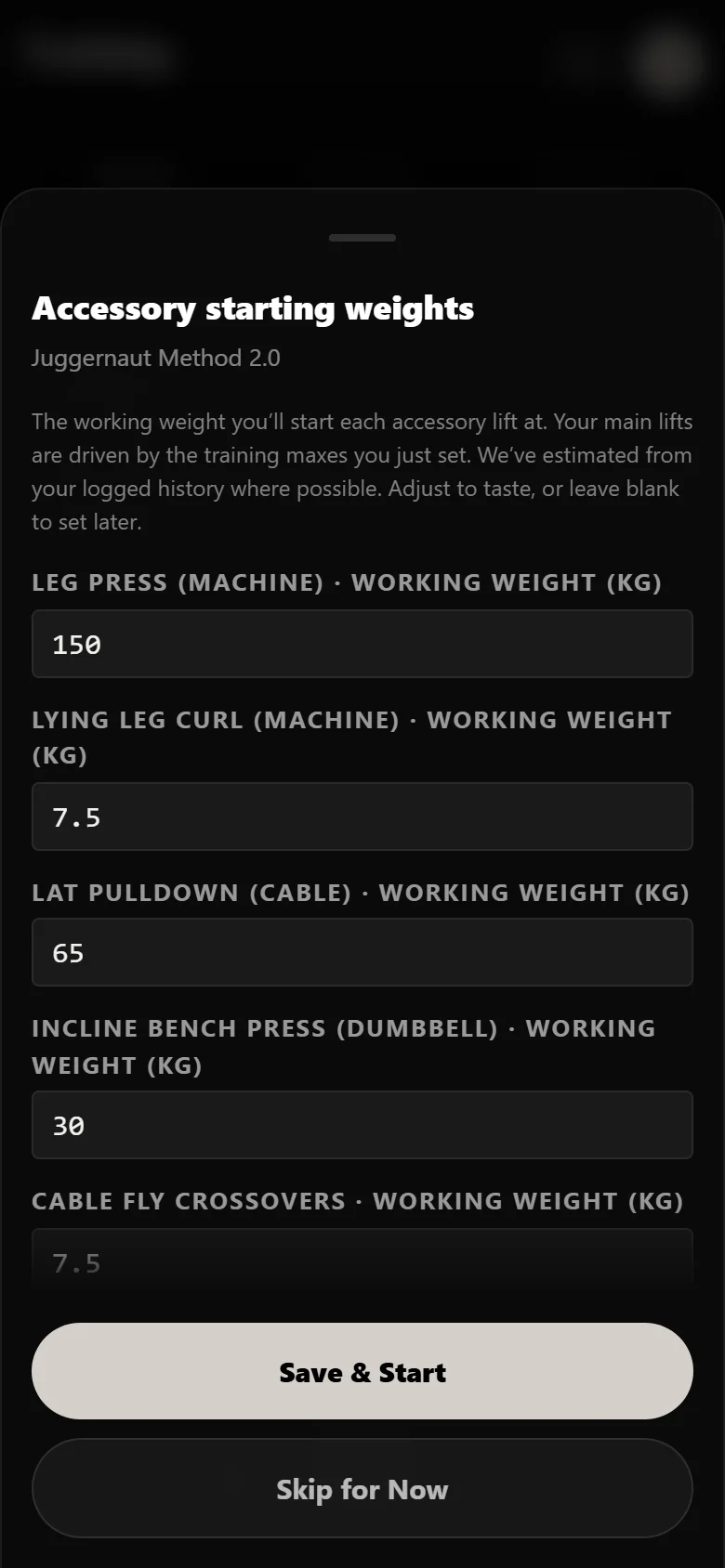
Squat, bench press, deadlift and overhead press are not given starting weights. They are given a training max each, and every set those lifts ever prescribe is a percentage of it. The assistance lifts sitting behind them work the ordinary way, on a plain working weight and a double-progression rule, which is why they are asked for separately.
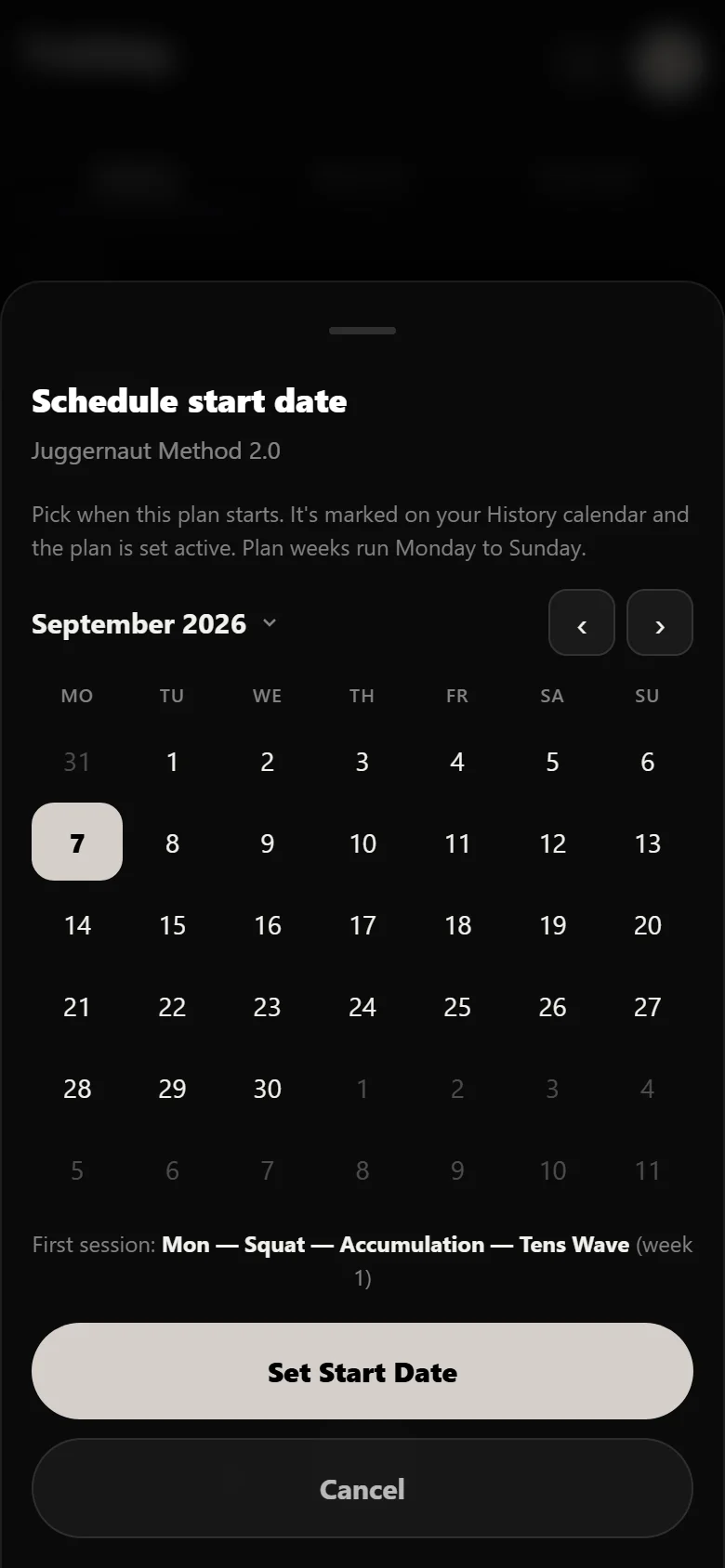
Set the start date and the whole sixteen-week schedule is laid out, all four waves of it, before a single session is logged.
How a wave is built
A training week is four days, one main lift each: squat, bench, deadlift, overhead press, each followed by three or four assistance exercises. Inside a wave the main lift's rep target is fixed and its percentages climb. In the Tens wave the squat opens at five sets of ten and works up over three weeks, and the last set of each session is a rep-out: the prescription is a floor, not a ceiling.
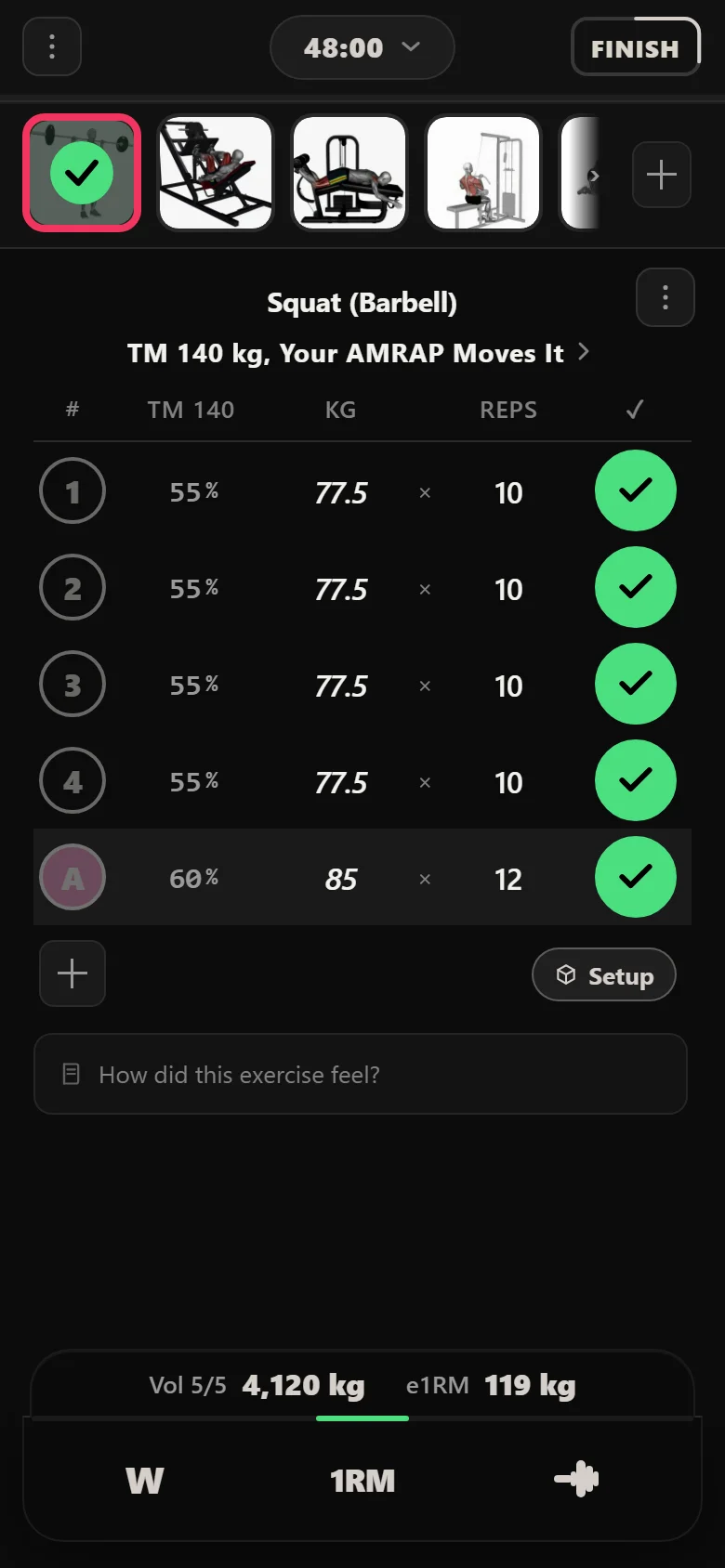
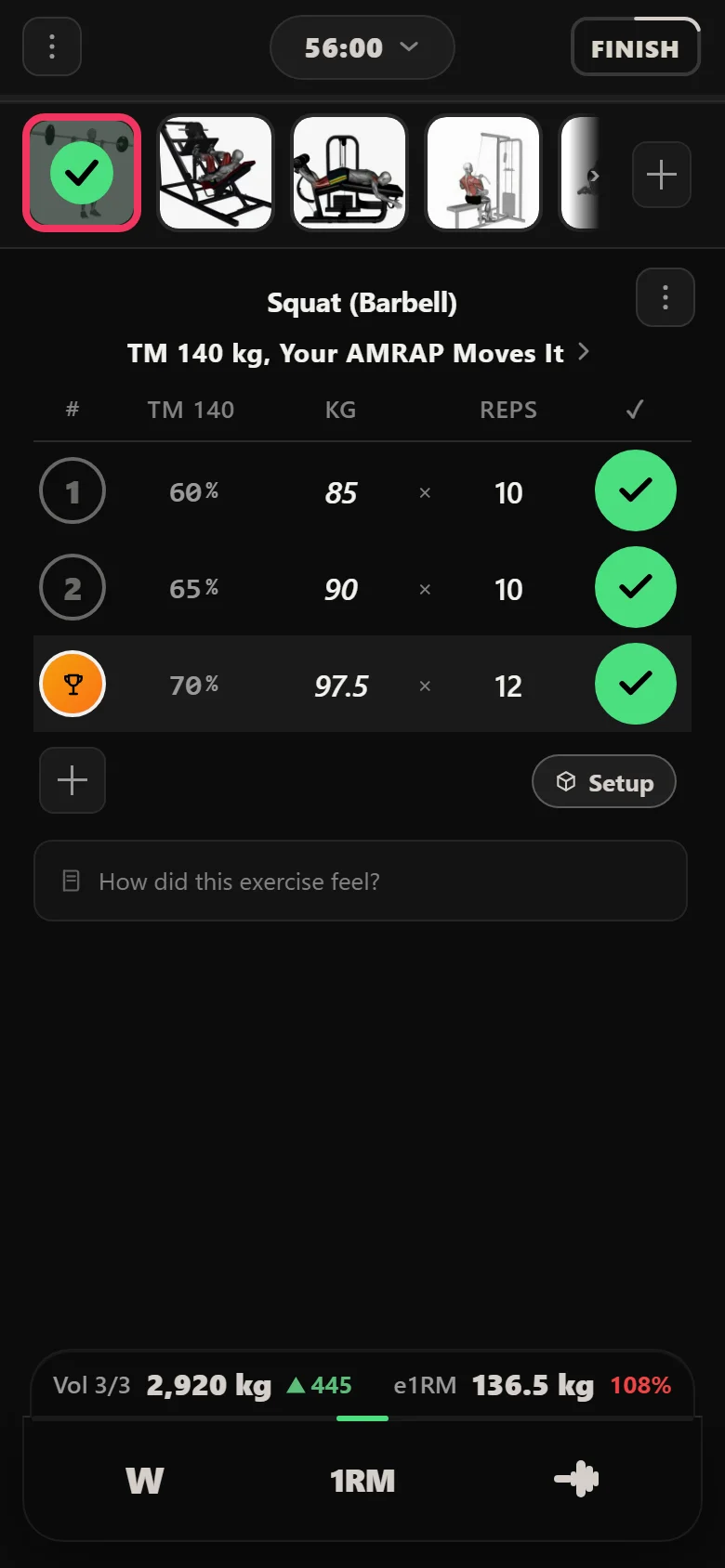
Week one of the Tens wave puts the squat at 85 kg for that rep-out, off a 140 kg training max. Nothing about that number was typed in. The max was, once, and the app has derived every set from it since.
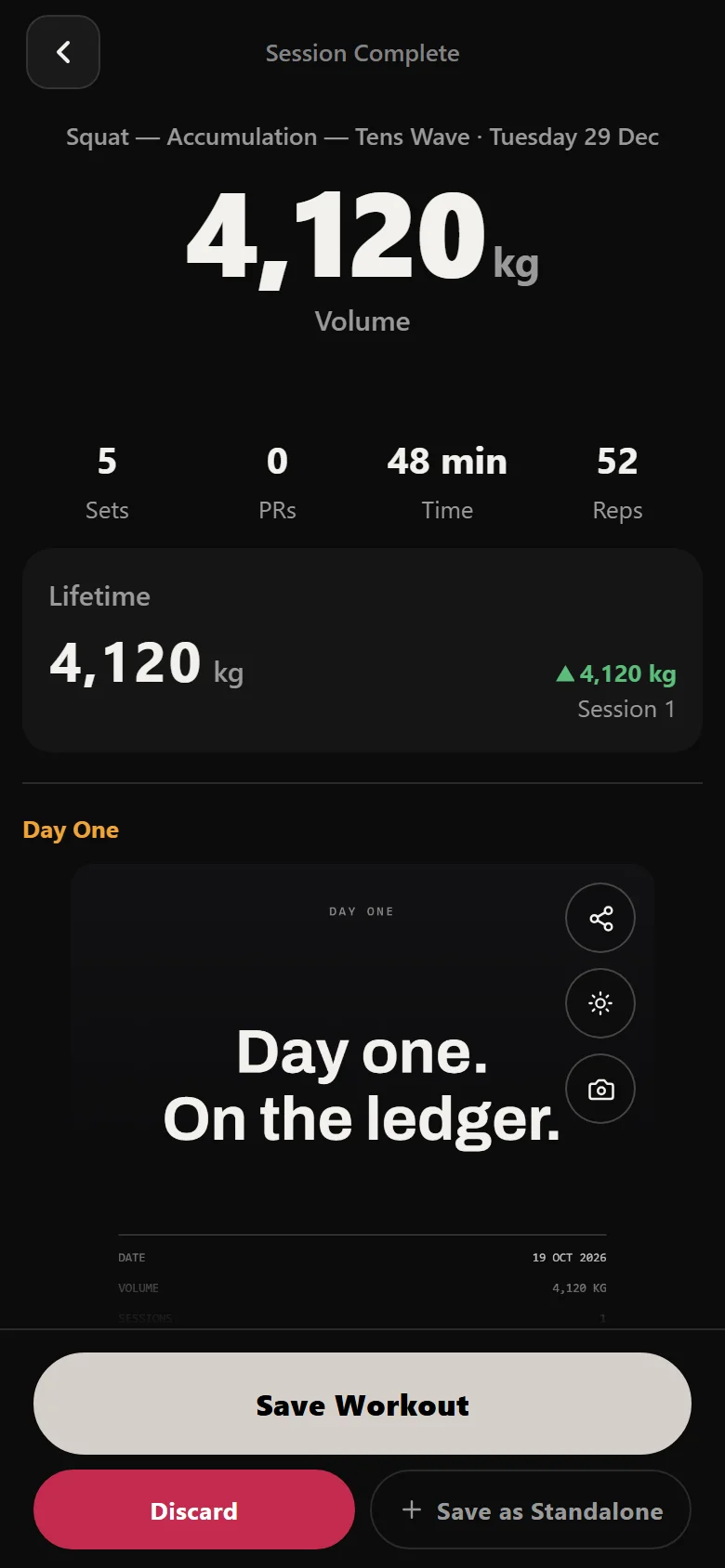
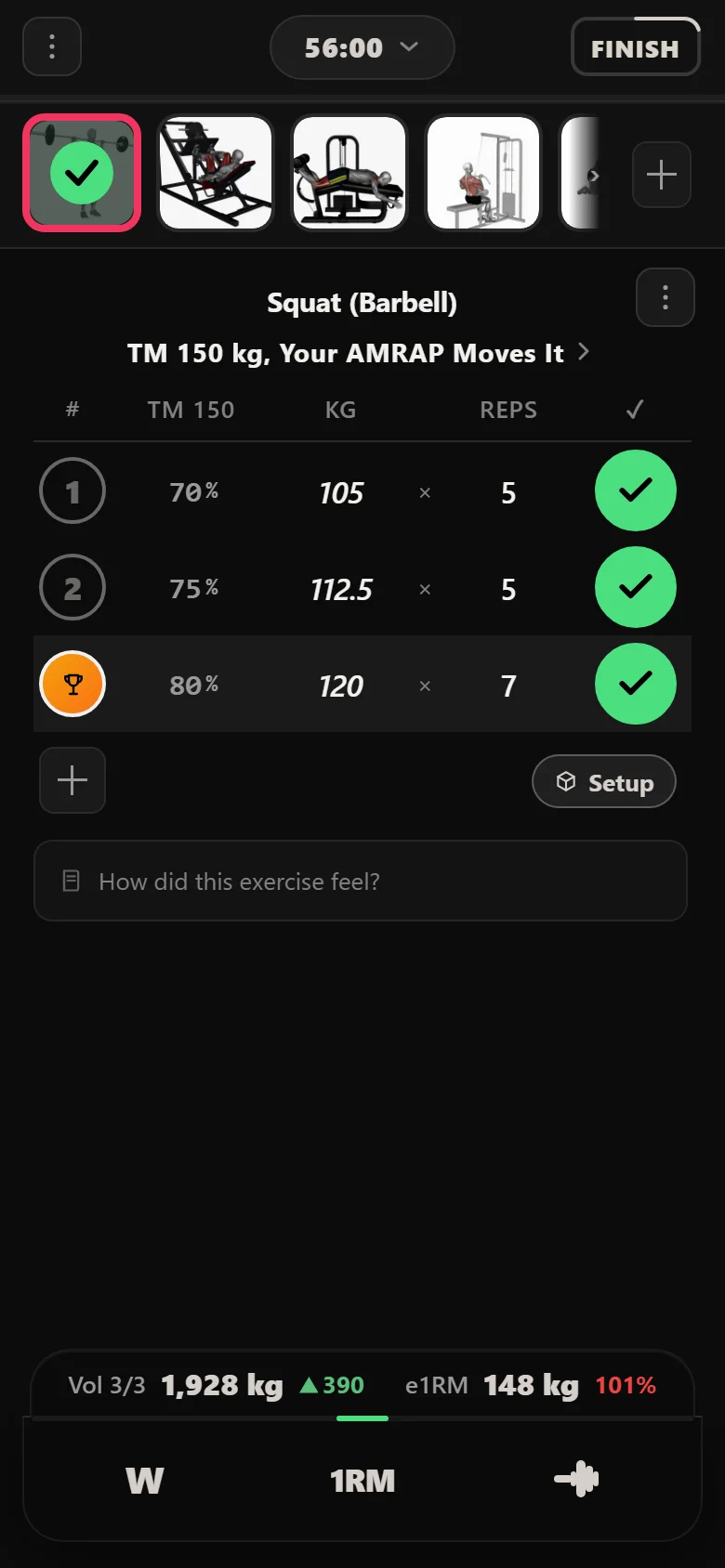
The session screen tallies the whole day before it saves, which is worth seeing once given how much a sixteen-week program stacks behind each main lift.
The week the number moves
Weeks one and two of a wave are work. Week three is the one that counts. The squat's last set on the realization week is still a rep-out, but this is the set the training max is judged against, and the arithmetic is blunt: every rep past the wave's standard adds to the max, and every rep short of it takes away. Nothing else in the wave can move it.
In this run the Tens realization set came in at 97.5 kg for two reps past the standard, so the squat's max went up 5 kg. The lower-body lifts move at 2.5 kg a rep; the upper-body lifts move at half that, which is why over the whole block the squat and deadlift gained twice what the bench and press did.
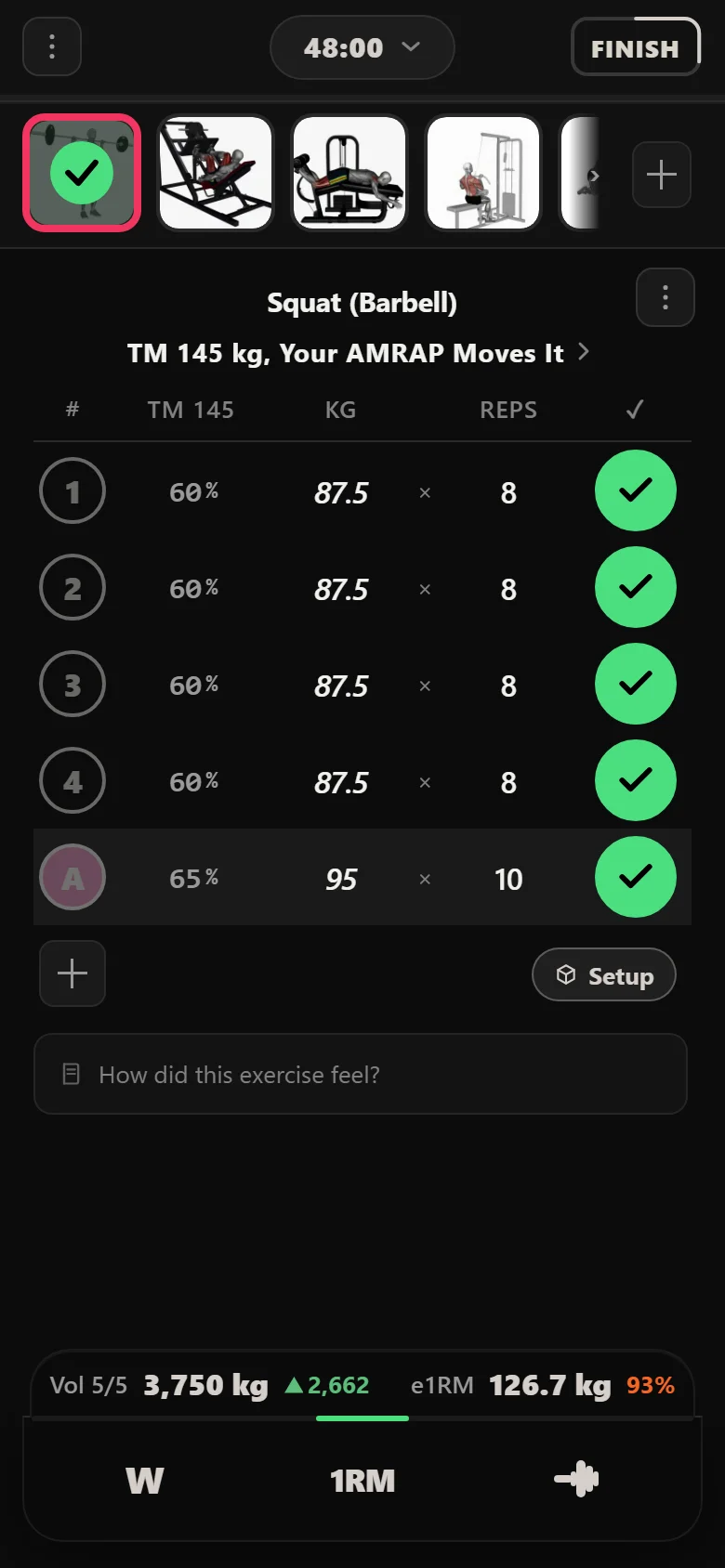
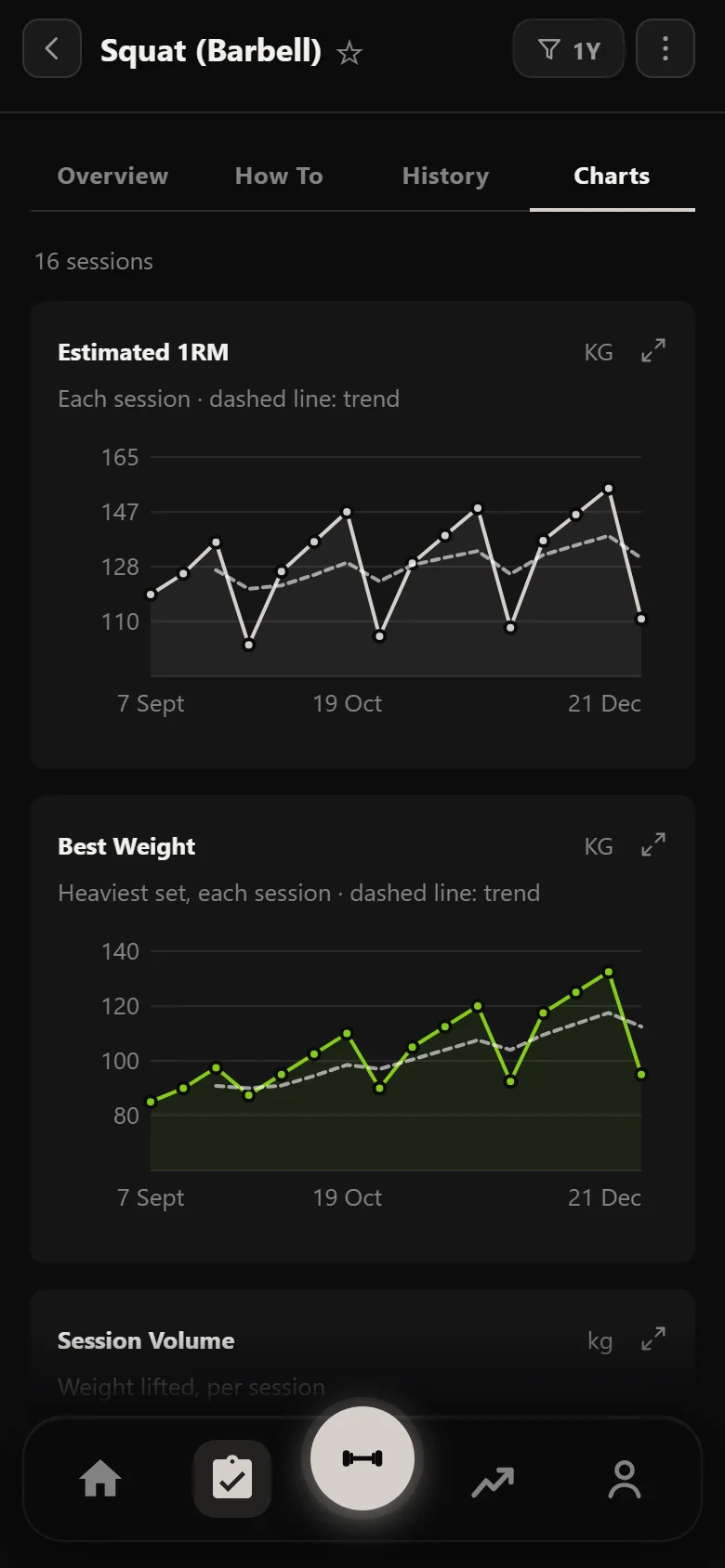
Then the wave ends, and the next one opens on the number the last one earned. The Eights wave's first squat session is 95 kg off a 145 kg max: fewer reps, a higher percentage, and a heavier bar than the wave before it started on. Between those two waves sits a deload week the app schedules itself, at 40 to 60 per cent, which is why the arc below dips before every climb rather than in spite of it.
Sixteen weeks of it
Read the whole block at once and the shape is unmistakable. Four ramps, each ending in a realization week, each interrupted by a deload that drops the bar to well under where the wave began. The rep standard falls from ten to eight to five to three while the percentage climbs, so the bar gets heavier for two reasons at once.
The squat's training max finished the block at 160 kg. The deadlift's did the same 20 kg, to 200 kg. The bench press moved 10 kg to 110 kg and the overhead press 10 kg to 70 kg: one bump per wave on every lift, in smaller steps on the upper body. Every bump was earned on a realization week, and none of them was typed in.
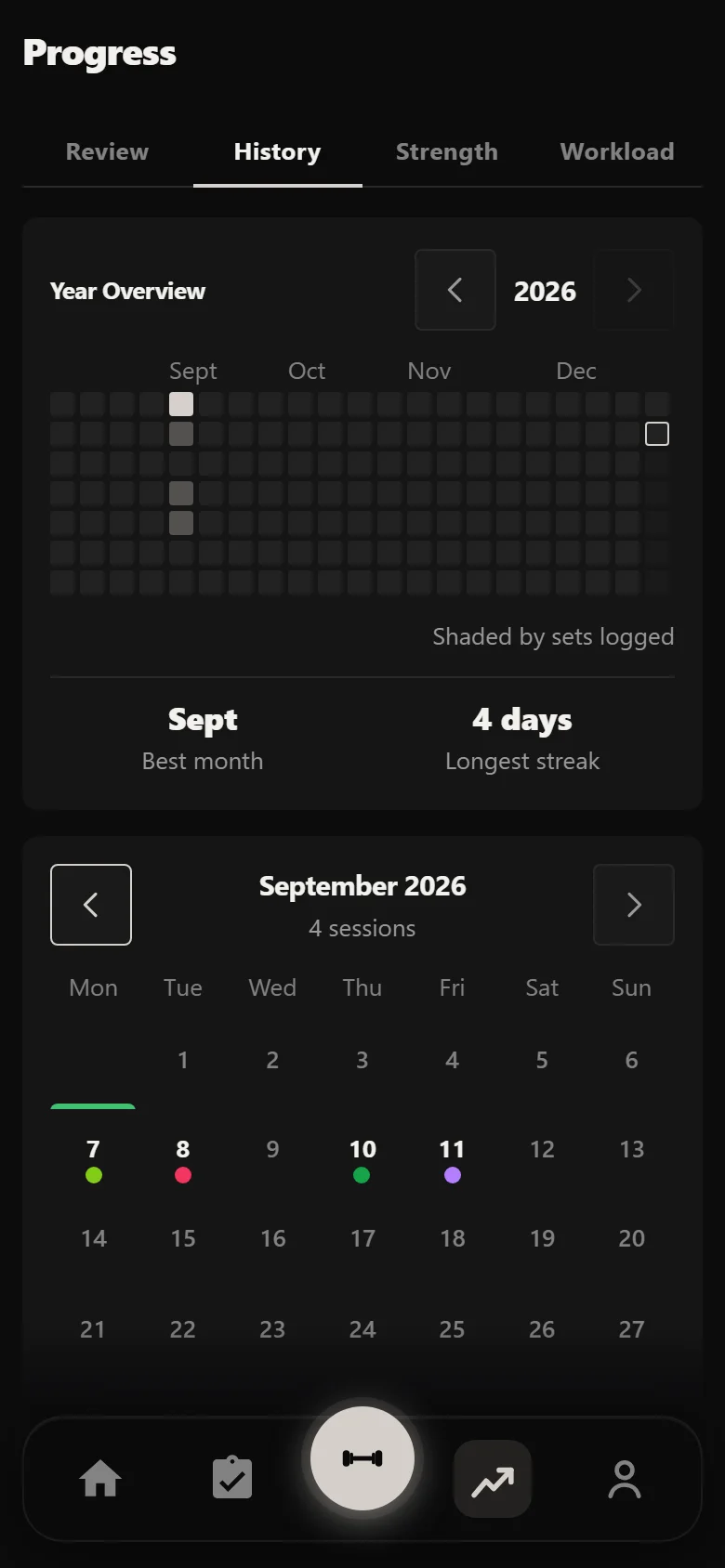
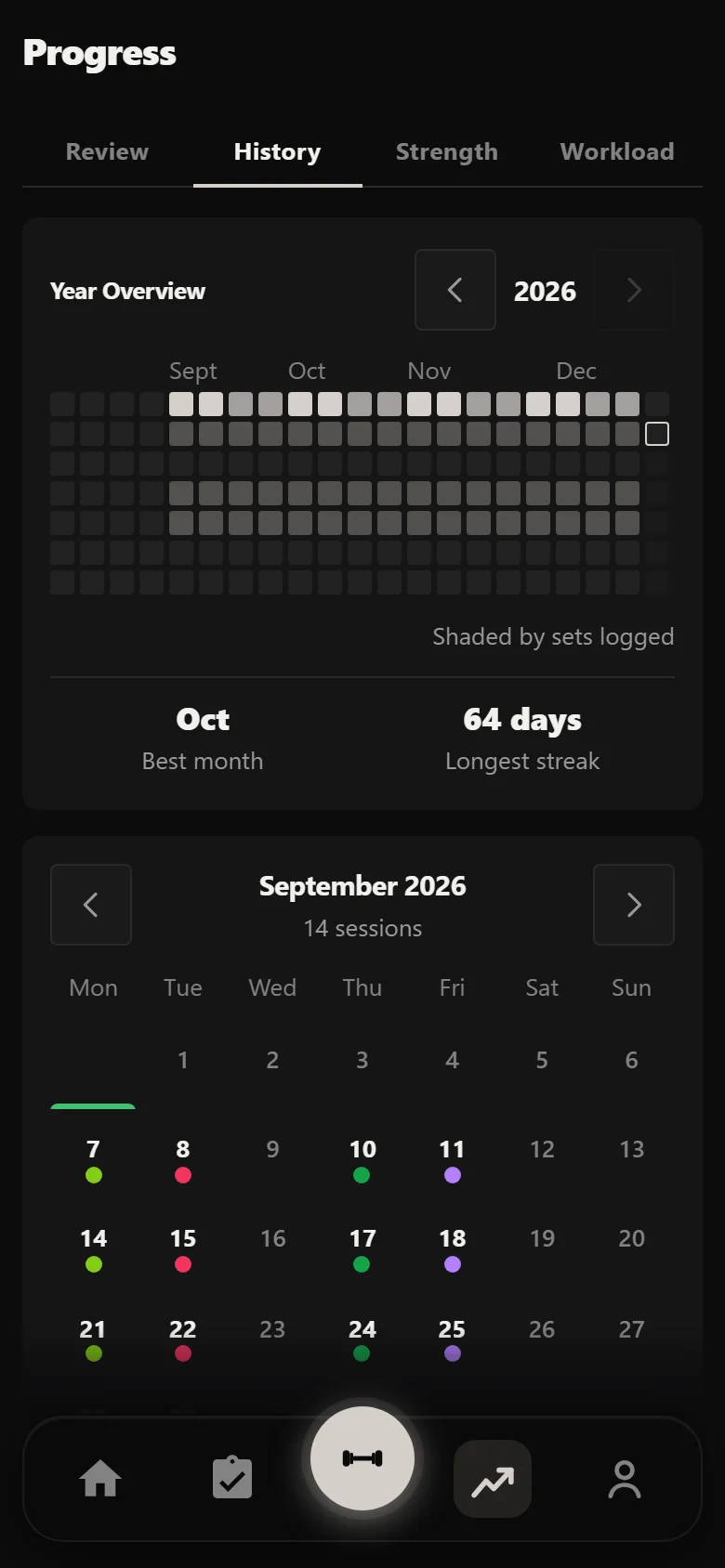
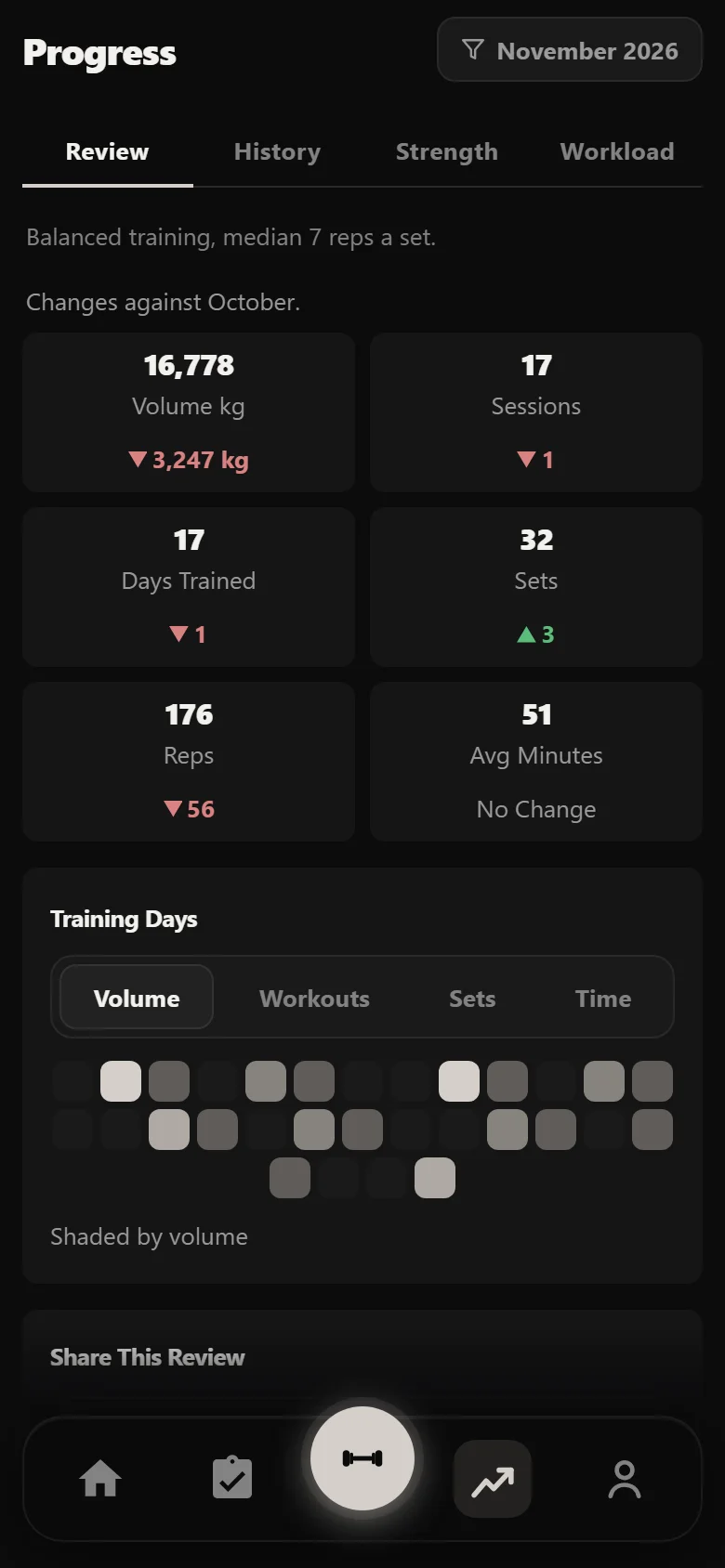
The History calendar, the Review tab and the Strength tab are all reading the same sixty-four saved sessions. Nothing here is a projection.
Squat (Barbell): top set, every week
- 85S1 Session 1 — Tens: accumulation
- 90S2 Session 2
- 97.5S3 Session 3 — realization
- 87.5S4 Session 4 — deload
- 95S5 Session 5 — Eights: accumulation
- 102.5S6 Session 6
- 110S7 Session 7 — realization
- 90S8 Session 8 — deload
- 105S9 Session 9 — Fives: accumulation
- 112.5S10 Session 10
- 120S11 Session 11 — realization
- 92.5S12 Session 12 — deload
- 117.5S13 Session 13 — Threes: accumulation
- 125S14 Session 14
- 132.5S15 Session 15 — last realization
- 95S16 Session 16 — deload
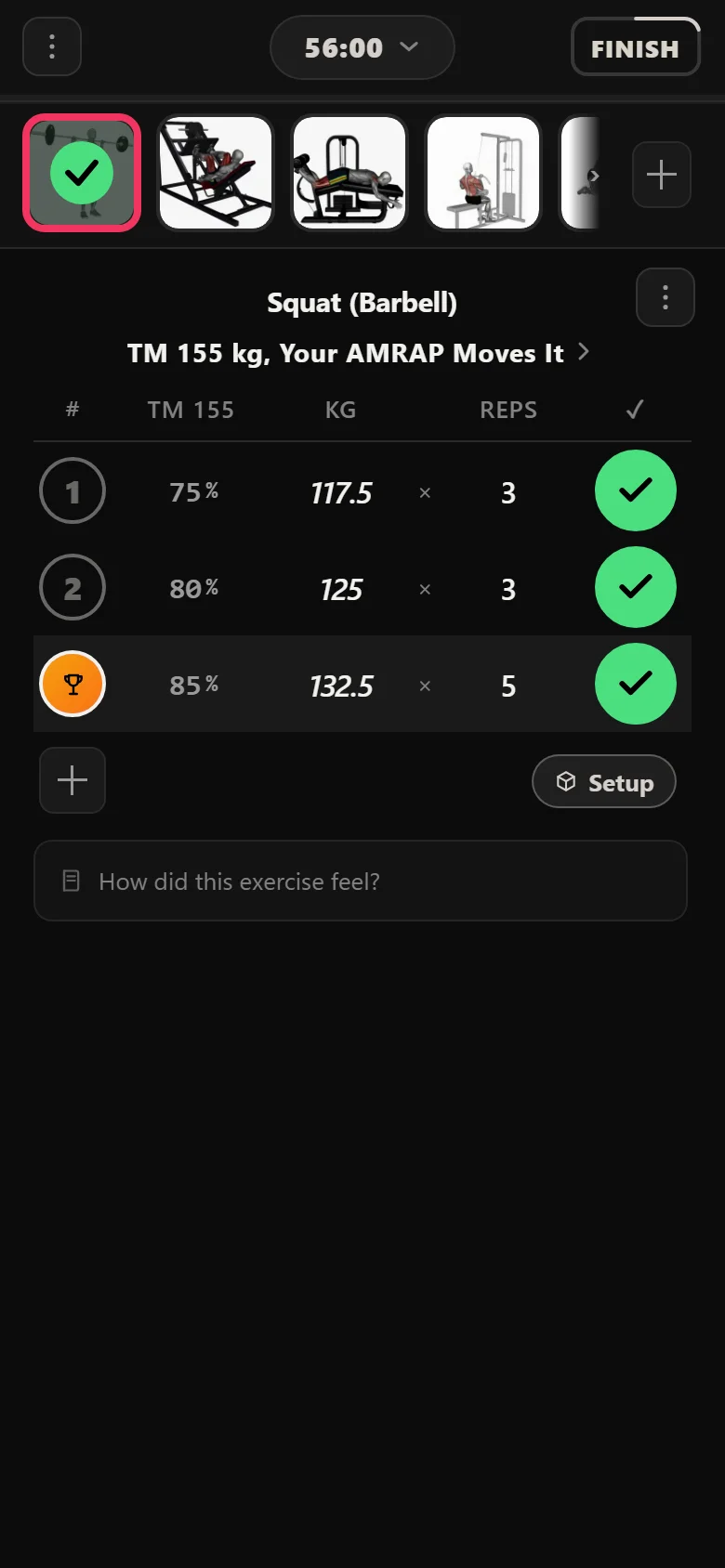
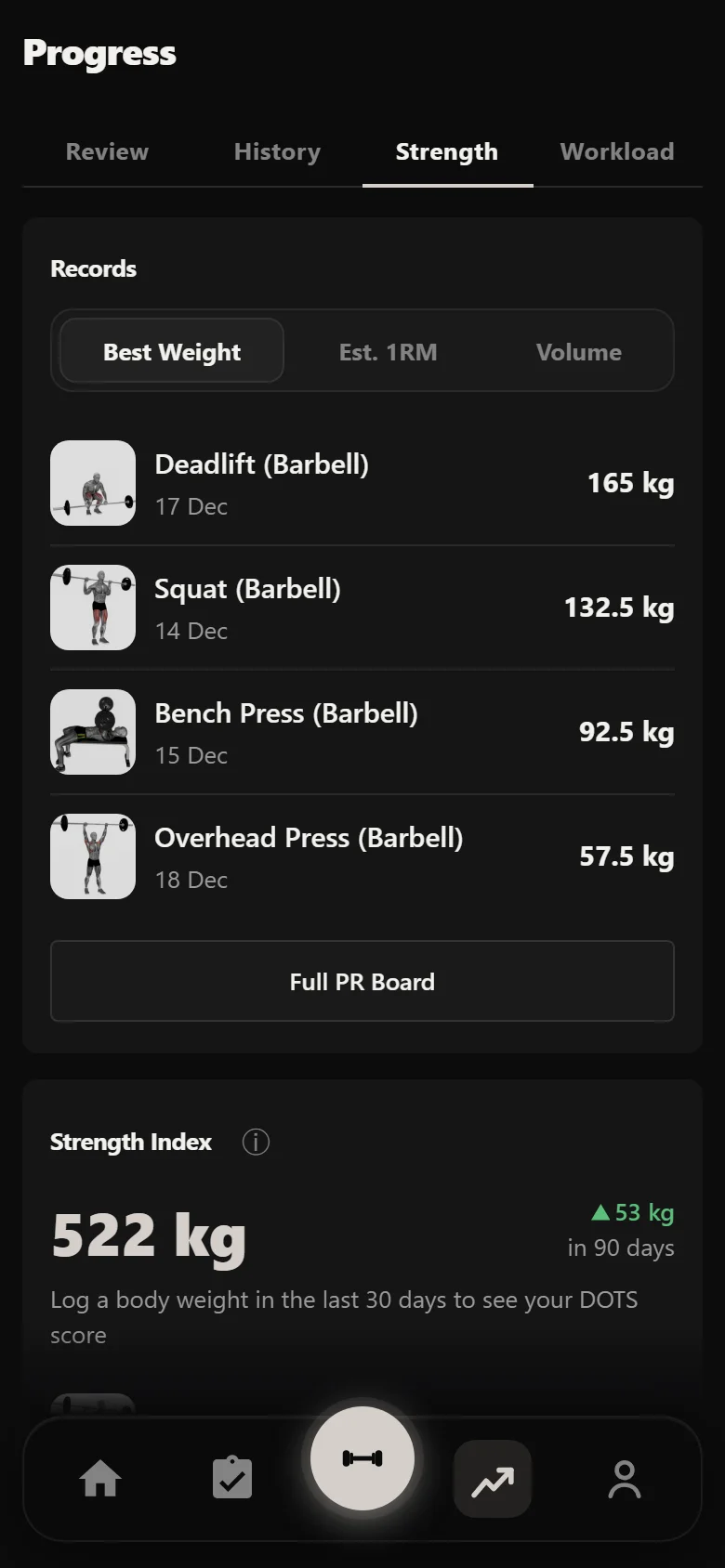
Training max, first session against last rep-out. Three of the four wave bumps sit between these two screens; the fourth is earned by the set on the right and finishes the block at 160 kg. On the bar that is 85 kg to 132.5 kg.
Common questions
What is Juggernaut Method 2.0?
Chad Wesley Smith's sixteen-week strength block, built from four four-week waves: Tens, Eights, Fives and Threes. Squat, bench, deadlift and overhead press each run off a training max, and each wave works through an Accumulation, Intensification and Realization week before a deload. The rep target falls and the percentages climb as the block goes on.
Why doesn't the training max go up every week?
Because the wave is the unit, not the week. All four weeks of a wave resolve their percentages off one fixed number, which is what lets the accumulation and intensification weeks be judged against the same standard. The max moves once per wave, on the realization week, and then the next wave opens on the new number.
What decides how much the training max moves?
The realization week's last set. It is a rep-out, and the training max moves by the number of reps you beat the standard by, times a per-rep figure: 2.5 kg for the squat and deadlift, half that for the bench and overhead press. In this run every realization set came in two reps past its standard, which is why the squat and deadlift gained 20 kg of training max across four waves and the two presses gained 10 kg.
What happens if I miss the reps on a realization week?
The training max comes down. The same arithmetic runs in both directions, so falling short of the standard cuts the max by the shortfall times the per-rep figure, and the next wave opens lighter. That is deliberate: it is the program's way of correcting a max that was set too high, without you having to decide when to back off.
Do the assistance lifts progress too?
Yes, on their own rule. They sit outside the percentage system entirely, on a plain working weight and double progression: clear the top of the rep range on every set and the weight goes up. That is why setup asks for a training max for the four main lifts and an ordinary starting weight for everything else.
Is sixteen weeks really the shortest useful run?
For seeing what the program does, close to it. One wave is four weeks and produces exactly one change to one number, so a shorter block shows you the sessions but not the mechanism. The whole point of the structure is what the next wave does with what the last one earned.
Is Durata free?
Yes. Durata is free to use, with the full program catalogue, automatic progression maths, rest timers and PR tracking. Everything in this walkthrough is in the app.
Put it into practice
Durata is free to use — 50 proven programs, automatic progression, rest timers and PR tracking, all on your phone.