


The 90-Day Transformation in Durata: twelve weeks, screen by screen
The 90-Day Transformation is the long one, the third step of the fat-loss track, and twelve weeks is long enough that the training has to be honest with you. You are eating in a deficit for three months. Some lifts will keep climbing. Most of them will stop, and stopping is not failing.
So this walkthrough shows both halves. The barbell squat that climbs one rep at a time, the accessories that quietly hold, and the cardio that ramps every single week from start to finish. The screens are the live app, the weights are engine output from a drive of the whole twelve weeks, and the cardio ramp is the program's own prescription for all twelve. The fat loss comes from the kitchen. The app's job is to keep the training progressing without you managing it.
Starting the block
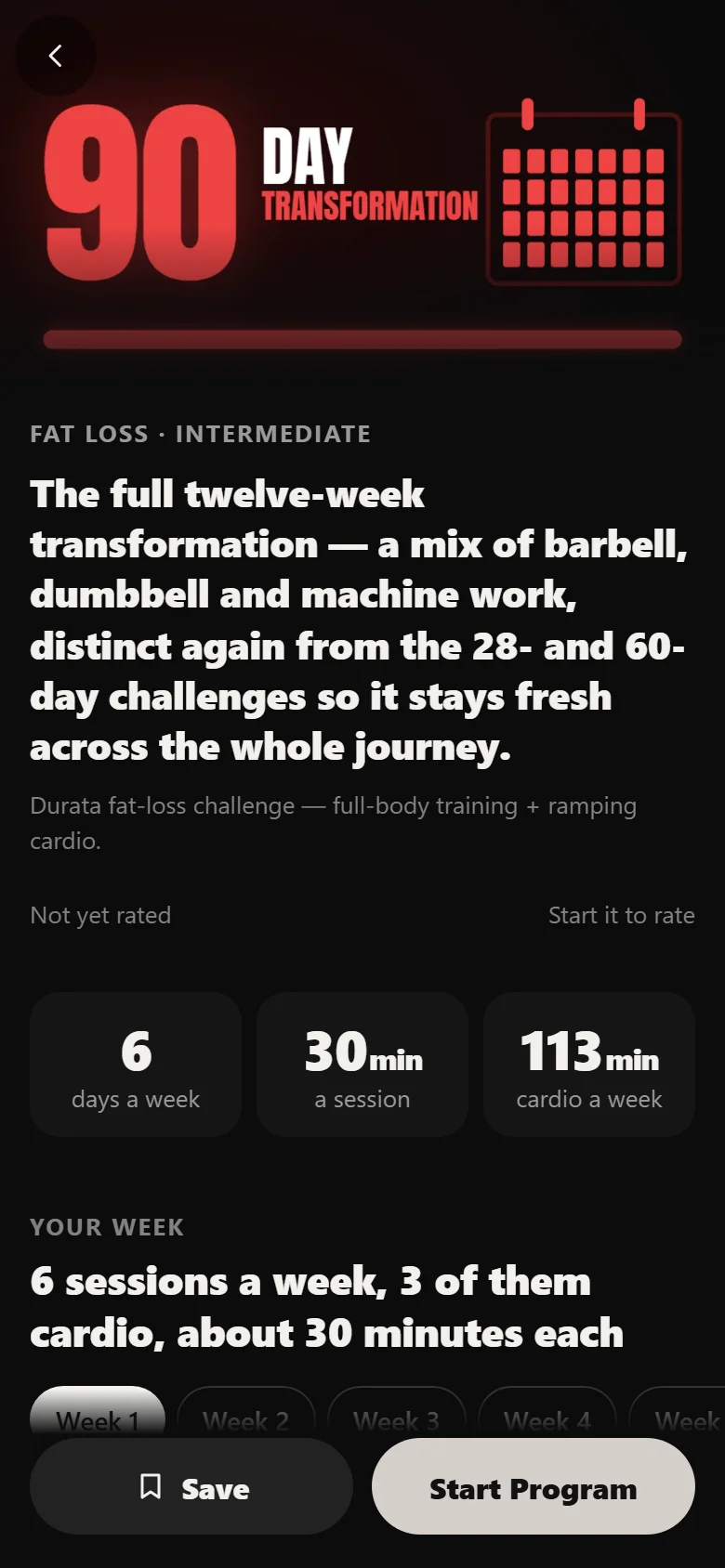
In Discover, the 90-Day Transformation sits on the Fat Loss shelf, marked Intermediate, at six days a week. Search finds it by name, or Filter narrows the shelves by level and days a week. Tap the cover for a quick look, then View Program for the full page.
It is the twelve-week one, and its exercise pool is different again from the 28-Day Shred and the 60-Day Cut, so running the fat-loss track end to end does not mean doing the same session for five months.
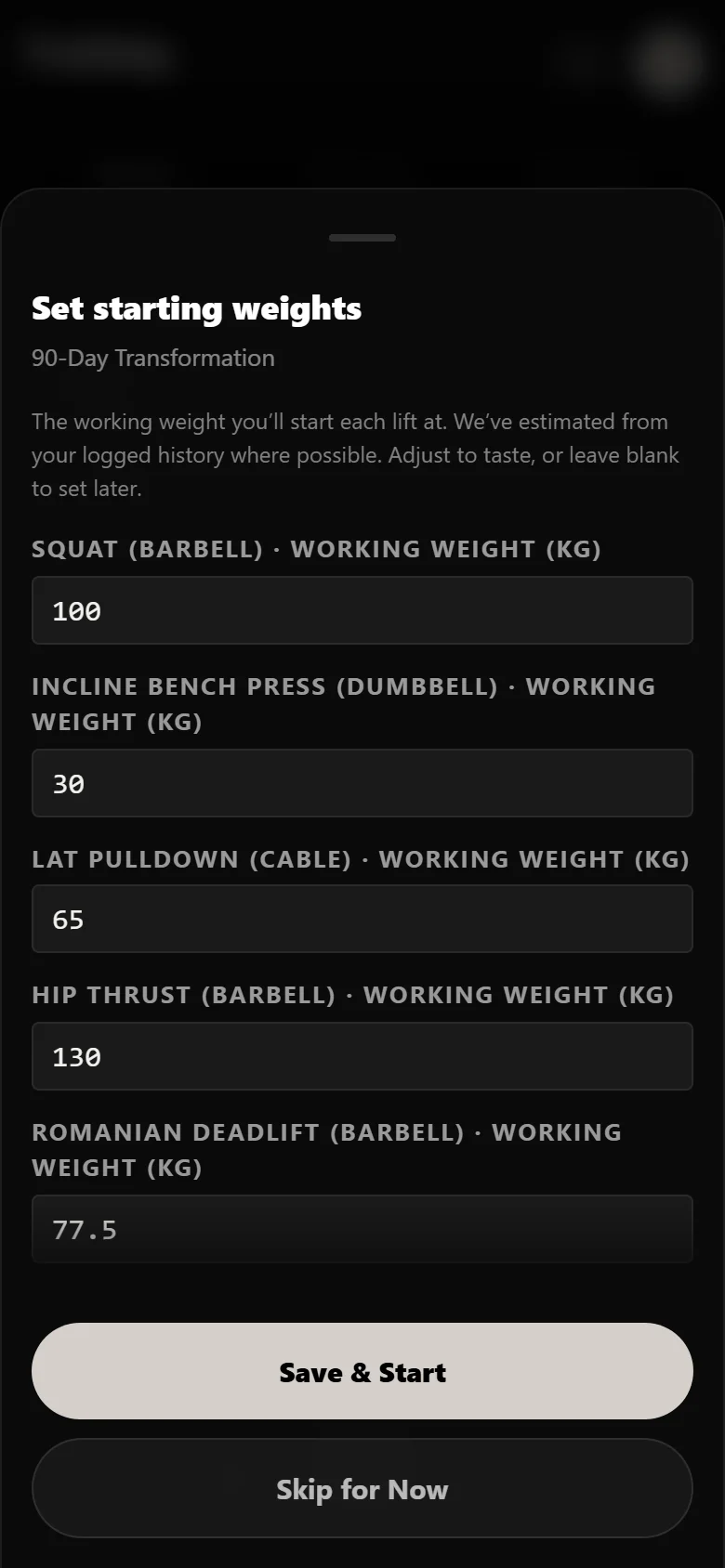
There are no training maxes to work out. Every lift runs off a working weight, so the app asks what you can currently handle and starts there: 100 kg on the squat on this run. The three cardio sessions are draggable in the planner, so the walk, the cycle and the finisher can sit wherever they fit around the rest of your week.
Barbell where it counts, dumbbells around it
Unlike the 60-Day Cut, which runs entirely on dumbbells and machines, this block keeps a barbell in the three places that earn one. The squat and the Romanian deadlift are barbell lifts, the hip thrust is loaded on a bar, and everything around them is dumbbell, cable or machine work.
Day one is the barbell squat, incline dumbbell bench, lat pulldown and barbell hip thrust. Day two is the barbell Romanian deadlift, dumbbell overhead press, dumbbell row and leg press. Day three is the Bulgarian split squat, dumbbell bench, face pulls and lying leg curls. The heavy compounds sit in an 8–12 range, the pressing and rowing work in 10–12, and the machine work higher, 10–15 or 12–20, because that is where each does its job.
Three cardio slots sit between them: a Zone-2 walk, a steady cycle and a HIIT finisher. The program page lays the whole thing out before you commit, and the start sheet asks for one working weight per lift. That is the entire setup.
The cardio ramps for the whole twelve weeks
The three cardio sessions ramp on a schedule and the app builds the whole ramp. You never edit an interval or set a minute count.
The HIIT finisher opens small on purpose: 30 seconds of work against 30 seconds of rest, ten rounds. For the first four weeks the intervals themselves sharpen, five seconds onto the work and five off the rest each week, until they reach 45 on and 15 off. After that the intervals hold and the volume takes over: 16 rounds in week four, then 18, 20, 22, and 24 by week eight, where the round count tops out and holds to the end of the block.
That is a real difference from the shorter cuts. In the 60-Day Cut the interval session is finished changing after week four. Here it keeps getting longer for another month, so the finisher grows from ten minutes of work to twenty-four rounds of it across the block.
The two steady sessions climb the simple way, and they never stop. The Zone-2 walk starts at 30 minutes and adds three a week to 63. The steady cycle starts at 20 and adds four a week to 64. Between the three, the weekly conditioning load rises every week for twelve weeks while the lifting holds steady. The training gets harder where a cut should get harder, and the app is what schedules it.
Cardio that hardens week by week: prescribed for you
HIIT Finisher work / rest, per week
- W1 30s / 30s 10 rounds Week 1: 30 second work intervals, 30 second rest, 10 rounds
- W2 35s / 25s 12 rounds Week 2: 35 second work intervals, 25 second rest, 12 rounds — harder than the week before
- W3 40s / 20s 14 rounds Week 3: 40 second work intervals, 20 second rest, 14 rounds — harder than the week before
- W4 45s / 15s 16 rounds Week 4: 45 second work intervals, 15 second rest, 16 rounds — harder than the week before
- W5 45s / 15s 18 rounds Week 5: 45 second work intervals, 15 second rest, 18 rounds — harder than the week before
- W6 45s / 15s 20 rounds Week 6: 45 second work intervals, 15 second rest, 20 rounds — harder than the week before
- W7 45s / 15s 22 rounds Week 7: 45 second work intervals, 15 second rest, 22 rounds — harder than the week before
- W8 45s / 15s 24 rounds Week 8: 45 second work intervals, 15 second rest, 24 rounds — harder than the week before
- W9 45s / 15s 24 rounds Week 9: 45 second work intervals, 15 second rest, 24 rounds
- W10 45s / 15s 24 rounds Week 10: 45 second work intervals, 15 second rest, 24 rounds
- W11 45s / 15s 24 rounds Week 11: 45 second work intervals, 15 second rest, 24 rounds
- W12 45s / 15s 24 rounds Week 12: 45 second work intervals, 15 second rest, 24 rounds
- Zone 2 Walk30 → 33 → 36 → 39 → 42 → 45 → 48 → 51 → 54 → 57 → 60 → 63 min
- Steady Cycle20 → 24 → 28 → 32 → 36 → 40 → 44 → 48 → 52 → 56 → 60 → 64 min
The squat climbs one rep at a time
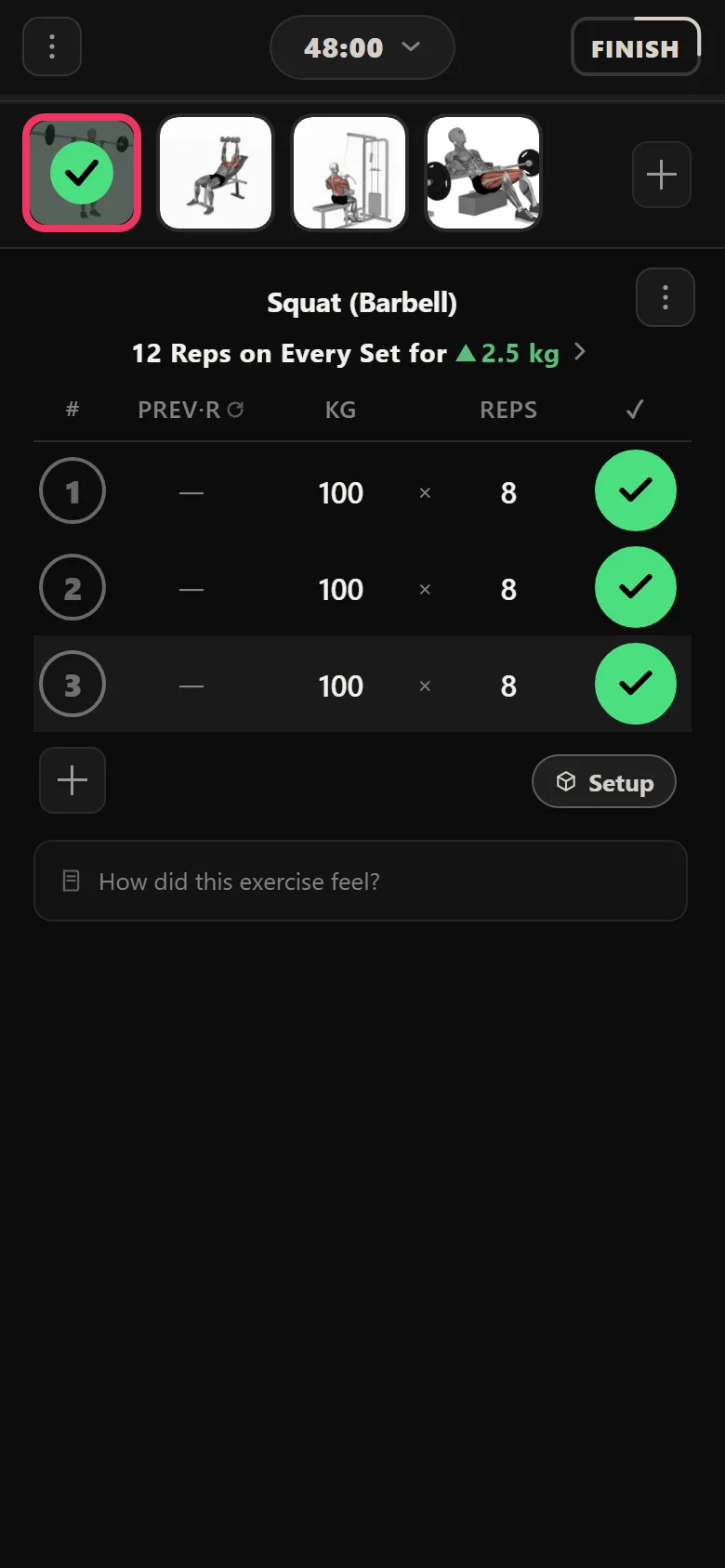
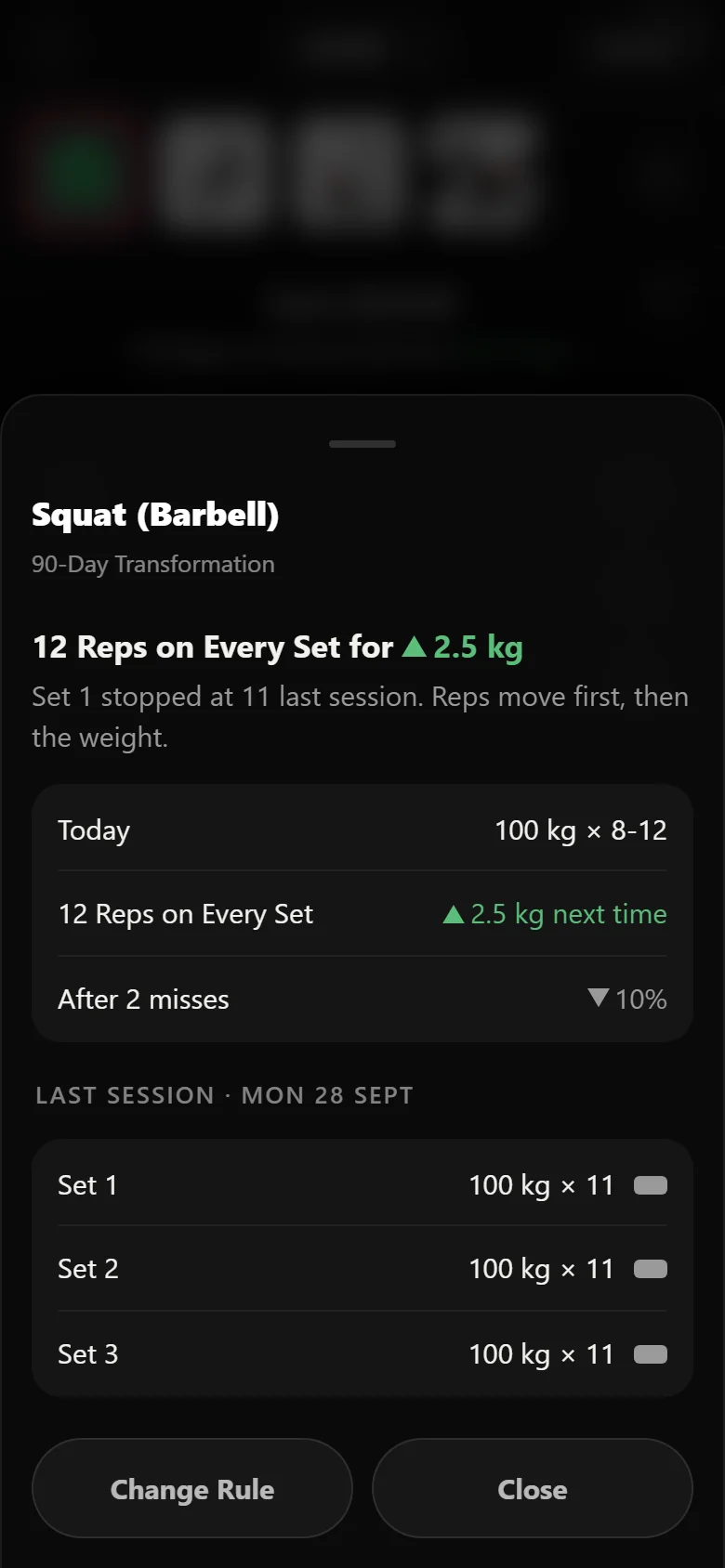
The squat runs double progression on three sets of 8–12. The first session is 100 kg for eight, the bottom of the range, and the chip on the exercise says what earns the next step: 12 reps on every set for 2.5 kg more.
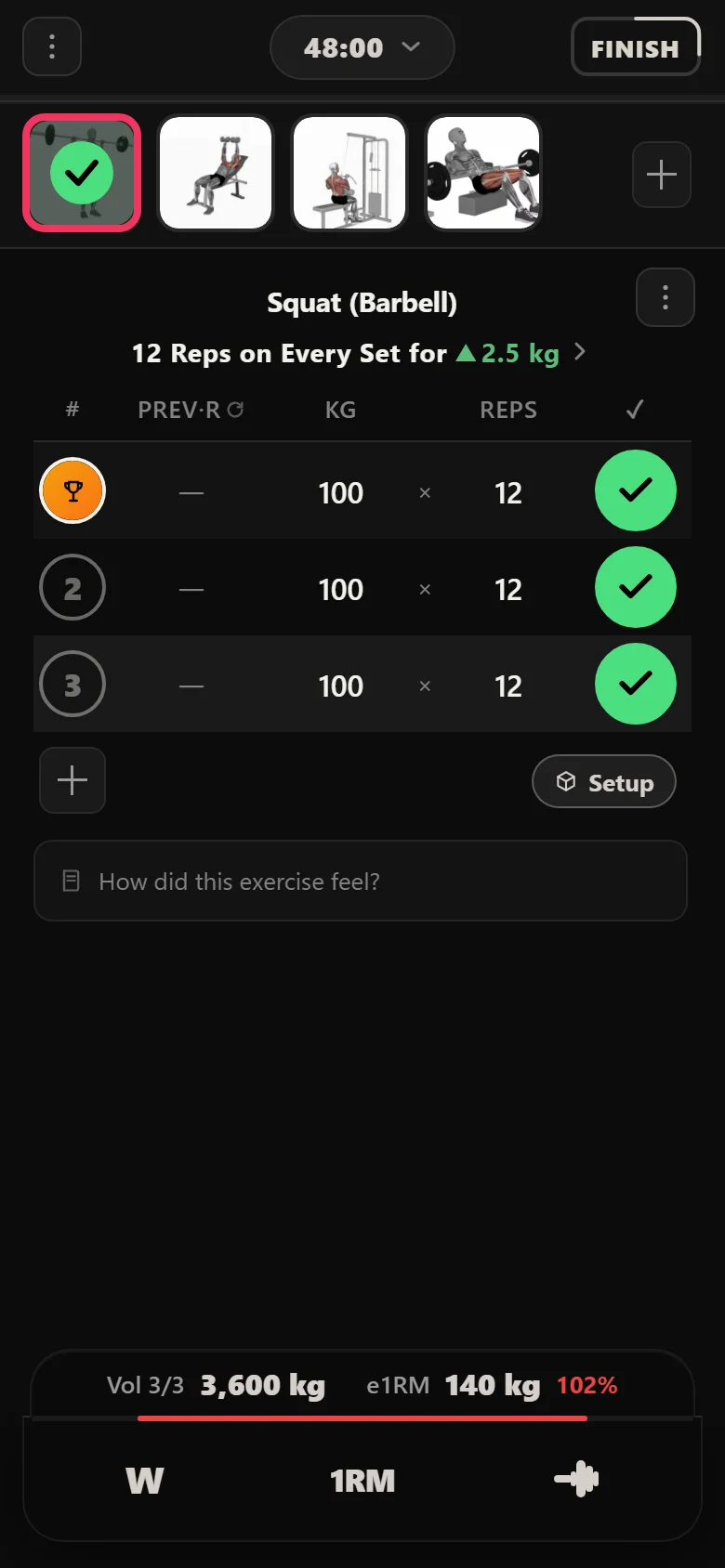
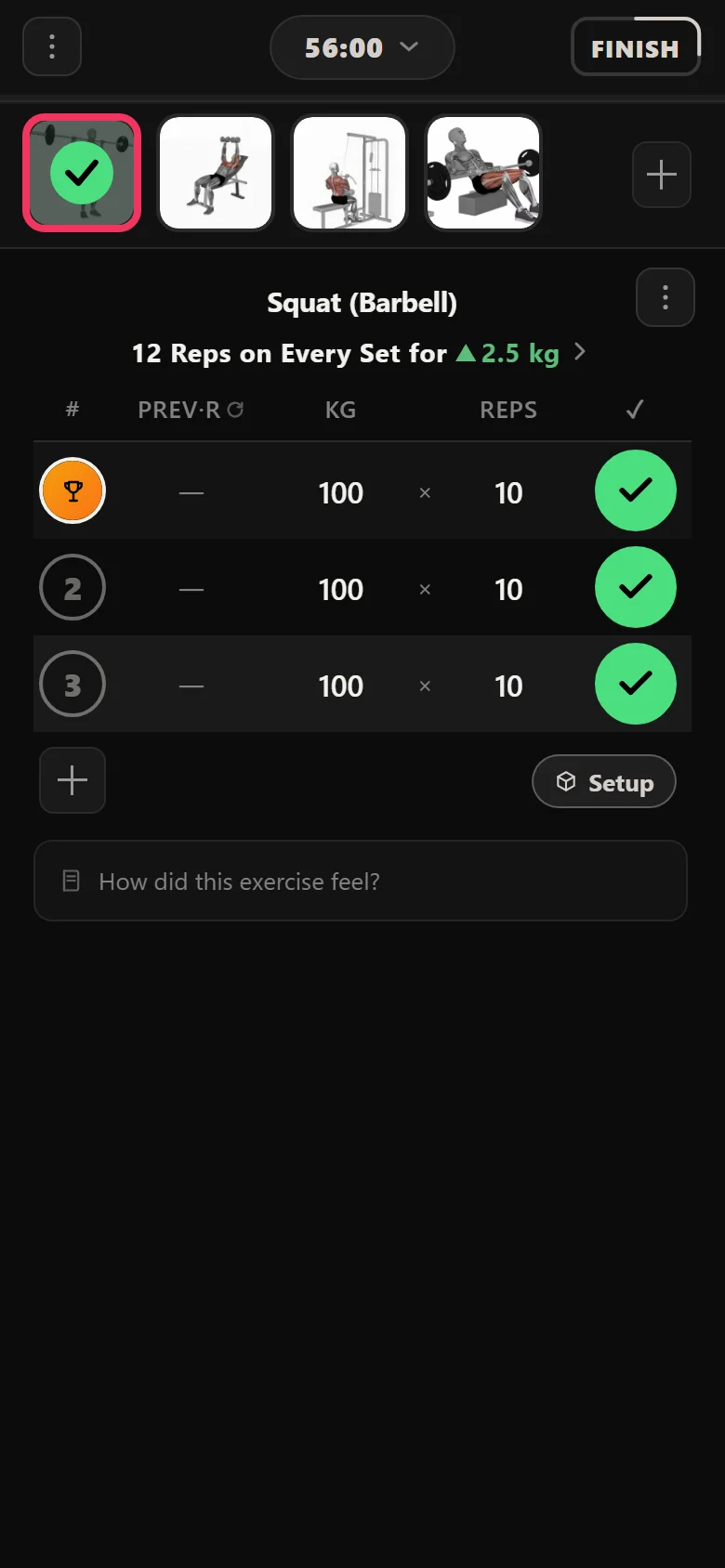
This run adds one rep a week, the smallest real improvement there is. Eight, nine, ten, eleven, and in week five all three sets reach twelve. Tap the chip on the way there and it shows its working: last session stopped at 11 on every set, so the weight waits.
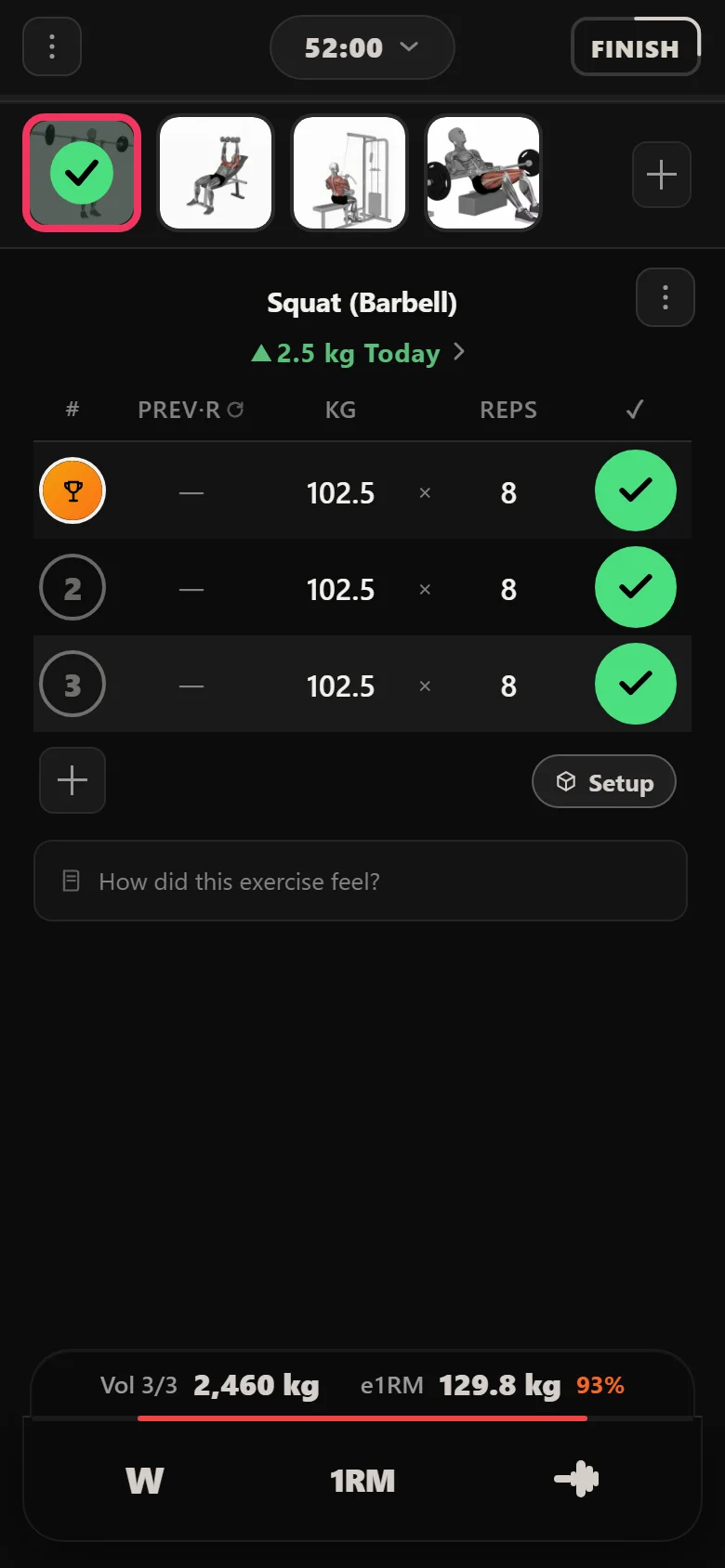
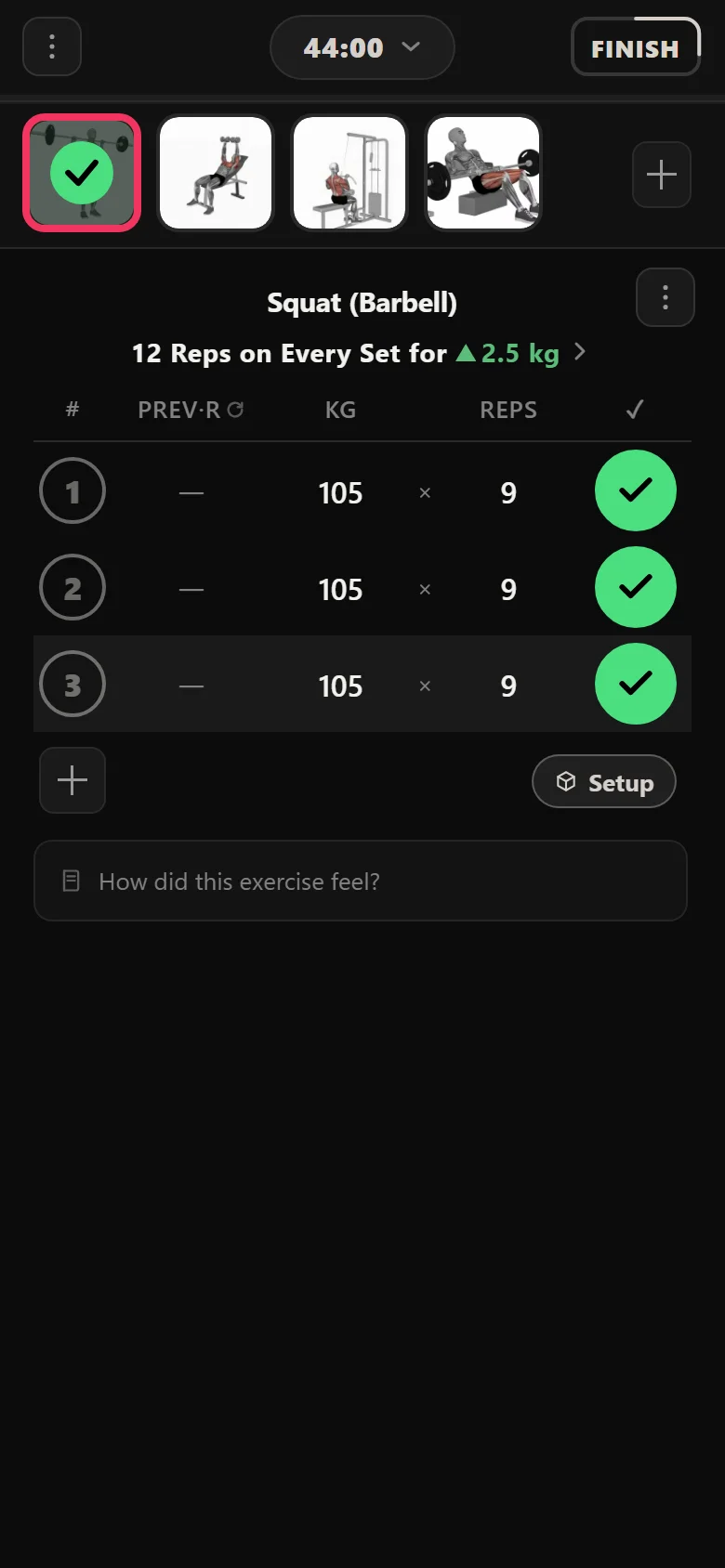
Week six opens at 102.5 kg and the reps are back at eight. The same climb takes it to twelve again by week ten, week eleven opens at 105 kg, and the run finishes on 105 kg for nine. Nobody typed a weight in after day one. The app read the sets that were logged and moved the bar when they earned it.
Two increments in twelve weeks is slow on paper. In a deficit it is the right speed, and it is why double progression suits a cut: a bad week costs you a rep, never the whole lift.
Squat (Barbell): weight on the bar, per weekly appearance
- 100S1 Session 1 — 8 reps
- 100S5 Session 5 — 12 on every set
- 102.5S6 Session 6 — back to 8
- 102.5S10 Session 10 — 12 on every set
- 105S11 Session 11 — back to 8
- 105S12 Session 12 — 9 reps
What does not move, and why that is fine
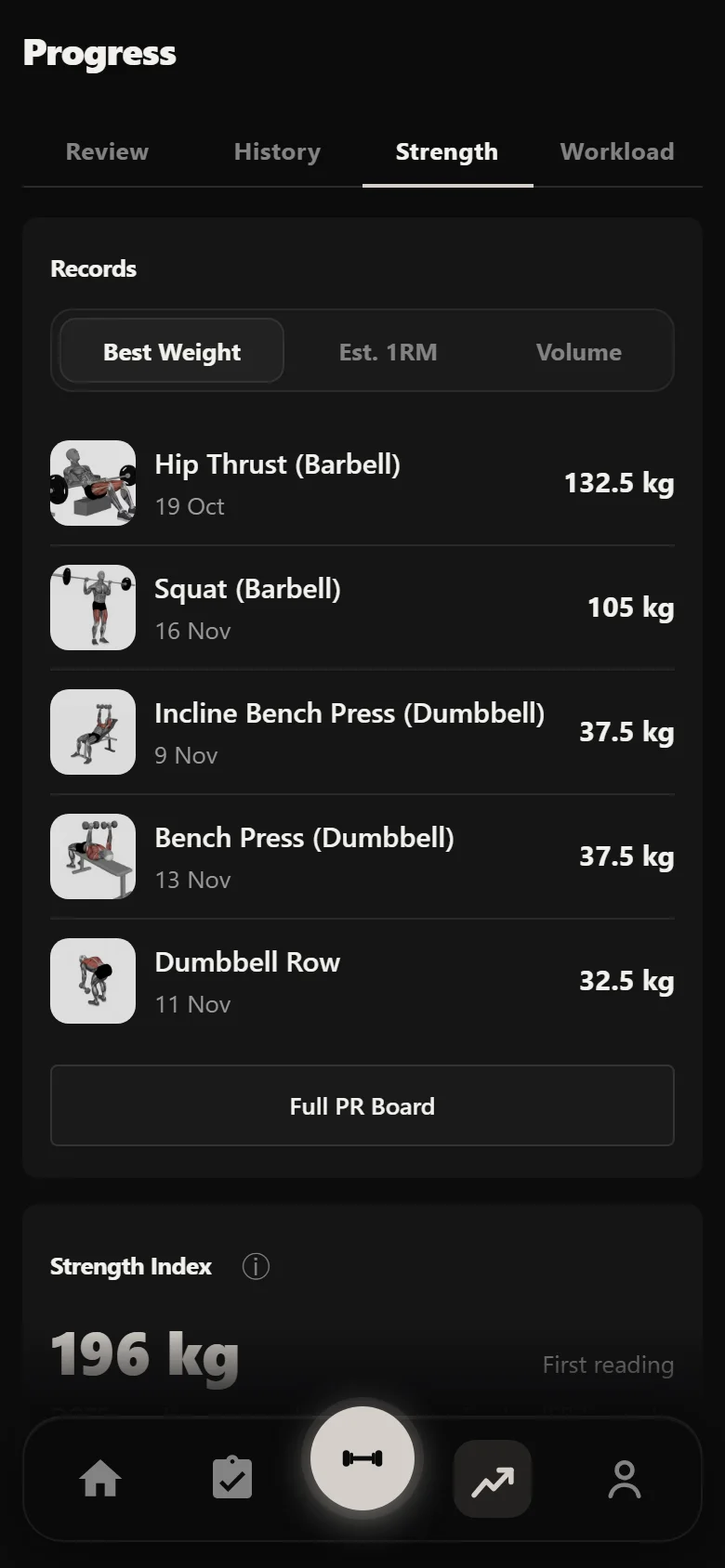
Here is the part most program write-ups leave out. Over the same twelve weeks four lifts finished on the weight they started on: the lat pulldown at 65 kg, the barbell Romanian deadlift at 77.5 kg, the dumbbell overhead press at 20 kg and the leg press at 20 kg, with the lying leg curl at 7.5 kg. The dumbbell work did best, the incline bench and the flat bench both reaching 37.5 kg and the dumbbell row 32.5 kg, and the hip thrust topped out at 132.5 kg.
That is what a cut looks like when nothing is being smoothed over. Some lifts hold, some creep, and none of it needs fixing. The rule holds the weight, you keep training, and if a lift misses twice in a row it cuts the weight 10% and lets you build back into it rather than grinding a number you cannot currently recover from.
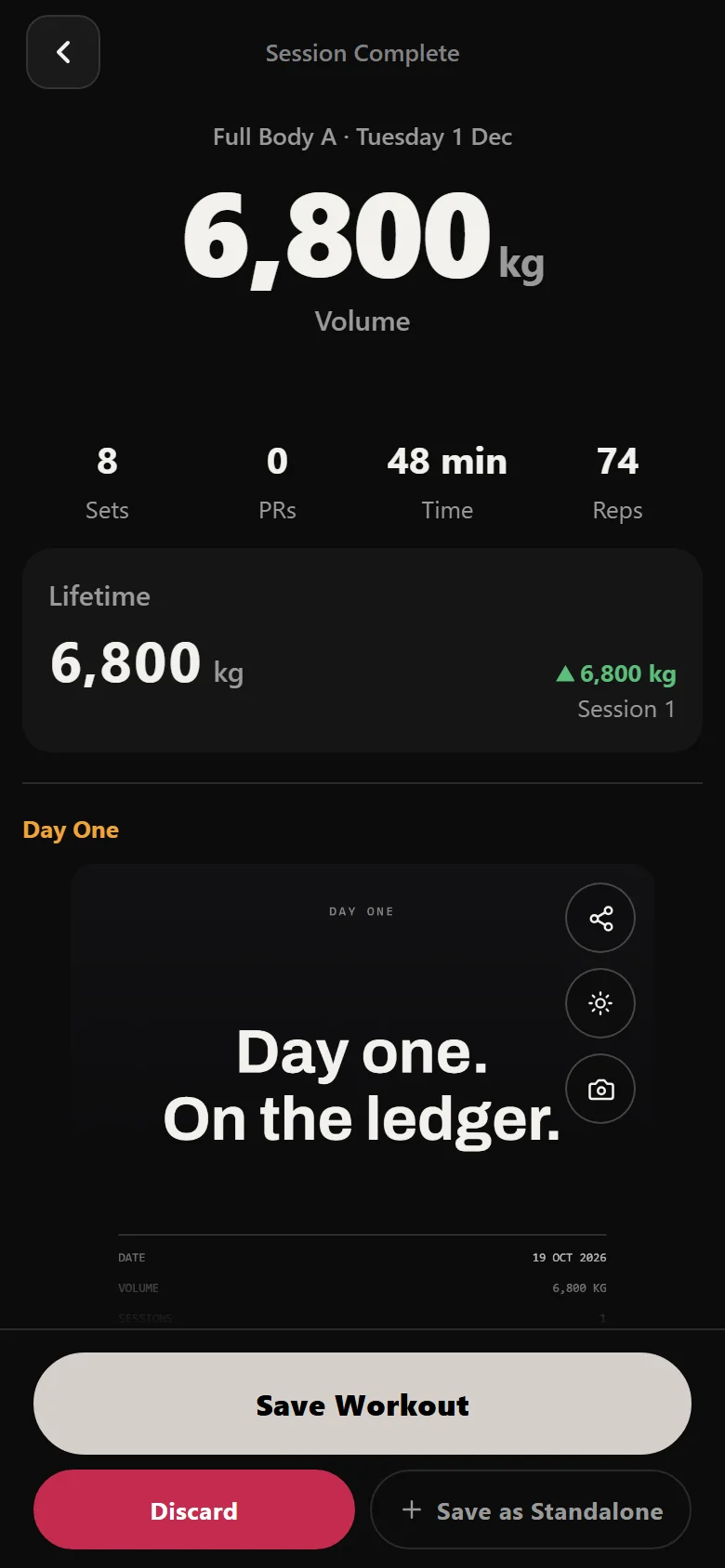
The session tallies itself when you finish: every set, the reps, the time and the volume, with no arithmetic on your side.
What the run looks like from above
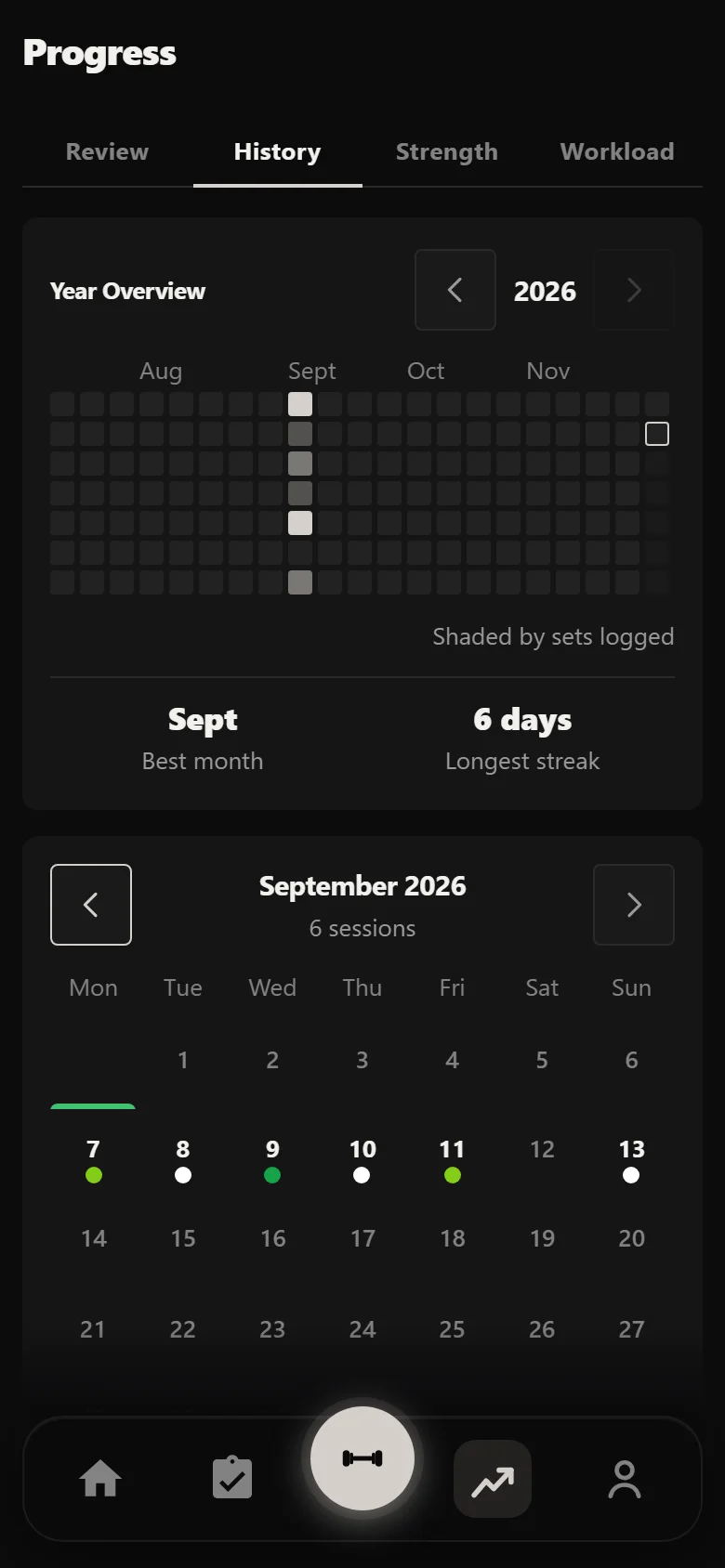
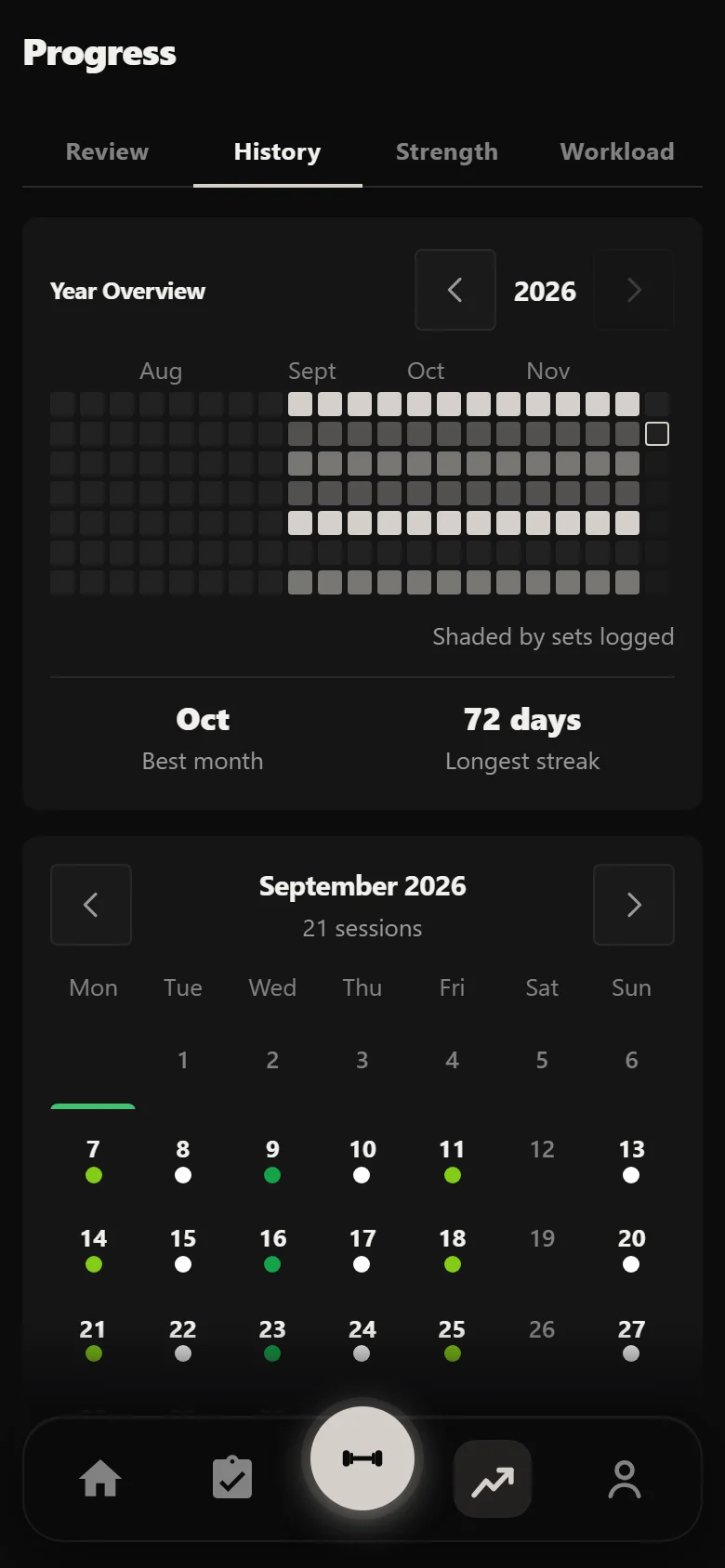
The first session lands on the start date and the calendar starts filling: three lifting days and three cardio days every week.
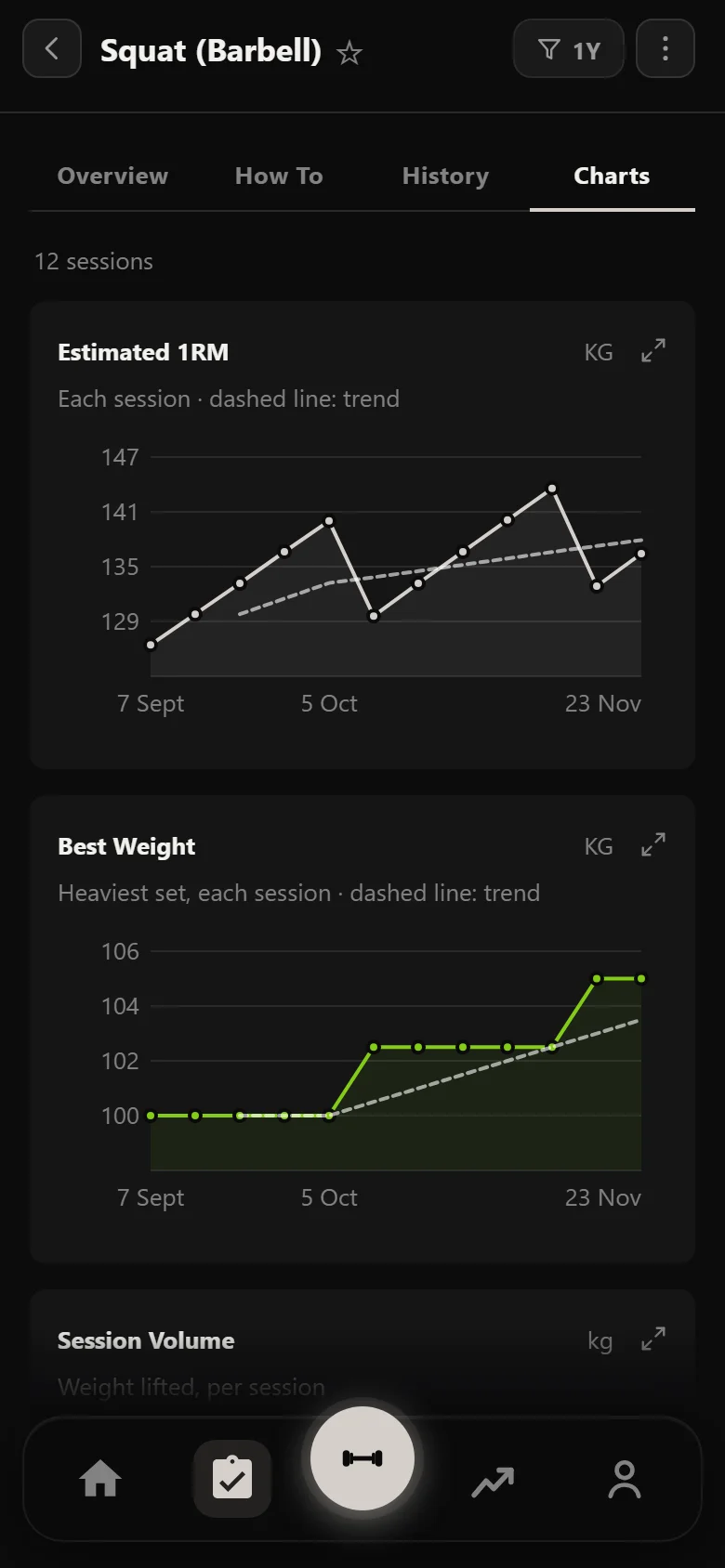
The squat's estimated 1RM chart is the honest picture of double progression. It climbs every week the reps go up, drops back each time the weight moves and the reps reset to eight, then climbs again. The best-weight chart underneath it is the staircase: flat for five weeks, a step, flat, a step.
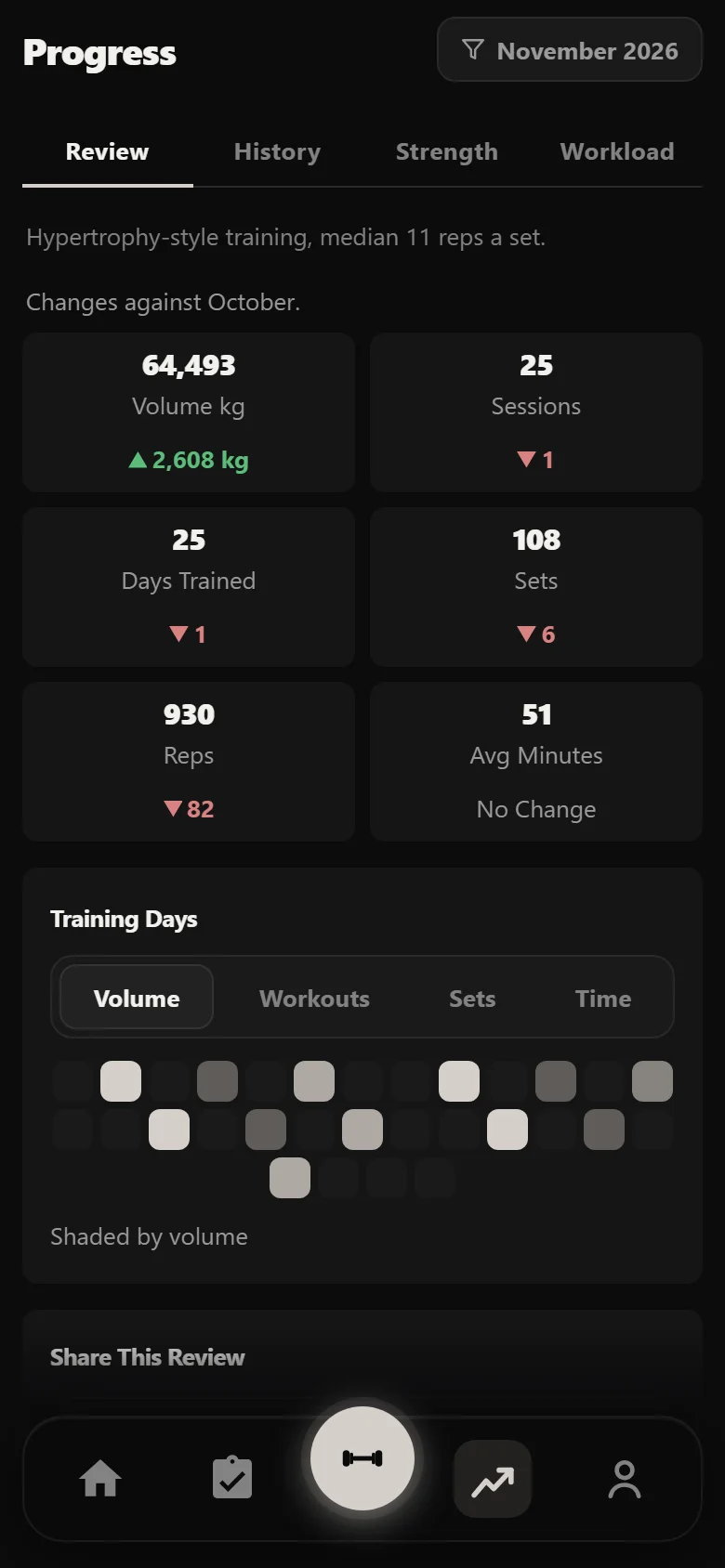
The Strength tab lists the records the run set by best weight, the hip thrust at 132.5 kg and the squat at 105 kg on top, and the Review tab reads a month at a time: November alone came to 64,493 kg across 25 sessions.
The payoff: what twelve weeks of cardio bought you
The squat moved 5 kg and several of the accessories held. That is the lifting doing its job, which in a deficit is defending the muscle you already have. The number that tells the story is the conditioning: the finisher went from 10 rounds of 30 on and 30 off to 24 rounds of 45 on and 15 off, and the two steady sessions between them added more than an hour a week of easy aerobic work.
None of it was typed in. The app built and scheduled the whole ramp for twelve weeks. The fat loss came from the deficit; the conditioning is what the training bought you.
The HIIT finisher, week 1 against week 12: the intervals sharpen for four weeks, then the round count climbs until week eight and holds.
- Zone 2 Walk30 min → 63 min
- Steady Cycle20 min → 64 min
Common questions
Why did most of my lifts stop going up?
Because you are eating in a deficit and recovering less. On this run the squat climbed from 100 kg to 105 kg while the pulldown, the Romanian deadlift, the overhead press and the leg press all finished on the weight they started. That is normal and it is not a failure. In a cut the lifting is there to keep the muscle you have; holding a weight for twelve weeks while you get lighter is progress in itself.
What happens if I miss the reps?
Nothing dramatic. Double progression holds the weight and you try again next time. Miss twice in a row on the same lift and the app cuts it by 10% and lets you build back into it, so a bad fortnight in a deficit costs you one step rather than the lift.
How does the cardio get harder?
The program bakes the ramp in and the app prescribes it. The HIIT finisher starts at 30 seconds work against 30 seconds rest for 10 rounds. For four weeks the intervals sharpen by five seconds each way, reaching 45 and 15, and then the round count climbs, 16, 18, 20, 22, 24 by week eight. The Zone-2 walk adds three minutes a week from 30 to 63; the steady cycle adds four a week from 20 to 64. You set none of it.
How is this different from the 28- and 60-day cuts?
Length and equipment, mostly. The 28-Day Shred is a four-week barbell block, the 60-Day Cut is eight weeks on dumbbells and machines, and this one runs twelve weeks on a mix, with the barbell kept for the squat, the Romanian deadlift and the hip thrust. Each uses a deliberately different exercise pool so the fat-loss track does not repeat itself. This is also the only one of the three whose interval session keeps growing past week four.
Can I move the cardio to different days?
Yes. The three cardio sessions are draggable in the planner, so the walk, the cycle and the finisher can go wherever they fit around the lifting days and the rest of your week. The ramp travels with them.
Is Durata free?
Yes. Durata is free to use, with the full program catalogue, automatic progression maths, rest timers, cardio interval timing and PR tracking. Everything in this walkthrough is in the app.
Put it into practice
Durata is free to use — 50 proven programs, automatic progression, rest timers and PR tracking, all on your phone.