


WS4SB3 in Durata: the lift changes before you adapt to it
Westside for Skinny Bastards is Joe DeFranco's answer to a specific problem: Westside barbell methods were built for geared powerlifters, and high-school athletes who need to get strong for a sport are not that. The third version, from 2006, is the one everybody runs. Four days a week, a max-effort upper day, a repetition upper day, and two lower days that pair jumping with heavy lifting.
The part that makes it interesting to watch inside an app is the rotation. The max-effort lifts change every week on a three-week cycle so you never settle into one movement long enough to stop responding to it. That means a given lift comes round once every three weeks, carrying its own weight, its own history and its own progress, and keeping five or six of those straight by hand is genuinely annoying.
This walkthrough follows six weeks, twenty-four sessions, two complete rotations. Every weight, rep and estimate is engine output from that run.
Finding it
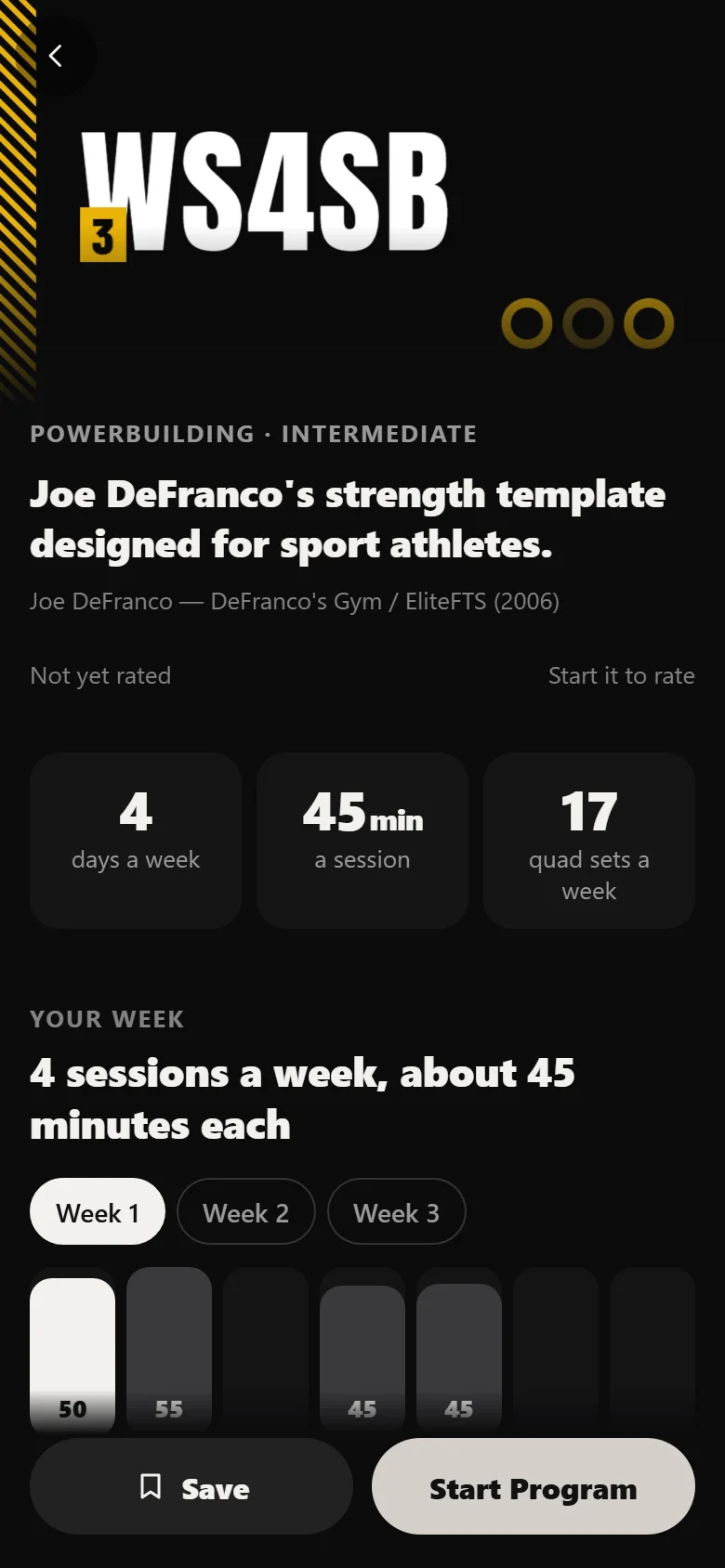
In Discover, WS4SB 3 sits on the Powerbuilding shelf, marked Intermediate, at four days a week. Search finds it by name, or Filter narrows the shelves by level and days a week. Tap the cover for a quick look, then View Program for the full page.
It is the first step of the app's athletic track, the one aimed at people who lift in order to be better at something else.
The program page lays out the four days and the three-week cycle before you commit, so the rotation is visible up front rather than a surprise in week two.
Four days, two of them upper
Max Effort Upper opens with the week's heavy pressing variant, worked up to a top set taken for as many reps as you have, then JM presses, dumbbell rows, face pulls, curls and planks. Repetition Upper is the mirror image: weighted dips taken to high reps, then rows, lateral raises, curls and triceps work. Two upper days is not an accident on a program written for athletes who need to throw, tackle and press.
The two lower days both open with jumping. Box jumps first, while you are fresh and can actually be explosive, then the heavy lifting: the week's max-effort squat variant with split squats and Romanian deadlifts behind it on one day, deadlifts with good mornings and step-ups on the other.
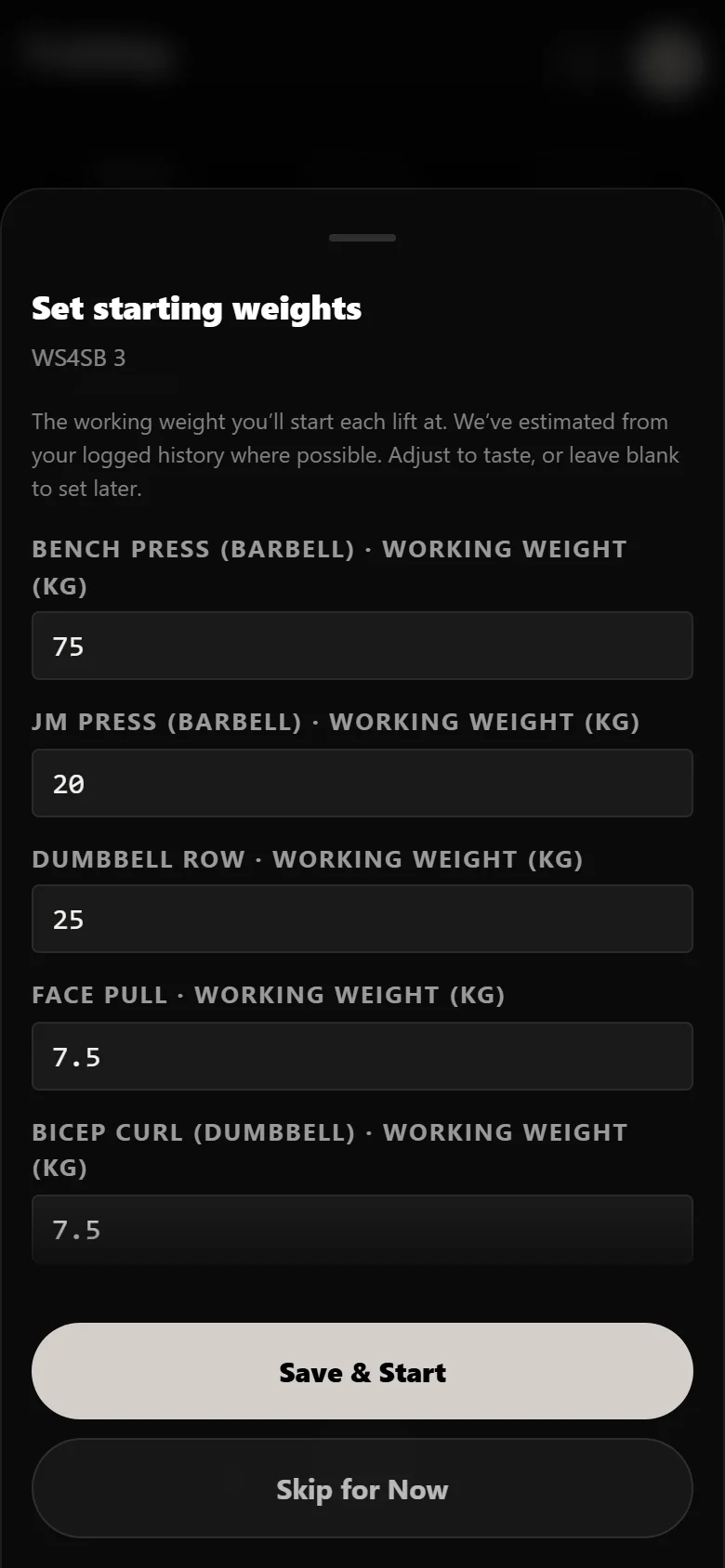
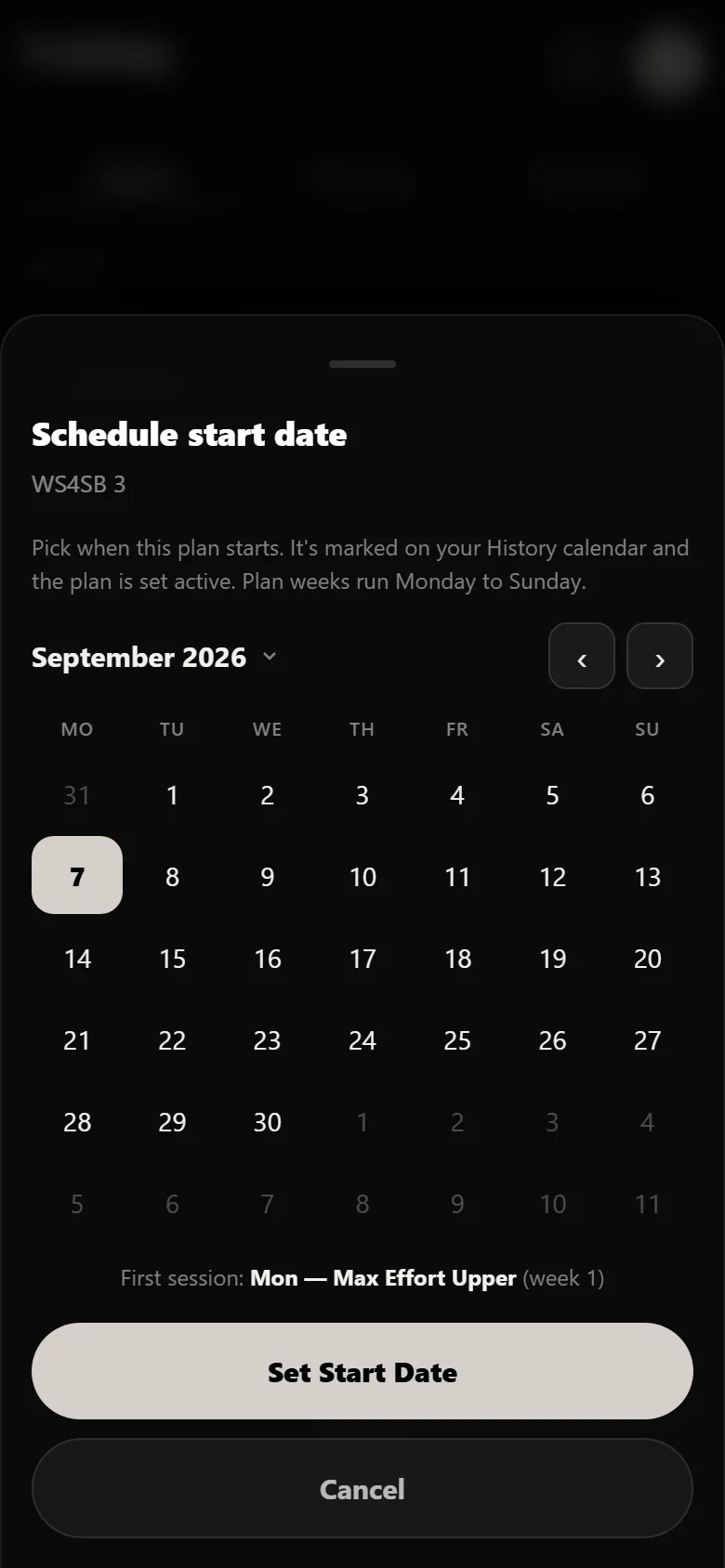
Setup asks for a working weight per lift, no training maxes and no percentages: 100 kg on the back squat, 75 kg on the bench, 77.5 kg on the Romanian deadlift on this run. Pick a start date and the sessions land on the calendar from there.
The rotation: a different lift every week
This is the Westside idea the program is named after. Keep hammering one movement and your body gets good at that movement rather than getting strong, so you rotate the movement before that happens. WS4SB3 does it on a three-week cycle: the max-effort press goes flat bench, then close-grip bench, then incline; the max-effort squat goes back squat, front squat, back squat.
In the app each of those is its own exercise with its own working weight and its own history, which matters more than it sounds. Your close-grip bench does not inherit anything from your flat bench, and adding weight to one never quietly moves the other. When week two comes round and the close-grip is on the card, the weight showing is the weight you last did a close-grip bench with, three weeks ago.
It also changes the rhythm of progress completely. A lift that appears once per rotation gets two chances to move in six weeks. The back squat is the exception, because the cycle puts it in weeks one and three, so it appears four times across the block. That is why the squat carries this article: it is the only lift in the rotation with enough appearances to draw a line through.
Heavy singles up front, rep ranges behind
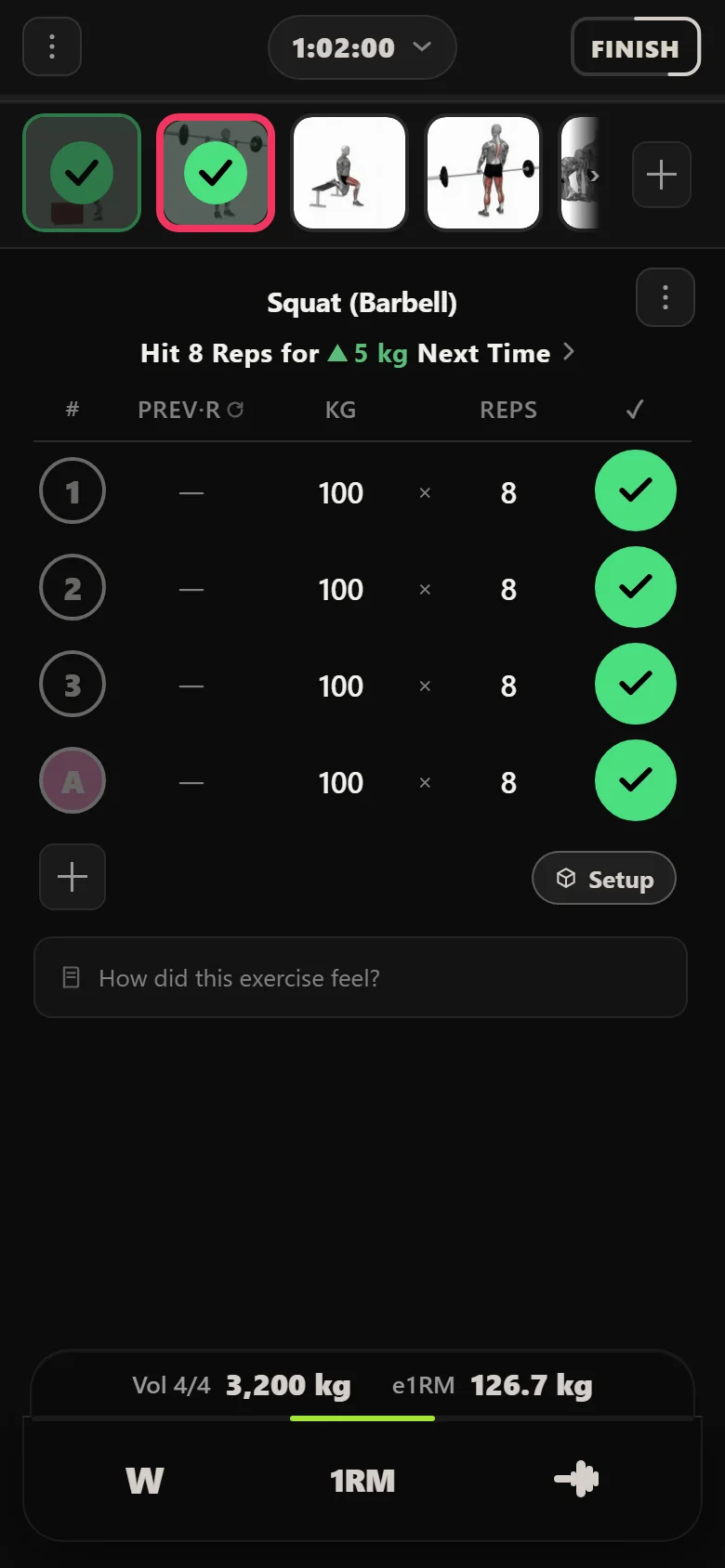
The max-effort lifts run linear: ramp sets into a heavy top set taken past the target, and when you beat the target the weight goes up next time that variant comes round, 2.5 kg on the pressing and 5 kg on the squat and deadlift. Miss it twice and the rule cuts the weight 10% and restarts the climb.
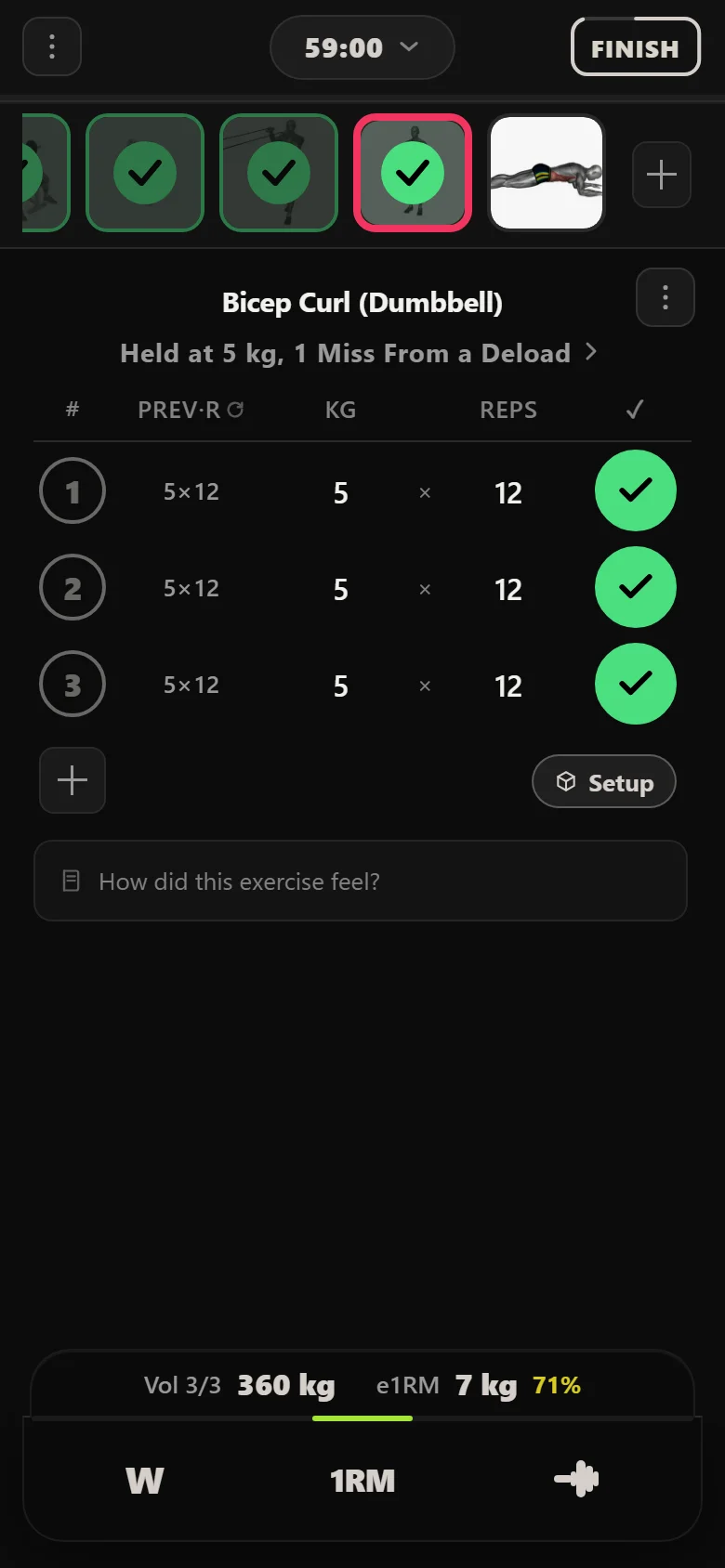
Everything behind them runs double progression, and the chip on the exercise says so plainly: hit the top of the rep range on every set and the weight goes up, then the reps reset to the bottom. Ranges run 8–10 and 10–12 on the compound accessories and 12–15 or 15–20 on the isolation work, so the lighter the movement the more reps it earns before the load moves.
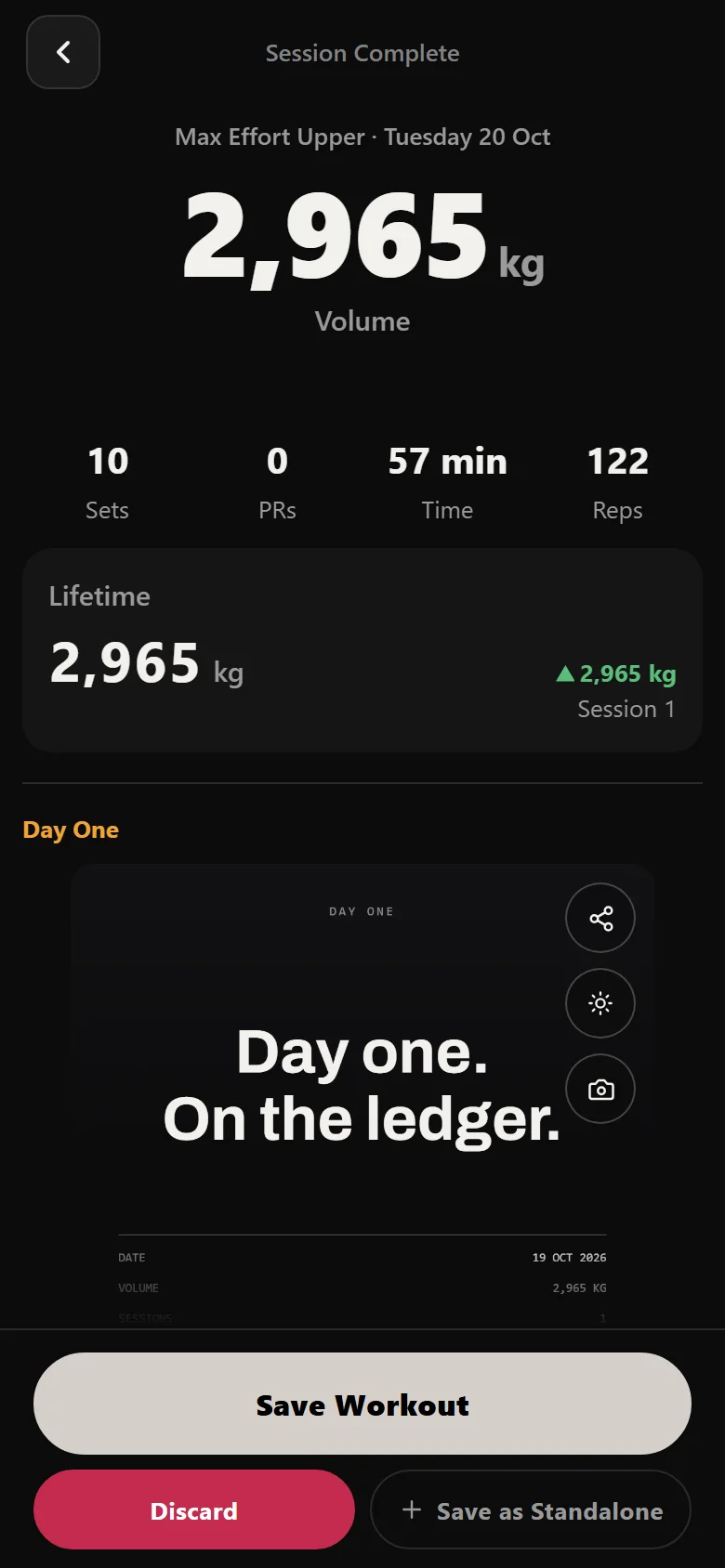
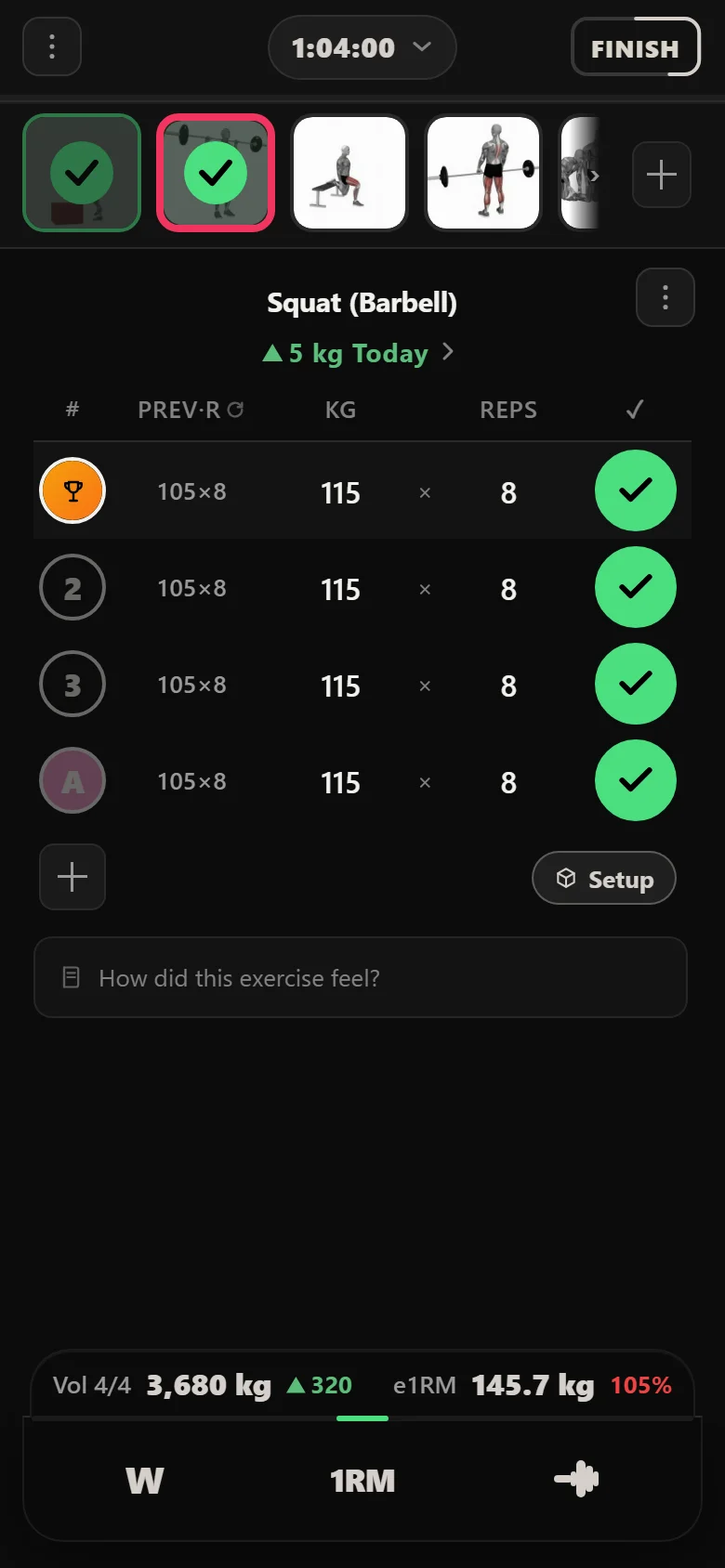
The session tallies itself as you go: ten sets and a hundred and twenty-two reps for 2965 kg on a max-effort upper day, which is a lot of reps for a session named after a single heavy set.
Four appearances, four increases
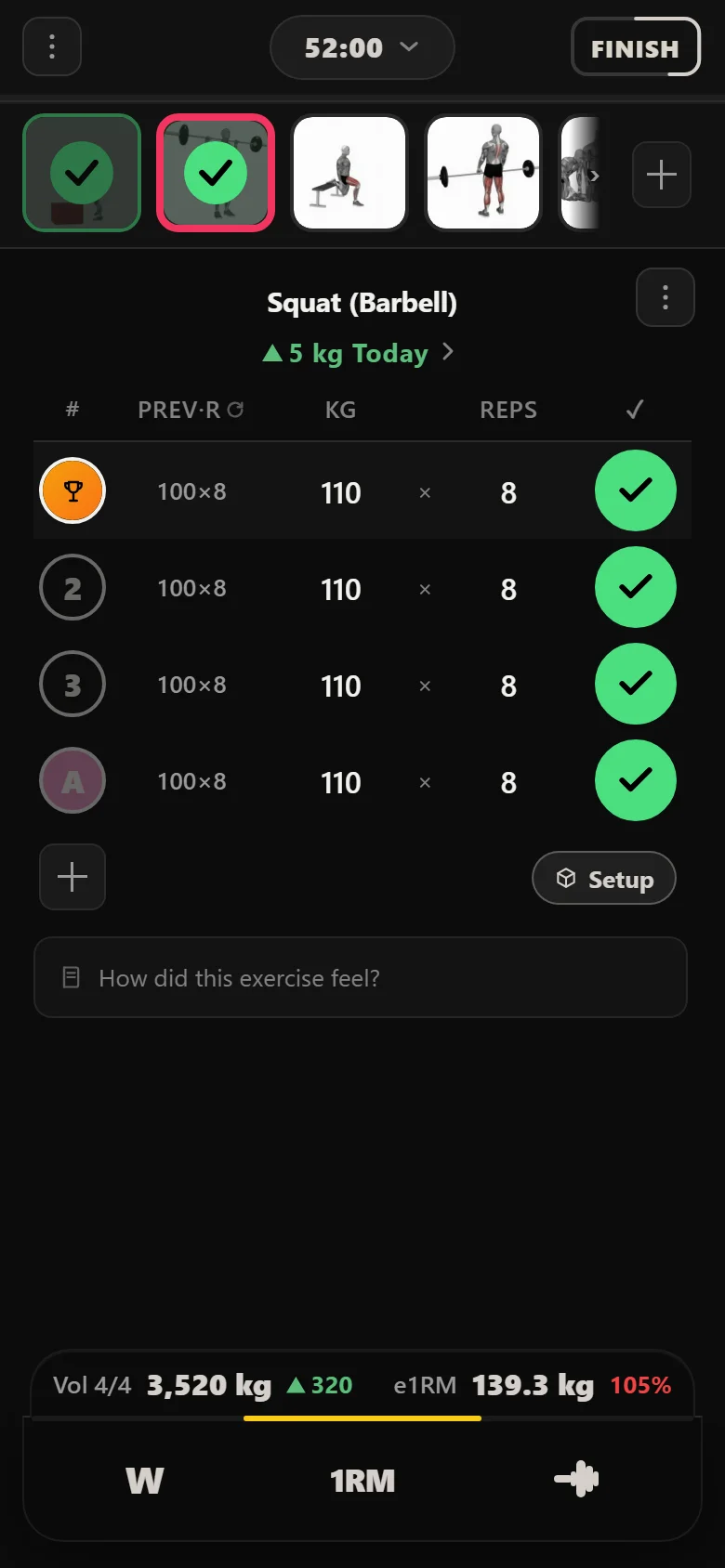
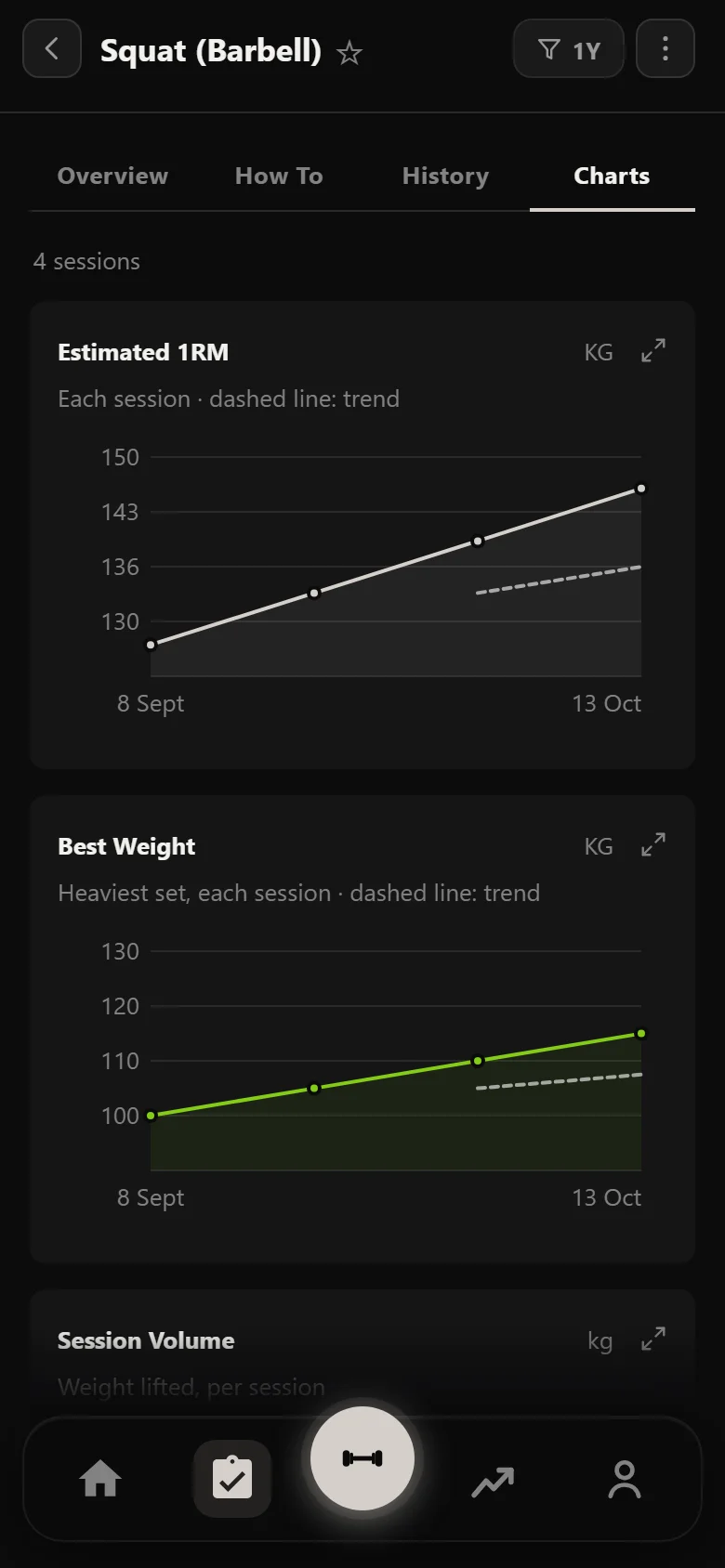
The back squat went up every single time it appeared: 100 kg in week one, 105 kg, 110 kg, 115 kg, with 120 kg waiting for its next turn. Four increases in six weeks, which is slower than a beginner program adding weight three times a week, and completely appropriate for a top set taken heavy enough to be called max effort.
The estimate tracks with it, reaching 145.7 kg by the last appearance. Nothing missed, nothing held, nothing cut, across the whole block.
Back Squat: weight on the bar, per max-effort appearance
- 100S2 Session 2
- 105S10 Session 10
- 110S14 Session 14
- 115S22 Session 22
The lifts that deliberately have no rule
Box jumps, Nordic hamstring curls, glute-ham raises and hanging leg raises carry no progression rule at all in this program, and that is a decision rather than an oversight.
A double-progression rule promises to add weight when you top out the rep range. None of those four movements has a weighted variant in the exercise library, so the promise could not be kept: the ladder sat frozen at the same load forever, and the deload that eventually fired was cutting a weight that did not exist. Worse than useless, because it looked like the app was tracking something.
So they are logged as reps within a range and nothing else. Box jumps in particular should never be chased for load or for fatigue: four sets of four, done fresh, and the moment they stop looking explosive the set is over. The rep range says that better than a progression rule ever could.
What moved, and why most of it didn't
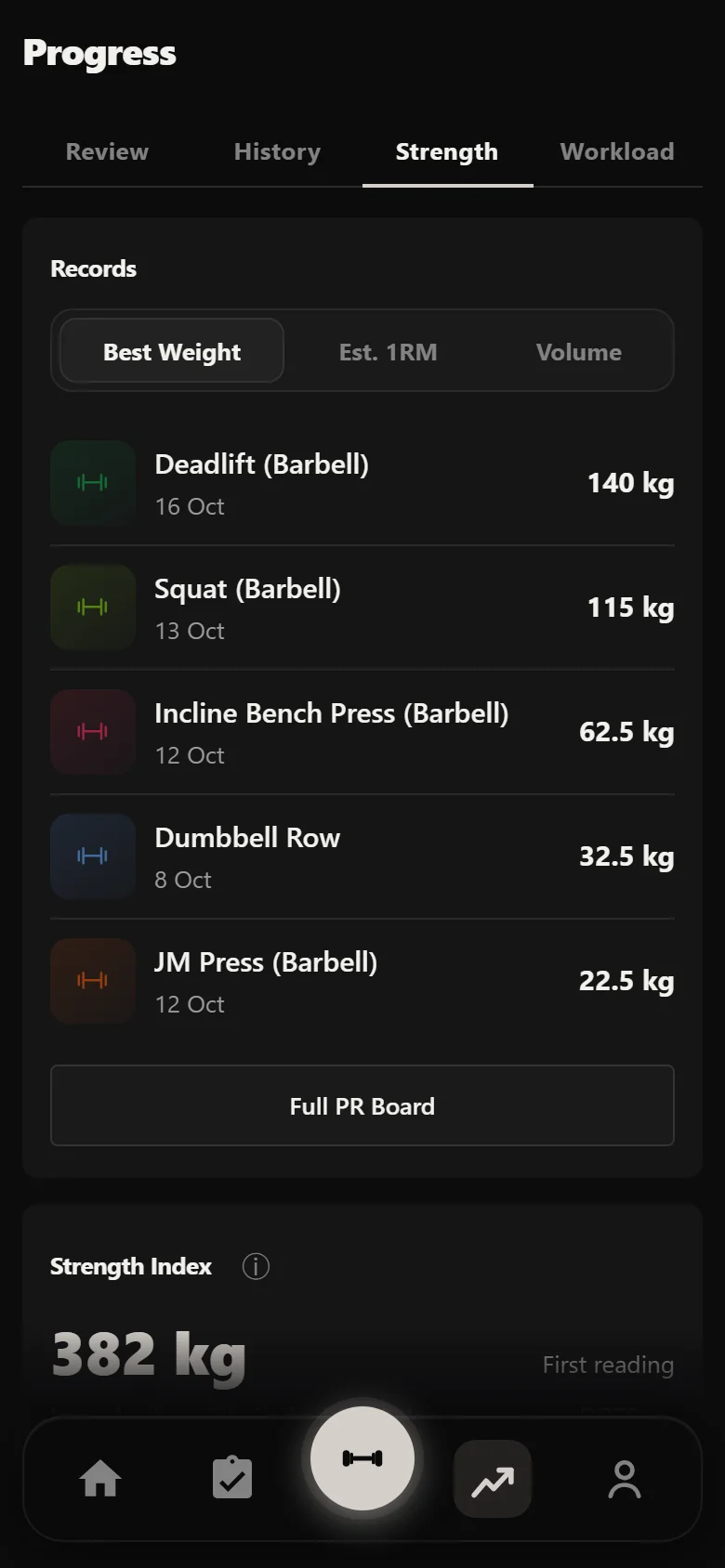
The back squat went 100 kg to 120 kg counting the weight waiting, and the deadlift 130 kg to 140 kg. Behind them the dumbbell row climbed 25 kg to 35 kg, the split squat 20 kg to 25 kg and the face pull 7.5 kg to 10 kg.
Everything else finished the block on the number it started with, including the flat bench at 75 kg, the close-grip at 60 kg, the incline at 60 kg and the front squat at 80 kg. That looks like a program that did not work until you count the appearances: each of those variants came round twice in six weeks, and the max-effort rule needs you to beat a target on a heavy top set before it adds anything. Two chances is not many.
This is the honest cost of rotating your lifts, and it is the trade the method is making on purpose. You give up the fast, satisfying week-to-week climb on any single movement in exchange for never grinding to a halt on one. Run this program for six months and the flat bench will have had a dozen turns, not two.
Six weeks from above
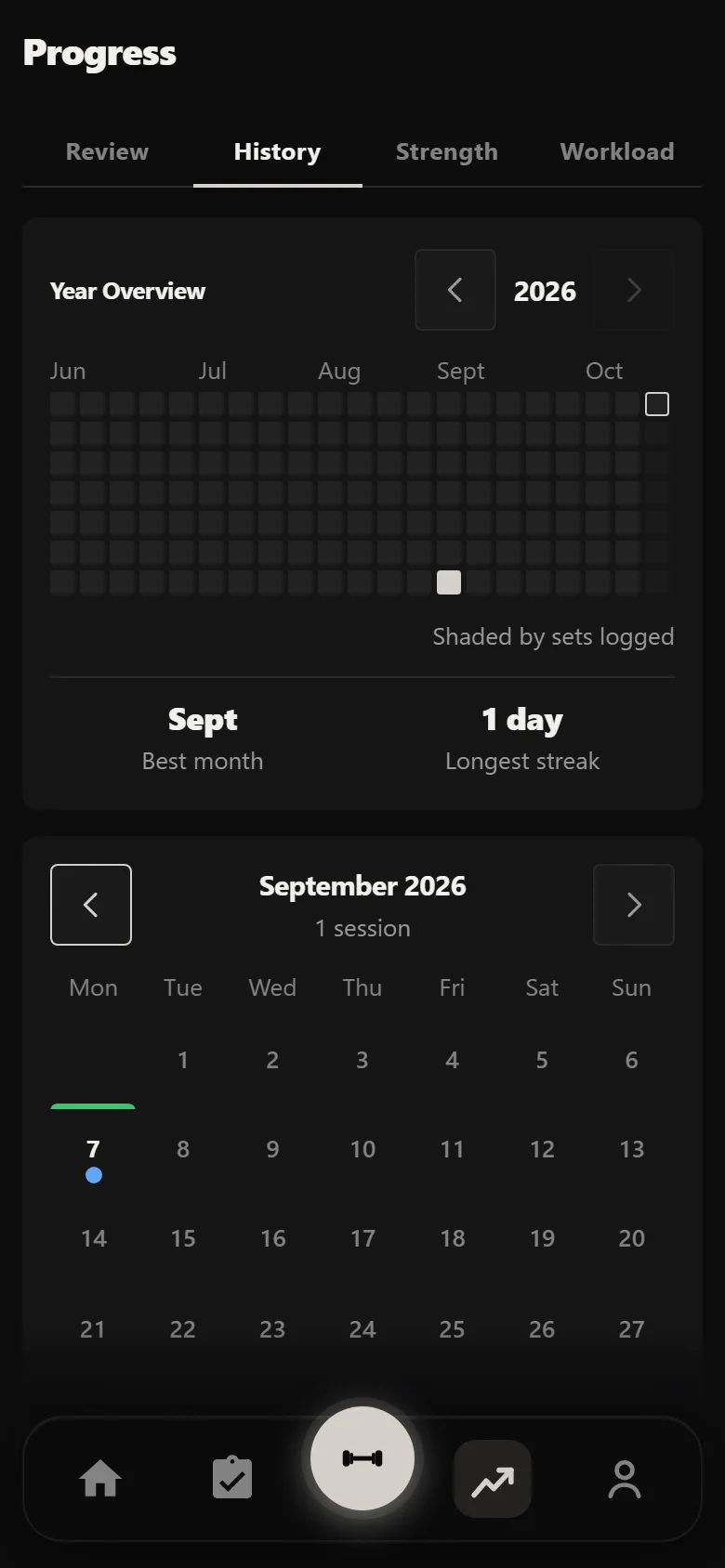
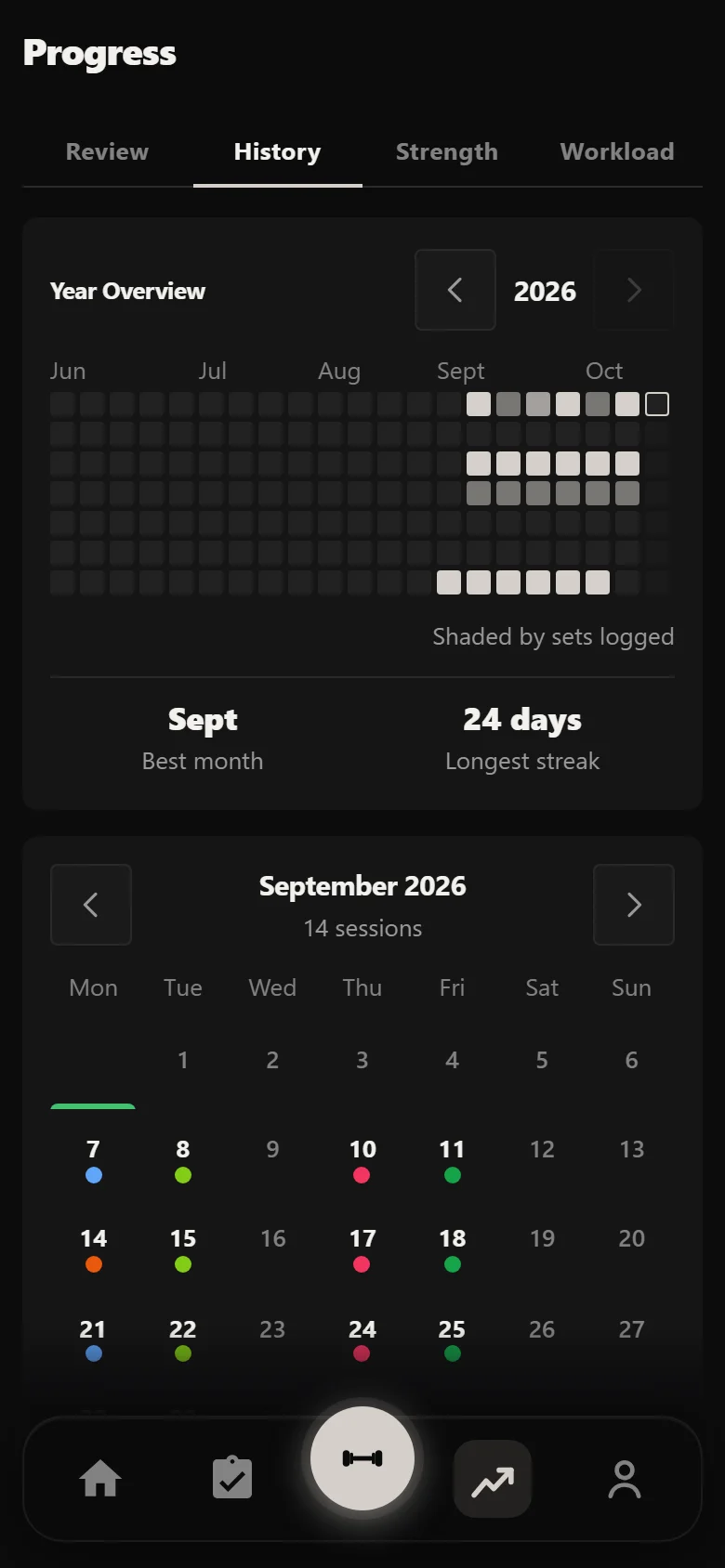
Twenty-four sessions fill six weeks of the calendar, four a week, and the session sizes alternate visibly with the day: ten and eleven sets on the upper days against three and seven on the lower ones. The back squat's estimated 1RM chart is drawn off just 16 sets, which is the rotation in one number.
The strength view ranks the lifts by estimate, the deadlift at 163.3 kg over the squat's 145.7 kg, with weekly volume charted alongside.
The payoff: five working weights, none of them yours to remember
At the end of six weeks the back squat is 15 kg heavier with 120 kg loaded for its next turn, and the deadlift has gone from 130 kg to 140 kg. More usefully, the close-grip bench, the incline bench and the front squat are all sitting exactly where you left them three weeks ago, ready for their turn in the rotation, and you did not have to write any of that down.
That is the actual work the app does on a program like this. The rotation is what makes WS4SB3 good and it is also what makes it a pain to run out of a notebook, because the thing you need to remember is always three weeks old.
The back squat, start to finish: 100 kg to 115 kg across four max-effort appearances in six weeks, with 120 kg on the card for the next rotation and the estimate at 145.7 kg.
Common questions
What is WS4SB3?
Westside for Skinny Bastards, third edition: Joe DeFranco's 2006 template for sport athletes, adapting Westside Barbell's max-effort methods for people who are not geared powerlifters. Four days a week, two upper (one max-effort, one repetition) and two lower that pair explosive jumping with heavy compound lifting.
Why do the max-effort lifts change every week?
To stop you accommodating to one movement. The three-week cycle rotates the heavy press through flat bench, close-grip bench and incline, and the heavy squat through back squat and front squat. Each variant is its own lift in Durata, with its own working weight and its own history, so nothing gets confused between them.
Why did most of my lifts not go up in six weeks?
Because a rotating max-effort lift only comes round once every three weeks, so six weeks gives it two chances to move. That is the trade the method makes: slower progress on any single movement, in exchange for never stalling out on one. The back squat is the exception, since the cycle gives it weeks one and three.
Why don't box jumps and Nordic curls track weight?
Because they have no weighted variant, so a rule that adds weight when you top out the rep range would be promising something the lift cannot take. Durata logs them as reps within a range instead. Box jumps especially should be done fresh and stopped the moment they stop looking explosive, which is a judgement no progression rule makes for you.
What happens when a max-effort lift stalls?
The weight is held rather than pushed. Miss the target twice on the same variant and Durata cuts it by 10% and restarts the climb from there. Nothing stalled in the six weeks shown here, partly because a rotating lift gets a three-week rest before it has to beat itself again.
Is Durata free?
Yes. Durata is free to use, with the full program catalogue, automatic progression maths, deload rules, rest timers and PR tracking. Everything in this walkthrough is in the app.
Put it into practice
Durata is free to use — 50 proven programs, automatic progression, rest timers and PR tracking, all on your phone.