


GZCL UHF in Durata: five weeks, five days, ten training maxes
Ultra High Frequency asks a question most programs avoid: what if you trained everything, nearly every day, for five weeks? Twenty-five sessions, five days a week, with the competition lifts or something close to them turning up over and over.
The obvious objection is recovery, and the program's answer is not the one people expect. You are not benching five times a week. You are benching, then incline benching, then close-grip benching, then pressing overhead, and each of those is treated as a separate lift with its own training max and its own wave. This drive covers the whole block, and the setup screen is where its argument starts.
Finding the program
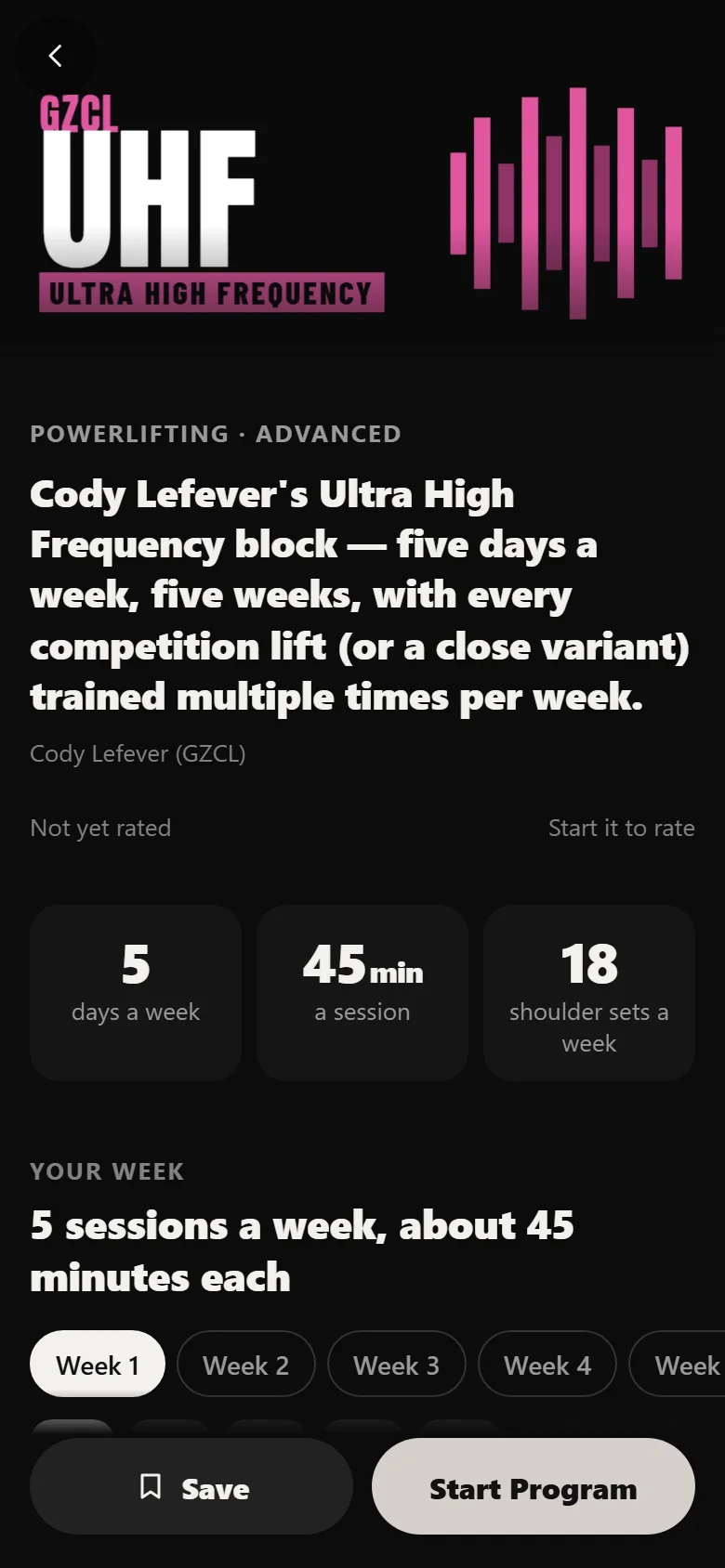
In Discover, GZCL UHF sits on the Powerlifting shelf, marked Advanced, at five days a week. Search finds it by name, or Filter narrows the shelves by level and days a week. Tap the cover for a quick look, then View Program for the full page.
The Advanced mark matters more than usual here. This is a peaking block for someone who already knows how they recover, not a way to find out.
The program page shows the shape before you commit: five weeks, five days, and a session structure that repeats with different lifts in the slots rather than different work in them.
Ten training maxes, and why there are ten
Setup does not ask for the usual four numbers. It asks for ten: bench 100 kg, squat 140 kg, deadlift 180 kg, overhead press 70 kg, and then incline bench 90 kg, front squat 110 kg, pause squat 120 kg, close-grip bench 90 kg, Romanian deadlift 140 kg and incline dumbbell press 40 kg.
That list is the program in one screen. Every variation is a lift in its own right, with its own max, its own percentages and its own place in the week. It is the mechanism that makes the frequency work: the bench pattern gets trained most days, but almost never with the same exercise at the same intensity, so the exposure accumulates without the same tissue taking the same load five times.
It is also the setup cost, and it is real. Ten honest maxes is a lot to know about yourself, and this is one place where guessing high is expensive rather than merely optimistic. All ten stay fixed for the whole five weeks, because the block is a single ramp toward one test rather than a repeating cycle.
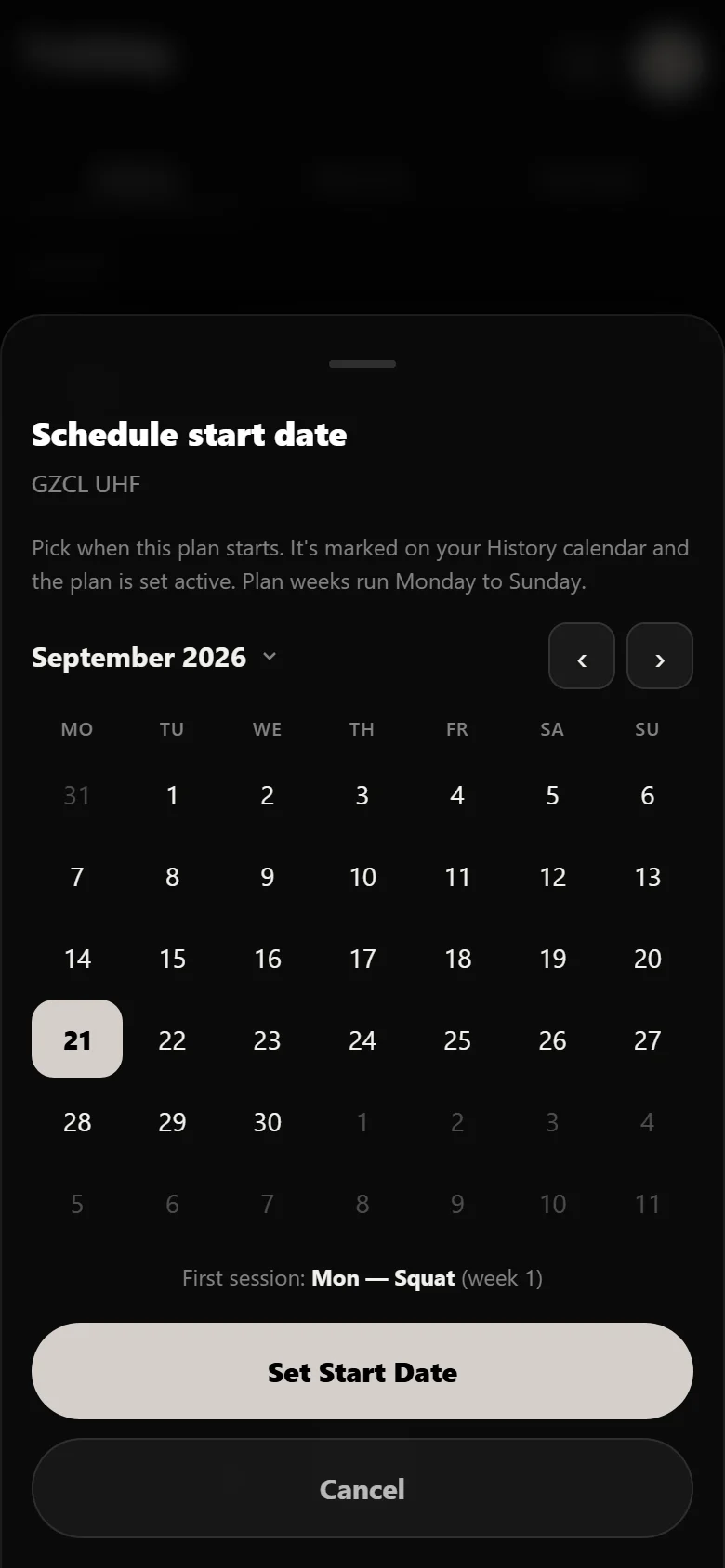
A start date lays the twenty-five sessions out. Five weeks is short enough to see the end of from the first day, which is part of why people finish this one.
Two waves in the same session
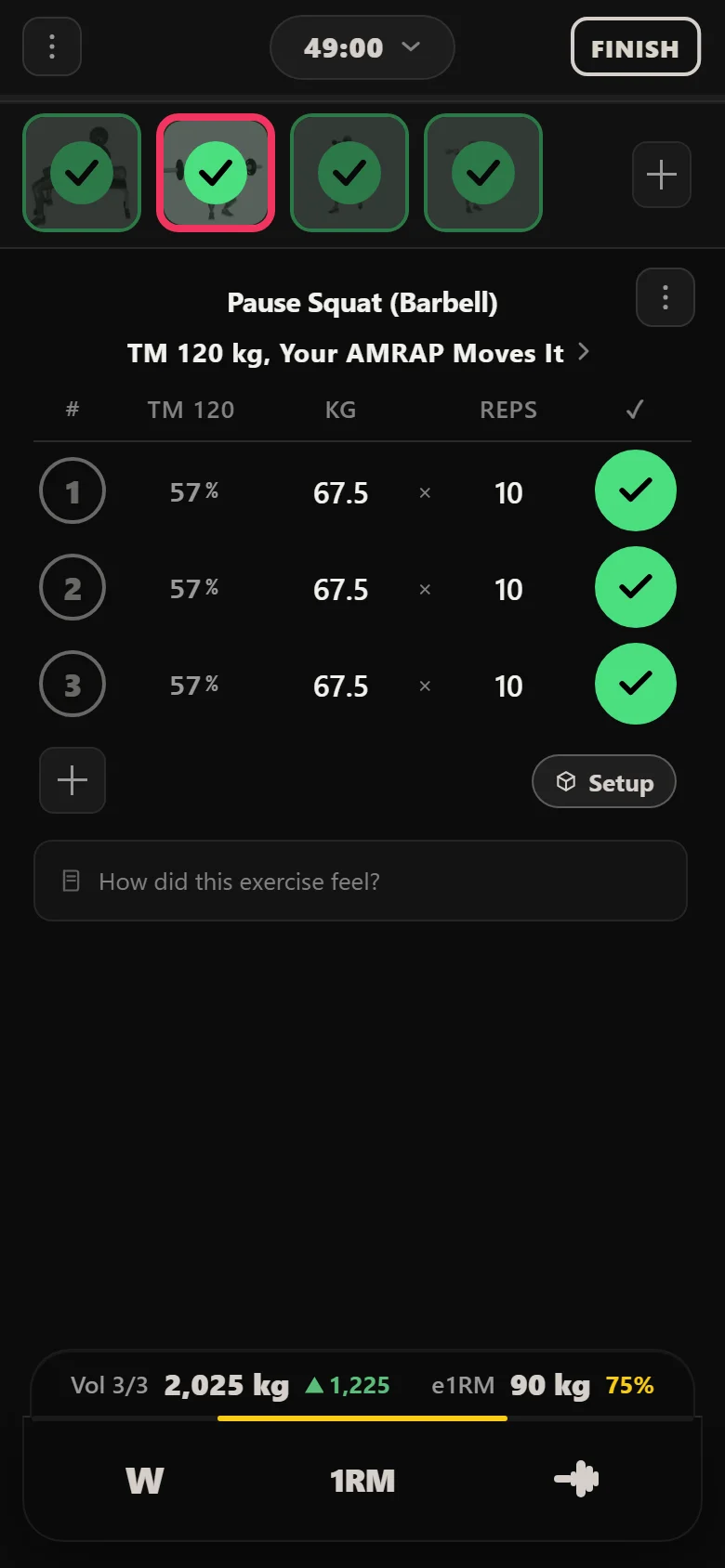
GZCL blocks are built in tiers: a heavy low-rep T1, a higher-volume T2 on a different lift, and T3 accessories. UHF does something most of the family does not, which is wave the T2 off a percentage as well.
So a session carries two independent percentage waves. The pause squat at 120 kg is not an afterthought under the day's main lift; it is running its own intensity progression off its own max, on its own schedule. Durata prescribes both without you doing any arithmetic, which on a block with ten maxes and two waves per session is the difference between running the program and administering it.
T3 is the one tier that is not on a percentage. It runs double progression with a rep-range target that shrinks as the week's intensity climbs, so the accessories get harder in the weeks the main work gets heavier rather than staying at a comfortable constant.
Week one, and the first thing that surprises people
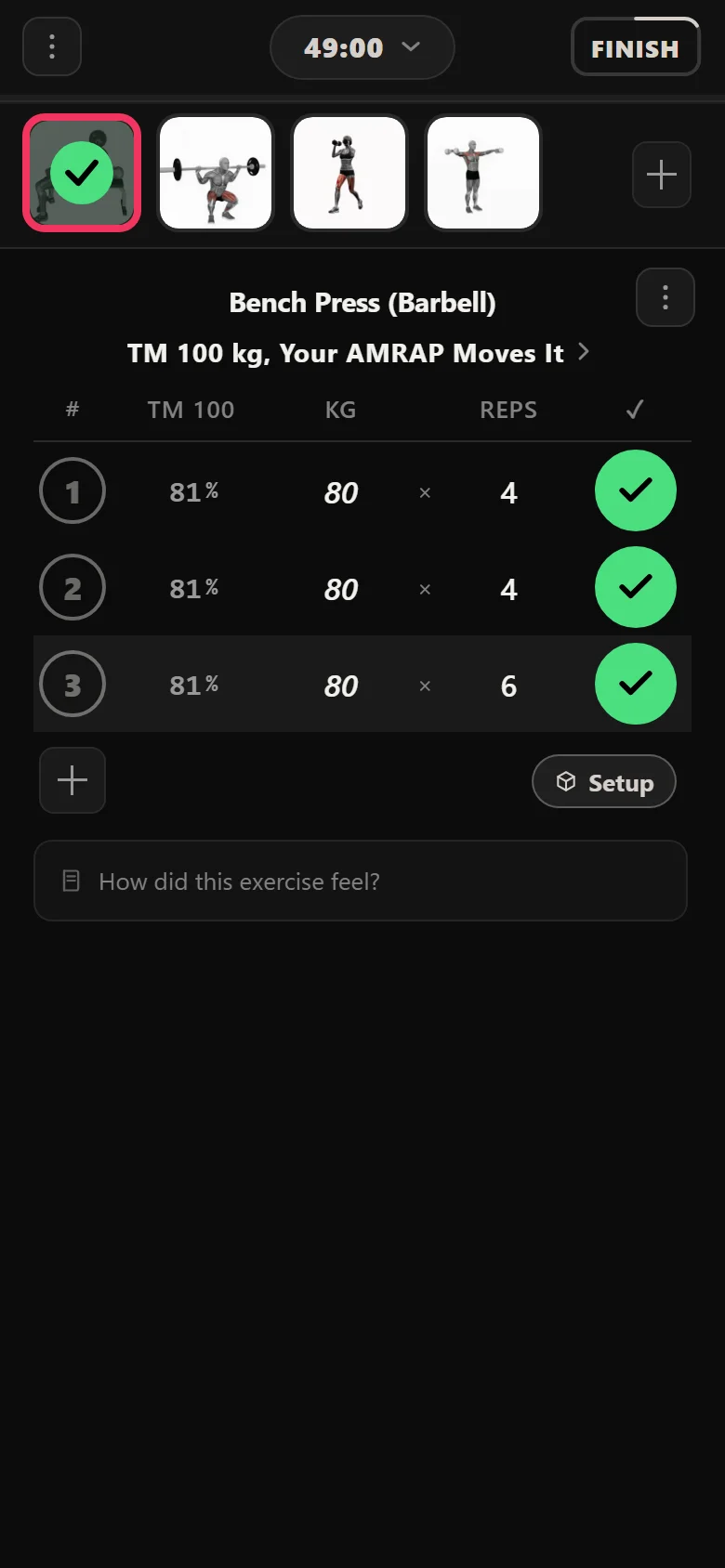
The bench opens at 80 kg for triples, eighty-one percent of the 100 kg max, with the last set repped out. That is not a light session, and it is week one of five.
There is no accumulation phase here. A twenty-week block can afford nine weeks of building; a five-week block cannot afford one. The intensity is high from the first session and the frequency is what provides the volume, which is the inversion at the centre of the program.
The rep-out on the last set is doing double duty. It is the work, and it is the measurement: the app takes an estimate off it, and by the end of the block those estimates are what tell you whether the ramp is going anywhere.
The wave that steps back on purpose
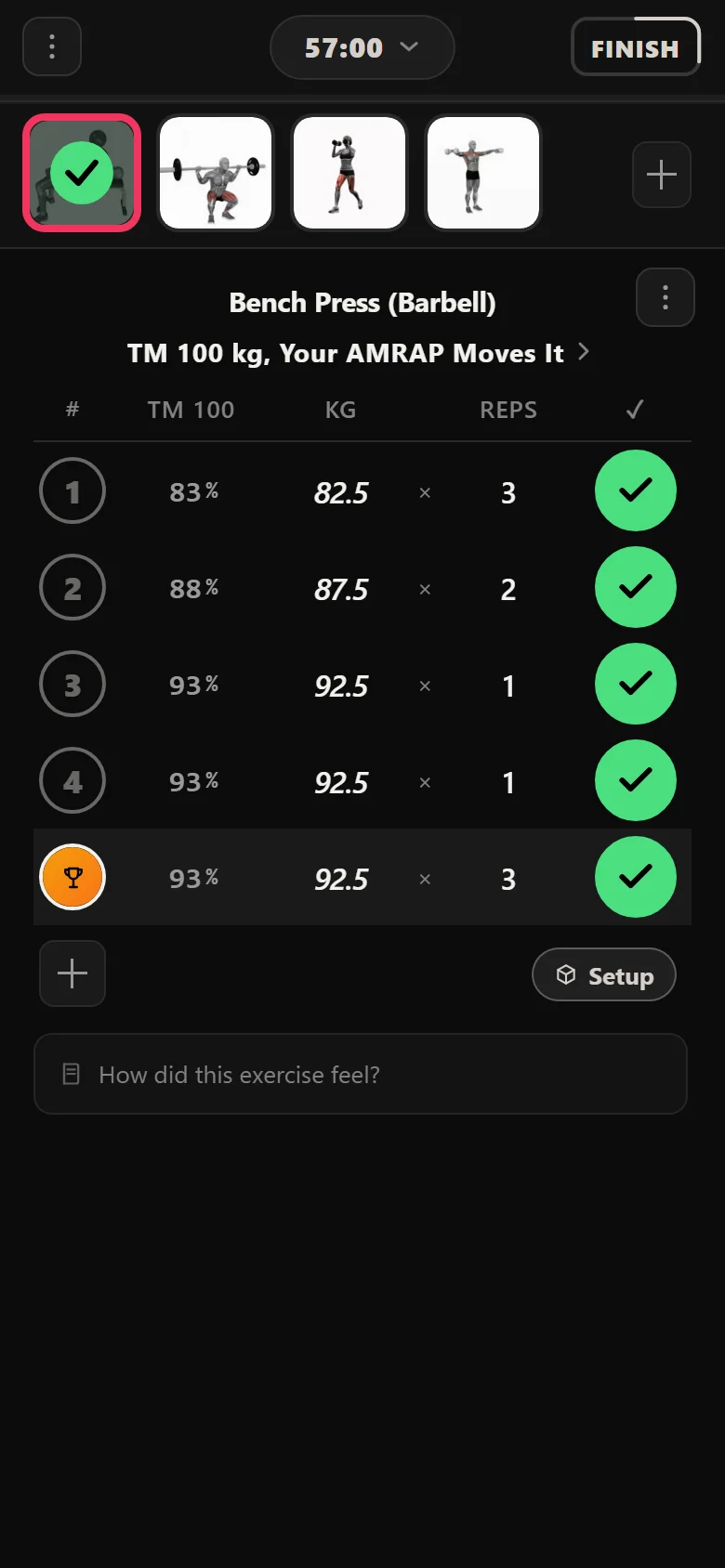
Week two opens the bench at 85 kg. Week three opens it at 82.5 kg, which looks like a mistake and is not. GZCL waves step back before they step up, so the third week is lighter at the start than the second and heavier at the end.
That is because the wave happens inside the session as well as across the weeks. Week three ramps 3-2-1-1-1, climbing from eighty-three percent to ninety-three, so a session that opens at 82.5 kg finishes at 92.5 kg, with the last set taken for as many as you have. Reading only the opening weight would tell you the block went backwards.
Week four then opens at 90 kg, the highest opening set of the block, before week five drops back again for the test. The strip below is those five openings in order, and the shape is the point.
Week five: a ramp, a single, and an answer
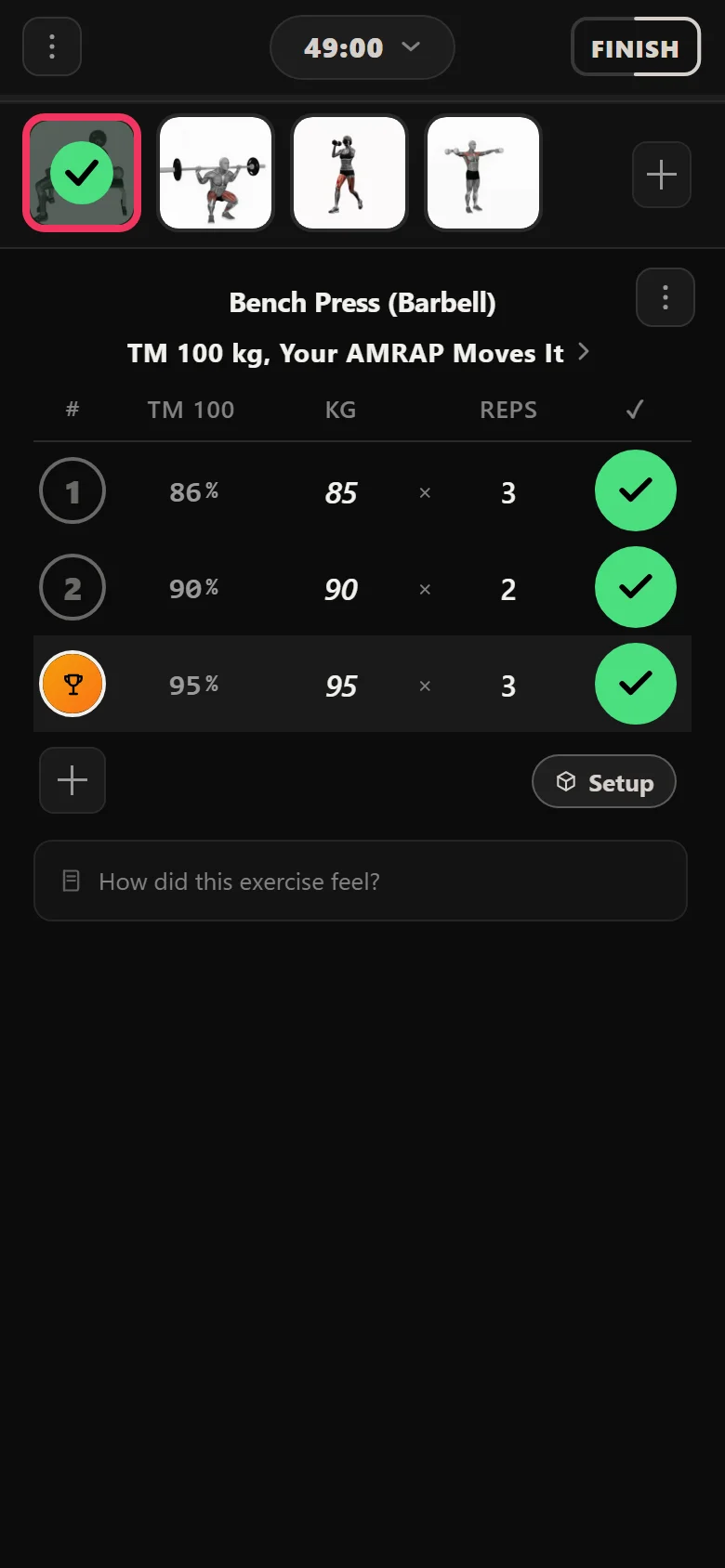
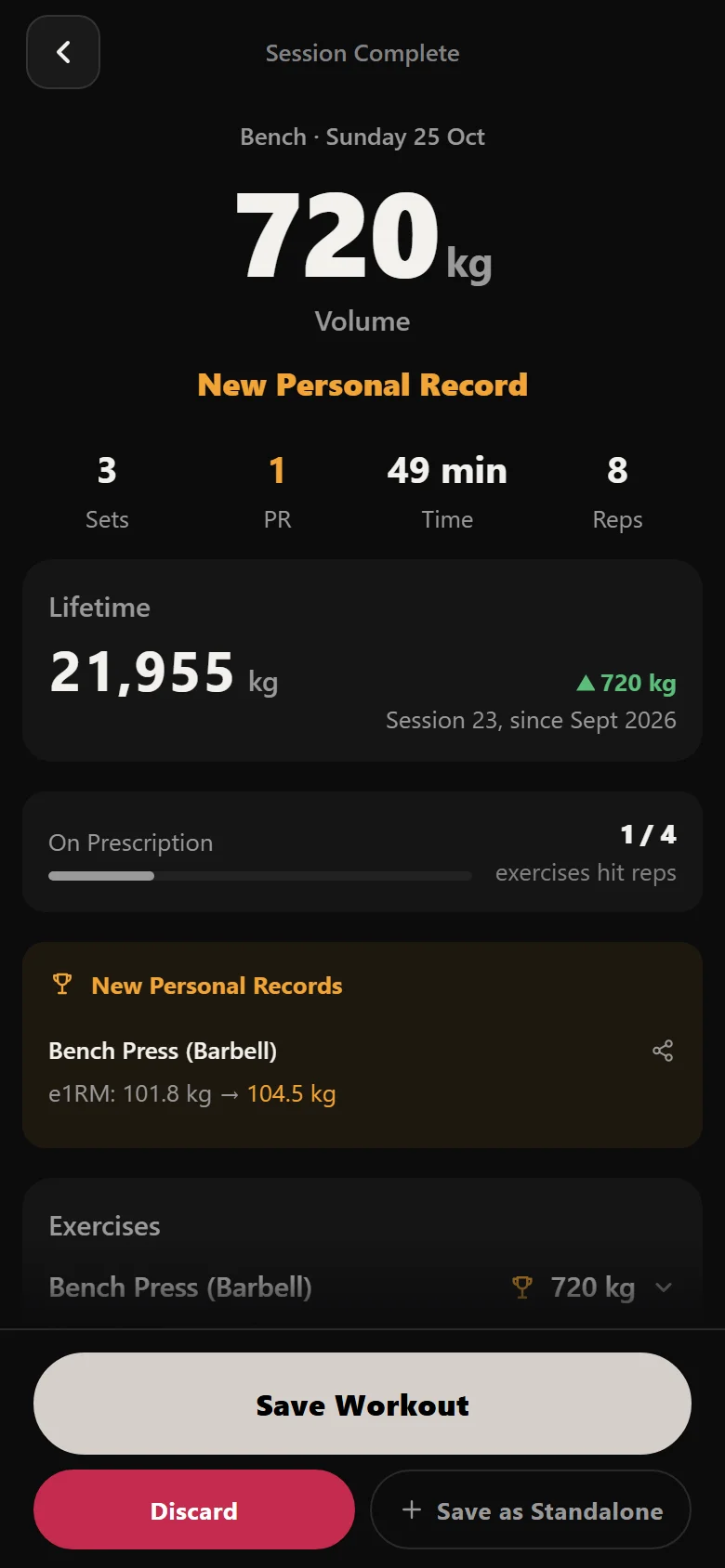
The last week opens lighter again and ramps to a single at ninety-five percent, repped out for as many as it has. The estimate that came off it was 104.5 kg against the 100 kg entered on day one.
Five weeks, twenty-five sessions, and about four and a half kilos on the bench. Written like that it sounds thin, and it is worth being straight about what a peaking block is for: it is not where strength is built, it is where strength already built gets expressed. UHF is what you run before a meet or before a retest, on top of a base that already exists.
The block ends with new estimates on five lifts at once, which is the more honest measure of a high-frequency block than any single number: 187 kg on the deadlift, 145.8 kg on the squat, 104.5 kg on the bench and 70 kg on the overhead press.
The strip below is the bench's opening set each week, deload-free, because this block does not have one.
Bench Press (Barbell): opening set of the T1 wave, week by week
- 80S1 Session 1 — block opens
- 85S2 Session 2
- 82.5S3 Session 3 — steps back
- 90S4 Session 4 — heaviest opener
- 85S5 Session 5 — test week
What twenty-five sessions in five weeks looks like
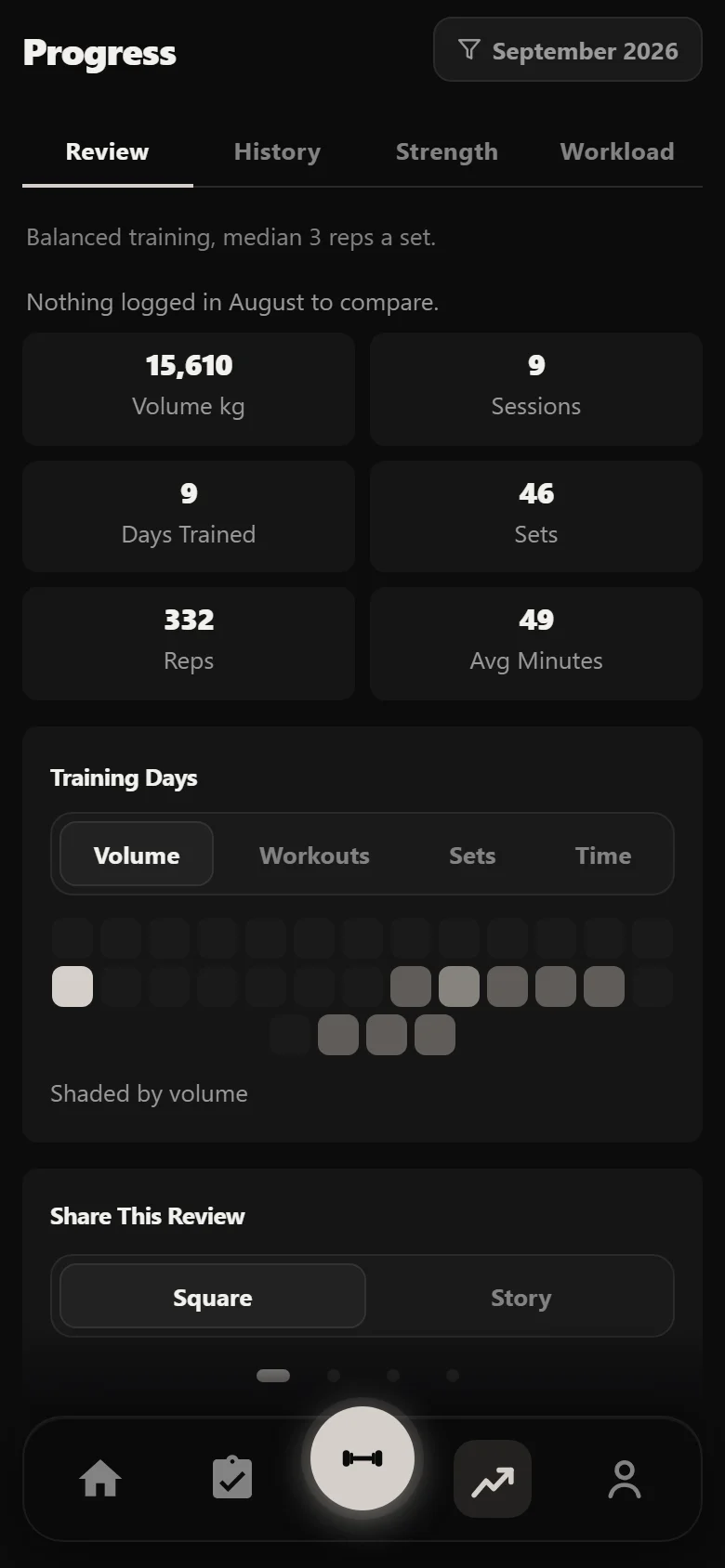
The Review tab reads one month at a time, and September alone came to 15,610 kg across 9 sessions, 46 sets and 332 reps, a median of 3 reps a set. Set against a twenty-week powerbuilding block that is not a large number, and set against a few weeks it is a great deal of work in a short window.
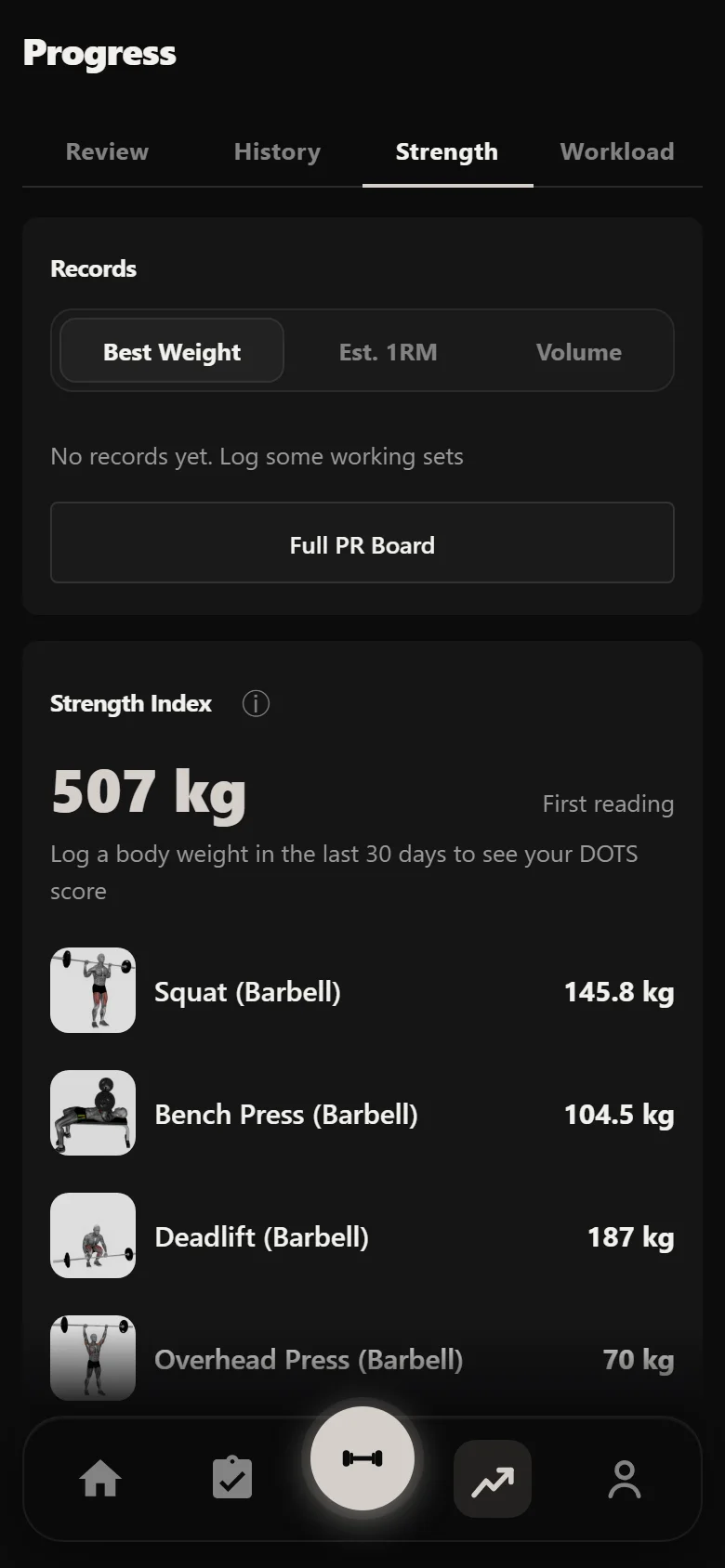
The strength view is where the frequency argument gets tested. All the lifts move, not just the one the block is named around, and the Strength Index adds them up: 507 kg on its first reading, from 187 kg on the deadlift, 145.8 kg on the squat, 104.5 kg on the bench and 70 kg on the overhead press. On a five-week block that is a wider set of improvements than a single-lift specialisation programme would produce.
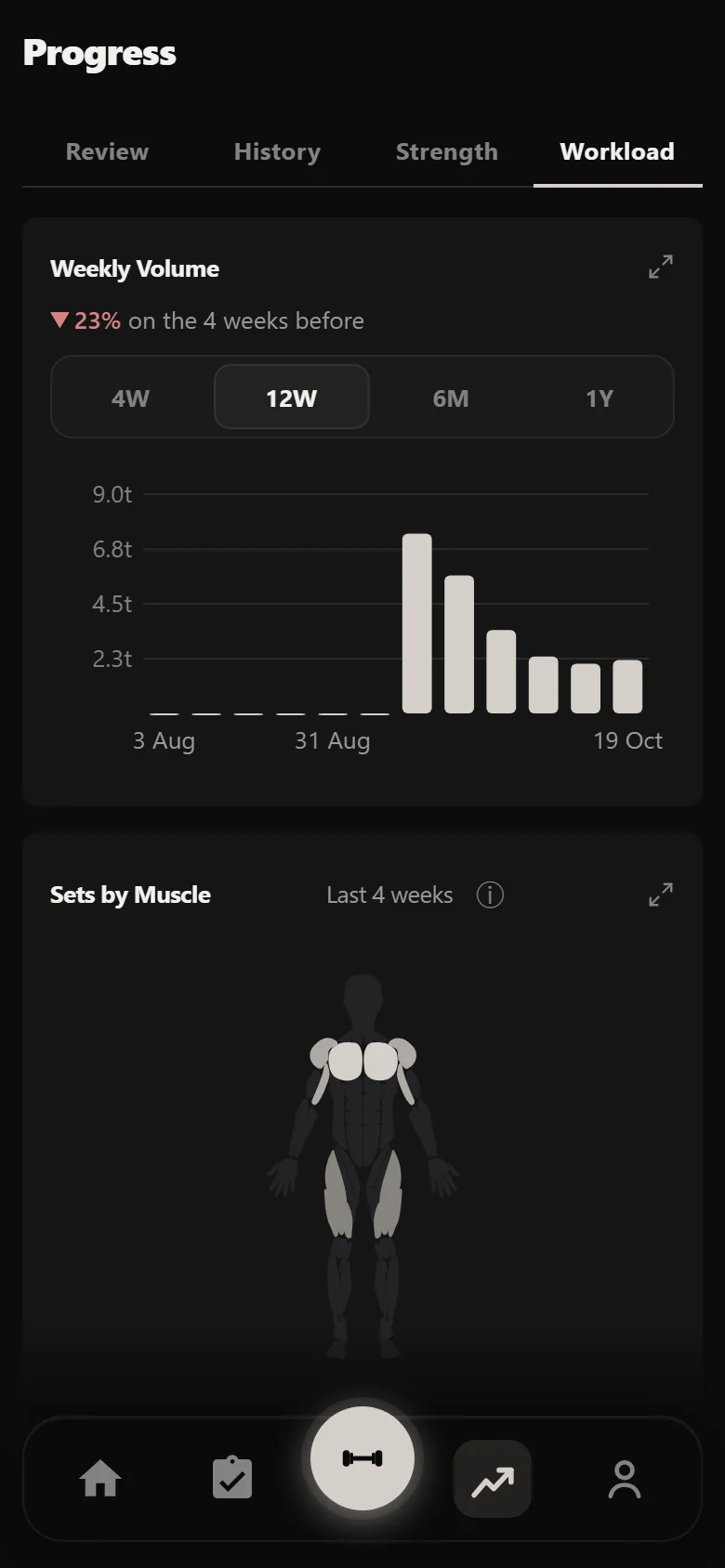
The workload view shows the cost side. Weekly volume is high and even rather than waving, and the muscle-group landmarks fill fast because everything is being trained repeatedly. If you are going to find out that you do not recover as well as you thought, this is the chart that tells you, and week three is when it usually says so.
Five weeks, seen from the outside
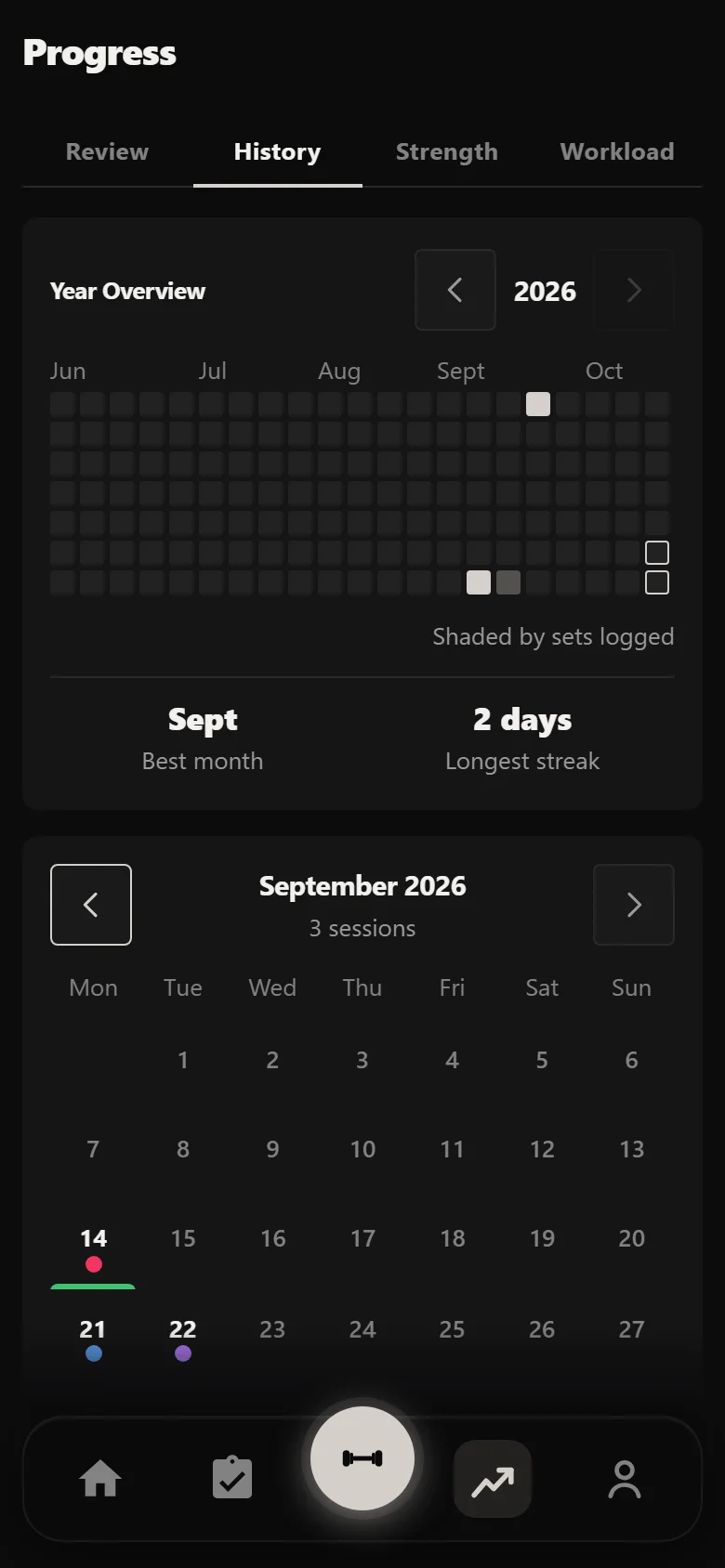
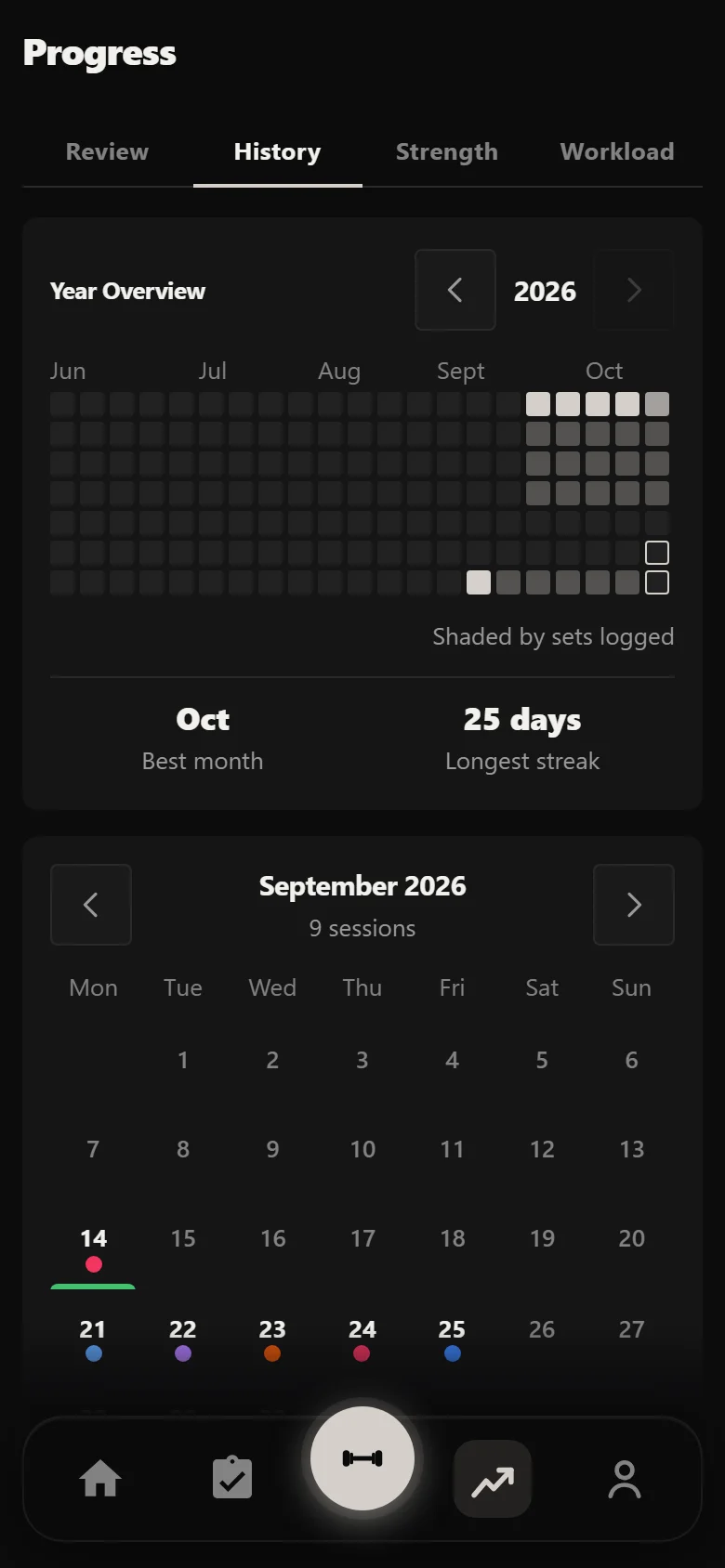
The History calendar holds all twenty-five sessions in a dense five-week block. There is no cycle boundary in it and no deload, which is unusual enough to be worth planning around: the recovery week for this program happens after it, not inside it.
It also explains why the block is short. Five weeks of this is a peak. Ten would be an injury, and the program knows it, which is why it terminates rather than repeating.
The payoff: the opening triples against the closing single
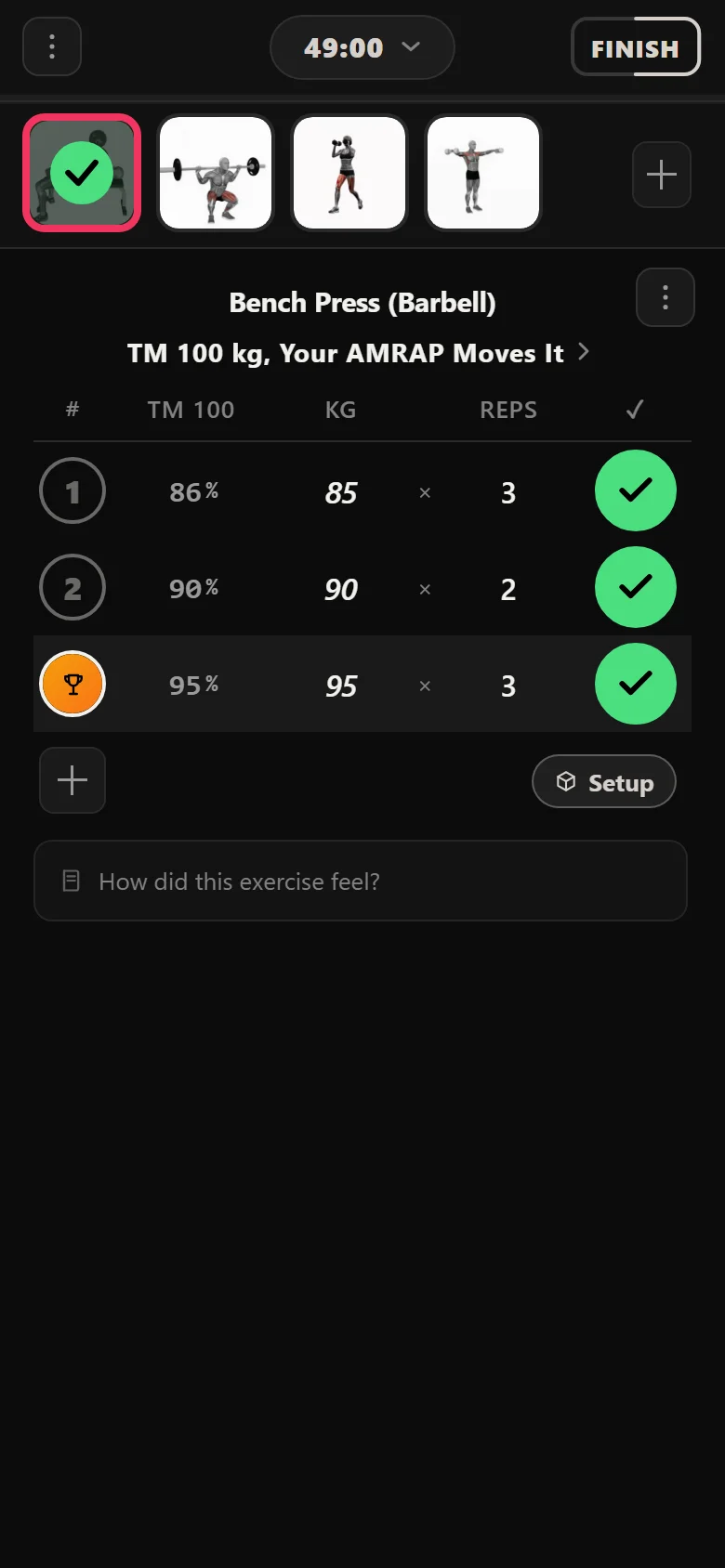
Two screenshots of the same lift on the same screen: week one and the test. Triples at eighty-one percent, and a ramp to a single at ninety-five, five weeks apart with the same 100 kg max underneath both.
The same 100 kg max under both, and an estimate of 104.5 kg off the final rep-out.
Common questions
What is GZCL UHF?
Cody Lefever's Ultra High Frequency block: five days a week for five weeks, with every competition lift or a close variant trained multiple times per week. Pressing gets the most exposure, squats three times a week, deadlifts twice. It is a short peaking block for advanced lifters, not a general training programme.
Why does it ask for so many training maxes?
Because every variation is treated as its own lift. This run entered ten: bench 100 kg, squat 140 kg, deadlift 180 kg, overhead press 70 kg, incline bench 90 kg, front squat 110 kg, pause squat 120 kg, close-grip bench 90 kg, Romanian deadlift 140 kg and incline dumbbell press 40 kg. Each one drives its own percentages, which is what lets the same movement pattern be trained most days without repeating the same load.
Why did week three open lighter than week two?
That is the GZCL wave, and it is deliberate. The block steps back before it steps up, and the ramp inside each session means a week that opens lighter can still finish heavier: week three opened at 82.5 kg and finished at 92.5 kg. Judge the wave on where the session ends, not where it starts.
Is five days a week too much?
It is for most people, most of the time, which is why the block is only five weeks long and has no deload inside it. The recovery comes after. If you are going to find out that the frequency is beyond you, it usually happens in week three, and the workload chart will have said so before you feel it.
My max only went up a few kilos. Was it worth it?
A peaking block expresses strength rather than building it, so a few kilos on the bar and new estimates across five lifts at once is roughly what a good outcome looks like. Run it on top of an existing base, retest at the end, and re-load your maxes before the next block.
Is Durata free?
Yes. Durata is free to use, with the full program catalogue, automatic percentage maths, rest timers and PR tracking. Everything in this walkthrough is in the app.
Put it into practice
Durata is free to use — 50 proven programs, automatic progression, rest timers and PR tracking, all on your phone.