


Candito 6 Week Strength in Durata: six weeks to drive progress on your main lifts
This run entered a 150 kg squat, a 100 kg bench and a 200 kg deadlift. Six weeks later the squat tested at 160 kg and the Strength tab read 167.2 kg, 110.5 kg and 221 kg. The stored training maxes still say 150, 100 and 200, and that is the point: Candito 6 Week Strength is a peaking block, so what it moves is what you can do on the day, not the number sitting in your settings.
It gets there the opposite way to everything else in the catalogue. Almost every program here has a rule that decides what happens next — add weight, hold the weight, cut ten percent, review the training max at the end of the cycle. Candito has none, and needs none. You enter one number per lift and all six weeks resolve from it immediately, because the climbing percentages ARE the progression.
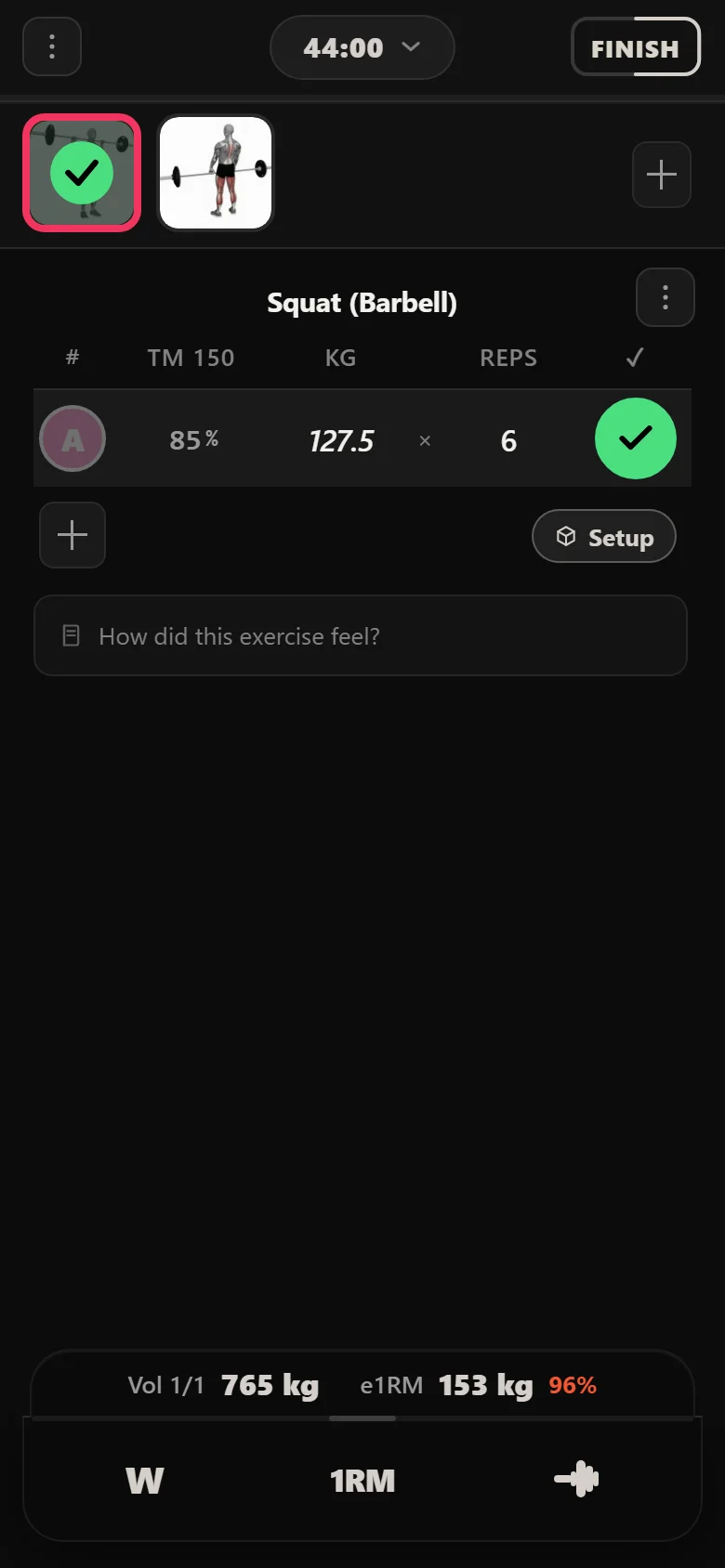
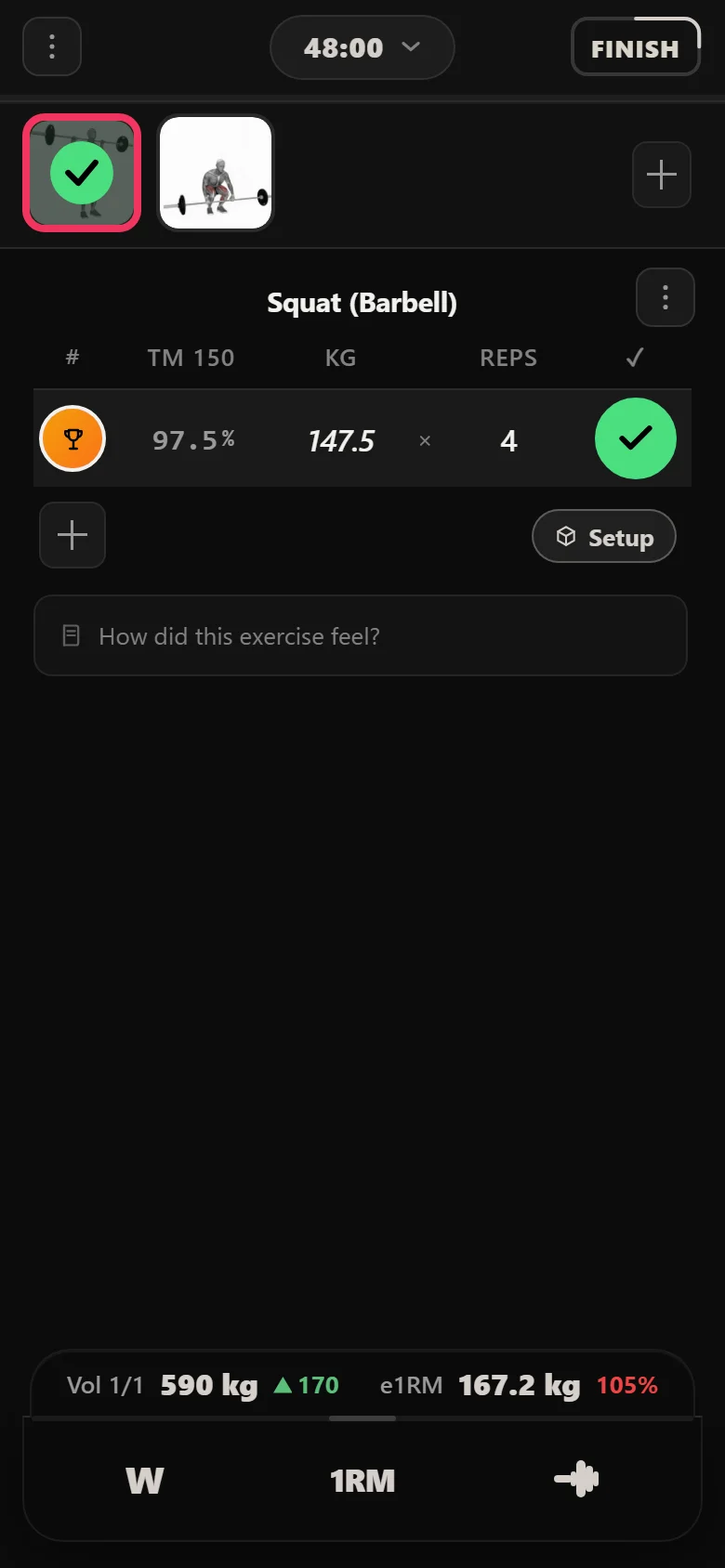
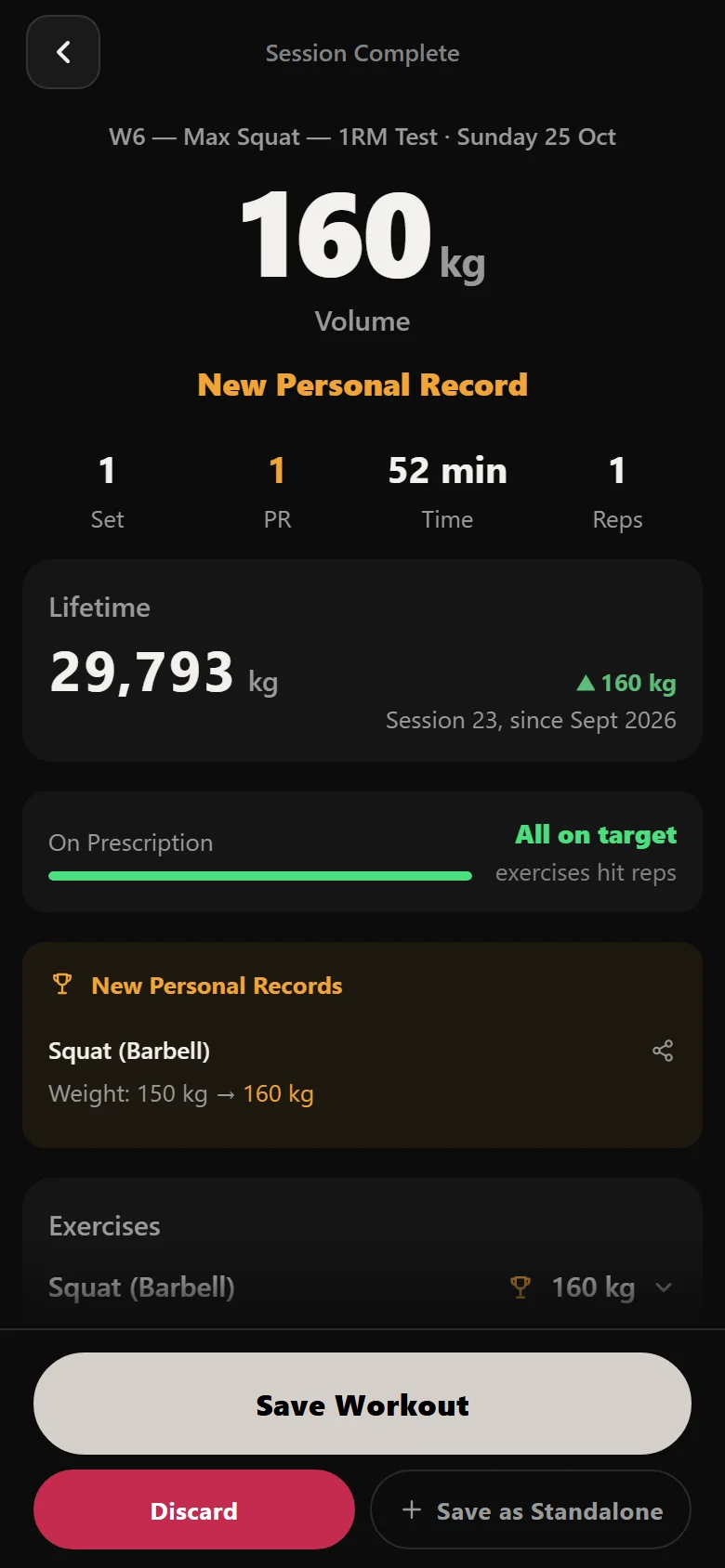
So the feedback does not arrive as a weight going up week by week. It arrives as the rep-outs, and then as the test. Week three put 127.5 kg on the bar and the estimate came back at 153 kg. Week five put up a single at 147.5 kg, repped out, and the estimate jumped to 167.2 kg. Week six prescribes no weight at all. It is an open single, the one session of the block where you pick the number, and this run took it to 160 kg.
Finding the program
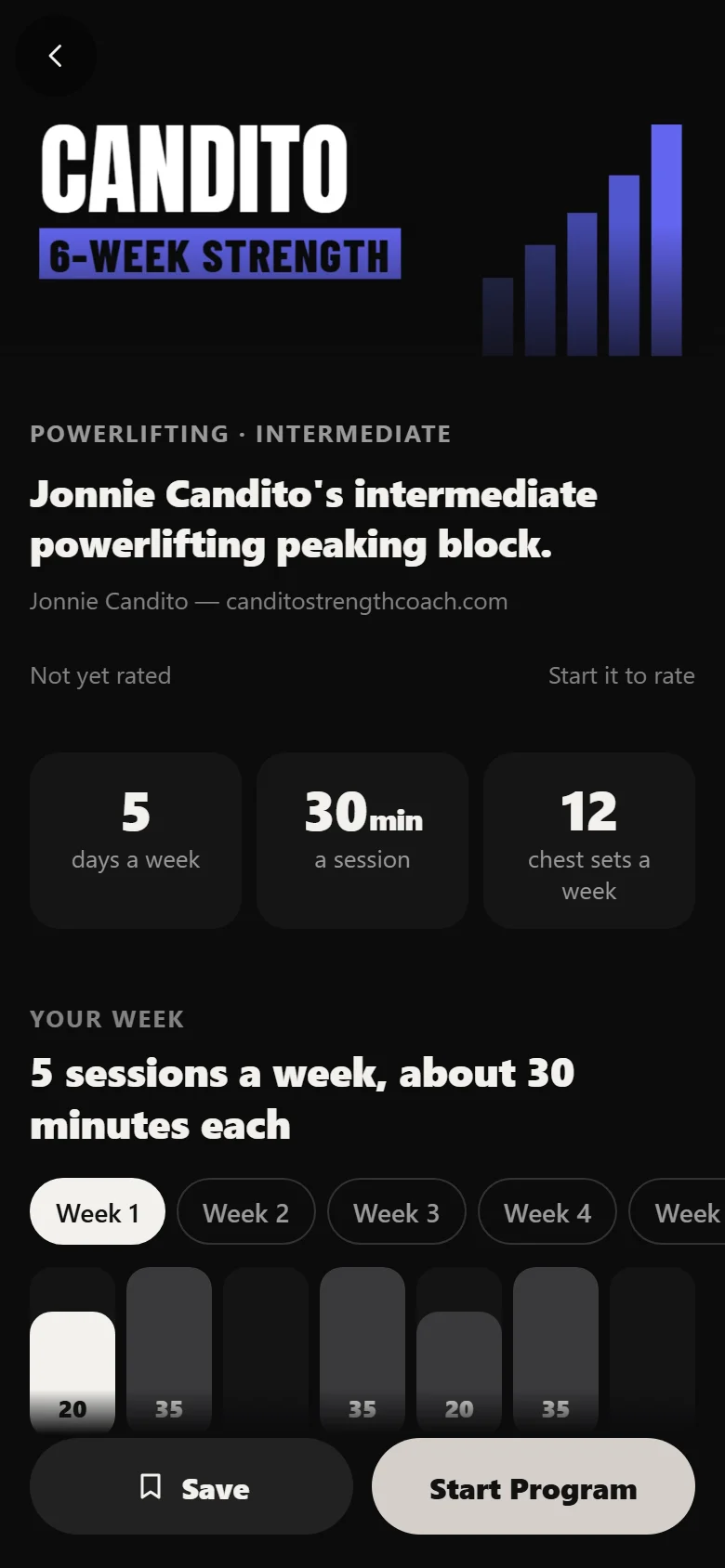
In Discover, Candito 6 Week Strength sits on the Powerlifting shelf, marked Intermediate, at five days a week. Search finds it by name, or Filter narrows the shelves by level and days a week. Tap the cover for a quick look, then View Program for the full page.
The program page is where the difference shows. There is no increment and no deload rule to read, because the schedule does all of it: six weeks, each with its own character, running from high-volume conditioning work through to a single-rep test. What you are agreeing to is the shape of the block rather than a rule that will be applied to you.
One number per lift, and then no more decisions
Setup asks for a current max on each of the three lifts the program prescribes by percentage: the squat, the bench press and the deadlift. This run entered 150 kg, 100 kg and 200 kg. That is the last decision anybody makes about weight for six weeks.
Every set of the first five weeks is then resolved from those numbers. Week one runs in the seventies and eighties, week three moves to the mid eighties, week five reaches ninety-seven and a half percent. None of it depends on how the previous week went, which is unusual enough to be worth saying plainly: this program does not react to you. Week six is the exception, and the only one: the test day prescribes no weight, because the whole block exists to find a number the entered max does not already contain.
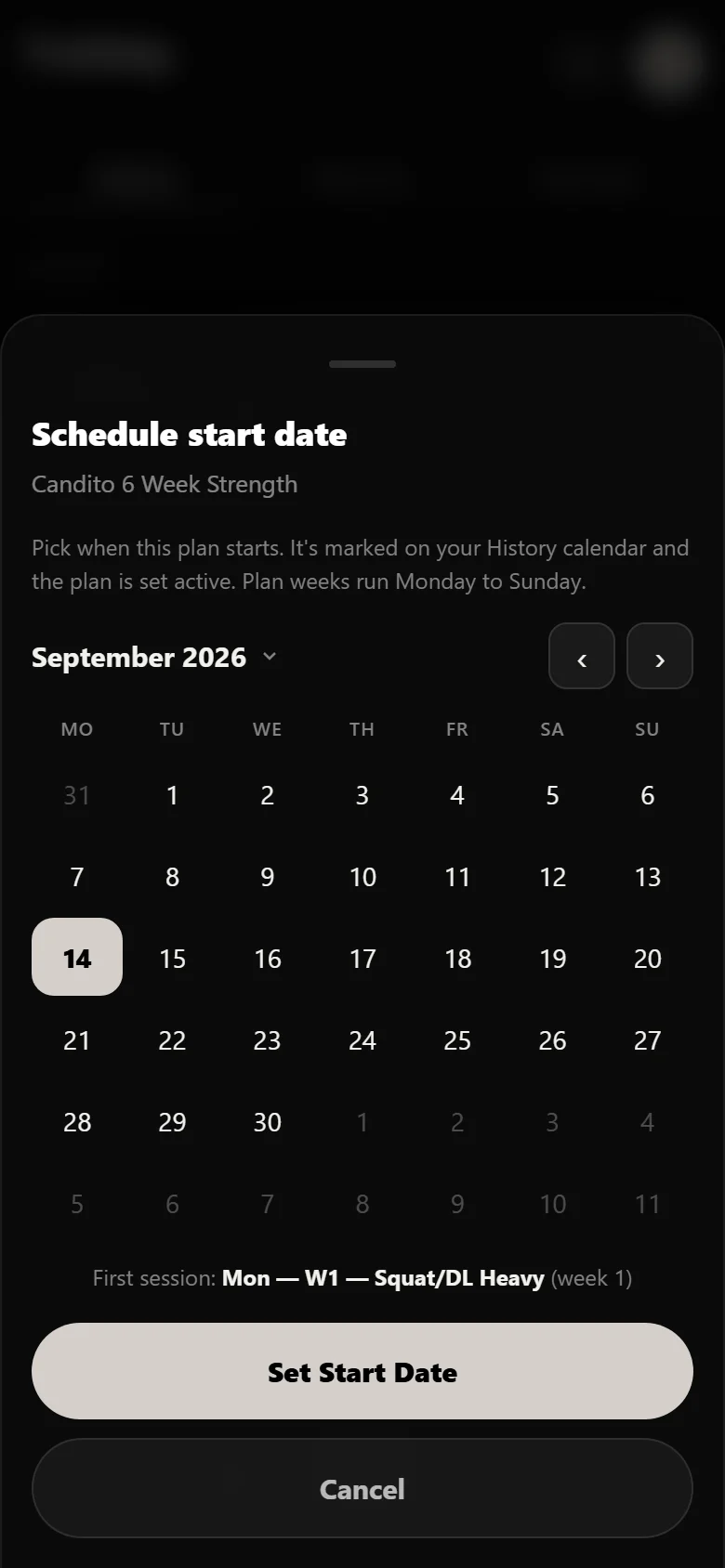
A start date puts the whole finite block on the calendar in one move. Six weeks, twenty-four sessions, twelve of them on the squat and deadlift, and then it stops. There is no cycle two waiting on the other side of it.
Weeks one and two: volume, and nothing near a limit
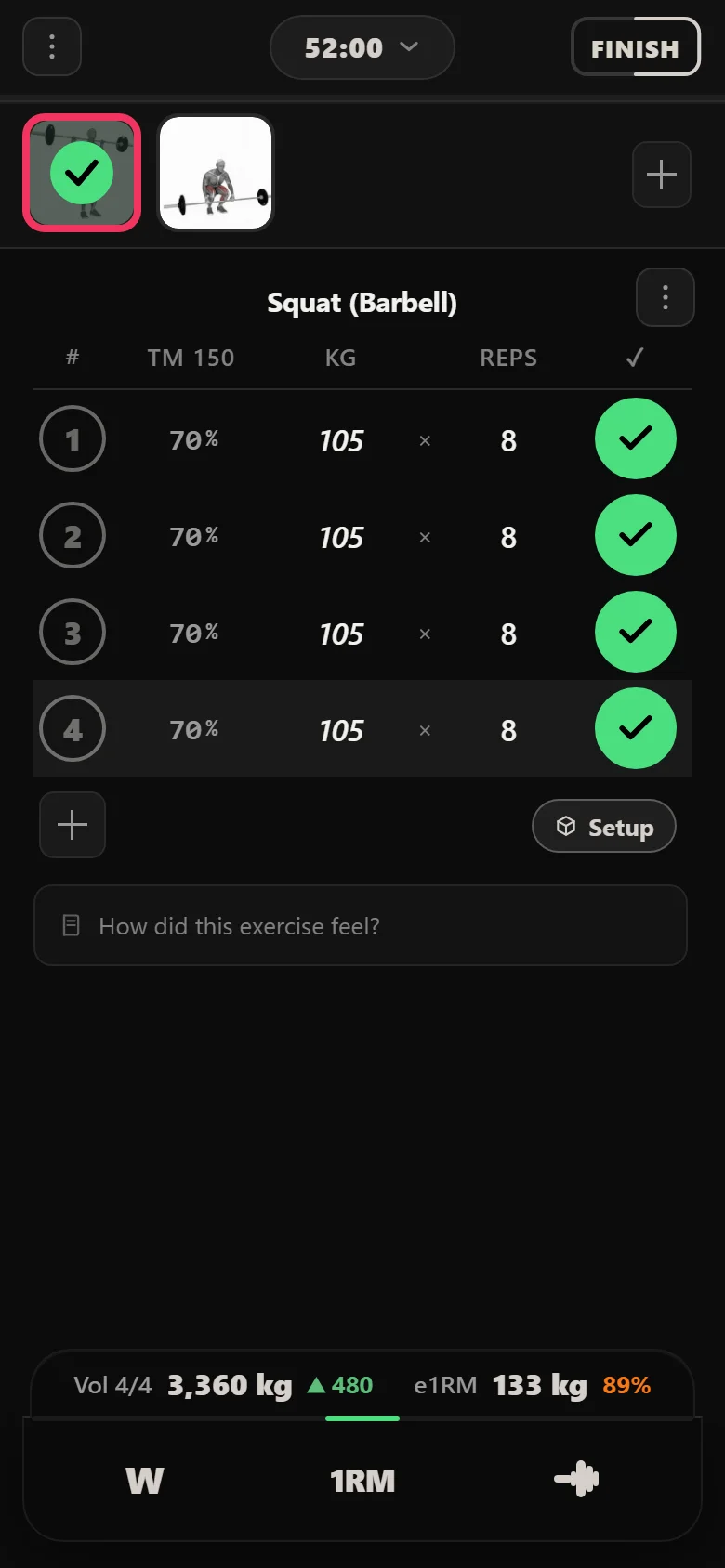
The first phase is conditioning work, and it is deliberately unimpressive. The squat runs four sets of six at eighty percent on the first day of the week and four sets of eight at seventy percent on the second, which puts 105 kg on the bar against a 150 kg max. Two squat days a week, high reps, no rep-outs, nothing that could go wrong.
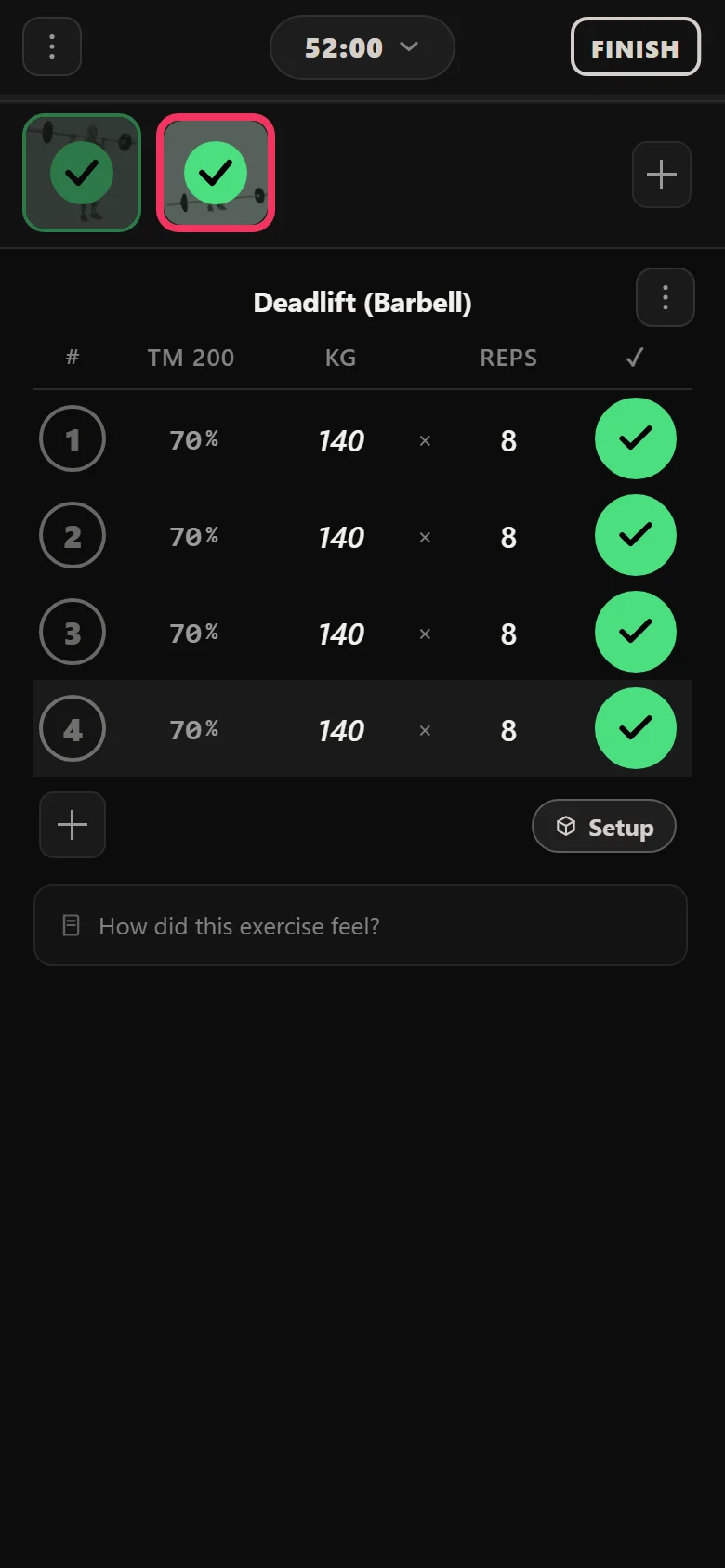
The deadlift runs off its own entered max on the same percentage schedule, so the heavy pulling and the heavy squatting climb together rather than competing. The upper-body days carry the bench press and the assistance work, which is where most of the week's remaining volume lives.
This is the phase people skip, and skipping it is why the later weeks stop working. The percentages in week five assume six weeks of accumulated work underneath them; run them cold and the schedule is just a heavy day with no base.
Weeks three and four: the reps drop, the bar climbs
The second phase is where the program starts asking questions. The reps come down into the four-to-six range, the bar goes to eighty-five percent, and the last set is taken for as many as you have. On this run that is 127.5 kg on the squat, and the app resolves it without being told, because it is simply a percentage of the number entered in week zero.
Week four splits the difference between the two phases: one heavier day and one lighter one, the bar reaching 140 kg by the end of the week. The rep-outs from here on are what tell you whether the entered max was honest, which is the only feedback loop the program has.
The strip below is every squat appearance across the block. It is not a ladder that was built one session at a time. It is a curve that existed in full before the first session was logged, and the drive simply walked it.
Squat (Barbell): prescribed working weight, session by session
- 120S1 Session 1 — week 1
- 105S2 Session 2
- 120S3 Session 3 — week 2
- 120S4 Session 4
- 127.5S5 Session 5 — week 3
- 127.5S6 Session 6
- 132.5S7 Session 7 — week 4
- 140S8 Session 8
- 147.5S9 Session 9 — week 5
- 160S10 Session 10 — the test
Week five, then the day the block was built for
Week five is a single working set at ninety-seven and a half percent, repped out. It is 147.5 kg here, and it is the last information the block gives you before the test. The estimate the app takes off that set is 167.2 kg, well above the 150 kg entered six weeks earlier, which is the program telling you the entered number was conservative.
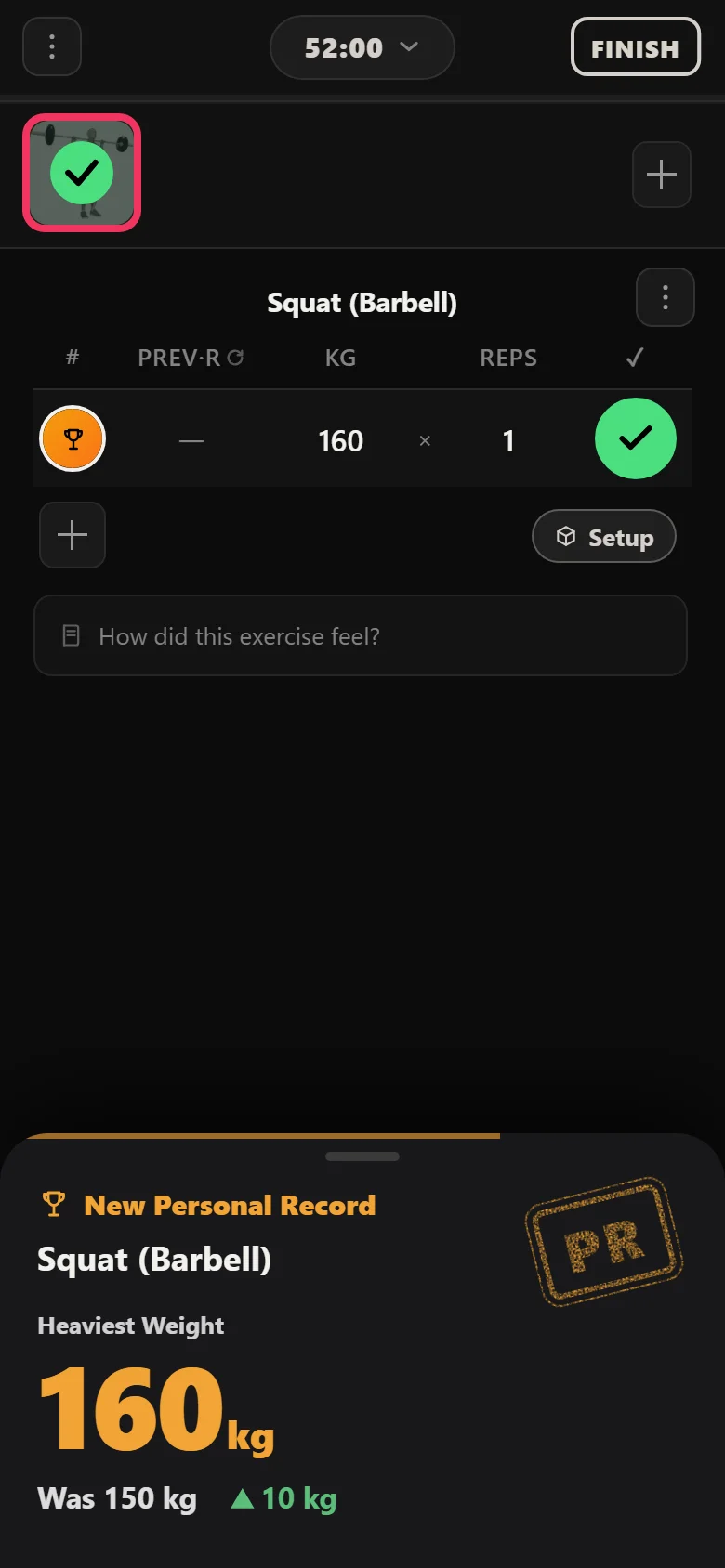
Week six is one rep, and Durata leaves the weight field empty. That is deliberate: a test pinned to a percentage of the max you entered six weeks ago could only ever hand it straight back, so the last session of the block is the one where the app prescribes nothing and you work up. There is no assistance work stacked behind it and no volume to grind out afterwards. This run took it to 160 kg, ten kilos over the entry and a little under what the week-five rep-out had estimated — which is the usual shape of a test day against an estimate.
Then the block ends. Durata marks it complete rather than rolling it into a second cycle, because a peaking block that repeats is no longer a peaking block. You retest, enter the number the test gave you, and the next six weeks resolve off that instead.
What the block leaves behind
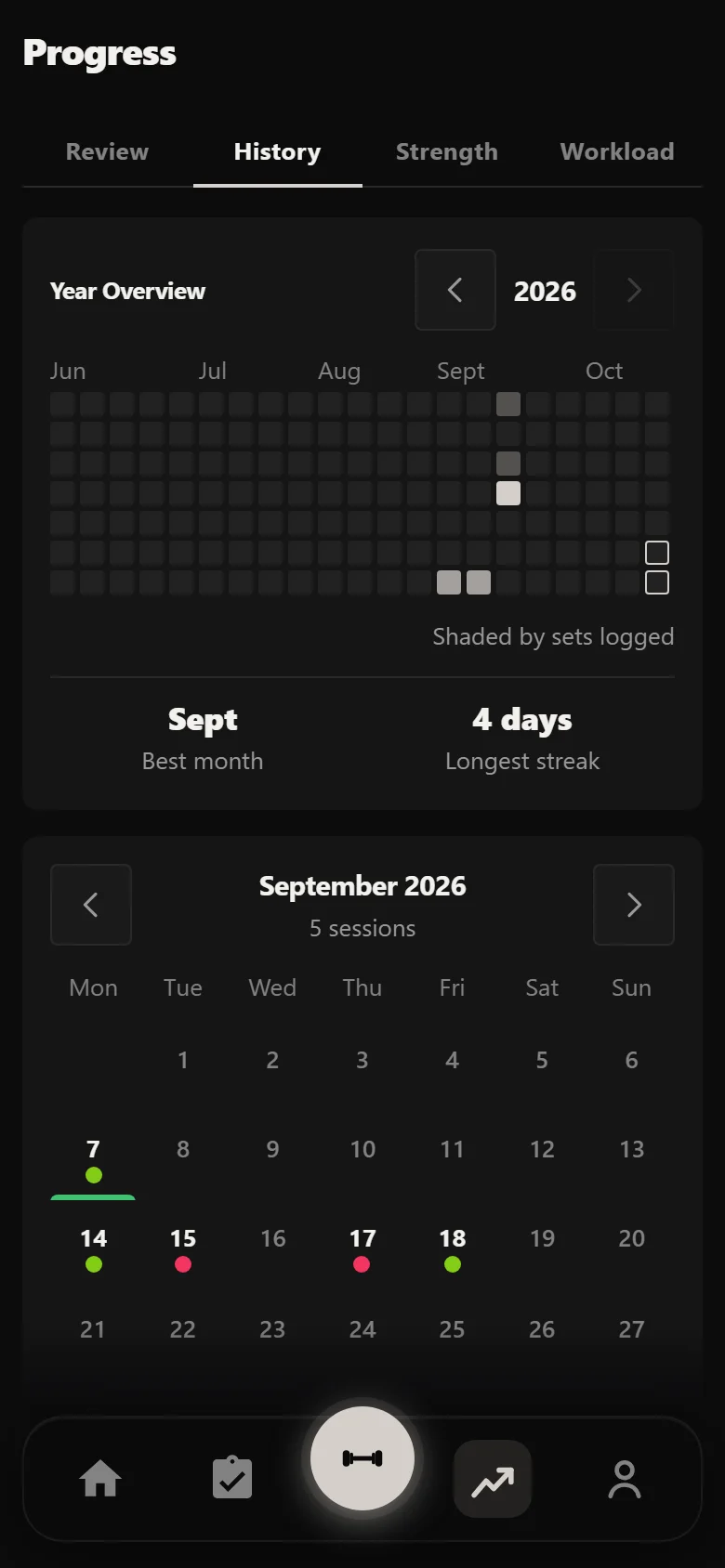
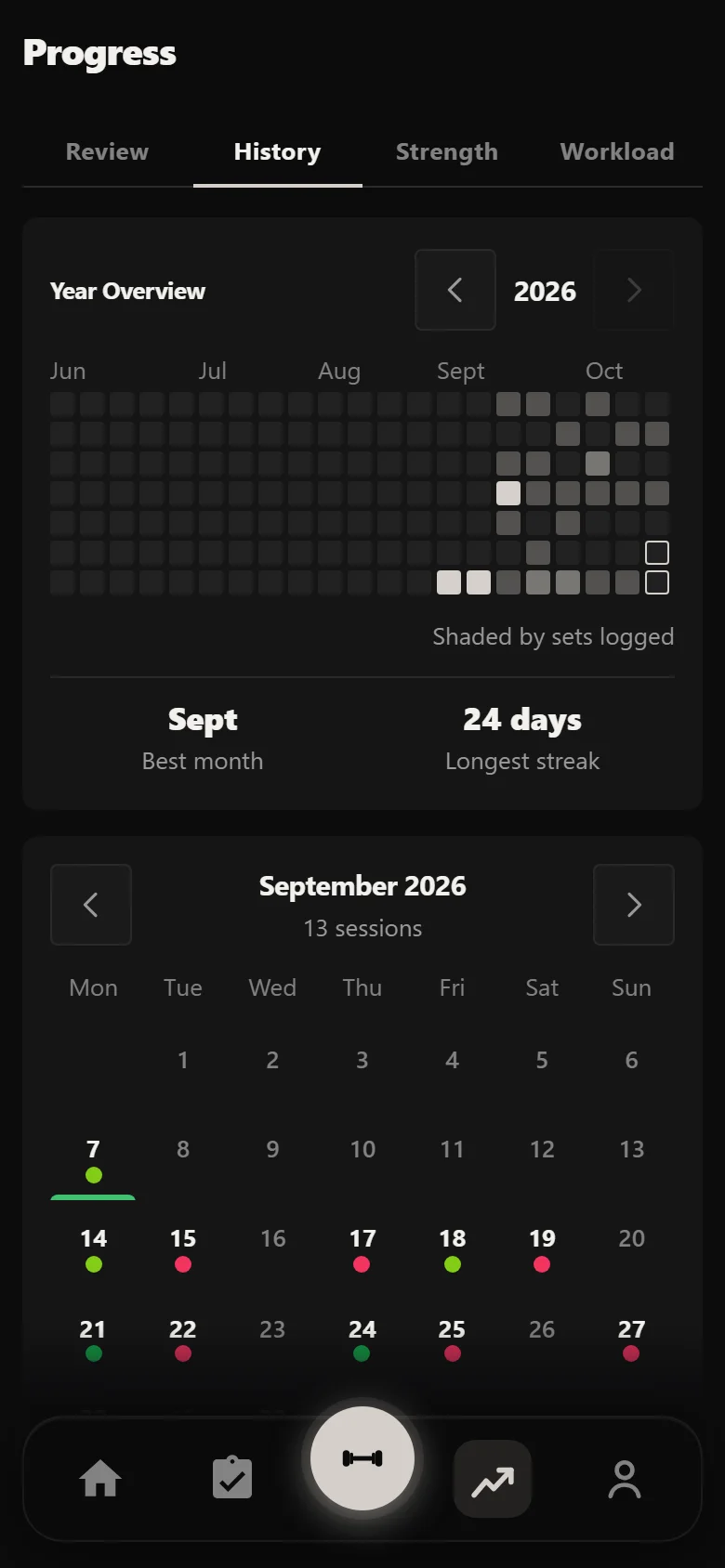
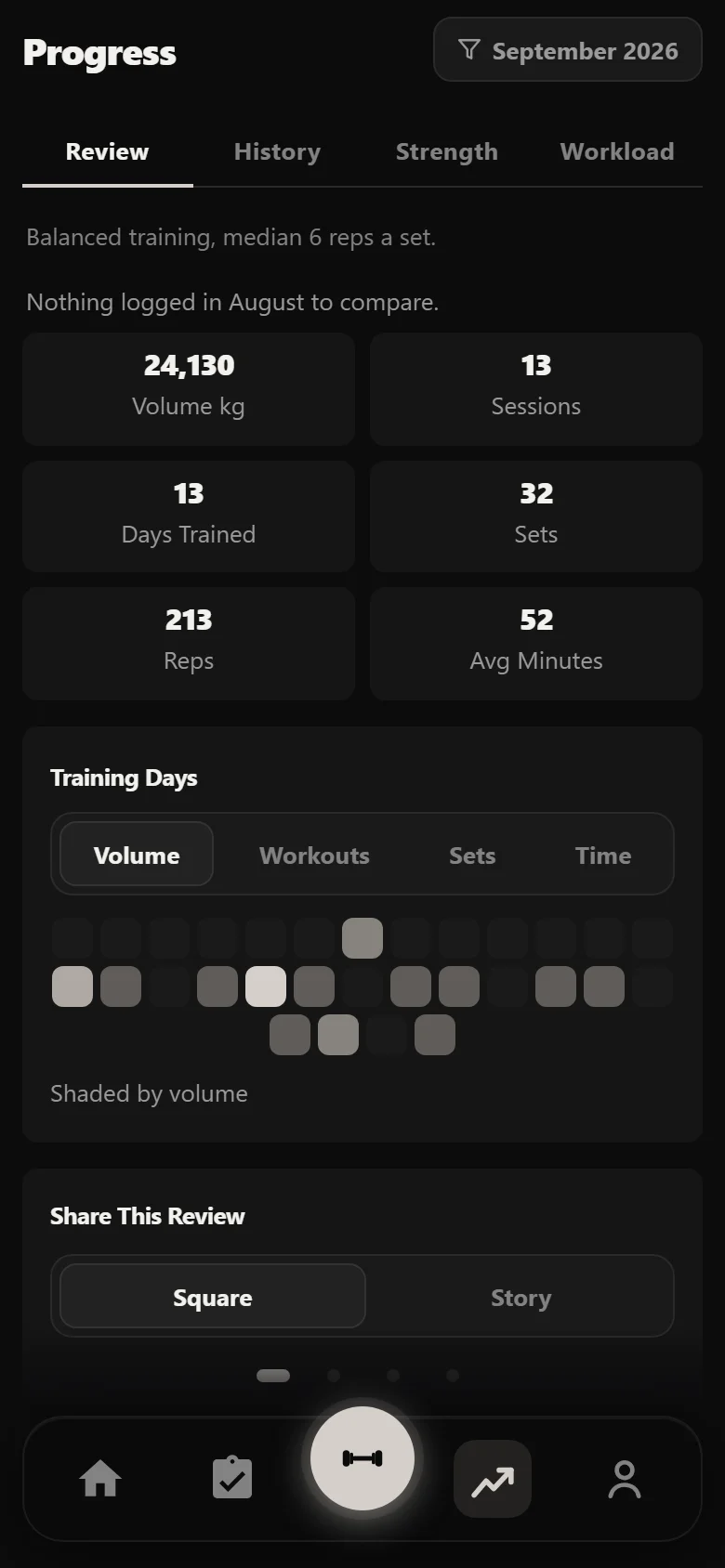
The History calendar holds all twelve main sessions across the six weeks, and the shape of them is visible from the calendar alone: dense early, sparse and heavy at the end.
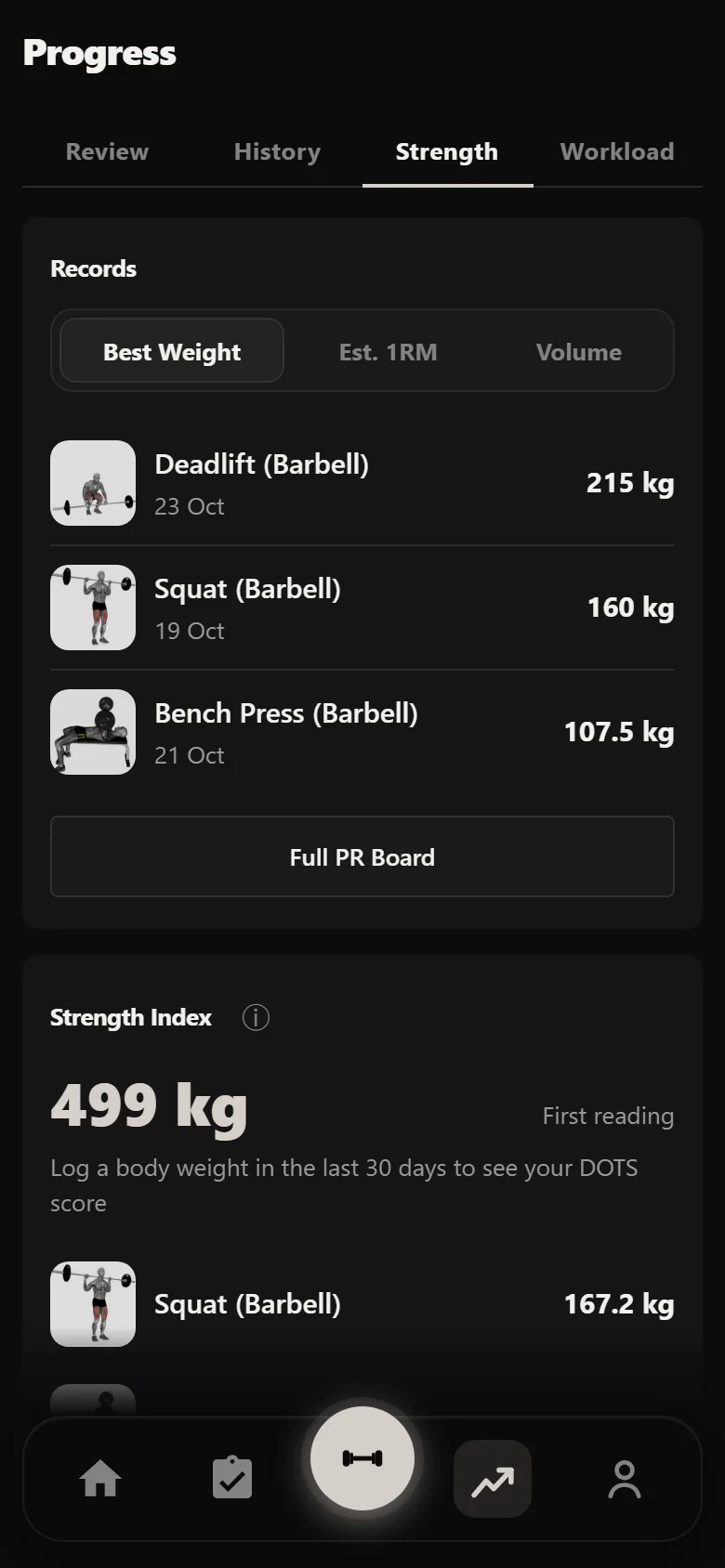
The strength view is the useful one. It carries an estimated max per lift, and on a peaking block that estimate does what the program does: it undulates through the volume weeks, where heavy sets of eight say little about a single, and then rises sharply into the test. The deadlift finishes at 221 kg, the squat at 167.2 kg and the bench at 110.5 kg, all of them above the numbers entered at setup.
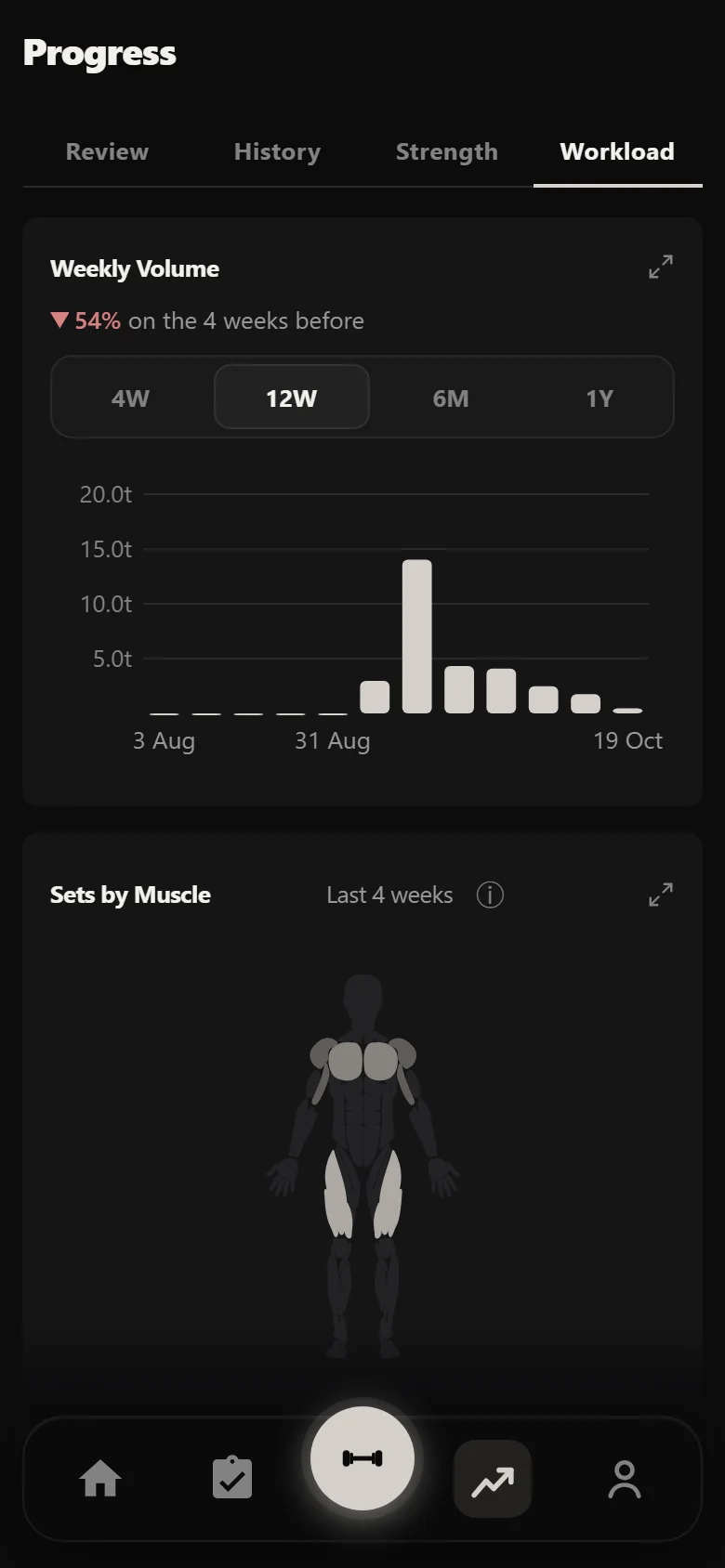
The workload view shows the other half of the argument. Weekly volume is front-loaded into the conditioning phase and falls away as the intensity climbs, which is the trade every peaking block makes and the reason the block has to end. You cannot hold that shape indefinitely; you run it, test, and start again from the new number.
The payoff: 150 kg in, 160 kg out
Two screenshots of the same squat six weeks apart. The first is the second conditioning day of week one, four sets of eight at 105 kg. The second is the test, one rep at 160 kg. Nothing between them was decided by a rule reacting to performance — the whole curve was resolved from a single number before the block began, and then the last session handed the decision back to the lifter.
The Strength tab tells the same story from the other side. The estimated max went 150 at setup, 153 off the week-three rep-out, then 167.2 off the repped-out single in week five. The stored training max never moved because Candito never asks it to — the block is finished, not rolled over. The 160 kg you actually made on the test is the number you enter when you run it again.
105 kg to 160 kg in six weeks. Every step up to week five was a percentage of the same entered max rather than a reaction to the session before, and the test day that closes the block prescribes nothing at all.
Common questions
What is Candito 6 Week Strength?
Jonnie Candito's six-week peaking program. It runs in phases: two weeks of high-volume conditioning work, two weeks where the reps drop and the intensity climbs, a heavy single-set week, and an open 1RM test in week six. Every prescribed weight in the first five weeks is a percentage of a max you enter at the start; the test itself prescribes nothing. The block finishes rather than repeating.
Why does my training max never go up?
Because this program has no progression rule to move it. The six weeks of climbing percentages are the progression, so the number you enter at setup is the reference for the whole block and stays where it is. When the block ends you retest, enter the new number, and the next run resolves off that.
If nothing goes up, does the block actually do anything?
It does, but not as a training max climbing week by week. On this run the squat was entered at 150 kg and tested at 160 kg, with the Strength tab reading 167.2 kg off the week-five rep-out; the bench estimate went 100 to 110.5 and the deadlift 200 to 221. A peaking block is not trying to add weight every week. It is concentrating what you already have onto one day and then letting that day tell you what it is worth.
What max should I enter?
A number you could genuinely hit today, not a goal. Every percentage in the block is taken off it, and weeks four and five sit close enough to the top that an optimistic entry makes them unmakeable rather than merely hard. On this run 150 kg was entered for the squat, the week-five rep-out estimated 167.2 kg, and the test made 160 kg — which is what a conservative entry looks like.
Can I run it back to back?
You can run it again, but not as a continuation. Retest first, take the number the test gave you, and start a fresh block off it. The volume is deliberately front-loaded and the intensity deliberately late, so the shape only works from a fresh start rather than bolted onto the end of the last one.
Is Durata free?
Yes. Durata is free to use, with the full program catalogue, automatic percentage maths, rest timers and PR tracking. Everything in this walkthrough is in the app.
Put it into practice
Durata is free to use — 50 proven programs, automatic progression, rest timers and PR tracking, all on your phone.