


One set of twenty: the 20-Rep Squat, session by session
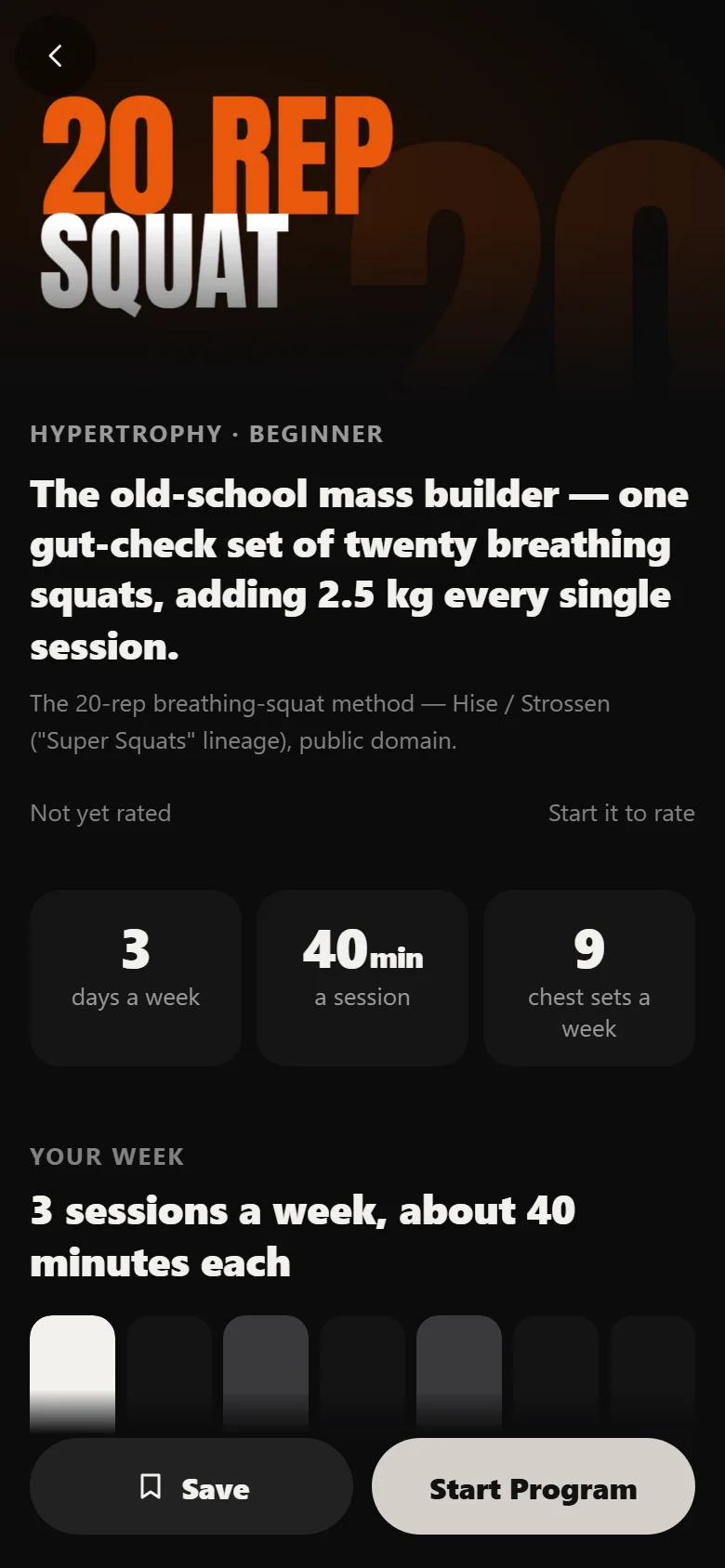
Most squat programs give you five sets. This one gives you one. Take a weight you could manage for about ten, then grind out twenty with deep breaths between reps, and add 2.5 kg the next session, whether you feel ready or not. It's the oldest mass-building protocol in lifting and it is brutally simple to track, because there's nothing to average out: one set decides the session.
That makes it an unusually honest test of a progression engine. There's no second set to redeem a bad first one, no top-set-plus-back-offs to hide behind. Either you got twenty at the prescribed weight or you didn't. This run is an intermediate's: a 100 kg squat, three sessions a week, six weeks, and every weight below was computed by the app from the sets that were logged.
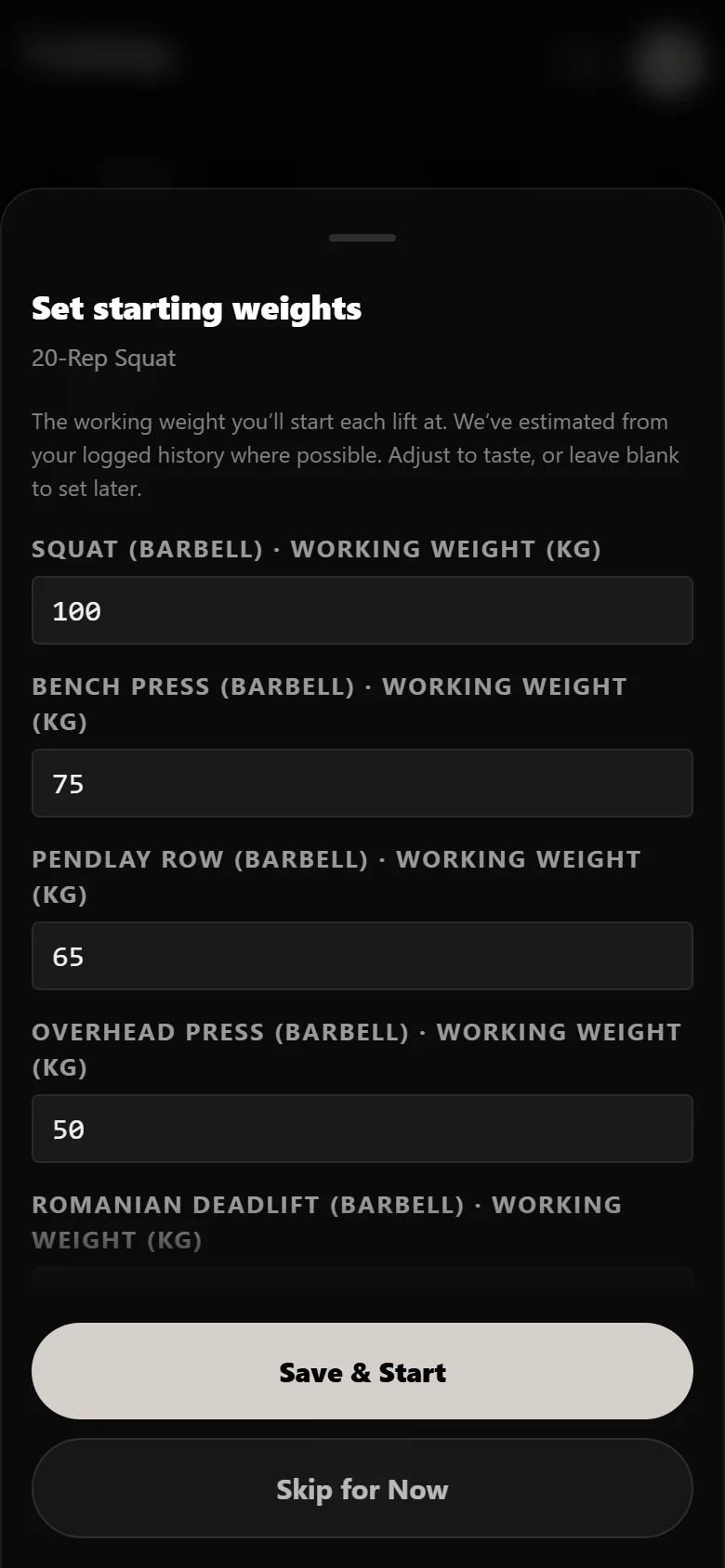
Setting it up
The setup asks for one number that matters: the weight you'll start the twenty-rep set at. The rule of thumb is a weight you could squat for ten good reps. You will find the other ten. Starting at 100 kg here.
The rest of the session is deliberately unglamorous: a dumbbell pullover straight after the squat, then bench, row, overhead press, Romanian deadlift and calf raises to cover everything else. Those run double progression, reps inside a range first and weight second.
2.5 kg a session, and no negotiation
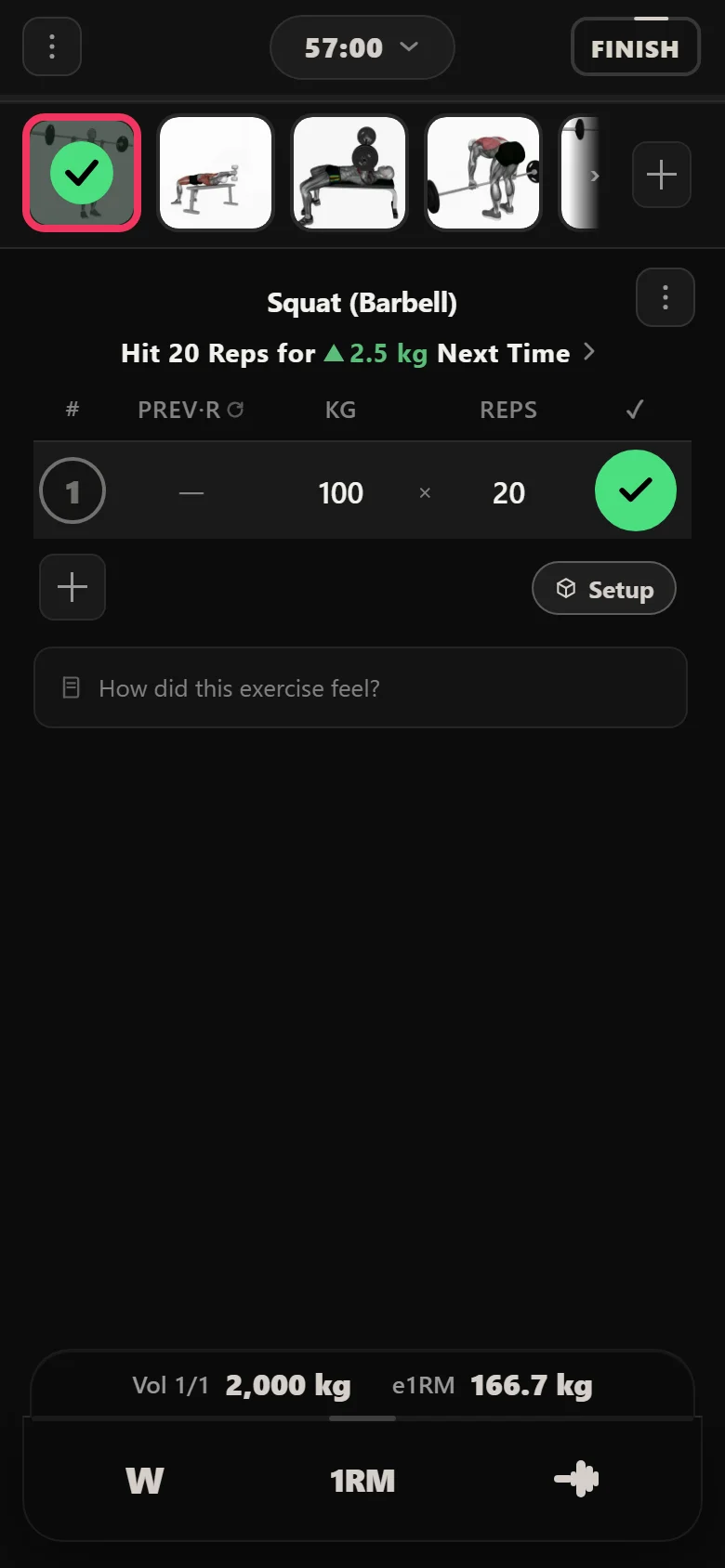
Complete twenty and the app adds 2.5 kg to the next session. Three sessions a week means 7.5 kg a week going onto the bar, which sounds trivial written down and stops being trivial around the third week.
The climb is relentless by design: 100, 102.5, 105, 107.5, 110, 112.5, 115. Seven sessions, 15 kg heavier, same twenty reps. The PREV column shows what you did last time, and the chip on the exercise shows the rule. You turn up and the number is already decided.
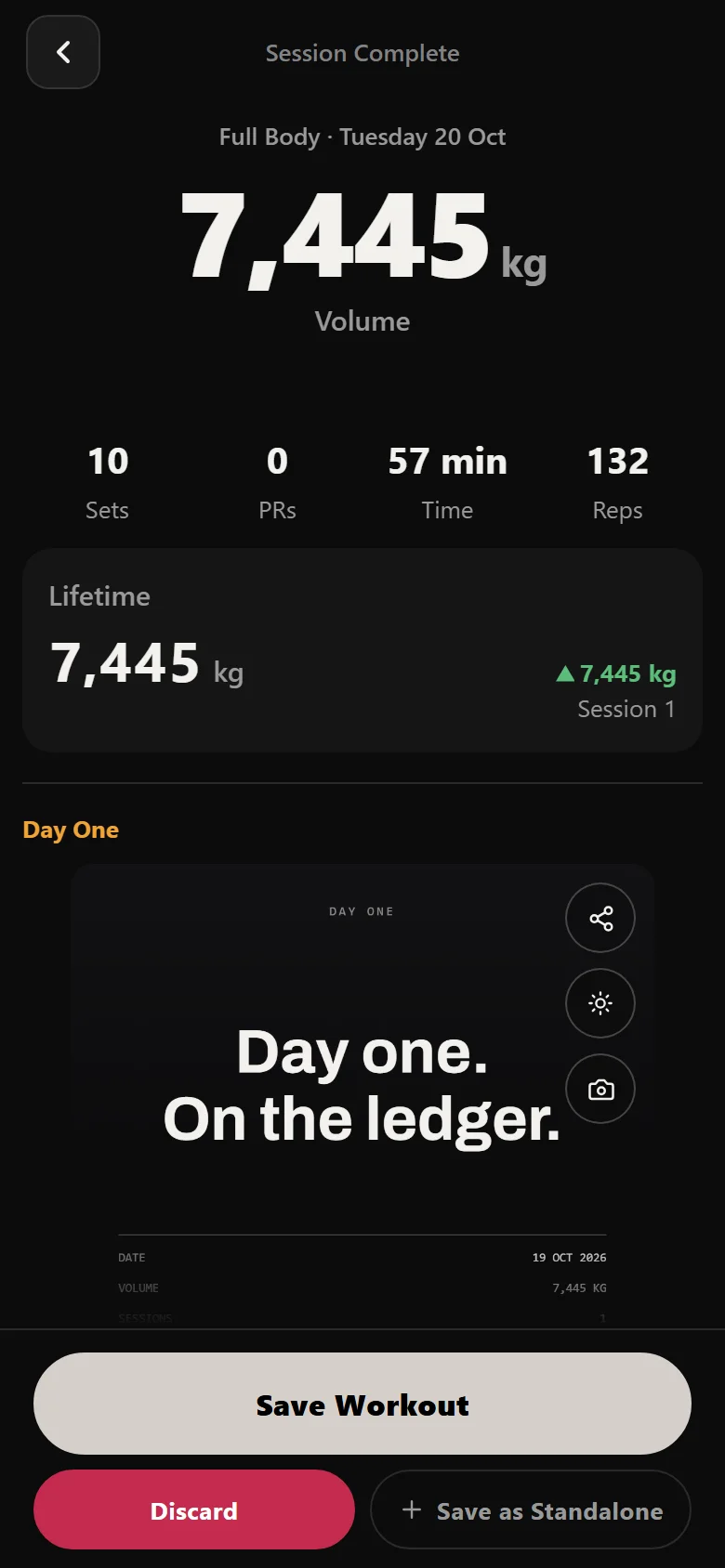
The session-complete screen tallies the whole thing before it saves: 10 sets, 132 reps, 7445 kg moved between the squat and the supporting work.
The set that doesn't finish
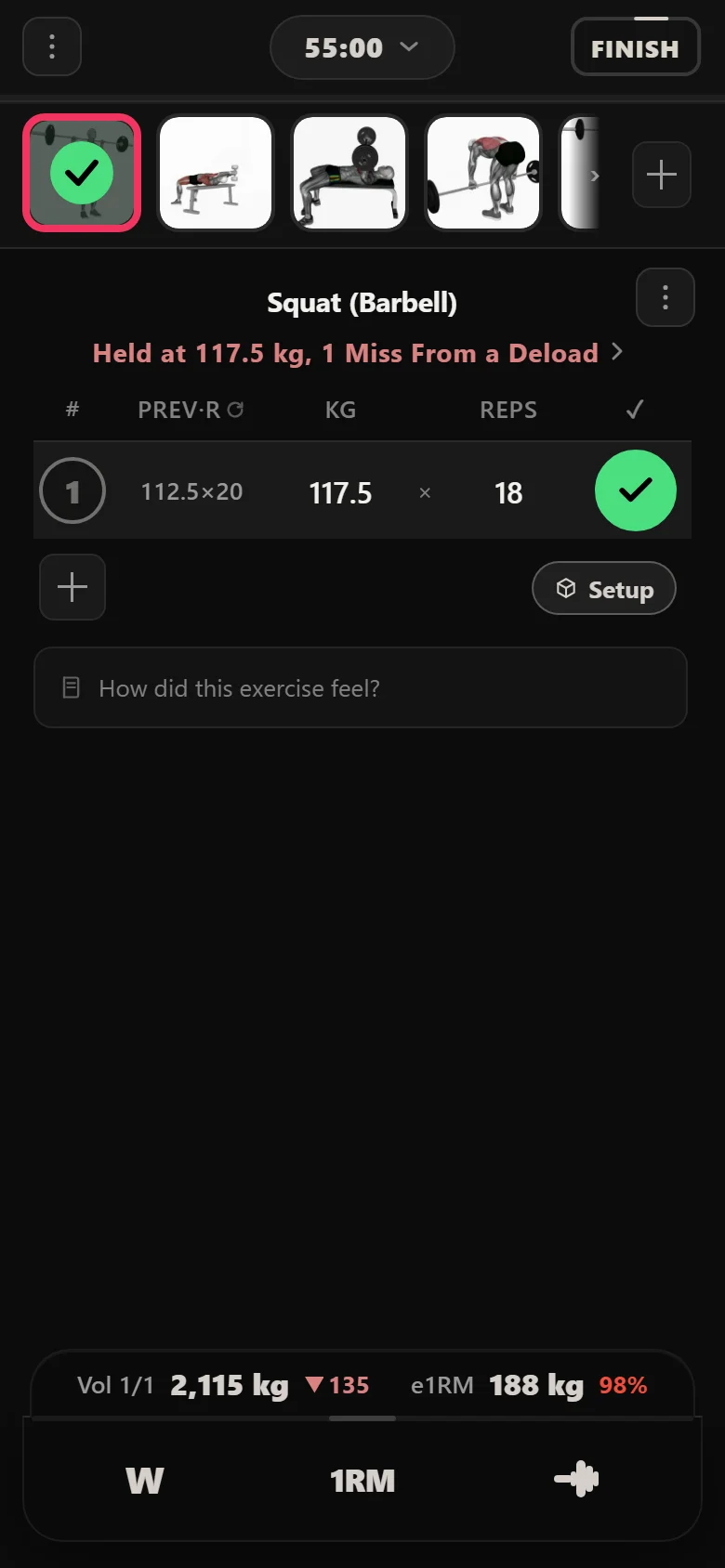
At 117.5 kg the twentieth rep doesn't happen. The working set comes in at 18. On a five-set program you can lose a rep on the last set and still have banked four good ones; here, falling short is the whole session.
Durata holds the weight. It doesn't matter that the bar was loaded correctly or that eighteen of the twenty went up. The prescription was twenty and the session came in under it, so nothing advances. It also wouldn't help to strip the bar and hit twenty lighter: the app judges the weight you actually lifted against what was prescribed, so an easier set can't earn an increase.
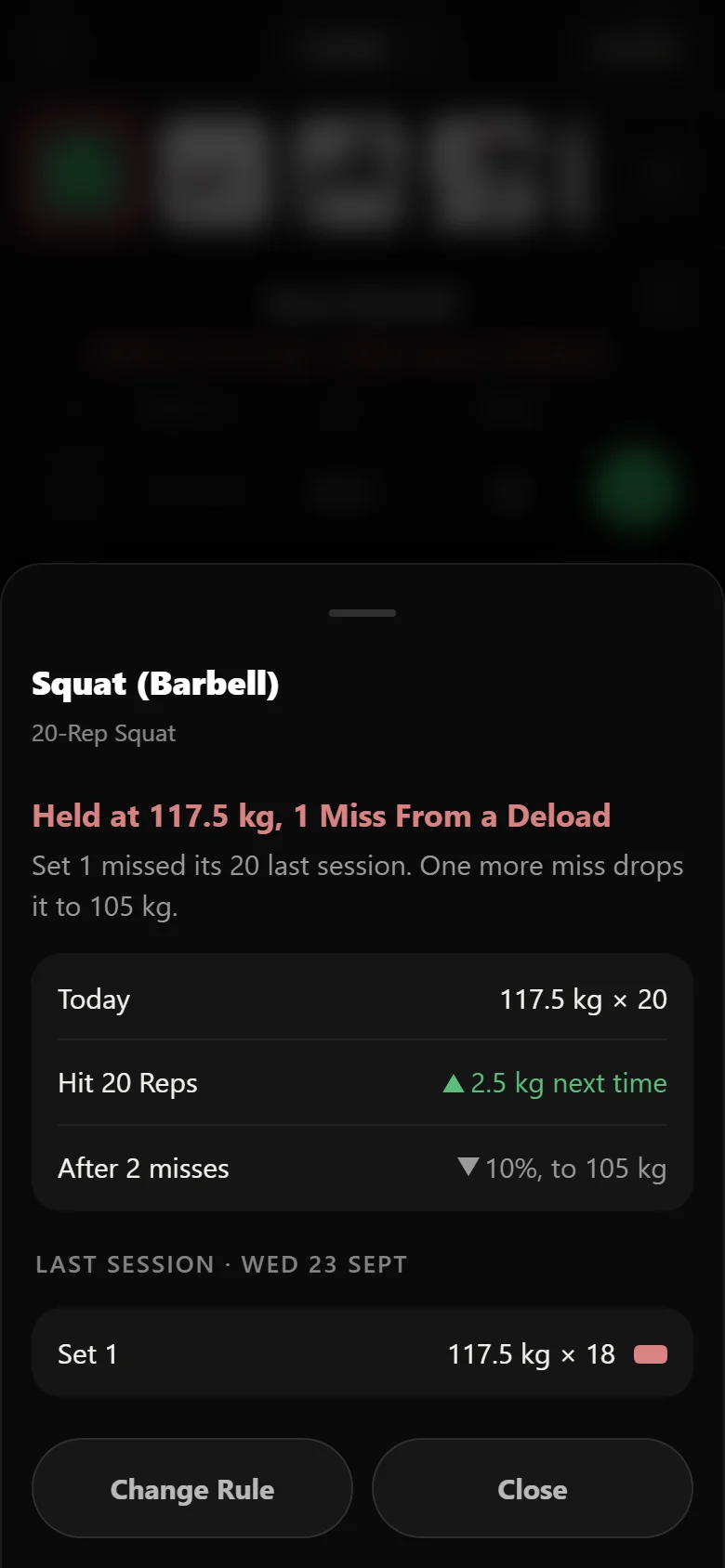
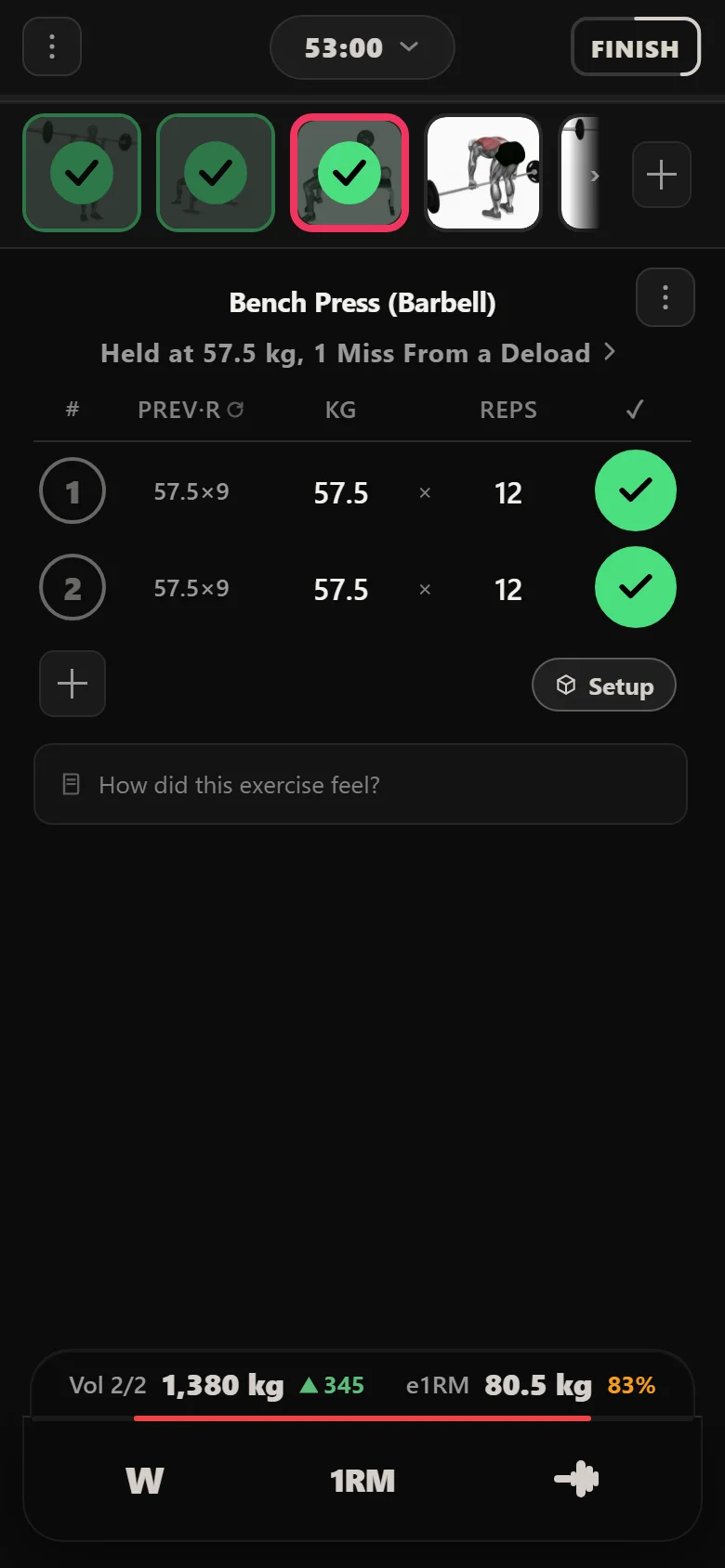
The rule chip is a button, and tapping it is how you find out where you stand without counting back through the log yourself. It shows this slot's own history and the rule being applied to it: one miss is banked, and a second at this weight cuts it 10%.
The cut, and the second climb
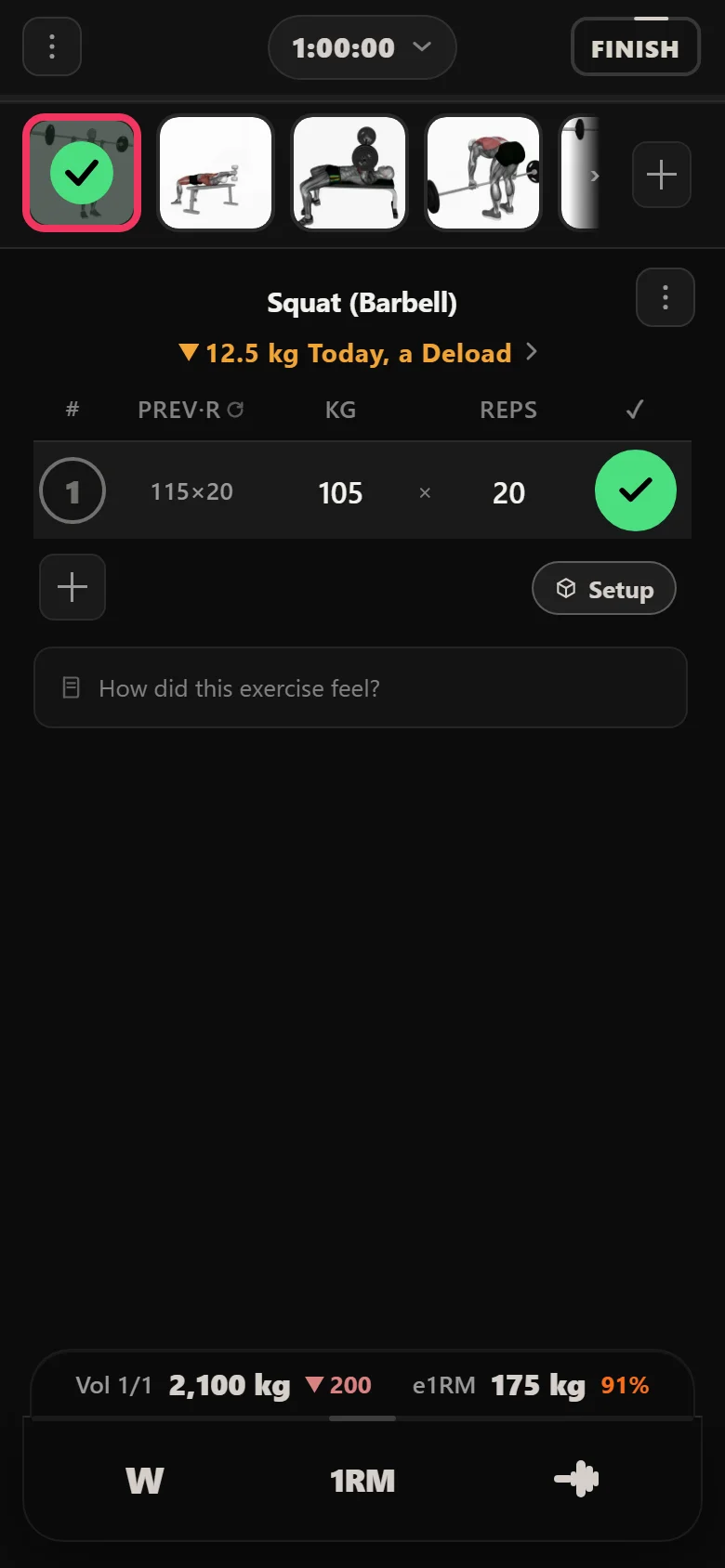
Repeat the miss and the deload fires: the app drops the squat 10%, from 117.5 kg to 105 kg, and the climb restarts. On a program that adds weight every session, a deload isn't a setback. It's the mechanism that lets the thing keep running, because a linear climb with no reset simply ends.
And the second climb goes further than the first. From 105 the squat rebuilds past the 117.5 kg that stopped it and finishes the block at 125 kg, 25 kg above where it started, on a set of twenty.
Squat: the twenty-rep set, per session (3 sessions a week)
- 100S1 Session 1
- 102.5S2 Session 2
- 105S3 Session 3
- 107.5S4 Session 4
- 110S5 Session 5
- 112.5S6 Session 6
- 115S7 Session 7
- 117.5S8 Session 8 — the set comes up short
- 117.5S9 Session 9 — missed again: deload triggers
- 105S10 Session 10 — weight cut 10%, climb restarts
- 107.5S11 Session 11
- 110S12 Session 12
- 112.5S13 Session 13
- 115S14 Session 14
- 117.5S15 Session 15 — back at the weight that stalled it
- 120S16 Session 16 — past the old ceiling
- 122.5S17 Session 17
- 125S18 Session 18 — 25 kg above the start
Everything else is support
The squat is the only lift here that moves every session. The supporting work runs double progression instead, and its chip spells the rule out on screen: hit 12 reps and the weight goes up 2.5 kg. You climb the 10 to 12 range session by session, and once every set reaches 12 the weight steps up and the reps reset to 10.
That is a much slower vehicle than 2.5 kg three times a week, which is what makes it usable alongside the squat. The supporting lifts keep the rest of you working without stacking fatigue onto the set the program is built around.
Six weeks later
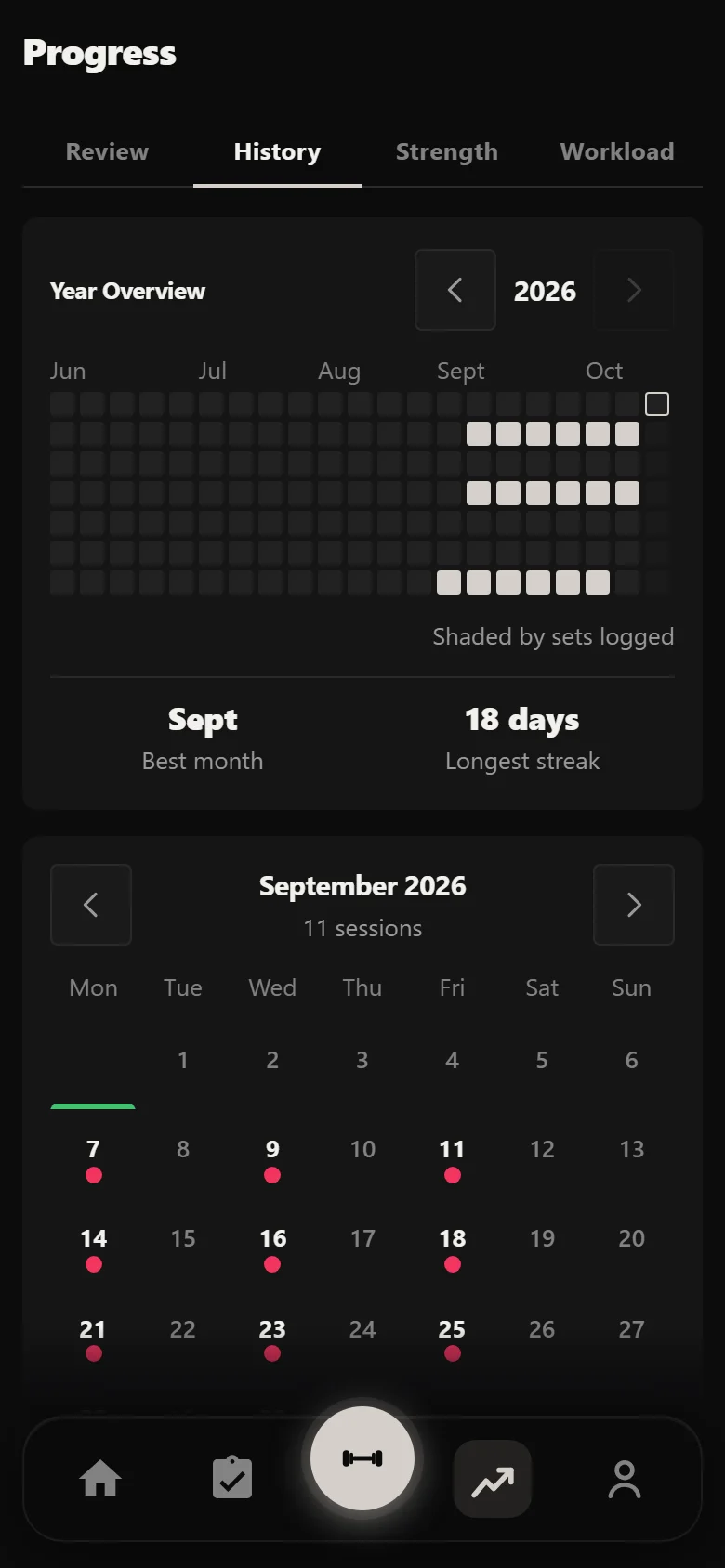
18 sessions in the calendar over six weeks: the climb, the stall, the deload and the rebuild in one view, 130 sets and 1796 reps of it.
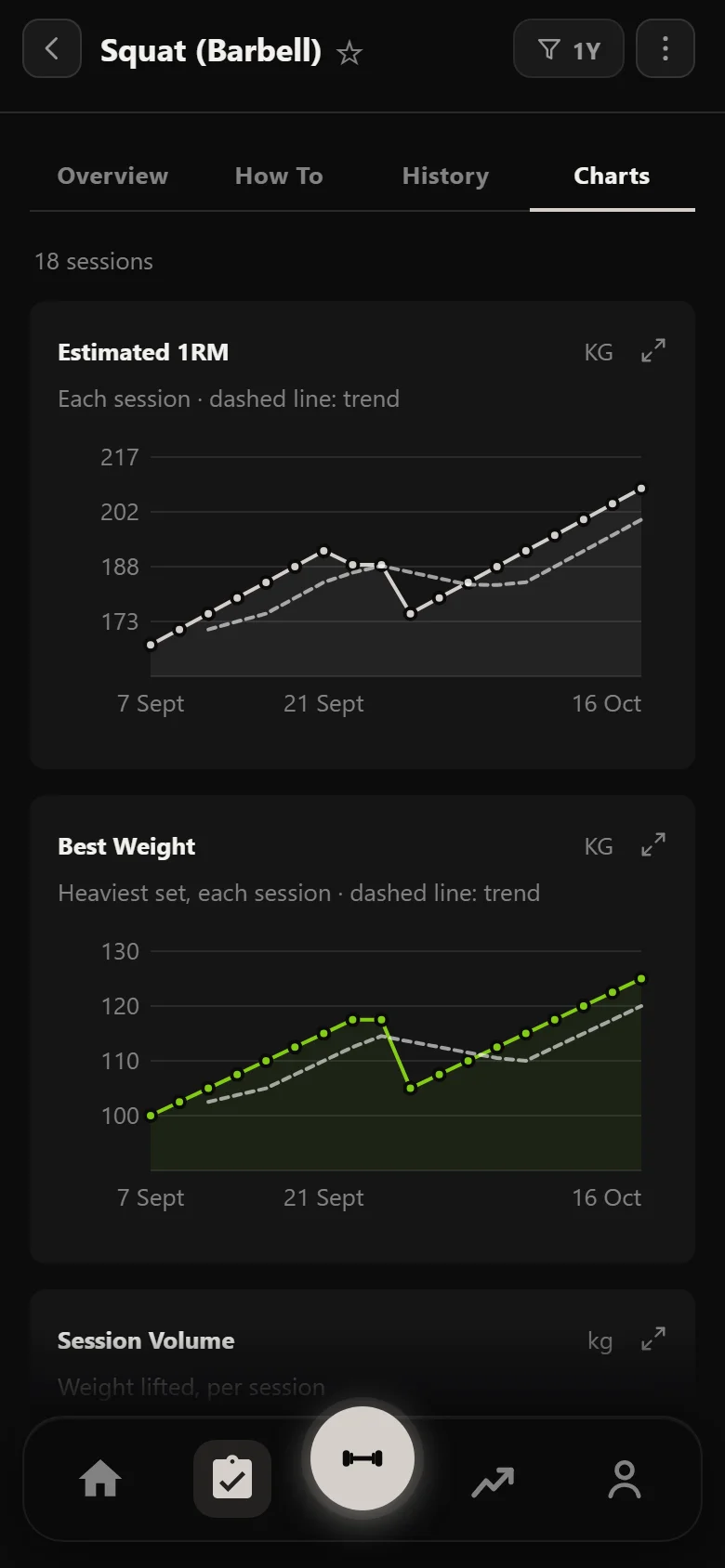
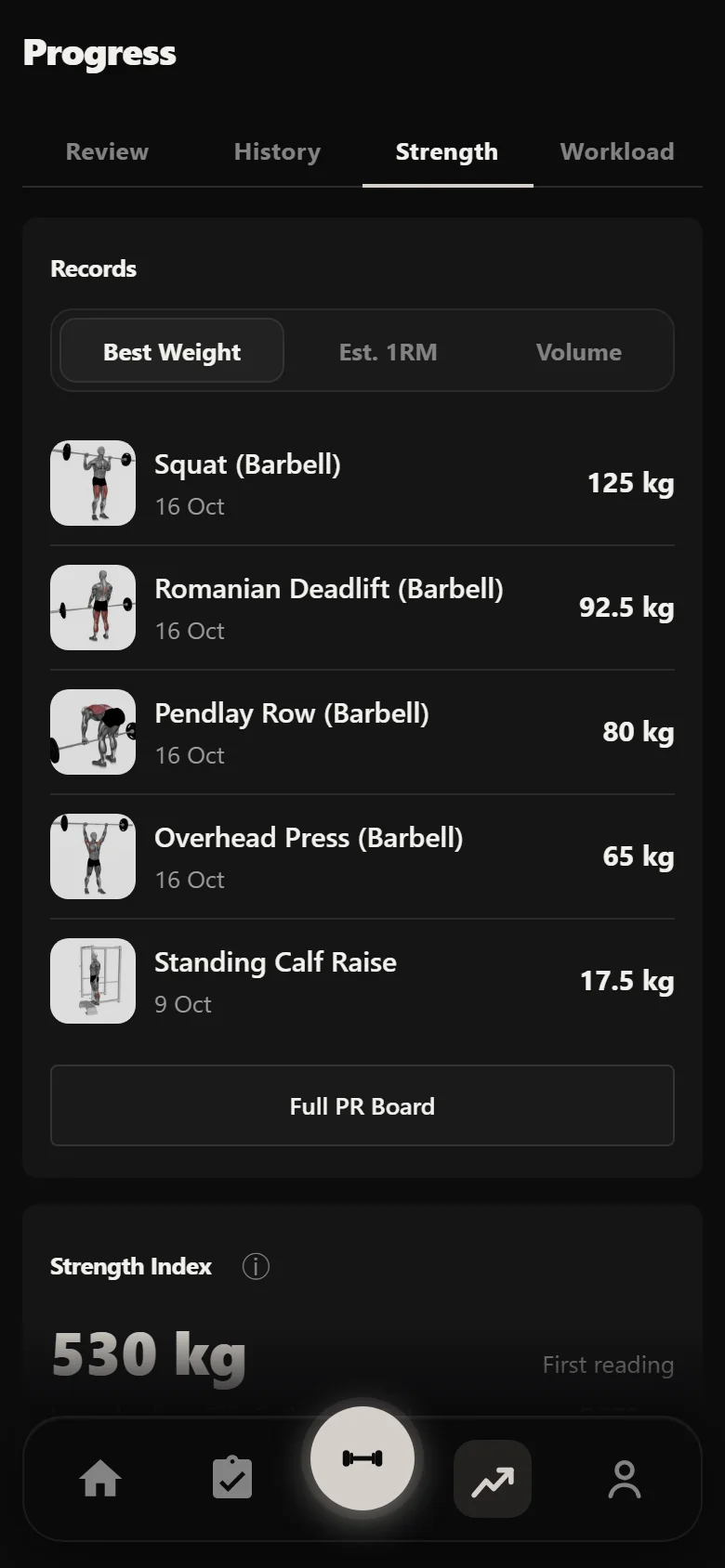
The estimated 1RM chart has the shape this program always makes: a steep climb, a flat spot where the set stopped finishing, the dip at the deload, then a longer climb straight through the old ceiling. The strength view underneath ranks the lifts by index across the block, squat at the top.
The payoff, where the set of twenty started and finished
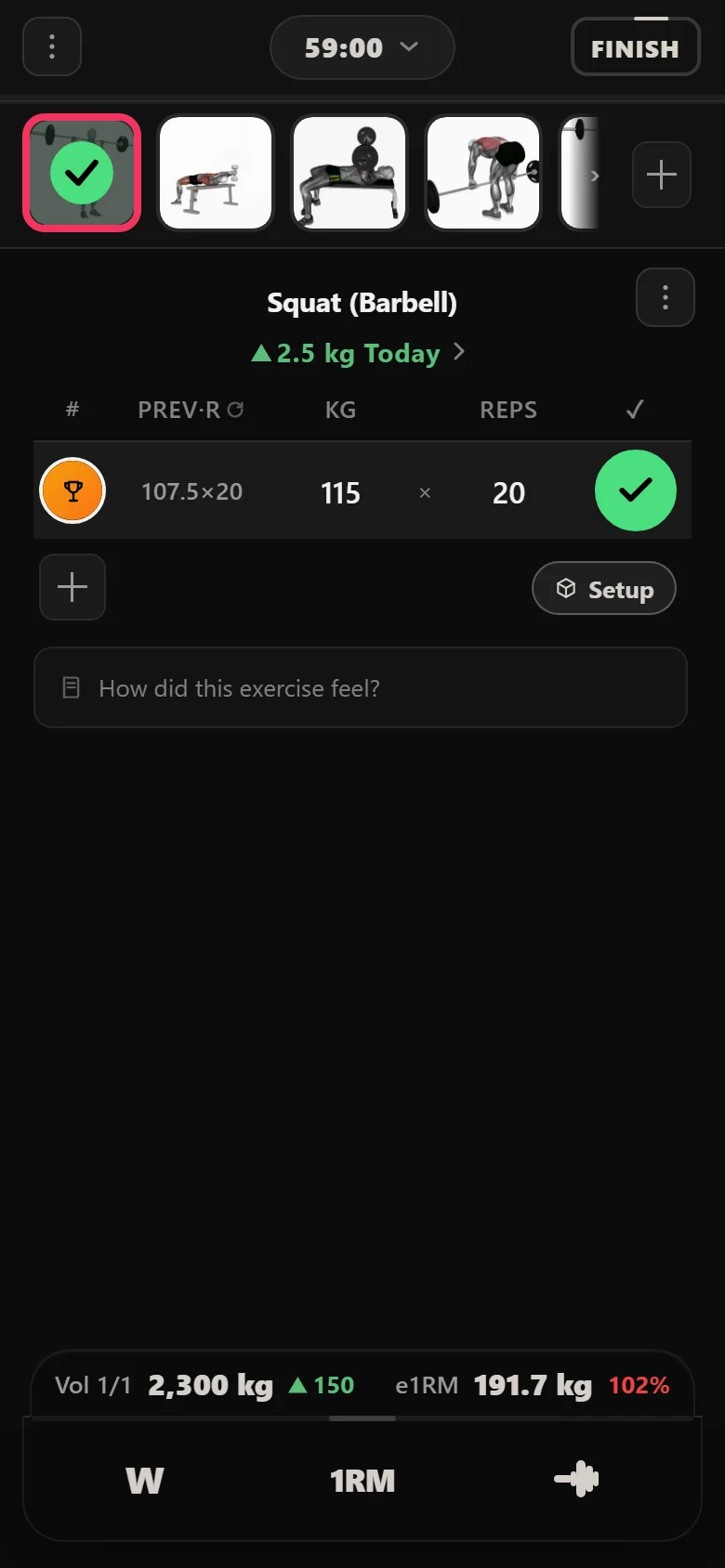
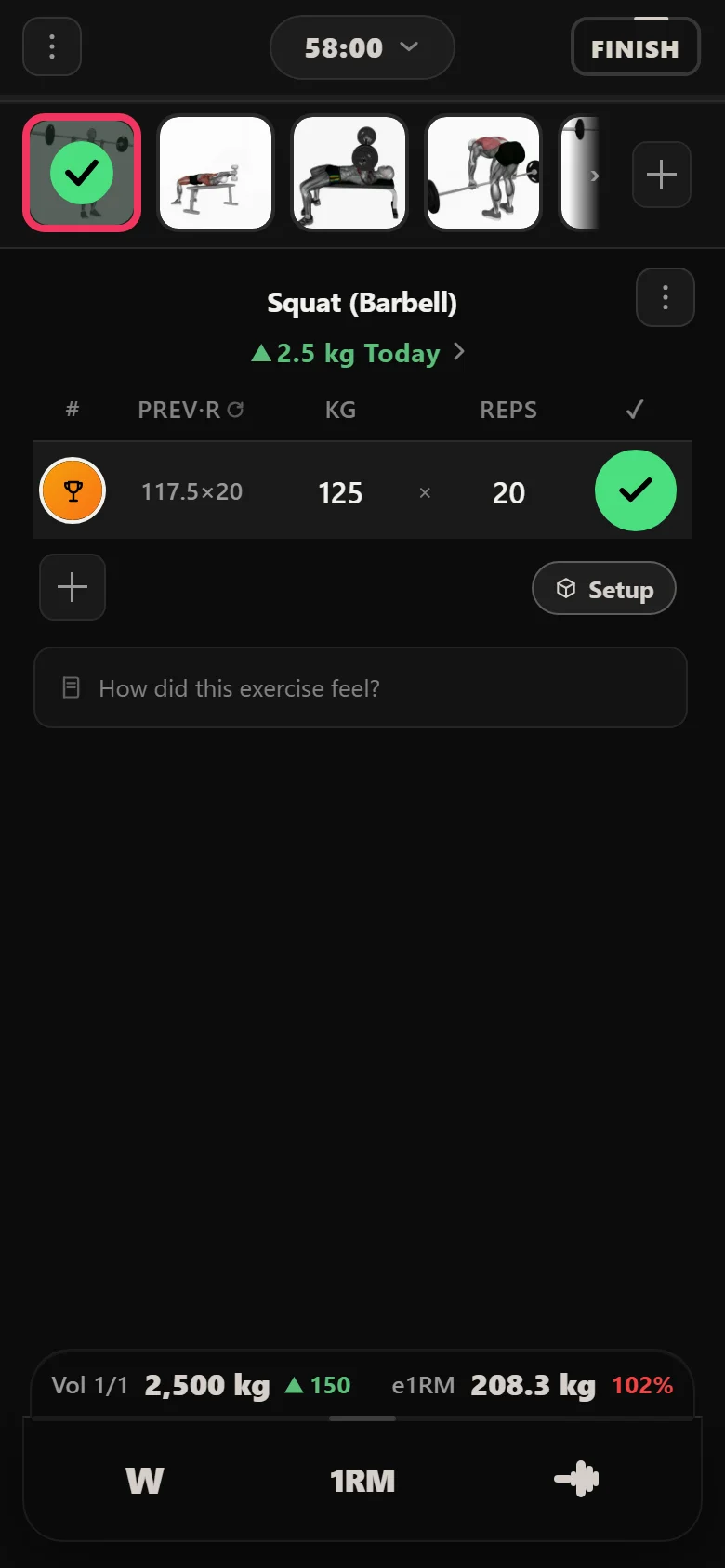
Two screenshots of the same lift on the same screen, the block's first session and its last. One set of twenty at 100 kg, then one set of twenty at 125 kg, with a stall and a 10% cut in between. Nothing was typed in. Every weight was decided by the engine from the sets that were logged.
The right-hand shot carries the detail that makes this program readable at a glance: the PREV column reads 117.5 kg, the weight that ended the first climb, sitting next to what's on the bar today.
The same set of twenty, start to finish: a 100 kg opener to 125 kg on session 18, having stalled at 117.5 kg and been cut to 105 kg on the way.
Common questions
What weight should I start the twenty-rep set with?
A weight you could squat for about ten good reps. You will find the other ten. That's the whole exercise. Starting too heavy ends the program in a fortnight; this run opened at 100 kg and finished six weeks later at 125 kg.
What are breathing squats?
Between reps, you rack-breathe: stand up, take two or three deep breaths, then go again. It's what makes twenty reps possible with a weight you'd normally manage for ten, and it's why the set takes several minutes rather than thirty seconds.
Why only one set?
Because one set of twenty at a genuinely hard weight is enough stimulus, and because it makes the progression unambiguous. There's no averaging across sets and no top-set-plus-back-offs to hide in. You either completed the prescription or you didn't, and the app moves the weight accordingly.
What happens when I miss the twentieth rep?
The weight holds. Nothing advances on a session that came in under the prescription, no matter how close it was: this run logged 18 of the twenty at 117.5 kg and stayed at 117.5 kg. Miss it a second time and the deload fires, cutting the weight 10%. Here that took the squat to 105 kg, and it climbed back past the old ceiling to finish at 125 kg.
Isn't adding weight every session unsustainable?
Yes, and that's expected. A linear climb with no reset simply ends; the deload is what lets it keep running. The honest arc of this program is climb, stall, cut, climb higher, which is exactly what the chart above shows.
Is Durata free?
Yes. Durata is free to use, with the full program catalogue, automatic progression maths, rest timers and PR tracking. Everything in this walkthrough is in the app.
Put it into practice
Durata is free to use — 50 proven programs, automatic progression, rest timers and PR tracking, all on your phone.