


Wolverine in Durata: when the training max goes up by a percentage
Wolverine is David Kingsbury's program, the one written to get Hugh Jackman ready to film X-Men. Five days a week, five main lifts, and each of them runs a four-week wave: fours and fives, then triples, then a deload week. It reads like 5/3/1 at a glance, and the thing that separates it is what happens at the end of each wave.
Most training-max programs review by a fixed step. Wolverine reviews by a percentage, ten percent on the lower-body lifts and five percent on the upper. On a small lift that is a rounding decision. On a deadlift it is a different program.
This run drove four full waves, sixteen weeks, through the real app. Every number below is engine output, and the lift the charts follow is the squat.
Finding it and starting it
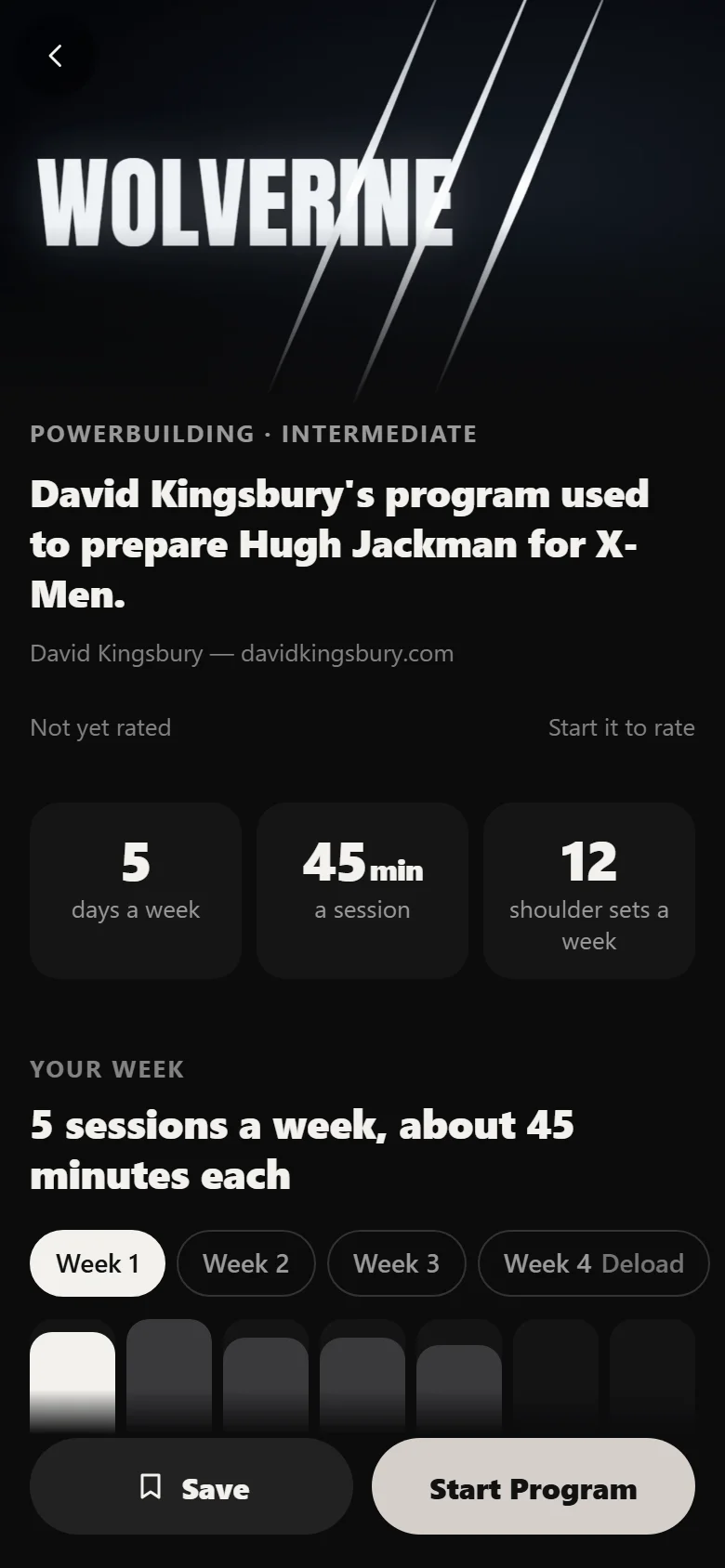
In Discover, Wolverine sits on the Powerbuilding shelf, marked Intermediate, at five days a week. Search finds it by name, or Filter narrows the shelves by level and days a week. Tap the cover for a quick look, then View Program for the full page.
Search also answers to Kingsbury and to the Hugh Jackman search that most people actually type.
The program page shows the five-day week and the shape of the wave before you commit to anything, which is worth reading here because the four weeks are not interchangeable.
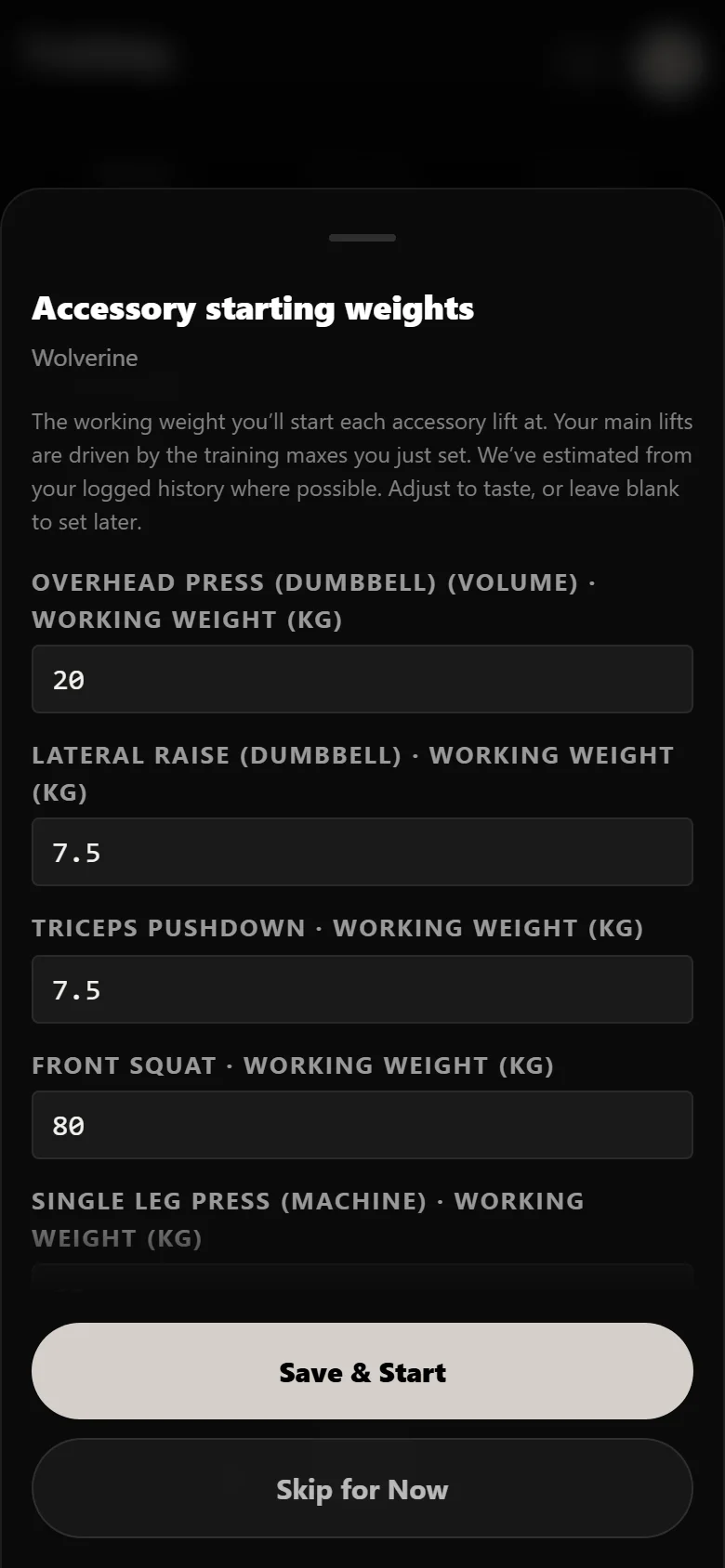
Setup asks for two kinds of number. The five main lifts each need a training max, which Kingsbury defines the same way 5/3/1 does, at ninety percent of a true one-rep max. The accessories need an ordinary working weight: this run opened the front squat at 80 kg, the dumbbell overhead press volume work at 20 kg, and the small isolation lifts at 7.5 kg.
Four weeks, and none of them are the same
Each main lift runs the same four-week wave. Week one is four sets of five, week two four sets of four, week three four sets of three, and week four is a deload at four sets of ten on a much lighter bar. Every one of those weights is a percentage of the training max, worked out before the block starts.
The sessions ramp rather than sitting on one number. A working set is preceded by lighter percentage steps of the same lift, so the top set arrives on a bar you have already been under twice that day.
The five main lifts sit one per day: bench on day one, squat on day two, weighted pull-ups on day three, dumbbell overhead press on day four, deadlift on day five. Everything else in the session is accessory work on the ordinary double-progression rule, which is the same rule the rest of the catalogue uses.
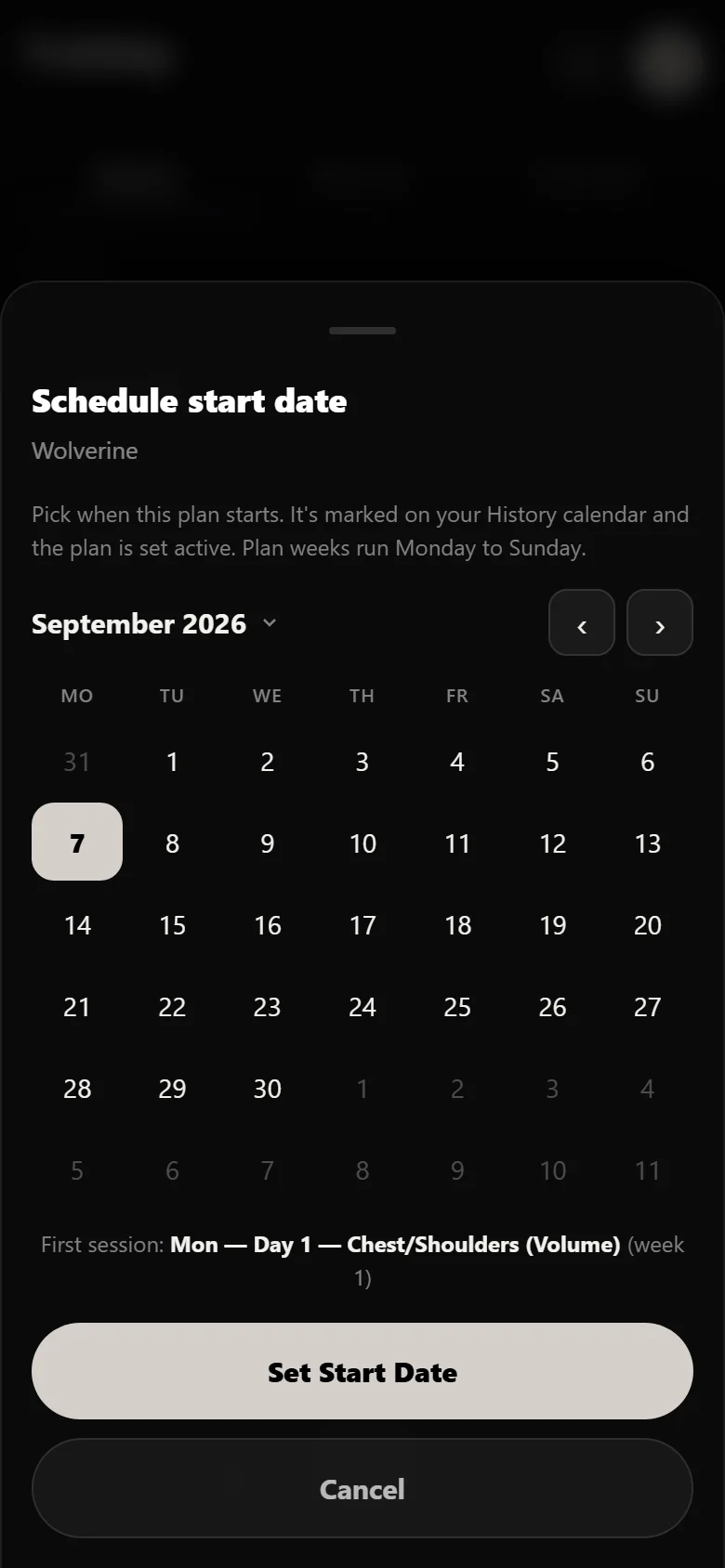
Pick a start date and the whole sixteen weeks lands on the calendar in one go.
Inside the first wave
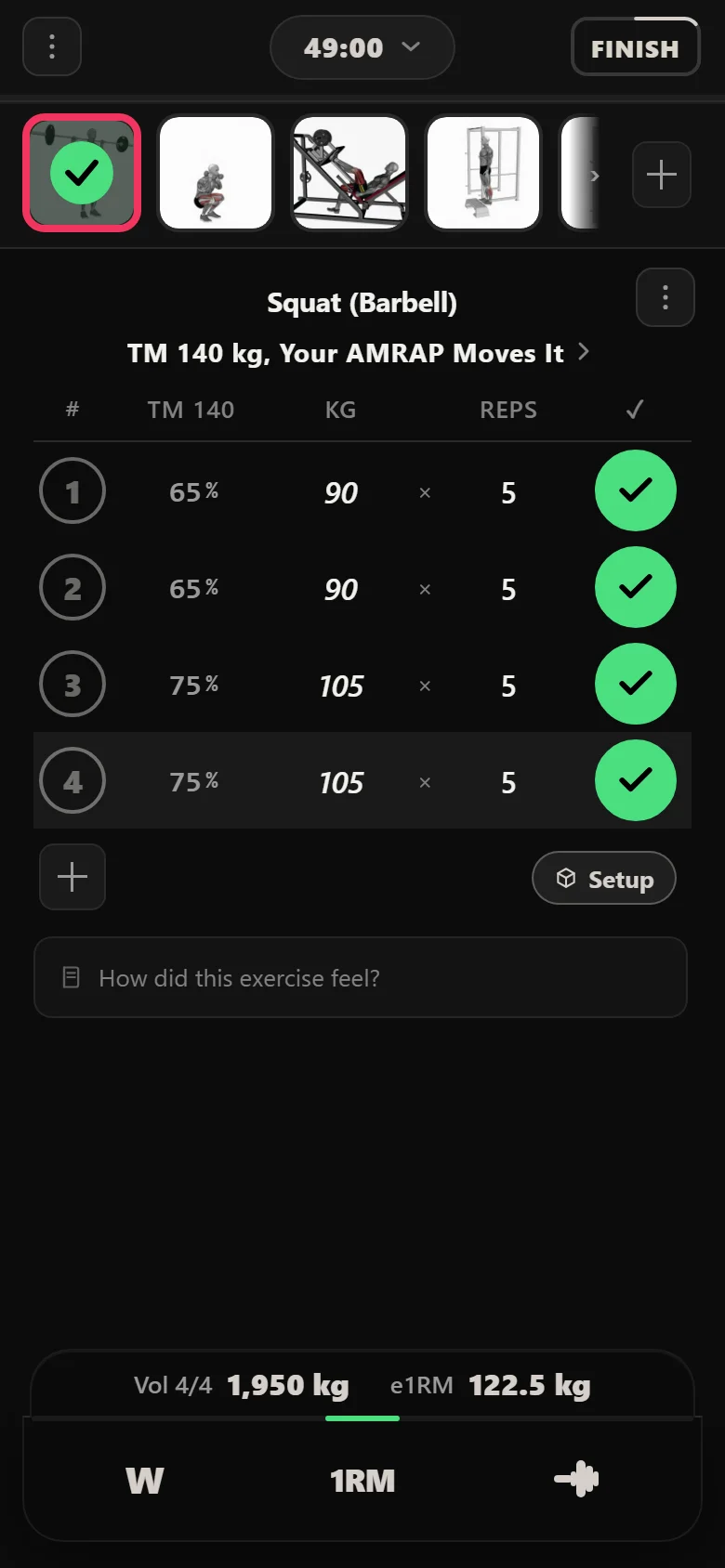
The squat opened on a 140 kg training max. Week one puts seventy-five percent of that number on the bar for four sets of five, deliberately submaximal. Nothing about the first week is meant to be hard.
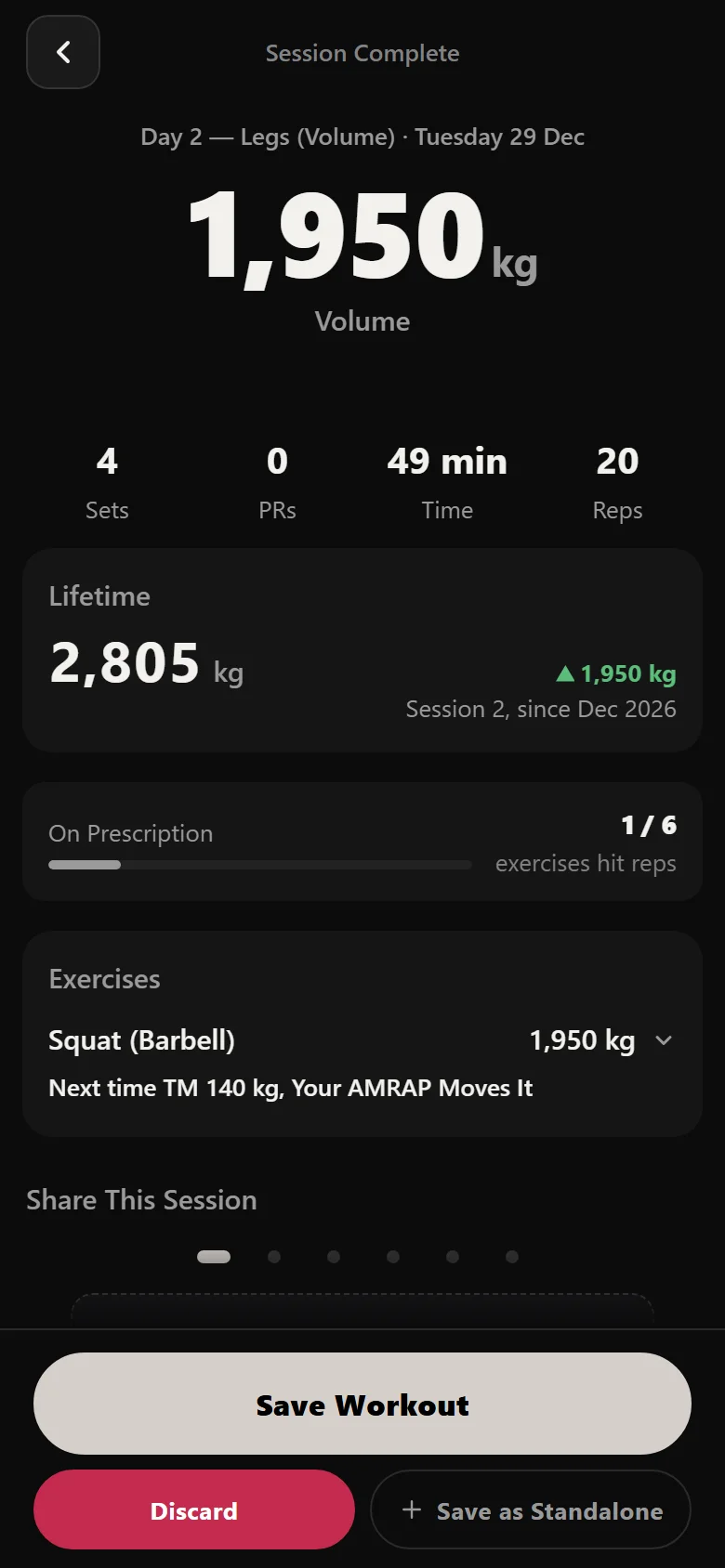
The session card totals it before saving: four working sets, twenty reps, 1950 kg moved. That is the whole point of the low week, a lot of quality reps at a weight that leaves plenty behind.
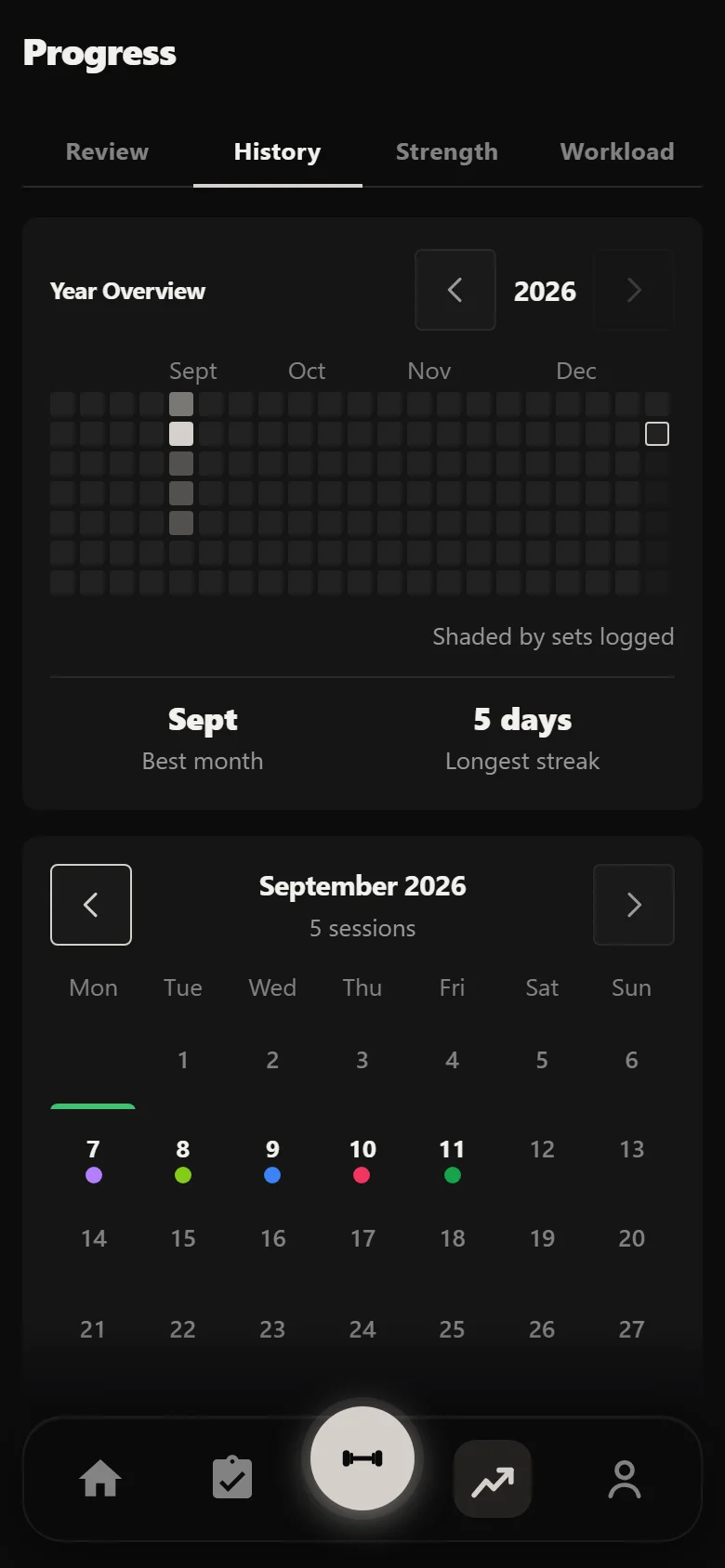
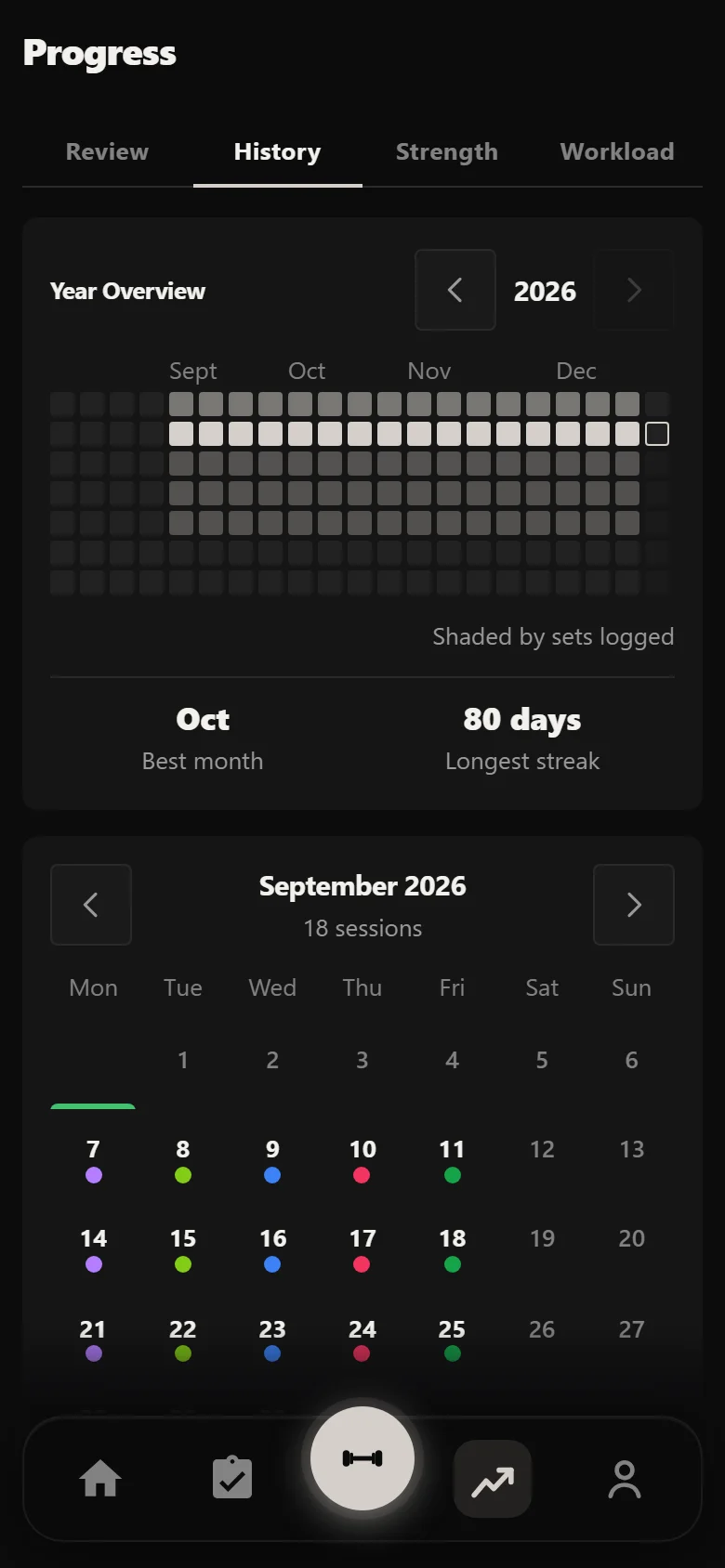
The History calendar starts filling five entries a week, and because every main lift is on its own day, the weekly pattern is legible immediately.
The triple week, then the drop
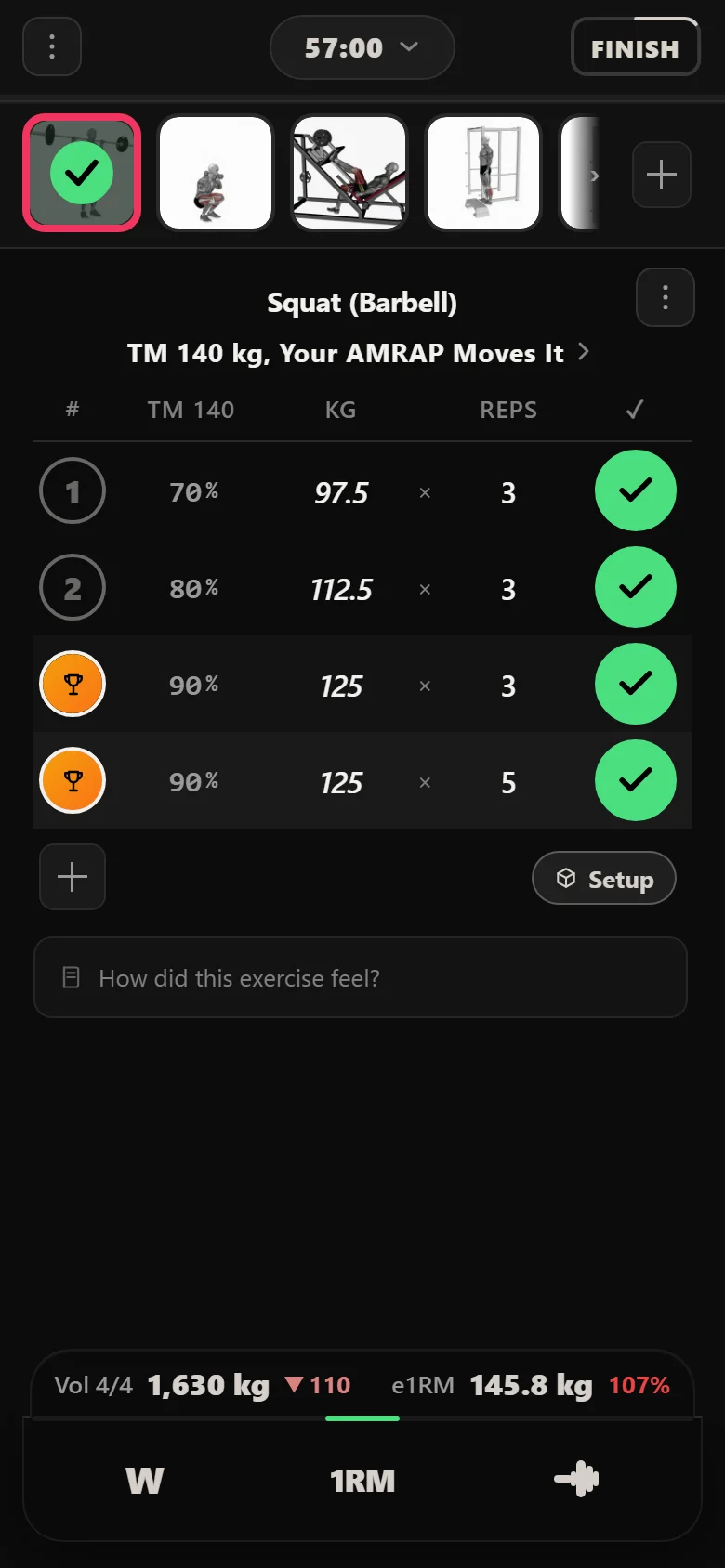
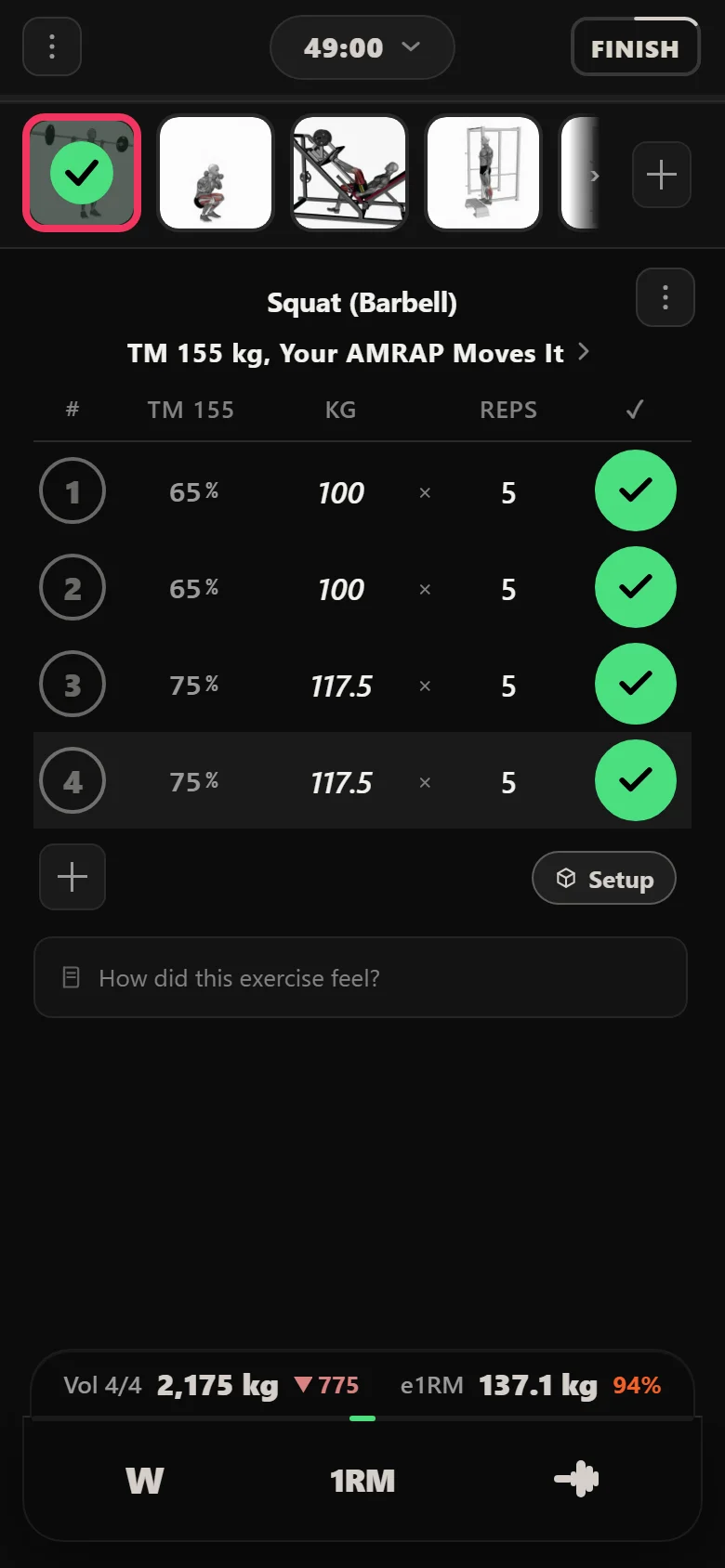
Week three is where the wave peaks. The squat ramps to 125 kg, ninety percent of the training max, for the heaviest triples of the cycle. It is the closest the program comes to a test, and it is still not a max attempt.
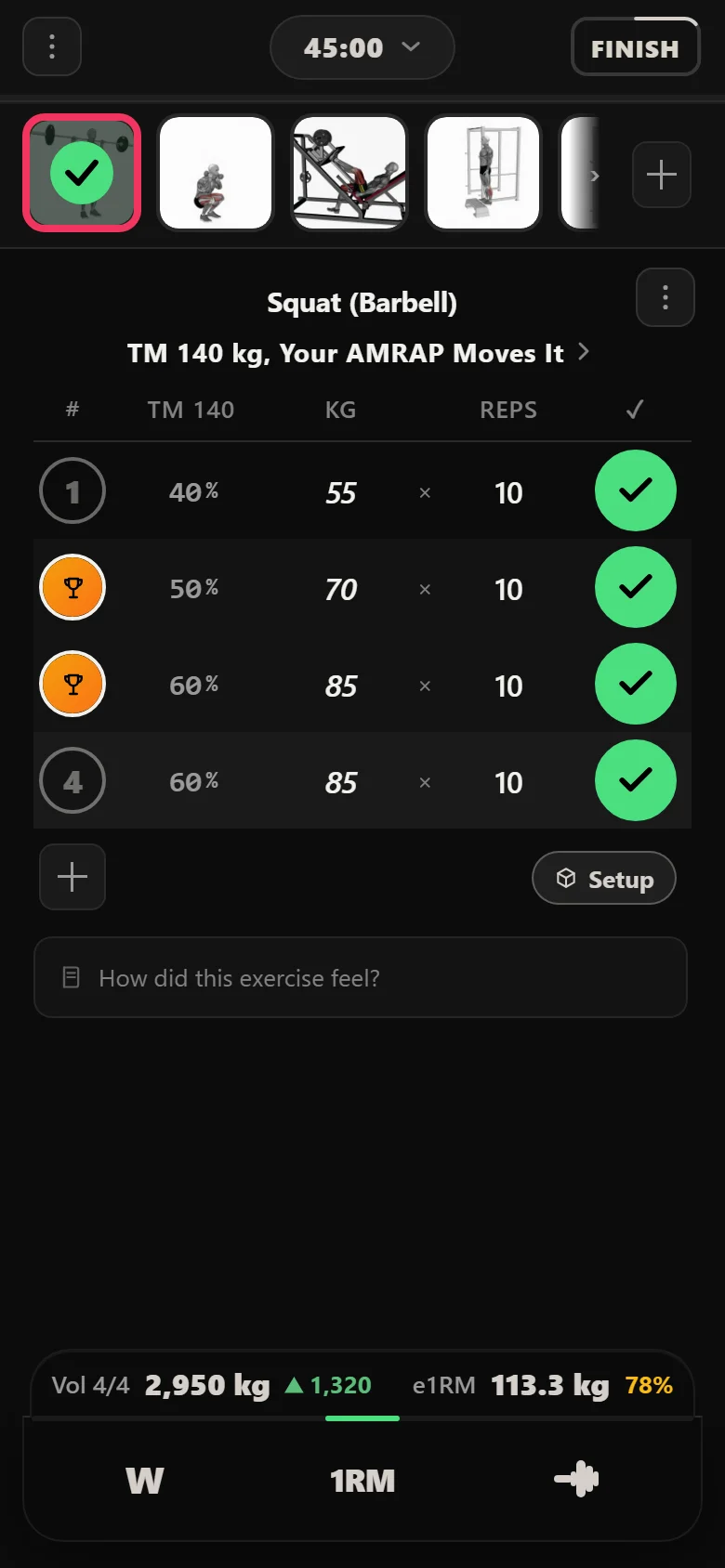
Then week four takes the bar back down to 85 kg for sets of ten. That is a large drop by design, not a bad week. The deload is doing the work of making the next wave possible, and the app prescribes it with the same confidence it prescribes the heavy week.
Neither of those weights is a response to how week three felt. Both were computed from the training max before the block began, which is the trade this style of program makes: you give up in-session judgement and you get a plan that does not negotiate with a bad night's sleep.
The review is a percentage, and it shows
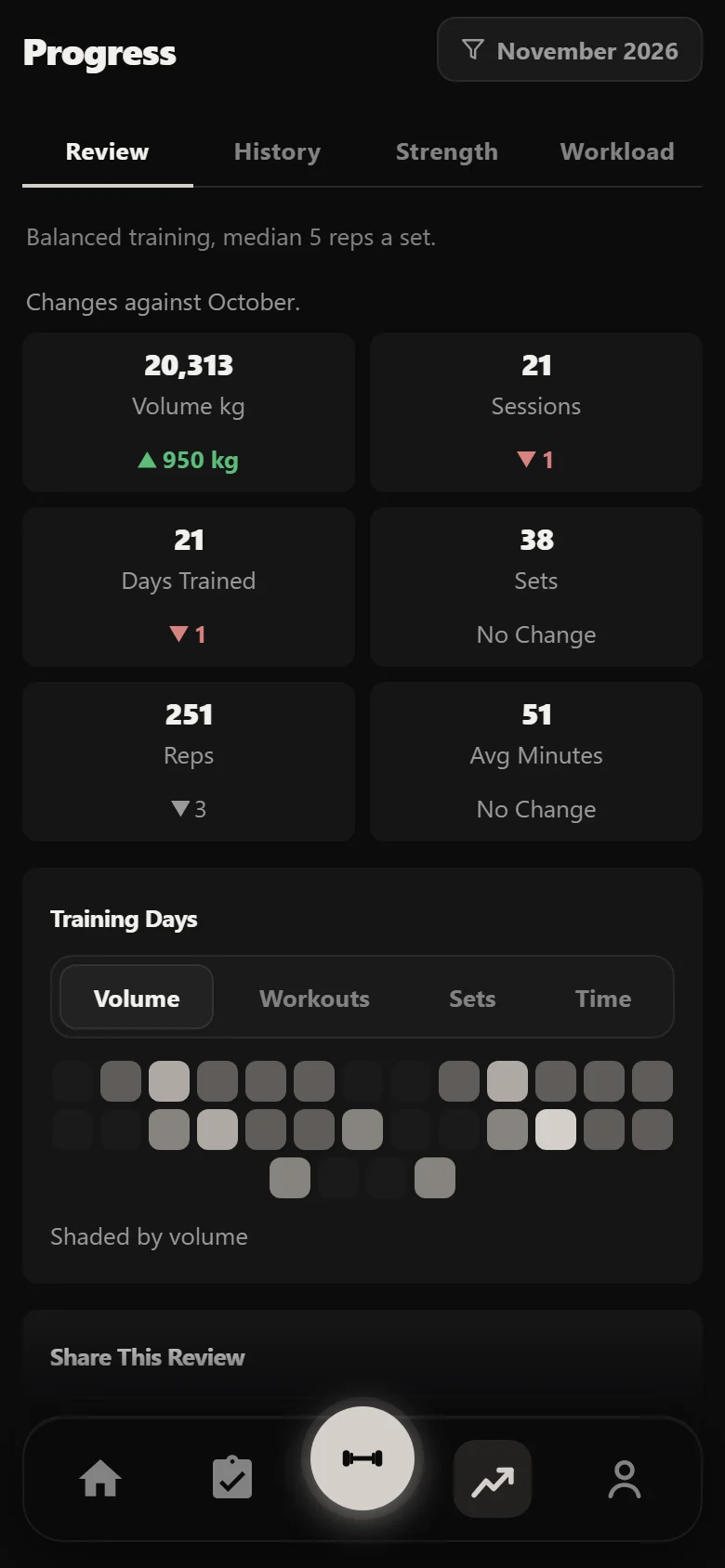
At the end of the wave the training max is reviewed, and this is where Wolverine parts company with the programs it resembles. The lower-body lifts go up ten percent and the upper-body lifts five percent. Not a fixed step, a proportion of what is already there.
The squat's training max went from 140 kg to 155 kg on the first review, and cycle two opened the identical wave on a correspondingly heavier bar. Same weeks, same percentages, bigger numbers underneath them.
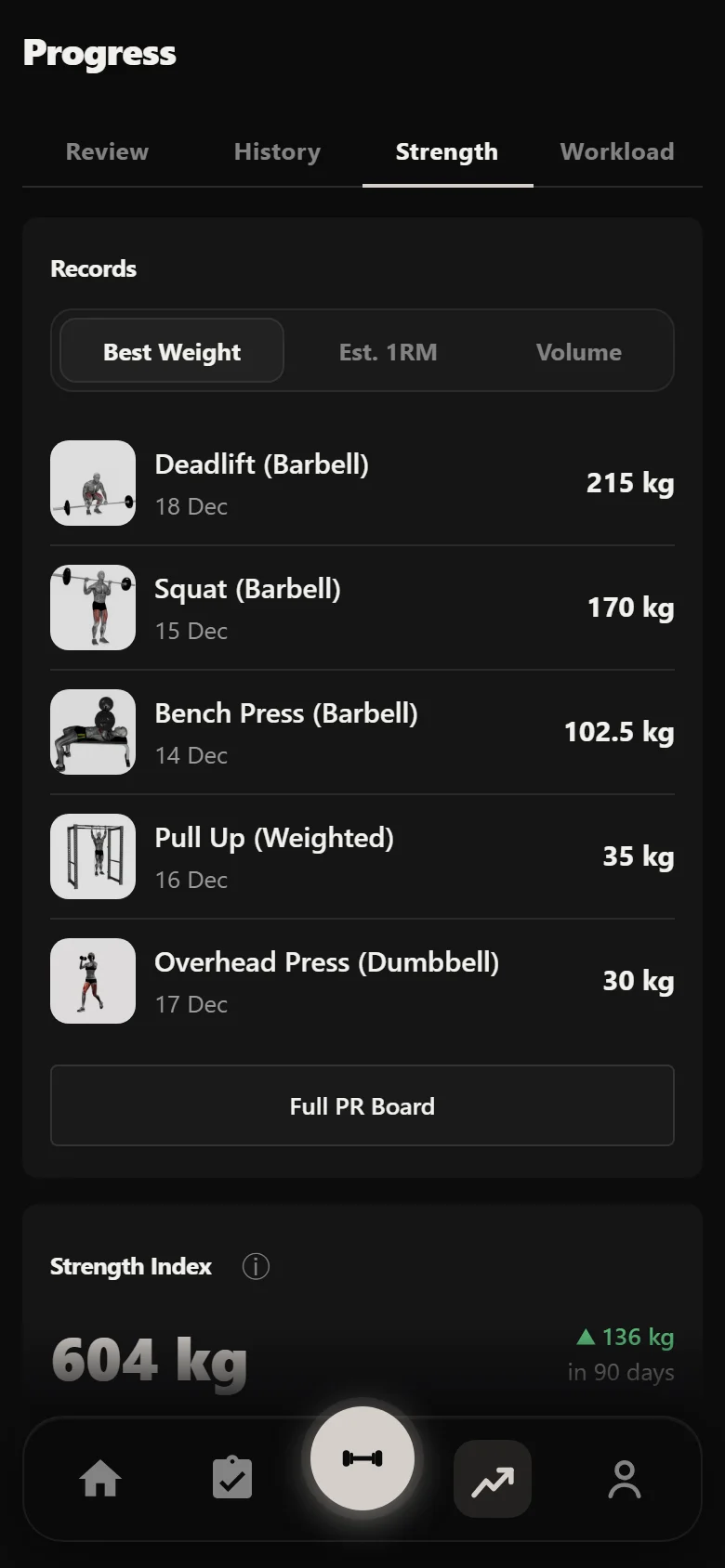
Across four reviews the difference between lifts becomes the story. The squat's training max travelled from 140 kg to 207.5 kg and the deadlift's from 180 kg to 265 kg. Over the same four reviews the bench press went from 100 kg to 120 kg and the weighted pull-up from 80 kg to 100 kg. A percentage of a big number is a big number.
The dumbbell overhead press shows the other edge of the same rule. Five percent of 25 kg is barely more than a kilogram, and there is no dumbbell that small, so each review rounds up to the next pair on the rack and the lift finished the block at 35 kg. On the smallest lift in the program, rounding does more work than the percentage does.
Squat (Barbell): triple-week top set, wave by wave
- 125S12 Session 12 — wave 1
- 140S32 Session 32
- 152.5S52 Session 52
- 170S72 Session 72 — wave 4
What moved, and what held
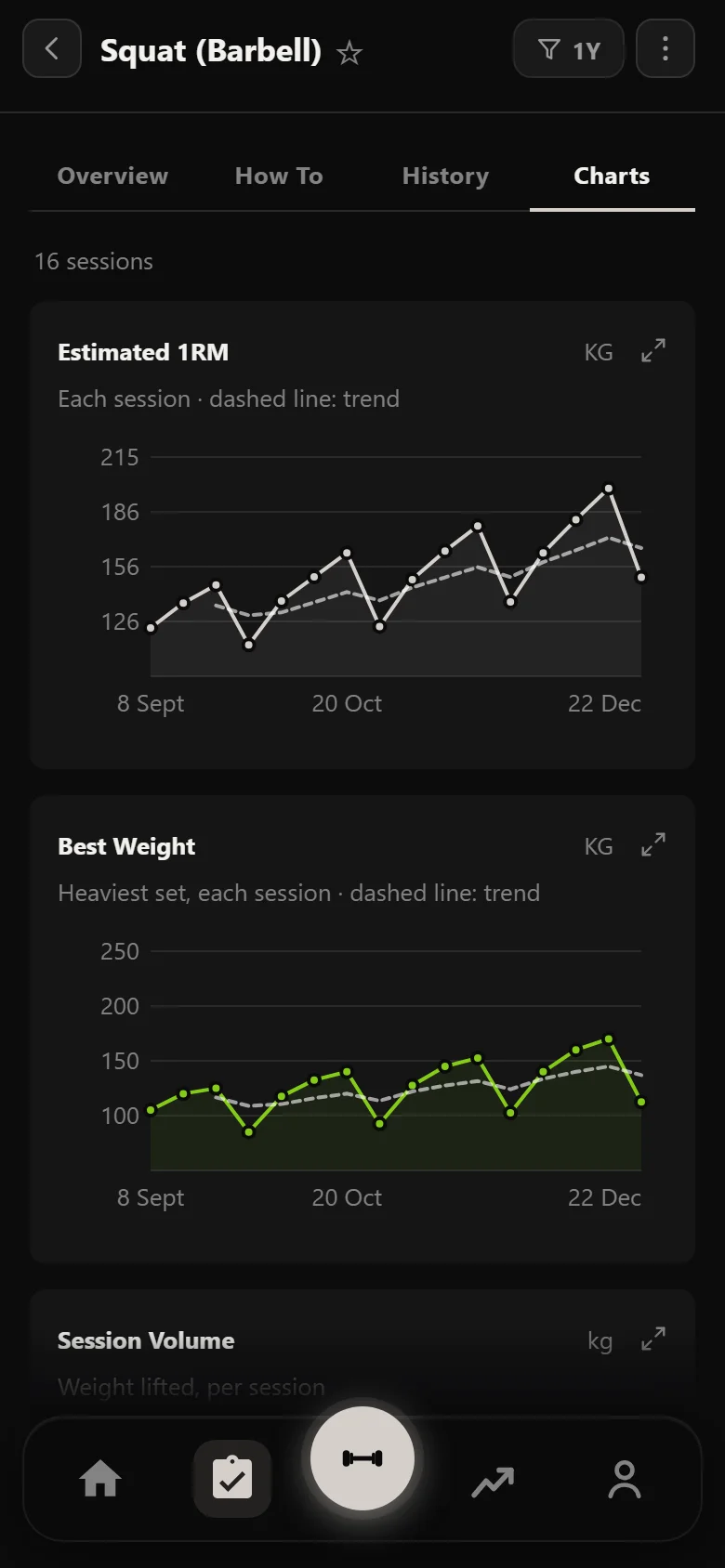
By the last triple week the squat was ramping to 170 kg off a 187.5 kg training max, and a fourth review took that training max to 207.5 kg for a fifth wave that this drive did not run. The estimated one-rep max chart shows the shape clearly: four climbs, four dips at the deload, each one starting higher than the last peak.
The accessories are the counterweight. Every double-progression lift in the program finished the sixteen weeks on the weight it started: the front squat at 80 kg, the bent-over row at 65 kg, the incline bench at 60 kg, the Romanian deadlift at 77.5 kg, the single-leg press and the skullcrusher at 20 kg, and the curls, raises, flyes and pushdowns at 7.5 kg.
That is the double-progression rule behind a heavy main lift, on four sets of ten to twelve, five days a week. A lift only moves when every working set reaches the top of its range, and none of them did across sixteen weeks of chasing five main lifts up a percentage ladder.
It is worth knowing which half of this program is designed to move. The main lifts are, on a schedule. The accessory work holds position while that happens, and the recap card and strength index report both halves without flattering either.
The payoff: 125 kg to 170 kg, four waves apart
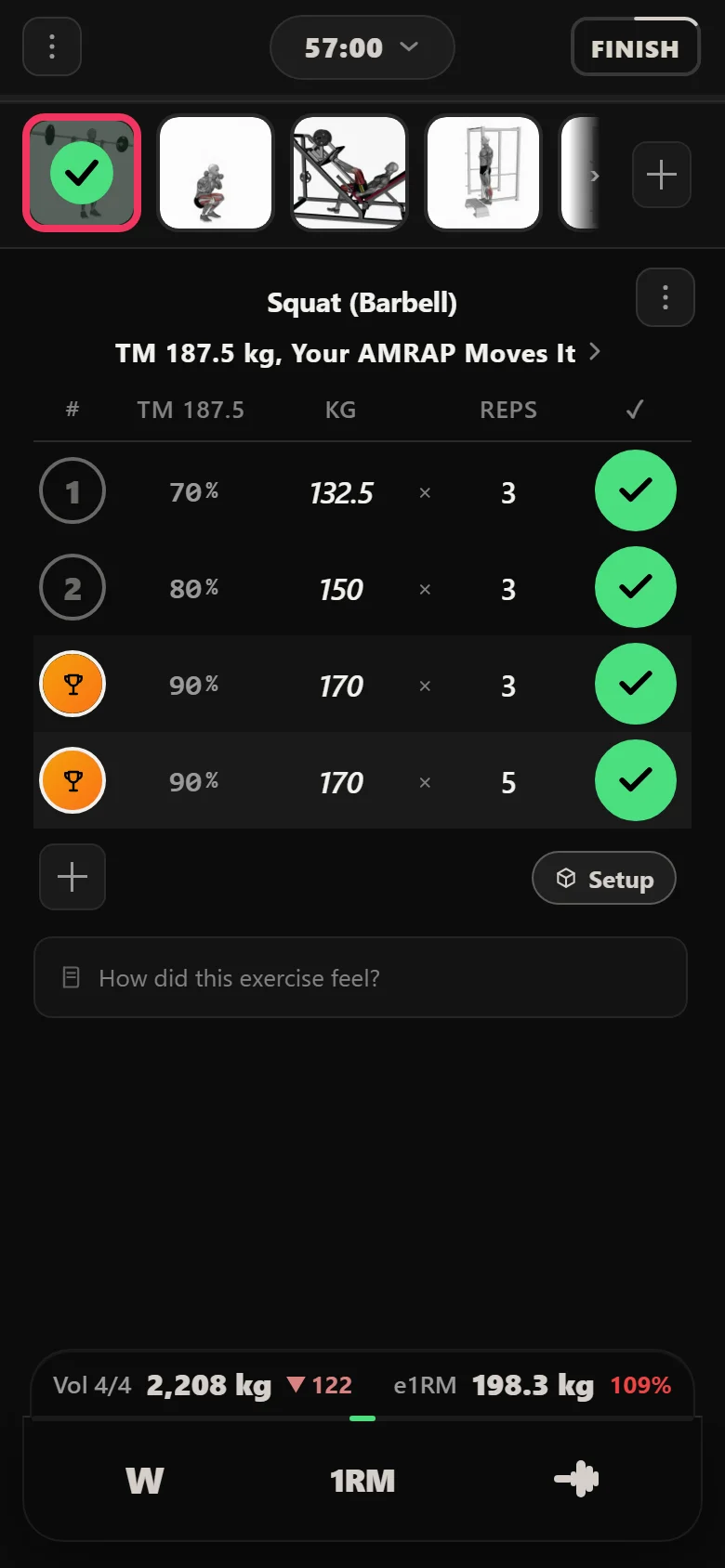
Two screenshots of the same week in the wave, sixteen weeks apart. The squat's heaviest triple went from 125 kg in the first cycle to 170 kg in the fourth, and every weight in between was computed from a training max that was reviewed four times and never argued with.
Nobody decided to add 45 kg to a squat. Four ten-percent reviews did, one wave at a time, and the app put the resulting weight on the screen each time the session came round.
The same week of the same wave, four cycles apart, with every weight computed from a training max the app reviewed on its own.
Common questions
What is the Wolverine program?
David Kingsbury's five-day strength and physique program, written to prepare Hugh Jackman for X-Men. Each of the five main lifts runs a four-week wave of fives, fours, triples and a deload, with every weight taken as a percentage of a training max.
What should I set my training max to?
Ninety percent of a true one-rep max for that lift, the same definition 5/3/1 uses. It is meant to sit below your best so the wave stays repeatable. This run drove the squat from a 140 kg training max and the deadlift from 180 kg.
How much does the training max go up between waves?
Ten percent on the lower-body lifts and five percent on the upper-body ones, so the increase scales with the lift rather than being a fixed step. Over four reviews on this run that took the deadlift's training max from 180 kg to 265 kg and the bench press from 100 kg to 120 kg.
Why did none of the accessories go up?
They run the standard double-progression rule, which only adds weight when every working set reaches the top of its rep range. Behind five heavy main lifts on a five-day week, none of them cleared that bar on this run, and the app held them rather than pushing weight onto a lift that had not earned it.
Is Durata free?
Yes. Durata is free to use, with the full program catalogue, automatic progression maths, rest timers and PR tracking. Everything in this walkthrough is in the app.
Put it into practice
Durata is free to use — 50 proven programs, automatic progression, rest timers and PR tracking, all on your phone.