

GZCLP in Durata: a stall, a restart, and a stronger squat
Most programs answer a missed session by cutting the weight. GZCLP doesn't, and that is the whole idea. Miss your reps on the main lift and it keeps the same bar and changes the rep scheme instead: five sets of three becomes six sets of two, then ten sets of one. Only when you fail that last stage does the cycle end and restart, lighter, off a fresh max. Every one of those steps is a decision, and in Durata the app makes it for you and shows its working.
This is a beginner's fourteen-week run, 56 sessions, followed on the T1 squat. It opens at 40 kg, climbs 5 kg a session, stalls at 65, drops through all three stages, gets restarted by the app at 47.5 kg, and rebuilds to a 77.5 kg prescription, well above where the stall stopped it. No weights were typed in after the first session. Every figure below is what the engine recorded on the drive.
Four sessions, three tiers, one working weight per lift
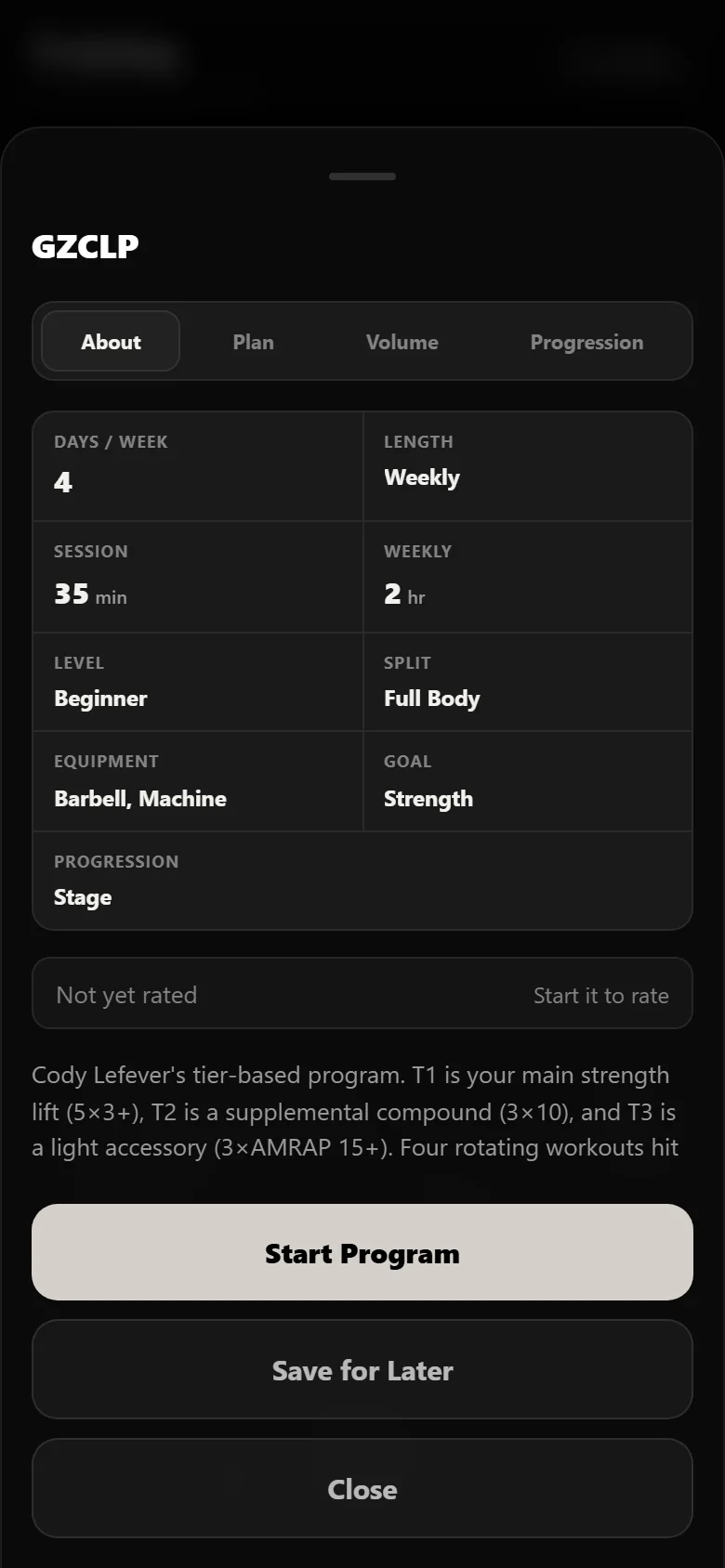
Four workouts rotate so every major pattern is trained twice a week. Each session is built the same way: a heavy T1 main lift, a supplemental T2 compound, and a light T3 accessory. Three tiers, each with its own job and its own rule. Day 1 opens with the T1 squat.
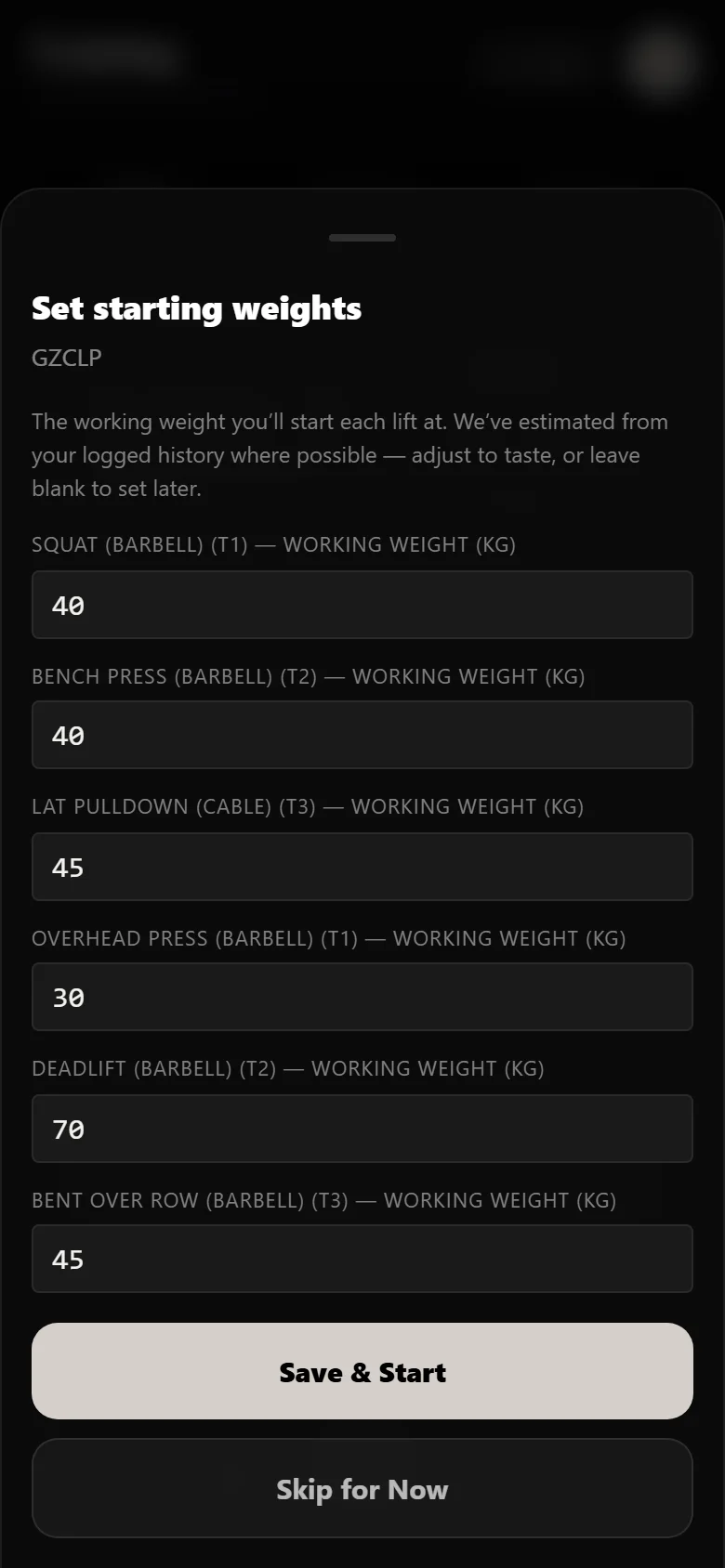
There are no training maxes and no percentages to work out. GZCLP asks for a working weight per lift and starts you there. Start conservatively, because the T1 adds weight fast and the whole method depends on having room to climb before you stall. This run seeds the squat at 40 kg, the overhead press at 30 kg and the deadlift at 70 kg.
The climb: 5 kg a session, and the app does the maths
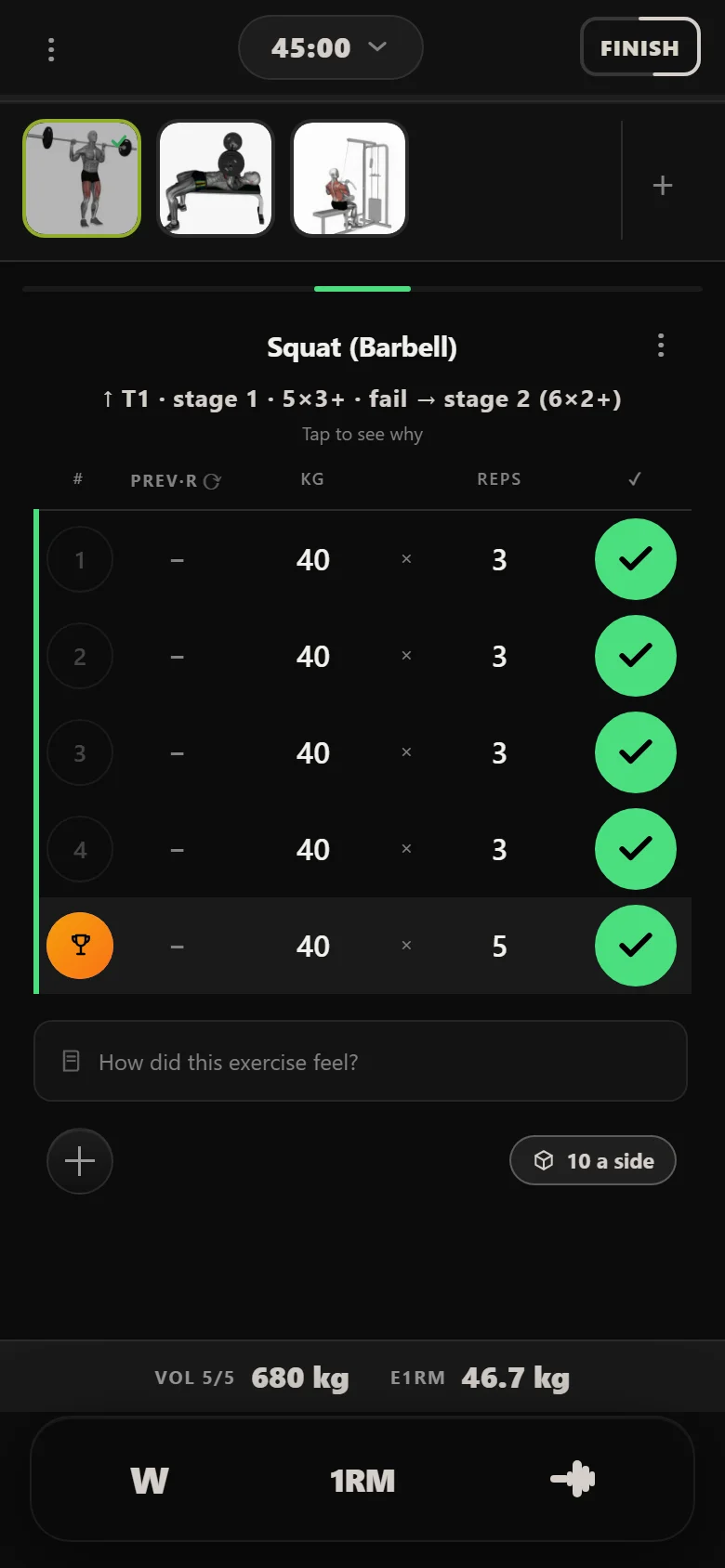
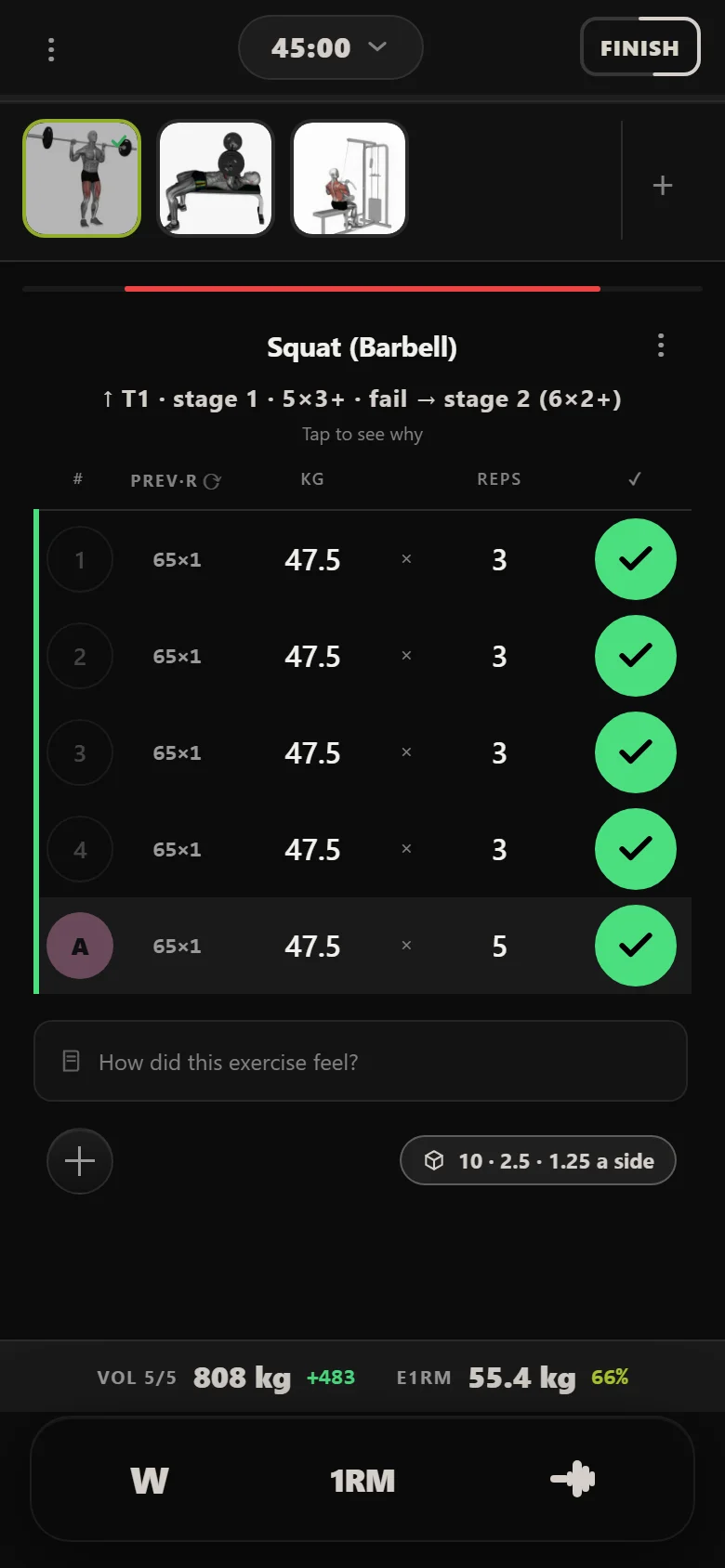
The T1 squat opens at 40 kg: five sets of three, with the final set taken for as many good reps as you can manage. Clear it and the app adds 5 kg for next time. That gives weekly jumps of 40, 45, 50, 55 and 60, and the chip under the exercise name spells the rule out while you lift rather than hiding it in a settings screen.
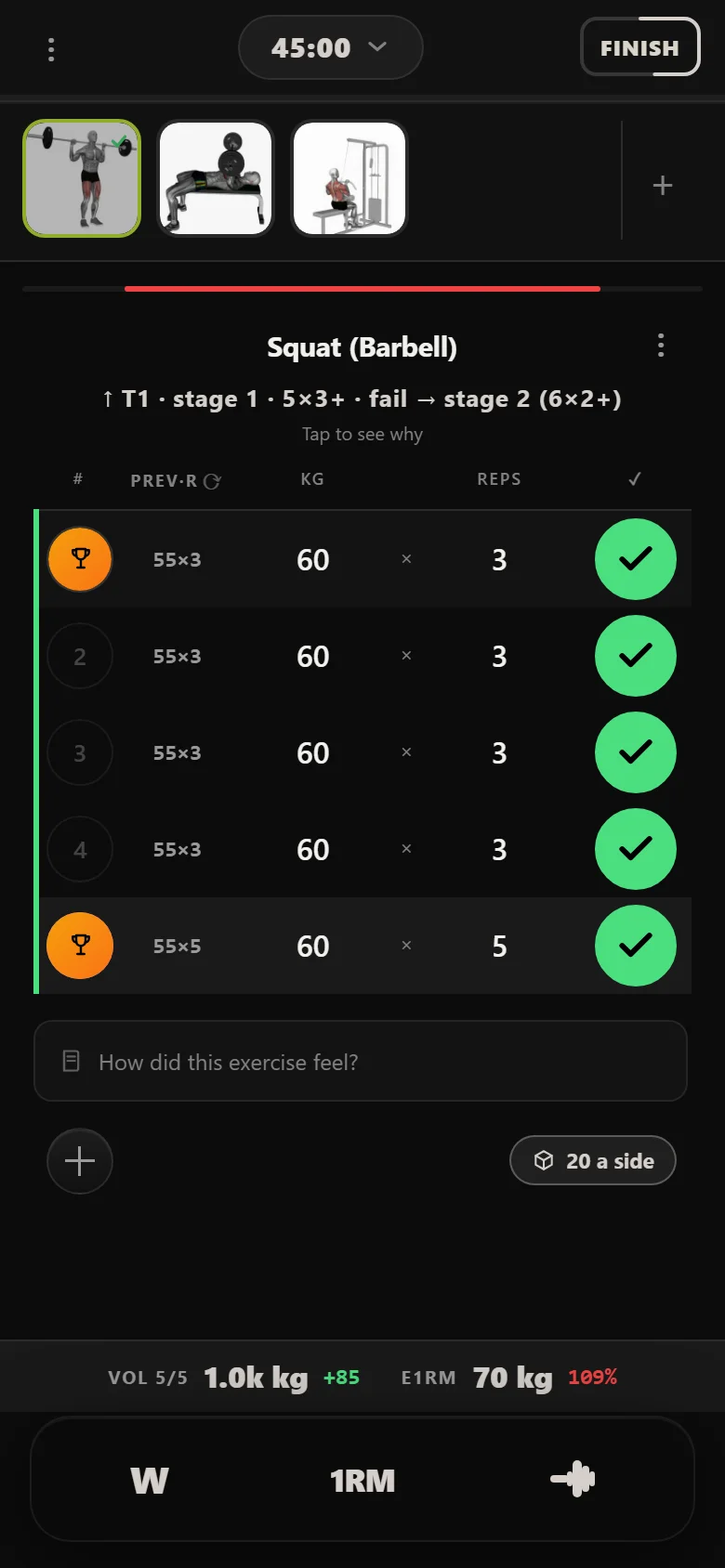
This is the part that makes GZCLP feel fast at the start. Five sessions in, the squat is at 60 kg, up 20 kg from where it began, and you have never once worked out what goes on the bar. You turn up, the weight is already on screen, and the PREV column shows what you did last time.
The stall: a miss drops a stage, not the weight
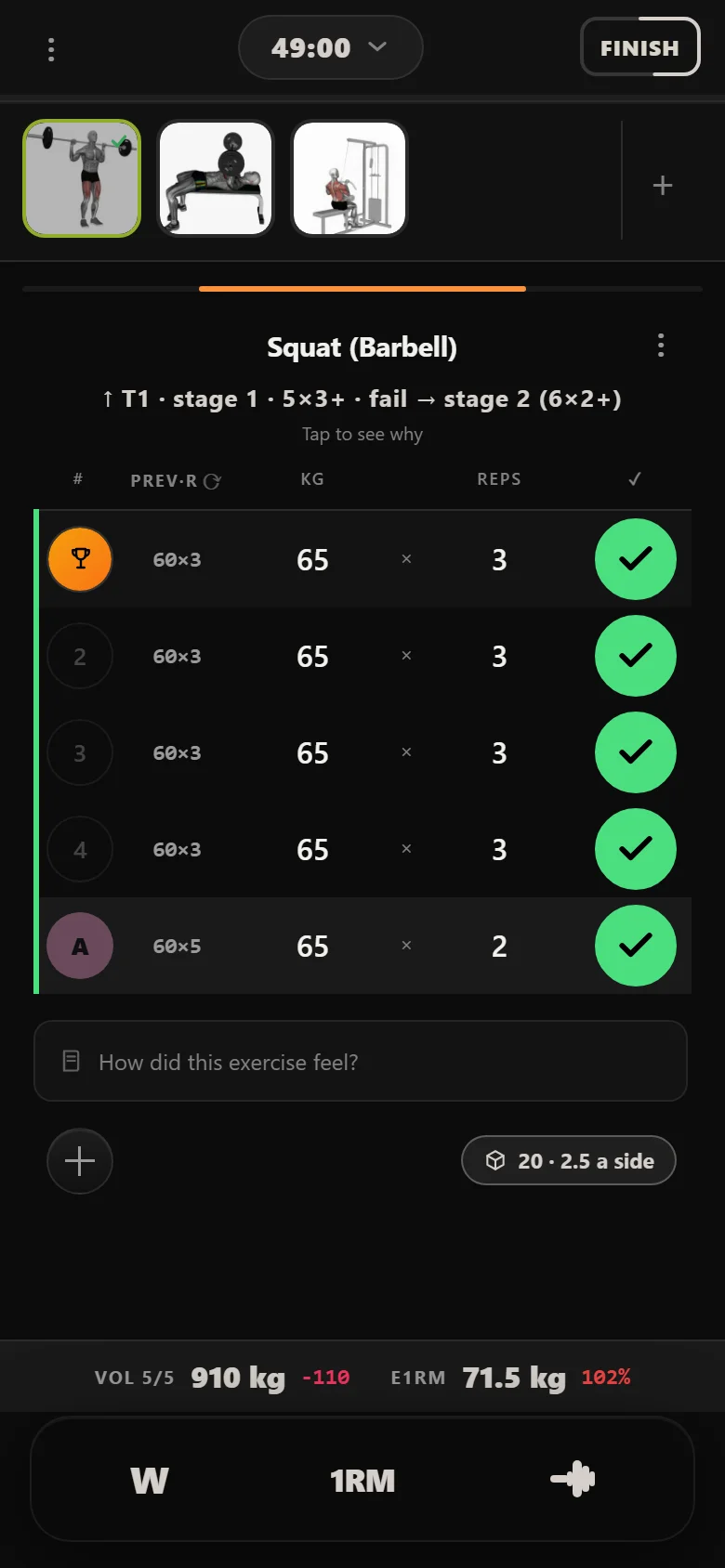
At 65 kg the squat stops clearing its target on the final set. Here is where GZCLP parts company with almost every other program: the weight doesn't come down. The app holds the 65 kg bar and drops the rep scheme, so five sets of three becomes six sets of two. Same load, reorganised, so you keep grinding at a weight your body is close to owning.
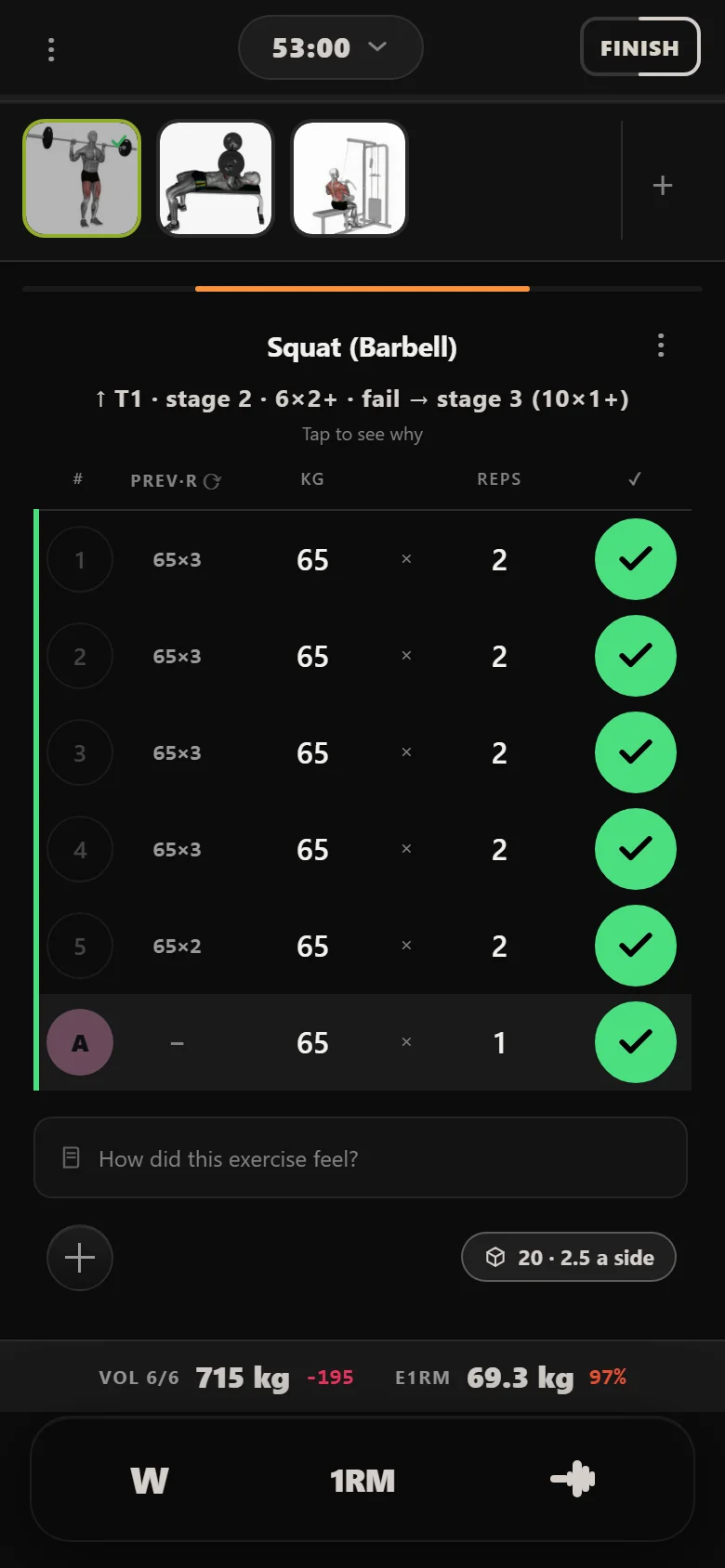
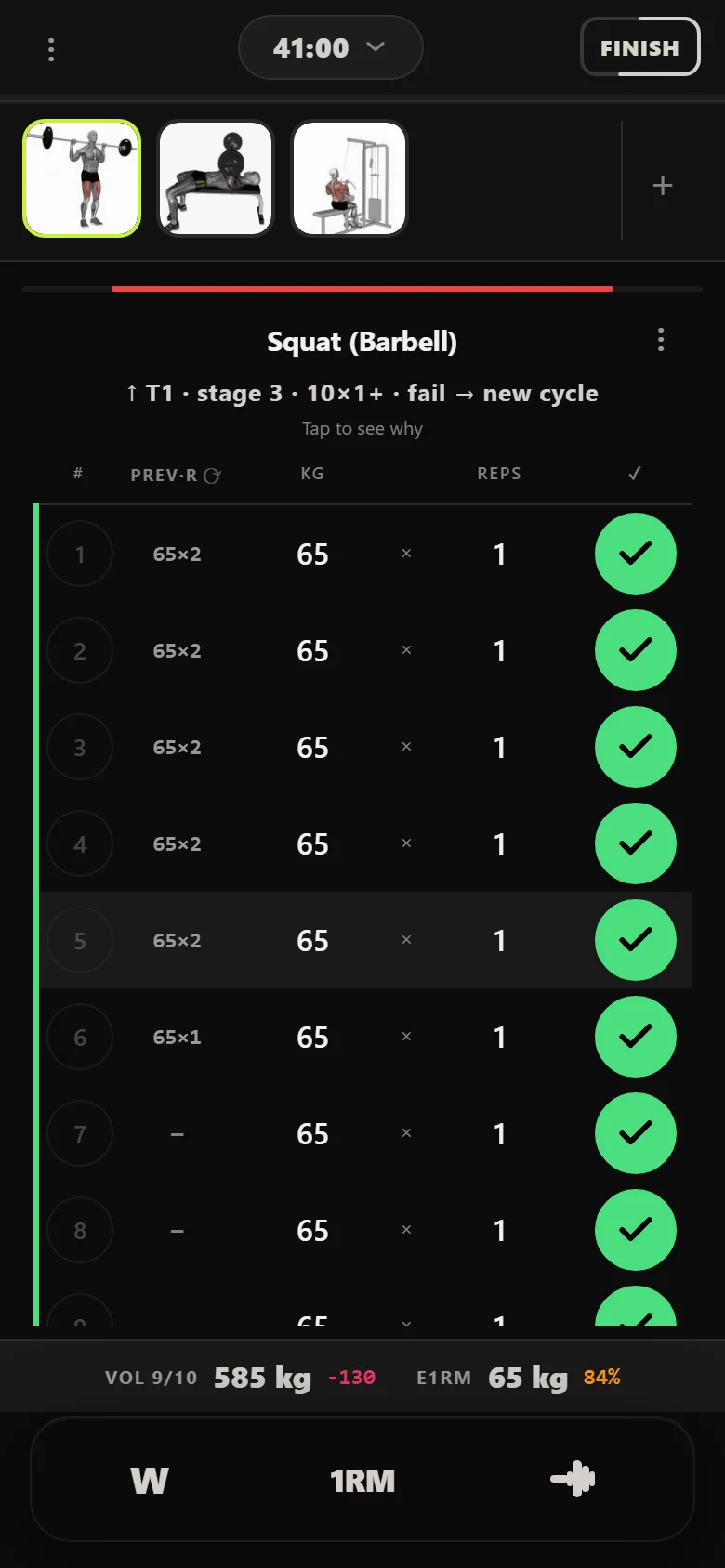
Miss the six sets of two as well and it drops once more, to ten sets of one, still at 65 kg. This is the last stage. You are now doing ten heavy singles at a weight that stalled your triples, and you stay there until you have taken everything you can from it.
Lowering the bar to force the reps wouldn't help either. Durata judges the weight you actually lifted against what was prescribed, so an easy set at a lighter weight never counts as progress. The stage is the only lever, and the app pulls it for you.
The T2 runs the same idea on its own ladder
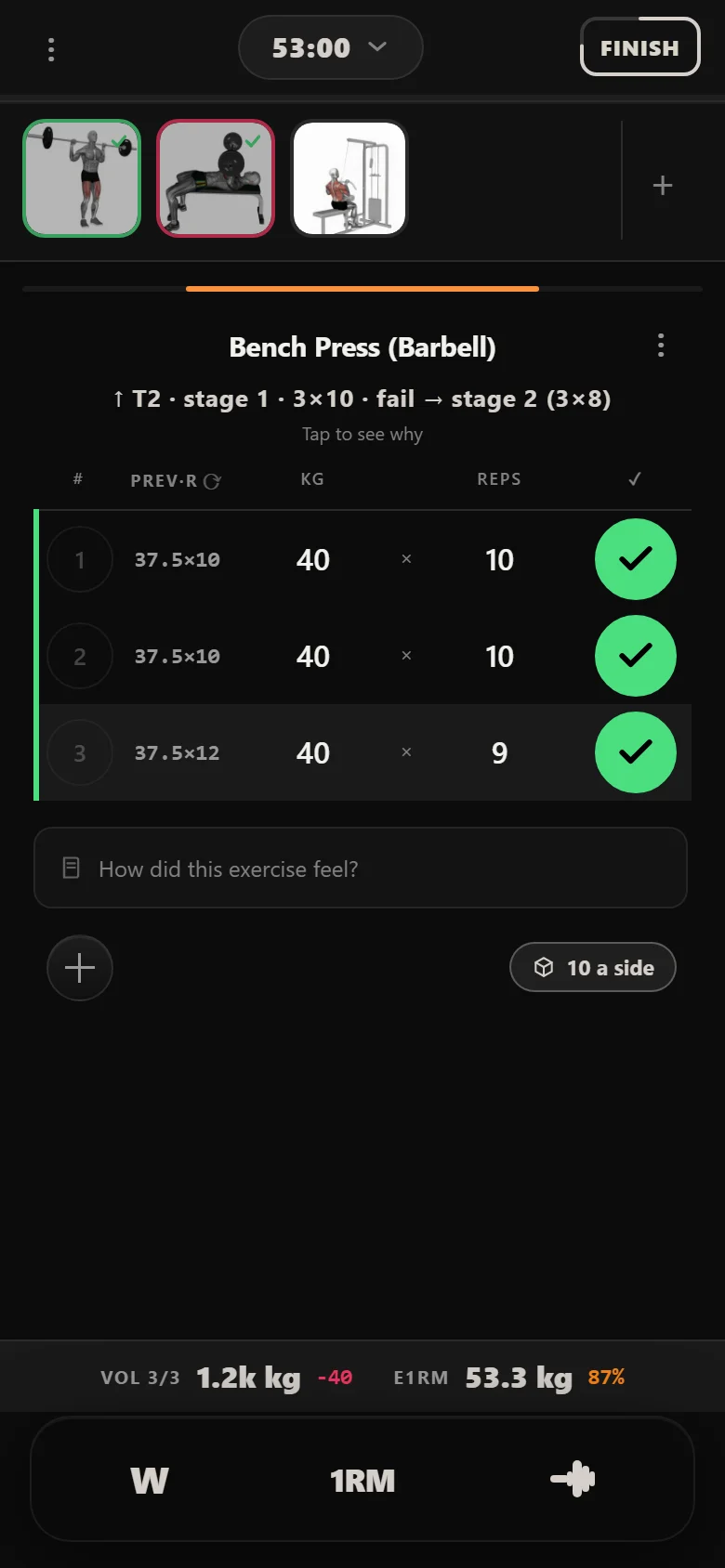
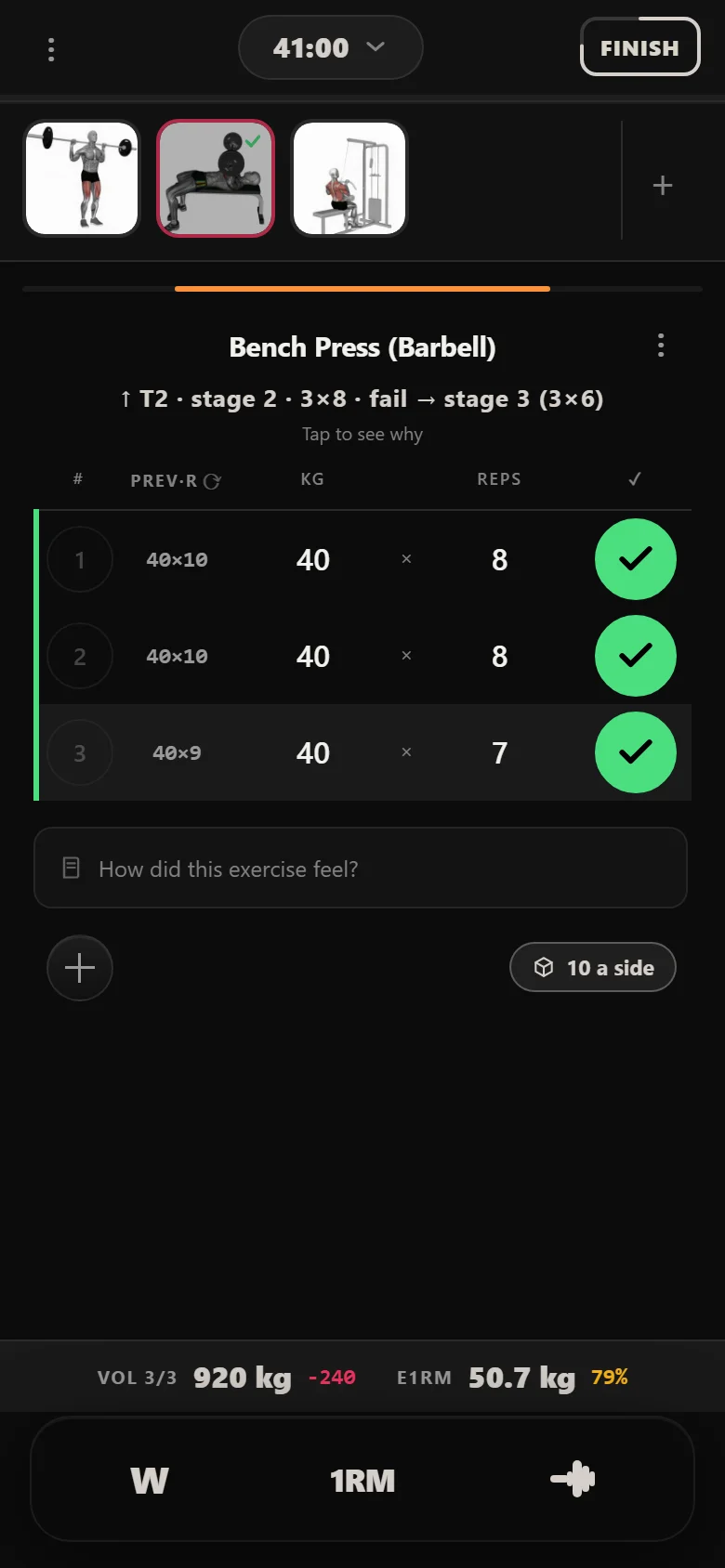
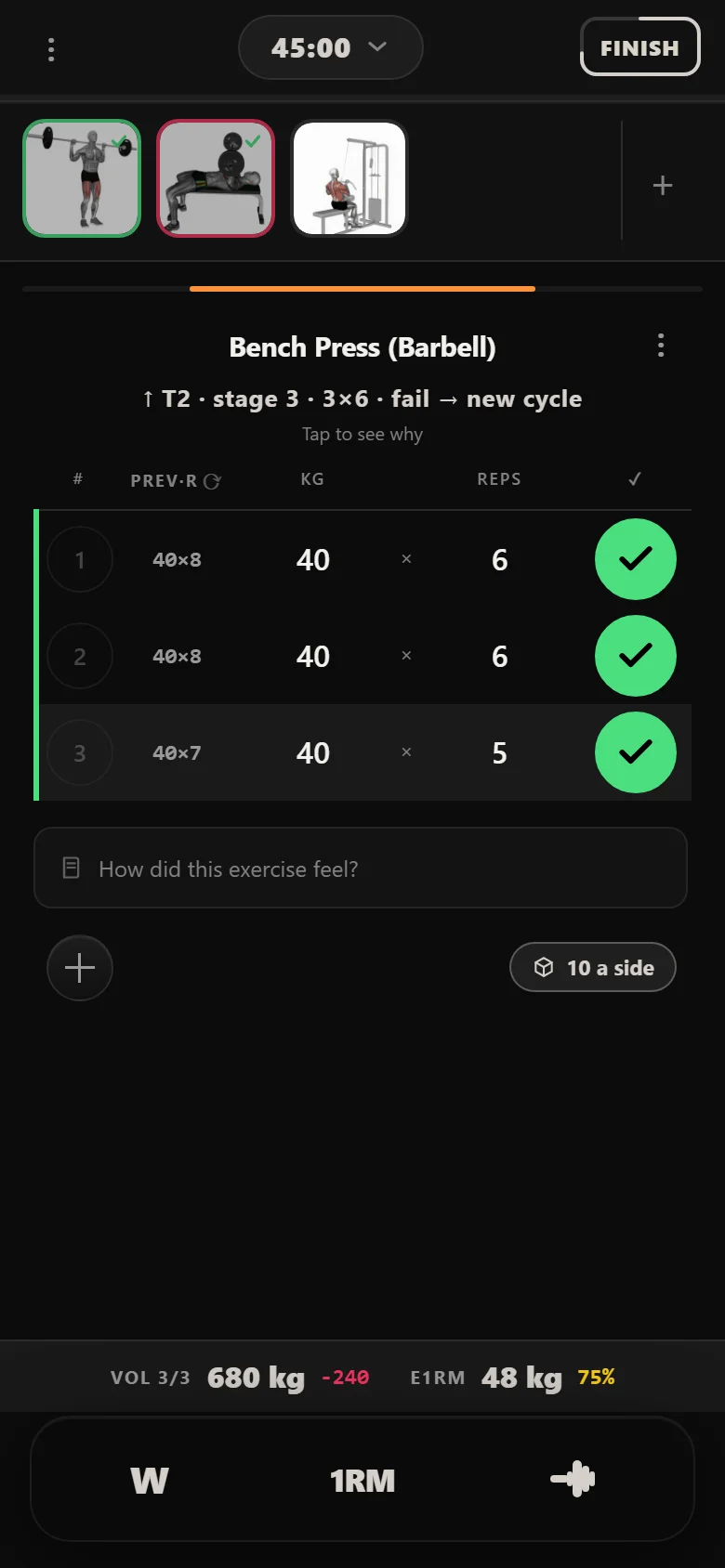
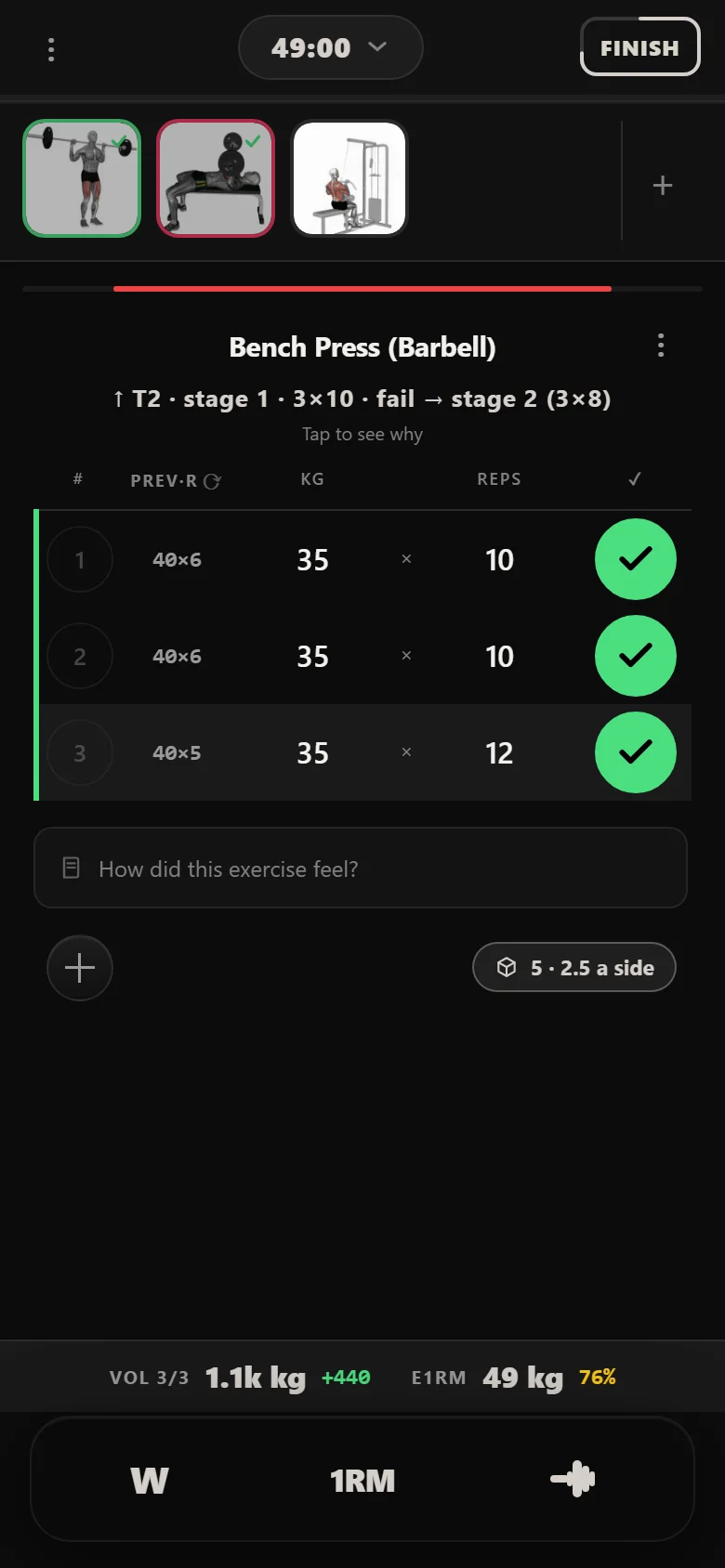
The tiers are independent. While the squat is stalling, the day's T2 bench press is running its own climb, from 25 kg up through 30 and 35 to 40, where it stalls on its three sets of ten.
The answer is the same shape on a different ladder. The bench keeps the 40 kg bar and drops to three sets of eight, then to three sets of six. Three stages, one weight, more work squeezed out of it each time. Nothing about the squat's stall touched the bench, and nothing about the bench's stall touched the squat.
The restart: the cycle ends and the app works out where you begin again
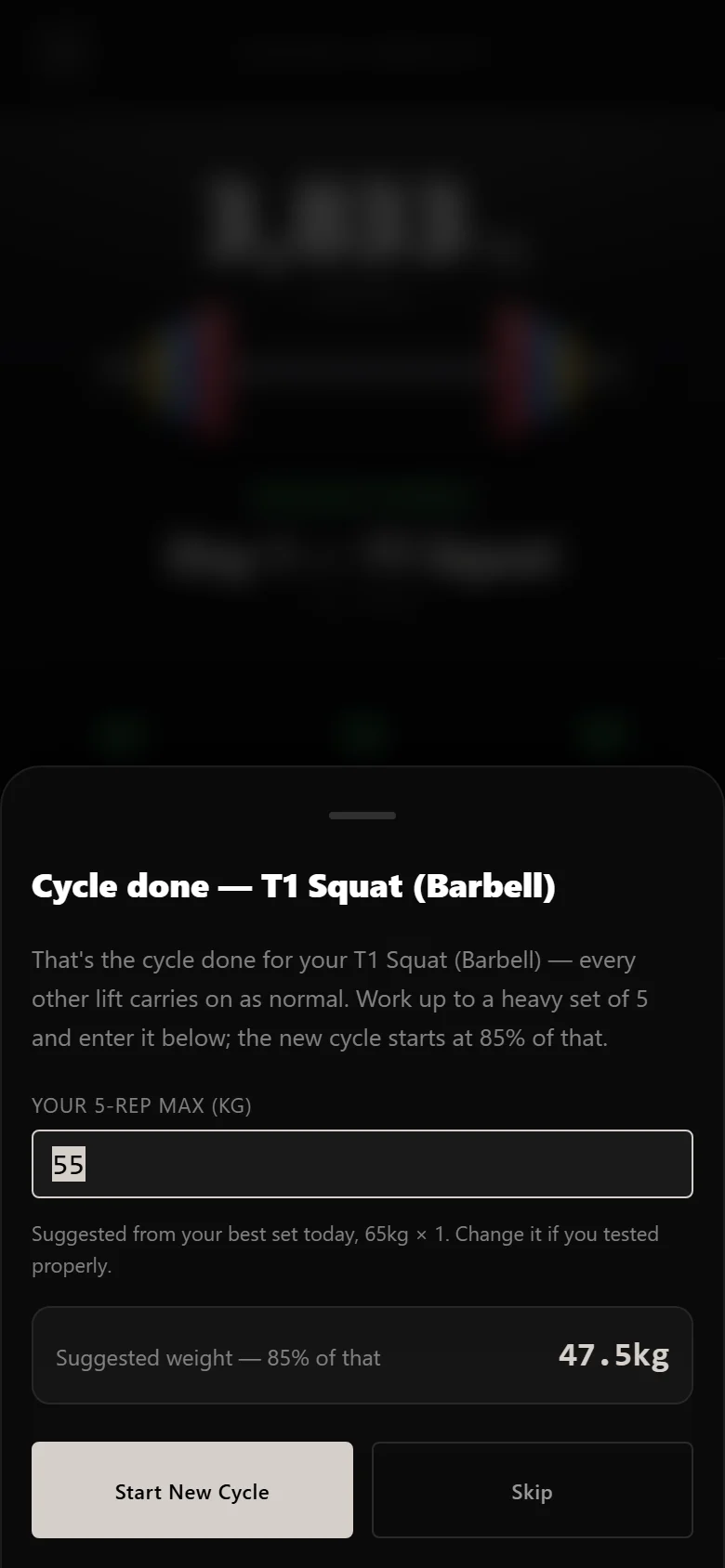
Miss the ten singles and the cycle is over for that lift, and only that lift. This is the moment GZCLP is genuinely fiddly to run by hand, because you are supposed to test a fresh five-rep max and restart at 85% of it, rounded to a weight you can load.
Durata does the arithmetic. It estimates your five-rep max from the best set you managed this cycle, takes 85% of it, rounds it to the plate and pre-fills the number. You confirm it, or type your own in if you actually tested. Here the estimate restarted the squat at 47.5 kg, back to five sets of three, with the whole calculation shown on screen.
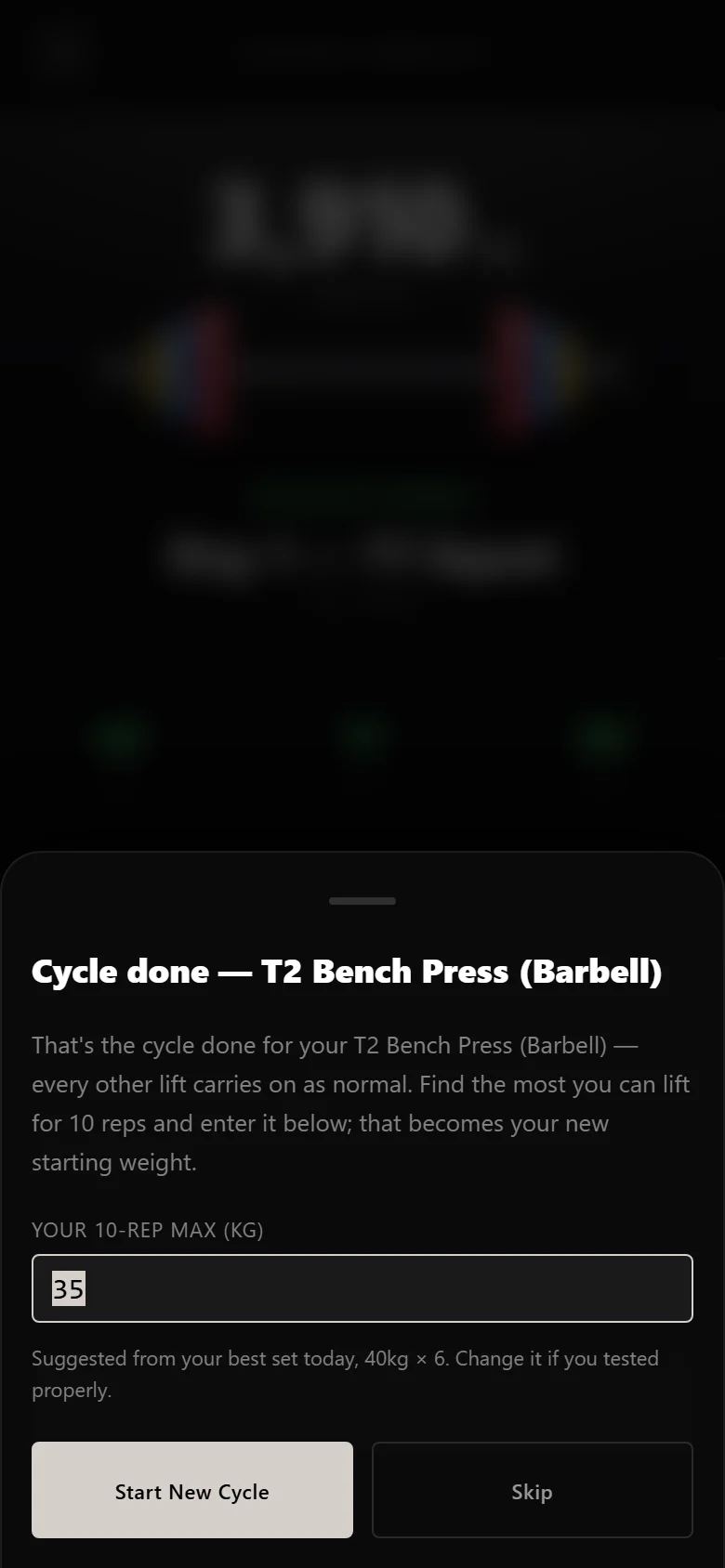
The T2 restarts on a different rule, and the app applies the difference for you. When the bench ran out of stages it came back at the ten-rep max it had just earned, taken straight rather than at a percentage, which put it at 35 kg on three sets of ten and climbing again.
It reads like a step back, but it isn't. The reps you ground out through the later stages built real strength at the stall weight. The restart gives you a running start at it rather than throwing you back into a wall.
The T3 climbs on reps, and never deloads
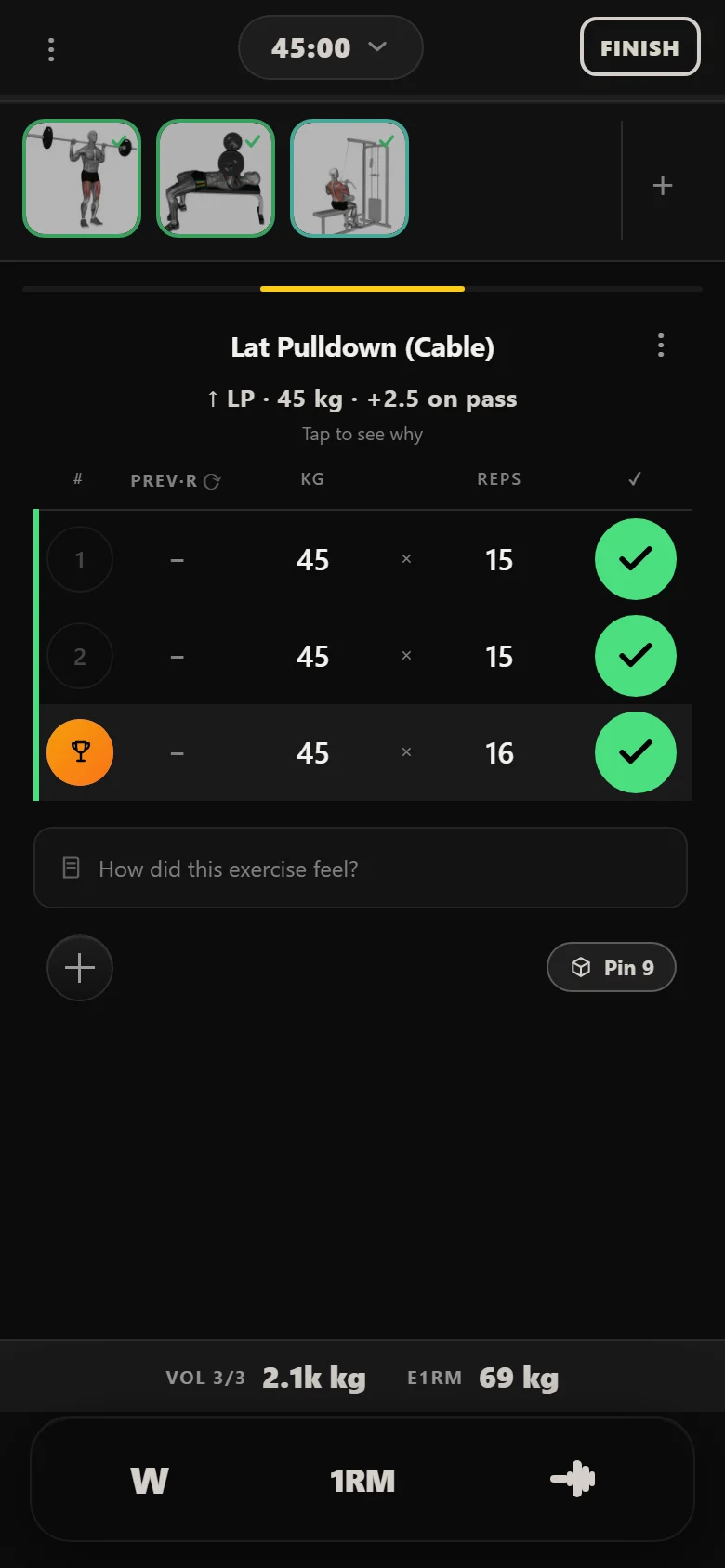
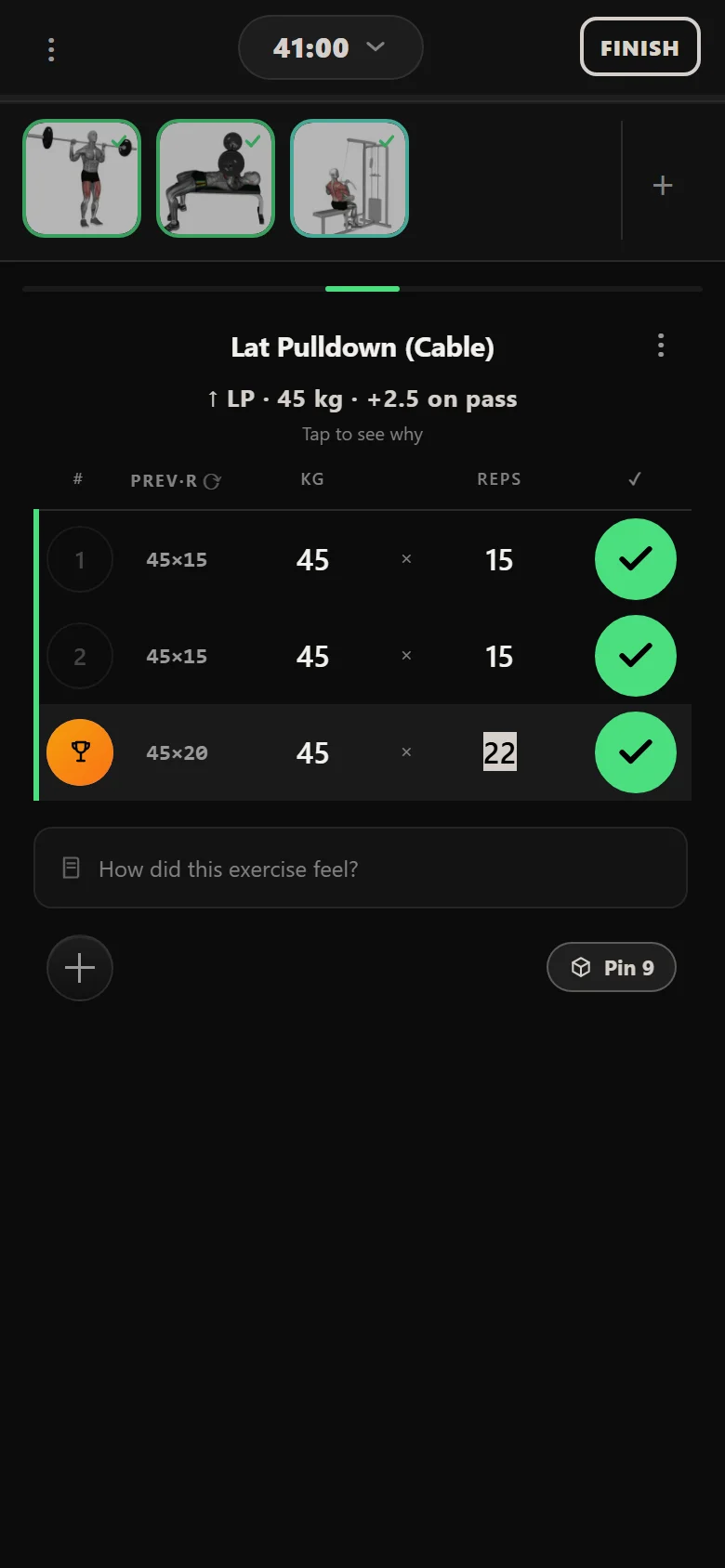
The third tier works the other way round. The lat pulldown sits at 45 kg for three sets of fifteen, the last one taken close to failure, and the weight does not move until that last set reaches 25 reps. Until then the reps you add are the progress.
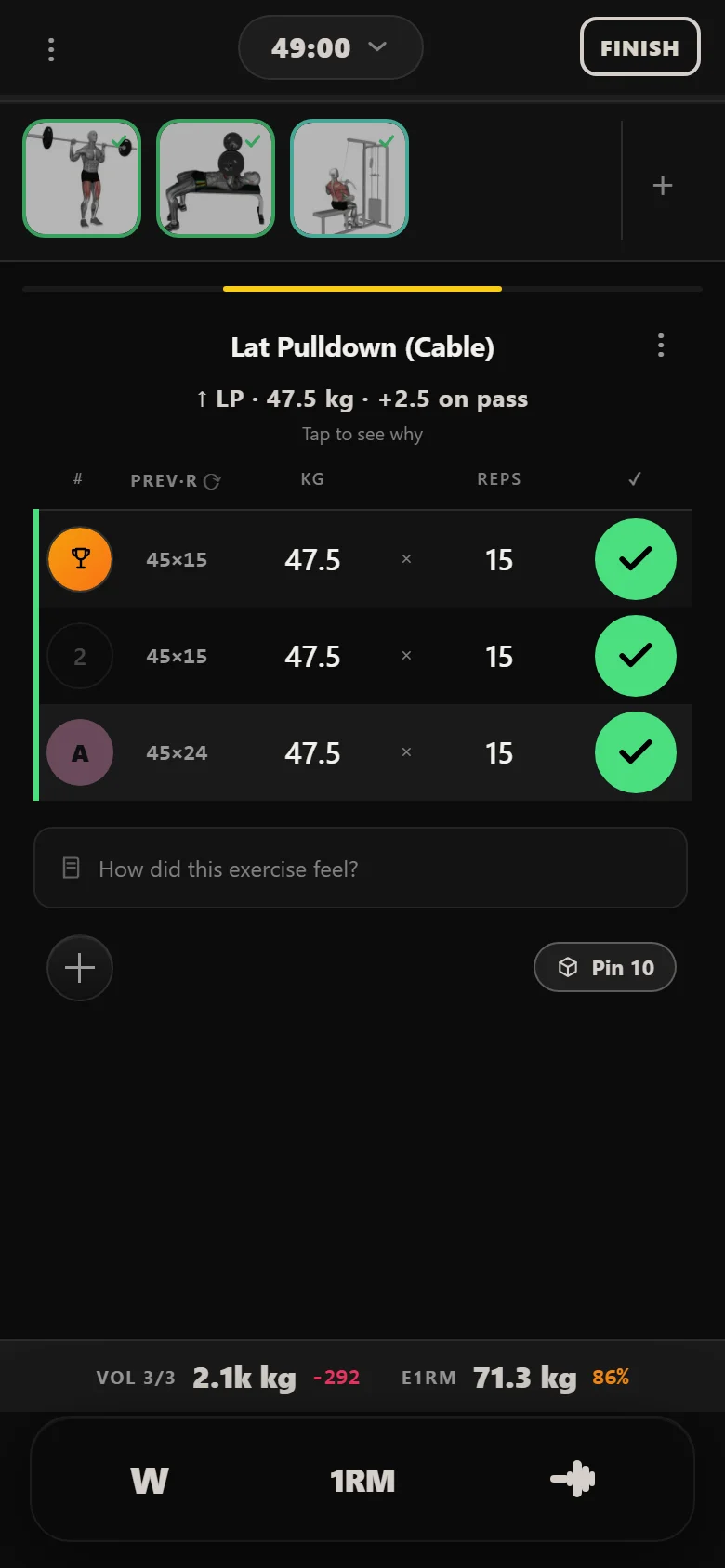
That is why a T3 has no stages and never deloads. A short set costs you nothing, because the weight simply waits. This run climbed the pulldown from 16 reps to 25 at 45 kg, at which point the app moved it to 47.5 kg and the rep climb started again from the bottom. By the end of the block it was at 50 kg.
The payoff: back through the ceiling that stopped you
Restarted at 47.5 kg, the squat climbs again through 52.5, 57.5, 62.5, 67.5 and 72.5, and this time it carries straight up through the weight that stalled the first run. By the end of the fourteen weeks it has passed the stall and 77.5 kg is already prescribed for the next session.
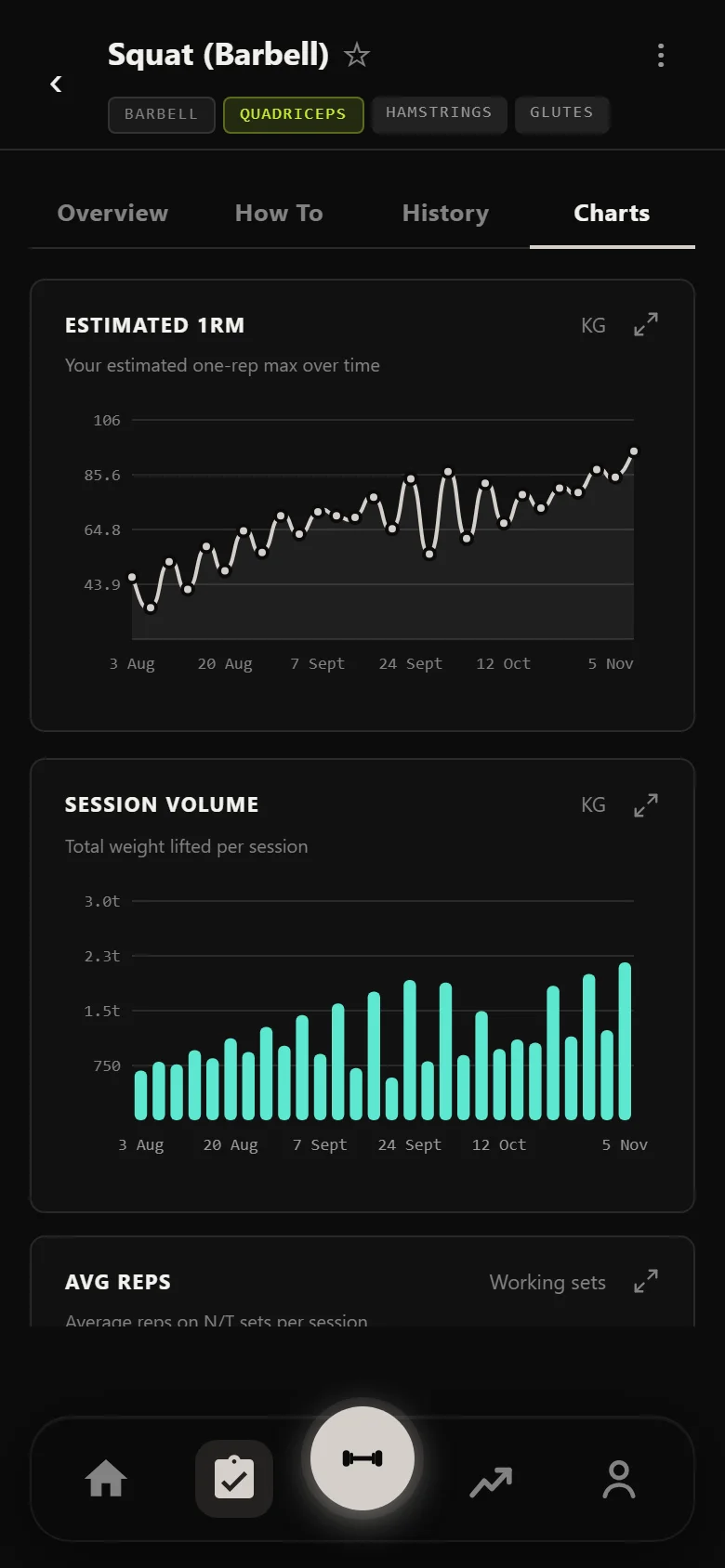
That is the shape GZCLP is built to produce, and it is the shape the estimated one-rep max chart shows: a climb, a plateau where it stalled, a dip at the restart, then a line that pushes past its own earlier high. Because the T1 squat is tracked on its own slot, that chart is about your heavy tier alone. The lighter volume work never drags the line around.
Fourteen weeks in the log
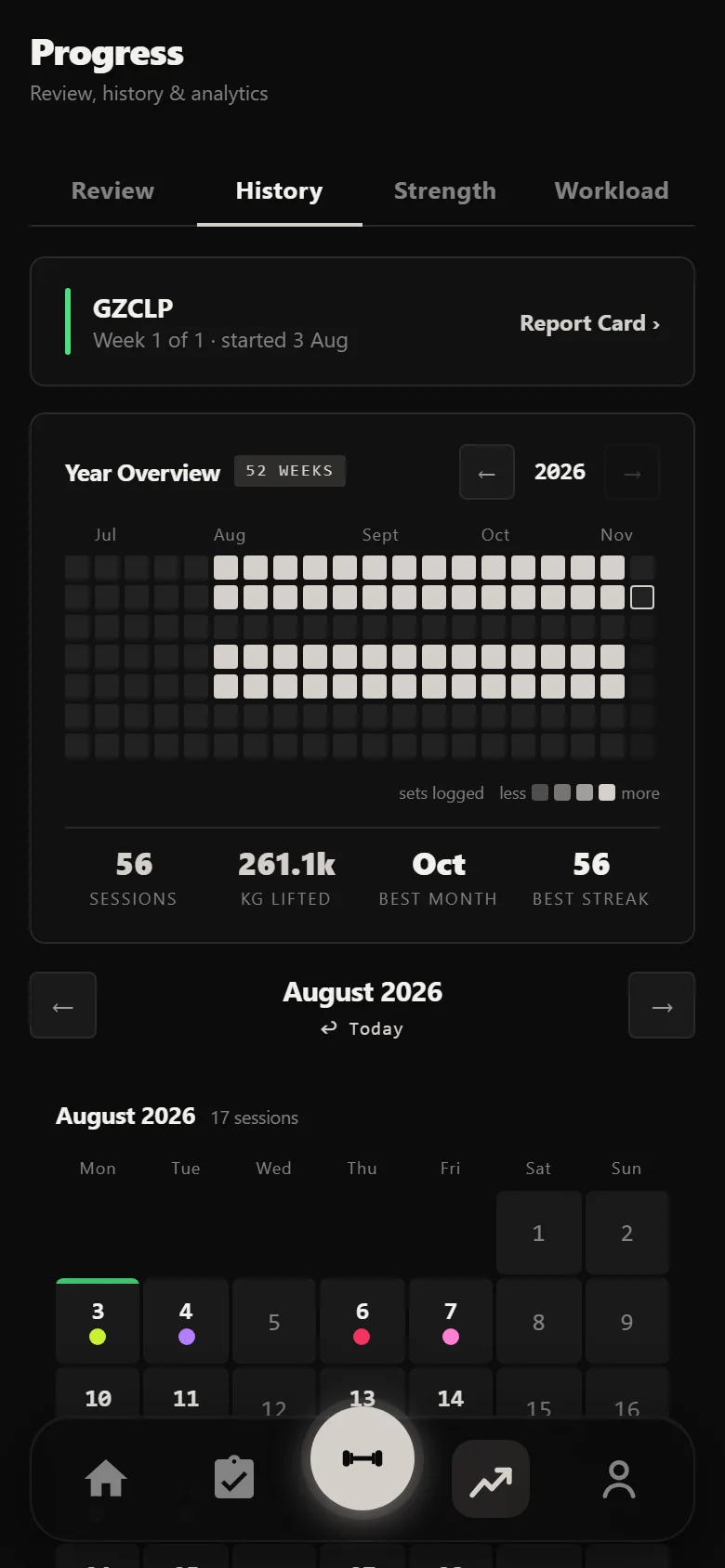
Four sessions a week for fourteen weeks fills the History calendar, and every session's date flows from the start date you set at the beginning, so the whole block is scheduled rather than guessed. The stall and the restart are both in there, in sequence, exactly as the engine drove them.
Start to finish: the T1 squat
Where the followed lift began and ended, taken from the program's own stored progression state. Fourteen T1 sessions: five decisions to add weight, three stage drops at the same bar, one restart the app calculated, and a finish above the weight that stalled the first run, with 77.5 kg already prescribed for the next session.
T1 squat: weight on the bar, per T1 session (trained once a week)
- 40S1 Session 1
- 45S2 Session 2
- 50S3 Session 3
- 55S4 Session 4
- 60S5 Session 5
- 65S6 Session 6 — 5×3 missed: stage drops to 6×2
- 65S7 Session 7 — 6×2 missed: stage drops to 10×1
- 65S8 Session 8 — 10×1 missed: the cycle ends
- 47.5S9 Session 9 — restart at 85% of a fresh 5RM, back to 5×3
- 52.5S10 Session 10
- 57.5S11 Session 11
- 62.5S12 Session 12
- 67.5S13 Session 13 — past the 65 kg stall
- 72.5S14 Session 14 — 77.5 prescribed next
The payoff, where the squat started and finished
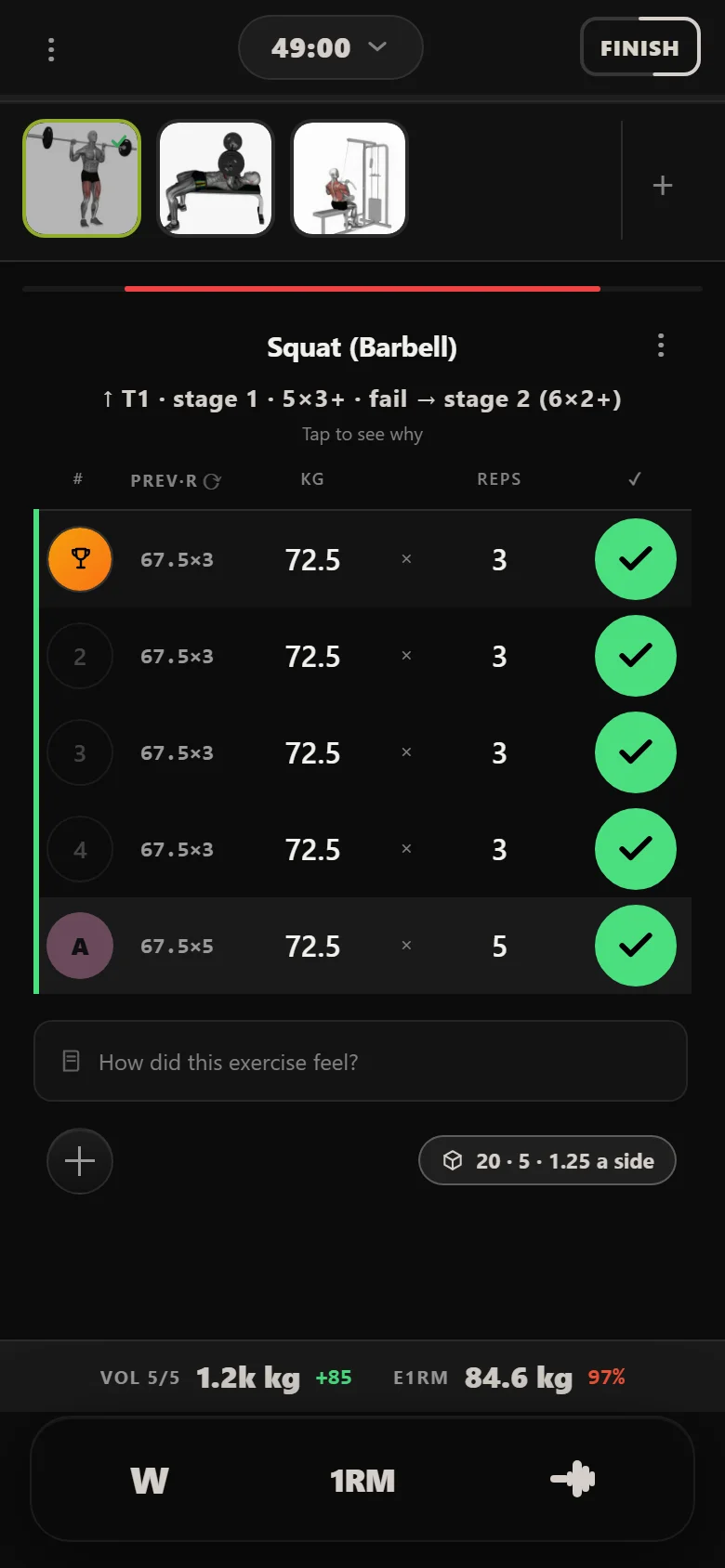
Two screenshots of the same T1 squat, fourteen weeks apart. Session one is the 40 kg opener you seeded. The later shot is the same lift back above the ceiling that stalled it, after a full stall through three stages and a restart the app calculated for you. Nothing between them was typed in. Every weight was decided from the sets you logged.
Same T1 squat, fourteen weeks apart: a 40 kg opener to 72.5 kg back through the ceiling. The stall and the restart are in between, and the app drove every weight.
Common questions
What do T1, T2 and T3 mean?
Tiers of intensity, all run in the same session. T1 is your main strength lift for the day, done heavy for low reps, starting at five sets of three. T2 is a supplemental compound for volume. T3 is a light accessory taken close to failure for high reps. Each tier has its own job and its own progression rule, and they stall independently.
What happens when my T1 stalls?
The weight is not cut. GZCLP drops the rep scheme instead: five sets of three becomes six sets of two, then ten sets of one, all at the same weight. Only when you fail the ten singles does the cycle end. Durata handles every one of those transitions automatically and holds the weight through them, so nothing is lost.
How does the cycle restart, and where does the weight come from?
When you fail the last stage, GZCLP restarts that lift at 85% of a fresh five-rep max. Durata estimates your five-rep max from the best set you managed in the cycle, takes 85%, rounds it to a weight you can load and pre-fills it. You confirm it, or type your own in if you tested properly. Only the lift that stalled restarts. Everything else keeps going.
Does the T2 restart the same way?
No, and the app applies the difference for you. The T2 ladder runs three sets of ten, then eight, then six at the same weight, and when it runs out it restarts at the ten-rep max you just earned, taken straight rather than at a percentage. In this run the bench stalled at 40 kg and came back at 35 kg on three sets of ten.
The restart weight is lighter than where I stalled: isn't that going backwards?
No. The reps you ground out through the later stages built strength at the stall weight, so the restart is a running start rather than a fresh wall. In this run the squat stalled at 65 kg, restarted at 47.5, and climbed back past it within the same block, finishing at 72.5 with 77.5 kg prescribed for the next session.
What is the '+' on the last set?
An AMRAP, as many reps as possible. It is the set that decides the session on the T1: clear the target and the app adds weight next time, fall short and the stage drops. Leave a rep in reserve rather than grinding to absolute failure. You will still trigger the progression and recover better.
Is GZCLP good for a beginner?
Yes. It is one of the most popular first programs after a pure linear progression, because it keeps adding weight quickly and then has a built-in answer for the stall that doesn't just cut your weight. This run is a beginner's numbers throughout: a 40 kg squat, four sessions a week.
Is Durata free?
Yes. Durata is free to use, with the full program catalogue, automatic progression maths, rest timers and PR tracking. Everything in this walkthrough is in the app.
Put it into practice
Durata is free to use — 50 proven programs, automatic progression, rest timers and PR tracking, all on your phone.