


Twice a week is enough: a full linear progression on two sessions
Two sessions a week is the constraint most lifters actually train under, and it's the one program guides quietly ignore. The assumption is always three days, or four, or six. But linear progression doesn't care how often you train. It cares that you add weight every time you complete the work. Train twice a week and the arc is the same shape, it just spans more calendar.
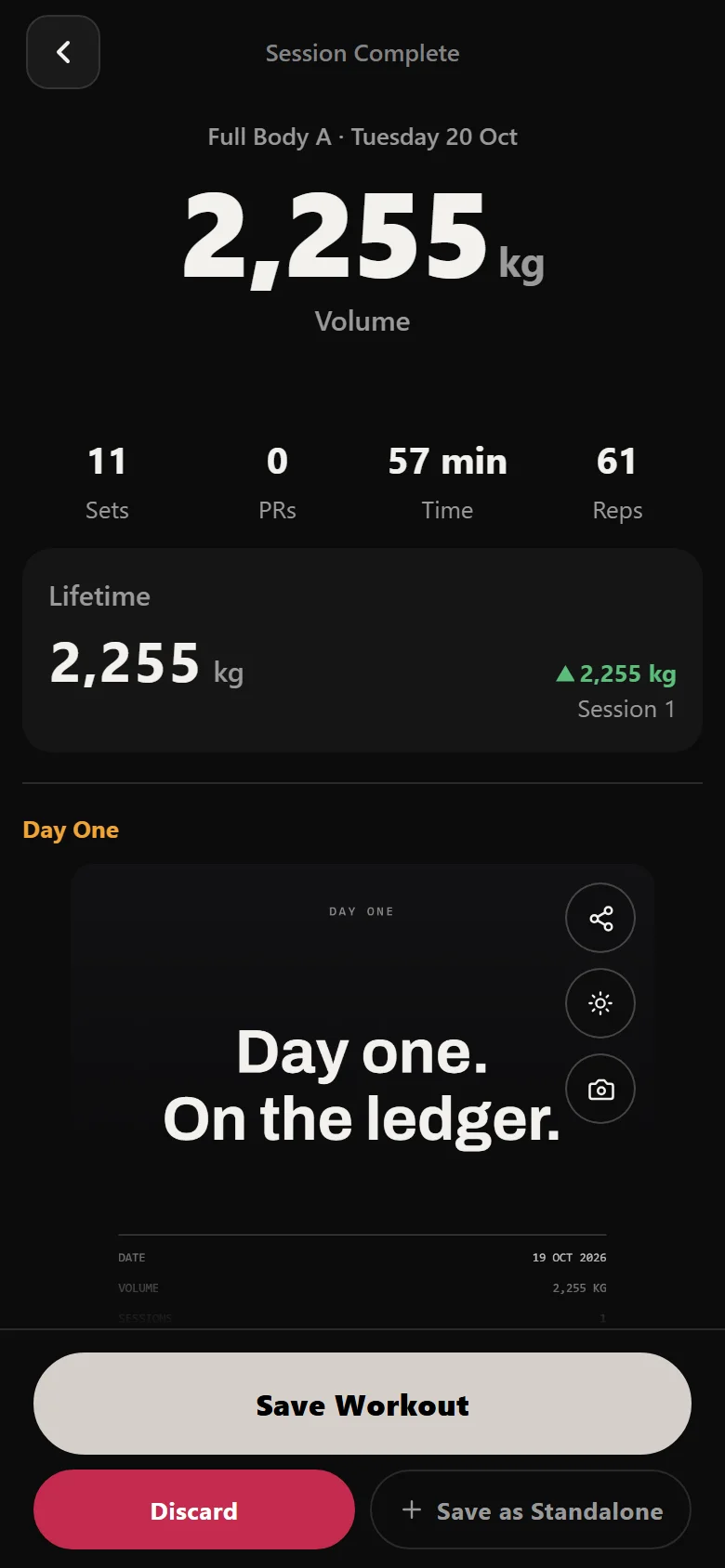
This run is a beginner's: a 60 kg squat, a 40 kg bench, six weeks of training and twelve sessions in total. The squat is trained in both sessions, so it's the lift worth following, and it goes up 5 kg every time it's completed. It also stalls, deloads, and finishes higher than it started by a distance. Every screen below is the live app and every number is computed by the real engine.
Starting the program
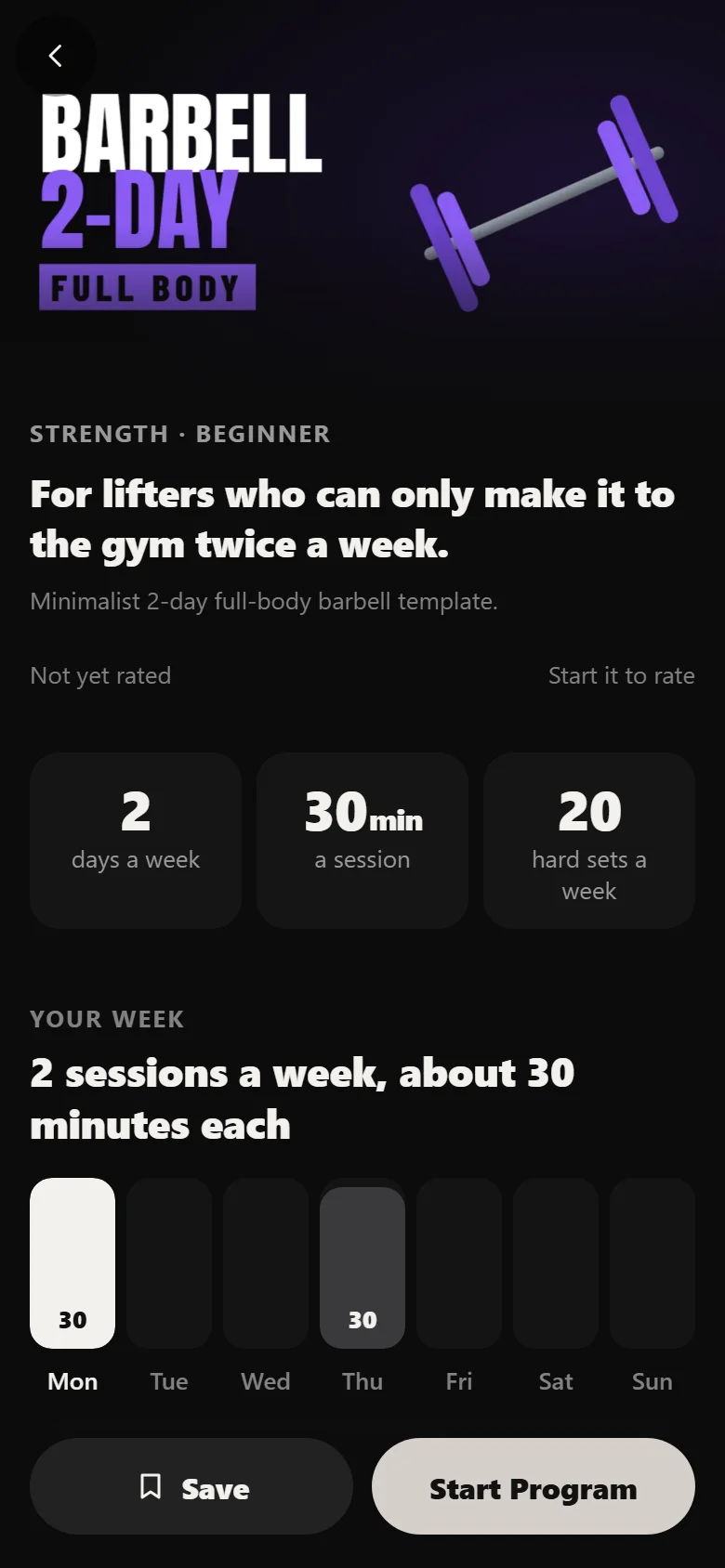
Two full-body sessions cover the whole body between them: Workout A is squat, bench and row; Workout B swaps in the overhead press and deadlift. Each session is a squat, a press, a pull and a hinge, which is what makes two days a week viable at all. Nothing gets skipped because there's no third day for it to live on.
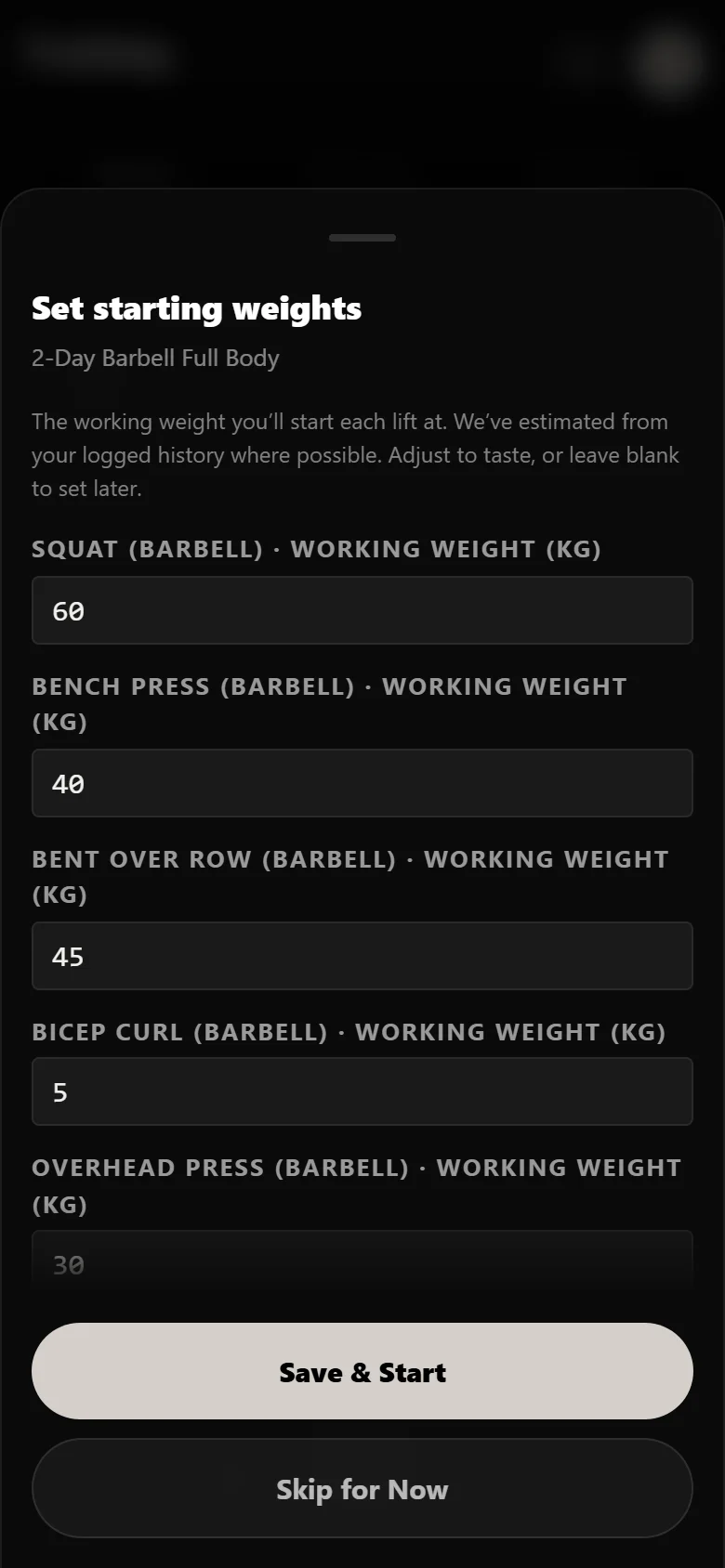
There are no training maxes to work out. Linear progression runs off a working weight per lift, so the app asks what you can currently handle for the prescribed sets and starts there, 60 kg on the squat here. Start conservatively: the method depends on having room to add weight for months, and the app adds it for you.
A start date goes in the calendar and every session date flows from it. From that point the program tells you what to lift and when.
The climb: 5 kg a session, decided for you
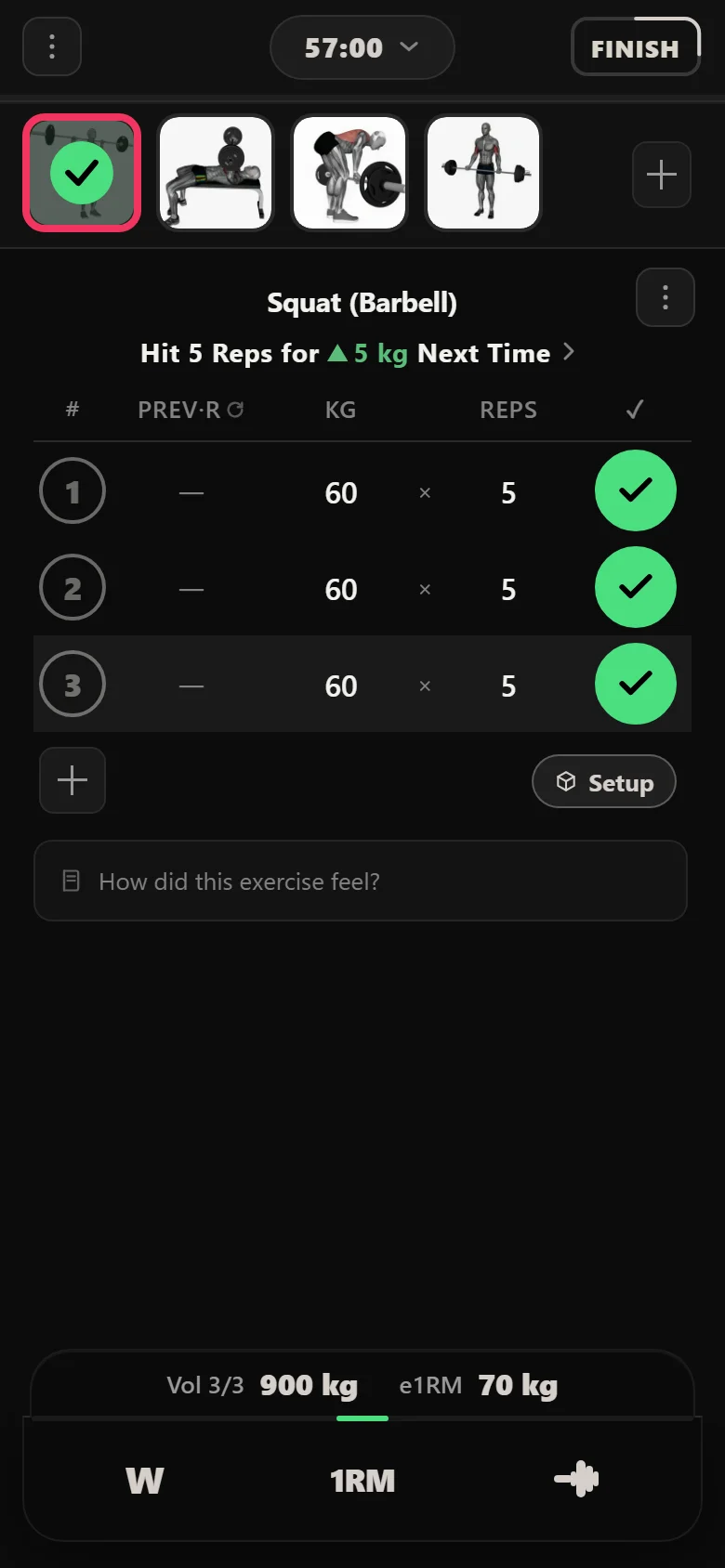
Squat opens at 60 kg. Complete the prescribed sets and reps and the app adds 5 kg to the next session. You don't tell it you succeeded and you don't do the arithmetic. It reads the sets you logged and moves the weight.
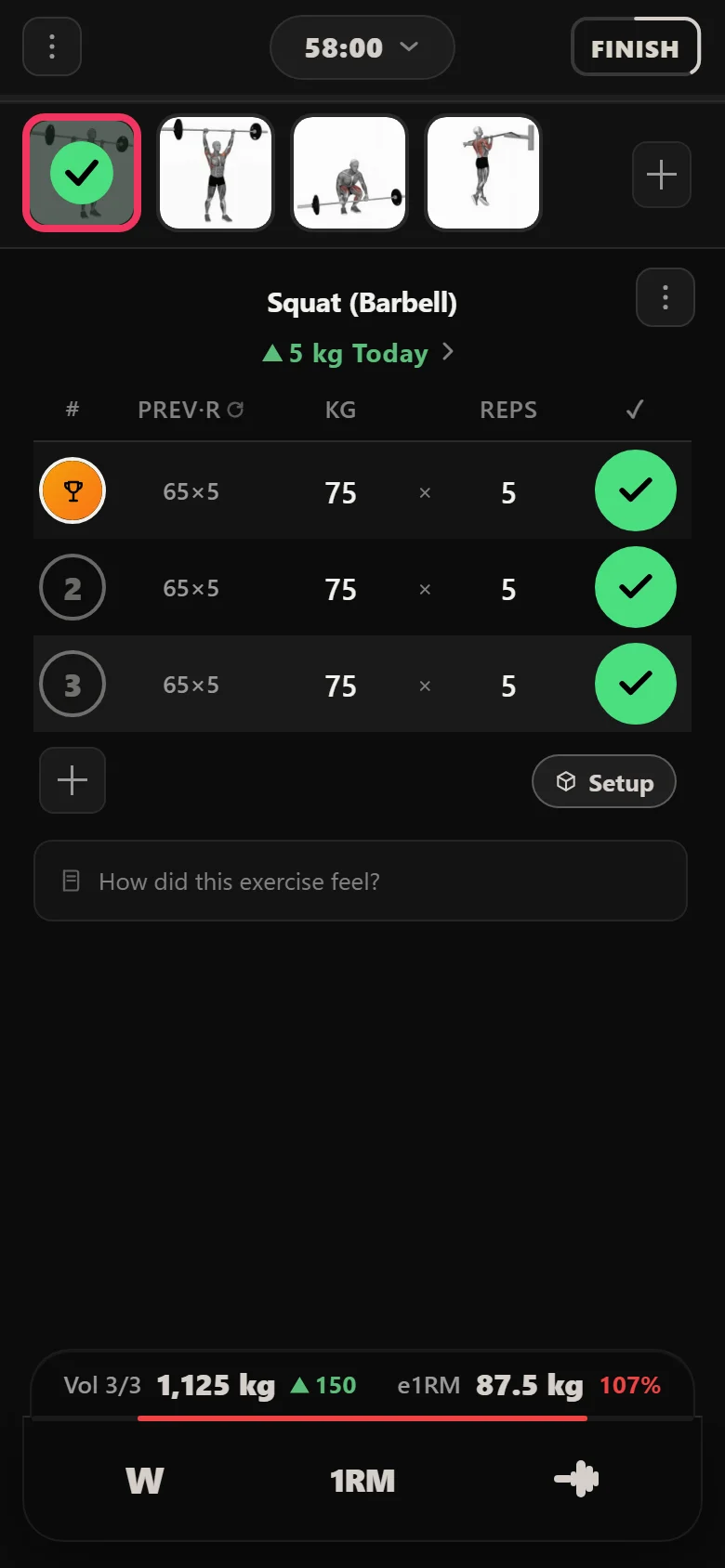
Because the squat is in both sessions, it moves twice a week: 60, 65, 70, 75. Four sessions in and it's already up 15 kg. That's the compounding that makes novice linear progression worth running even on a two-day schedule. The frequency is low but the increment is generous, and the lower body earns 5 kg jumps rather than 2.5.
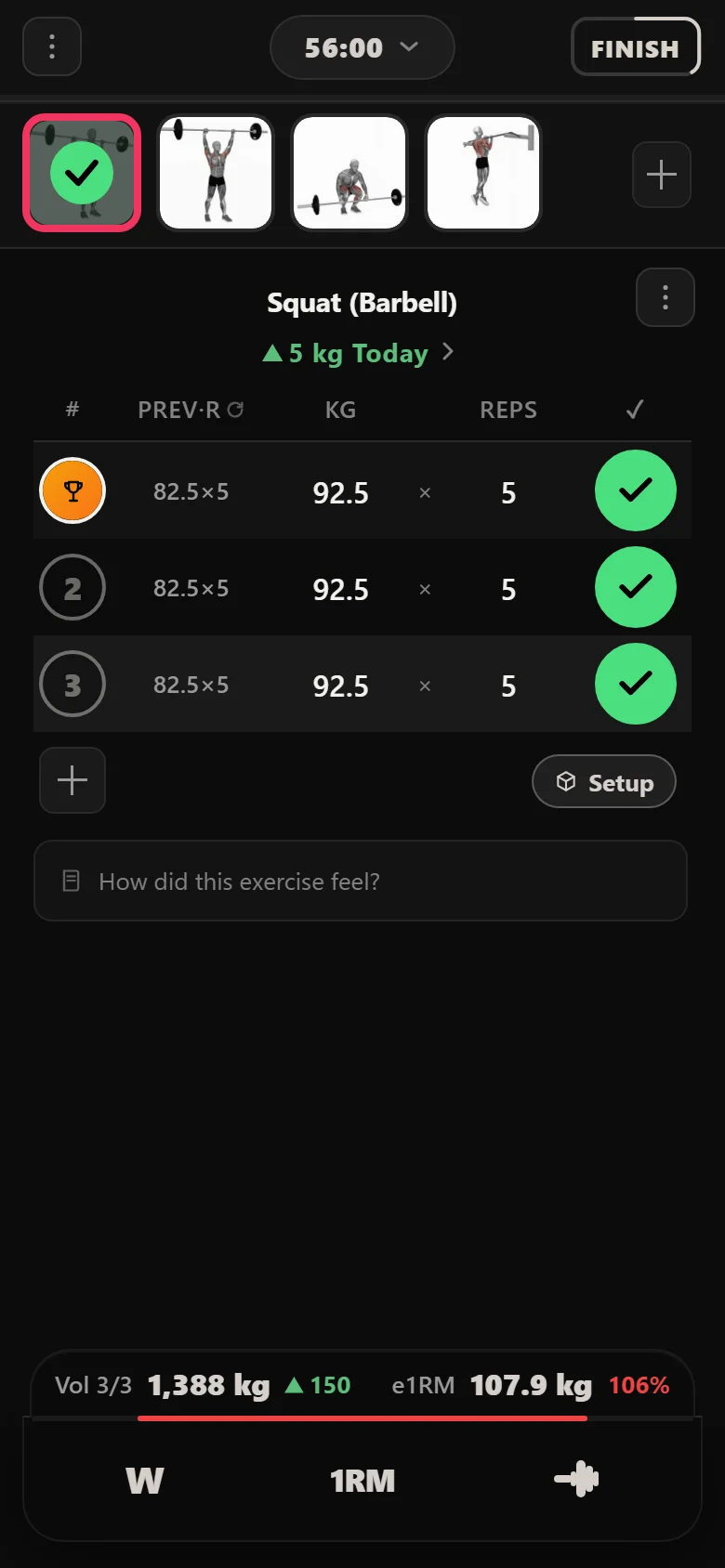
The chip under the exercise name shows the rule while you're training rather than burying it in a settings screen, and the PREV column shows what you did last time. You turn up and the weight is already on the screen.
The stall, where the climb runs out
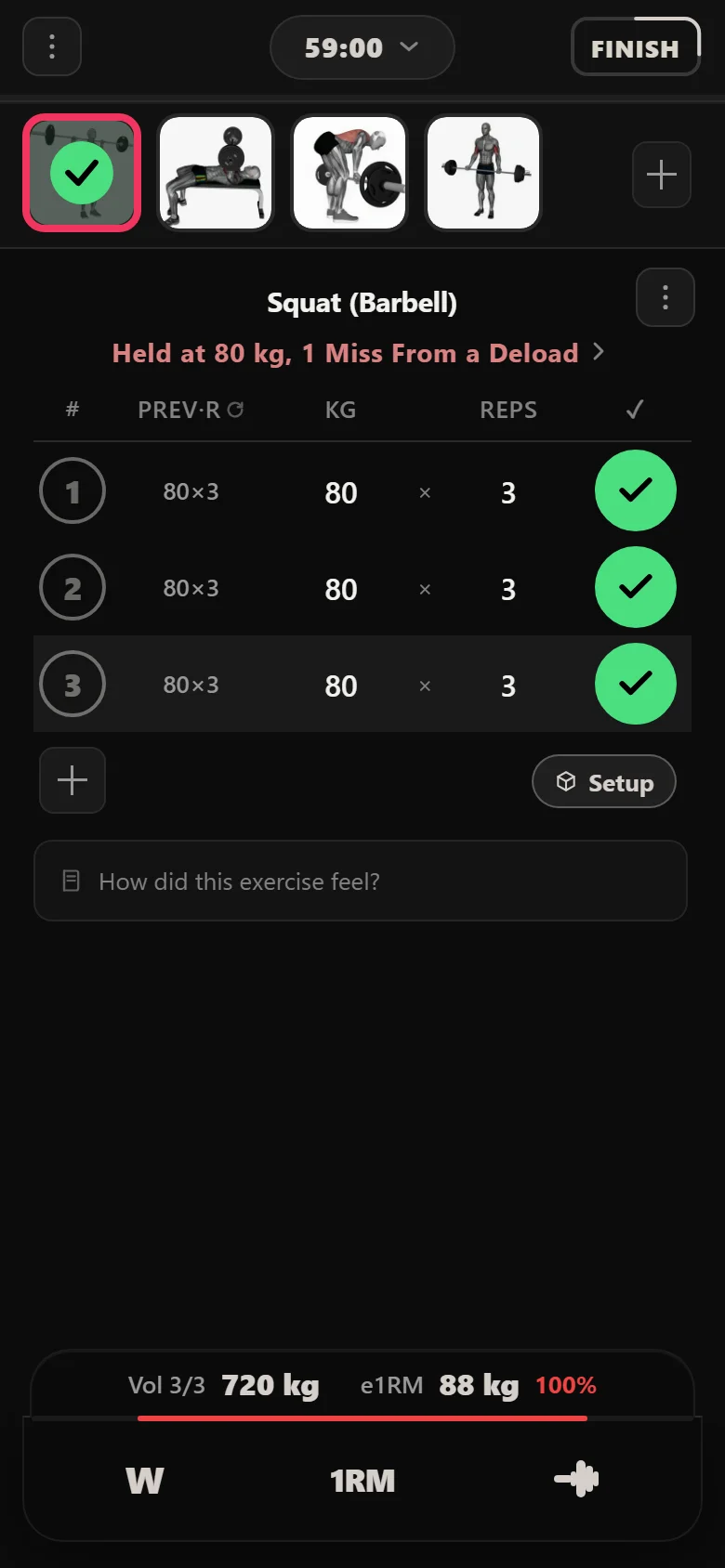
At 80 kg it stops. The prescription asks for five reps on every working set and only three go up. That's a failed session, and it's the moment that separates a progression engine from a spreadsheet: the obvious mistake is to look at the heaviest completed set, see 80 kg on the bar, and add weight anyway.
Durata holds. The weight stays at 80 kg for the next session, and the one after that, because the target was five reps on every working set and three of them fell short. Nothing advances on a session you didn't complete, and lowering the bar to make the reps doesn't count either. What you actually lifted is what's judged.
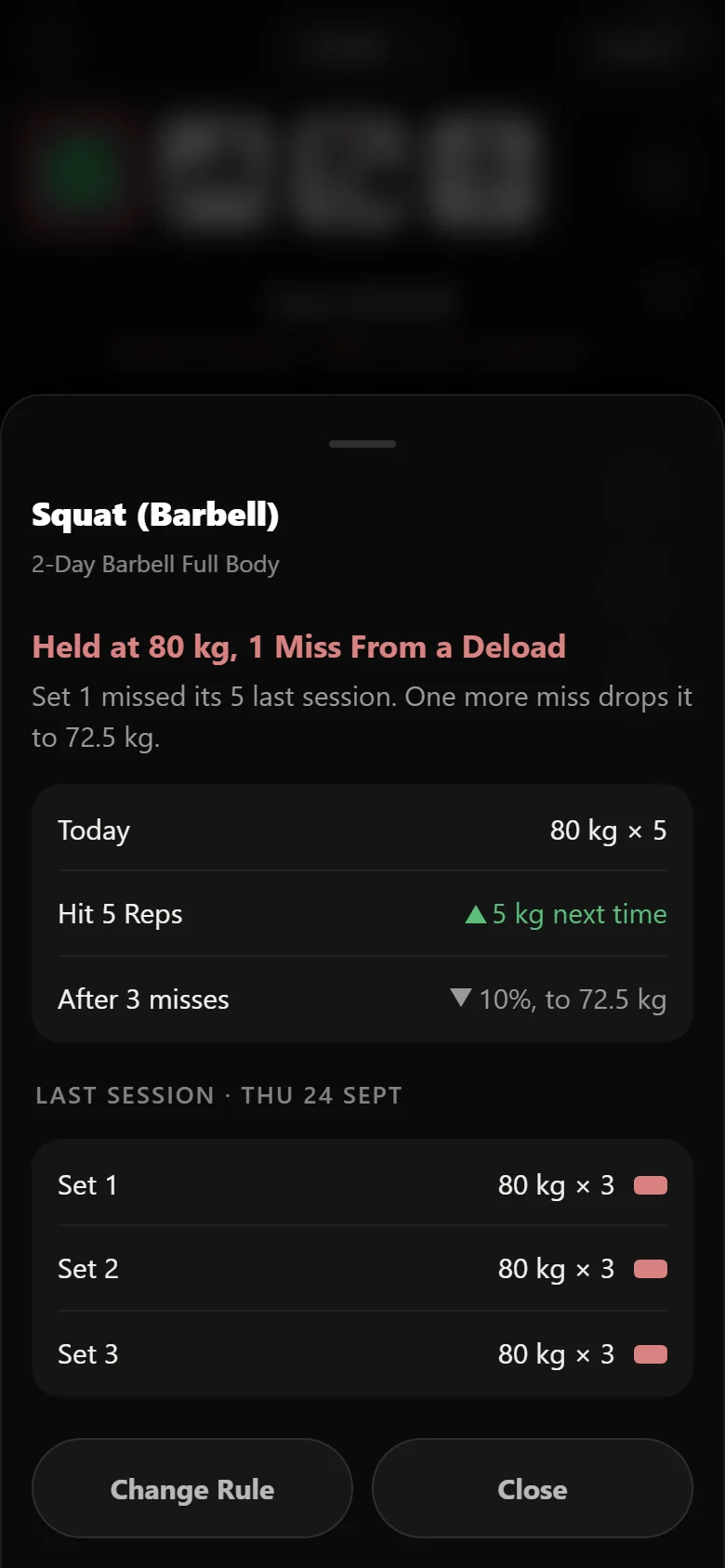
Three of those in a row is the program's cue to act, and you can check its working before it does. The rule chip under the exercise name is a button: tap it and the app lays out the evidence from this exact slot's own history against the rule it is being judged by. Two misses recorded at 80 kg, a third pending, and the law that says three misses at a weight cuts it by 10%.
The deload: the app backs you off
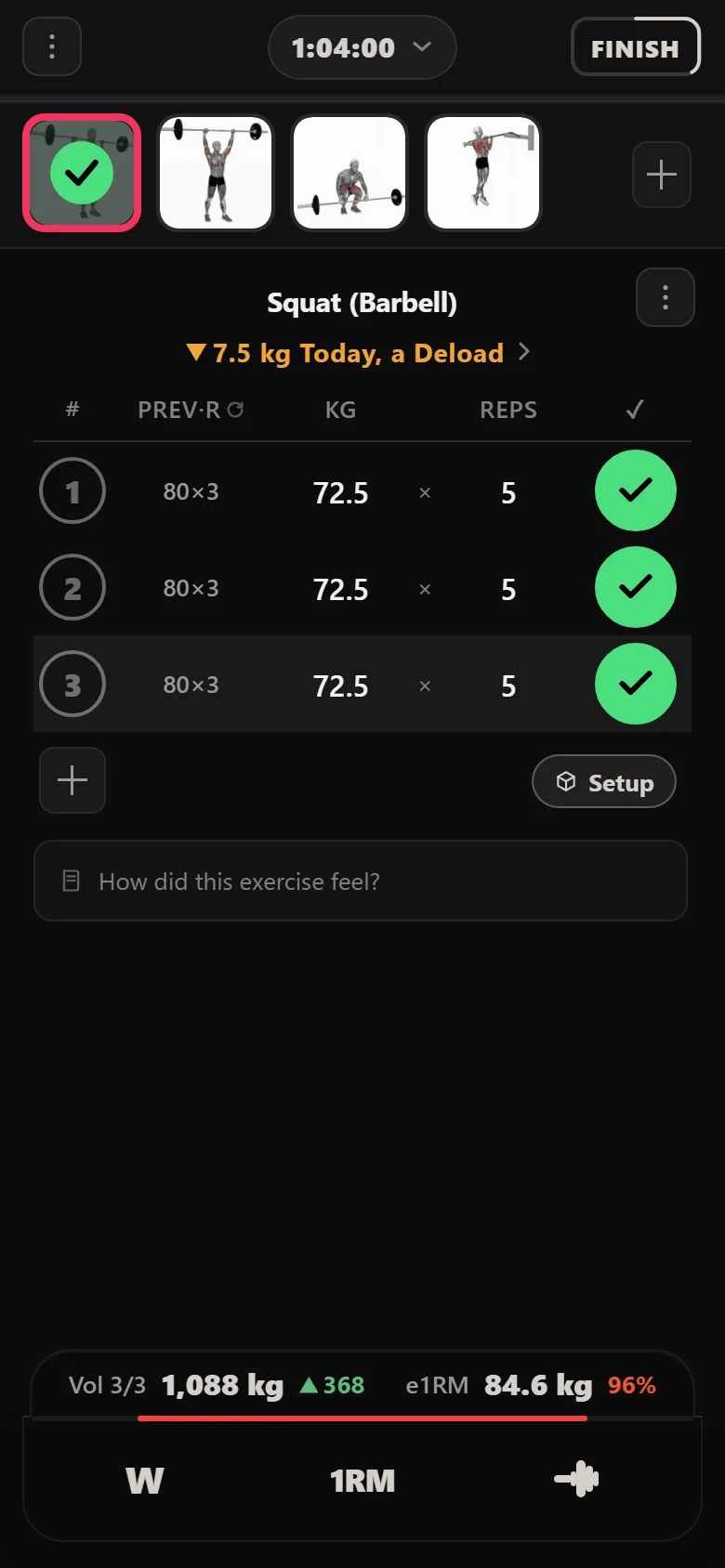
Three missed sessions trips the rule and the app drops the squat by 10%, so 80 kg becomes 72.5 kg, then restarts the climb from there. You didn't decide that, calculate it, or remember to do it. The program specifies a deload after three failures and the engine applied one.
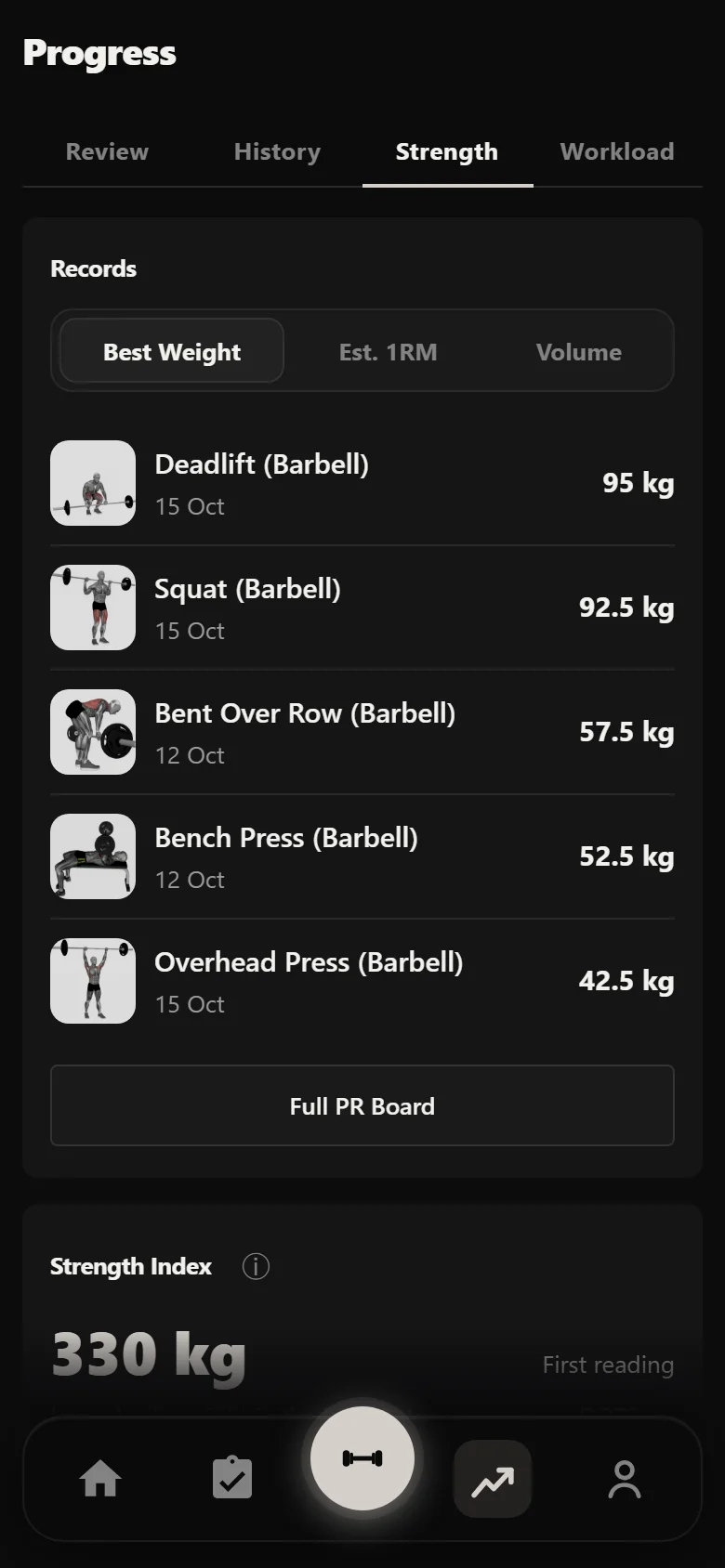
The deload doesn't cost you the block. It sets up the climb that follows. Twelve sessions across six weeks look like this: four sessions of adding weight, three where it held, one cut of 10%, and a rebuild that carries you straight back through the weight that stopped you. By session 10 you're above it. You finish at 92.5 kg, which is 12.5 kg above the ceiling that beat you and 32.5 kg above where you started.
Squat: weight on the bar, per session (2 sessions a week)
- 60S1 Session 1
- 65S2 Session 2
- 70S3 Session 3
- 75S4 Session 4
- 80S5 Session 5 — 80×3: missed, weight held
- 80S6 Session 6 — 80×3: missed, weight held
- 80S7 Session 7 — third miss trips the deload
- 72.5S8 Session 8 — −10% applied automatically
- 77.5S9 Session 9
- 82.5S10 Session 10 — past the old ceiling
- 87.5S11 Session 11
- 92.5S12 Session 12 — 12.5 kg above the stall
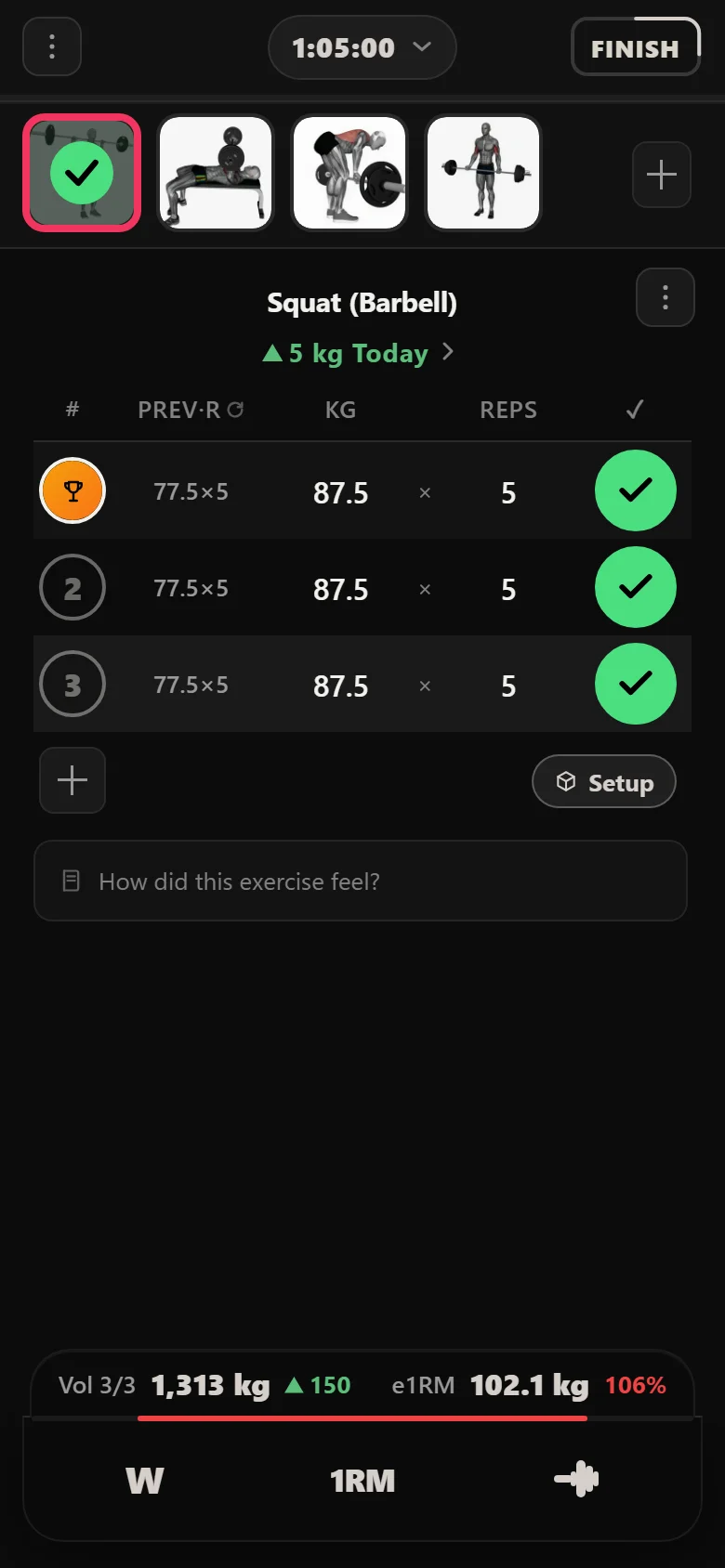
The curl runs a different rule entirely
The barbell lifts run linear progression. The curl doesn't. It runs double progression, and both rules are live in the same session. On double progression the weight is fixed and you chase reps inside a range first. Only when every set reaches the top of the range does the weight go up, and the reps reset to the bottom.
Reps inside the range are not a failure. Getting 9 where you managed 8 last time is progress, so the app holds the weight and lets you keep climbing rather than counting it against you. It's the right rule for an isolation lift, where 5 kg jumps every session would be absurd.
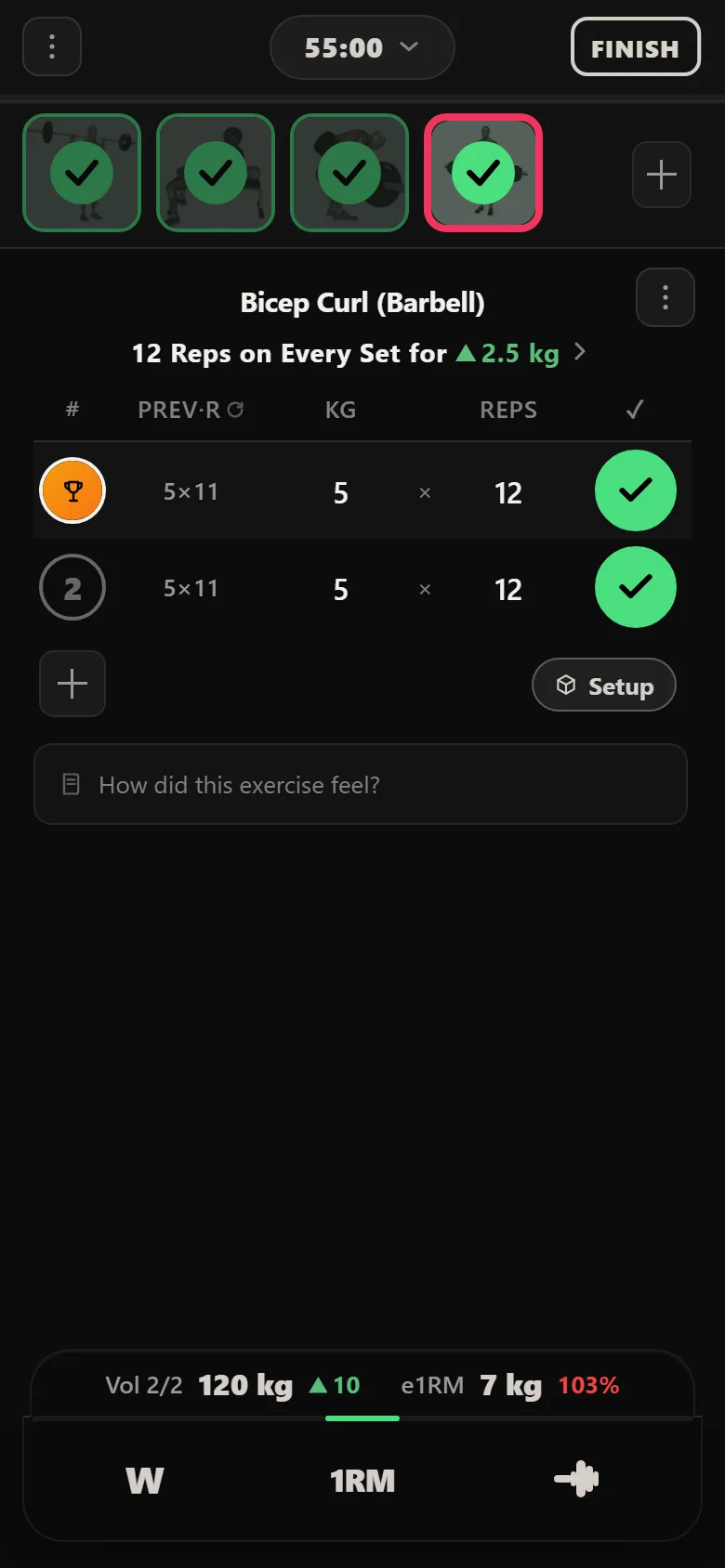
Six weeks later
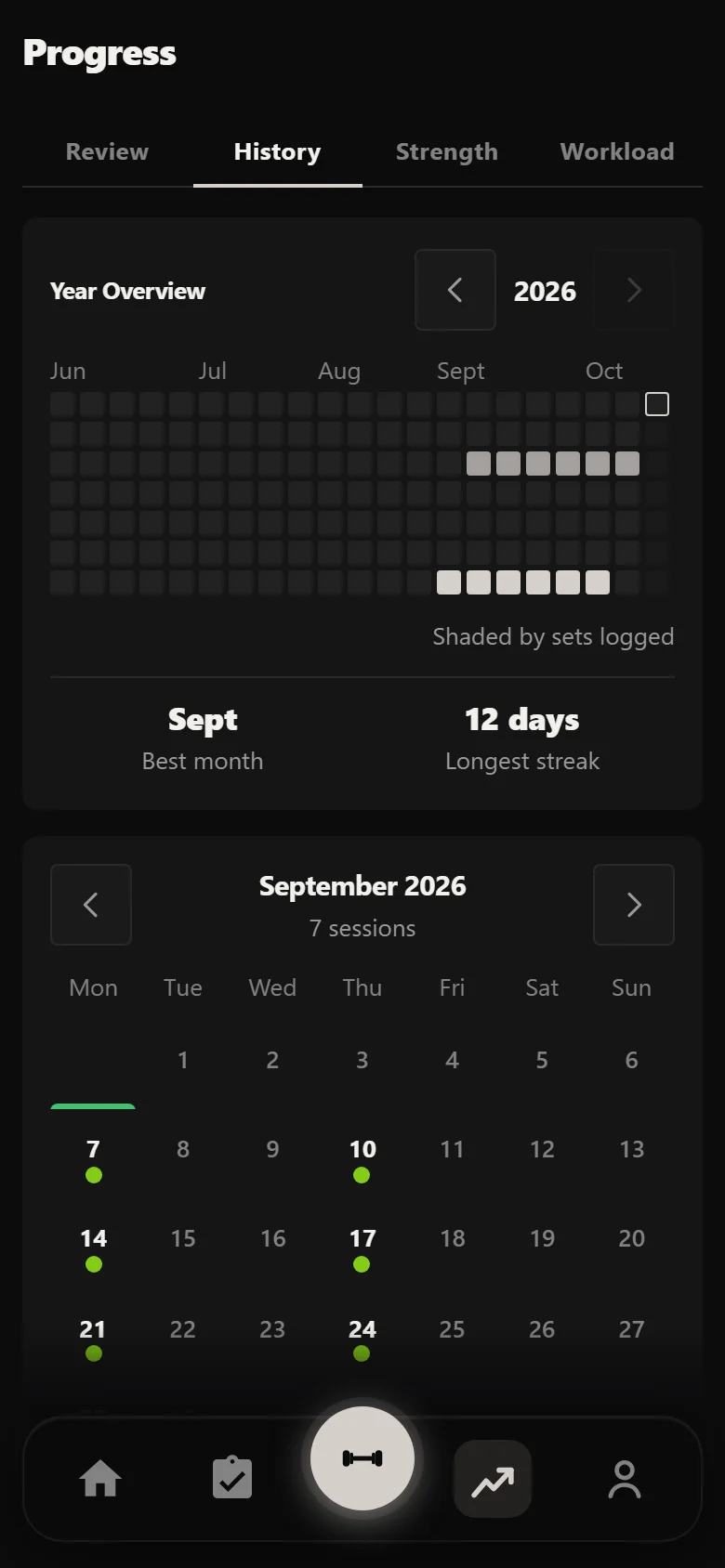
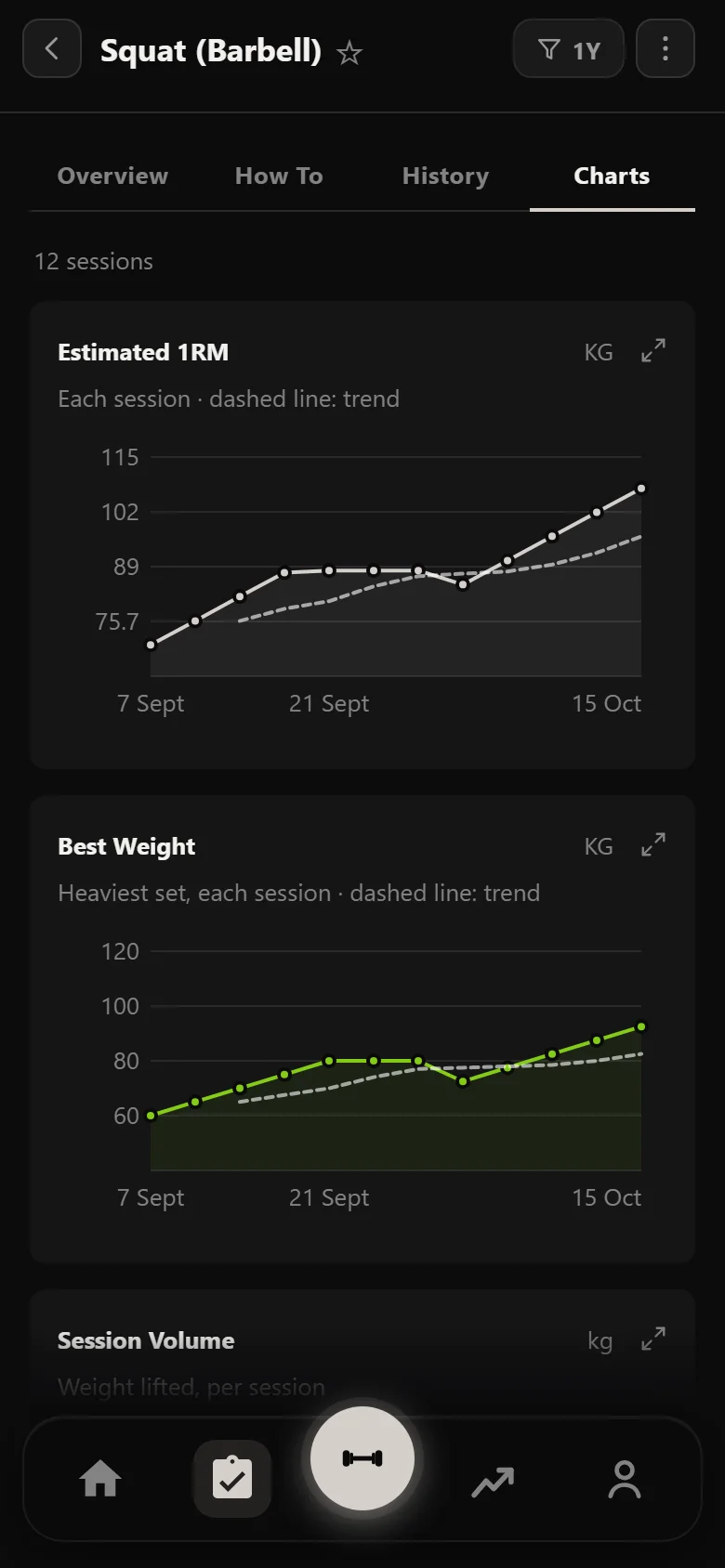
Twelve sessions fill the History calendar from the start date, two a week, and the squat's own Estimated 1RM chart draws the shape of the block: a climb, a flat stretch where the weight held, the dip at the deload, then a longer climb through the old ceiling. That sawtooth is what linear progression actually looks like once you train long enough to stall.
Six weeks of training on two days a week, no spreadsheet, and no session where you had to work out what to put on the bar.
Start to finish
The same lift and the same working sets, twelve sessions apart. Every step in between was decided by the engine from the sets that were logged: four increases, three sessions where the weight held, one cut of 10%, and a rebuild straight back through the ceiling.
The estimated one-rep max tells the same story from the other end. Session one's squat estimated 70 kg; the last one estimates 107.9 kg. Six weeks, two sessions a week, and nothing to work out.
The squat, start to finish: 60 kg on session one to 92.5 kg on session twelve, having stalled three times at 80 kg and been cut to 72.5 kg on the way.
Common questions
Can you really make progress on two sessions a week?
Yes, for as long as linear progression lasts. Frequency changes how fast the calendar moves, not whether the method works: this run added 32.5 kg to the squat in six weeks on two sessions a week, because the squat appears in both of them and earns 5 kg every time it's completed. What two days a week costs you is total weekly volume, which matters more later than it does at the start.
Why does the squat go up 5 kg when the bench goes up 2.5?
Bigger muscles and a bigger lift tolerate a bigger jump. The lower body earns 5 kg a session on this program, the upper body 2.5 kg, because pressing 5 kg more week after week stalls almost immediately. Each lift carries its own rule and you don't configure any of it.
What counts as a failed session?
Missing the rep target on any working set. All sets at the target is a success; falling short on one is a miss, and the weight holds. Dropping the weight to make the reps is also a miss. Durata judges what you actually lifted against what was prescribed, so an easier session can't earn an increase.
What happens when I stall?
The weight stays where it is. Miss the number of sessions the program specifies in a row (three, here) and Durata reduces the weight by the deload percentage the program specifies (10%) and restarts the climb. You don't have to notice the stall or work out the new number.
Isn't a deload going backwards?
Only if you stop. The reduced weight is a run-up: you climb back through the weight that stalled you with more training behind you. Here the squat stalled at 80 kg, deloaded to 72.5 kg, was above 80 kg again by session 10 and finished at 92.5 kg.
What if I set my starting weight too low, or too high?
Change it. Open the program's ⋯ menu and choose Working Weights to adjust any lift at any time. That is useful if you were conservative at the start and the first few sessions felt like nothing. If you skipped the starting-weights step entirely, the first weight you log for a lift becomes its working weight and the climb starts from there.
Is Durata free?
Yes. Durata is free to use, with the full program catalogue, automatic progression maths, rest timers and PR tracking. Everything in this walkthrough is in the app.
Put it into practice
Durata is free to use — 50 proven programs, automatic progression, rest timers and PR tracking, all on your phone.