


Bro Split in Durata: one muscle a day, double progression on everything
Bro Split is the classic bodybuilding template. Five training days, one muscle group each: chest, back, shoulders, legs, arms. Each session hammers its target with five or six exercises, then that muscle gets a full week off before its day comes round again. It trades frequency for volume, which is exactly the trade the golden-era physiques were built on.
It is also the first program in this series with no linear progression anywhere in it. Every loaded lift on all five days runs double progression: hold the weight until every set has topped out its rep range, then add. That single rule, applied to a once-a-week schedule, produces a block that looks nothing like a beginner's climb, and this walkthrough follows what the app actually did with it. Every weight, rep and estimate below is computed by the real engine on a live drive.
Finding the split
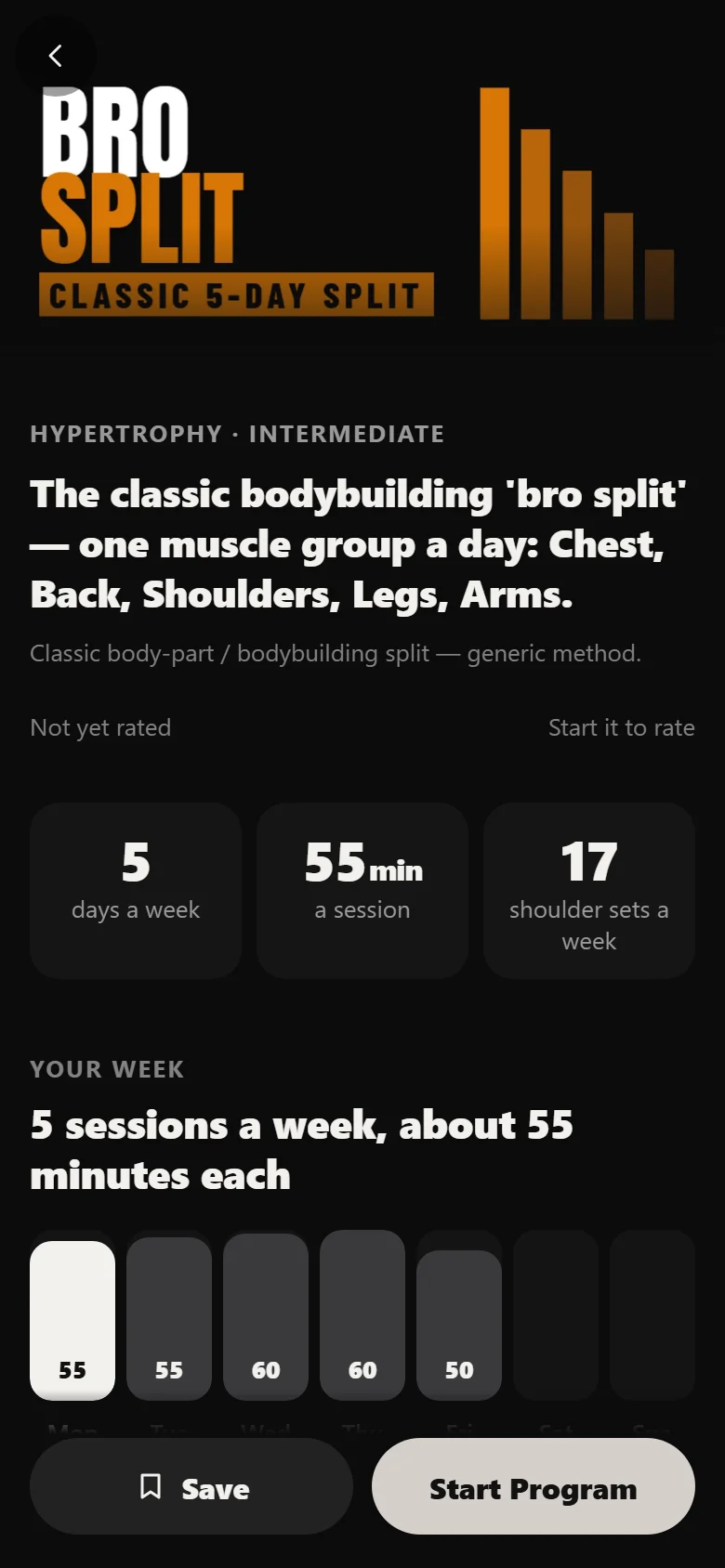
In Discover, the Bro Split sits on the Hypertrophy shelf, marked Intermediate, at five days a week. Search finds it by name, or Filter narrows the shelves by level and days a week. Tap the cover for a quick look, then View Program for the full page.
Five days is what it needs. There is no shorter version of it: drop a day and a muscle group loses its slot.
Five days, five muscle groups
The program page lays the whole week out before you start anything. Chest opens with the barbell bench press and four more pressing and fly movements. Back is built on the deadlift, then pull-ups, rows and a pulldown. Shoulders runs the overhead press into lateral raises, rear-delt work, Arnold presses and shrugs. Legs is squat, leg press, Romanian deadlift, curls, extensions and calves. Arms takes close-grip bench, curls, skullcrushers and pushdowns.
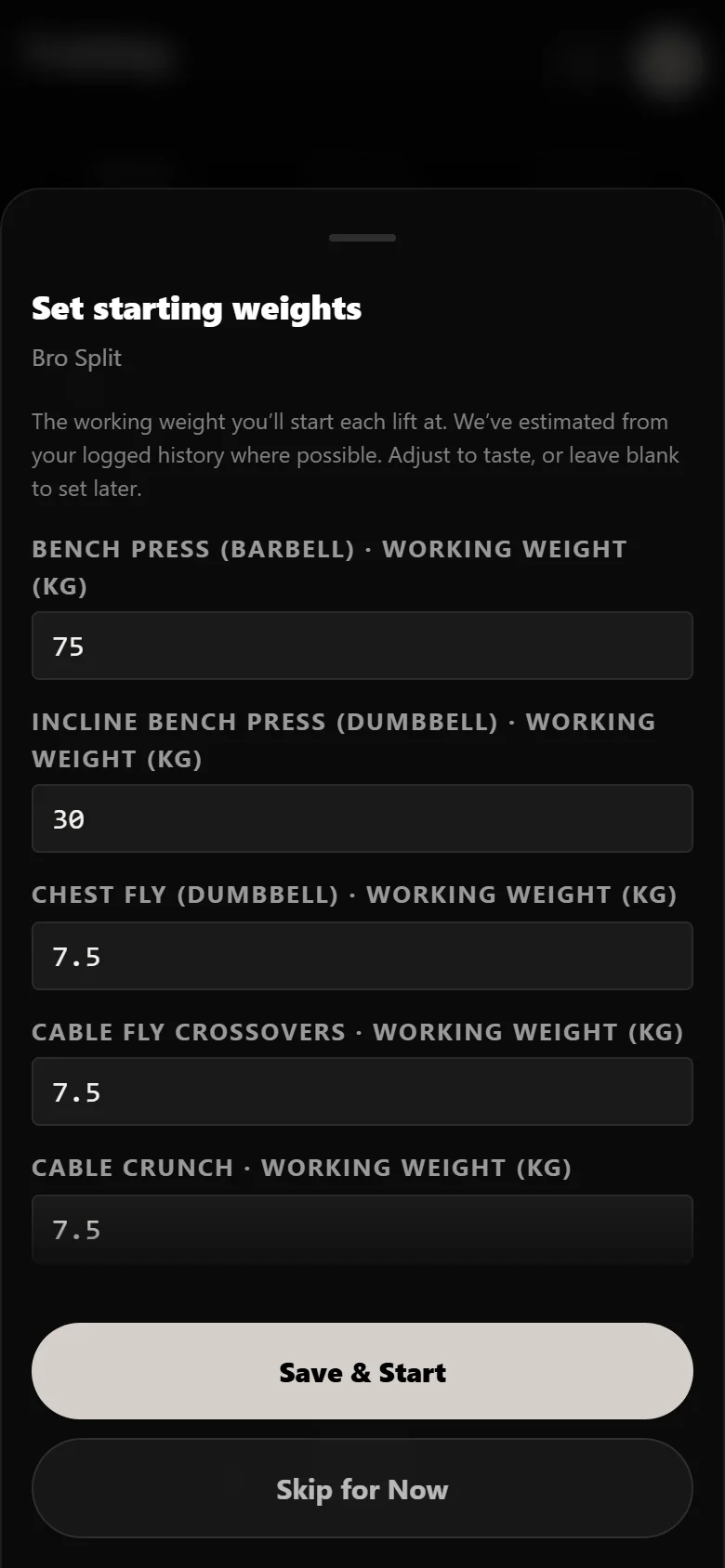
There are no training maxes to test and no percentages to calculate. Double progression needs one number per lift: the weight you can currently handle for the prescribed sets and reps. The setup screen asks for that and nothing else. This run opens the deadlift at 130 kg, the bench at 75 kg, the barbell row at 65 kg, and the isolation work down at 7.5 kg, which is the app's cautious default when you have no history with a movement.
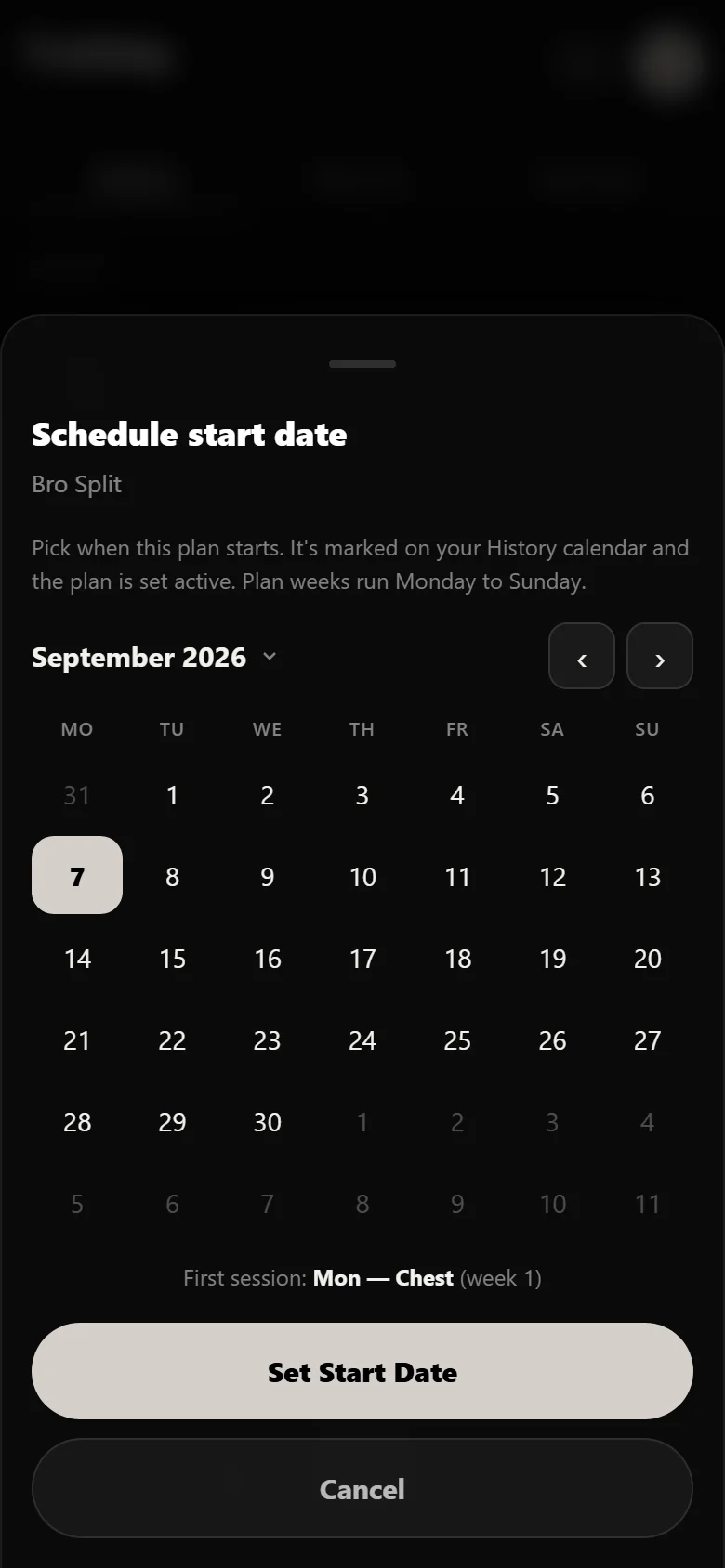
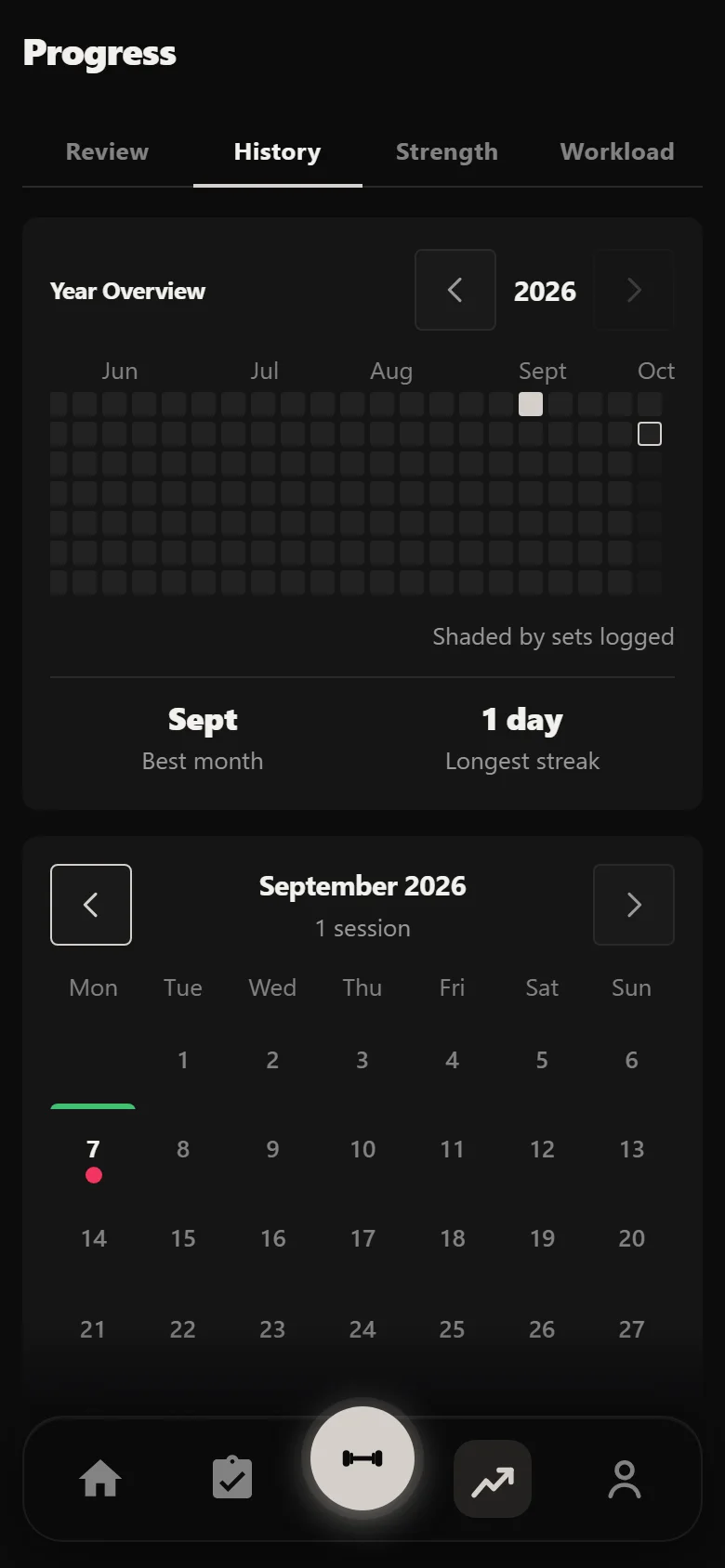
Then you pick a start date. The whole block's sessions land on the History calendar from there, five a week, and the app knows which muscle group is due on any given day without being told again.
One rule, on every loaded lift
Open any session and the chip under the exercise name tells you which rule is governing that lift while you train. On this program the chip says the same thing every time. The squat is double progression at 5 kg. The bench, the row, the overhead press and the close-grip bench are double progression at 2.5 kg. So are the curls, the raises, the flyes and the calf work, just with wider rep ranges to top out.
The mechanics are simple to state and slow to satisfy. The squat is prescribed as four sets of eight to ten. Get eight on any of them and the weight stays. Get ten on all four and the weight goes up 5 kg next time. Nothing partial counts. One set short of the top of the range and the whole lift holds.
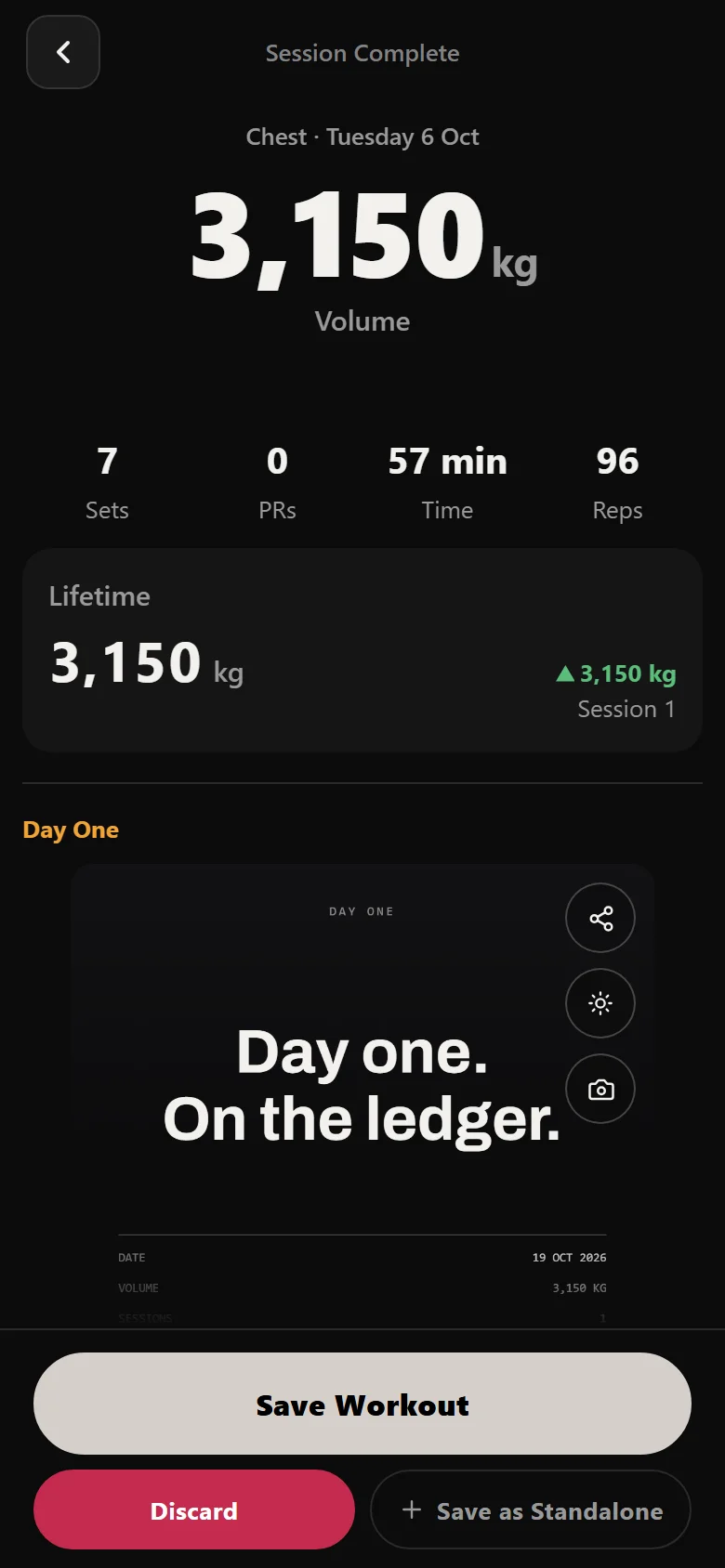
The set rows show the target range and what you did last time, so there is no arithmetic to do at the rack. You work, you log, and the decision about next week's weight is already made by the time you close the session. The complete screen tallies the whole thing before it saves: duration, every set, and 3150 kg of total volume on this one.
Four leg days, four increases
Legs is the fourth day of the week, so across a four-week block the squat is trained on sessions 4, 9, 14 and 19. Four appearances. That is the whole budget, and it is the number that decides what a body-part split can and cannot do.
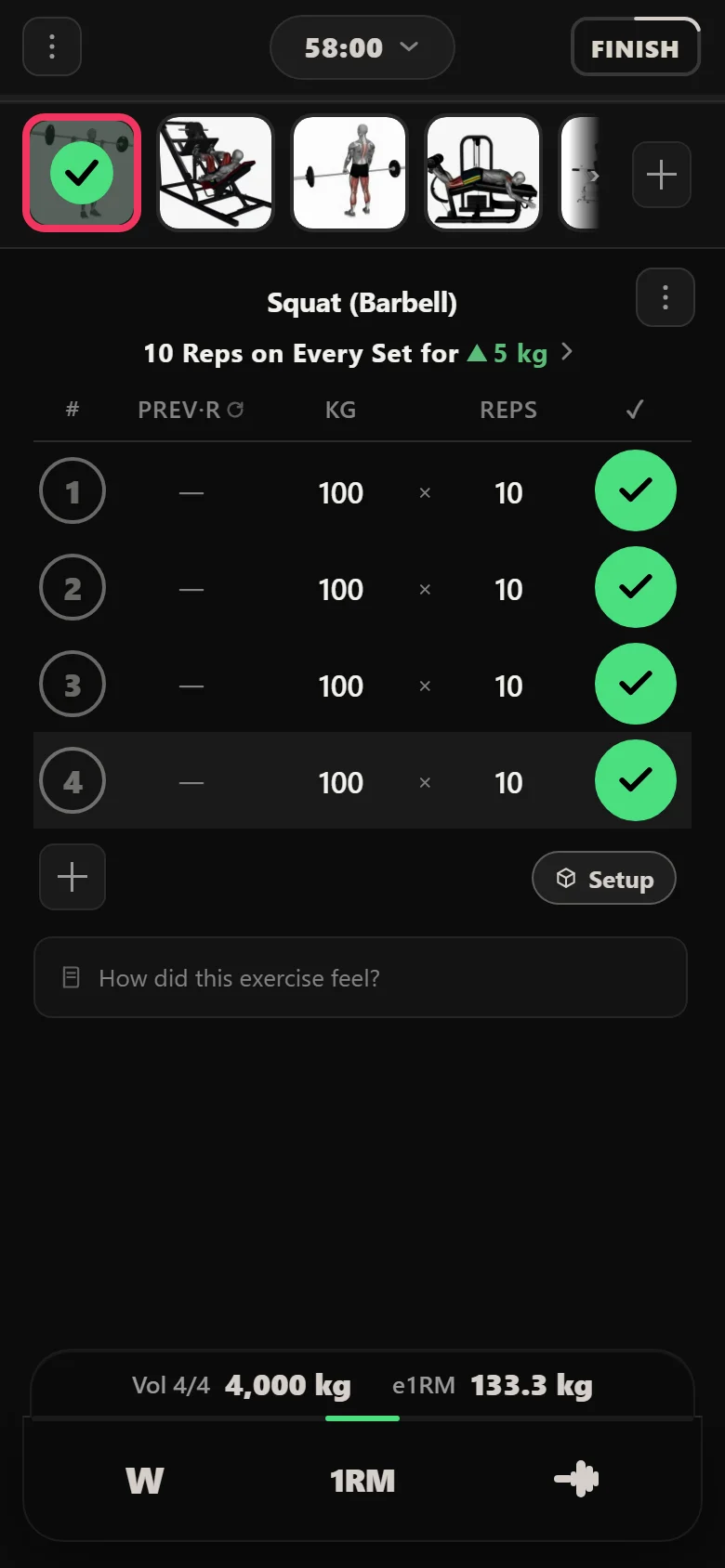
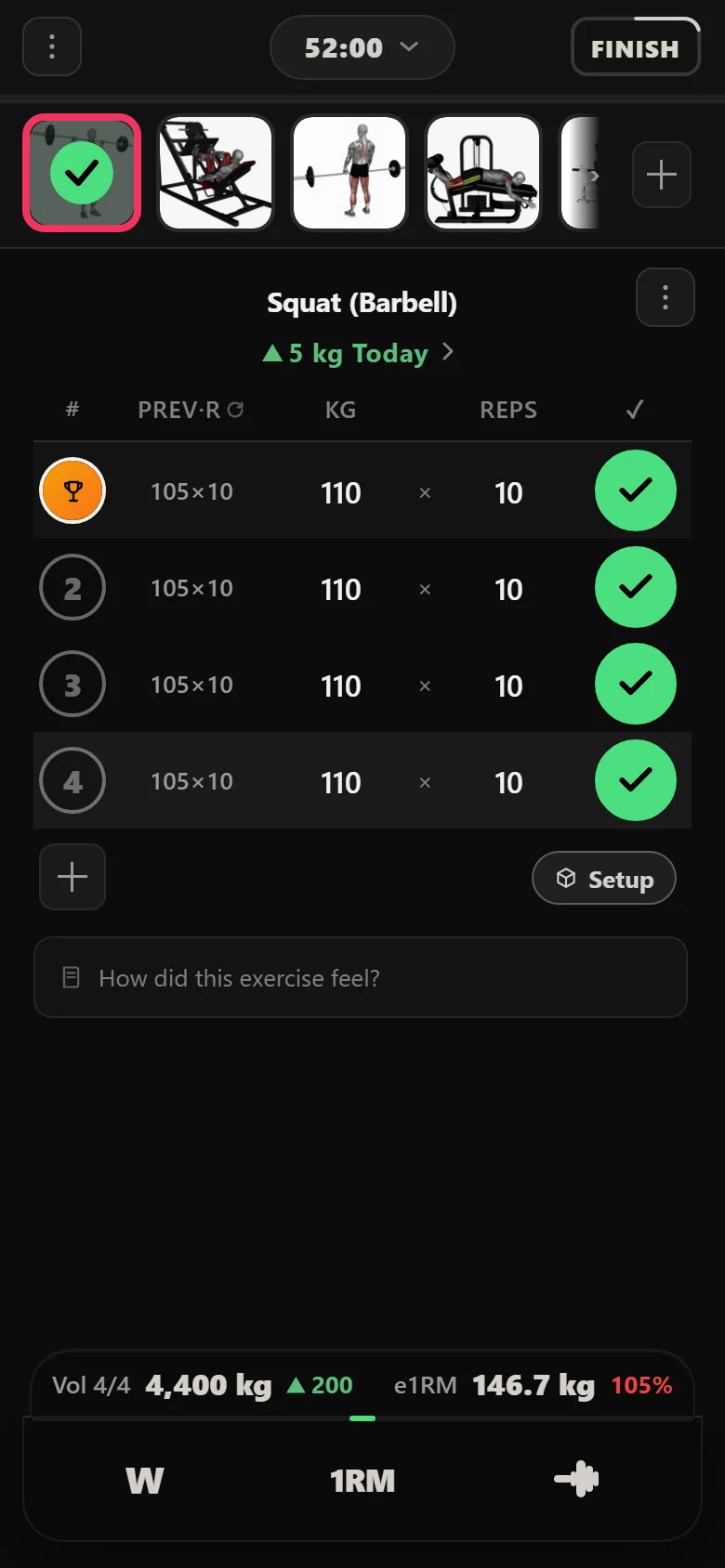
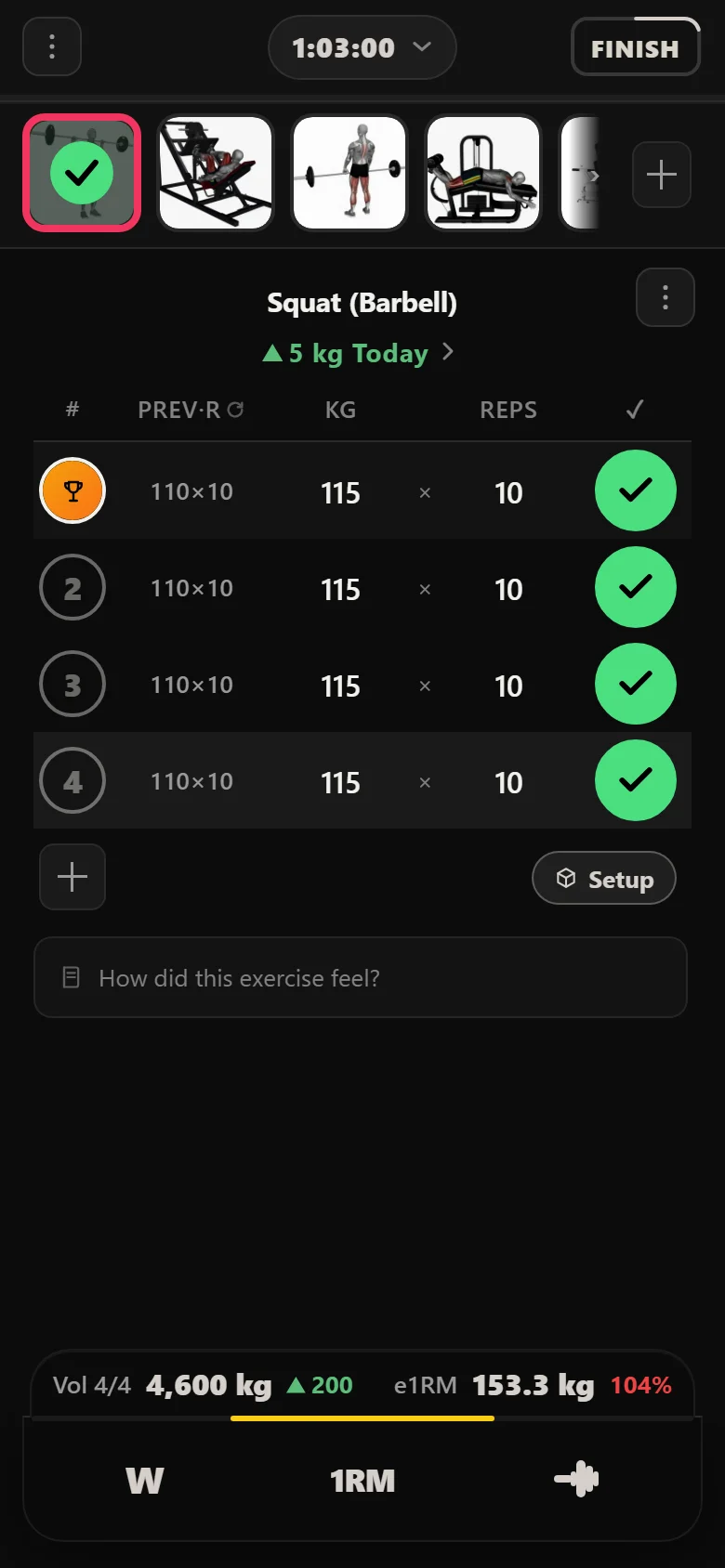
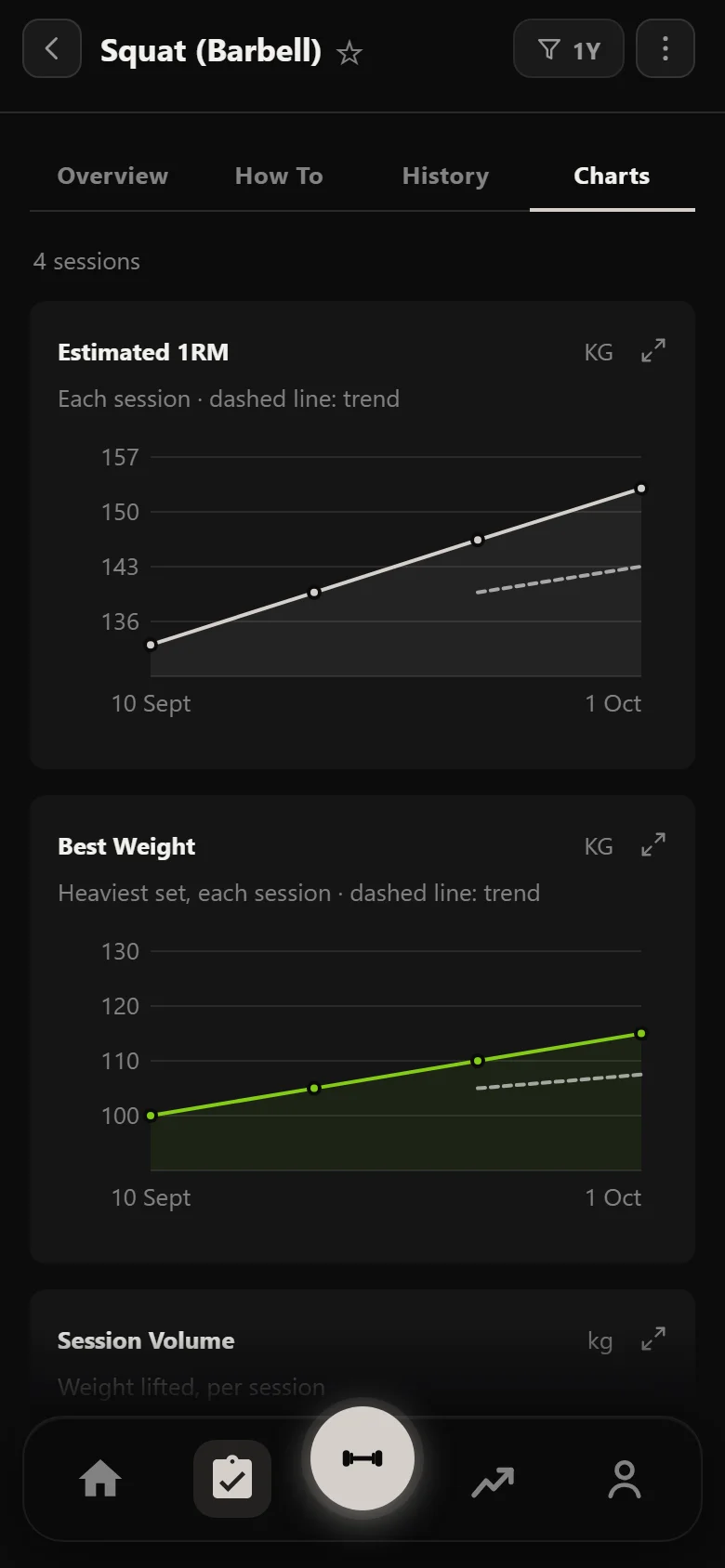
On this run the squat cleared every time. Four sets of ten at 100 kg on the first leg day, so the app put 105 kg up for the second, 110 kg for the third and 115 kg for the fourth. By the end of the block it has 120 kg queued for the leg day after this one. Four increases out of four attempts is the best case for a lift under this rule, and it still only comes to 15 kg, because there were only ever four chances to take.
Nothing about that climb was typed in. The engine read the reps off each set as they were logged and made the call. The session estimate moved with it, to 153.3 kg on the last session.
Squat (Barbell): weight on the bar, leg day by leg day
- 100S4 Session 4 — leg day 1
- 105S9 Session 9
- 110S14 Session 14
- 115S19 Session 19 — leg day 4
What moved, and what did not
The squat is the exception on this block, not the pattern. Read the rest of the lifts start to finish and the picture is much quieter, which is the honest thing a four-week body-part split produces.
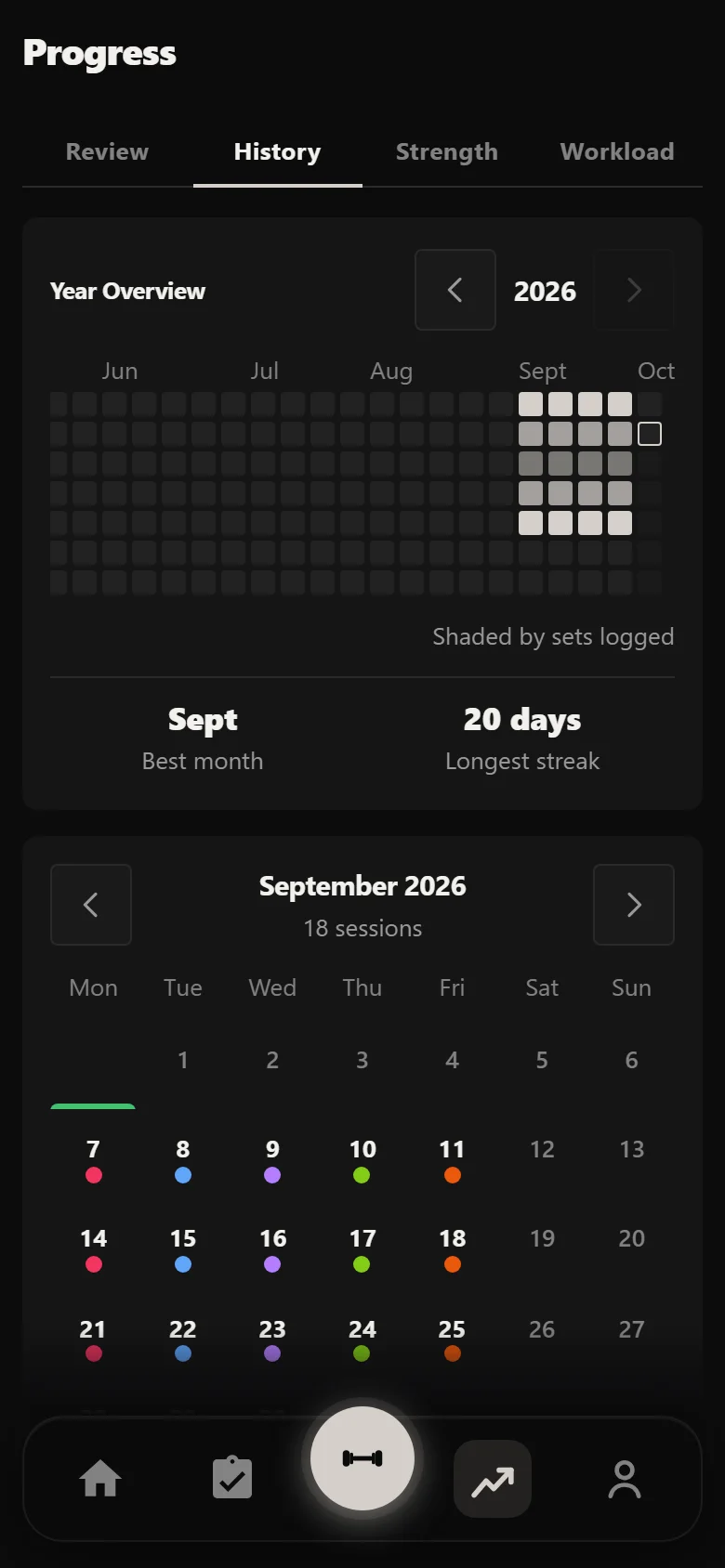
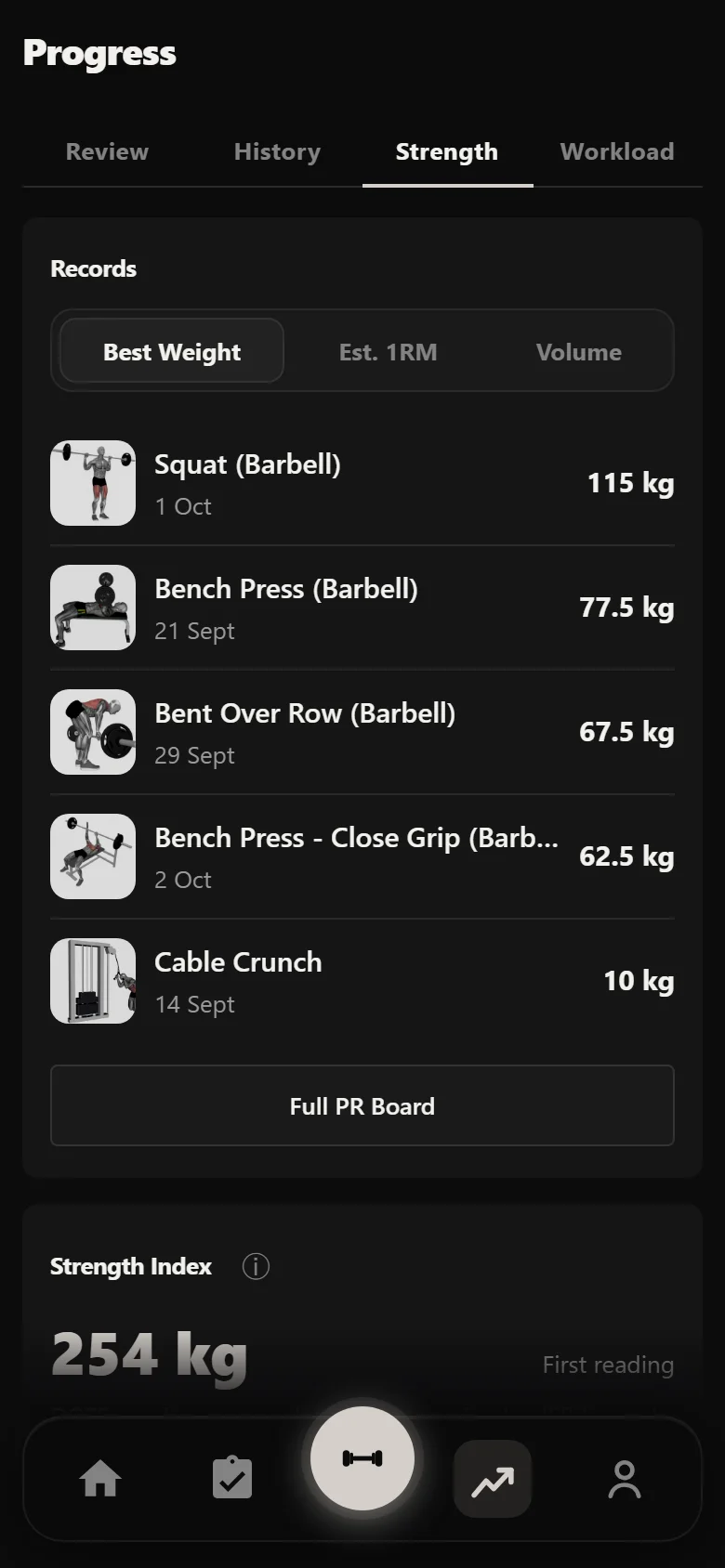
The bench press went 75 kg to 77.5 kg. The barbell row went 65 kg to 67.5 kg. The close-grip bench went 60 kg to 62.5 kg. Three lifts, one increase each, across four attempts each. The cable crunch and the barbell curl both went 7.5 kg to 10 kg. The deadlift sat at 130 kg the whole way and never moved, because three sets of six to eight is a hard range to top out on a heavy pull when you only see it once a week.
A long list of lifts finished on exactly the weight they started: the incline dumbbell press at 30 kg, the overhead press at 50 kg, the Romanian deadlift at 77.5 kg, the lat pulldown and the seated row at 65 kg, and every 7.5 kg isolation movement. None of that is a failure state. Under double progression a lift that has not topped every set of its range holds, and holding is what most lifts do for the first month.
One lift went backwards. The Arnold press opened at 20 kg, missed the top of its ten-to-twelve range twice, and the app cut it to 17.5 kg. Two misses is the deload threshold on this rule, and the cut is ten per cent rounded to the nearest plate. It is worth seeing on a program that otherwise looks like it only goes one direction: the same rule that adds weight also takes it away, without being asked.
Reading it afterwards
The squat's own estimated one-rep max chart draws the block as four points and a straight line between them, which is exactly what four leg days look like. There is no weekly texture to read because there is no weekly frequency to produce it. On a program that squats three times a week you get a noisy line worth studying. Here you get four data points and a direction.
That is the trade a body-part split makes, and the charts show it rather than hide it. Volume per session is high, because five or six exercises on one muscle group adds up fast. Frequency is low, because that muscle waits a week. If you want to know whether the split is working, the per-lift strength index over several blocks is a better read than any single four-week line.
The payoff: 100 kg to 115 kg in four leg days
Two screenshots of the same lift on the same screen, a block apart. The squat opened the block at 100 kg and finished it at 115 kg, with 120 kg already queued for the next leg day, and every one of those jumps was decided by the engine from the reps that were logged rather than by anyone's plan.
Fifteen kilos in four weeks is not a beginner's rate of climb, and it should not be. This program touches each muscle group once a week and asks a full rep range to be topped out before it moves anything. What you get in exchange is a session that can do real damage to one target and then leave it alone long enough to recover. The app's job is to remember which lifts earned their increase, which ones held, and which one needed cutting. It did all three here without being asked.
Four leg days apart. Four sets of ten cleared every time, so the app added 5 kg on each of them.
Common questions
What is a Bro Split?
One muscle group per training day across a five-day week: chest, back, shoulders, legs and arms. Each session works its target with five or six exercises, and that muscle then gets a full week before it is trained again. It trades training frequency for per-session volume, which is the classic bodybuilding approach to building size.
Does this program use linear progression?
No. Every loaded lift on all five days runs double progression, which is a different rule. The weight is held until every prescribed set has reached the top of its rep range, and only then does it go up. Linear progression adds weight on a schedule; double progression adds it on a condition, so lifts on this program hold far more often than they climb.
Why did most of my lifts not move in four weeks?
Because each muscle group is trained once a week, so a lift gets four attempts in a four-week block, and under double progression an attempt only counts if every set tops out the range. Holding is the normal outcome, not a stall. On the drive in this walkthrough the squat, bench, row, close-grip bench, cable crunch and barbell curl all increased, and everything else held at its starting weight.
What happens if a lift keeps missing the rep range?
It gets cut. Two consecutive sessions short of the top of the range and Durata reduces the weight by ten per cent, rounded to the nearest usable increment, and you climb back through it. On this run the Arnold press went from 20 kg to 17.5 kg that way. You do not have to notice the misses or decide the cut, the app does both.
What weights should I start with?
Whatever you can currently do for the prescribed sets and reps, not your best single. Double progression has no percentages and no training max, so the only input is an honest working weight per lift. Starting light costs you very little because the rule will move it the moment you top the range, and starting heavy means holding for weeks.
Is Durata free?
Yes. Durata is free to use, with the full program catalogue, automatic progression maths, rest timers and PR tracking. Everything in this walkthrough is in the app.
Put it into practice
Durata is free to use — 50 proven programs, automatic progression, rest timers and PR tracking, all on your phone.