


Fierce 5 in Durata: the climb, the stall, and the comeback
Most program walkthroughs show you the good weeks. This one doesn't. Fierce 5 is a beginner linear progression. You add a little weight every session until you can't, and the whole point is what happens when you can't. So this run misses. Twice in a row, on purpose, to show you exactly what the app does about it.
The numbers are a true beginner's: a 60 kg squat, three sets of five, three sessions a week. That's who runs Fierce 5, and it's the only honest way to show one. Every screen below is the live app and every weight, rep and estimate is computed by the real engine.
Starting the program
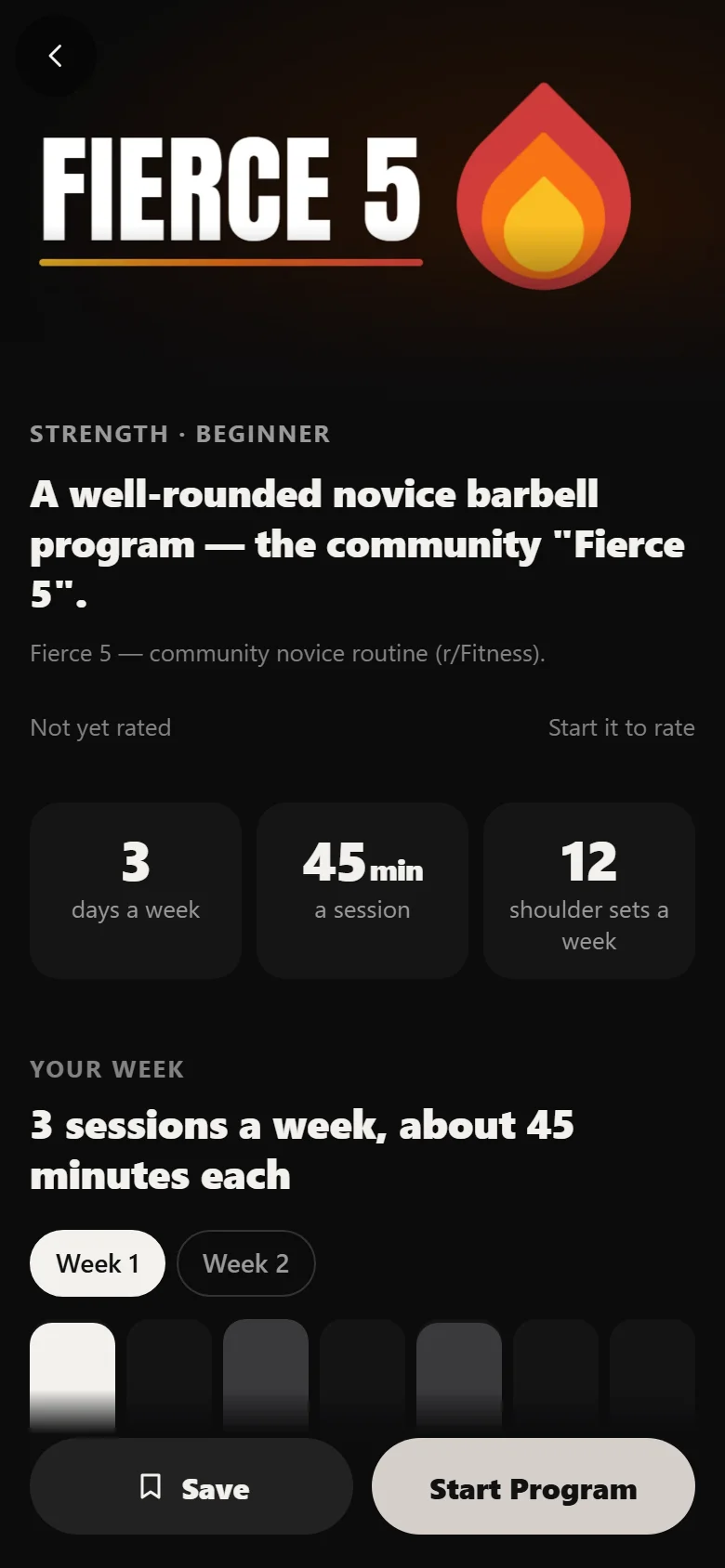
In Discover, Fierce 5 sits on the Strength shelf, marked Beginner, at three days a week. Search finds it by name, or Filter narrows the shelves by level and days a week. Tap the cover for a quick look, then View Program for the full page.
It is the main barbell lifts on straight 3×5, with a short list of accessories for the shoulders, arms and calves.
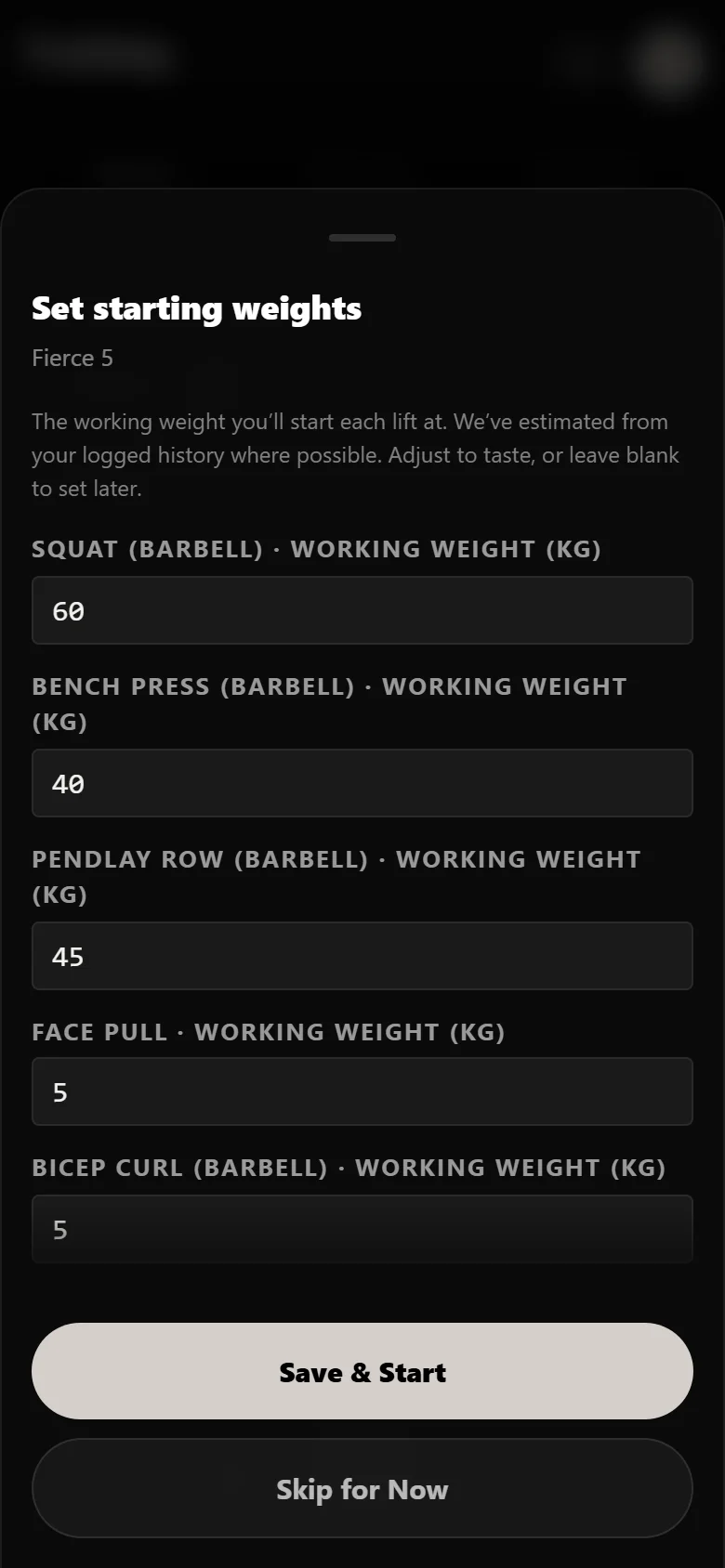
There are no training maxes to work out. Linear progression runs off a working weight per lift, so the app asks what you can currently do for three solid sets of five and starts there, 60 kg on the squat here. Start conservatively: the whole method depends on having room to add weight for months, and the app adds it for you every session.
Two sessions alternate. You squat in every single session, which is why the squat is the lift worth following through this article, and why the numbers below count sessions, not weeks.
The climb: 5 kg a session, decided for you
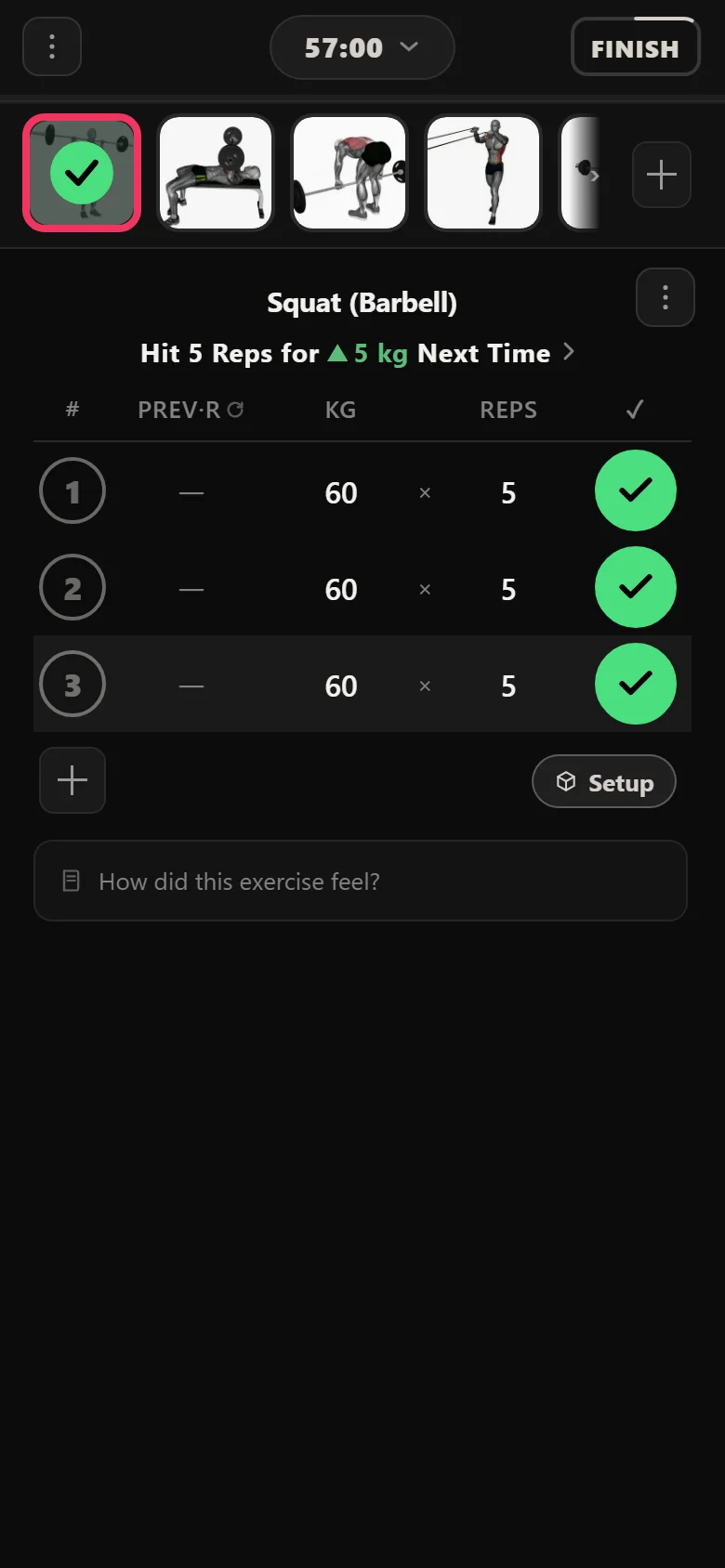
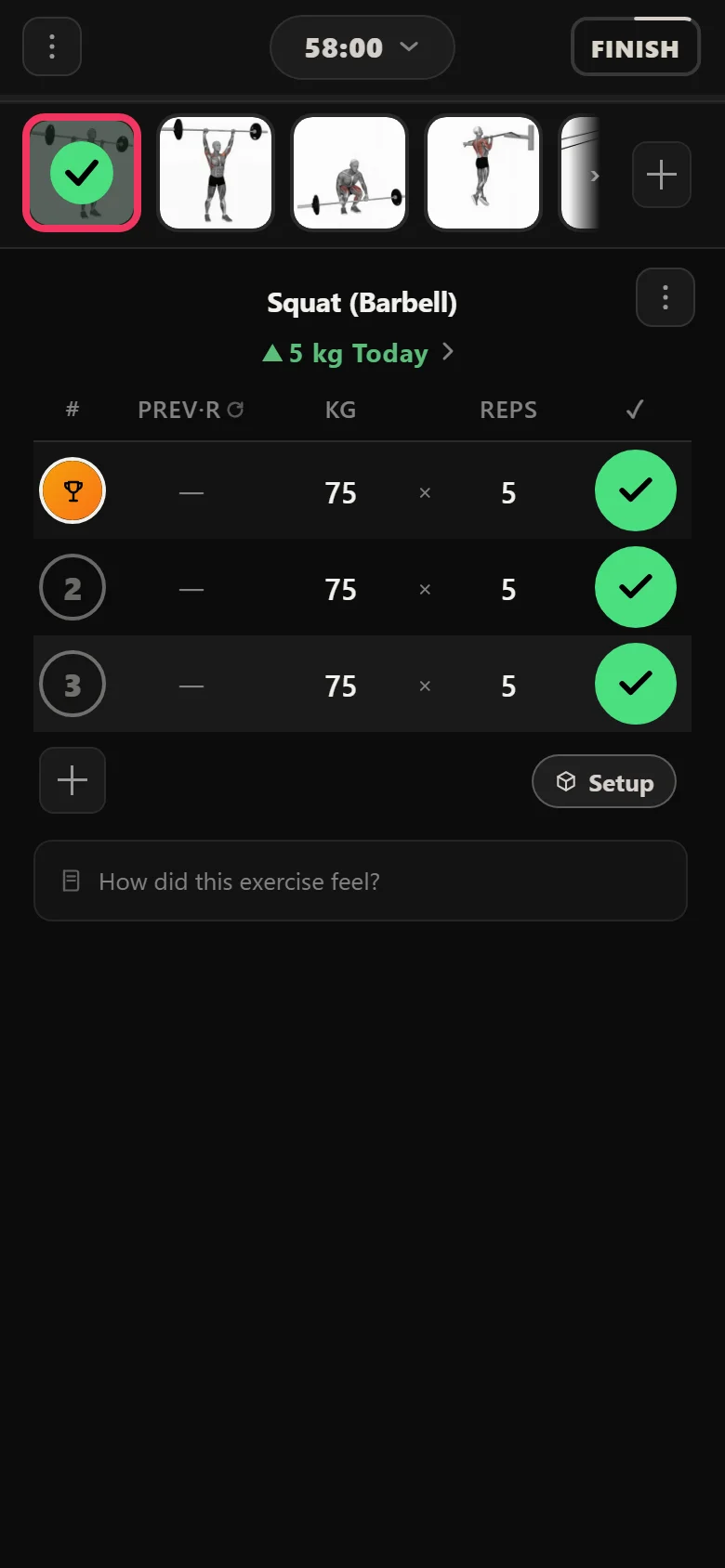
Squat opens at 60 kg for three sets of five. Complete all three sets at five reps and the app adds 5 kg to the next session. You don't tell it you succeeded and you don't do the arithmetic. It reads the sets you logged and moves the weight.
The chip under the exercise name spells the rule out while you are training, rather than burying it in a settings screen: hit your reps and 5 goes on; miss twice in a row and it deloads. Four sessions in, squat has gone 60, 65, 70, 75, up 5 kg every single time, and you turn up to find the weight already on screen.
Every compound carries its own rule and you configure none of it. The squat and deadlift climb in 5 kg steps; the bench, press and row move in 2.5 kg steps because upper-body lifts run out of road faster. Each lift moves at its own rate because the program says so, not because you told the app anything.
The stall: two sessions that don't go up
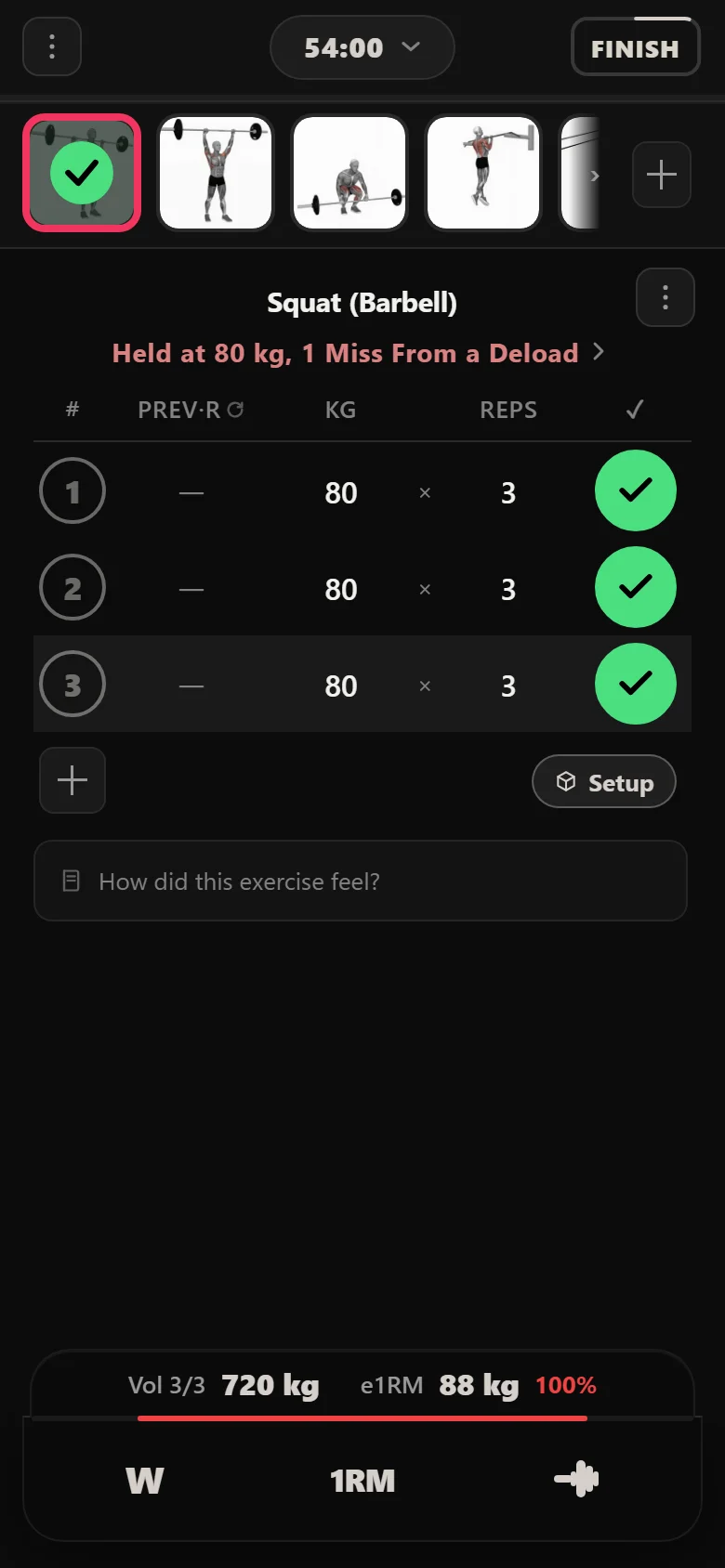
At 80 kg the wheels come off. Three sets are prescribed at five reps and only three reps go up on each of them, so it is a genuinely failed session. This is the moment that matters, because the obvious mistake is for an app to look at the heaviest set you logged, see a completed set at 80 kg, and add weight anyway.
Durata holds. The weight stays at 80 kg for the next session, because the target was five reps on every working set and the sets fell short. Nothing advances on a session you didn't complete.
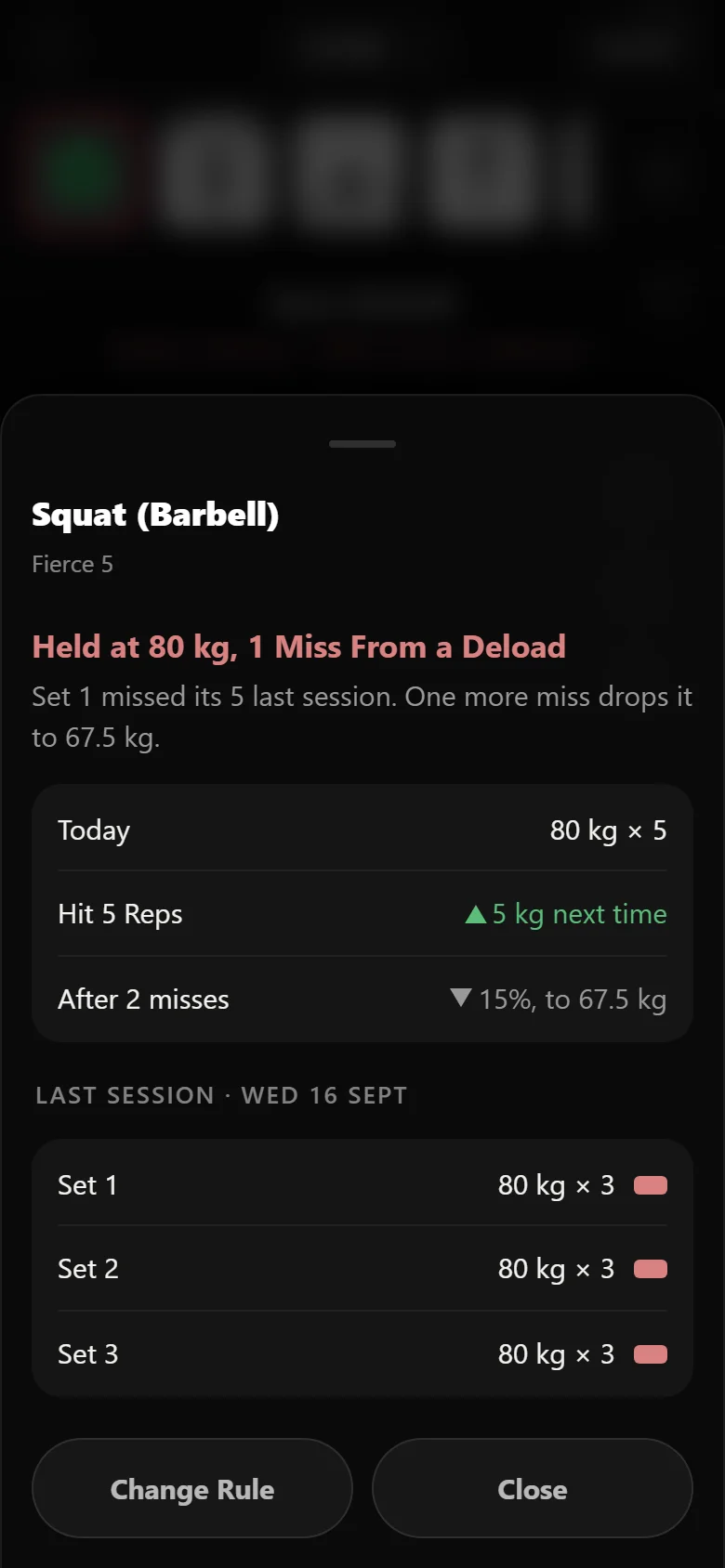
The second attempt at 80 kg misses too, and the line under the name says where you stand before you start it: held at 80 kg, one miss from a deload. Fierce 5's own rule is exact about what comes next: fail the same lift two workouts in a row, and the working weight drops 15%. Two misses is the app's cue to act.
The deload: the app backs you off
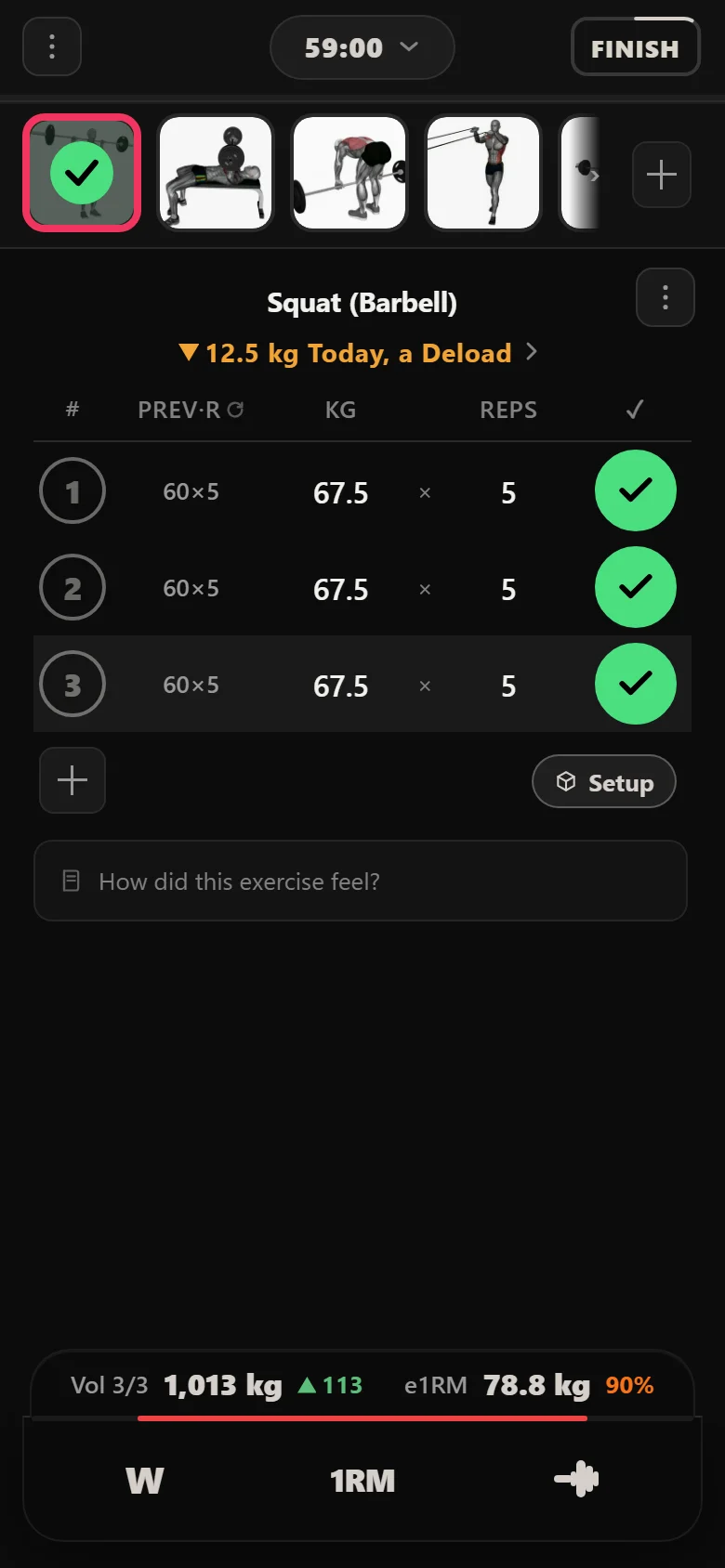
Two missed sessions in a row trips the rule, and the app drops the squat by 15%, so 80 kg becomes 67.5 kg, then restarts the climb from there. You didn't decide that, calculate it, or remember to do it. Fierce 5 specifies a 15% cut after two failures on the same lift and the engine applied exactly that.
The deload doesn't cost you the block. It sets up the climb that follows. The whole block looks like this: four sessions of +5 kg, two missed at 80 kg, one cut to 67.5, then a rebuild that carries you straight back through the weight that stopped you. Three sessions after the deload you're at 82.5 kg, above the 80 that beat you, and you finish with 92.5 kg on the bar, 12.5 kg over the ceiling that stalled the first run.
Squat: weight on the bar, per session (3 sessions a week)
- 60S1 Session 1
- 65S2 Session 2
- 70S3 Session 3
- 75S4 Session 4
- 80S5 Session 5 — 80×3: missed, weight held
- 80S6 Session 6 — second miss in a row trips the deload
- 67.5S7 Session 7 — −15% applied automatically
- 72.5S8 Session 8
- 77.5S9 Session 9
- 82.5S10 Session 10 — past the old ceiling
- 87.5S11 Session 11
- 92.5S12 Session 12 — 12.5 kg above the stall: 97.5 prescribed next
The accessories run a different rule entirely
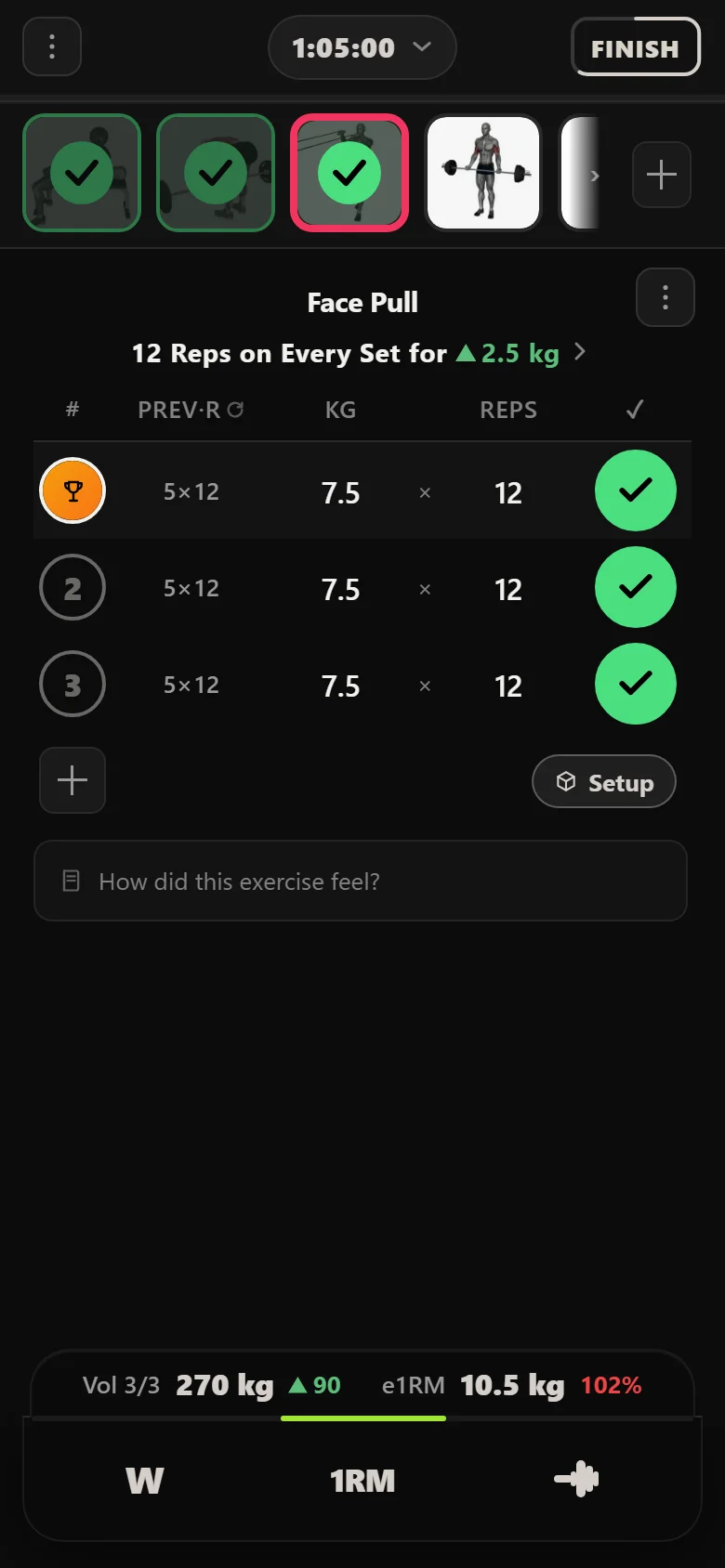
The compounds run linear progression. The accessories don't. They run double progression, and both rules are live in the same session. On double progression the weight is fixed and you chase reps inside a range first: 8, then 9, then 10, then 11, at the same weight. Only when every set reaches the top of the range does the weight go up.
The chip spells the rule out in place, so you know what the session is asking of you before you start it. Hit the top of the range on every set and the next session is heavier, back at the bottom of the range.
The prescribed range never changes for as long as you run the program. What moves is the weight. And reps inside the range are not a failure. Grinding out one more than last time is progress, so the app holds the weight and lets you keep climbing rather than counting it against you.
What it looks like afterwards
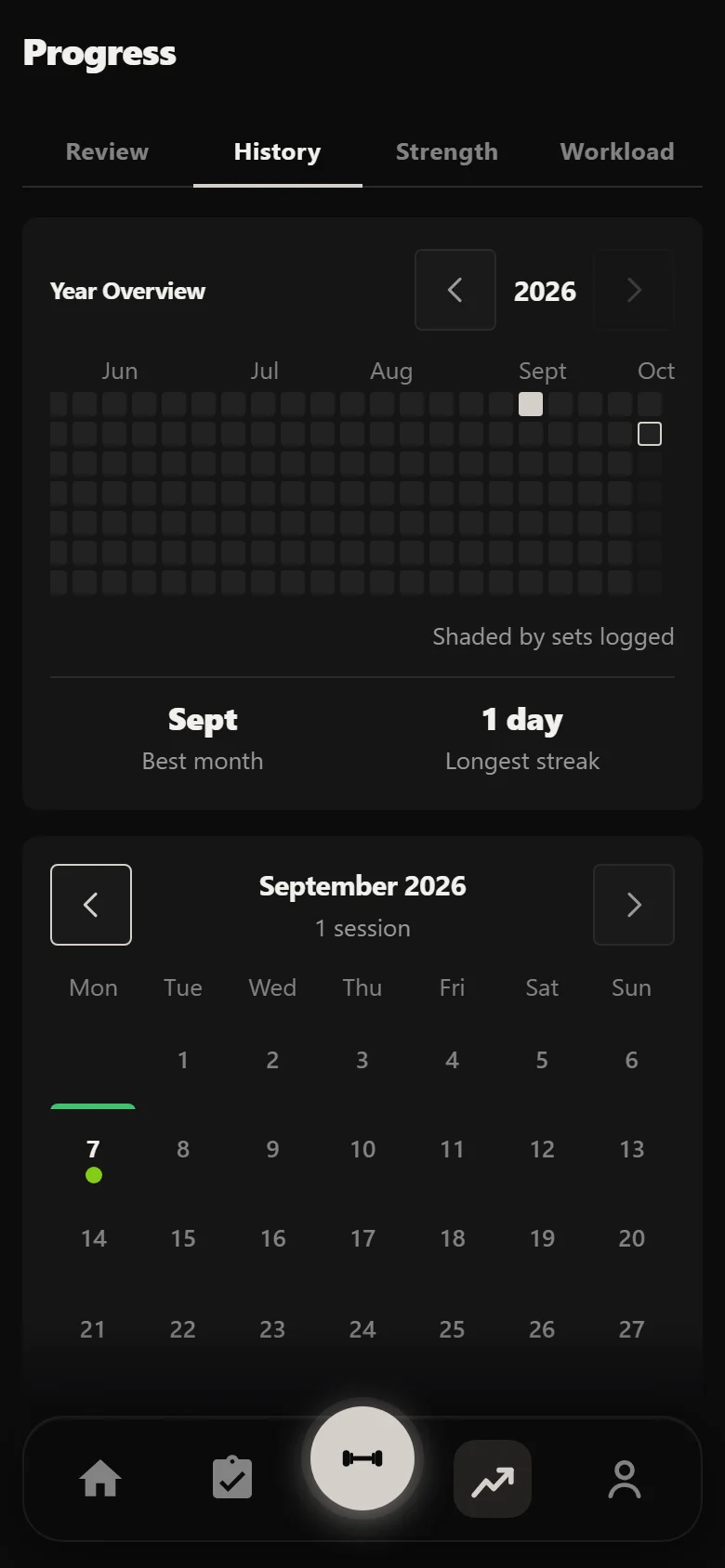
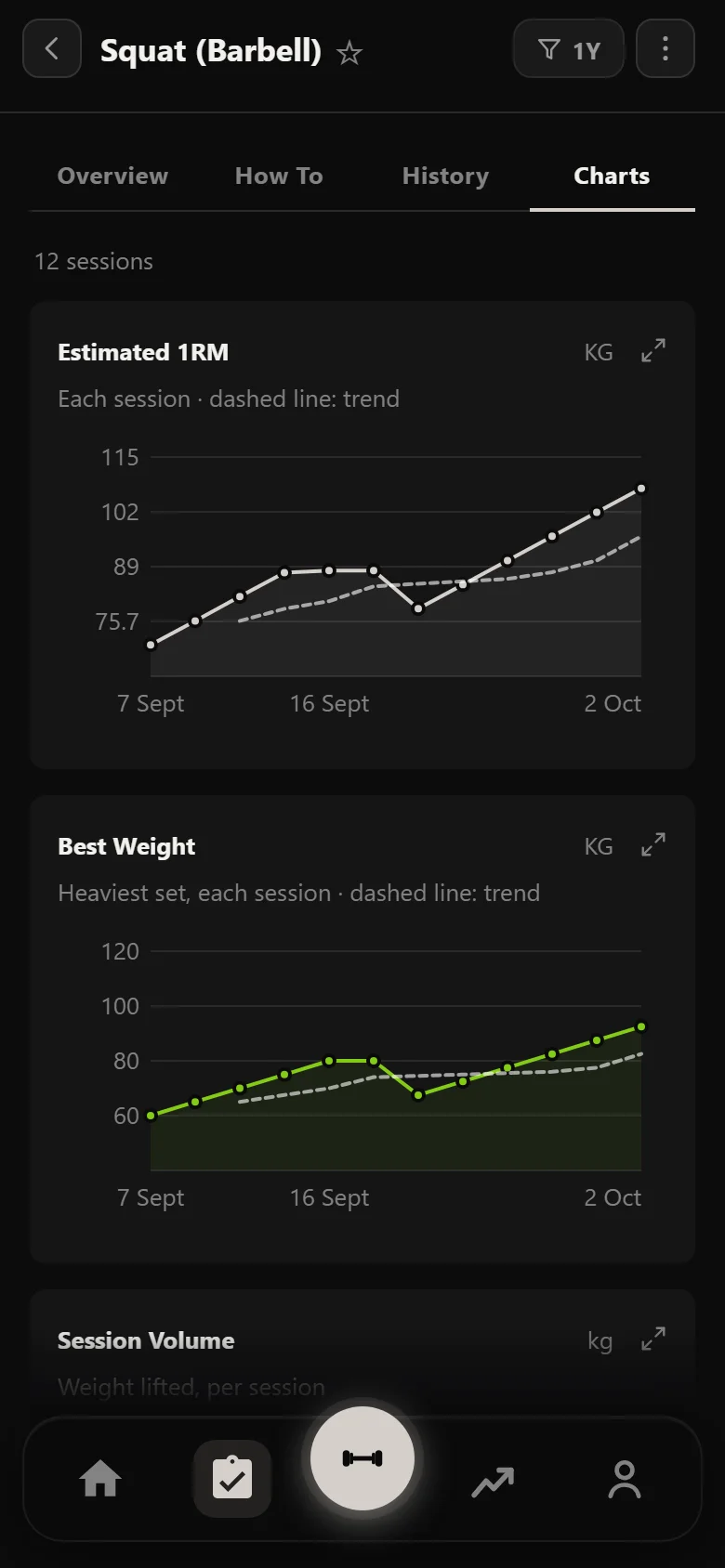
The sessions fill the History calendar from the start date, and the squat's own Estimated 1RM chart draws the shape of the block: a straight climb, a flat step where the weight held at 80, the dip at the deload, then a longer climb through the old ceiling. That sawtooth is what linear progression actually looks like once you train long enough to stall. It is the honest picture, not a line that only goes up.
The session-volume chart underneath tells the same story from the other side: bars stepping up, two short bars through the stall, the deload's dip, then a taller run than before. A month of training, no spreadsheet.
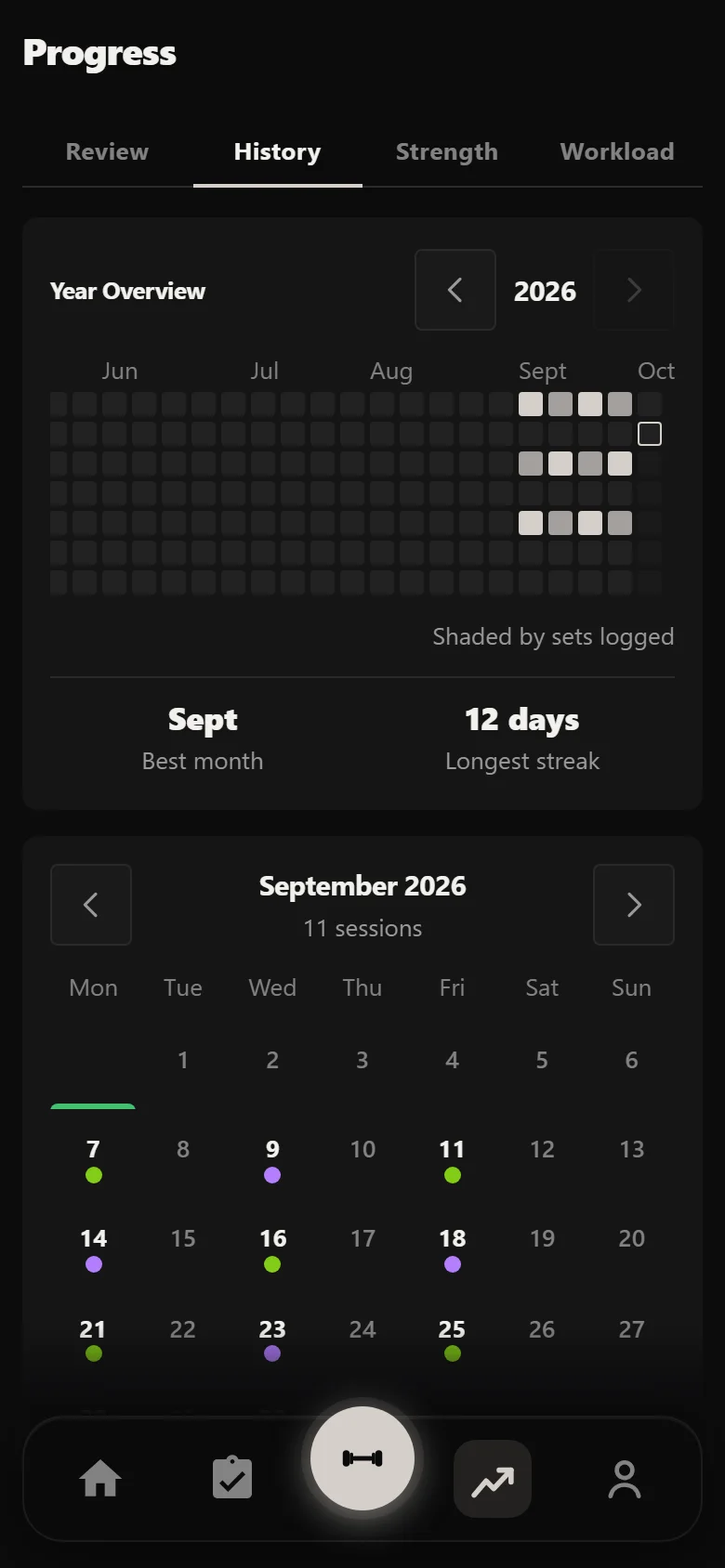
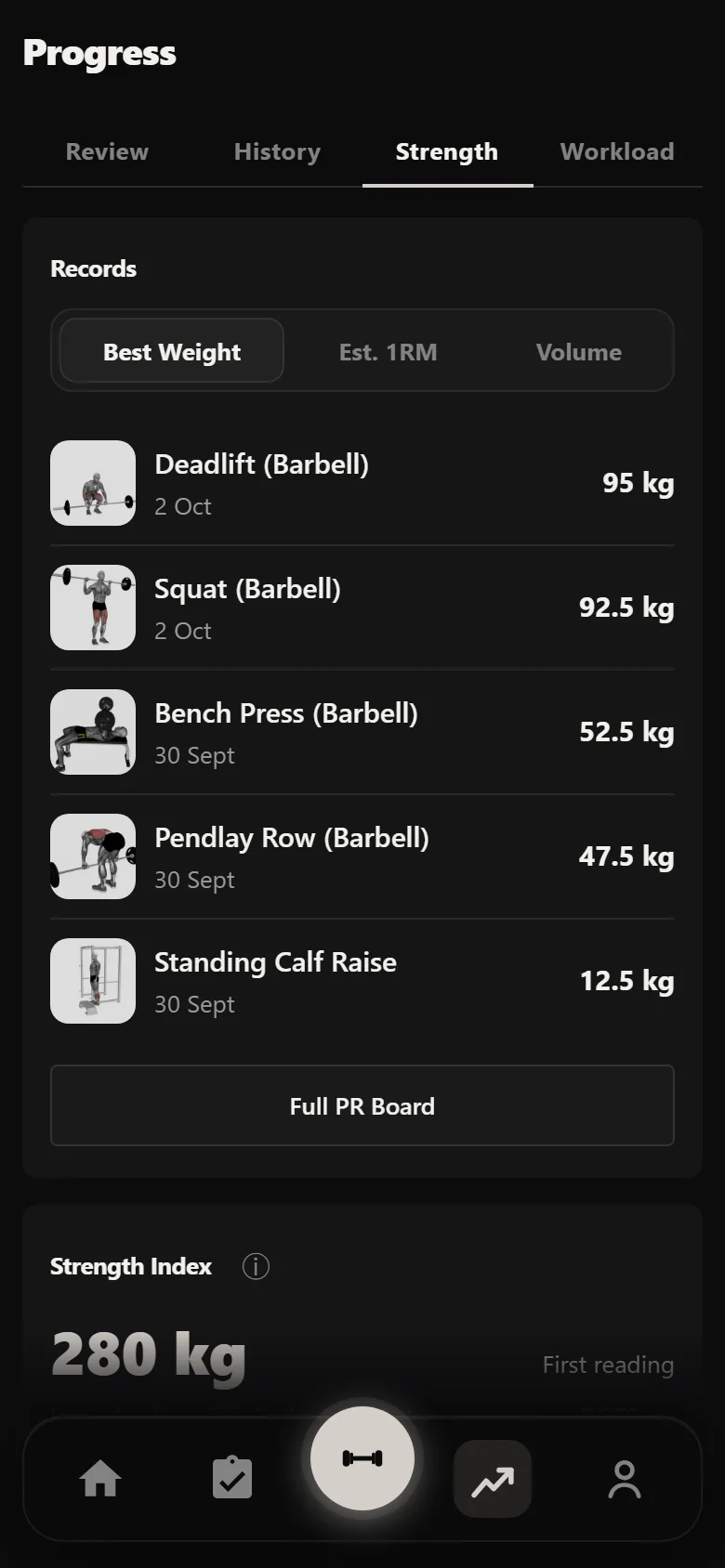
The payoff, where the squat started and finished
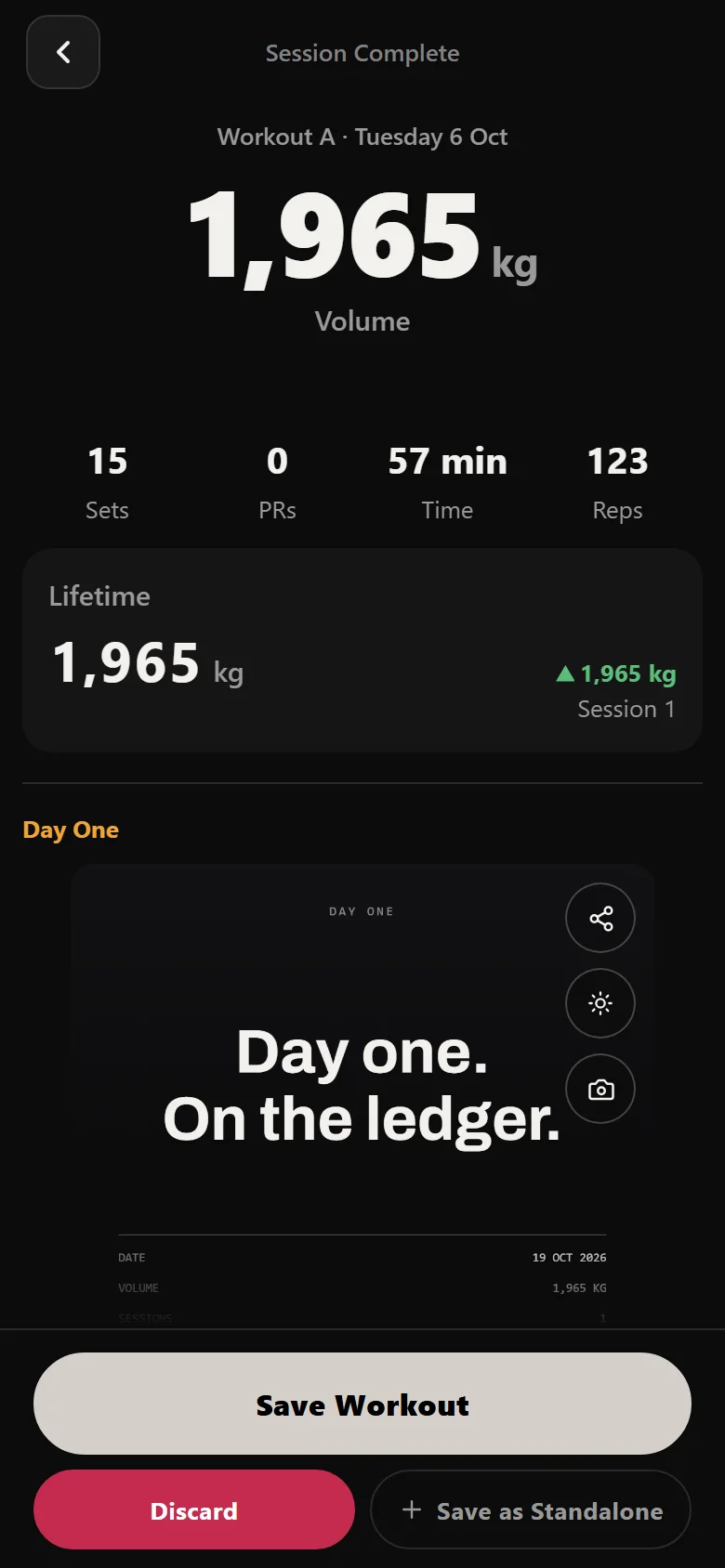
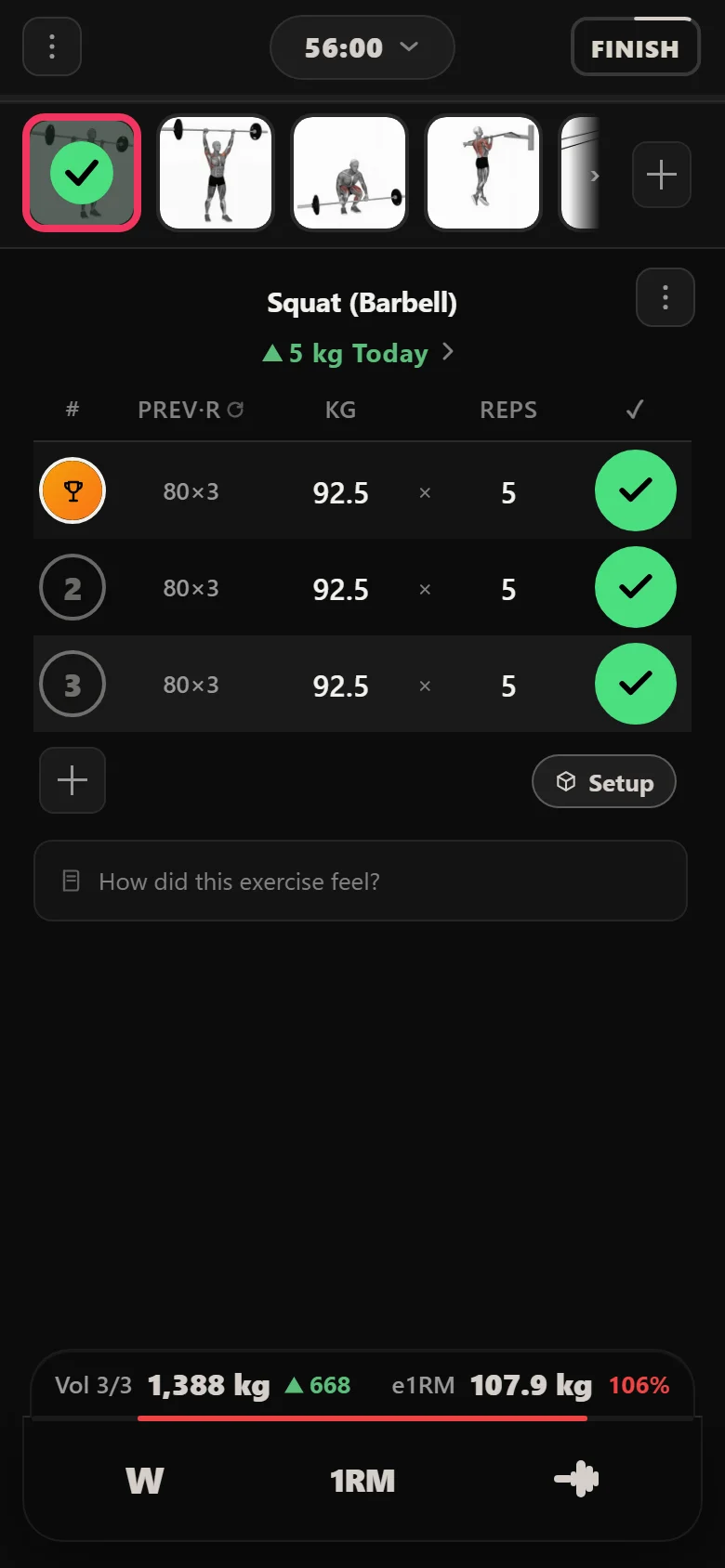
Two screenshots of the same squat, a month apart: the same three sets of five, the same lift, the same screen. Session one opened at 60 kg; the block's last session has 92.5 kg on the bar, 12.5 kg above the 80 that stalled the middle of the run, with 97.5 kg prescribed next. Nothing in between was typed in. Every weight was decided by the engine from the sets that were logged. That is the case for the app in one screen.
Same squat, a month apart: 60 kg opener to 92.5 kg on the block's last session, with the 80 kg stall and the 15% deload in between. Every weight decided by the app.
Common questions
What is linear progression?
The simplest progression there is: add a small fixed amount of weight every session for as long as you can complete the prescribed sets and reps. On Fierce 5 the squat runs 3×5 and goes up 5 kg a session, and the app moves the weight for you off the sets you log.
What weight should I start with?
Less than you think. Linear progression works because you can add weight for months, so starting light is the whole point rather than a compromise. This run opens at a 60 kg squat and finishes a month later with 92.5 kg on the bar. Pick a weight you can complete all three sets with comfortably and let the app do the adding.
What counts as a failed session?
Missing the rep target on any working set. All three sets at five reps is a success; 5, 5, 3 is a miss, and the weight holds. Durata judges every working set on a straight-sets scheme, not just the heaviest one. Otherwise a session you clearly didn't complete would still add weight.
What happens when I stall?
The weight holds after the first miss. Miss the same lift two workouts in a row and Fierce 5's rule kicks in: Durata drops the working weight by 15% and the climb restarts from there. You don't have to notice the stall or work out the new number. This run stalled at 80 kg and the app deloaded it to 67.5 kg on its own.
Isn't a deload going backwards?
Only if you stop. The reduced weight is a run-up: you climb back through the weight that stalled you with a few more weeks of training behind you. In this block the squat stalled at 80 kg, deloaded to 67.5 kg, and finished with 92.5 kg on the bar.
What is double progression?
A rule for work prescribed in a rep range. The weight stays fixed while you add reps session to session; once every set reaches the top of the range, the weight goes up and you start again at the bottom. The range itself never changes, only the load does. Fierce 5's accessories run this way.
Is Durata free?
Yes. Durata is free to use, with the full program catalogue, automatic progression maths, rest timers and PR tracking. Everything in this walkthrough is in the app.
Put it into practice
Durata is free to use — 50 proven programs, automatic progression, rest timers and PR tracking, all on your phone.