


Metallicadpa PPL in Durata: one lift, two rules, the same week
Metallicadpa PPL is the six-day pull/push/legs routine u/Metallicadpa posted to Reddit's /r/Fitness as a program for beginners. It does something most templates never bother with: it runs the same barbell lift under two different progression rules inside the same week. Bench press is the linear primary on Tuesday and a double-progression accessory on Friday. Overhead press is the mirror image. Deadlift and bent-over row take turns as the primary on the two pull days.
That structure is easy to describe and awkward to track by hand, because the two appearances of a lift are not the same lift as far as progression is concerned. They carry separate weights, separate histories and separate rules. This run drove all 36 sessions of a six-week block through the real app to see what the engine does with it, and followed the squat (barbell) through the charts, since it is the one barbell lift that runs the same rule on both leg days.
Finding it and starting it
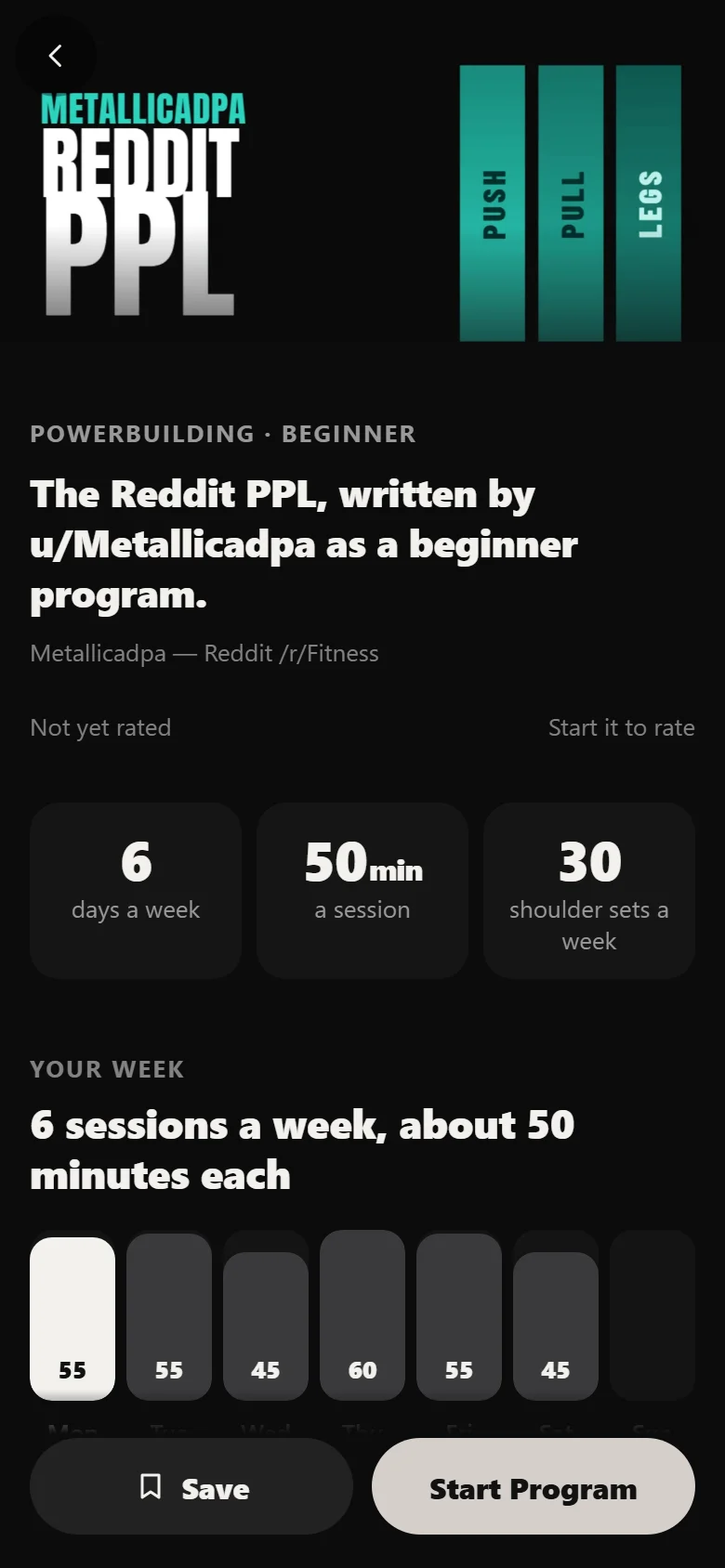
In Discover, Metallicadpa PPL sits on the Powerbuilding shelf, marked Beginner, at six days a week. Search finds it by name, or Filter narrows the shelves by level and days a week. Tap the cover for a quick look, then View Program for the full page.
The program page is the last stop before committing: six sessions a week at about 50 minutes each, with the progression rule and the shape of each session laid out, so the six-day commitment is visible before you take it rather than after.
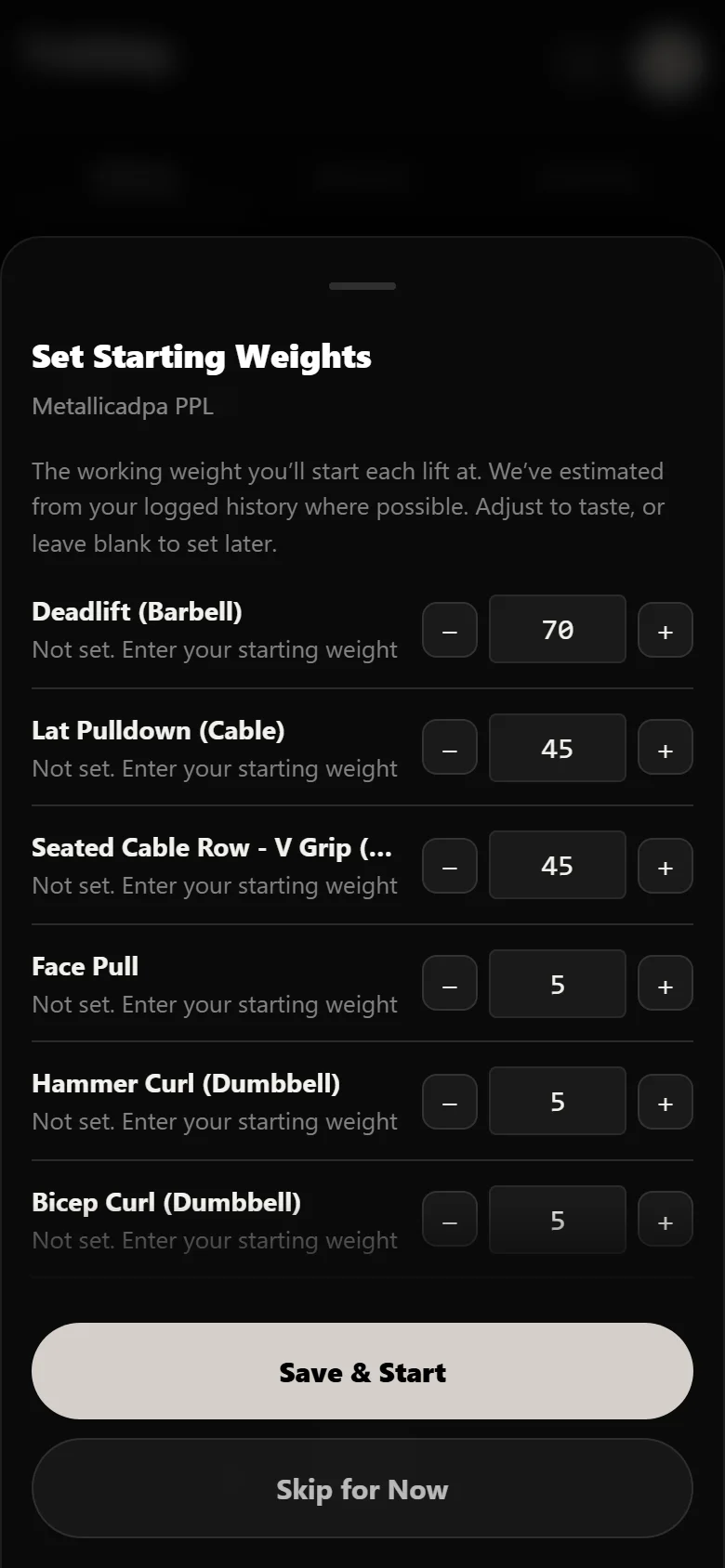
There are no training maxes to work out here. Every lift runs off a working weight, so the app asks what you can currently do for each one and starts there. The week opens on Pull A, so the first lifts it asks about are the pull day's: this run opened the deadlift at 70 kg, the lat pulldown and seated cable row at 45 kg, and the face pulls and both curls at 5 kg.
Six days, and two of them share a lift
The week runs Pull A, Push A, Legs A, Pull B, Push B, Legs B, Monday to Saturday, the order of the original post. Pull A opens with a single all-out deadlift set. Pull B opens with the bent-over row for four sets of five and a fifth set taken for as many reps as you have. The accessories behind them are identical on both days: lat pulldown, seated cable row, five sets of face pulls, then hammer curls and dumbbell curls.
The push days do the same thing. Push A is built around the bench press, four sets of five and an AMRAP, with the overhead press dropping in behind it for three sets of eight to twelve. Push B swaps them: overhead press takes the four-by-five, and the bench press moves to three sets of eight to twelve.
Both leg days are the same session: squat for two sets of five and an AMRAP, then Romanian deadlifts, leg press, lying leg curls and five sets of calf raises. The squat is the one barbell lift that runs the same rule twice a week, and that turns out to matter more than anything else in the block.
One more repetition hides inside each push day. The lateral raise is supersetted behind the triceps pushdown and again behind the overhead triceps extension, so it appears twice per push session. The app treats those as two separate slots and gives each its own weight.
Two rules, running side by side
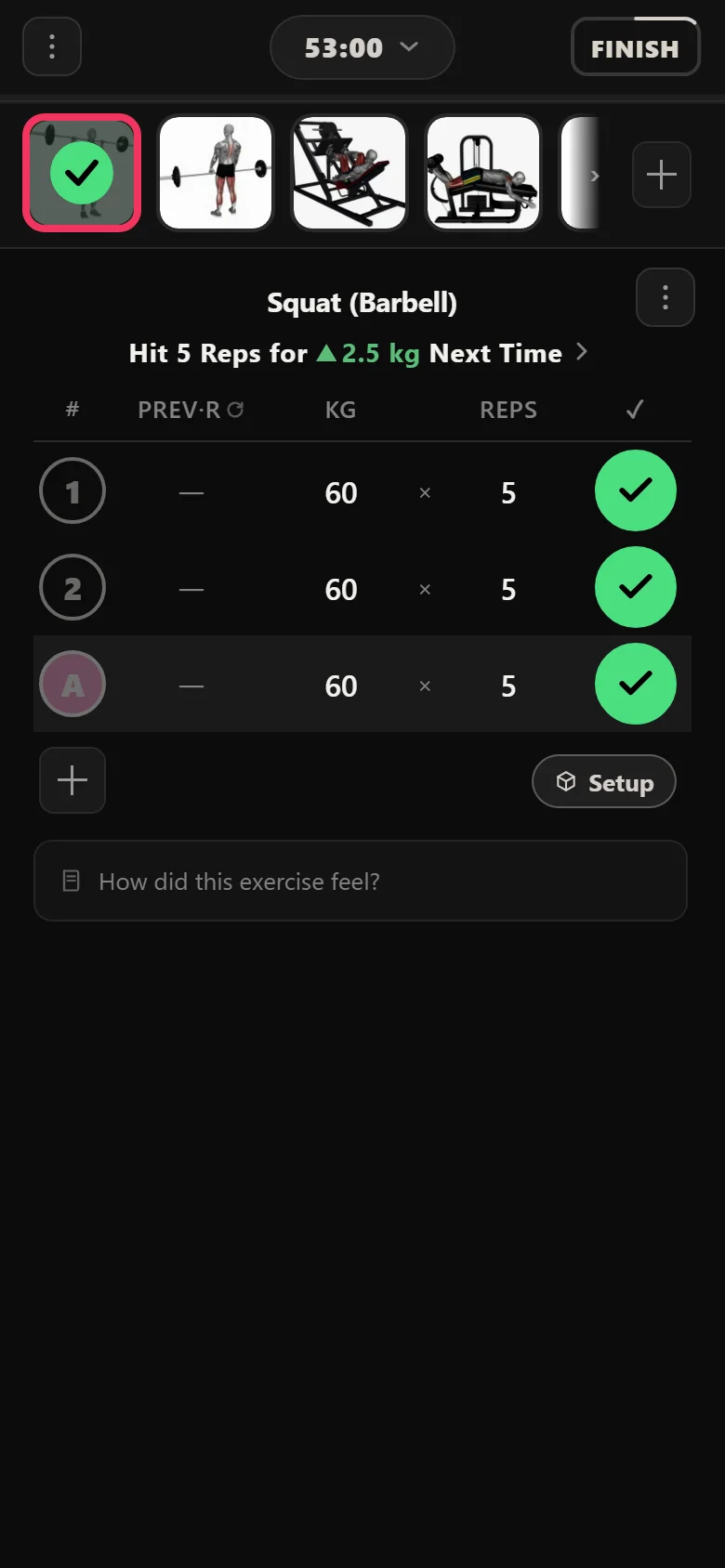
The primary lifts run linear. Complete the prescribed sets and the app adds 2.5 kg to that lift's next appearance, 5 kg on the deadlift. Miss a working set and the weight holds where it is. Miss three times at the same weight and the engine cuts it by ten percent and restarts the climb.
The accessories work the other way round. The weight stays put and the reps climb through a range, and only when every set reaches the top of the range does the weight move and the reps reset to the bottom. The lateral raises and face pulls run a 15 to 20 range; everything else runs 8 to 12.
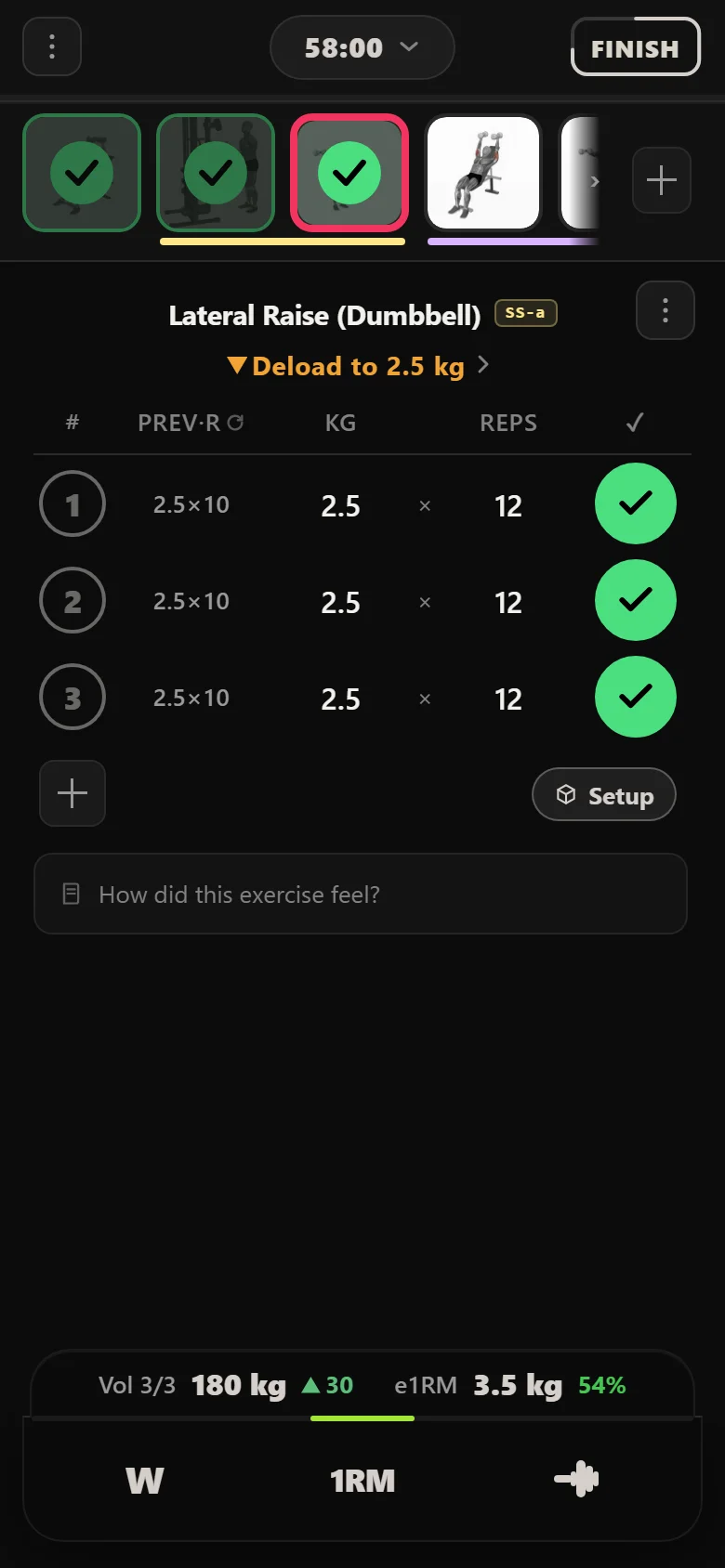
Both rules are printed on the exercise while you train, on the line under its name, and an accessory can be cut as well as raised. The lateral raise in the first superset slot opened at 5 kg; sets of 10 and 12 on a 15 to 20 range never reached the top, and by the end of the block its line read Deload to 2.5 kg.
That is what makes the two-rule week work. Bench press on Push A and bench press on Push B are separate slots with separate histories, so the linear rule reads only the Tuesday sets and the double-progression rule reads only the Friday sets. Both opened at 40 kg and both reached 45 kg, by different routes, and neither one knew about the other.
Twice a week is twice the attempts
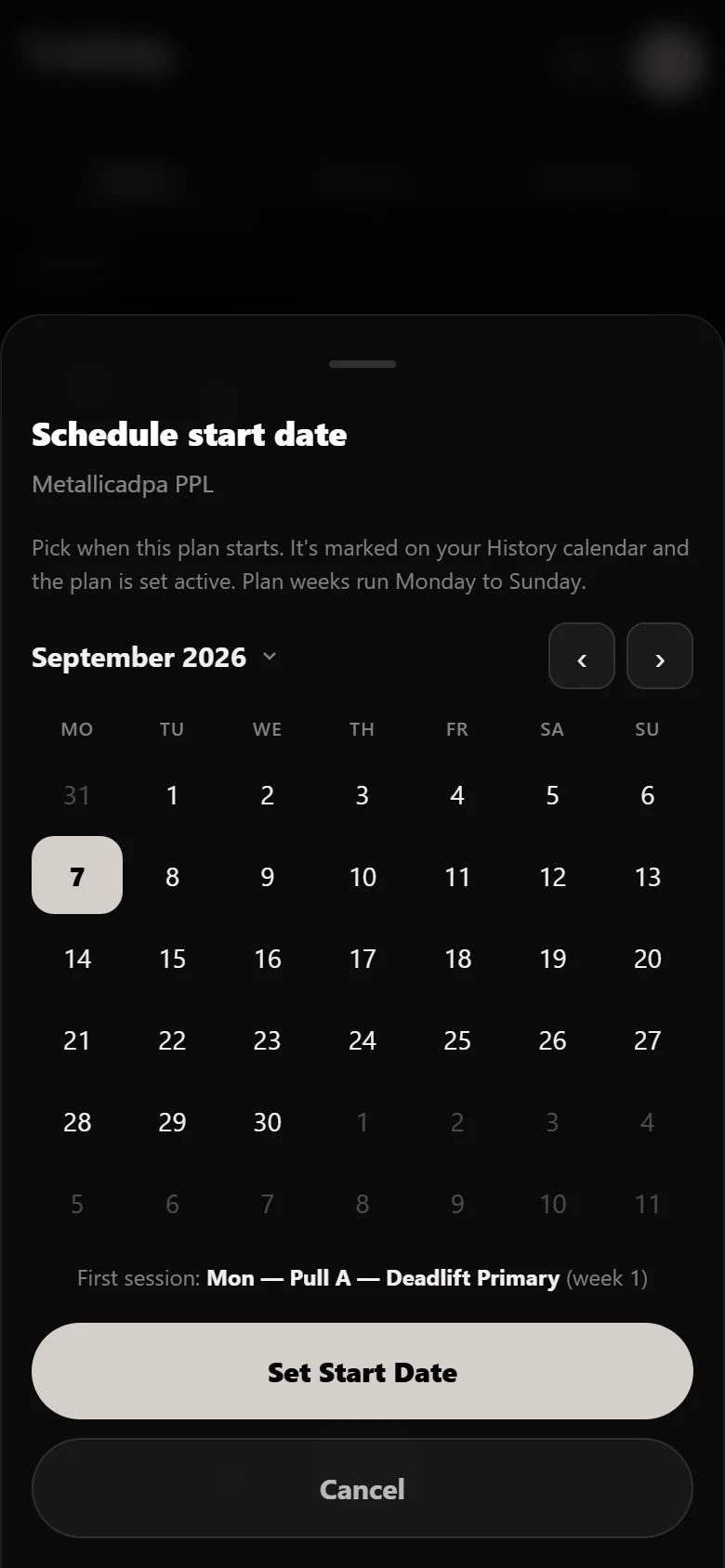
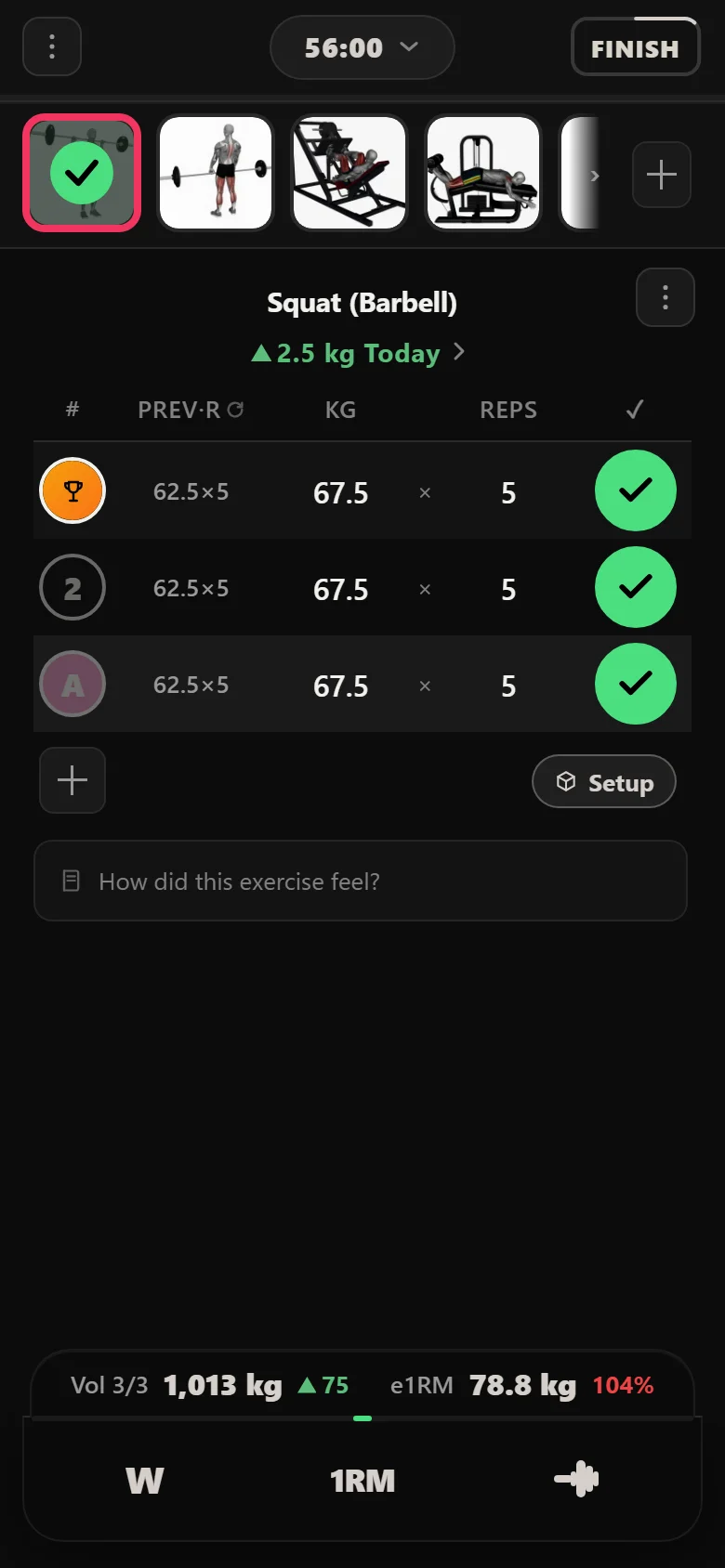
The squat opened at 60 kg on Wednesday's Legs A and came round again three days later on Saturday's Legs B. Because both leg days run the same session, the squat got twelve chances to move in a six-week block. A lift trained once a week got six.
That doubles the rate of climb without changing the rule. The squat added 2.5 kg on each of its first four appearances, so by session twelve it was at 67.5 kg, with 62.5 kg in the previous column from the last time that same leg day ran.
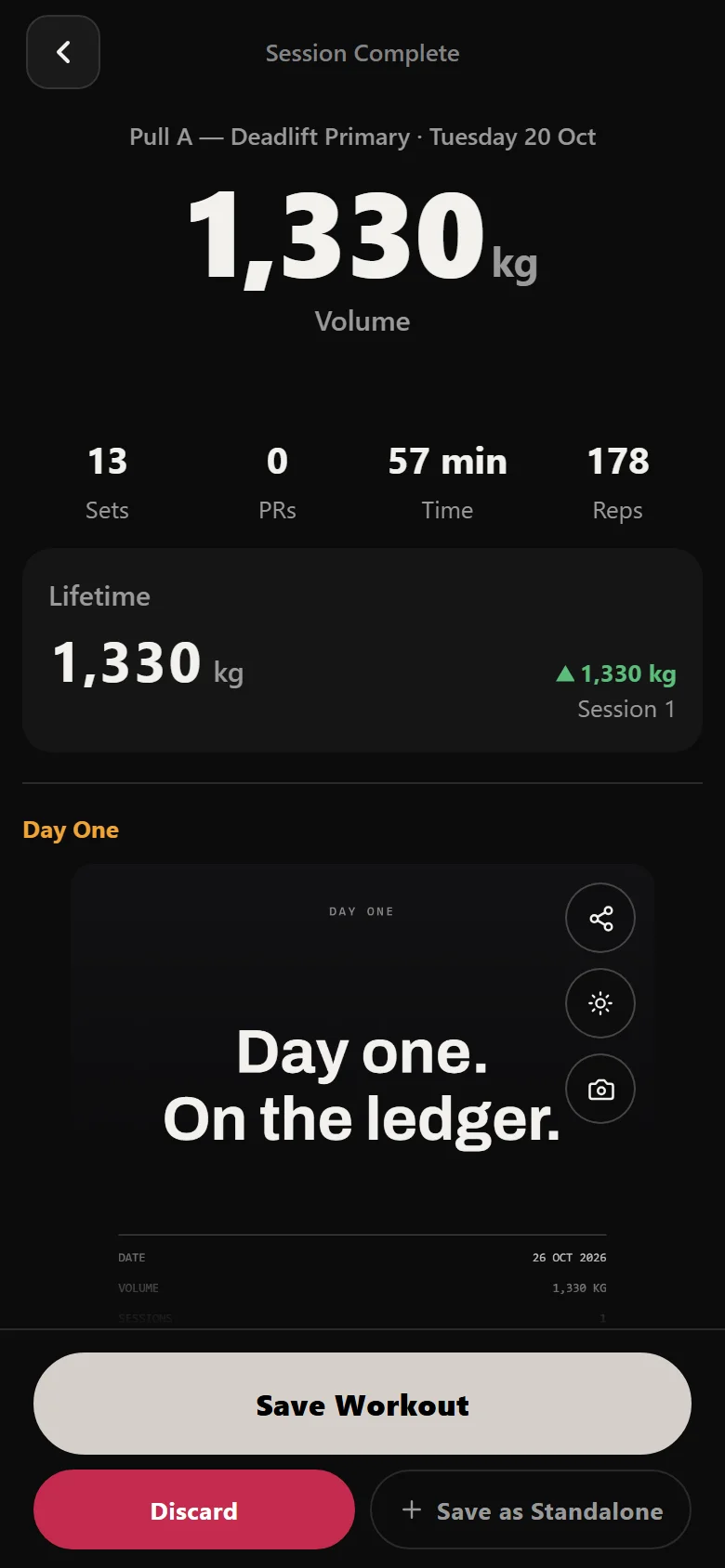
Nothing about that required a decision. You turn up, the weight is on the screen, and the app has already read the last session to work out what it should be. The end-of-session card totals the work before it saves: the first Pull A came to 13 sets, 178 reps and 1,330 kg.
70 kg, three times
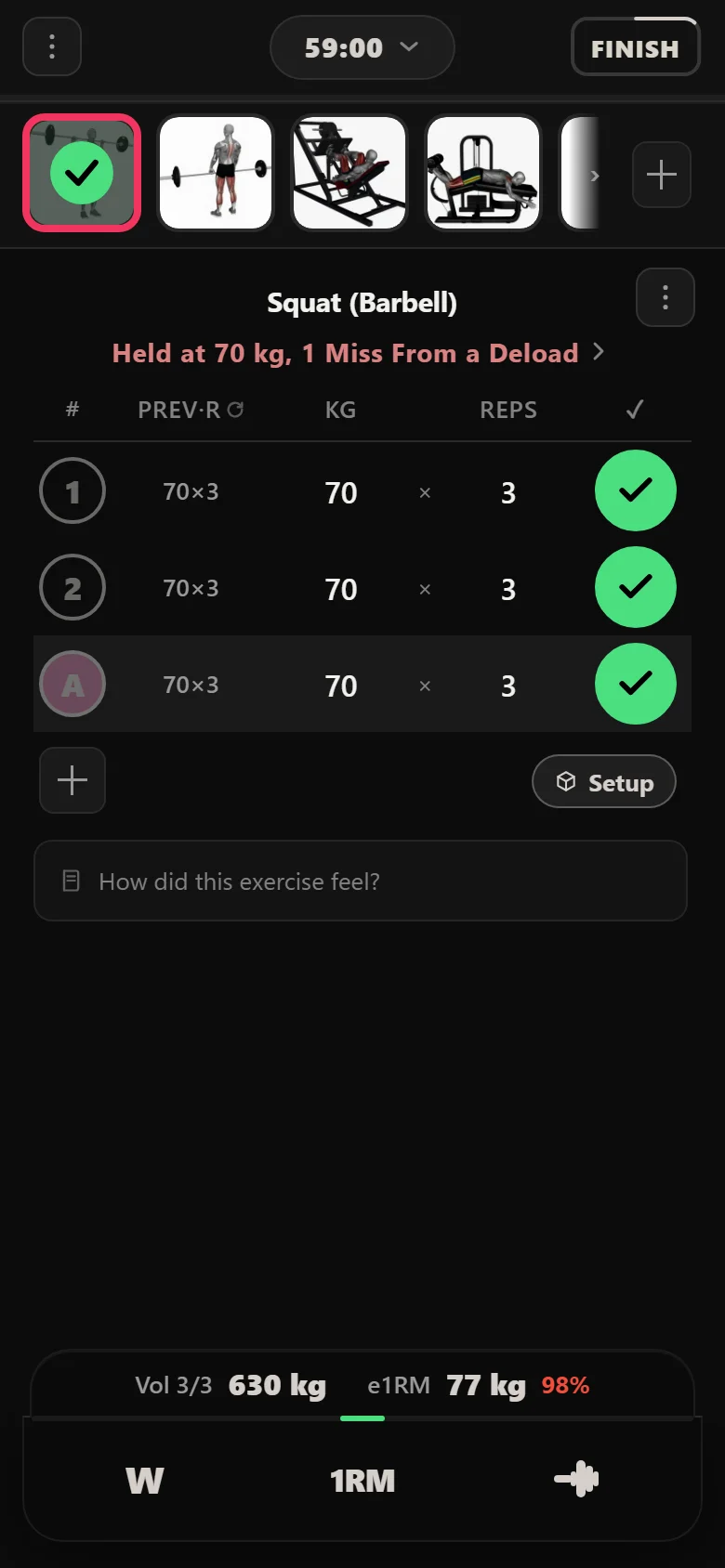
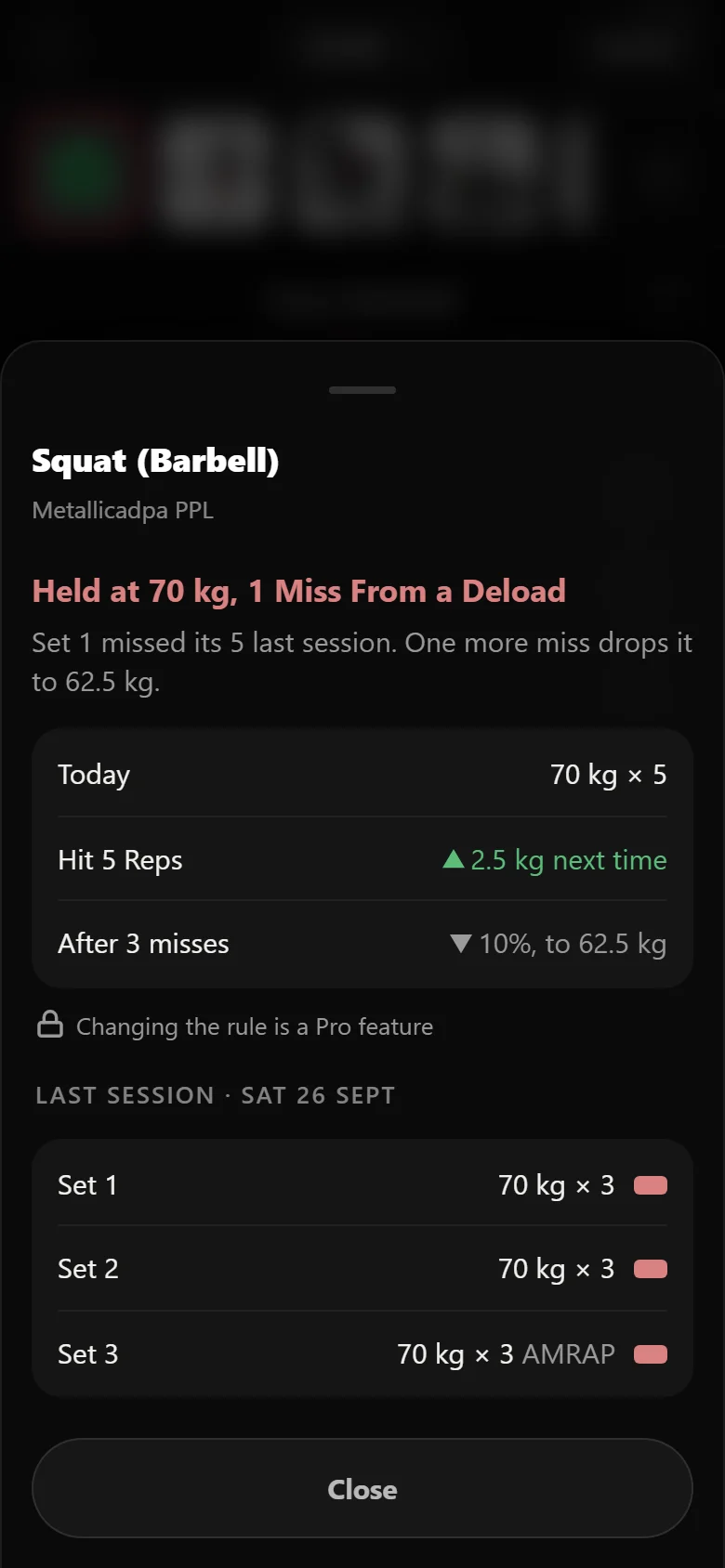
Twelve chances to add weight also means the weight arrives sooner than it would on a once-a-week schedule, and 70 kg is where this squat ran out of room. The working sets came in at three reps instead of five.
Missing any working set makes the whole session a failed one, so the weight held. It held again on the next leg day, and again on the one after that. Three attempts at the same number, three sessions short.
The rule line is a button, and this is when it earns its place. Tapping it shows the evidence the engine is working from, drawn from that slot's own history, next to the rule it is being judged against: last session's three sets of 70 kg for 3, one more miss to a deload, and after three misses the weight goes down 10%, to 62.5 kg.
The cut, and the way back up
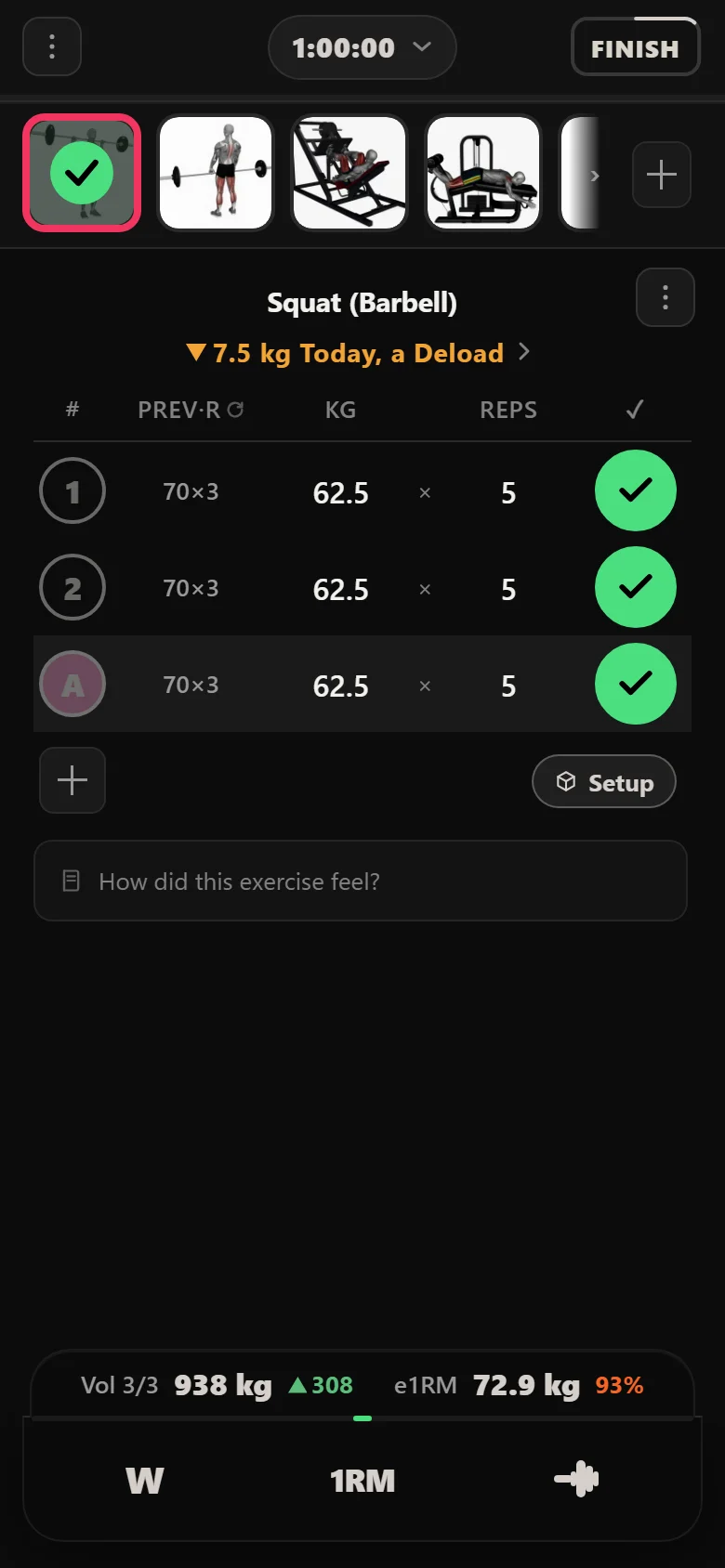
The third miss tripped the rule. The engine took ten percent off the squat, rounded to the plate, from 70 kg back to 62.5 kg, and started the climb again from there. Nobody calculated it and nobody decided it. The rule read the logged sets and applied itself.
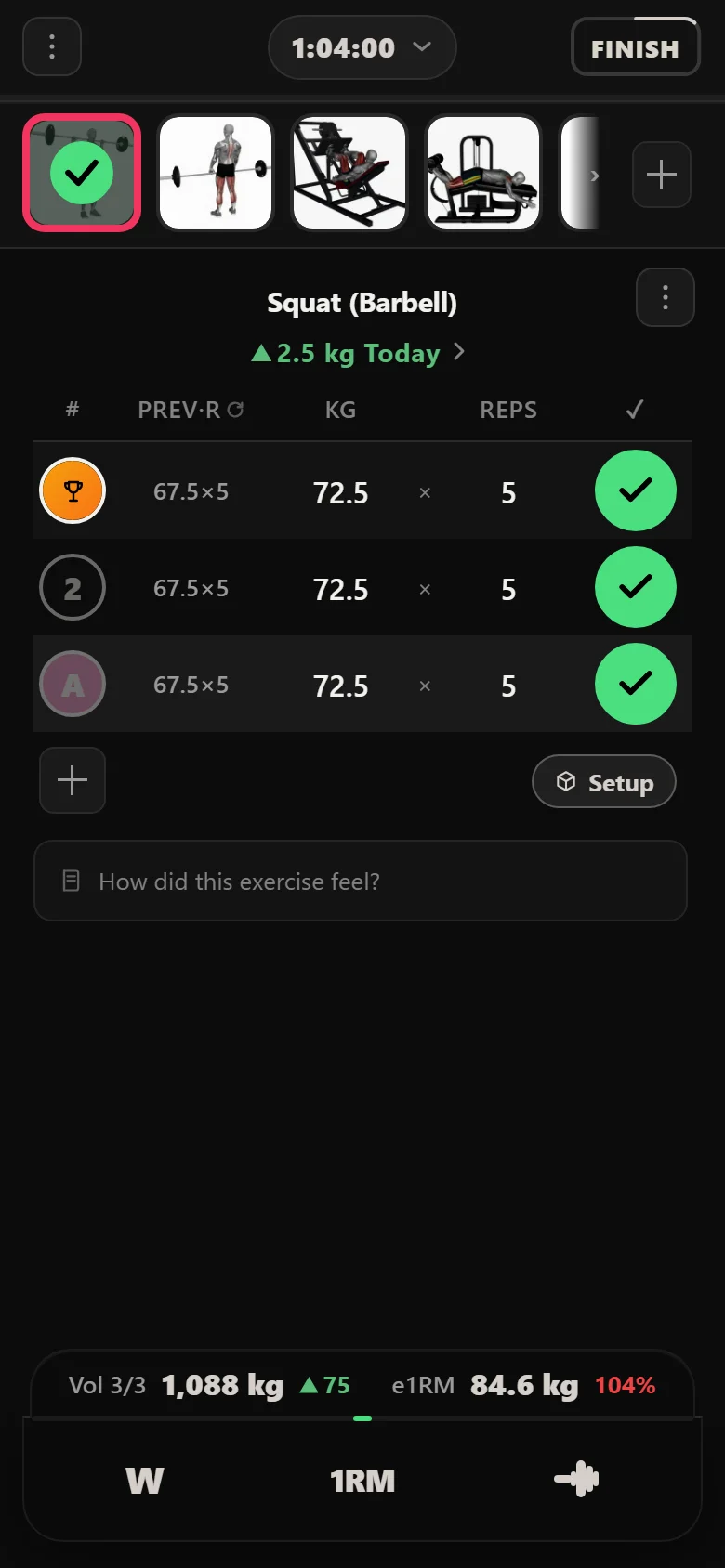
From 62.5 kg the climb ran as it had the first time: 65 kg, 67.5 kg, 70 kg, and then 72.5 kg on the last leg day of the block, past the number that stopped it. Twelve appearances, seven weights, one stall and one cut, all of it drawn from the sets that were logged rather than from a plan written in advance.
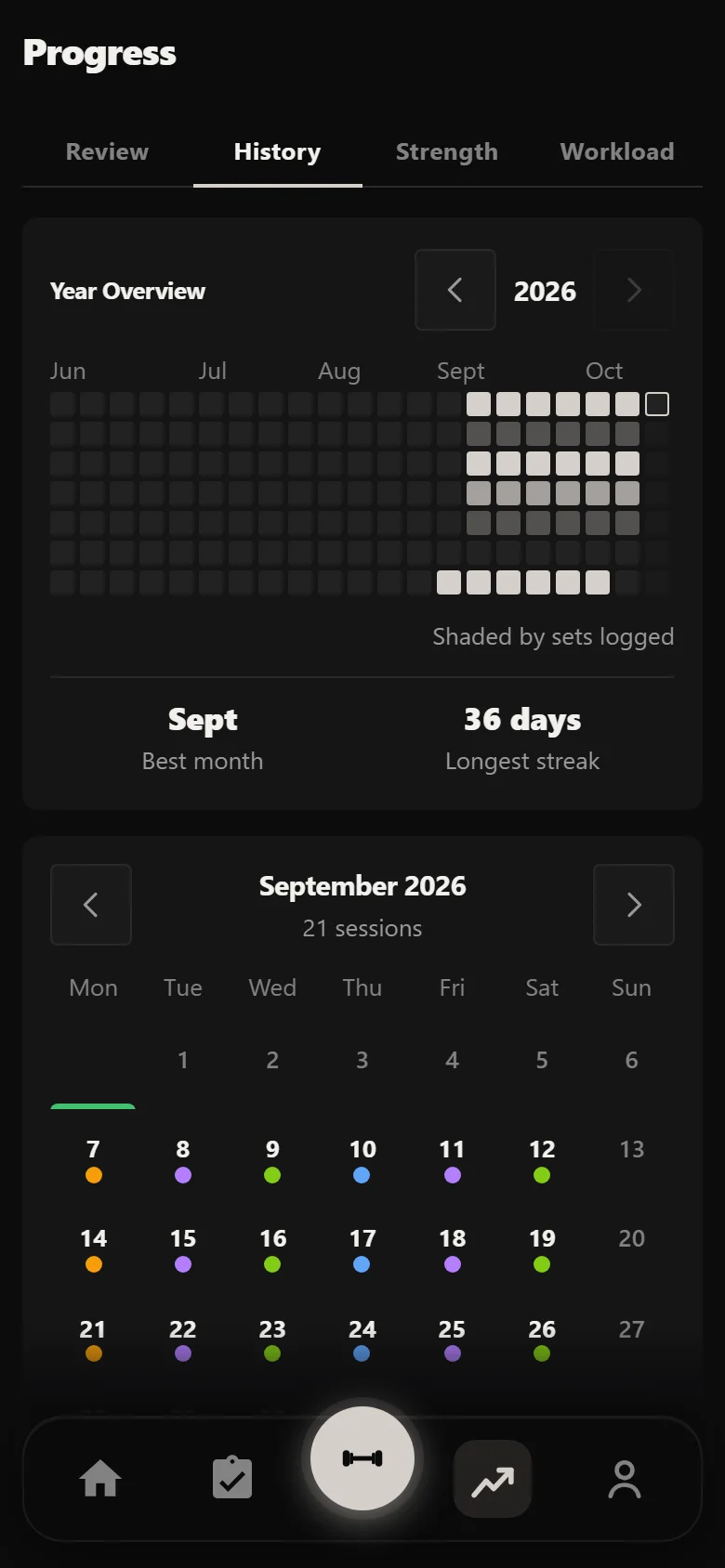
The sixth week finished with the next squat already prescribed at 75 kg. The History tab shows the whole block: 36 sessions over six weeks, six a week, Monday to Saturday.
Squat (Barbell): working weight, session by session
- 60S3 Session 3 — first leg day
- 62.5S6 Session 6
- 65S9 Session 9
- 67.5S12 Session 12
- 70S15 Session 15
- 70S18 Session 18
- 70S21 Session 21
- 62.5S24 Session 24 — deload
- 65S27 Session 27
- 67.5S30 Session 30
- 70S33 Session 33
- 72.5S36 Session 36 — last leg day
What moved, and what did not
Across the block the movers were the lifts that appear twice a week. The incline dumbbell press is on both push days and went from 15 kg to 25 kg. Face pulls, hammer curls and dumbbell curls are on both pull days and all three went from 5 kg to 12.5 kg. The triceps pushdown doubled, 5 kg to 10 kg.
Bench press moved in both of its slots, 40 kg to 45 kg as the Tuesday primary and 40 kg to 45 kg again as the Friday accessory. The overhead press accessory went from 30 kg to 35 kg. The squat, the lift with the most appearances of all, finished with 75 kg prescribed.
Plenty held still in this run. The deadlift stayed at 70 kg, the bent-over row, lat pulldown and seated cable row at 45 kg, the Romanian deadlift at 42.5 kg, the leg press at 90 kg, and the overhead triceps extension, lying leg curl and calf raise at 5 kg.
One lift went backwards: the lateral raise in the first superset slot, 5 kg down to 2.5 kg. The same movement in the second slot ran its own separate history, which is the reason the two are tracked apart.
The Strength tab lists the records the block set, with the squat at 72.5 kg, and a first Strength Index reading of 190 kg. The squat's own estimated one-rep max chart shows the arc: climbing, flattening through the stall, dipping at the deload, then climbing past where it stopped.
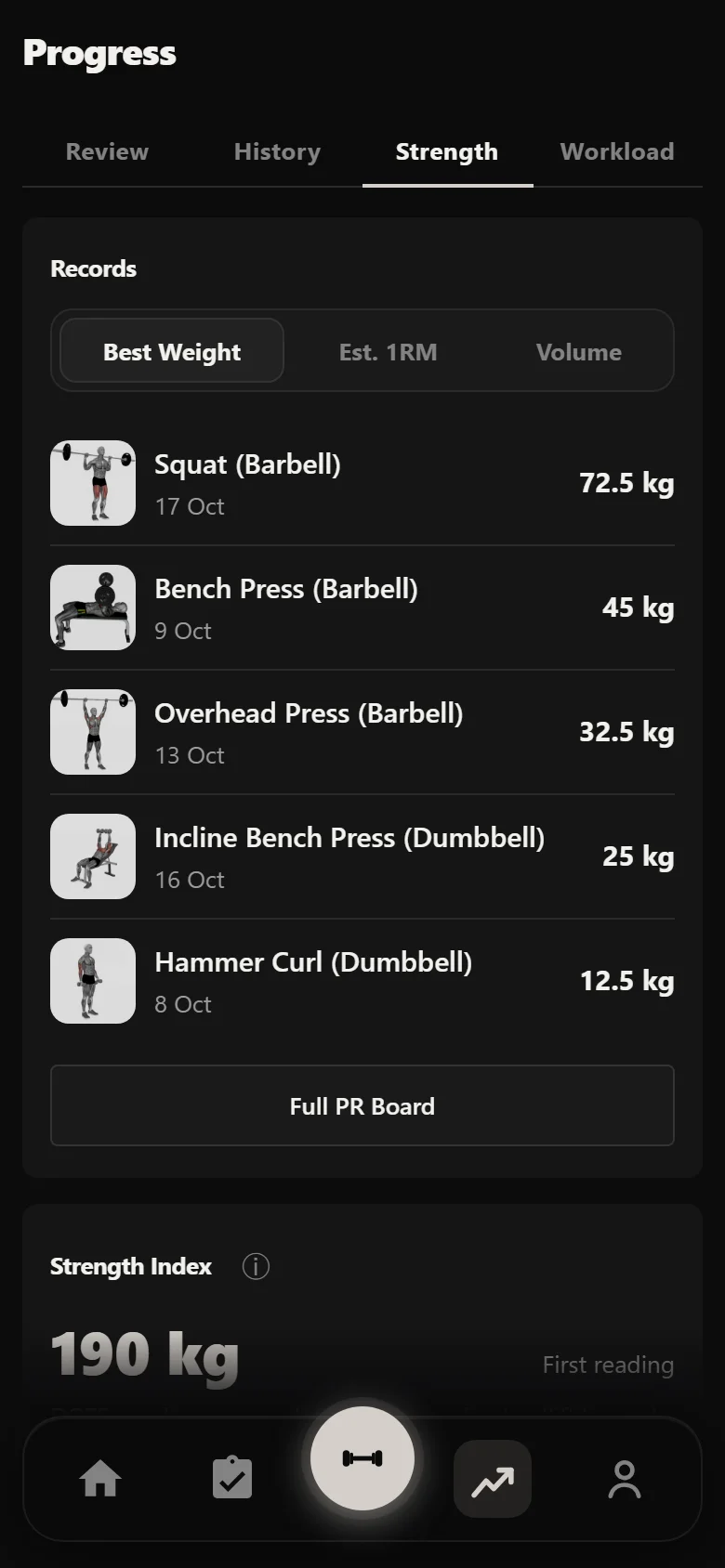
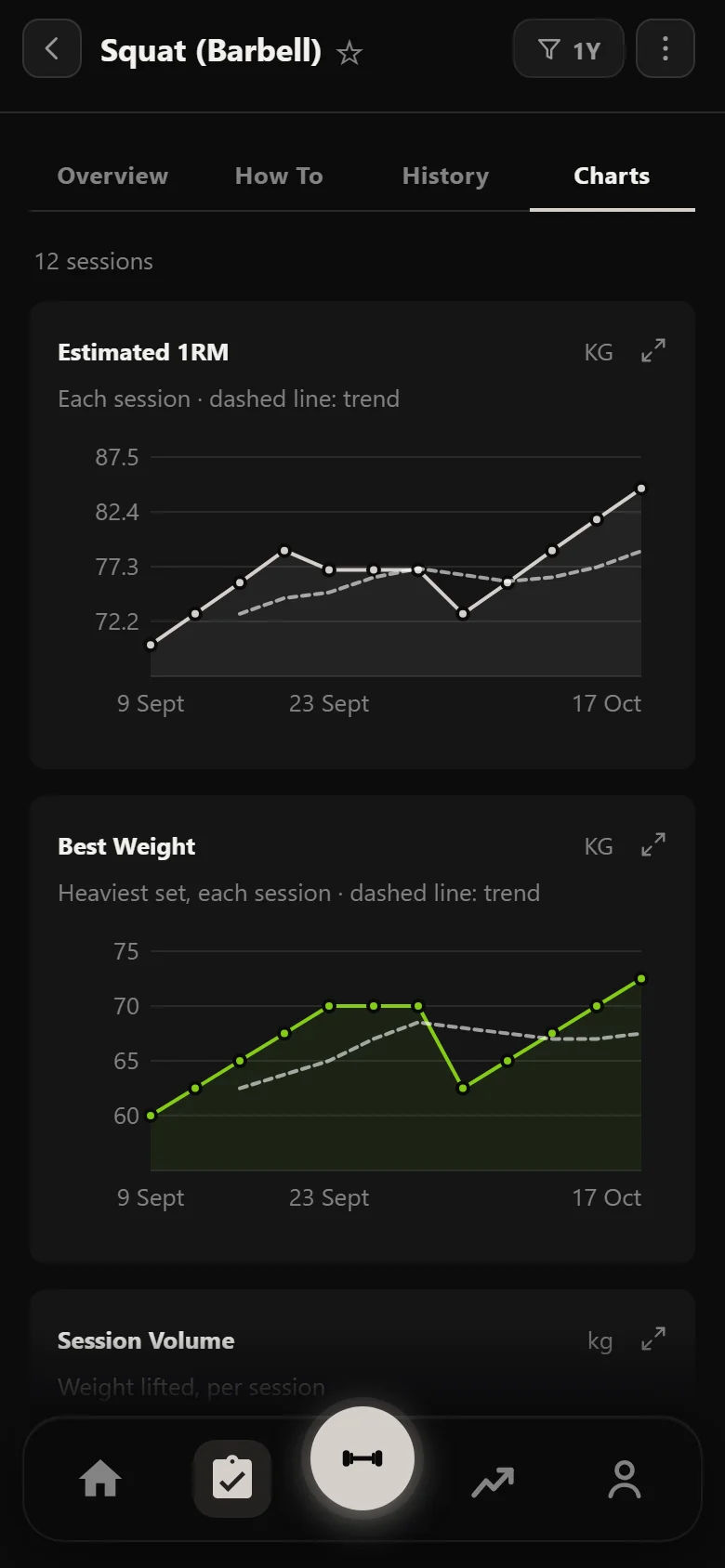
The payoff: past 70 kg the hard way
Two screenshots of the same lift, six weeks apart. The squat opened the block at 60 kg and finished it at 72.5 kg, having stalled at 70 kg three times and been cut back to 62.5 kg in between. Every step of the route between them was decided by the engine from the sets that were logged.
Same lift, six weeks apart, with a stall and a deload in between, and the app drove every weight.
Common questions
What is Metallicadpa PPL?
A six-day pull/push/legs routine from Reddit's /r/Fitness, written by u/Metallicadpa for beginners. Each day opens with a heavy barbell lift you add weight to each session, followed by hypertrophy accessories. Deadlift and rows alternate as the primary pull, bench and overhead press as the primary push, and the squat leads both leg days.
Why does the same lift have two different weights?
Because the program gives it two different jobs. Bench press is the linear primary on Push A and a double-progression accessory on Push B, so Durata tracks them as separate slots with separate weights, histories and rules. On this run both started at 40 kg and both reached 45 kg, independently.
Six days a week is a lot. Does it work if I miss one?
The progression rules read sessions, not calendar dates, so a missed day pushes the schedule rather than breaking the maths. The lift picks up at the weight it was owed the next time you train it.
What happens when a lift stalls?
The weight holds. Miss the same weight three times and Durata cuts it by ten percent and restarts the climb. On this run the squat stalled at 70 kg three times, was dropped to 62.5 kg, and climbed to 72.5 kg by the end of the block.
Is Durata free?
Yes. Durata is free to use, with the full program catalogue, automatic progression maths, rest timers and PR tracking. Everything in this walkthrough is in the app.
Put it into practice
Durata is free to use — 50 proven programs, automatic progression, rest timers and PR tracking, all on your phone.