


Dumbbell + Bench Full Body in Durata: three days, one pair of bells
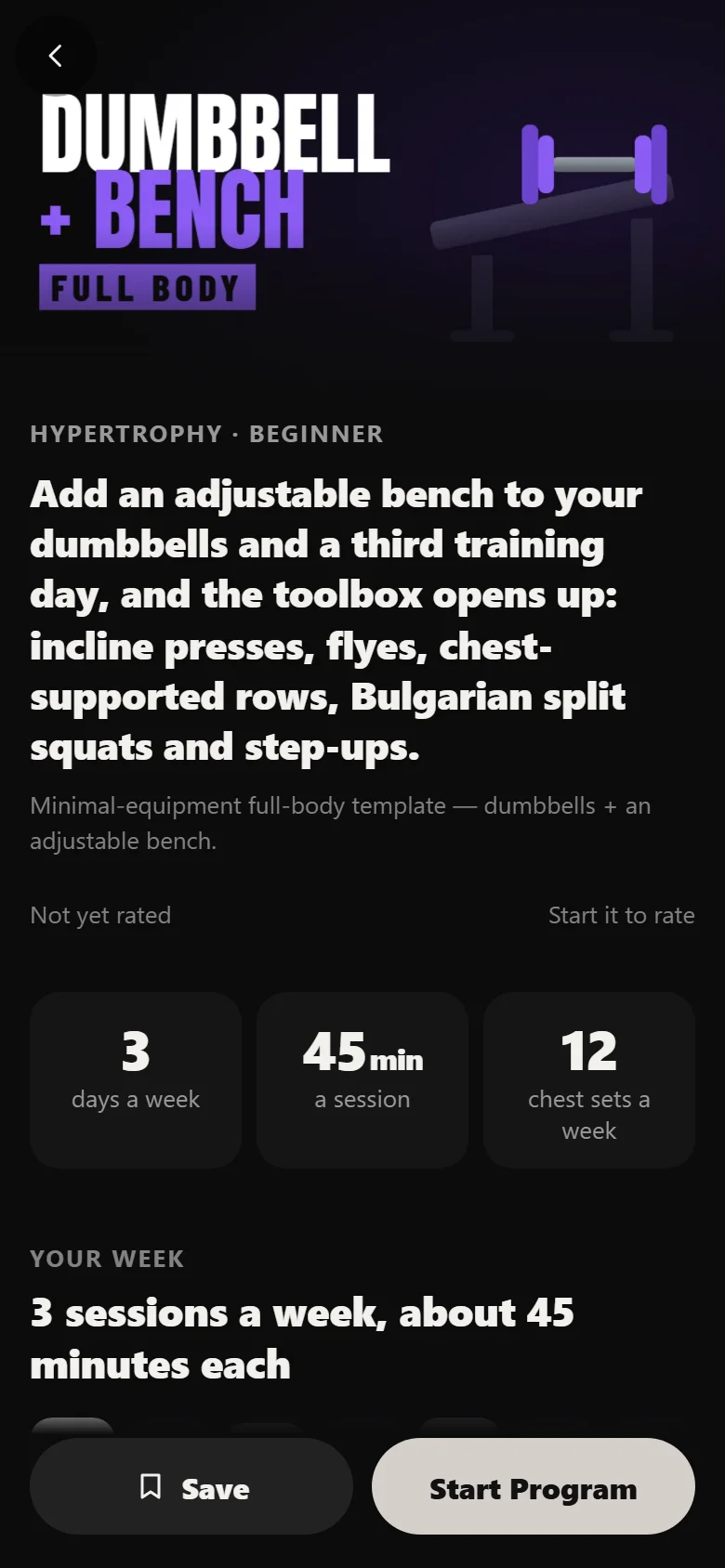
Dumbbell + Bench Full Body assumes exactly the equipment its name promises: one adjustable pair of dumbbells and a bench. No barbell, no rack, nothing that needs a room to itself. On top of that it builds three full-body sessions a week, A, B and C, each one hitting legs, a press, a pull and some arm work. It sits a step up from the dumbbell-only program, because adding a bench is what makes incline pressing, flyes, chest-supported rows and split squats possible.
Every loaded lift on it runs double progression: work up through the rep range at the weight you have, and only when every set has topped the range does the weight go up. That rule and a fixed 2.5 kg dumbbell increment turn out to interact in a way worth watching, and this walkthrough follows what the engine actually did across twelve sessions. Every weight, rep and estimate below is computed by the real app on a live drive.
Finding a program that fits the kit
In Discover, Dumbbell + Bench Full Body sits on the Hypertrophy shelf, marked Beginner, at three days a week. Search finds it by name, or Filter narrows the shelves by level and days a week. Tap the cover for a quick look, then View Program for the full page.
It is a complete routine that never asks for equipment you might not have. Plenty of good three-day programs are built on a barbell and a rack, and if you train in a spare room they are not options at all. The quick look lists the equipment each program needs, and Filter can narrow the shelves by it.
Three full-body days, A, B and C
The program page shows the whole rotation before you start. Day A is goblet squats, incline dumbbell press, chest-supported incline rows, Romanian deadlifts, lateral raises and curls. Day B swaps in Bulgarian split squats, flat dumbbell bench, bent-over rows, flyes, seated overhead press and skullcrushers. Day C runs step-ups, single-leg Romanian deadlifts, incline press again, reverse flyes, Arnold presses, hammer curls and kickbacks.
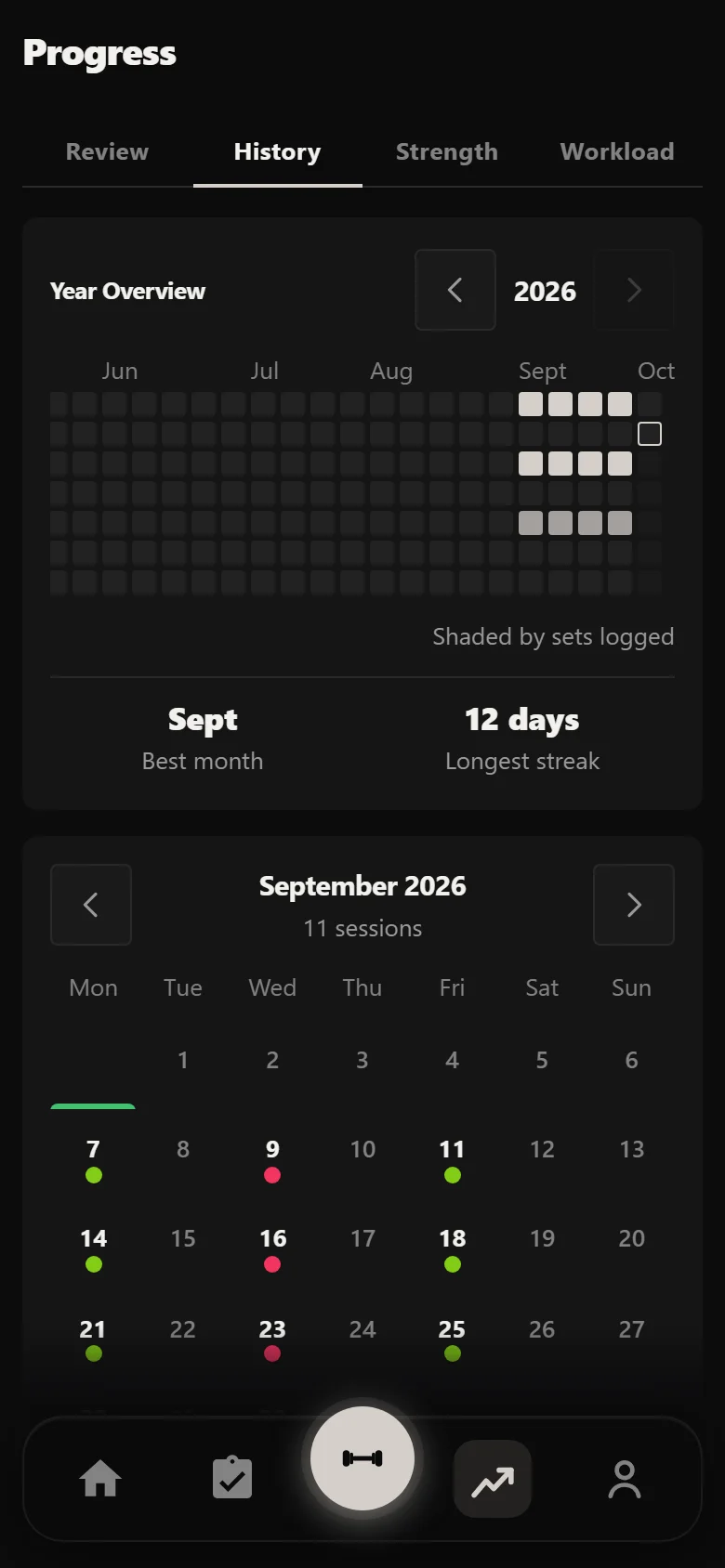
The incline press is the only lift that appears twice, on A and on C. Everything else gets one slot a week. That matters more than it looks, and the block bears it out later.
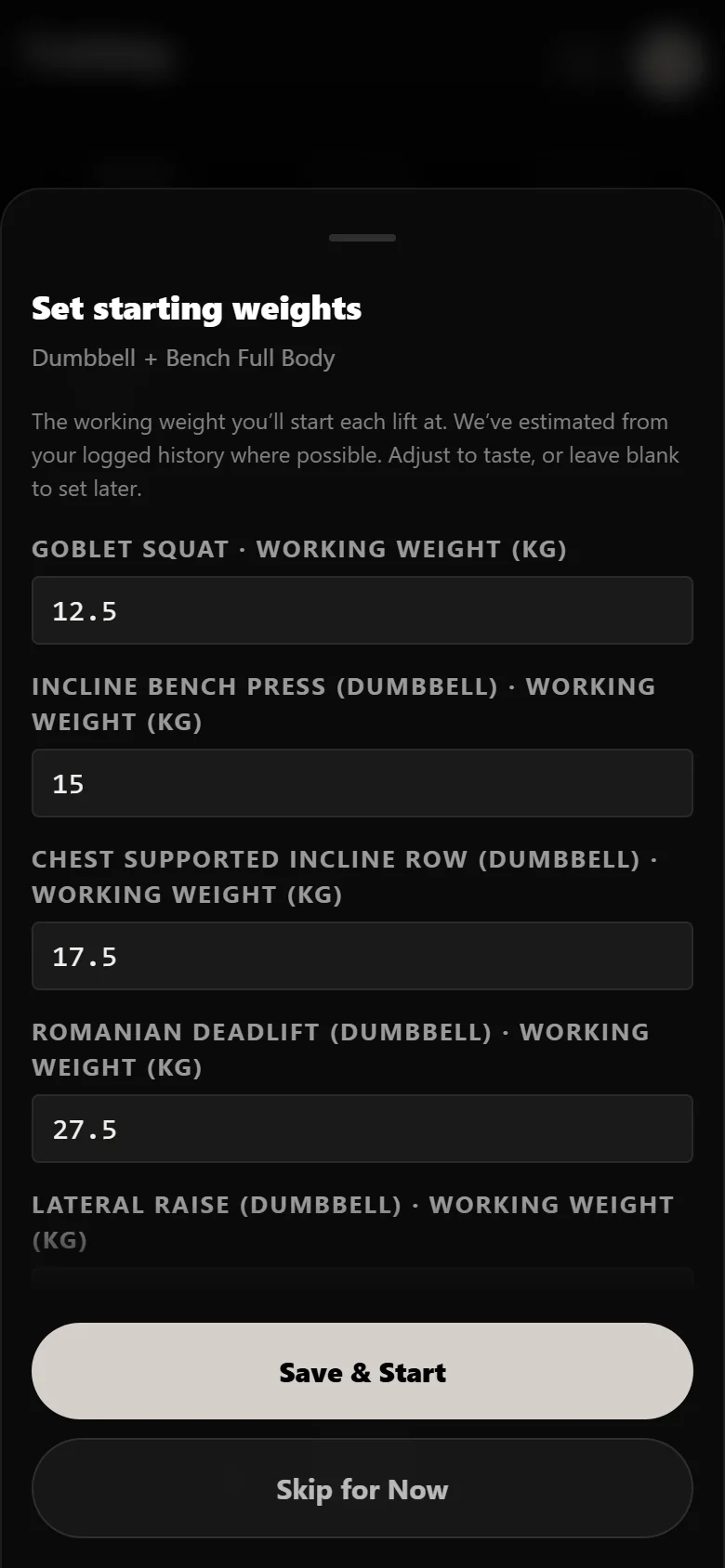
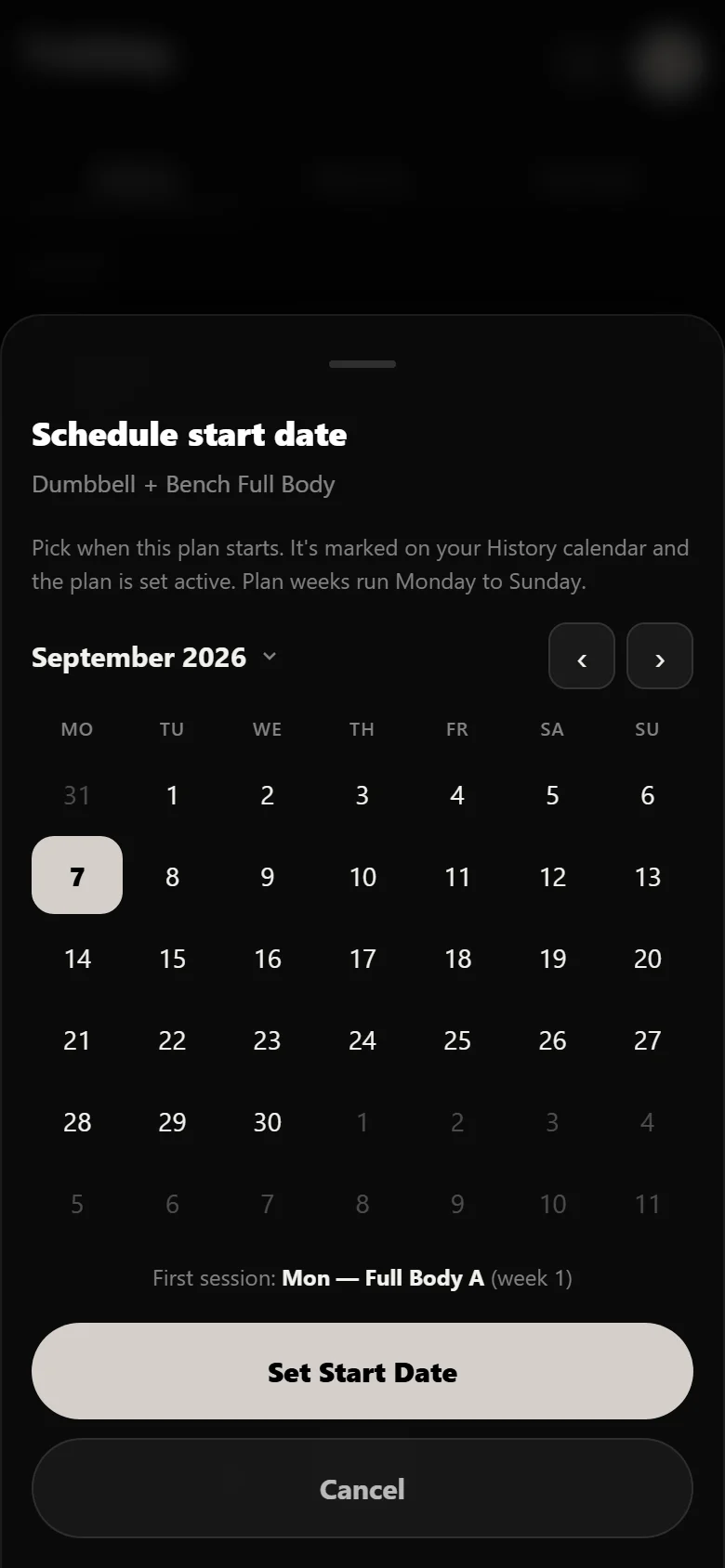
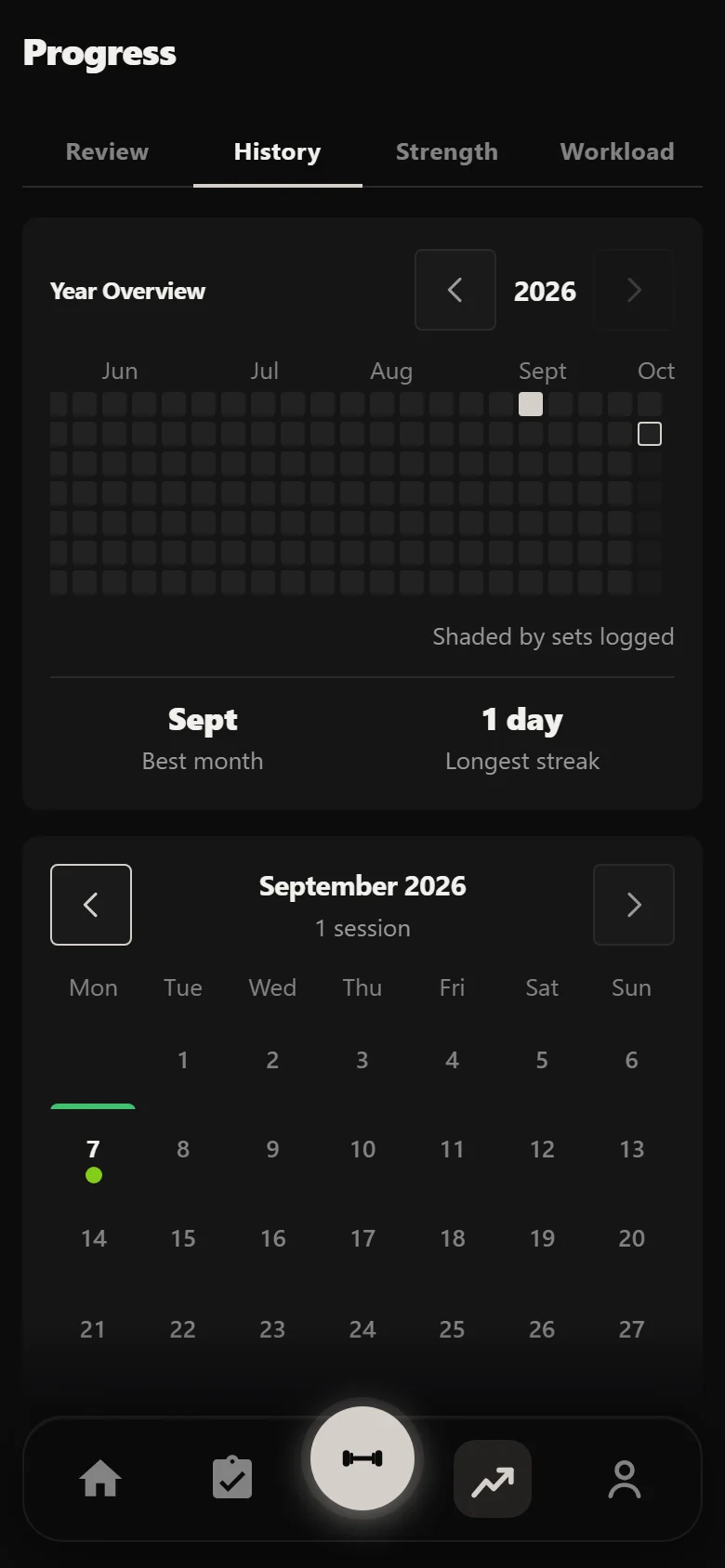
Setup asks for one working weight per lift and nothing else. There is no training max to test and no percentage to calculate. This run opens the goblet squat at 12.5 kg, the chest-supported row at 17.5 kg, both Romanian deadlift variants at 27.5 kg, and the raises and flyes at 5 kg. Then you pick a start date and the twelve sessions land on the History calendar from there.
One rule on everything, spelled out on the lift
Open a session and the chip under each exercise name says which rule is running and what it takes to satisfy it. On this program the chip says the same thing on every loaded lift, only with a different range: hit the top of the range on every set, then the weight steps up 2.5 kg. The goblet squat is three sets of twelve to fifteen. The presses and rows are ten to twelve. The raises and flyes go fifteen to twenty.
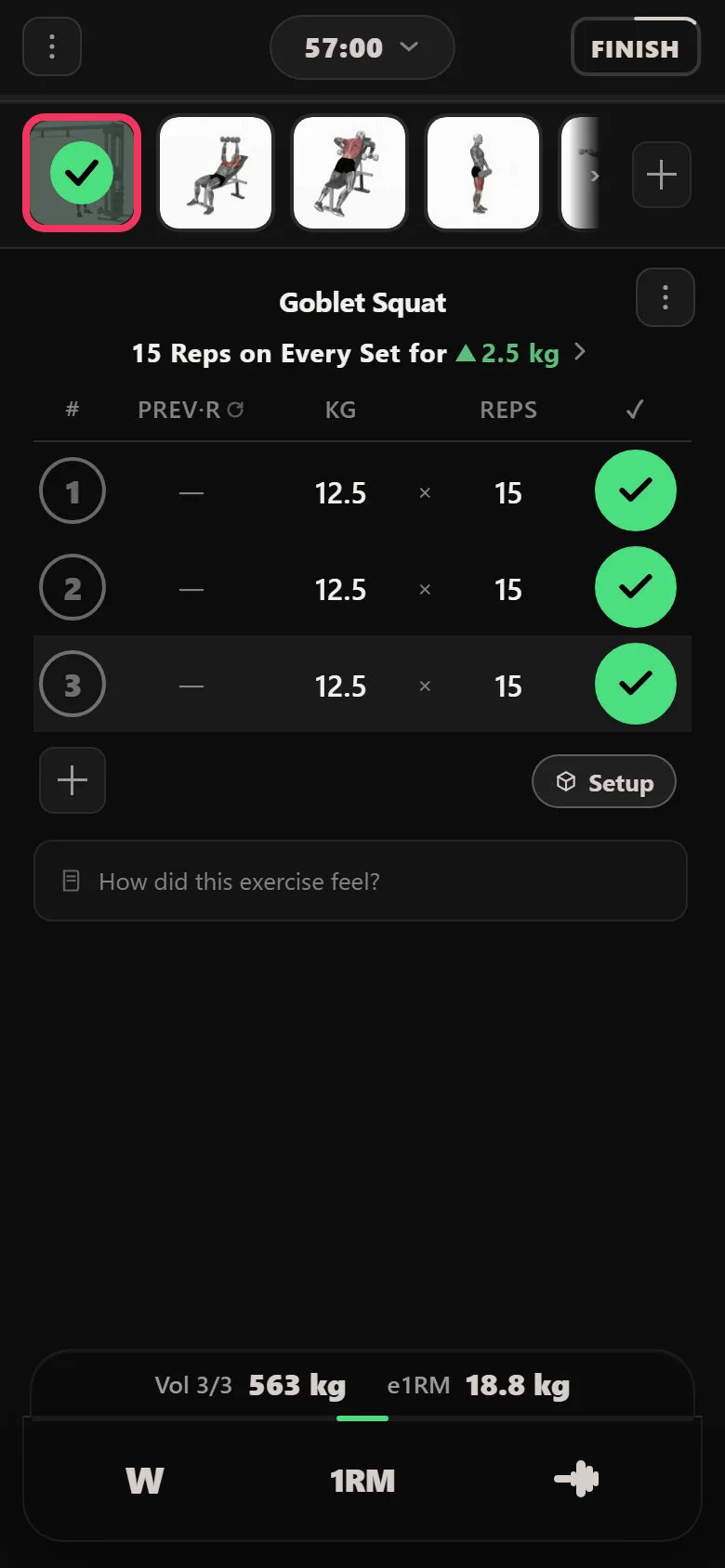
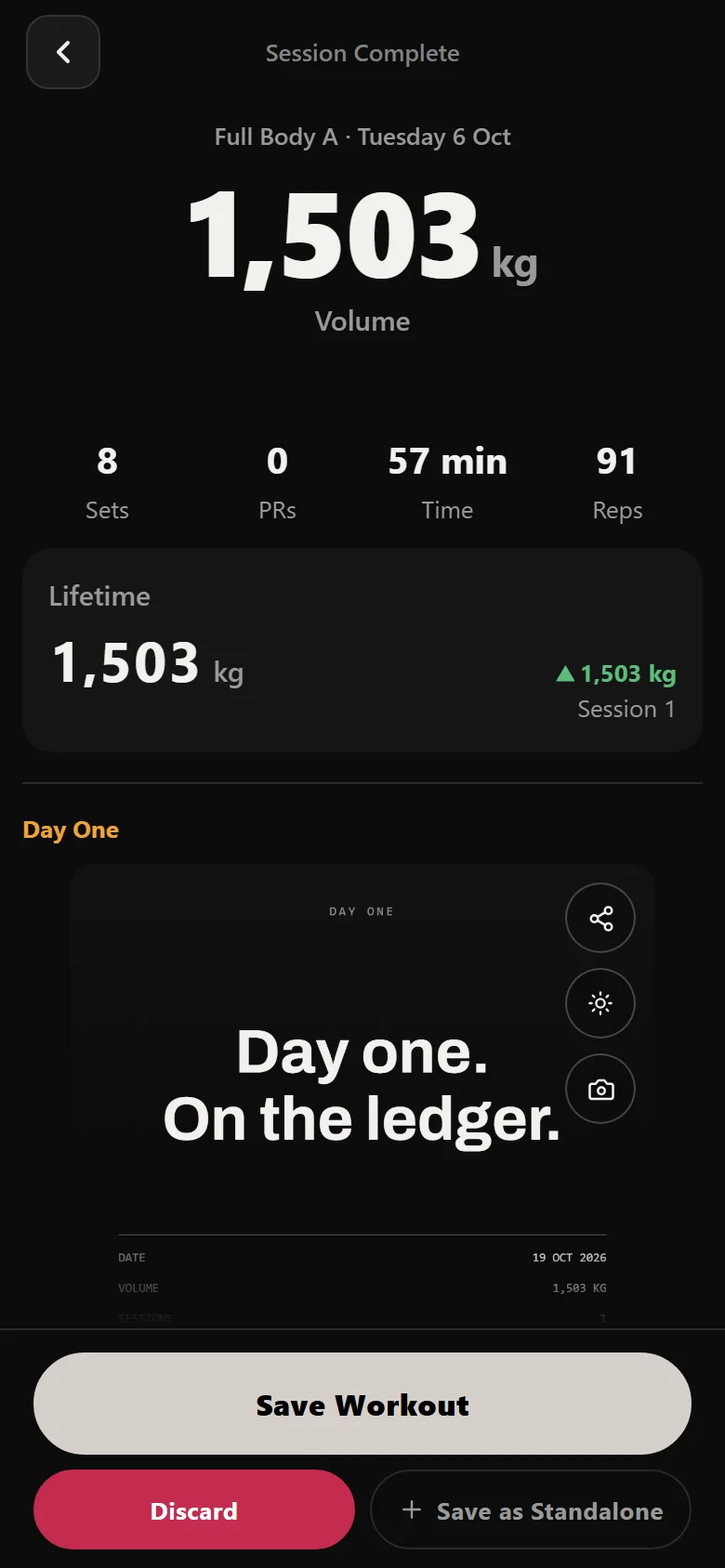
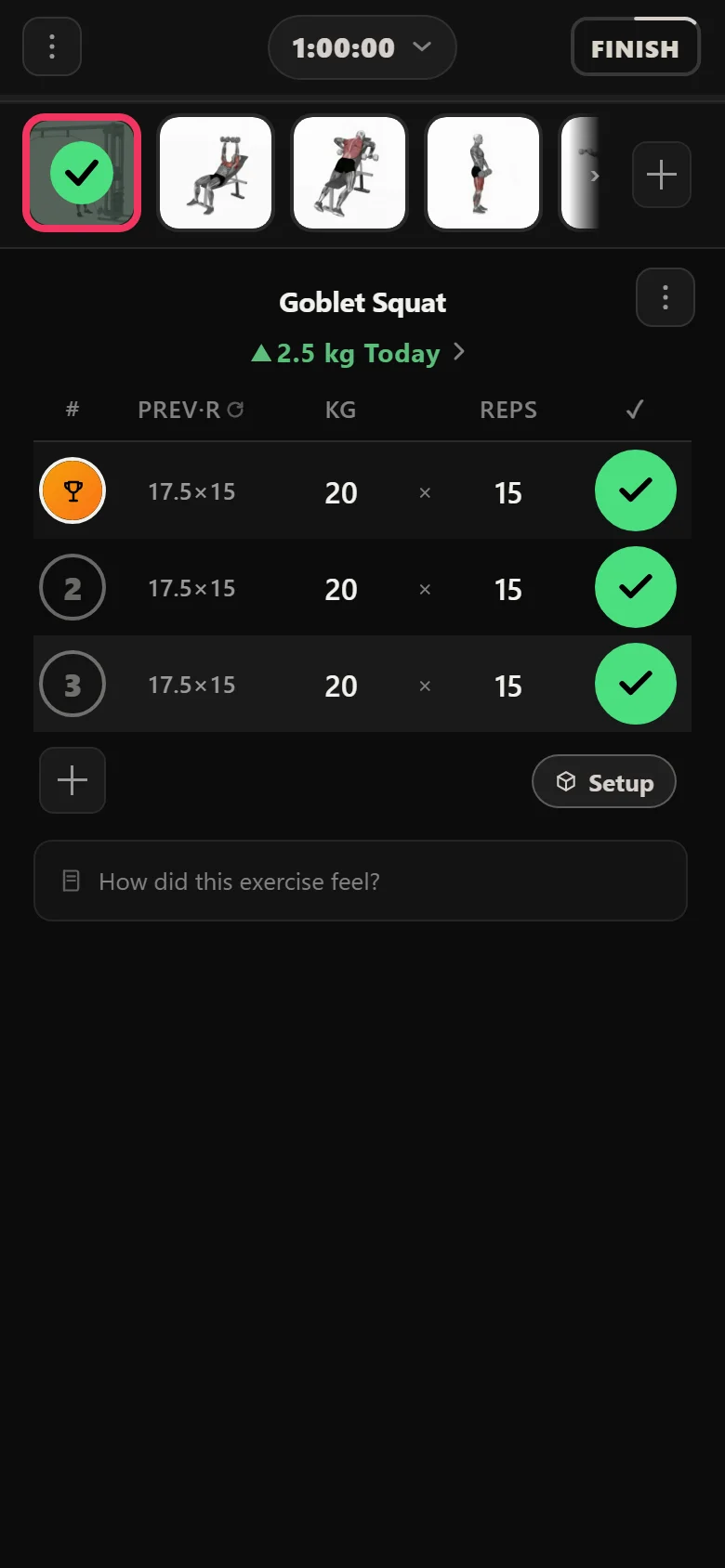
That is the entire mechanic. There is no schedule to keep to and nothing to work out at the end of a set. You log the reps, and the decision about next week's weight has already been made by the time you close the session. The first goblet squat session comes to 563 kg of volume, and the complete screen tallies duration, sets, reps and 1503 kg of total volume before it saves.
The accessory chips are worth reading once, because they state the target in plain words rather than leaving you to infer it: hit twelve reps and the bells go up 2.5 kg. Nothing partial counts. Eleven on one set out of three and the weight holds for another week.
The goblet squat: four appearances, four increases
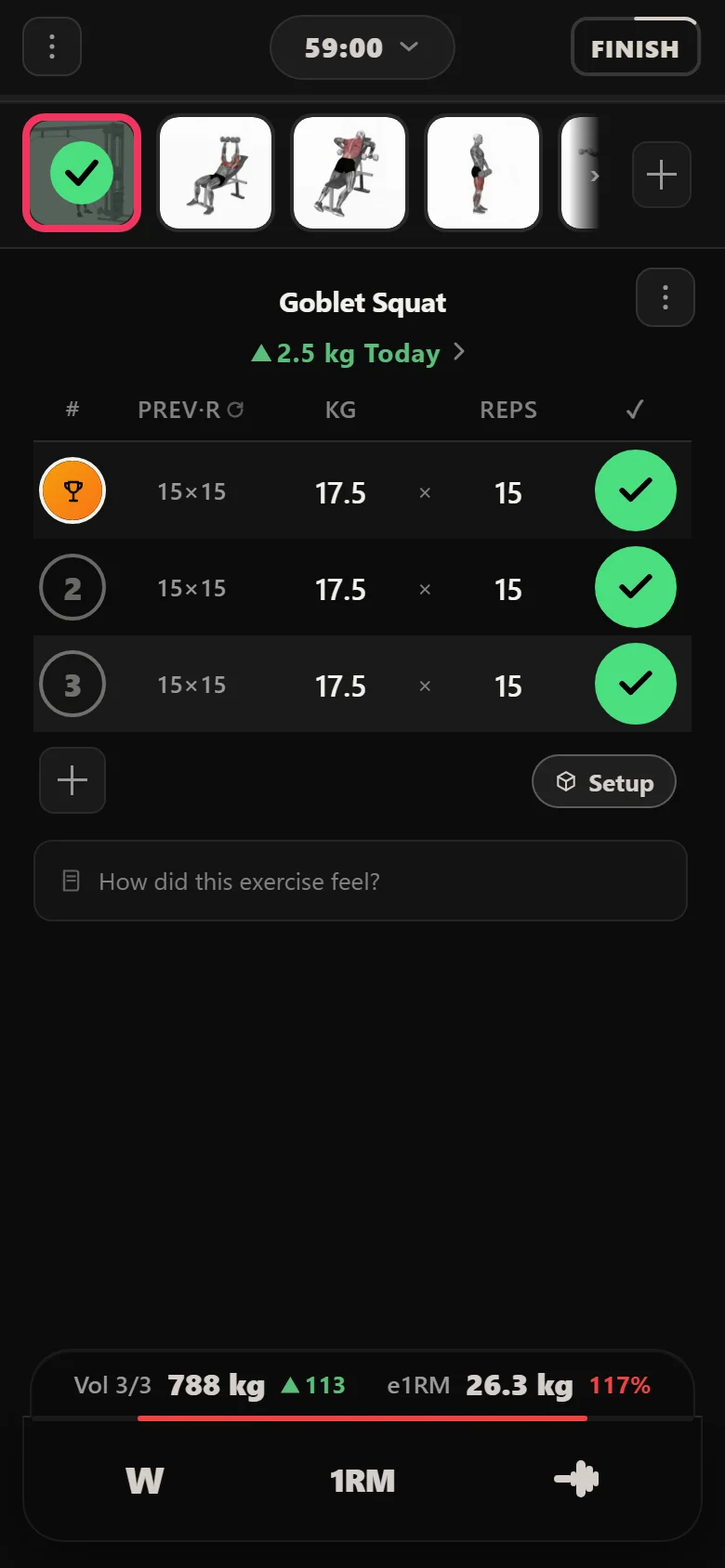
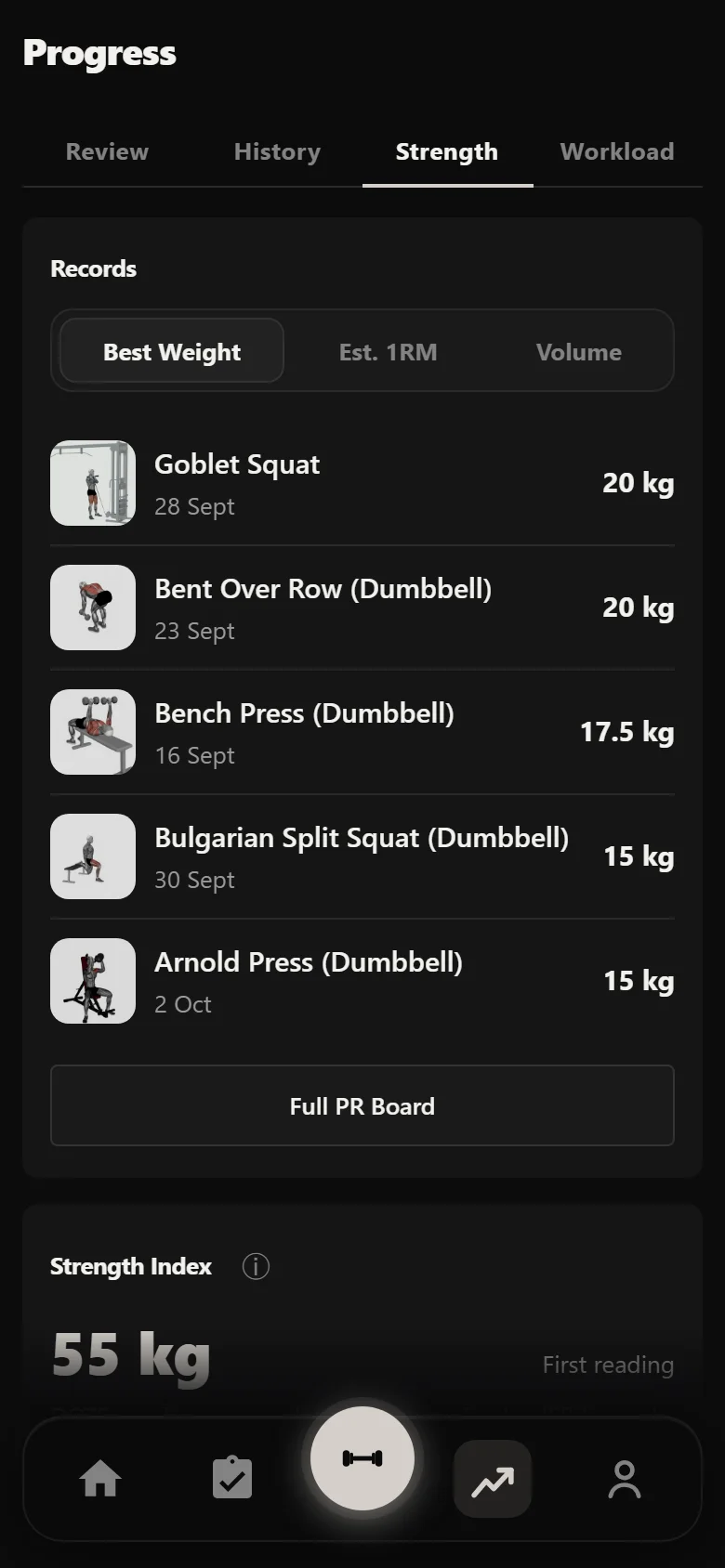
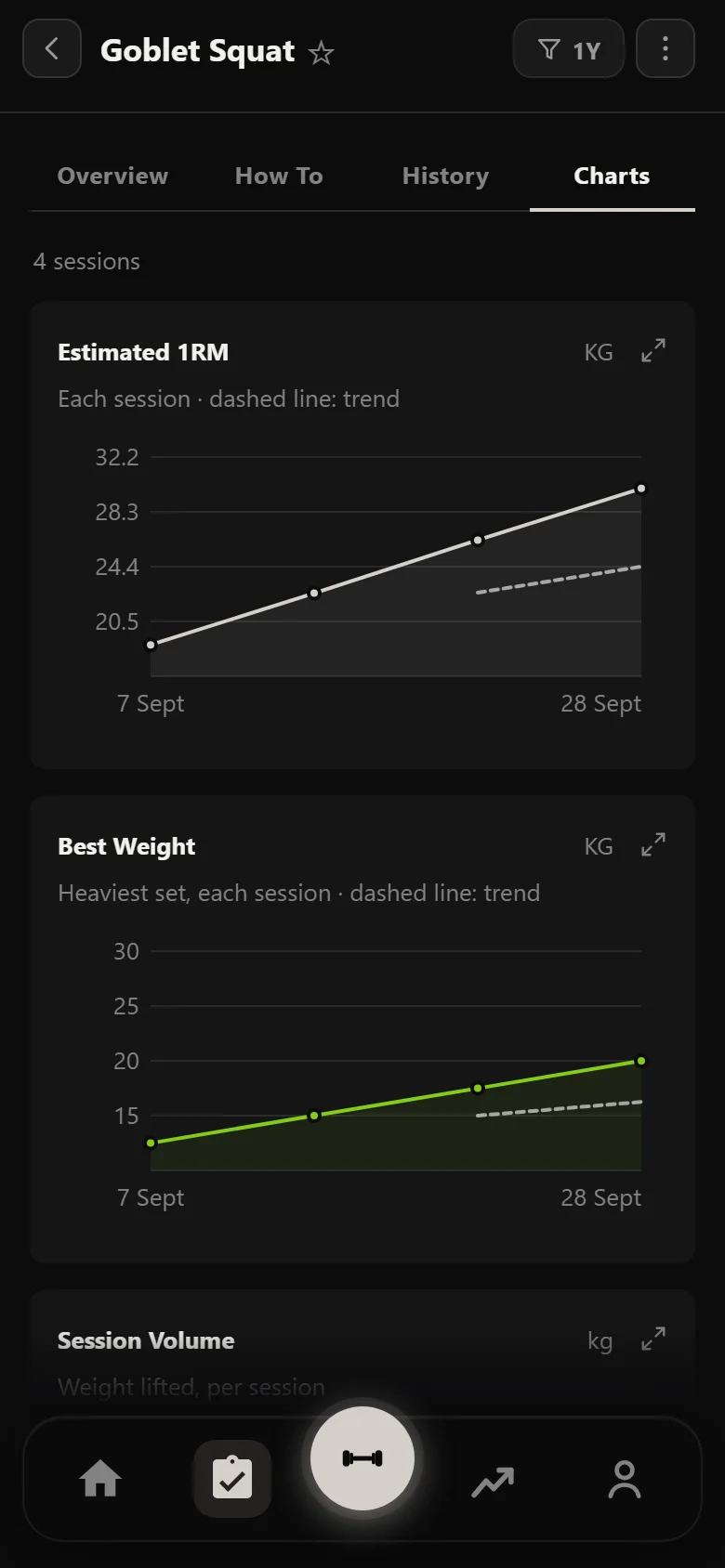
The goblet squat sits on day A only, so across four weeks it comes up on sessions 1, 4, 7 and 10. Four attempts, and on this run it cleared all four. Fifteen reps on all three sets at 12.5 kg, so the app put 15 kg up next time, then 17.5 kg, then 20 kg. The block ends with 22.5 kg queued for the session after.
The estimate tracks the weight and finishes the block at 30 kg. That is not a large number by barbell standards and it is not meant to be. A goblet squat is limited by what you can hold at your chest, not by what your legs can do, which is exactly why the program pairs it with split squats and step-ups on the other two days rather than leaning on it alone.
The doubling is worth stating plainly: the working weight went from 12.5 kg to 20 kg in four sessions. On a dumbbell that has to move in 2.5 kg steps, four steps is the most anyone could have taken.
Goblet Squat: dumbbell weight, session by session
- 12.5S1 Session 1 — session 1
- 15S4 Session 4
- 17.5S7 Session 7
- 20S10 Session 10 — session 10
Why the light lifts are the hardest to move
Now the part that only shows up when you read every lift start to finish. A dumbbell steps in 2.5 kg no matter what it is loading, and on this program that single number means completely different things depending on where a lift sits.
On the 27.5 kg Romanian deadlift, 2.5 kg is a small ask. On a 5 kg lateral raise it is a fifty per cent jump, and you have to earn it by getting twenty controlled reps on every set first. So the light work stayed light: the lateral raise, the chest fly, the chest-supported reverse fly and the hammer curl all finished the block at 5 kg, exactly where they started. Both Romanian deadlift variants held at 27.5 kg. The seated overhead press, the skullcrusher, the step-up and the kickback all held at 12.5 kg.
The lifts in the middle moved. The flat dumbbell bench went 15 kg to 20 kg, two full steps. The bent-over row went 17.5 kg to 20 kg. The Bulgarian split squat and the Arnold press both went 12.5 kg to 15 kg. The dumbbell curl went 5 kg to 7.5 kg, which on a curl is the same fifty per cent jump the lateral raise never managed, and it took the whole block to get there.
None of that is the app being conservative. It is what a fixed increment does to a percentage-based rule, and it is the honest reason a home dumbbell program feels slower on the small movements than on the big ones. Micro-plates fix it on a barbell. There is no equivalent on a fixed pair of bells, so the rule holds instead.
The one lift that went backwards
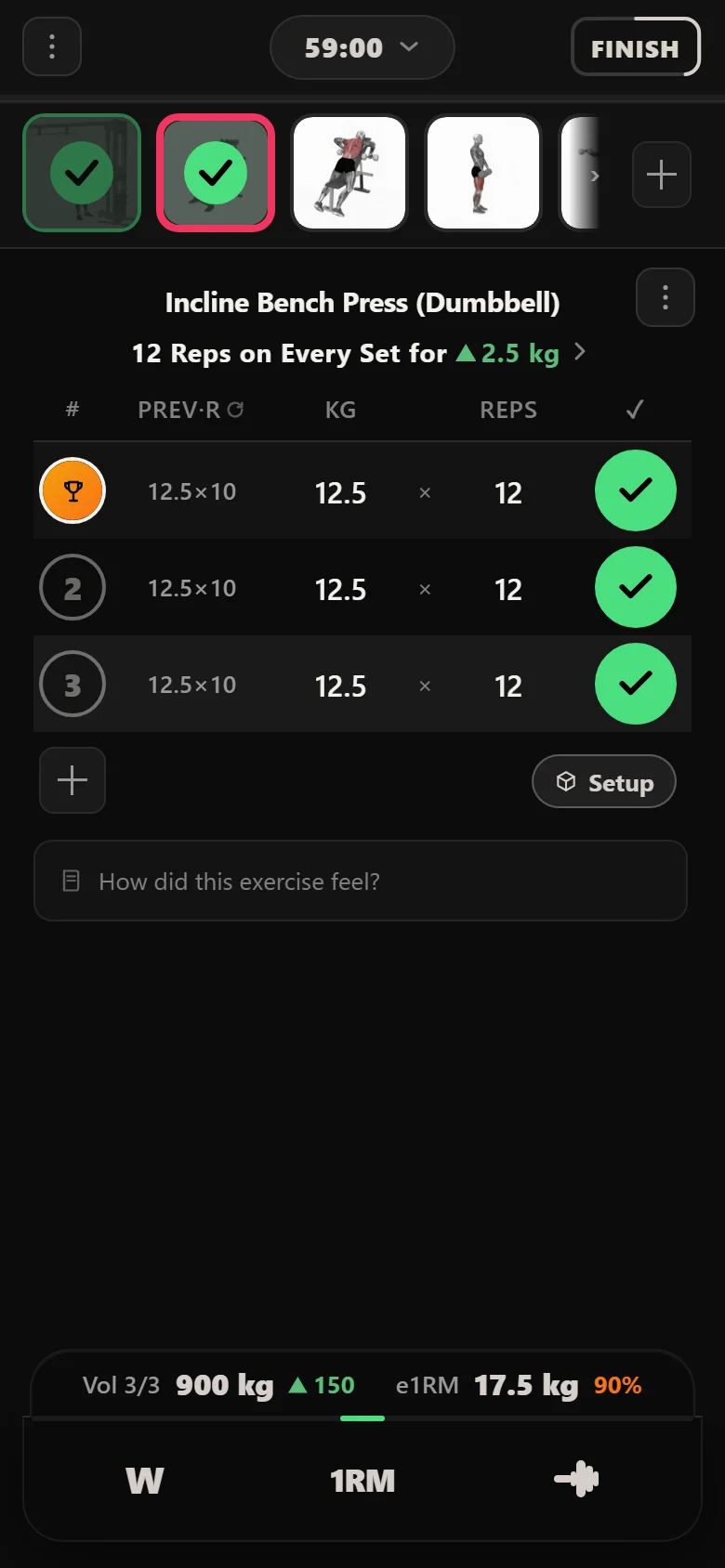
The incline dumbbell press is the lift this program leans on most. It is the only movement scheduled twice a week, on day A and again on day C, so across the block it got eight attempts where everything else got four. It is also the only lift that finished the block lighter than it started, at 12.5 kg against an opening 15 kg.
That is the rule working, not failing. Ten to twelve reps on three sets of incline press twice a week is a real ask, and when the sets came up short twice in a row the app cut the weight by ten per cent and rounded it to the nearest bell. You climb back through it from there with reps you can actually complete.
It is a useful correction to the way progression is usually described. More attempts is not the same as more progress. The lift with the most chances to move is the one that ran out of room first, because it was the one being asked for the most work.
The estimated one-rep max chart for the block shows the same thing from the other side: a climb through the first three weeks and then a flattening, which is what four weeks of real training looks like rather than a straight line drawn afterwards.
The payoff: 12.5 kg to 20 kg, no barbell involved
Two screenshots of the same goblet squat on the same screen, ten sessions apart. It opened the block at 12.5 kg and finished at 20 kg with 22.5 kg queued for next time, and every one of those steps was decided by the engine from the reps that were logged.
The wider point is what the rest of the block looks like around it. Some lifts doubled, most held, one got cut. That is a normal four weeks, and the value of having the app run it is that you do not have to keep track of which is which. It remembers that the bench earned two increases, that the Romanian deadlift is still working on its first, and that the incline press needs to come back down. All of it from a pair of dumbbells and a bench.
Four appearances apart. Fifteen reps on all three sets every time, so the bells went up 2.5 kg on each of them.
Common questions
What equipment does Dumbbell + Bench Full Body need?
One adjustable pair of dumbbells and a bench. No barbell and no rack. The bench is what makes it a step up from a dumbbell-only routine, because it adds incline pressing, flyes, chest-supported rows, Bulgarian split squats and step-ups to what you can train.
Does this program use linear progression?
No. Every loaded lift runs double progression, which adds weight on a condition rather than on a schedule. You hold the same bells until every prescribed set has reached the top of its rep range, and only then does the weight step up 2.5 kg. Holding for two or three weeks on a given lift is the normal outcome, not a stall.
Why do my lightest exercises never go up?
Because a dumbbell's smallest step is fixed. Adding 2.5 kg to a 27.5 kg Romanian deadlift is a small ask; adding it to a 5 kg lateral raise is a fifty per cent jump, and you have to earn it by hitting twenty good reps on every set first. On the block in this walkthrough the raises, flyes and hammer curls all finished at 5 kg while the mid-weight presses and rows moved. That is the increment, not the app.
What happens if a lift keeps falling short of the range?
Durata cuts it. Two consecutive sessions short of the top of the range and the weight drops by ten per cent, rounded to the nearest bell, and you work back up through it. On this run the incline press went from 15 kg to 12.5 kg that way. It is the lift trained twice a week, so it accumulated the most fatigue and hit the cut first.
What weights should I start with?
Whatever you can genuinely do for the prescribed sets and reps with controlled form, not your best single effort. There is no training max and no percentage, so the only input is an honest working weight per lift. Starting a little light costs almost nothing, because the rule moves the weight as soon as you own the range.
Is Durata free?
Yes. Durata is free to use, with the full program catalogue, automatic progression maths, rest timers and PR tracking. Everything in this walkthrough is in the app.
Put it into practice
Durata is free to use — 50 proven programs, automatic progression, rest timers and PR tracking, all on your phone.