


The 60-Day Cut in Durata: the cardio is what climbs
A cut is not a strength program, and pretending otherwise is how fat-loss plans lie to you. You are eating in a deficit, so you are not going to add much to the bar, and you do not need to. The job of the lifting is to hold onto the muscle you already have while the deficit strips fat. So this walkthrough follows the part that actually changes over eight weeks: the cardio.
The 60-Day Cut trains six days a week: three full-body sessions built entirely on dumbbells and machines, and three cardio sessions. The lifts run double progression and tick up gently, the way they should in a deficit. The cardio ramps hard, and it ramps on a schedule the app builds for you. Every screen below is the live app. The weights are engine output from a drive of all eight weeks; the cardio ramp is the program's own prescription for all eight. The fat loss itself comes from the kitchen. The app's job is to make the training progress on its own so you only have to turn up.
Starting the cut
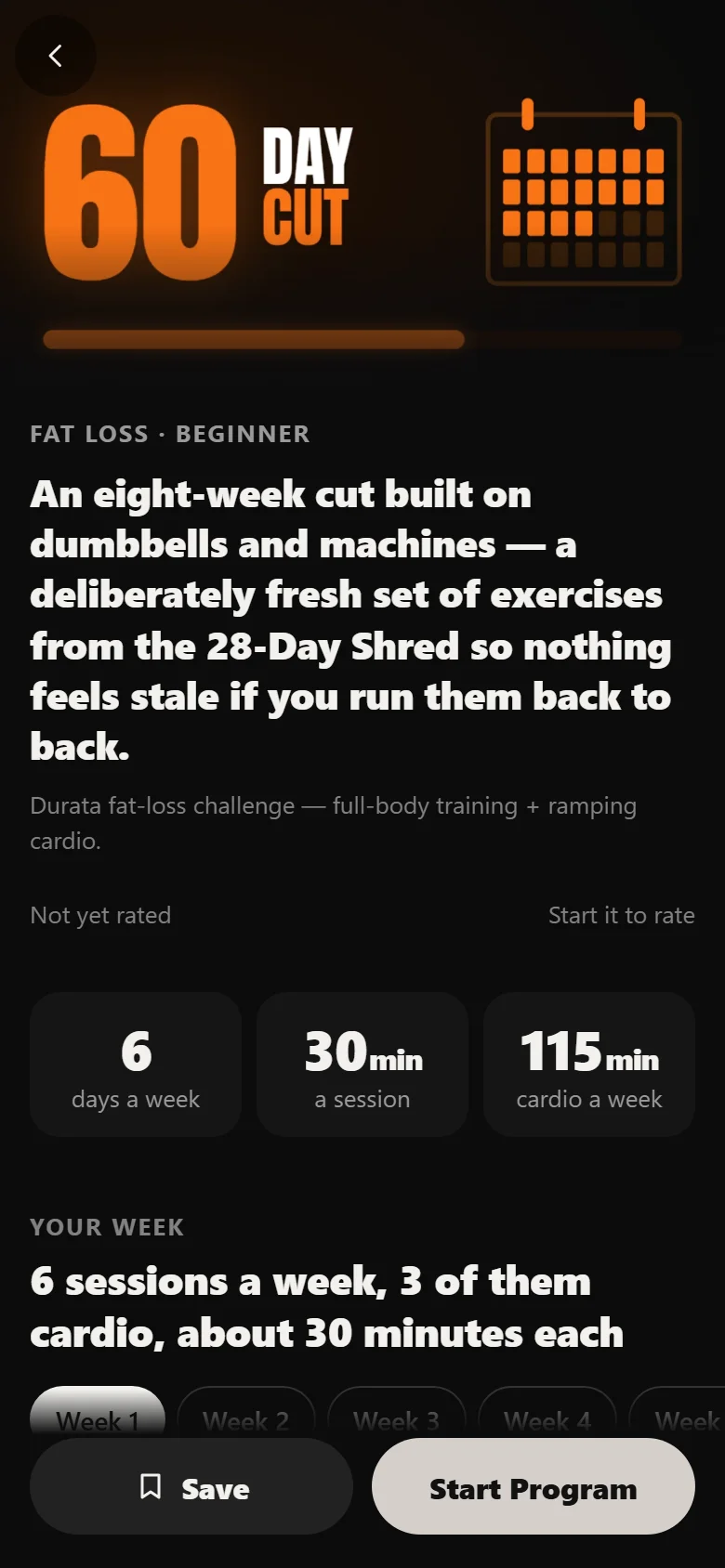
In Discover, the 60-Day Cut sits on the Fat Loss shelf, marked Beginner, at six days a week. Search finds it by name, or Filter narrows the shelves by level and days a week. Tap the cover for a quick look, then View Program for the full page.
It is the eight-week one, and it is built from a different exercise pool than the 28-Day Shred, so the two do not feel stale if you run them back to back.
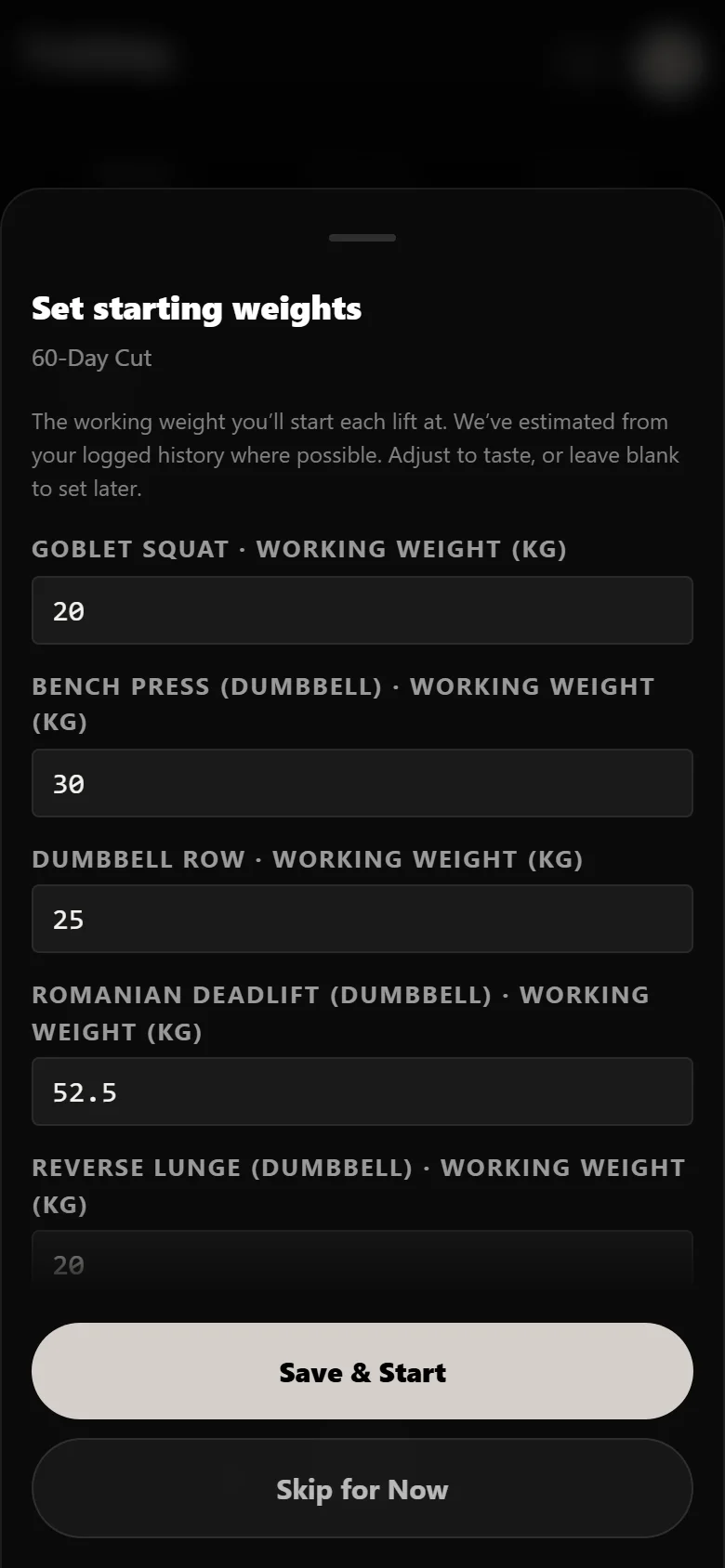
There are no training maxes to work out here. Every lift runs off a working weight, so the app asks what you can currently handle and starts there, 20 kg on the goblet squat on this run. The three cardio sessions are draggable in the planner, so the intervals, the cycle and the walk can sit wherever they fit around the rest of your week.
Dumbbells and machines, three full-body days
There is no barbell in this program, which is deliberate. The three lifting days run on dumbbells, cables and machines, so it needs less equipment than a barbell block and asks less of your recovery while you are eating in a deficit.
Day one is the goblet squat, dumbbell bench, dumbbell row and a dumbbell Romanian deadlift. Day two is the reverse lunge, dumbbell overhead press, lat pulldown and lying leg curl. Day three is the Bulgarian split squat, incline dumbbell bench, face pulls and lateral raises. The squat patterns and the pulls sit in a 12–15 range, the presses and rows in 10–12, and the lateral raise higher still at 15–20, because that is where each does its work.
Between them sit three cardio slots: a steady cycle, a rowing-interval session and an incline walk. The program page lays all of it out before you commit to anything, and the start sheet asks for one working weight per lift. Nothing else.
The cardio is the part that climbs
Here is what actually changes over eight weeks. The three cardio sessions ramp on a schedule, and the app builds the whole ramp for you. You never edit an interval or set a minute count.
The row intervals start at 30 seconds of work against 30 seconds of rest, for 15 rounds. Every week the work interval gains five seconds and the rest loses five: 35 on and 25 off in week two, 40 and 20 in week three, 45 and 15 in week four. The round count climbs alongside, 15 to 18 to 21 to 24. By week four the effort is half again as long as it was, the rest is half what it was, and you are doing nine more rounds of it.
Then it stops. Week four is the ceiling for that session (45 seconds is as long as the work interval gets, 15 seconds as short as the rest gets, 24 as many rounds as the app will prescribe) and weeks five through eight repeat it. If you want the back half of the block to keep getting harder on the rower, you push the pace rather than the clock.
The two steady sessions carry the ramp the rest of the way, and they climb the simple way. The steady cycle opens at 25 minutes and adds five a week to 60. The incline walk runs the same ramp from 30 to 65. Between the three, the weekly conditioning load rises every single week while the lifting holds steady, which is the design of a cut. The training gets harder where it should, and the app is the thing scheduling it.
Cardio that hardens week by week: prescribed for you
Row Intervals work / rest, per week
- W1 30s / 30s 15 rounds Week 1: 30 second work intervals, 30 second rest, 15 rounds
- W2 35s / 25s 18 rounds Week 2: 35 second work intervals, 25 second rest, 18 rounds — harder than the week before
- W3 40s / 20s 21 rounds Week 3: 40 second work intervals, 20 second rest, 21 rounds — harder than the week before
- W4 45s / 15s 24 rounds Week 4: 45 second work intervals, 15 second rest, 24 rounds — harder than the week before
- W5 45s / 15s 24 rounds Week 5: 45 second work intervals, 15 second rest, 24 rounds
- W6 45s / 15s 24 rounds Week 6: 45 second work intervals, 15 second rest, 24 rounds
- W7 45s / 15s 24 rounds Week 7: 45 second work intervals, 15 second rest, 24 rounds
- W8 45s / 15s 24 rounds Week 8: 45 second work intervals, 15 second rest, 24 rounds
- Steady Cycle25 → 30 → 35 → 40 → 45 → 50 → 55 → 60 min
- Incline Walk30 → 35 → 40 → 45 → 50 → 55 → 60 → 65 min
The goblet squat holds its weight while the reps climb
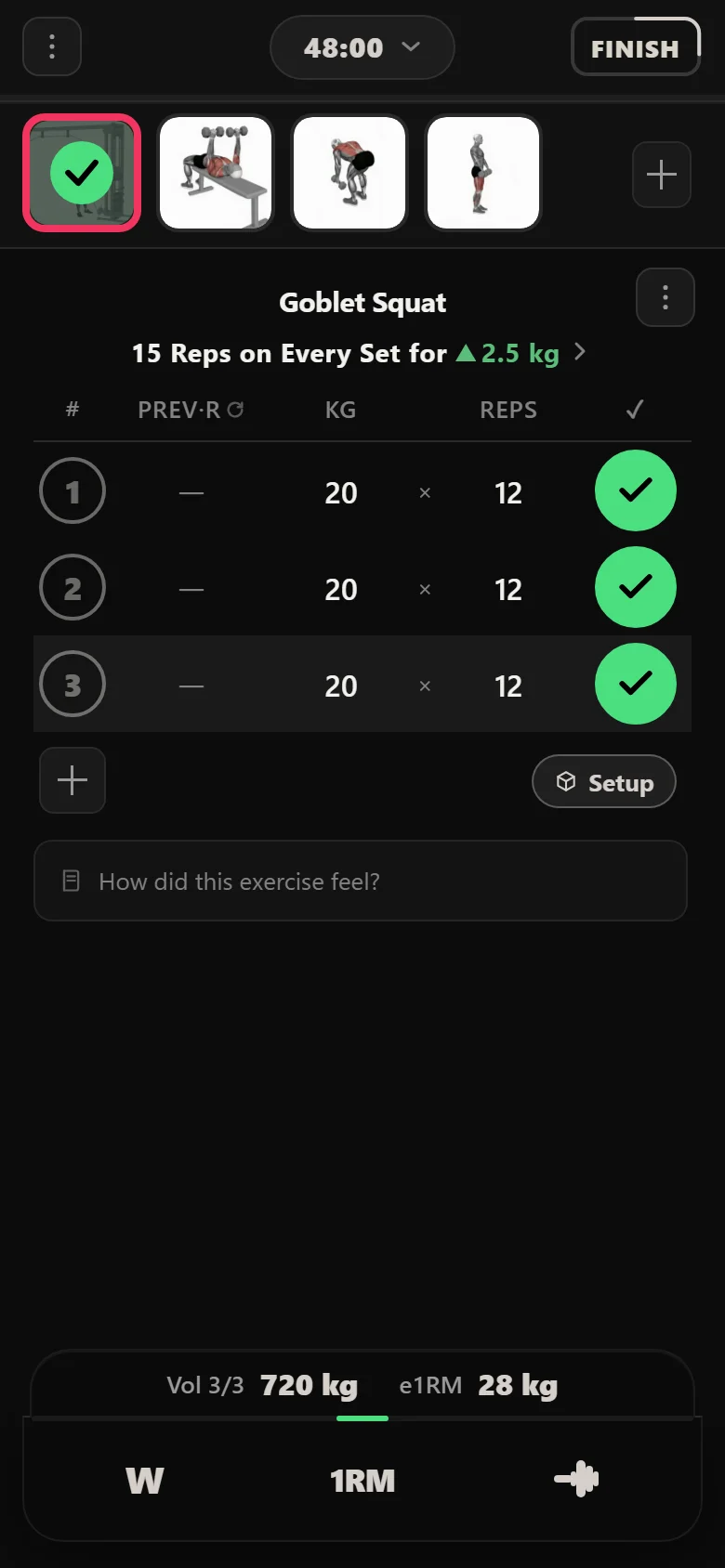
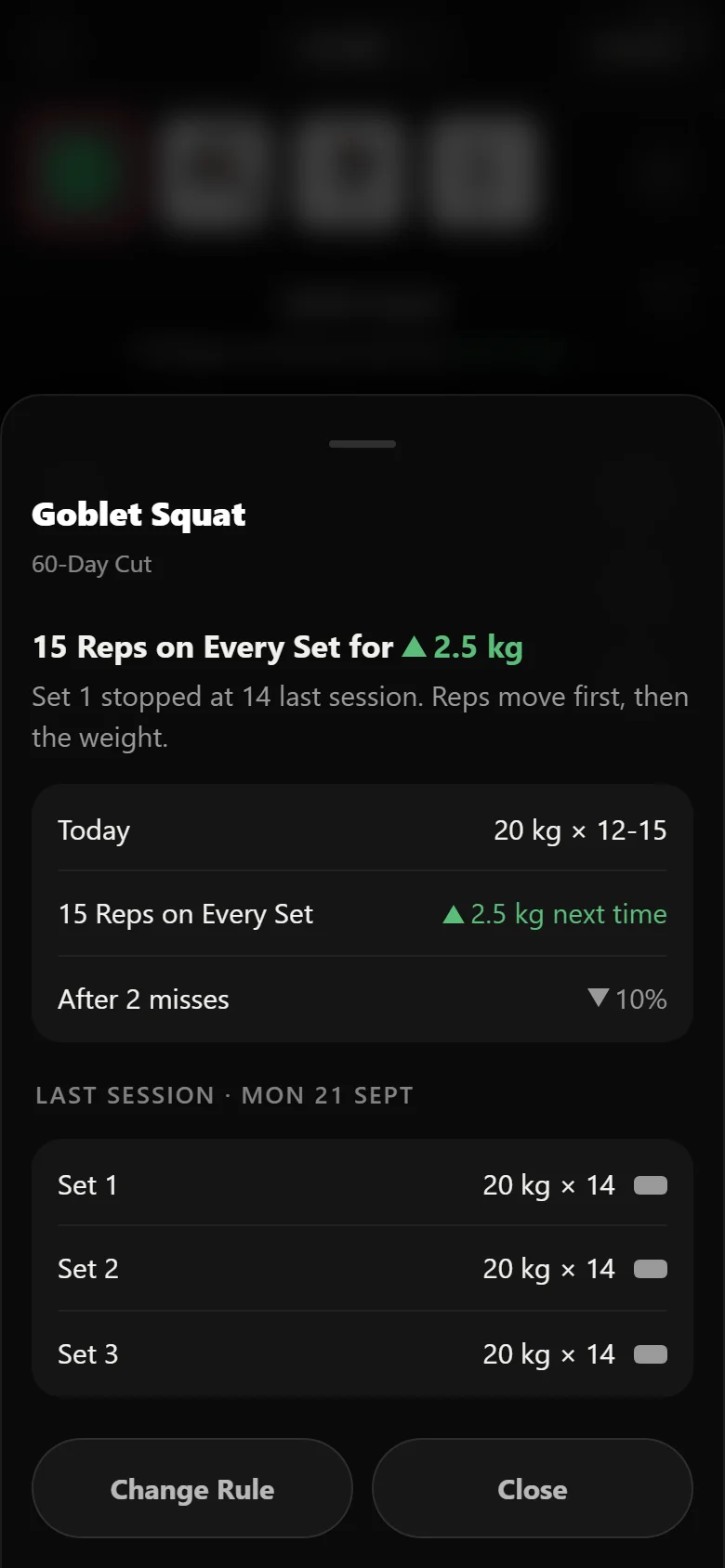
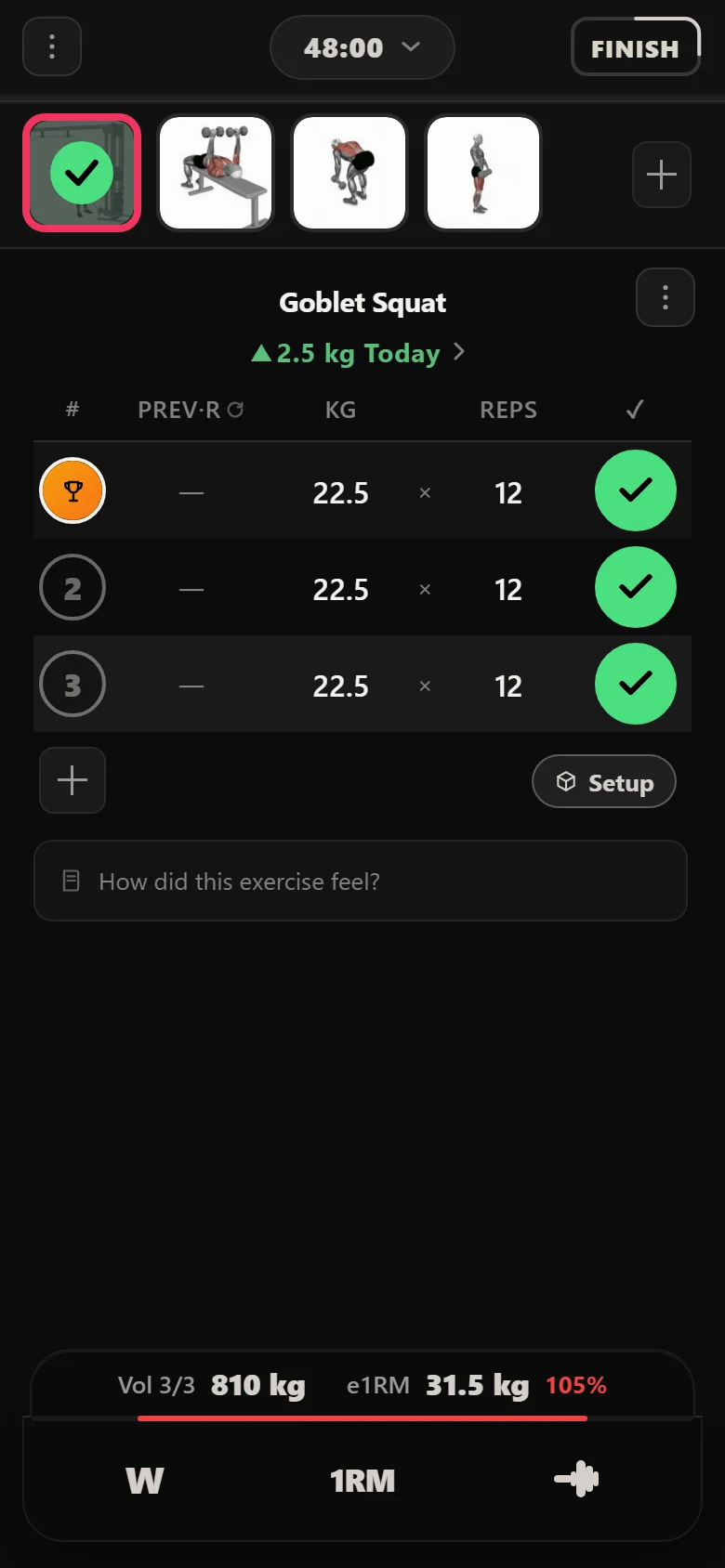
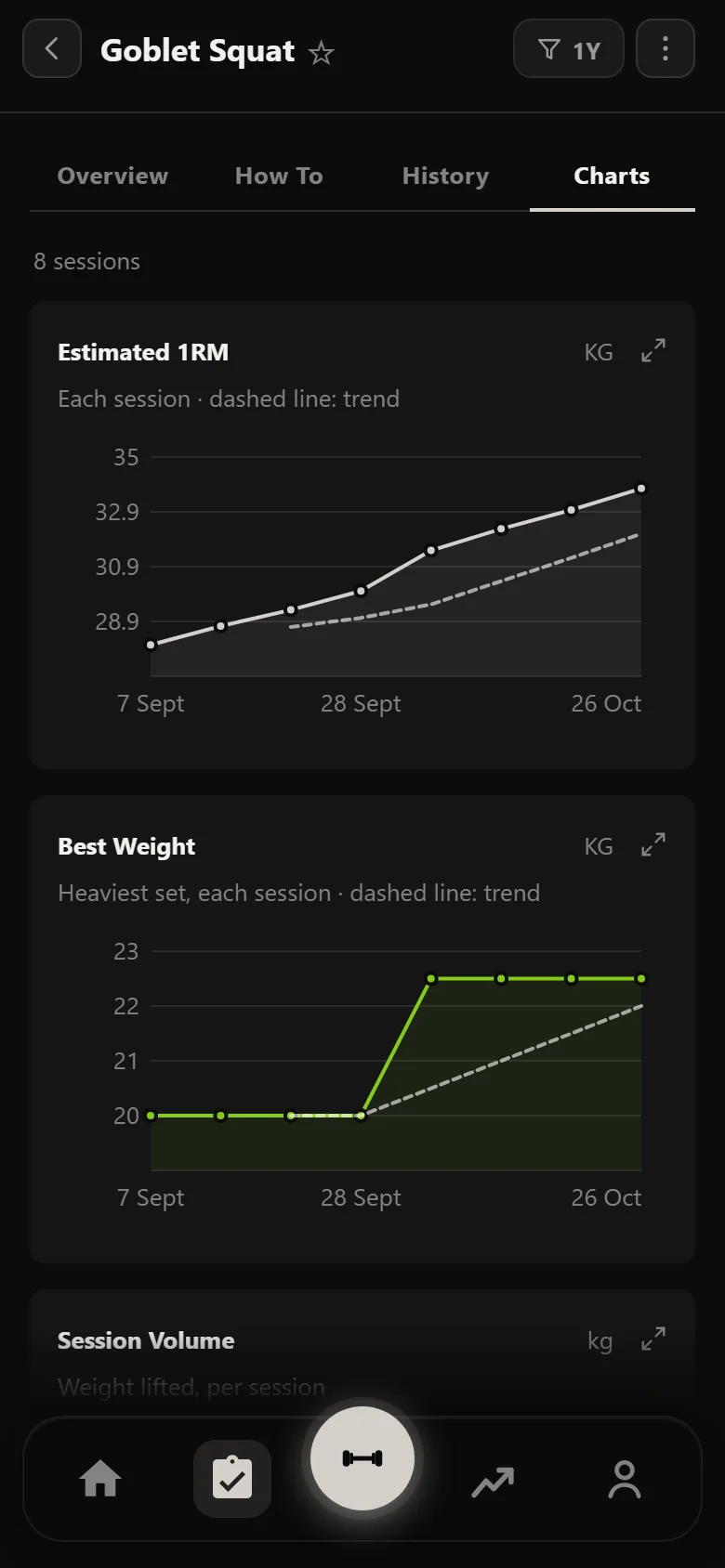
The goblet squat runs double progression on three sets of 12–15. The first session is 20 kg for twelve, the bottom of the range, and the chip on the exercise says what earns the next step: 15 reps on every set for 2.5 kg more.
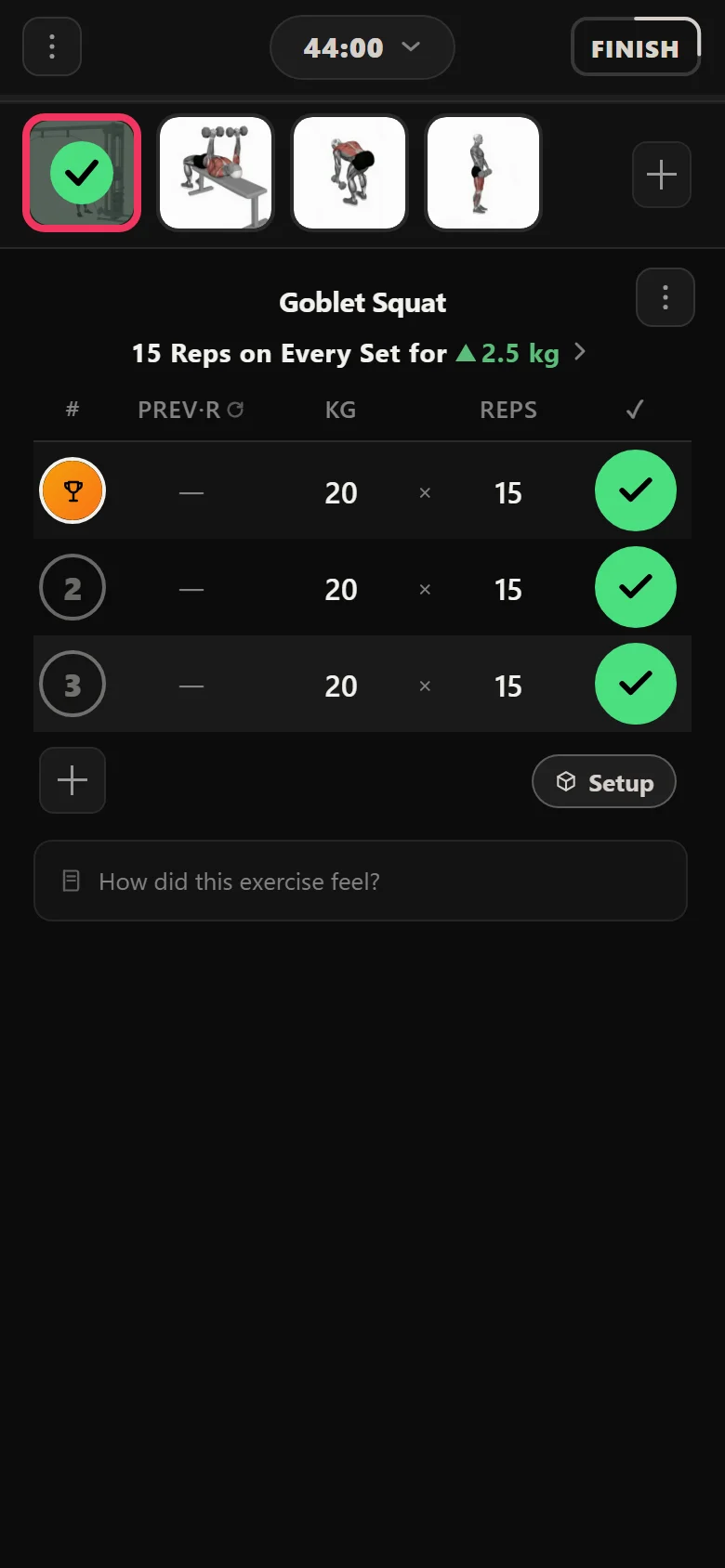
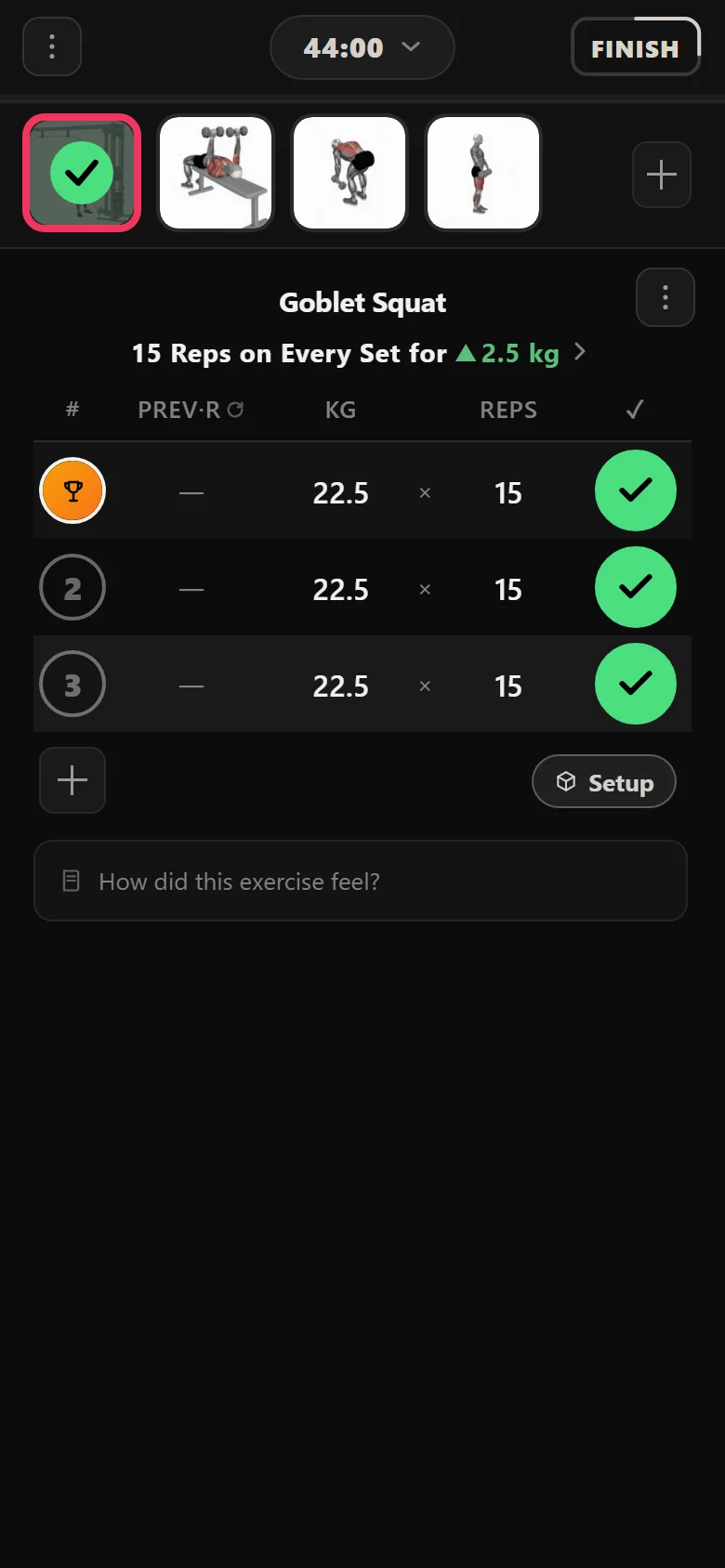
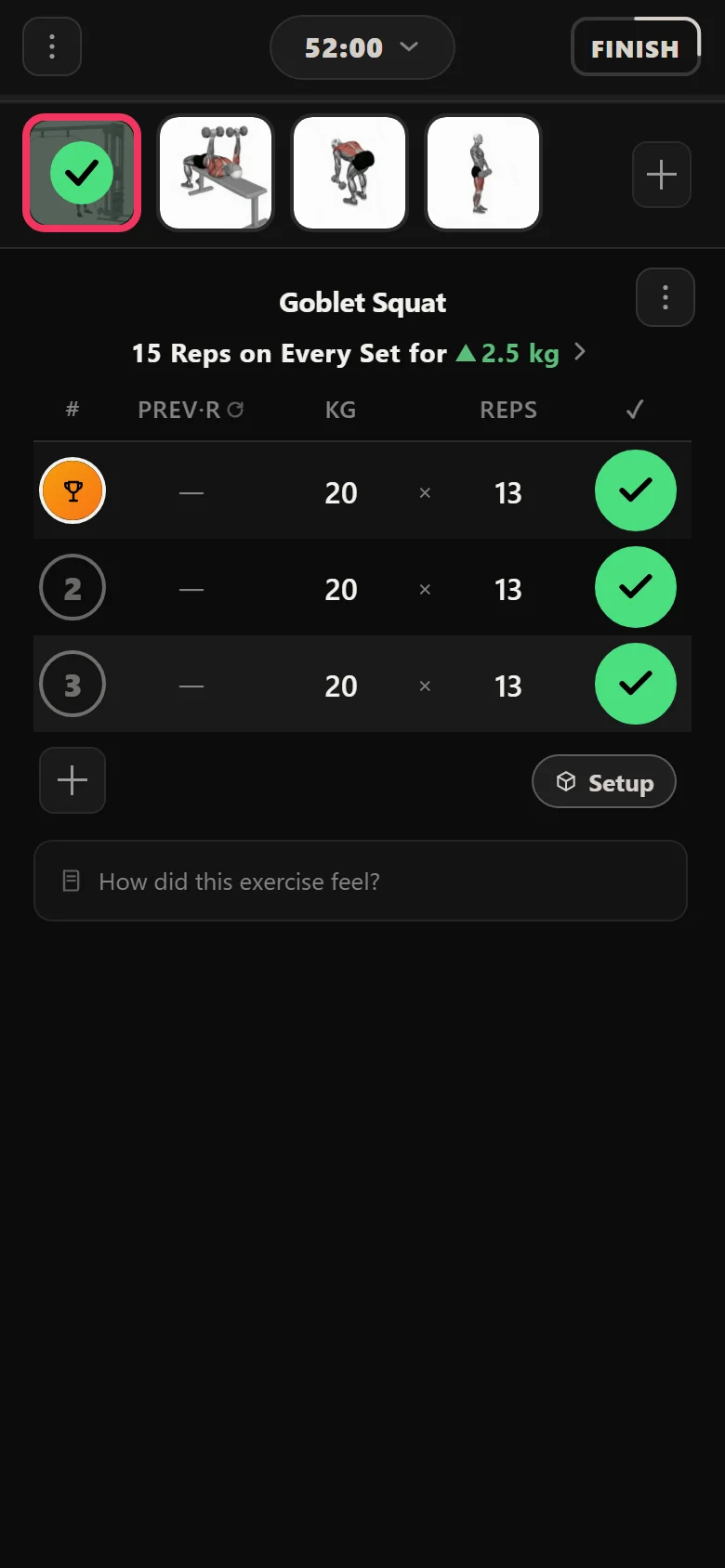
This run adds one rep a week. Twelve, thirteen, fourteen, and in week four all three sets reach fifteen. Tap the chip on the way there and it shows its working: last session stopped at 14 on every set, so the weight waits.
Week five opens at 22.5 kg and the reps are back at twelve. The same climb takes it to fifteen again by week eight, and the app has 25 kg lined up for whoever runs on. Nobody typed a weight in after day one.
One increment in eight weeks is the point of a cut, not a shortfall. The lifting is there to hold muscle while the deficit does its work; the cardio is what climbs.
Goblet Squat: weight per weekly appearance
- 20S1 Session 1 — 12 reps
- 20S4 Session 4 — 15 on every set
- 22.5S5 Session 5 — back to 12
- 22.5S8 Session 8 — 15 on every set
Reps first, then weight, on everything
Every lift in the program runs the same way, and the rule chip on each one spells it out: hit the top of the range on all your sets and the weight goes up. Climb a rep at a time, top the range out, and the next appearance moves the weight and resets you to the bottom.
This is the right rule for a cut. Adding load every session assumes you are recovering like someone eating in a surplus, and you are not. Adding a rep is something you can do on a bad week, and the weight follows when you have actually earned it. Some lifts moved over the eight weeks, the dumbbell bench and row by 5 kg each, and some held, the Romanian deadlift at 52.5 kg and the overhead press at 20 kg. Both are what a cut looks like.
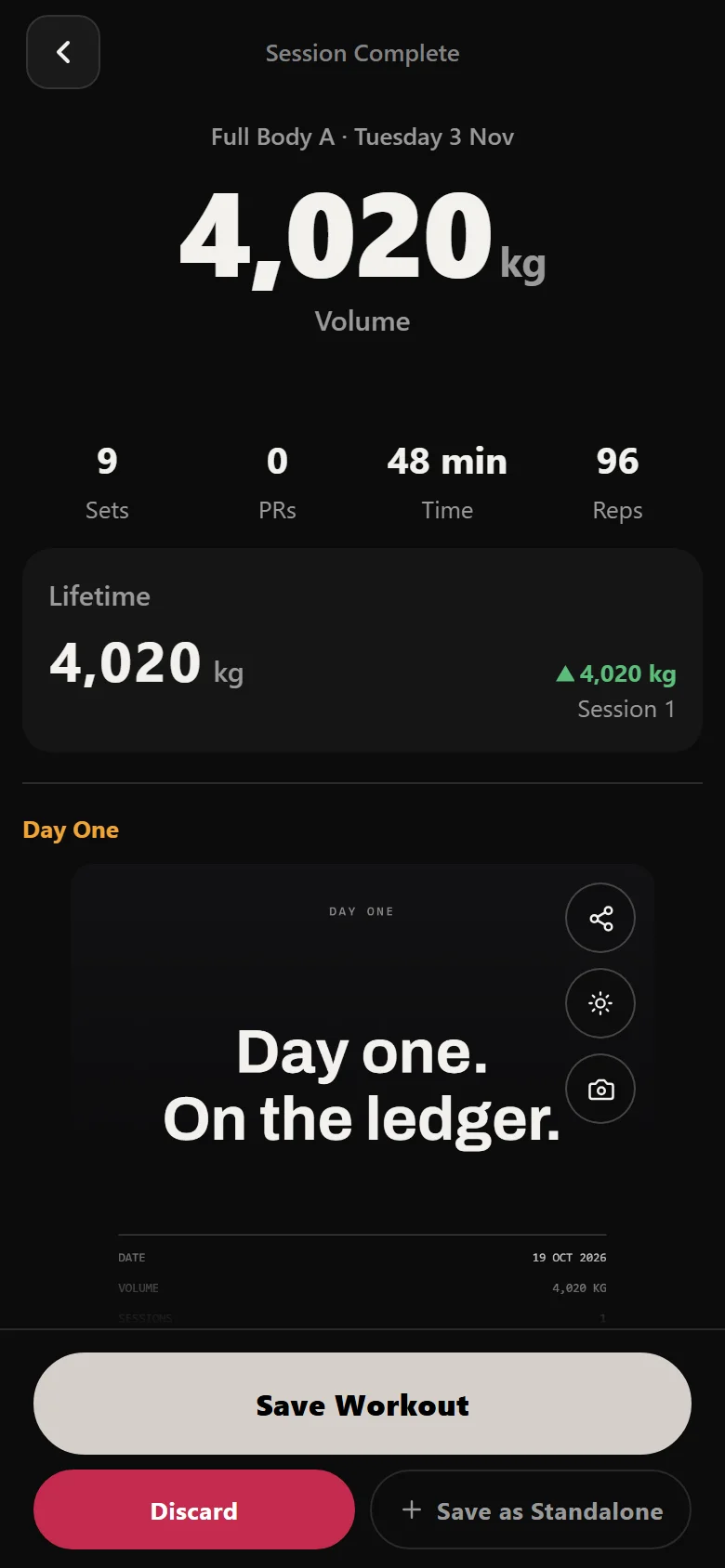
Finish the session and it tallies everything before it saves: every set, the total reps and the volume moved, with no arithmetic on your part.
What the run looks like from above
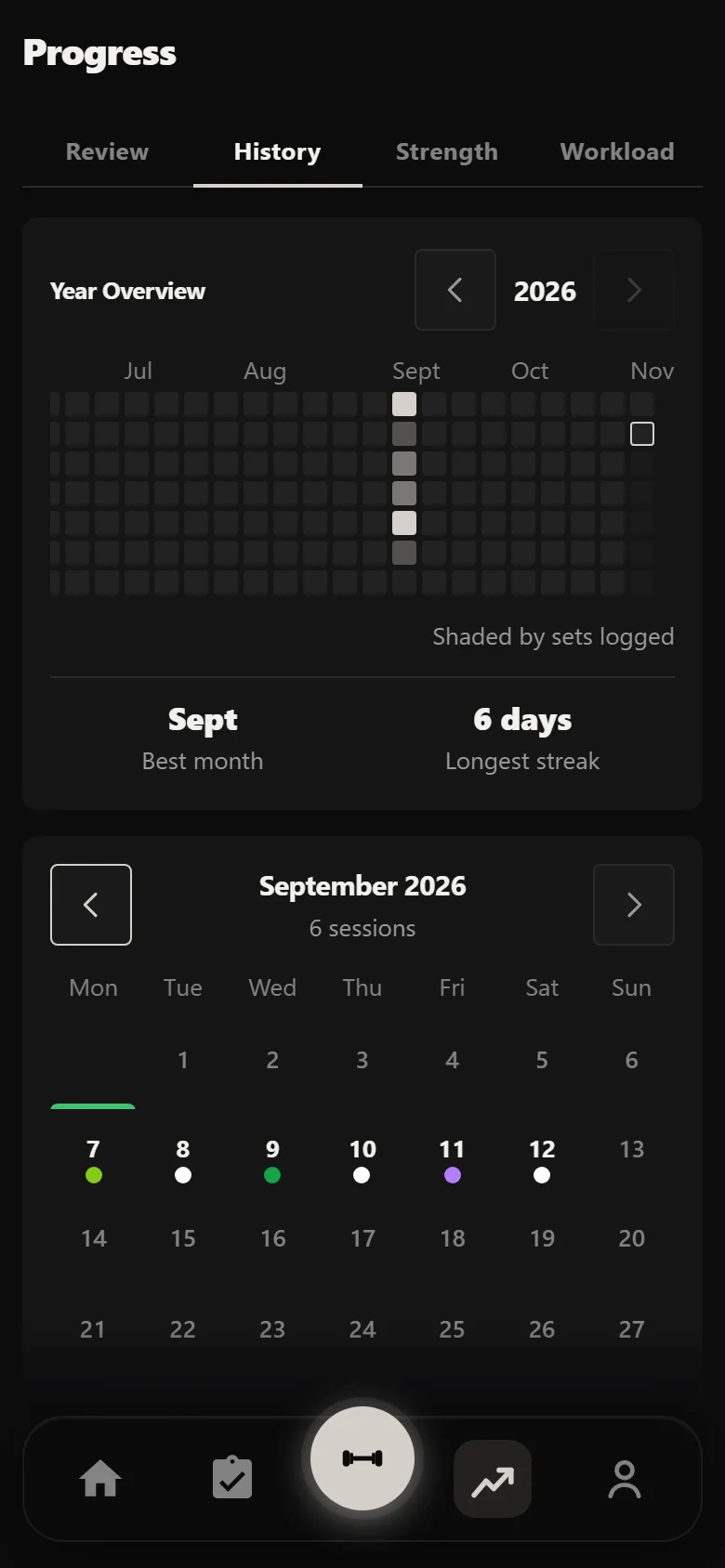
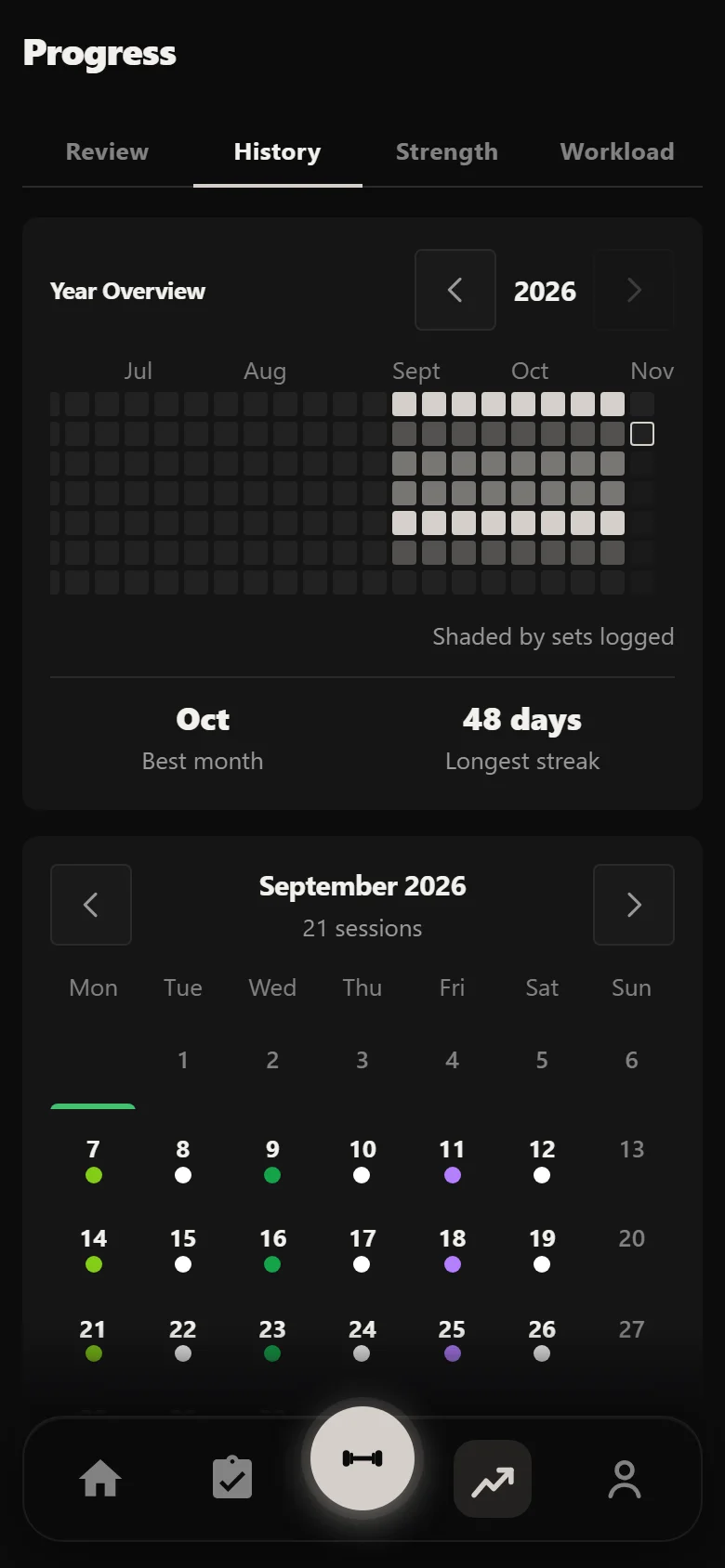
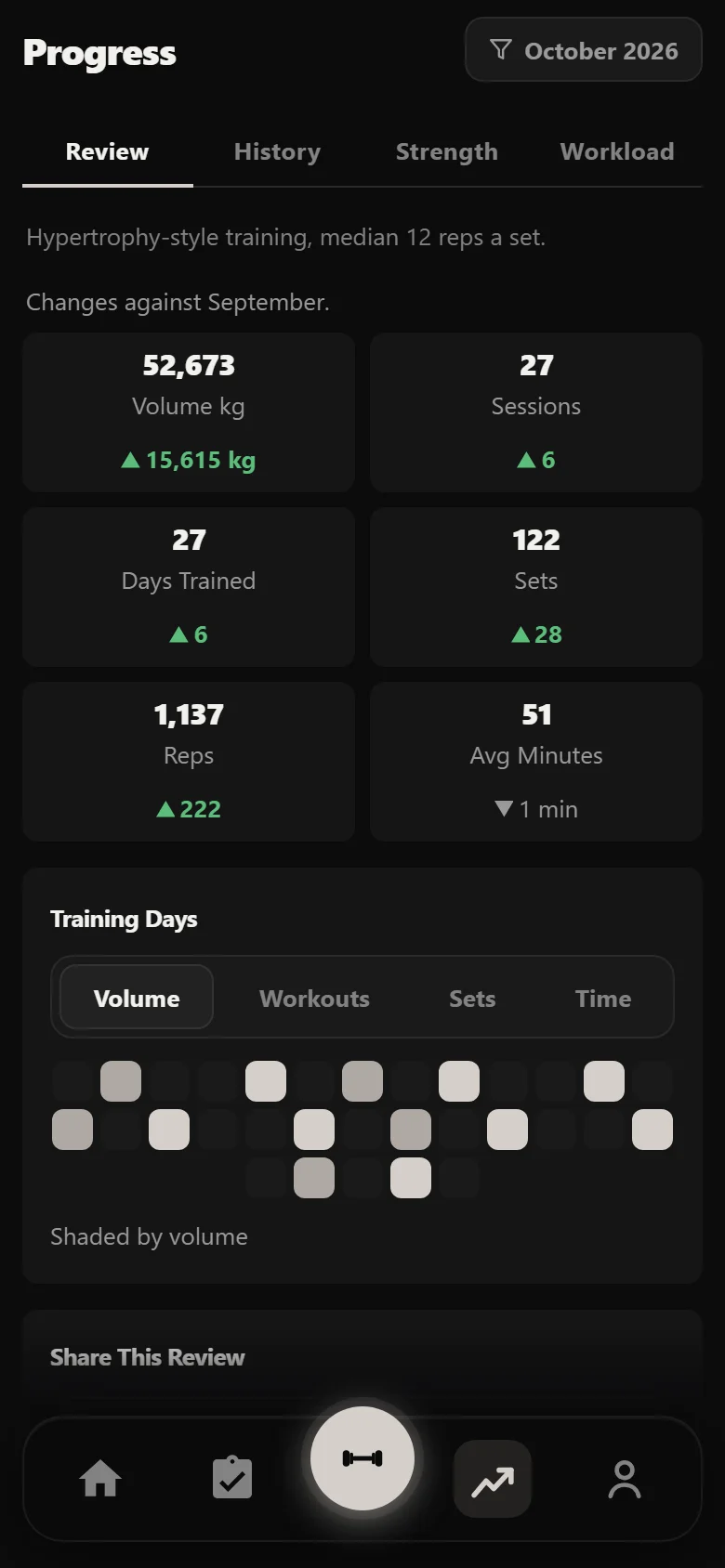
The first session lands on the start date and the calendar starts filling: three lifting days and three cardio days every week.
The goblet squat's estimated 1RM chart rises with every rep added and dips back when the weight moves and the reps reset; the best-weight chart under it is a single step from 20 kg to 22.5 kg.
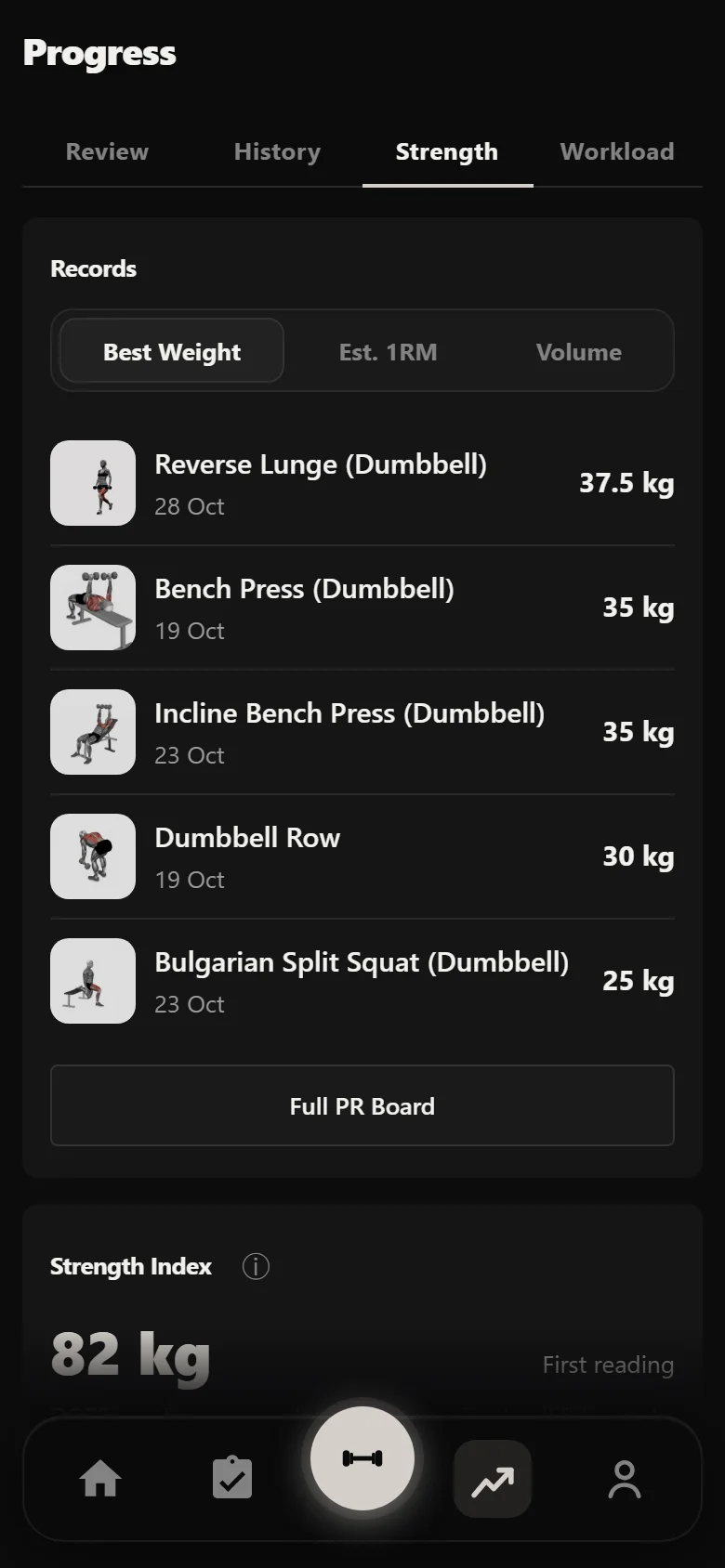
The Strength tab lists the records the run set by best weight, the reverse lunge at 37.5 kg, the flat and incline dumbbell bench at 35 kg, the row at 30 kg, and the Review tab reads a month at a time: October came to 52,673 kg across 27 sessions, up on September.
The payoff: what the cardio ramp bought you
The goblet squat moved one step, on purpose. That is double progression holding the line through a deficit. The number that tells the story is the conditioning: the row intervals went from 15 rounds of 30 on and 30 off to 24 rounds of 45 on and 15 off, and the two steady sessions both stretched to a full hour. That is more than twice the work per round at a third of the rest, plus over an hour a week of extra steady work on top.
Nothing here was typed in. The app built and scheduled the whole ramp, and the fat loss came from the deficit. The conditioning is what the training actually bought you.
The row intervals, week 1 against week 8: same session, same screen, five seconds onto the work and five off the rest every week until week four's ceiling.
- Steady Cycle25 min → 60 min
- Incline Walk30 min → 65 min
Common questions
Should I expect to get stronger on a cut?
Not much, and that is fine. In a deficit the job of the lifting is to hold onto muscle, not to add plates. On this run the goblet squat went from 20 kg to 22.5 kg over eight weeks, one rep at a time, and that is about right. The real progress in a cut is the conditioning, and the fat loss comes from the deficit in the kitchen.
Why are there no barbells in it?
The 60-Day Cut is built on dumbbells, cables and machines on purpose. It needs less equipment than a barbell block, it is easier to recover from while you are eating in a deficit, and it uses a deliberately different exercise pool from the 28-Day Shred so the two do not feel stale if you run them back to back.
How does the cardio get harder?
The program bakes the ramp in and the app prescribes it. The row intervals start at 30 seconds work against 30 seconds rest for 15 rounds, and each week adds five seconds to the work and takes five off the rest, reaching 45 and 15 for 24 rounds in week four. The steady cycle and the incline walk each add five minutes a week, from 25 and 30 minutes up to 60 and 65. You set none of it; it arrives ready each week.
Why do the intervals stop changing after week four?
Because they have reached the top of their scheme. The work interval caps at 45 seconds, the rest bottoms out at 15, and the round count caps at 24, so weeks five to eight repeat the week-four session. The weekly load still rises, because the two steady sessions keep adding five minutes each. If you want the rower itself to get harder in the back half, add pace rather than time.
Can I move the cardio to different days?
Yes. The three cardio sessions are draggable in the planner, so the intervals, the cycle and the walk can go wherever they fit around the lifting days and the rest of your week. The ramp travels with them.
Is Durata free?
Yes. Durata is free to use, with the full program catalogue, automatic progression maths, rest timers, cardio interval timing and PR tracking. Everything in this walkthrough is in the app.
Put it into practice
Durata is free to use — 50 proven programs, automatic progression, rest timers and PR tracking, all on your phone.