


German Volume Training in Durata: ten sets of ten, and the rule that stops you adding weight
German Volume Training is the most demanding program in the catalogue to log and the least demanding to think about. Two lifts a session get ten sets of ten reps at a single weight, supersetted with their antagonist, ninety seconds of rest, and that weight does not change until you complete all one hundred reps. Then it goes up 2.5 kg and you start failing again.
That rule turns the usual expectation inside out. On most programs a lift that has not moved in three weeks is a problem. Here it is the design working: you were meant to pick a weight you could not finish, and you are meant to stay on it until you can. This run drove four weeks of it, twelve sessions, and the twelve lifts involved ended up in three quite different places — which is the clearest picture of the rule you will get.
Finding the program
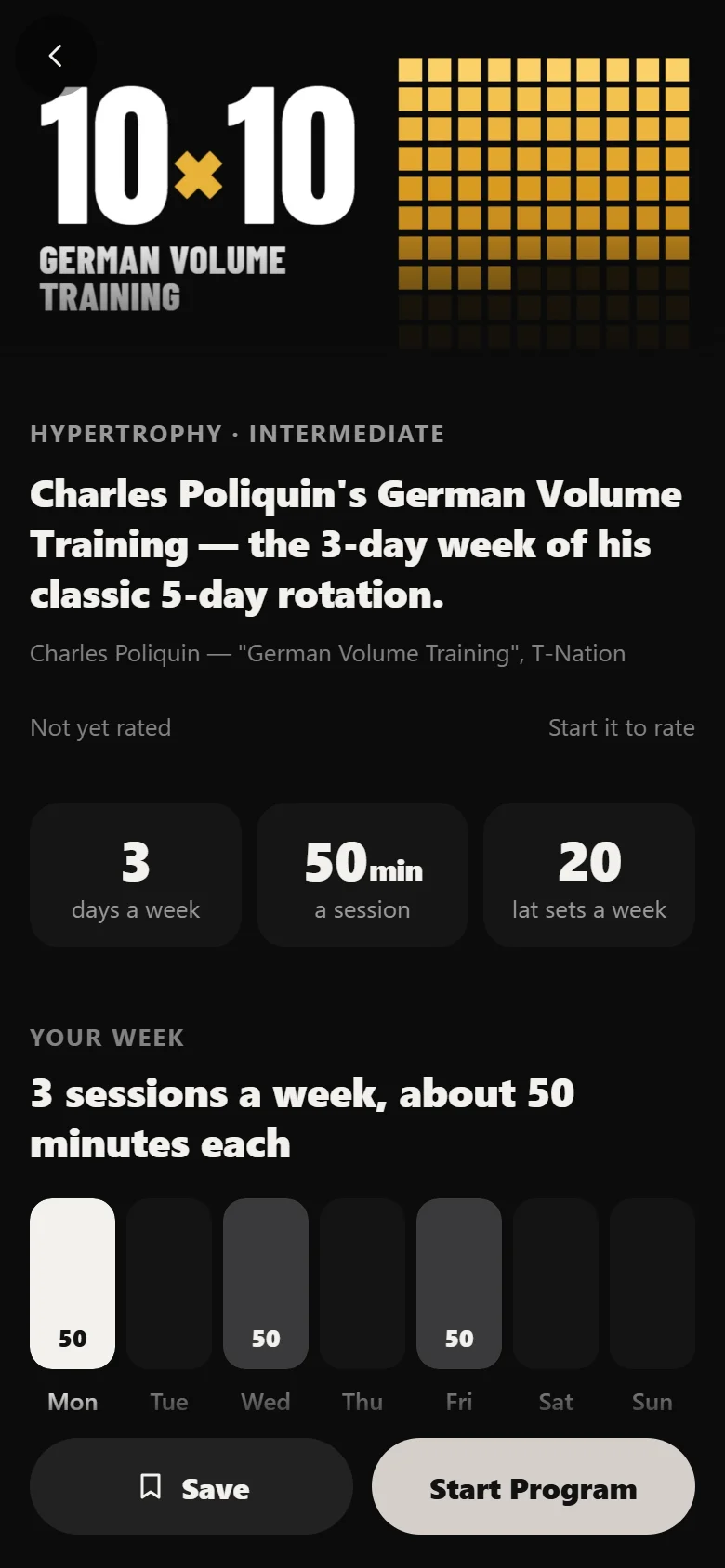
In Discover, German Volume Training (GVT) sits on the Hypertrophy shelf, marked Intermediate, at three days a week. Search finds it by name, or Filter narrows the shelves by level and days a week. Tap the cover for a quick look, then View Program for the full page.
The program page shows what you are signing up for before you commit: three sessions a week, chest and back, then legs and abs, then arms and shoulders. Two lifts a session at ten sets of ten, two accessories at three sets of twelve to fifteen, and the progression rule stated plainly — complete all 100 reps, then add 2.5 kg.
One weight per lift, and it wants to be too light
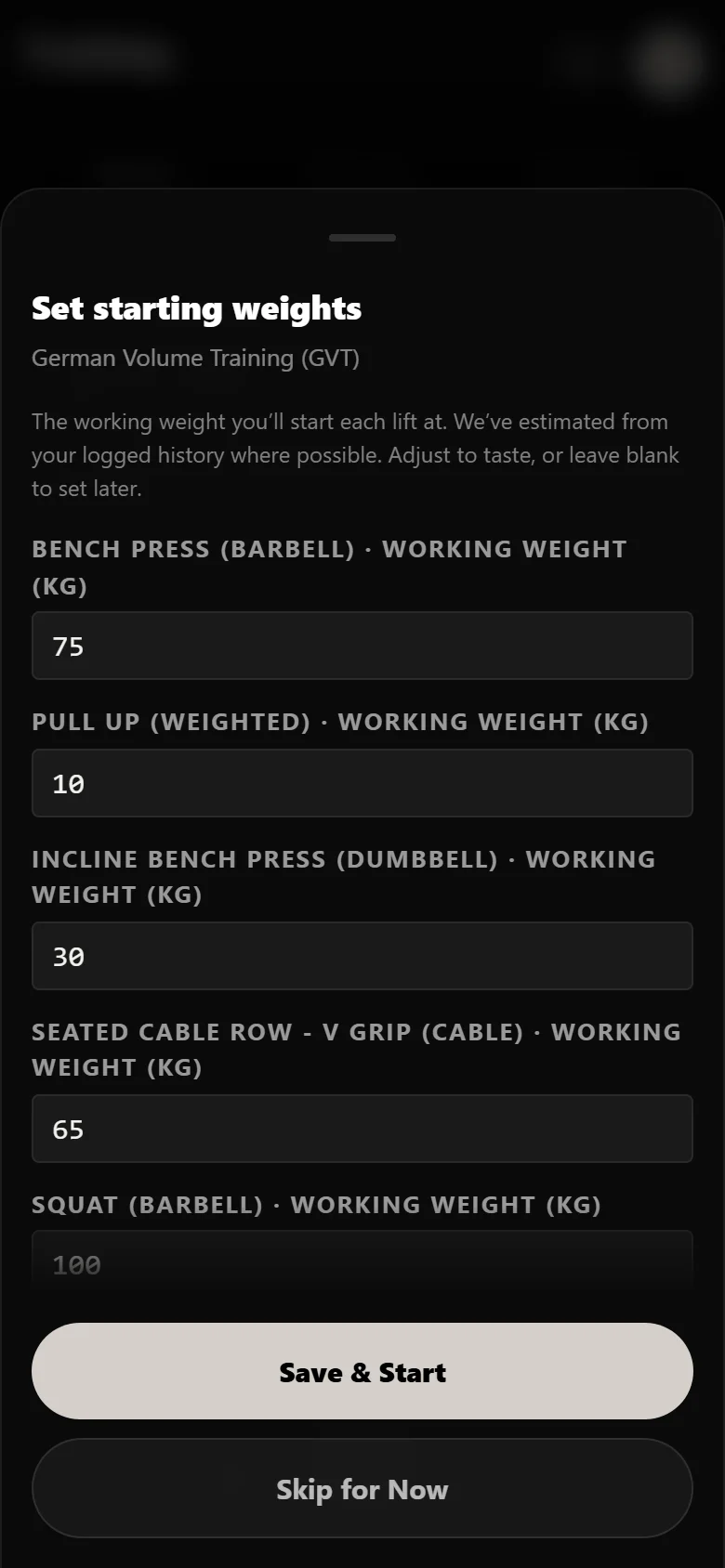
There are no training maxes here. Setup asks for a working weight on each lift and that is the whole configuration. The squat went in at 100 kg and the bench at 75 kg.
Poliquin's instruction is to pick roughly sixty percent of your one-rep max, which is to say a weight you could manage about twenty times in one go. On set one that feels absurd. On set six it does not. The mistake almost everyone makes on their first block is starting twenty percent too heavy, finishing the first session on sets of six, and concluding the program does not work.
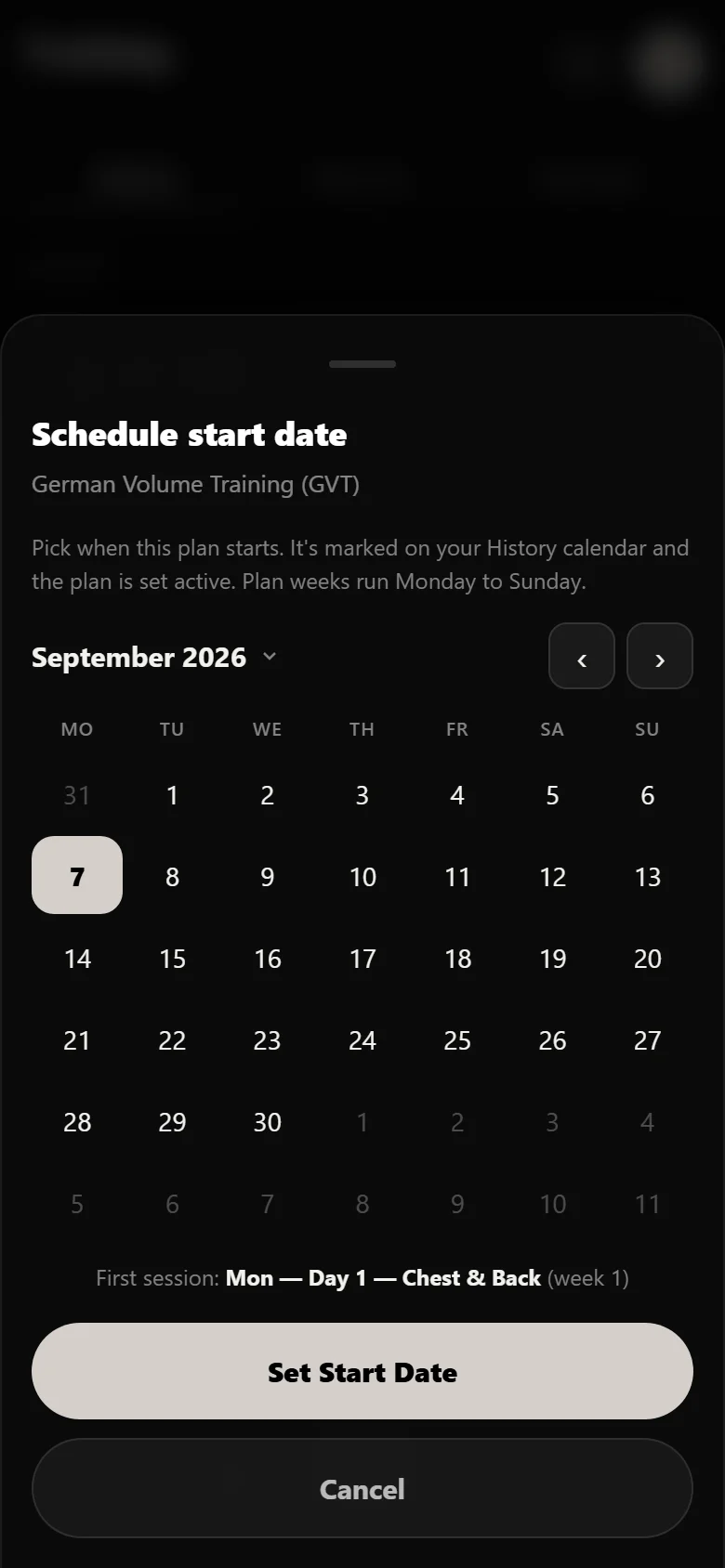
A start date puts the four weeks on the calendar. Three sessions a week, twelve in total, and each of the six main lifts comes around once a week — which is why the squat's story below is four data points rather than twelve.
What ten sets of ten actually looks like in the logger
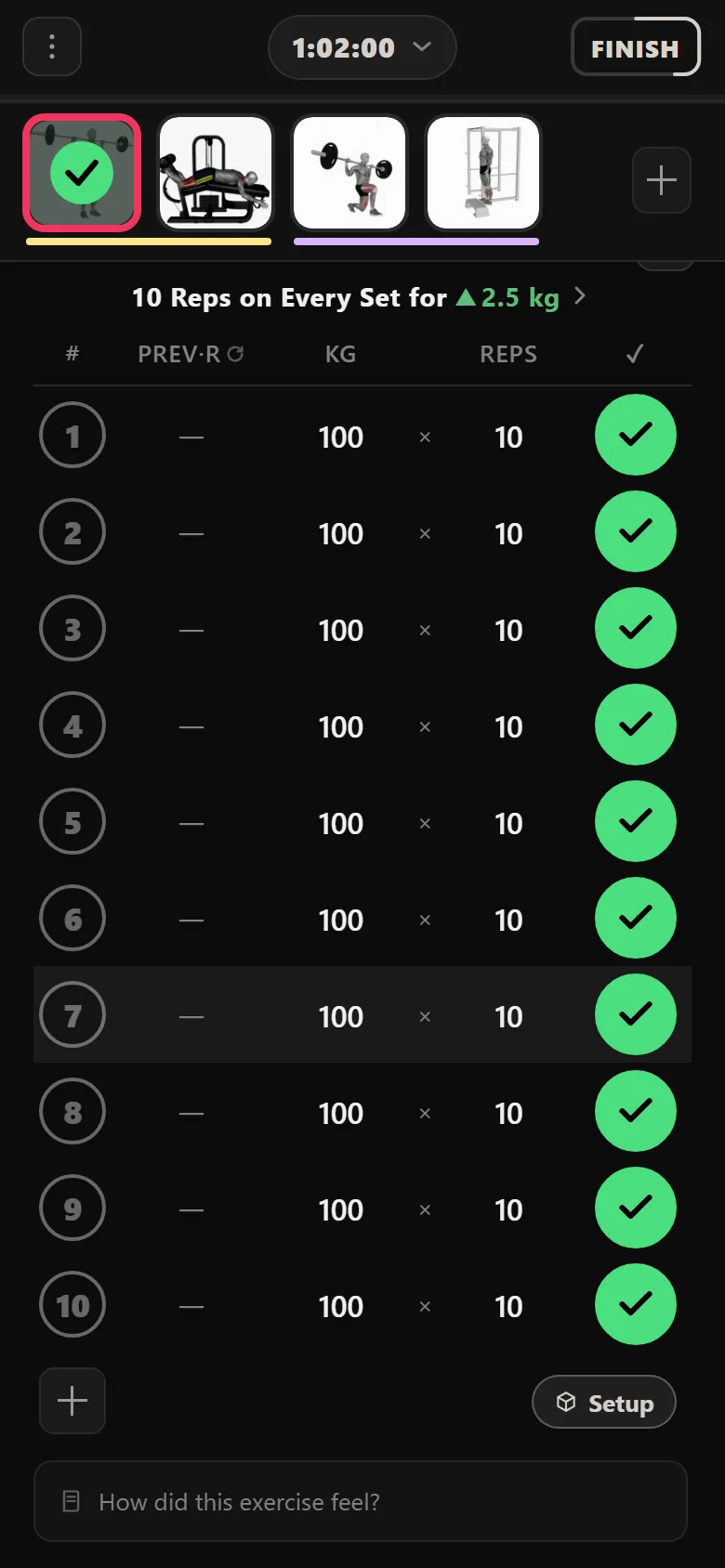
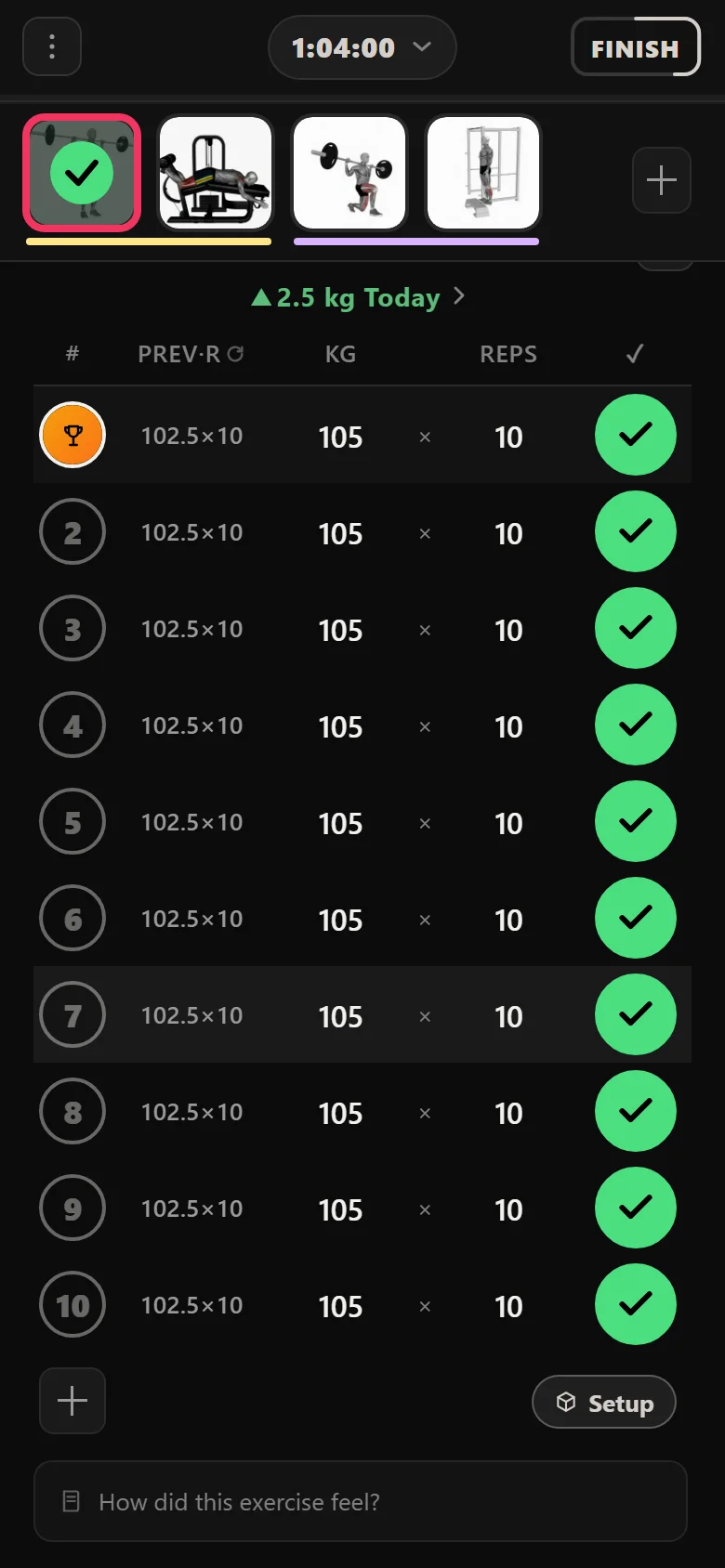
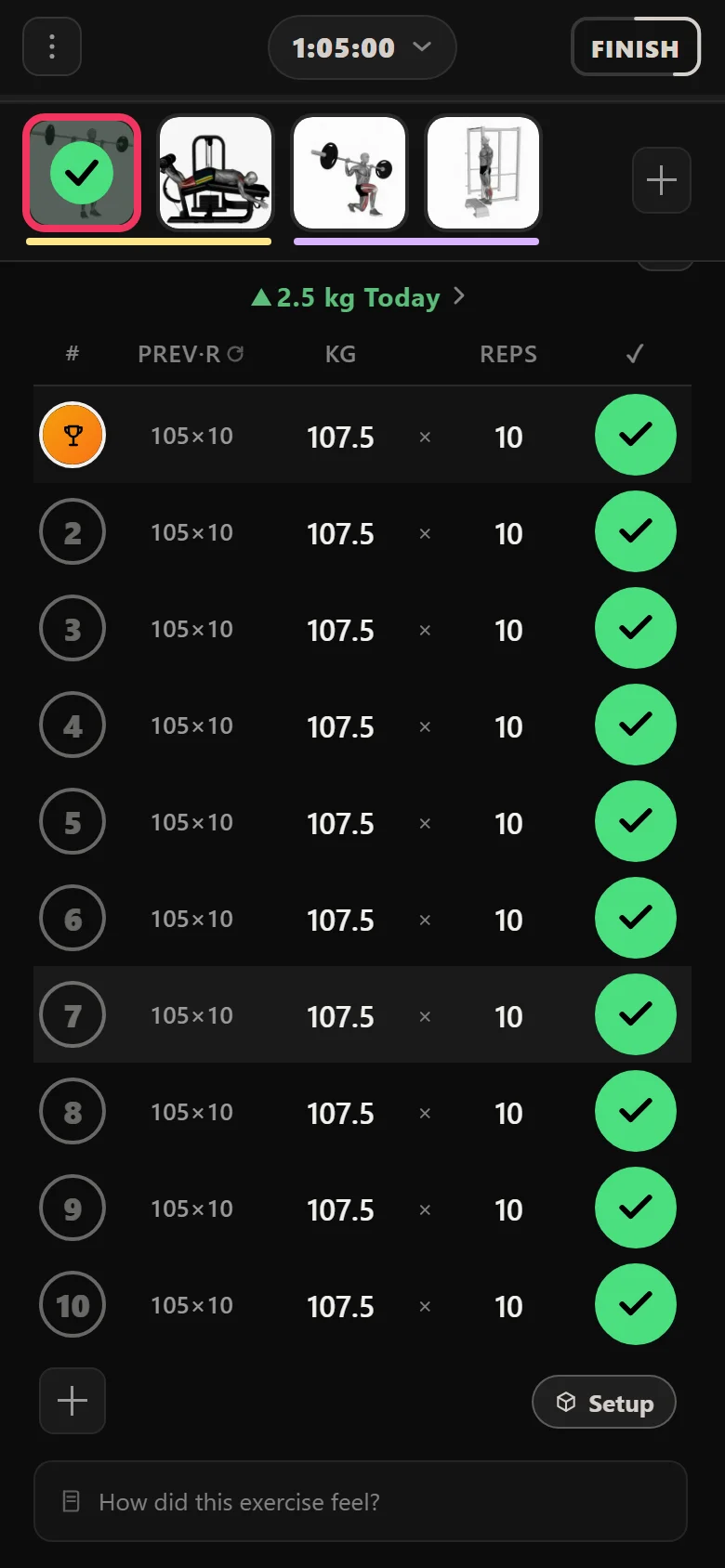
The squat opens at 100 kg with ten identical sets waiting under it. The chip on the lift shows the rule that governs it while you train, so the answer to "when does this go up" is on screen rather than in a forum post. Complete every prescribed rep and the app adds 2.5 kg for next time, on its own.
The rest timer matters more here than on any other program in the catalogue. Ninety seconds after each half of the superset is not a suggestion; it is the variable that makes the tenth set hard in the right way. Durata starts it automatically on every set, which is the only reason a session of this shape is loggable without a stopwatch in your other hand.
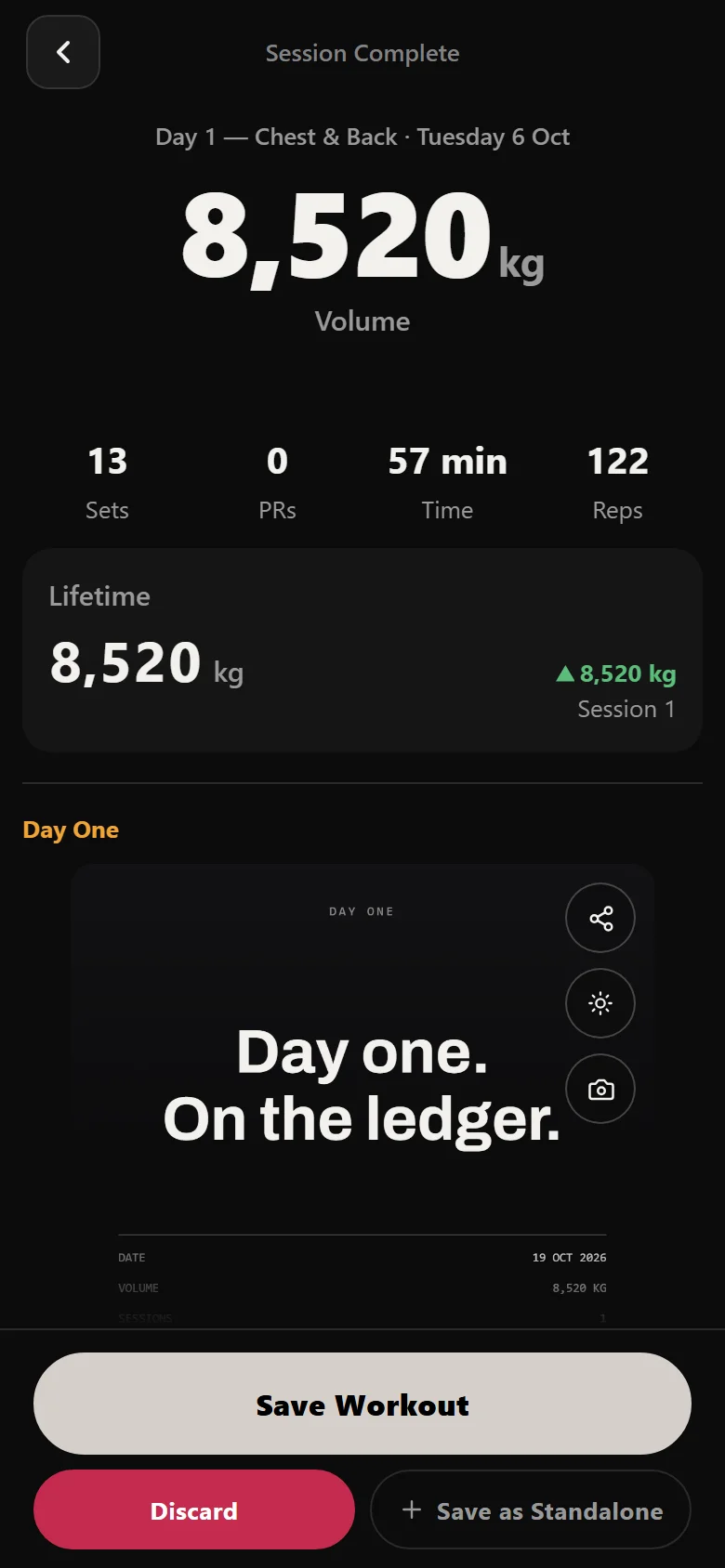
The session recap is where the volume becomes visible: 8520 kg in one workout, across 13 sets and 122 reps. Nothing in that number came from heavy weights. It came from repetition, which is the entire premise.
The squat: four appearances, four completed hundreds
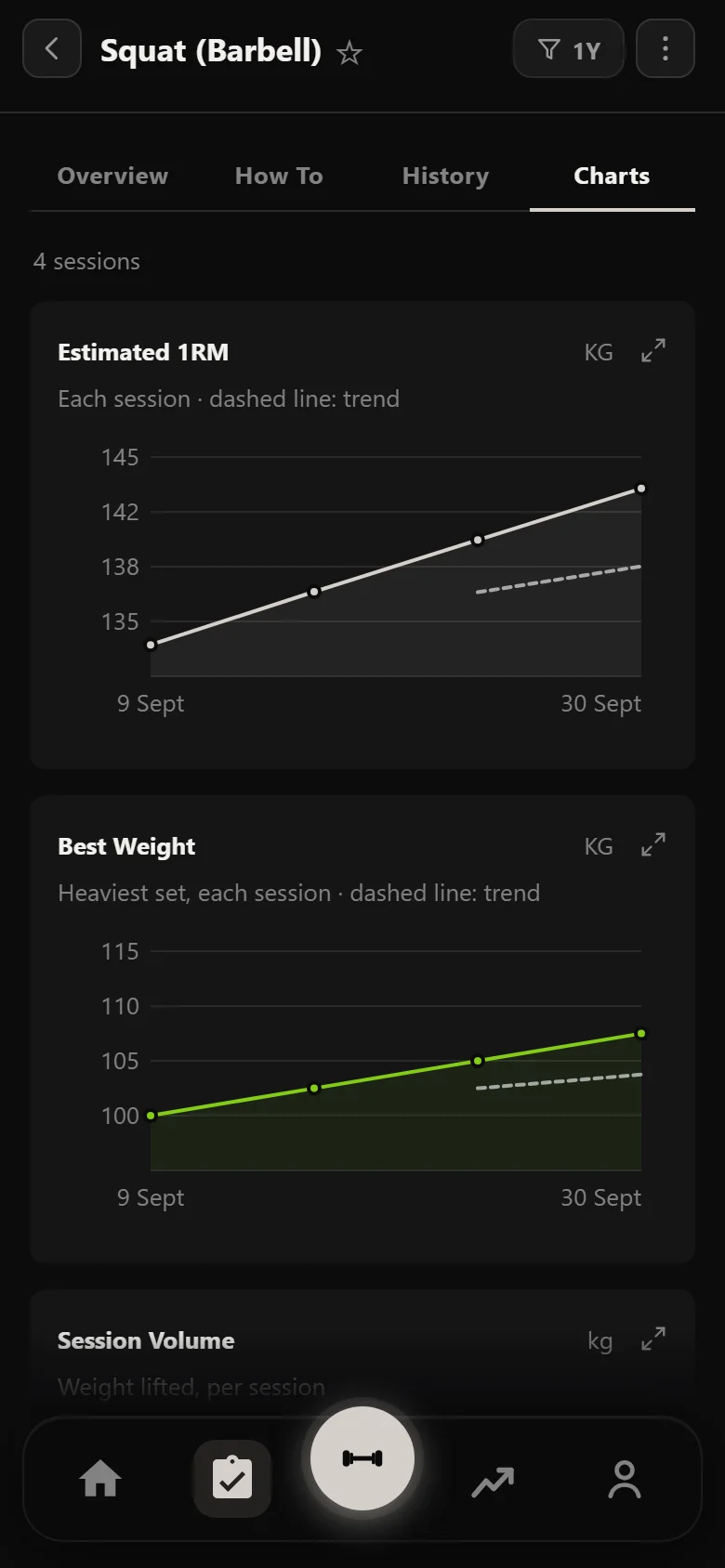
The squat is trained once a week, so it has four appearances in this block and every one of them earned its increase. 100 kg, then 102.5 kg, then 105 kg, then 107.5 kg, with a fifth session's 110 kg already prescribed when the block ended.
Four steps in four weeks reads modestly next to a linear-progression program that adds weight three times a week. It is not the same 2.5 kg. Each of these was paid for with a hundred completed reps at a weight that got harder every set, and the tonnage behind that ten-kilo move is enormous: 93,405 kg in September's eleven sessions alone, 183 sets and 1,951 reps.
The strip below is the whole squat story. There is nothing hidden in it, no missed sessions and no cut-backs, because this lift did what the program asks: it finished the hundred every single time.
Squat (Barbell): working weight, week by week
- 100S2 Session 2 — start
- 102.5S5 Session 5
- 105S8 Session 8
- 107.5S11 Session 11 — last session
One rule, twelve lifts, three different endings
The squat's arc is the flattering version. The start-to-finish log covers all twelve lifts and it tells a more useful story, because the same rule produced three completely different results in four weeks.
Three lifts ran the table. The squat went 100 kg to 110 kg, the weighted chin-up 65 kg to 75 kg and the lying leg curl 7.5 kg to 17.5 kg, each of them completing the full hundred on every appearance and taking the increase every time. On the leg curl that is more than a doubling, which tells you the starting weight was too light rather than that the lifter got twice as strong.
Five lifts never moved at all. The weighted pull-up sat at 65 kg for the whole block, the cable row at 65 kg, the standing calf raise at 7.5 kg, the weighted dip at 20 kg and the dumbbell overhead press at 20 kg. On any other program four weeks without an increase would be a stall to diagnose. Here it means those weights were chosen correctly: the lifter kept falling a few reps short of the hundred, and the rule kept them exactly where they were.
And one lift went backwards. The bench press opened at 75 kg and finished with 72.5 kg on the card for next time. When a lift keeps coming up short, holding it there forever is not the answer either, so the rule eventually takes weight off and lets it build back into the hundred. That is not a failure of the block; it is the only mechanism that stops German Volume Training turning into four weeks of grinding the same unfinishable session.
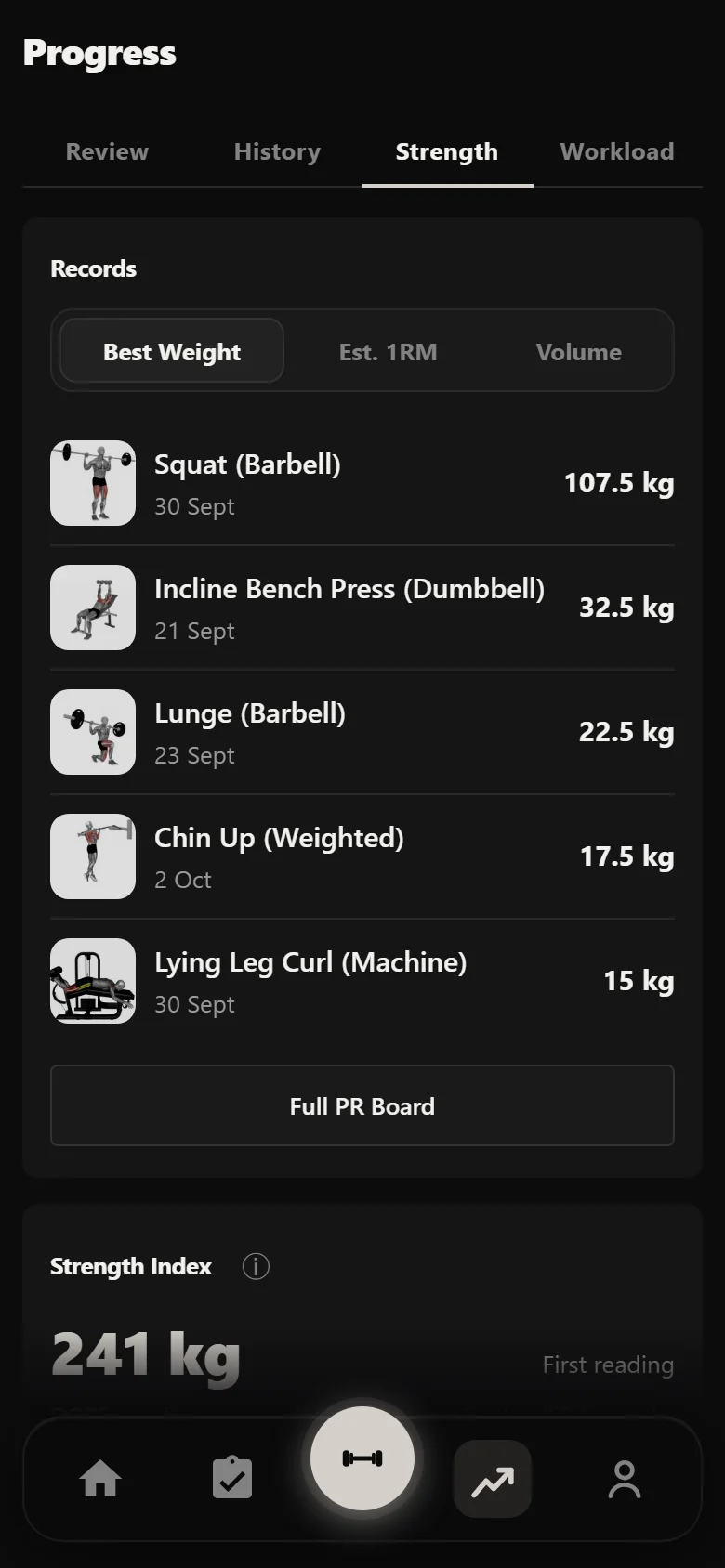
The accessories, which run on a rep range rather than a fixed hundred, moved on their own schedule: the incline dumbbell press 30 kg to 32.5 kg, the barbell lunge 20 kg to 22.5 kg, the dumbbell curl 7.5 kg to 10 kg. Different rule, different pace, same principle — the app decides from the sets you logged.
Four weeks, seen from the outside
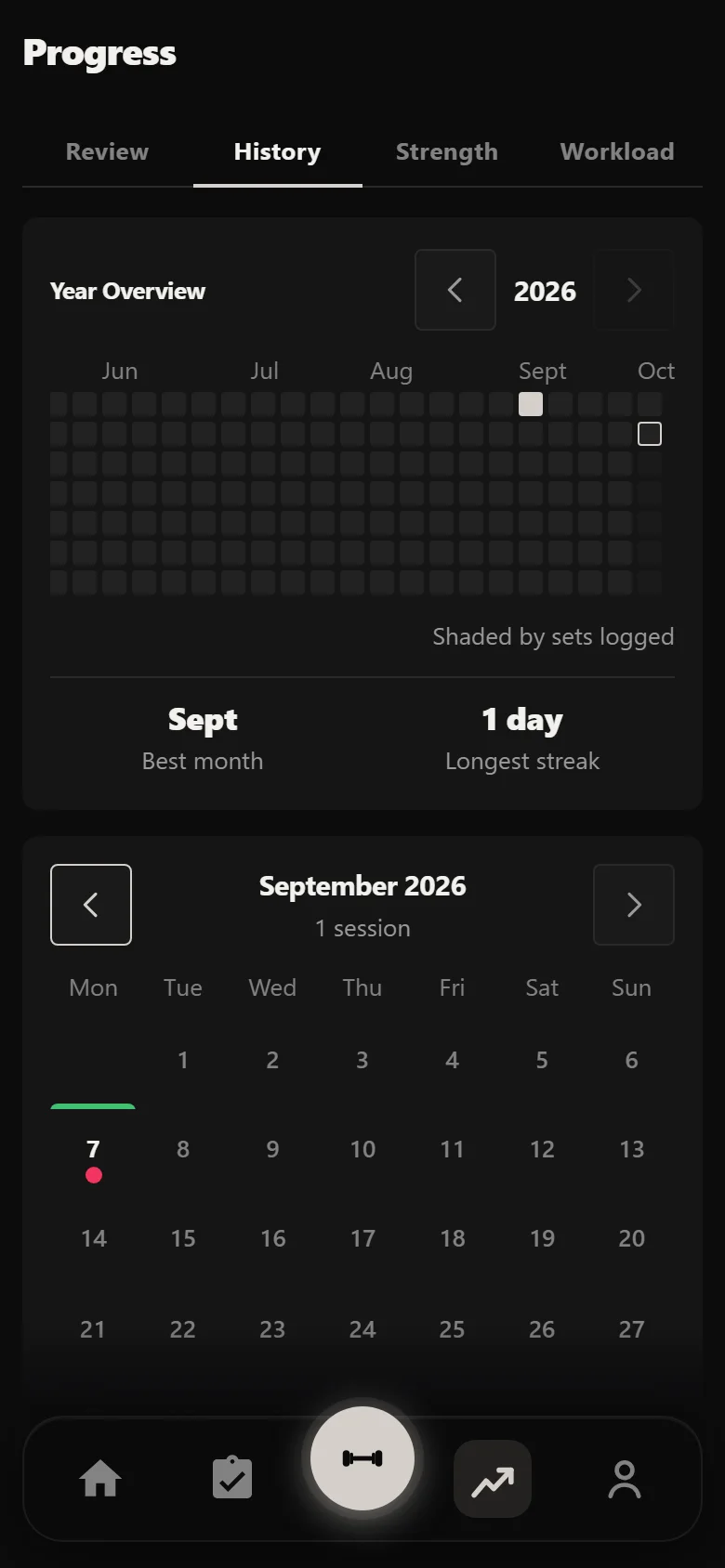
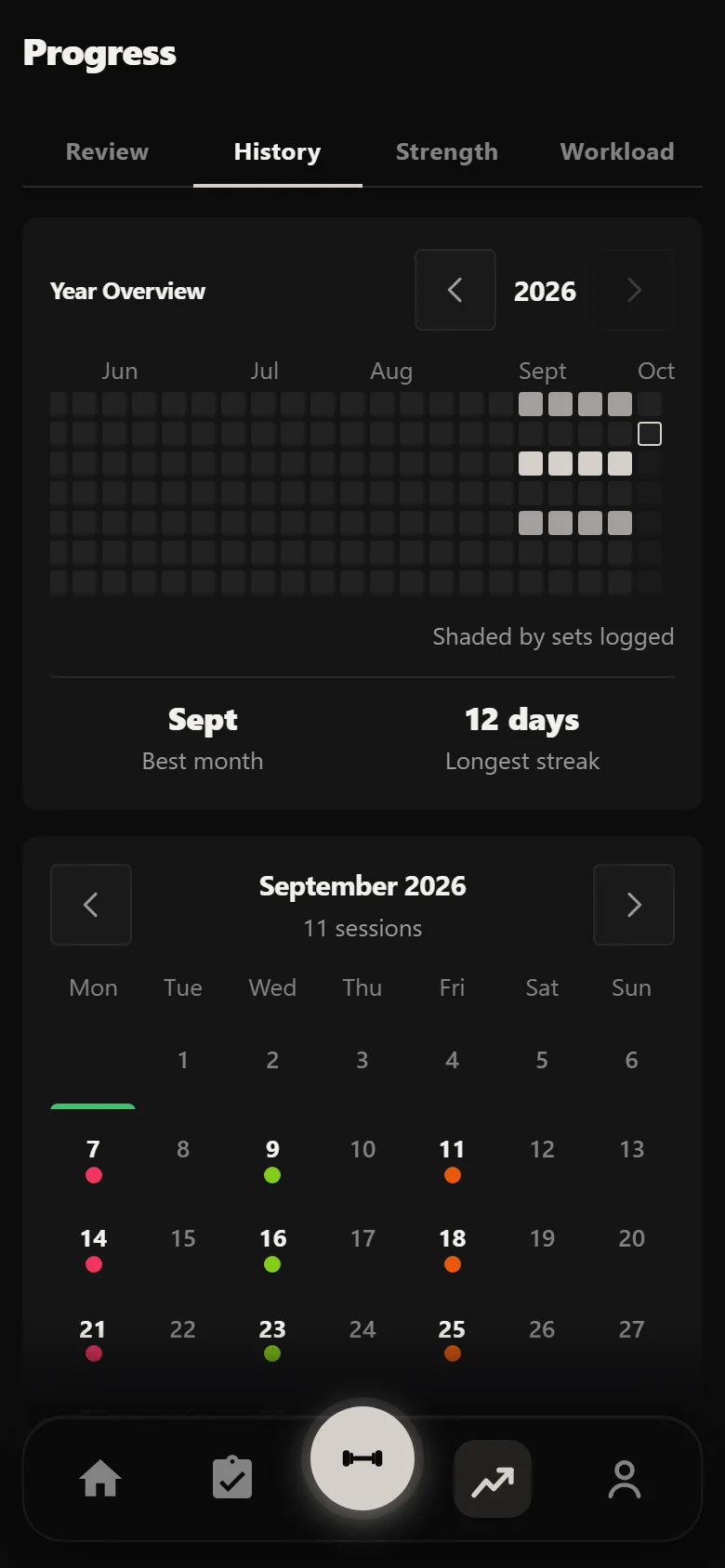
The History calendar holds all twelve sessions, three a week, in a pattern so regular it looks printed. That regularity is the point: German Volume Training has no waves, no deload week and no cycle structure. It is the same session shape until the weights stop moving, and then you change program.
The squat's estimated one-rep max chart steps up four times and does nothing else. There is no curve to read here and no plateau to interpret, because the estimate is derived from a fixed ten-rep set and the weight only changes when the rule says so. On a program that judges you on completed reps rather than on a heavy single, a flat stretch on this chart is information about the rule, not about the lifter.
The payoff: the same ten sets, four weeks apart
Two screenshots of the same lift on the same screen: week one and the last session of the block. Ten sets of ten in both, and 7.5 kg more on the bar in the second, because four hundreds got finished in between.
Four appearances, four completed hundreds, and 110 kg already prescribed for the session after this one.
Common questions
What is German Volume Training?
Charles Poliquin's ten-sets-of-ten method. Two antagonist lifts a session are supersetted for ten sets of ten reps at a constant weight, ninety seconds of rest, with accessories at three sets of twelve to fifteen. The load stays put until all one hundred reps land, then goes up 2.5 kg. Durata runs it as three sessions a week: chest and back, legs and abs, arms and shoulders.
What weight should I start with?
About sixty percent of your one-rep max, or a weight you could genuinely lift twenty times in one set. It will feel far too light for the first three sets and correct by the sixth. Starting heavier is the single most common way to ruin the block, because you never complete the hundred and the weight never moves.
My weight has not gone up in three weeks. Am I stalling?
Probably not. On this program the load only moves when you complete all one hundred reps, so a lift sitting on the same number for weeks is the rule doing its job. In this four-week run, five of the twelve lifts never advanced once, and September alone still came to 93,405 kg. If a lift keeps coming up well short, the app will eventually cut it back rather than leave you grinding it.
Can I skip the ninety-second rest?
You can, and the tenth set will tell you why you should not have. The rest interval is what keeps the last few sets in the intended range instead of collapsing to sets of five. Durata starts the timer on every set so you do not have to police it yourself.
How long should I run it?
Four to six weeks is the usual answer, and the twelve sessions here sit at the short end of that. It is a high-fatigue block by design, not something to sit on indefinitely. When the increases dry up across most of the lifts at once, that is the signal to move on rather than to push harder.
Is Durata free?
Yes. Durata is free to use, with the full program catalogue, automatic progression, rest timers and PR tracking. Everything in this walkthrough is in the app.
Put it into practice
Durata is free to use — 50 proven programs, automatic progression, rest timers and PR tracking, all on your phone.