


Metallicadpa PPL 5/3/1 in Durata: one number sets the whole session
Metallicadpa PPL: 5/3/1 is the Reddit push/pull/legs routine laid out the way its author suggested for lifters past the beginner stage. Bench, deadlift, squat, overhead press and front squat each run Jim Wendler's four-week 5/3/1 wave, followed in the same session by five sets of ten at 50% of the same training max. The hypertrophy accessories behind them are the original PPL's.
That makes it a clear example of two progression systems in one program. The main lifts are prescribed in advance from a single number per lift, and that number only changes at the end of a cycle. The accessories are prescribed from what you did last time, and only move when you earn it.
This run drove two full cycles, 48 sessions, through the real app. Everything below is engine output. The lift the charts follow is the squat, on Wednesday's Legs A.
Finding it and starting it
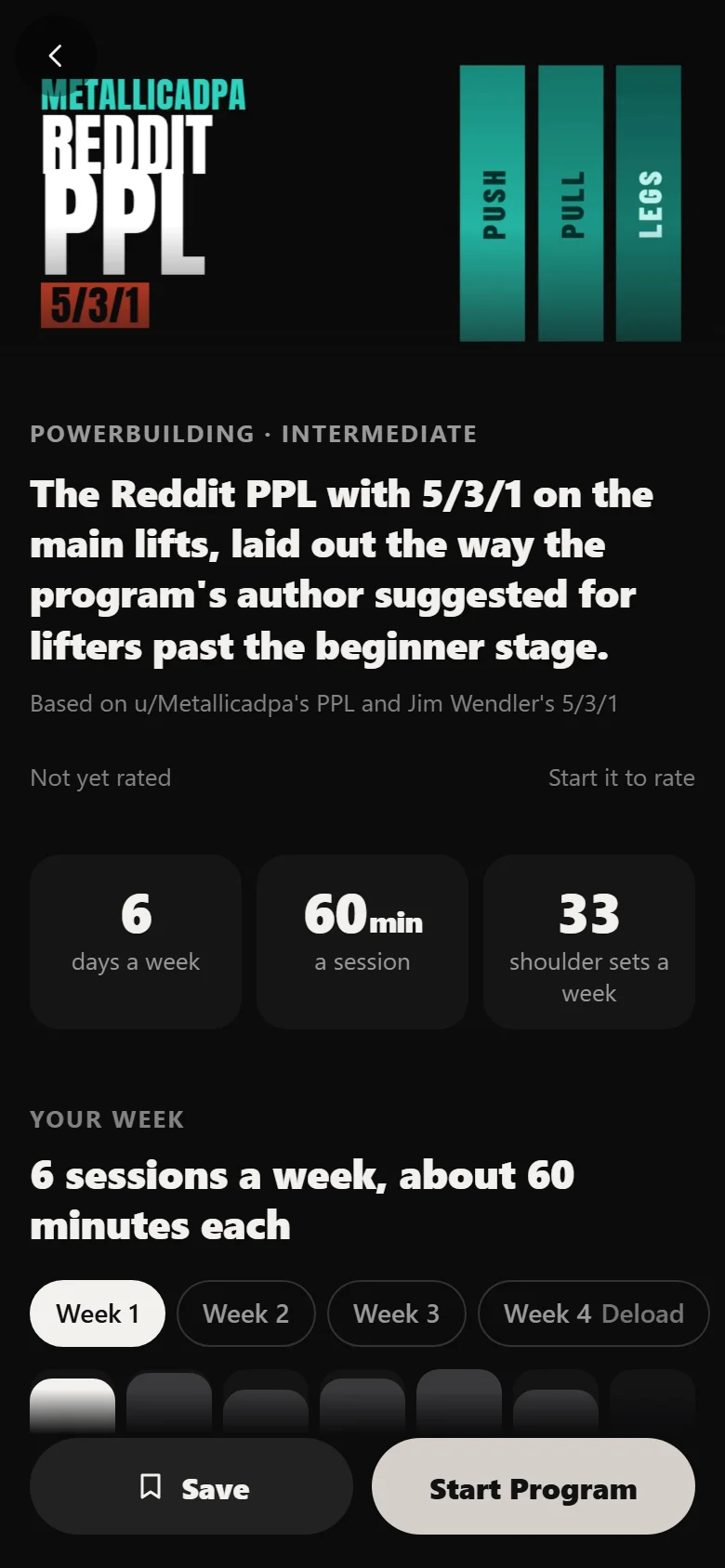
In Discover, Metallicadpa PPL: 5/3/1 sits on the Powerbuilding shelf, marked Intermediate, at six days a week. Search finds it by name, or Filter narrows the shelves by level and days a week. Tap the cover for a quick look, then View Program for the full page.
It is a step up from base Metallicadpa PPL rather than a replacement for it. The program page carries the schedule before you commit: six sessions a week at about 60 minutes each, and the four weeks of the wave, with week 4 marked as the deload.
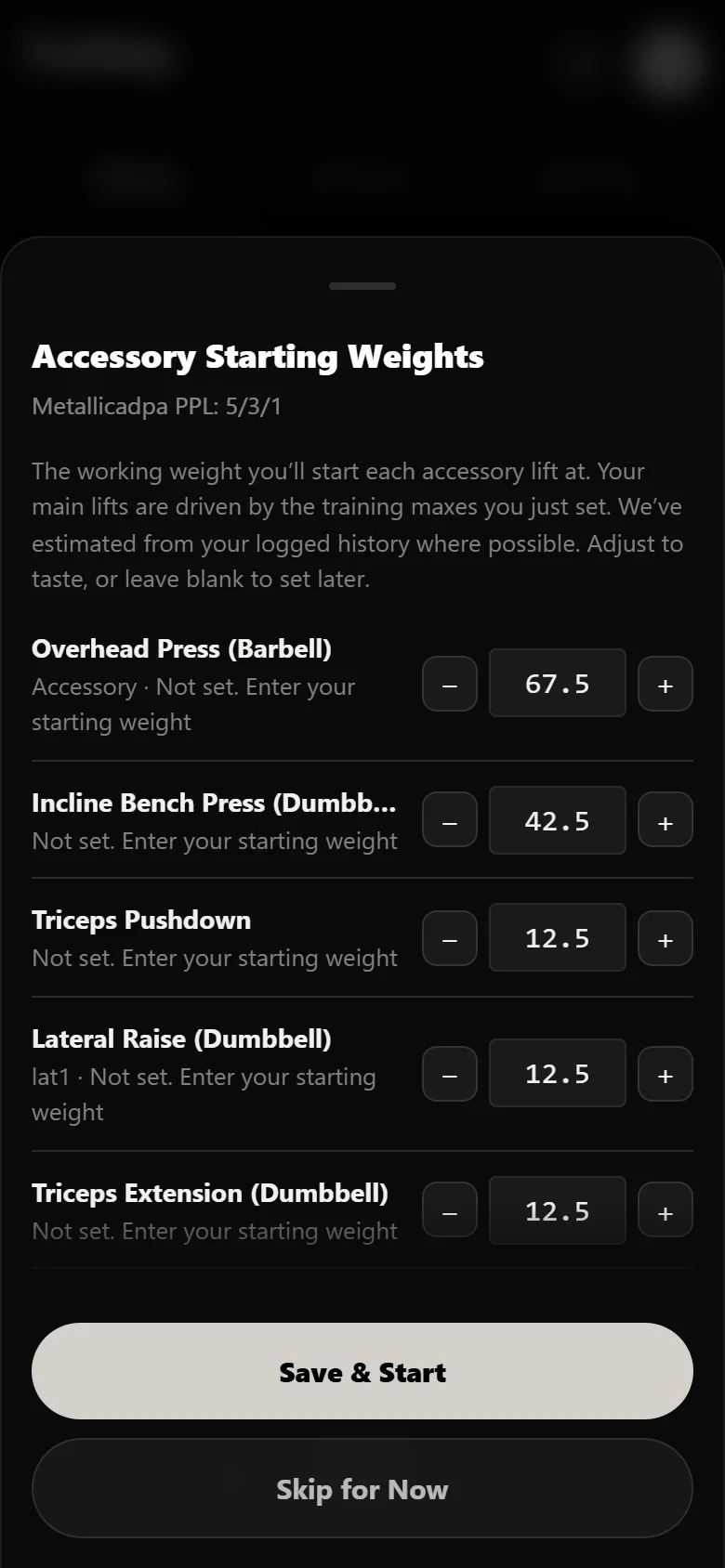
Setting it up asks for two kinds of number. Each of the five main lifts needs a training max, the number every prescribed percentage is taken from. This run used 140 kg for the bench press, 240 kg for the deadlift, 200 kg for the squat, 80 kg for the overhead press and 160 kg for the front squat. Each accessory needs a plain working weight, the same as in the base program: here 67.5 kg on the accessory overhead press and 42.5 kg on the incline dumbbells.
The training max is the only number you set
In base Metallicadpa PPL the app reads the sets you logged and decides the next weight from them. Here it works the other way round. You set a training max per main lift, and every weight in the next four weeks is already decided: percentages of that number, week by week.
Week one is sets of five, week two sets of three, week three the 5/3/1 week that finishes at 95% of the training max, and week four is a deload. The last set of each working week is taken for as many reps as you have. Then the training max is reviewed, and the whole wave repeats on a heavier bar.
The week runs Push A on Monday, then Pull A, Legs A, Push B, Pull B and Legs B on Saturday. Bench leads Push A, deadlift Pull A, squat Legs A, overhead press Push B and front squat Legs B, each on its own max. Pull B is the one day without a wave: barbell rows for five sets of five, adding weight when all five sets are made, then chest-supported rows for five sets of 10 to 12.
Eight sets, one number
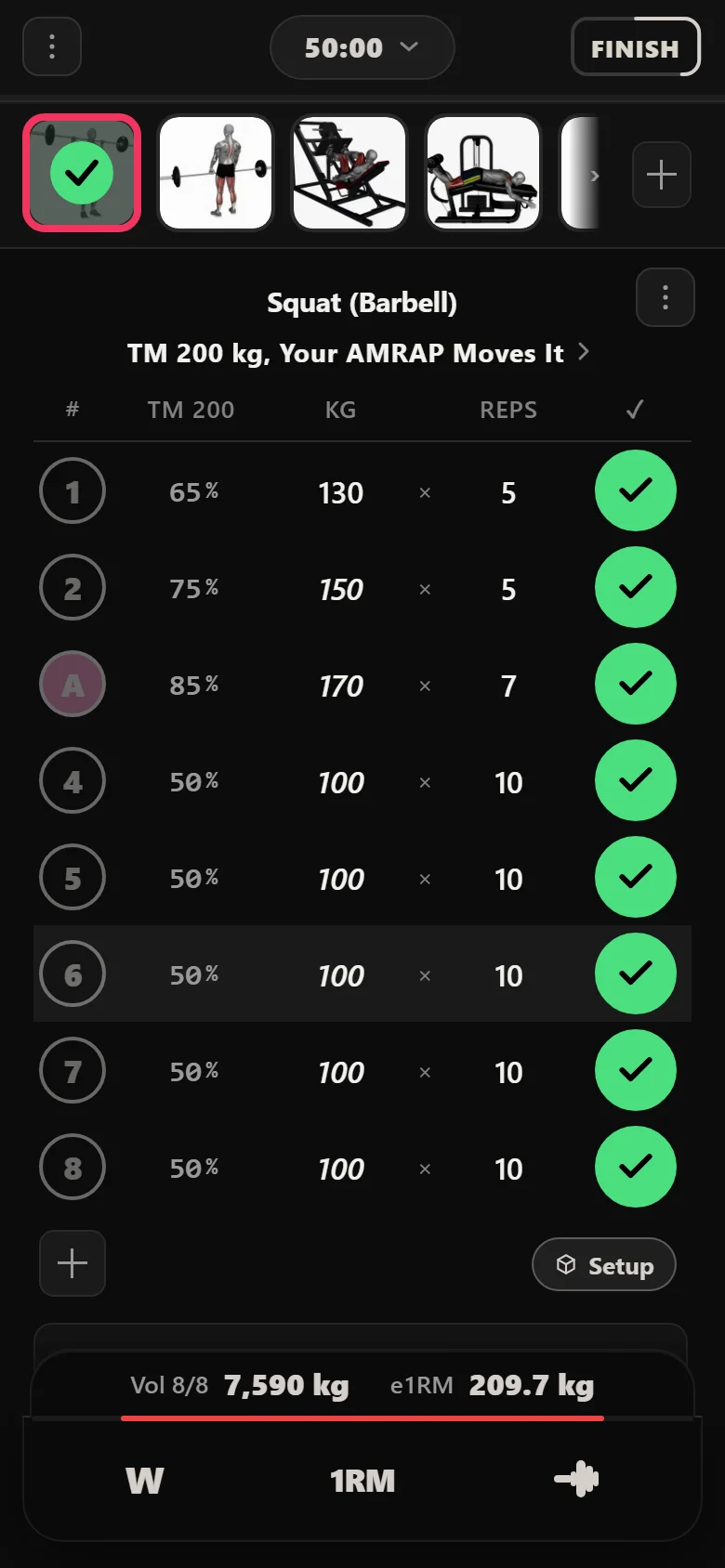
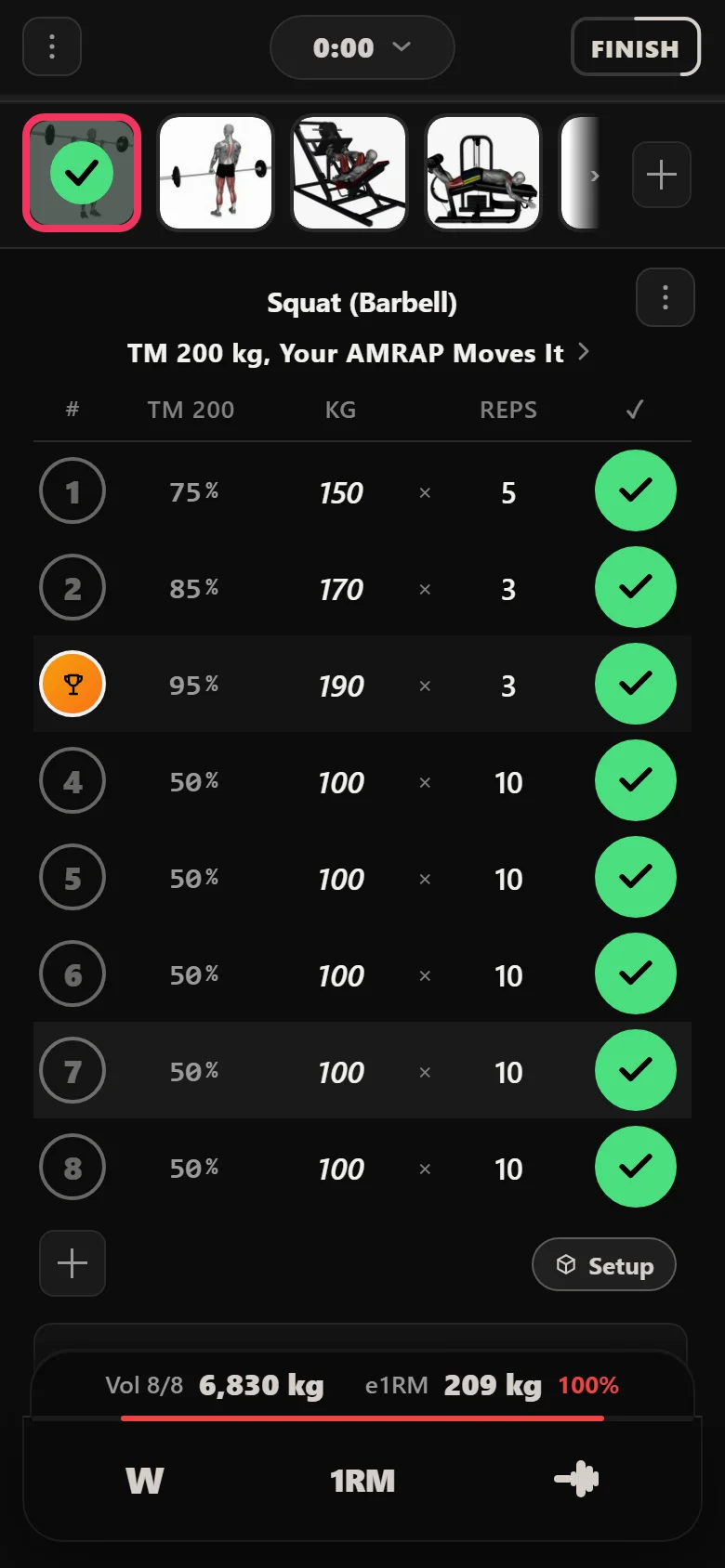
Legs A shows the design in a single screen. On a 200 kg training max, week one's squat is 130 kg for five, 150 kg for five, and 170 kg for as many as you have, then five sets of ten at 100 kg, which is 50% of the same max. This run took seven reps on the 170 kg set.
None of those eight weights was typed in. They are percentages, and the line under the lift says where they come from: TM 200 kg, Your AMRAP Moves It. The five sets of ten have no working weight and no rule of their own. They rise when, and only when, the training max rises.
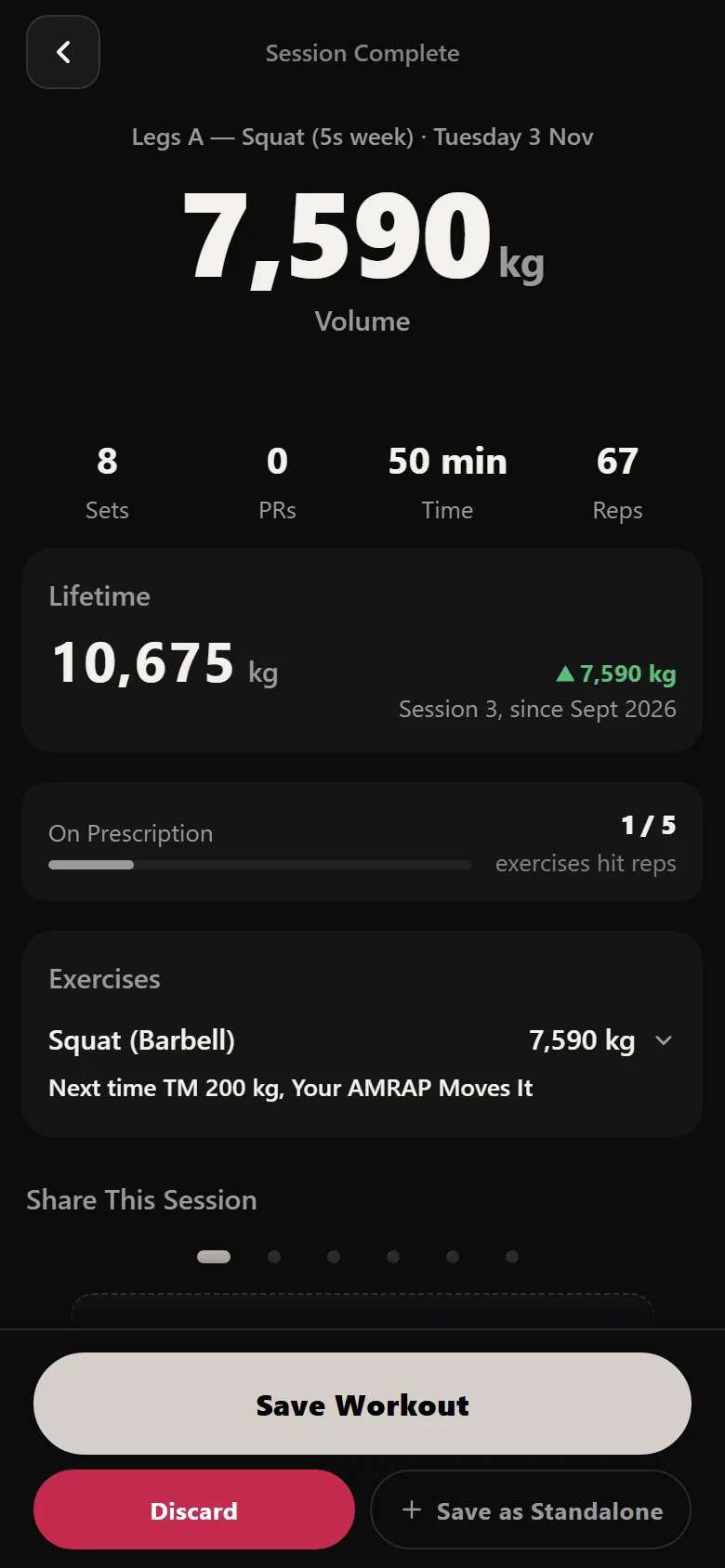
The session card totals it before it saves: 8 sets, 67 reps and 7,590 kg on the squat.
Three weeks up, one week down
Week three is where the wave peaks: 150 kg for five, 170 kg for three, and 190 kg, 95% of the training max, for as many as you have. The five sets of ten behind it are still 100 kg. Nothing in the program treats a hard week as a reason to push the volume work harder.
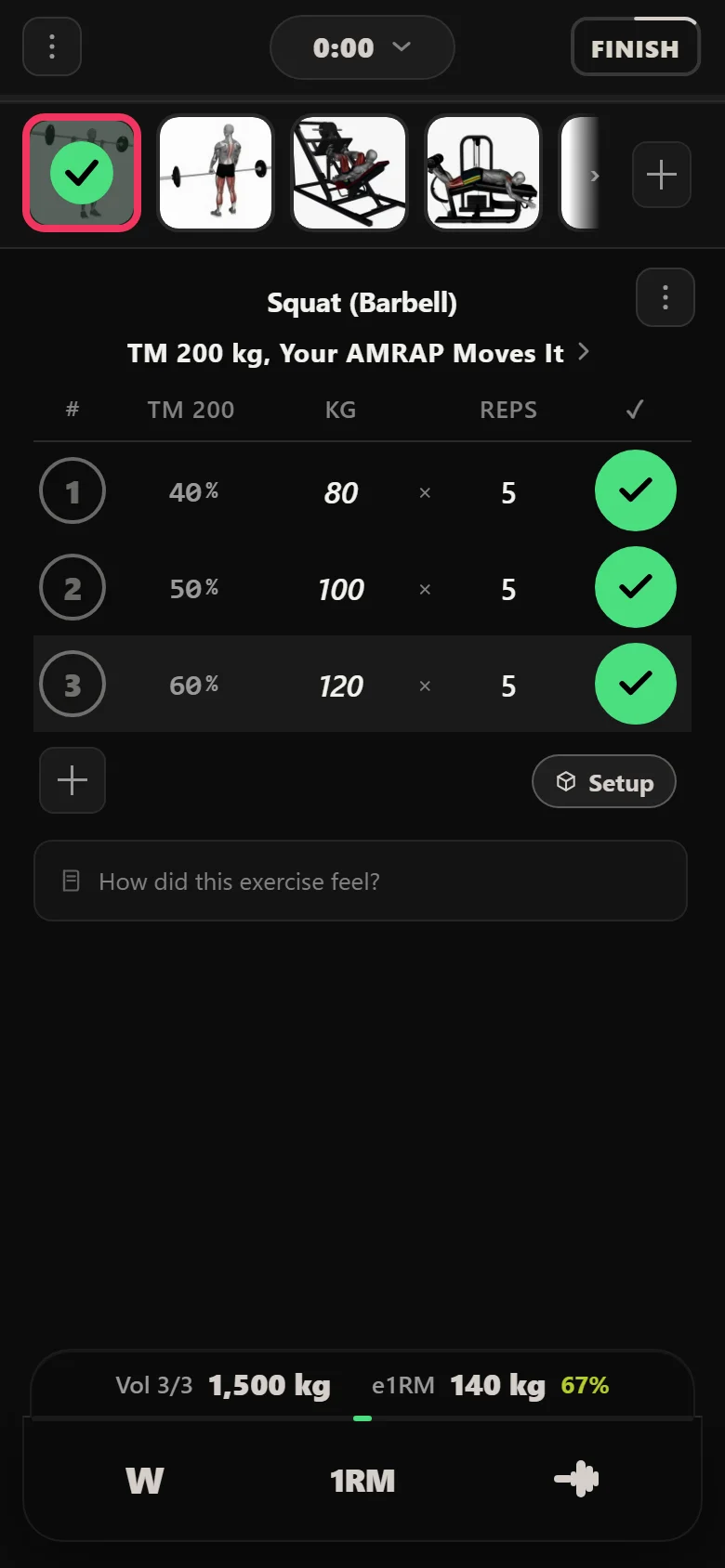
Week four is the deload: 80, 100 and 120 kg for five, which is 40, 50 and 60% of the max, and no sets of ten at all. The accessories carry on as they were.
This is the part of 5/3/1 that reads as strange on paper and makes sense in the app. The heavy sets test the training max and the sets of ten feed it, and neither is allowed to drift on how the session felt.
The review, and the whole session moves
At the end of the cycle the training max is reviewed. The squat, deadlift and front squat take 5 kg a cycle in this program and the bench and overhead press 2.5 kg, so the squat's training max went from 200 kg to 205 kg.
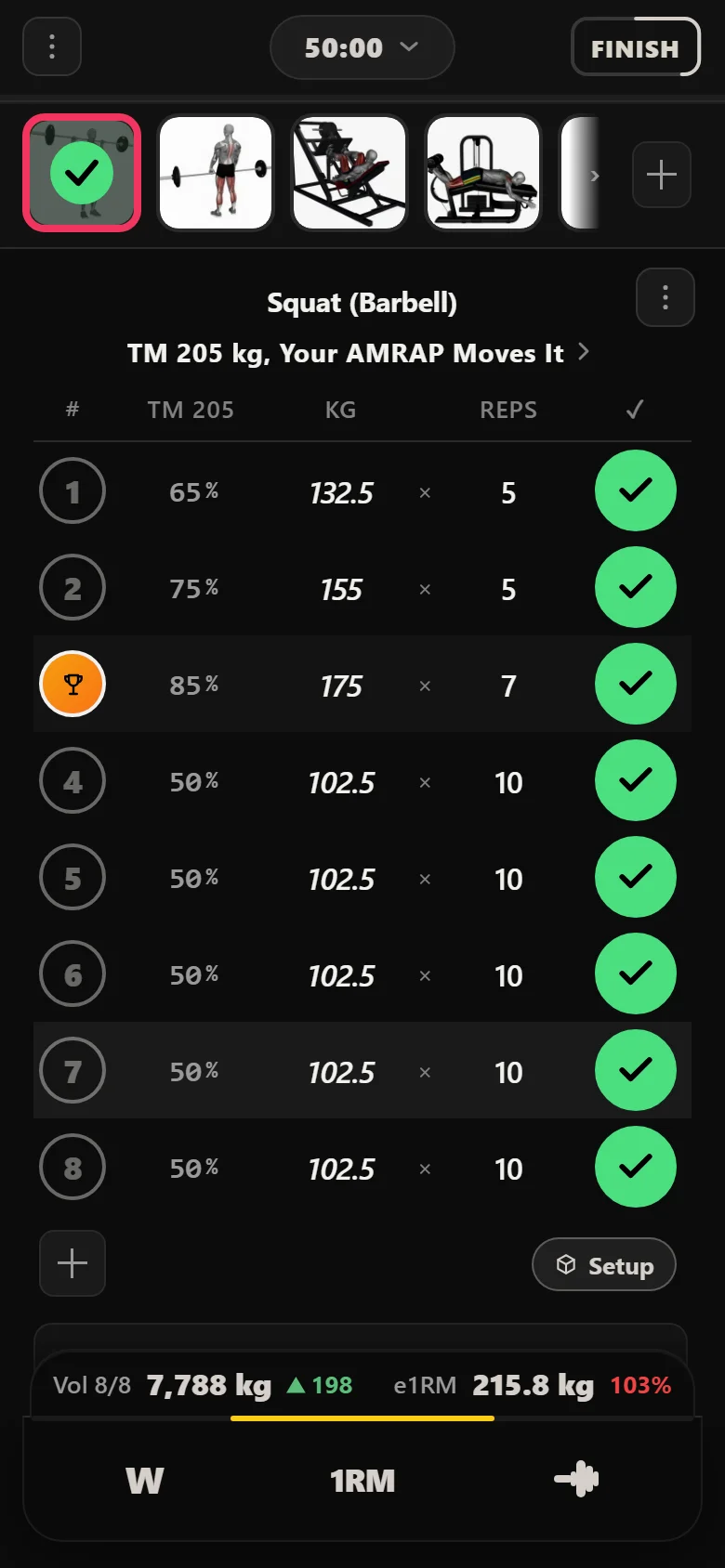
One number, eight sets. Cycle two opens on the identical wave at 132.5, 155 and 175 kg where cycle one was at 130, 150 and 170 kg, and the five sets of ten go from 100 kg to 102.5 kg on their own, because they were never anything other than half of that number.
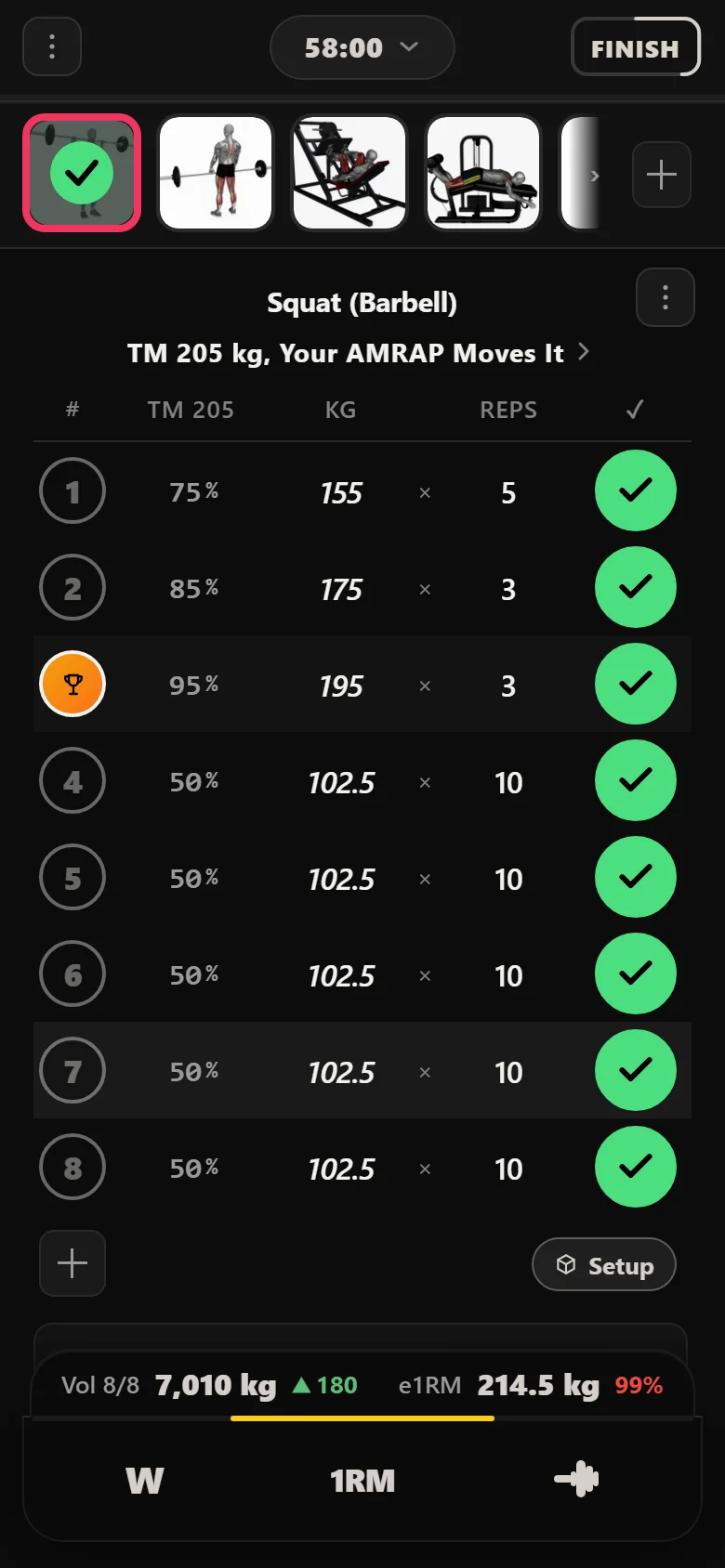
Nothing else needed touching for that to happen. By week three of the second cycle the top set is 195 kg, and after the second review the squat's training max stands at 210 kg. Over the two cycles the deadlift's max went from 240 kg to 250 kg, the front squat's from 160 kg to 170 kg, the bench's from 140 kg to 145 kg and the overhead press's from 80 kg to 85 kg.
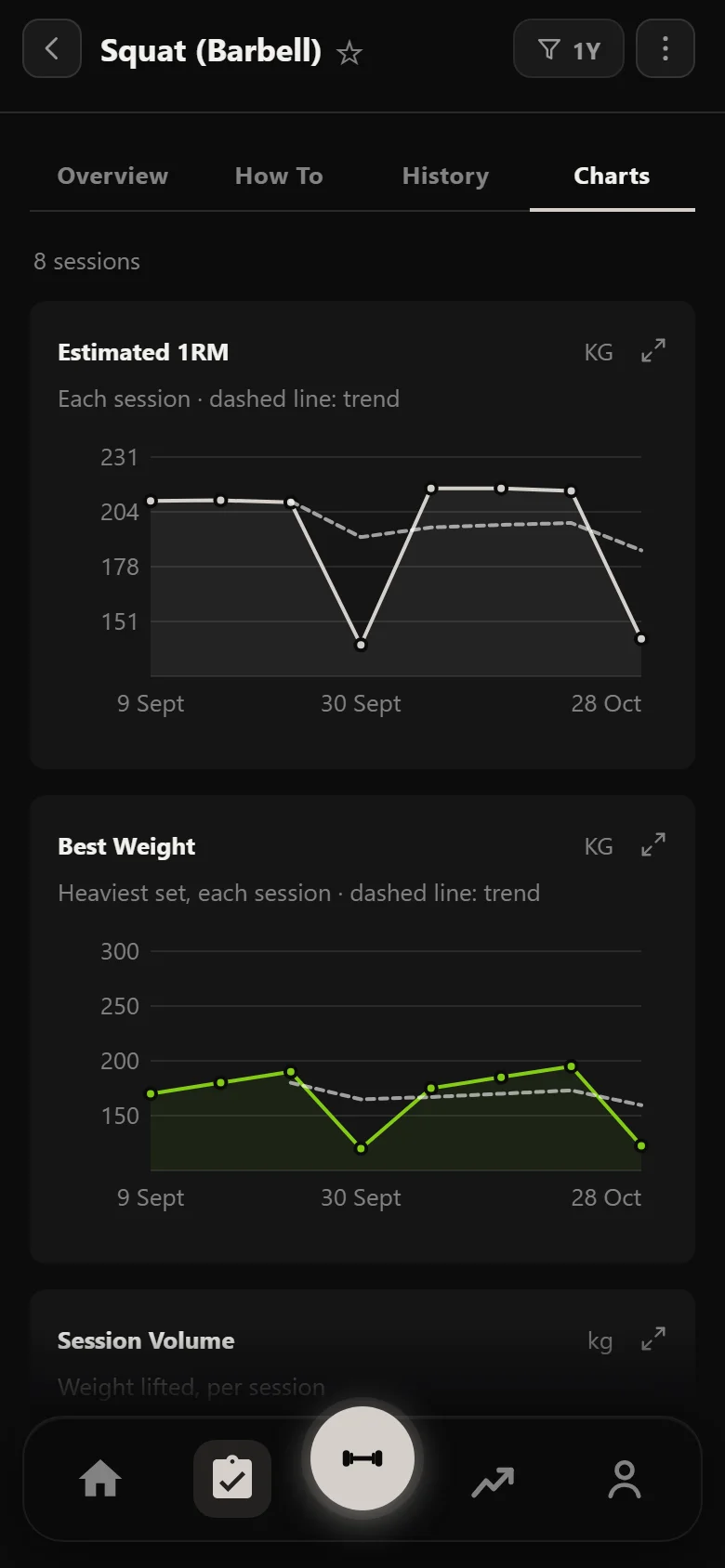
Squat (Barbell): Legs A top-set weight, cycle by cycle
- 170S3 Session 3 — cycle 1, 5s week, 7 reps
- 180S9 Session 9
- 190S15 Session 15 — 95% top
- 175S27 Session 27 — cycle 2, TM 205
- 185S33 Session 33
- 195S39 Session 39 — 95% top
The accessories did not move at all
The honest half of this run is the accessory list. Every one of them finished the eight weeks on the weight it started on: the bench press accessory at 105 kg, the overhead press accessory at 67.5 kg, the lat pulldown and seated cable row at 92.5 kg, the chest-supported row at 37.5 kg, the incline dumbbell press at 42.5 kg, the Romanian deadlift at 105 kg, the leg press at 217.5 kg, and the pushdowns, extensions, face pulls, curls, leg curls, calf raises and lateral raises all at 12.5 kg.
That is the rule doing what it says. An accessory only moves when every working set reaches the top of its rep range, and in this run none of them did. Pull B's barbell row is not an accessory: it runs the linear rule, adding 2.5 kg only when all five sets of five are made, and it also finished the run on 92.5 kg. The main lifts are the part of this program built to move, and they move on a schedule rather than on a good day.
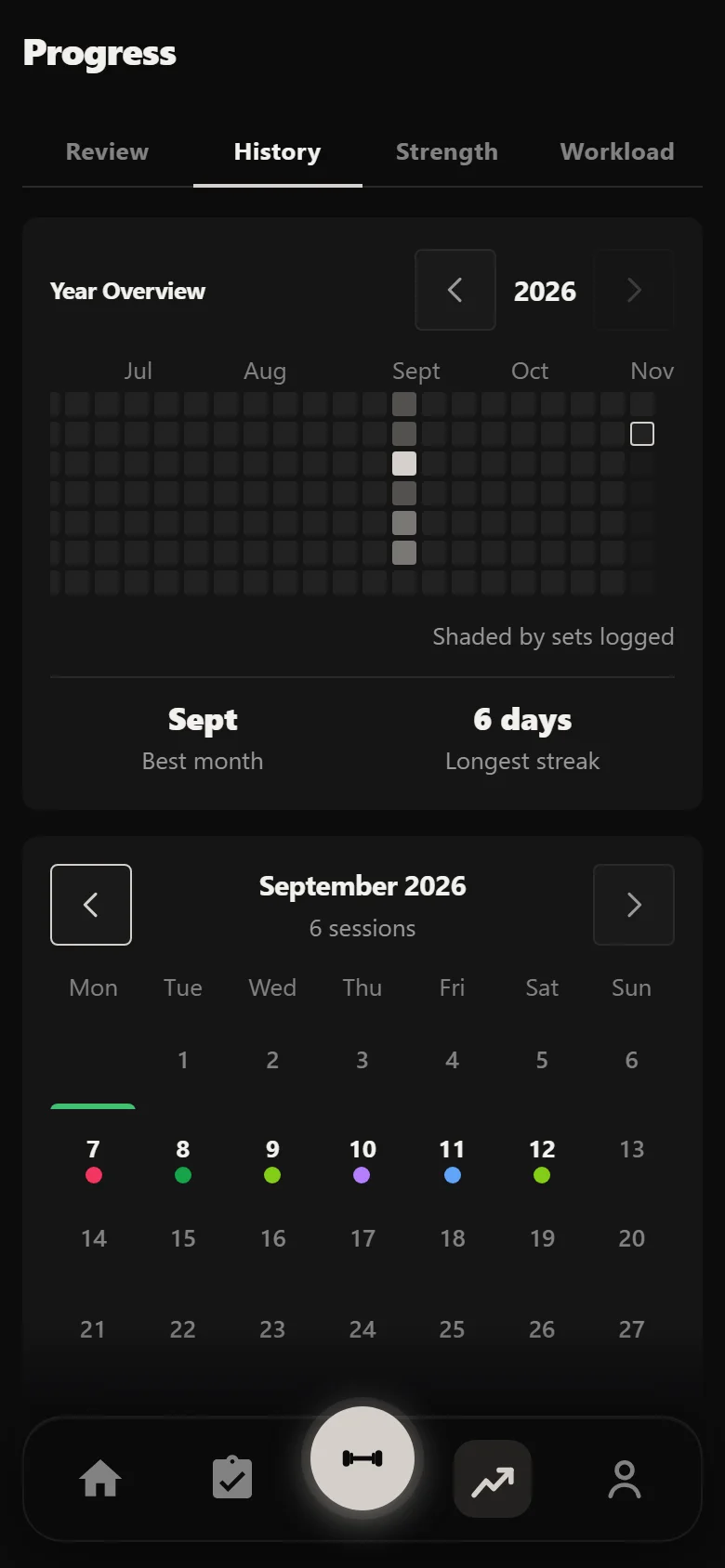
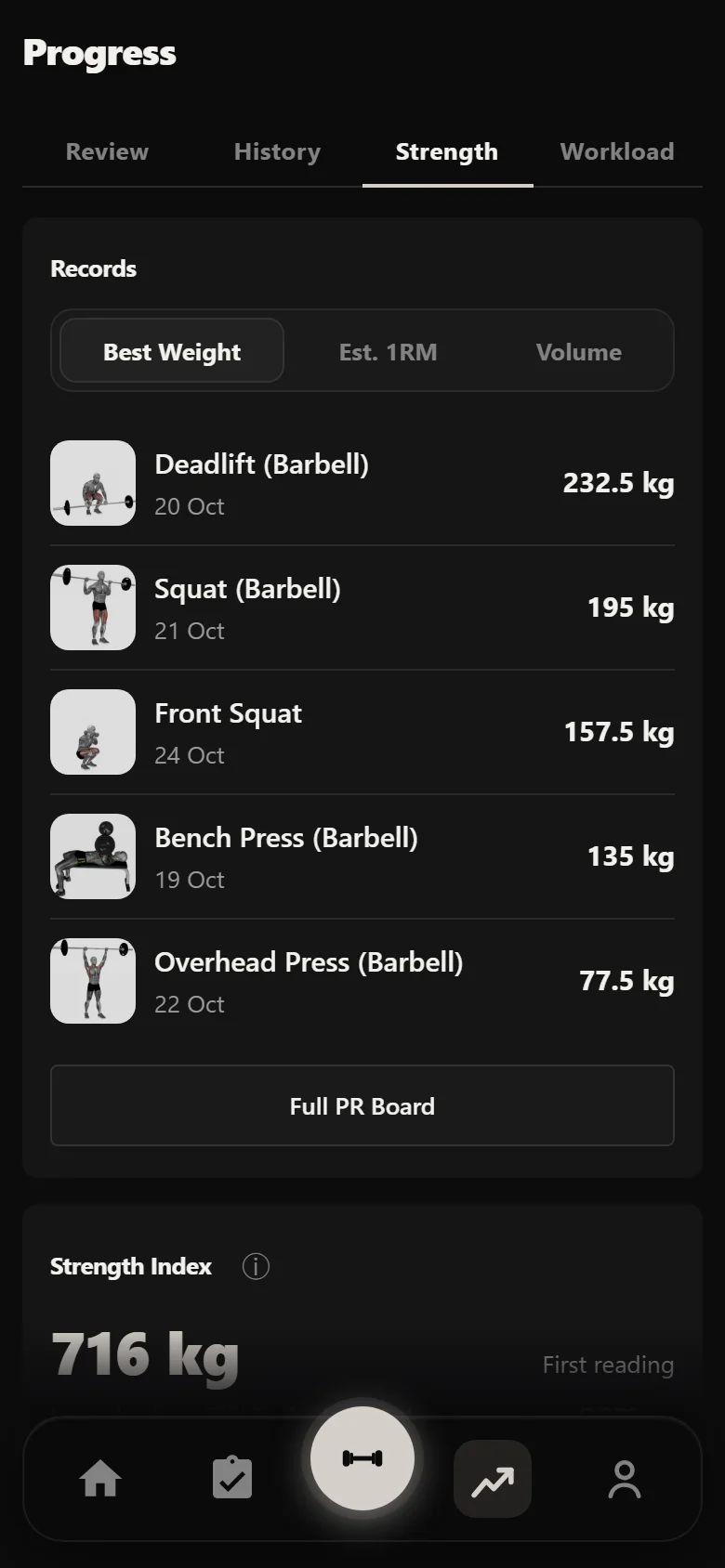
The Strength tab lists the best weights the run set, deadlift on top at 232.5 kg and the squat at 195 kg, with a first Strength Index reading of 716 kg. The squat's estimated one-rep max chart shows the saw-tooth the training max produces: level through each wave, dipping at the deload, then a step up once the max is reviewed.
The payoff: the same week, a cycle heavier
Two screenshots of the same session, the first week of each cycle. The top set went from 170 kg to 175 kg and the five sets of ten from 100 kg to 102.5 kg, and nobody typed any of it. Every weight is a percentage of a training max that was set once and reviewed once.
Same session, four weeks apart. One review of the training max moved all eight sets.
Common questions
What is Metallicadpa PPL: 5/3/1?
The six-day Reddit push/pull/legs routine with Jim Wendler's 5/3/1 on the main lifts, as its author suggested for lifters past the beginner stage. Bench, deadlift, squat, overhead press and front squat each run a four-week training-max wave followed by five sets of ten at 50%; Pull B runs barbell rows 5x5; the accessories are the original PPL's.
What is a training max, and what should I set it to?
It is the number every prescribed percentage is taken from, and it is meant to sit below your true best so the wave stays repeatable. Set it once per lift and Durata computes every weight in the cycle from it. This run drove the squat from a 200 kg training max.
Do the sets of ten have their own weight?
No. They are 50% of the same training max as the wave in front of them, so they rise only when the training max is reviewed upward. They are left out of the deload week.
How much does the training max go up by?
The squat, deadlift and front squat take 5 kg a cycle, the bench and overhead press 2.5 kg. On this run the squat's training max went from 200 kg to 205 kg after the first cycle, which moved the week-one top set from 170 kg to 175 kg and the sets of ten from 100 kg to 102.5 kg at the same time.
Is Durata free?
Yes. Durata is free to use, with the full program catalogue, automatic progression maths, rest timers and PR tracking. Everything in this walkthrough is in the app.
Put it into practice
Durata is free to use — 50 proven programs, automatic progression, rest timers and PR tracking, all on your phone.