


Dumbbell Only Full Body in Durata: two days, no bench, no barbell
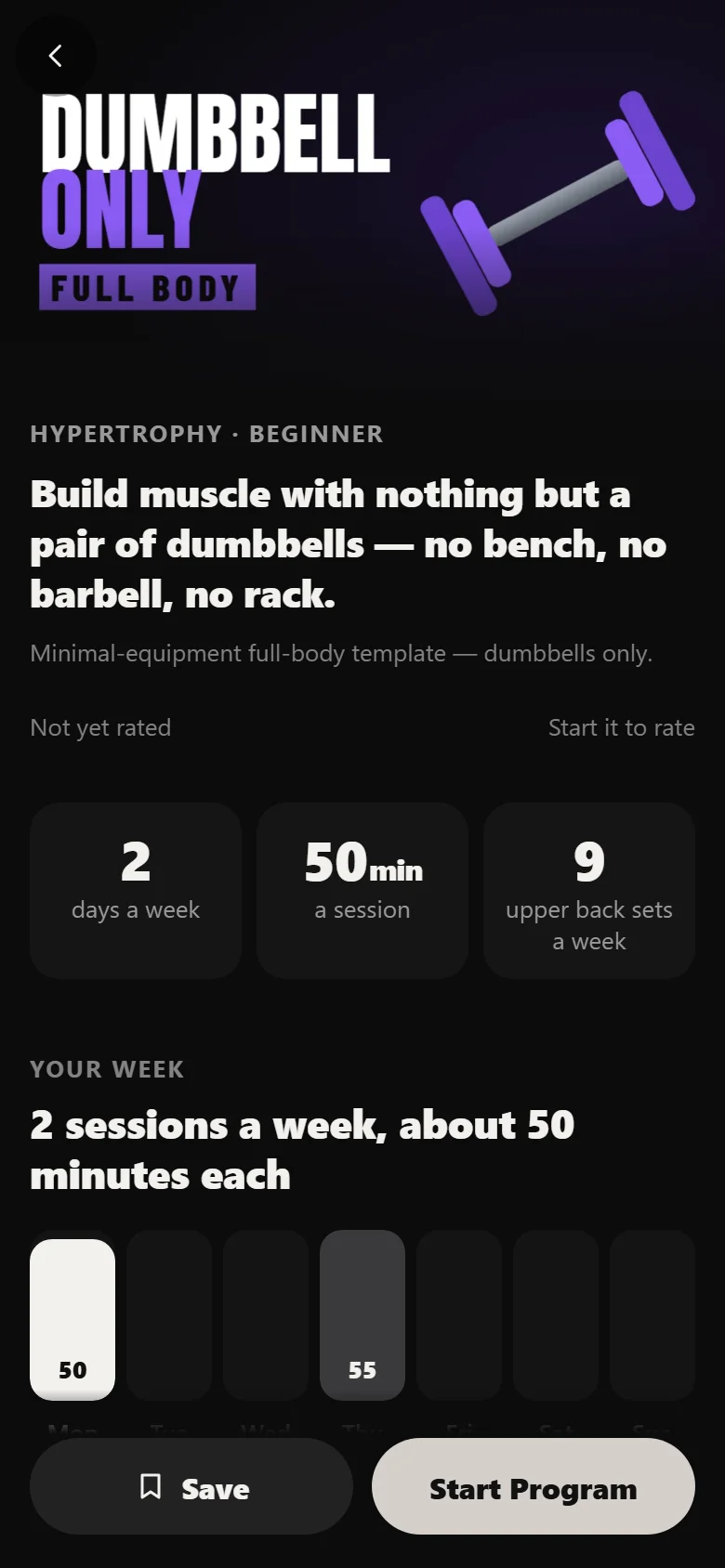
Dumbbell Only Full Body is the least demanding program in the catalogue in terms of equipment and time. A pair of dumbbells, no bench, no barbell, no rack, and two full-body sessions a week. The floor press covers chest work because there is nothing to lie on, and between the two days you still get legs, a press, a pull, a hinge and arms.
Every loaded lift runs double progression, and the program is explicit about the order it wants: add controlled reps across the range first, then the weight, and only once every set has topped out. This walkthrough follows eight sessions of that in the real app. Every weight, rep and estimate below is what the engine computed on a live drive.
The program for the equipment you actually have
In Discover, Dumbbell Only Full Body sits on the Hypertrophy shelf, marked Beginner, at two days a week. Search finds it by name, or Filter narrows the shelves by level and days a week. Tap the cover for a quick look, then View Program for the full page.
Very few complete programs are honest about running on two sessions a week. This one is built for it.
It is also the entry point of the home track. Add a bench and a third day and there is a bigger version of the same idea waiting. Start here if what you own is a pair of bells and a floor.
Two days, and a floor press instead of a bench
Day A is goblet squats, floor press, bent-over rows, Romanian deadlifts, lateral raises and curls. Day B is reverse lunges, dumbbell overhead press, single-arm dumbbell rows, single-leg Romanian deadlifts, rear-delt flyes, triceps extensions and calf raises. Six exercises and seven. Nothing on either day needs anything you cannot carry.
The floor press is the substitution worth understanding. Without a bench you cannot get the range of a dumbbell bench press, so the program uses the version that stops at the floor instead of pretending otherwise. It shortens the bottom of the movement and it is a genuine press, which is a better answer than skipping chest work for a month.
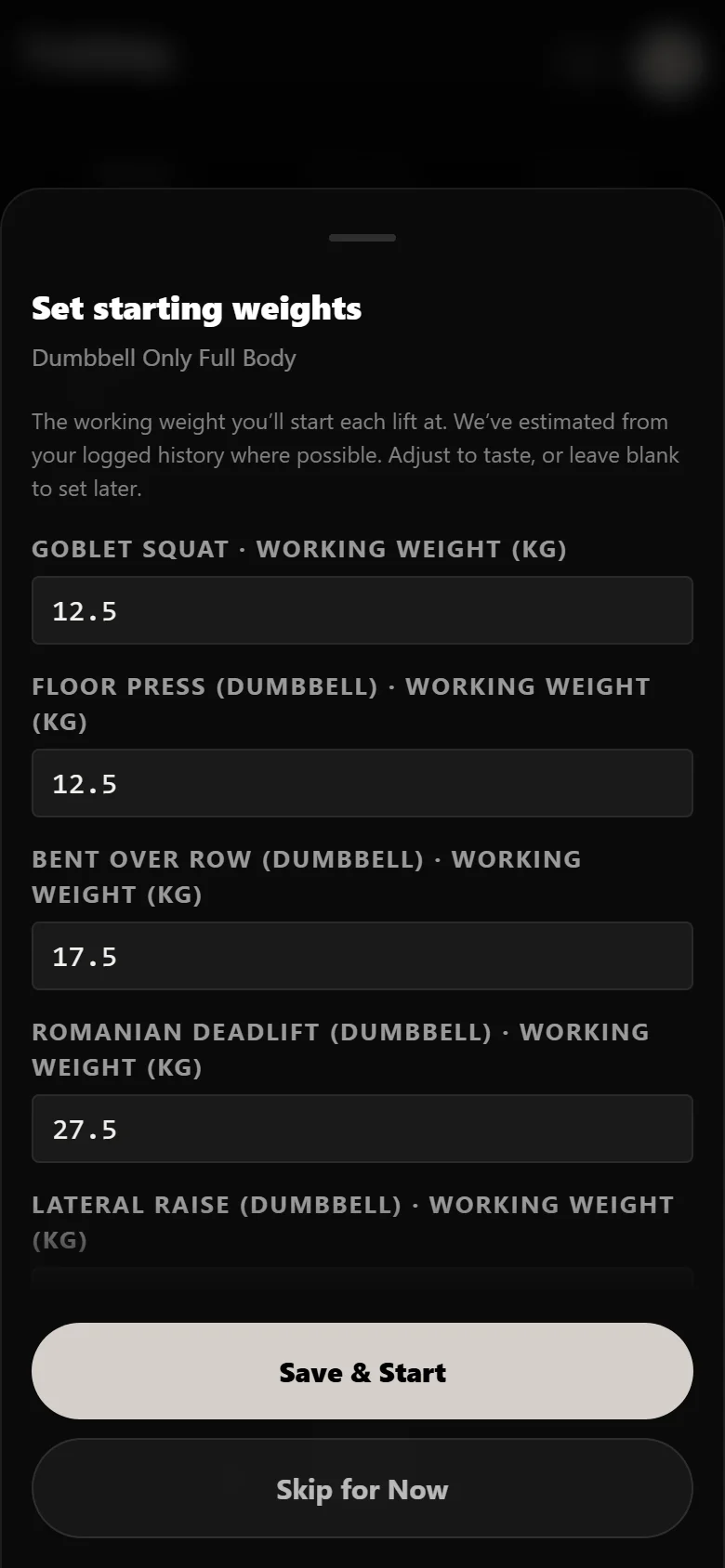
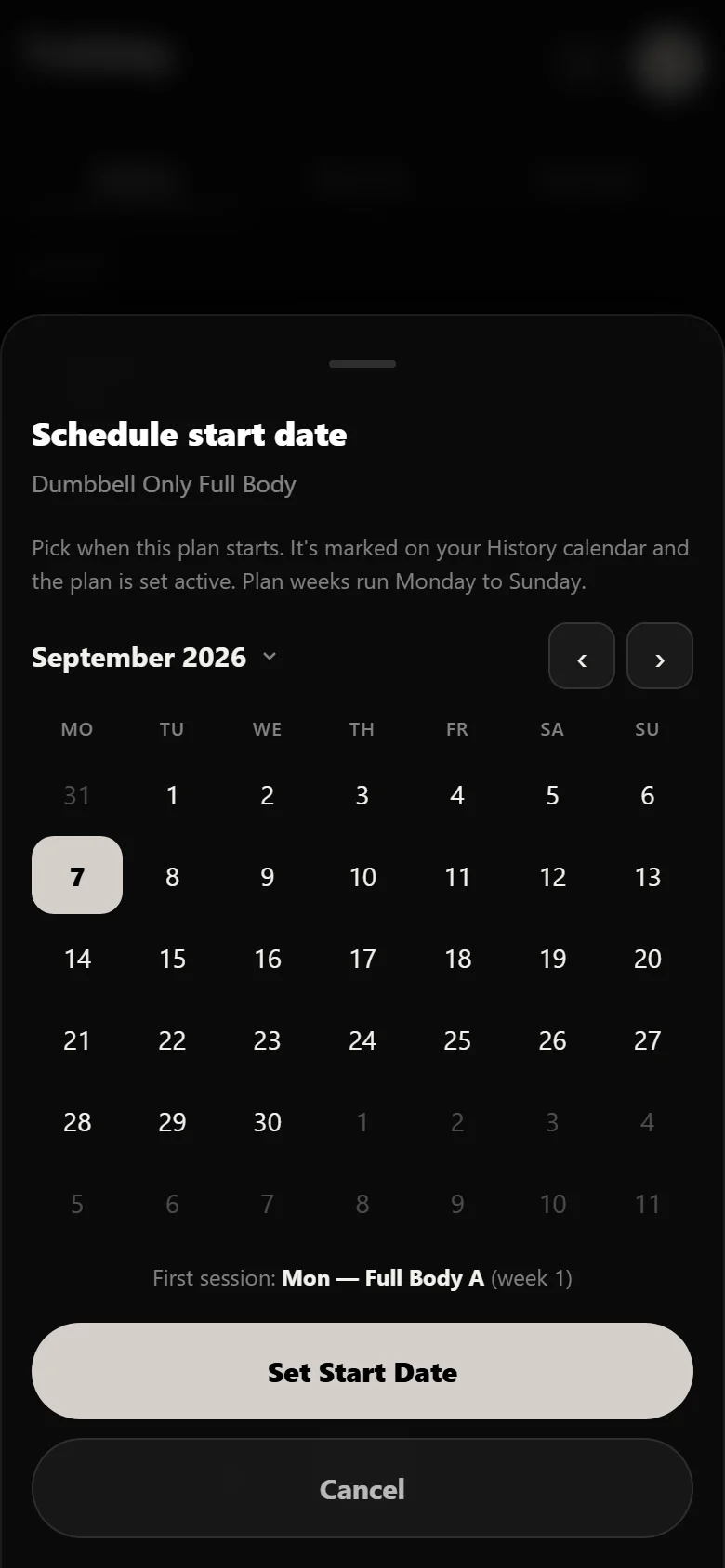
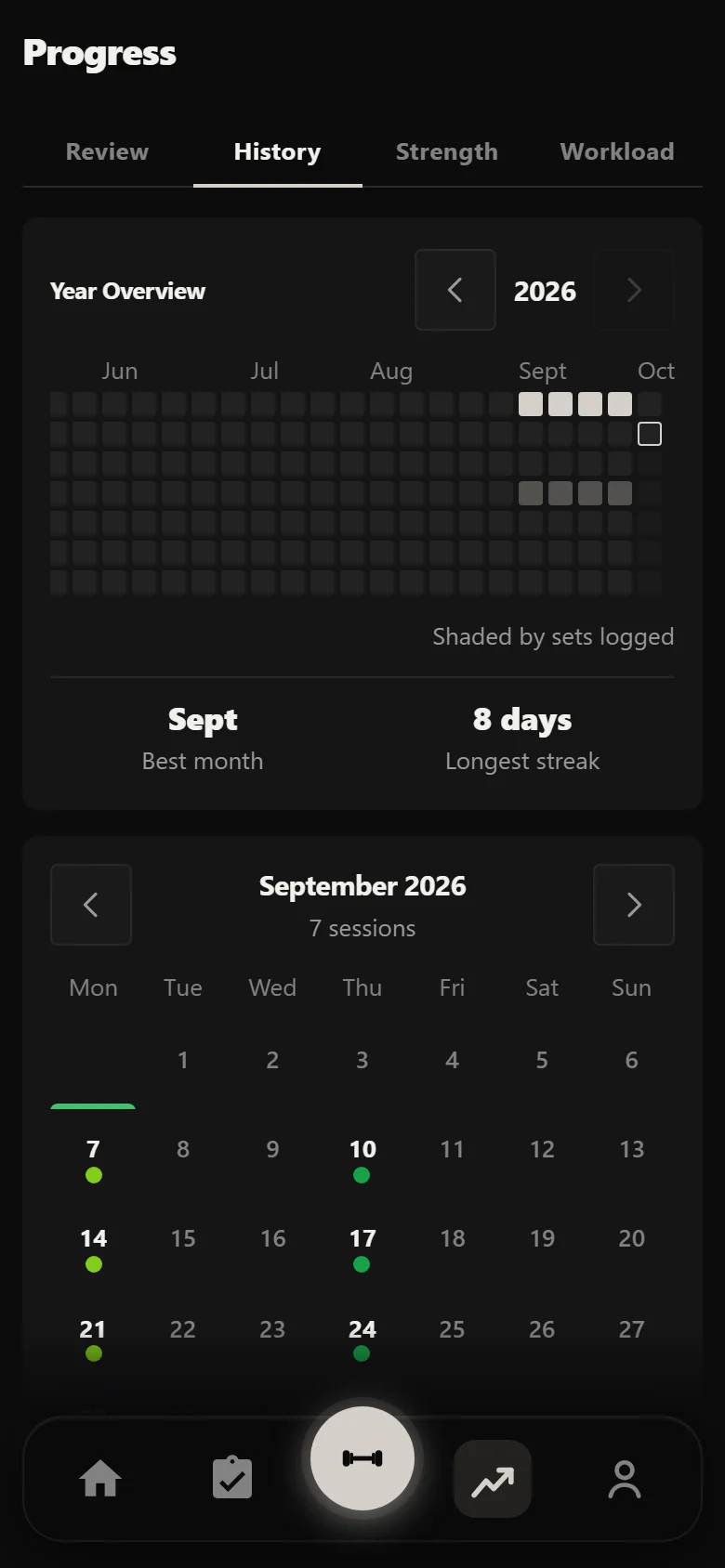
Setup asks for one working weight per lift and nothing else. No training max, no percentages, nothing to test. This run opens the goblet squat and the floor press at 12.5 kg, both rows at 17.5 kg, both Romanian deadlift variants at 27.5 kg, and the raises, flyes and arm work at 5 kg. Pick a start date and the eight sessions land on the History calendar from there.
Reps first, then weight
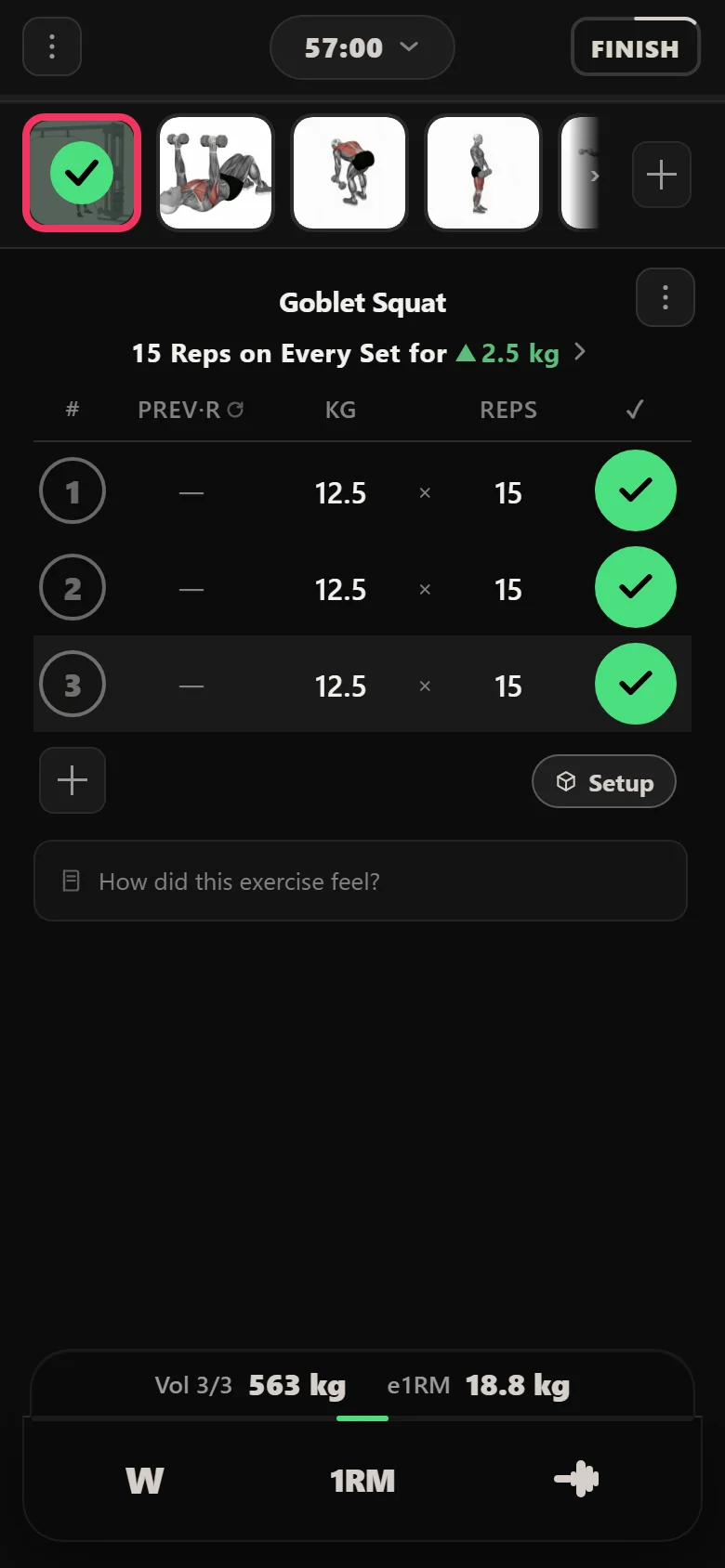
The chip under each exercise name states the rule while you are training. It is the same rule on every loaded lift here, just with a different range attached: reach the top of the range on every prescribed set, then the weight steps up 2.5 kg. Goblet squats and Romanian deadlifts are twelve to fifteen. Presses, rows and curls are ten to twelve. Raises, flyes and calves are fifteen to twenty.
The order matters more on dumbbells than anywhere else. A barbell can take a micro-plate; a fixed pair of bells cannot, so the reps have to carry the progression between the jumps. Getting from twelve reps to fifteen at the same weight is not marking time, it is the work that earns the next bell.
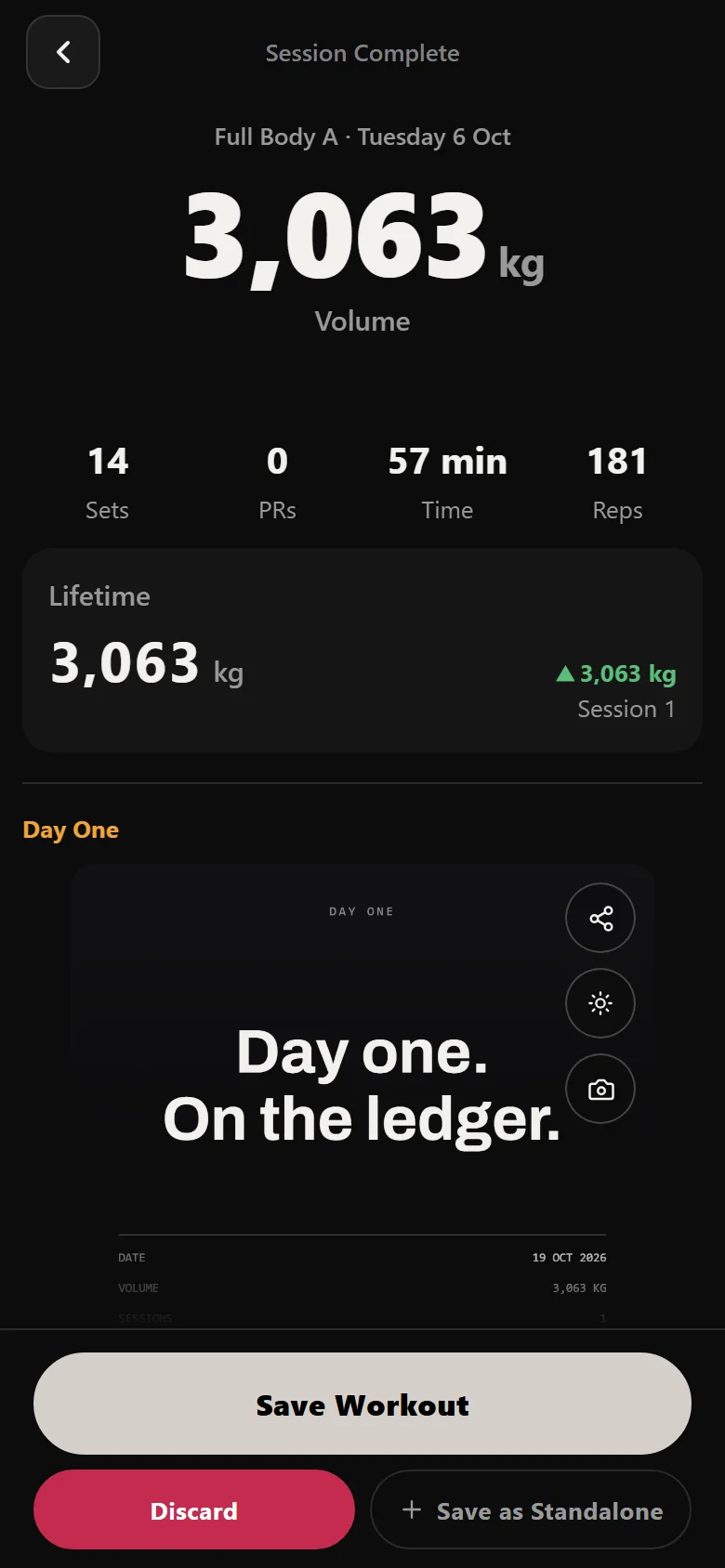
The app does the bookkeeping. The first goblet squat session goes down as 563 kg of volume, and the complete screen tallies a whole day-B session at 14 sets, 181 reps and 3063 kg of volume before it saves. Nothing there is typed in and nothing needs adding up afterwards.
The goblet squat: four appearances in four weeks
The goblet squat is on day A, so it comes up on sessions 1, 3, 5 and 7. That is four appearances in four weeks, which is worth pausing on: a lift's frequency is decided by how many days it sits on, not by how many days a week the program runs. Two sessions a week gives a once-a-week lift exactly as many chances as five sessions a week would.
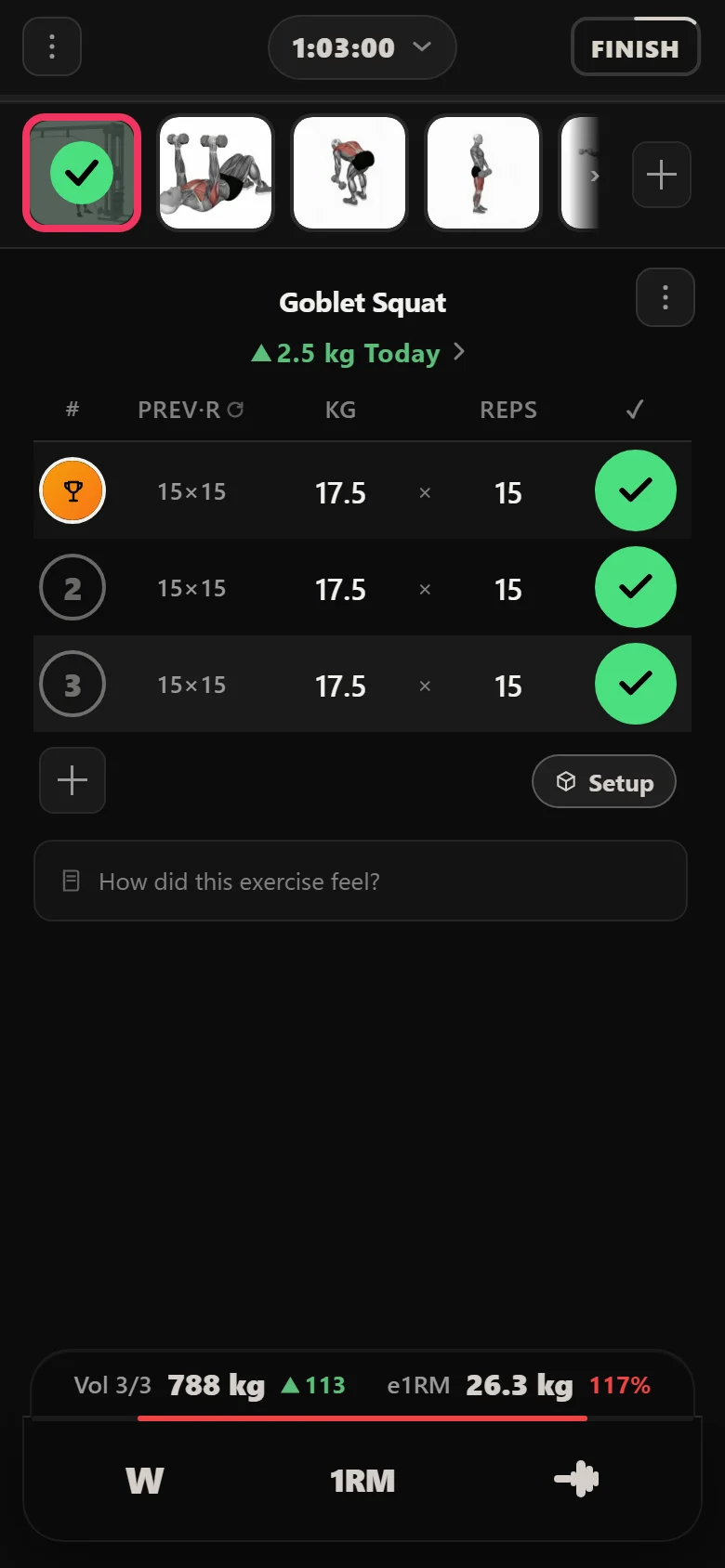
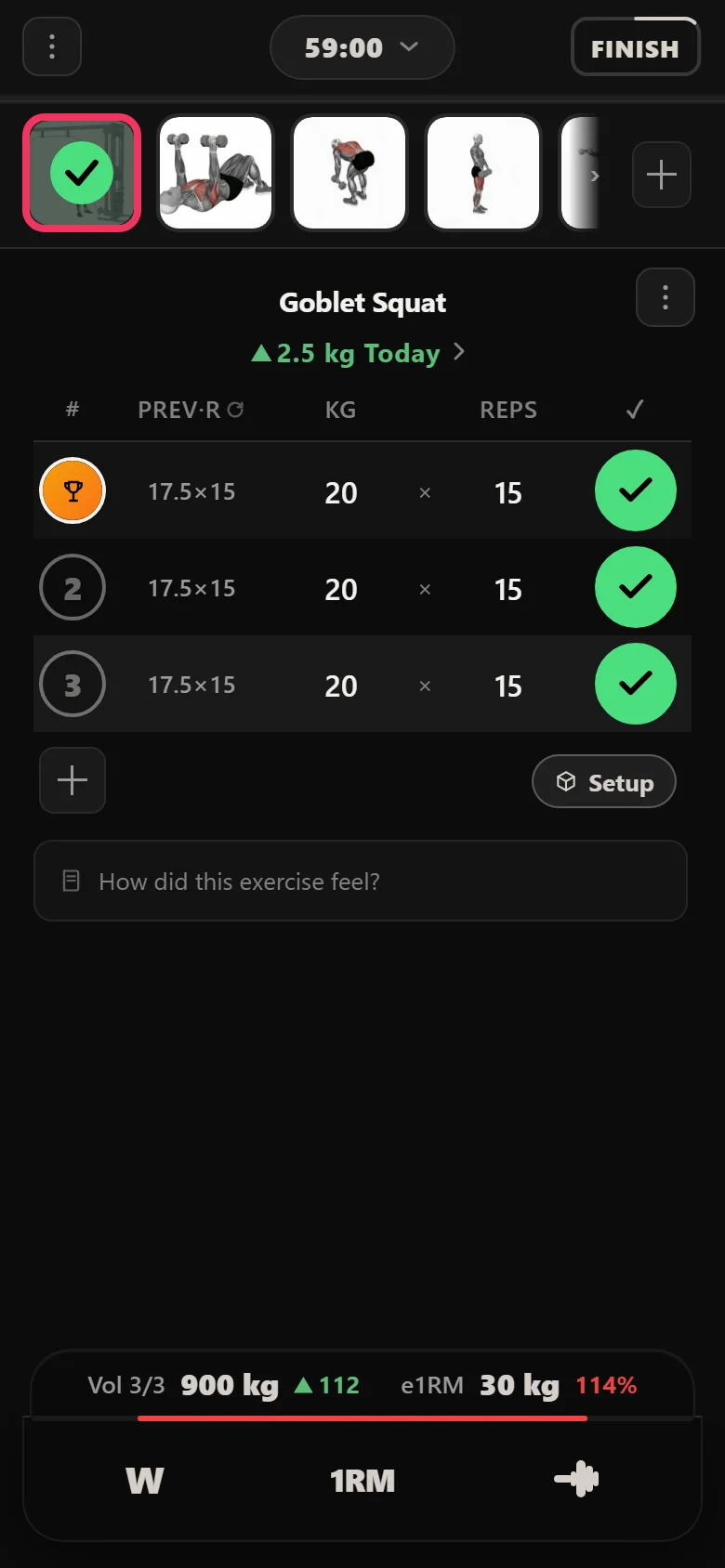
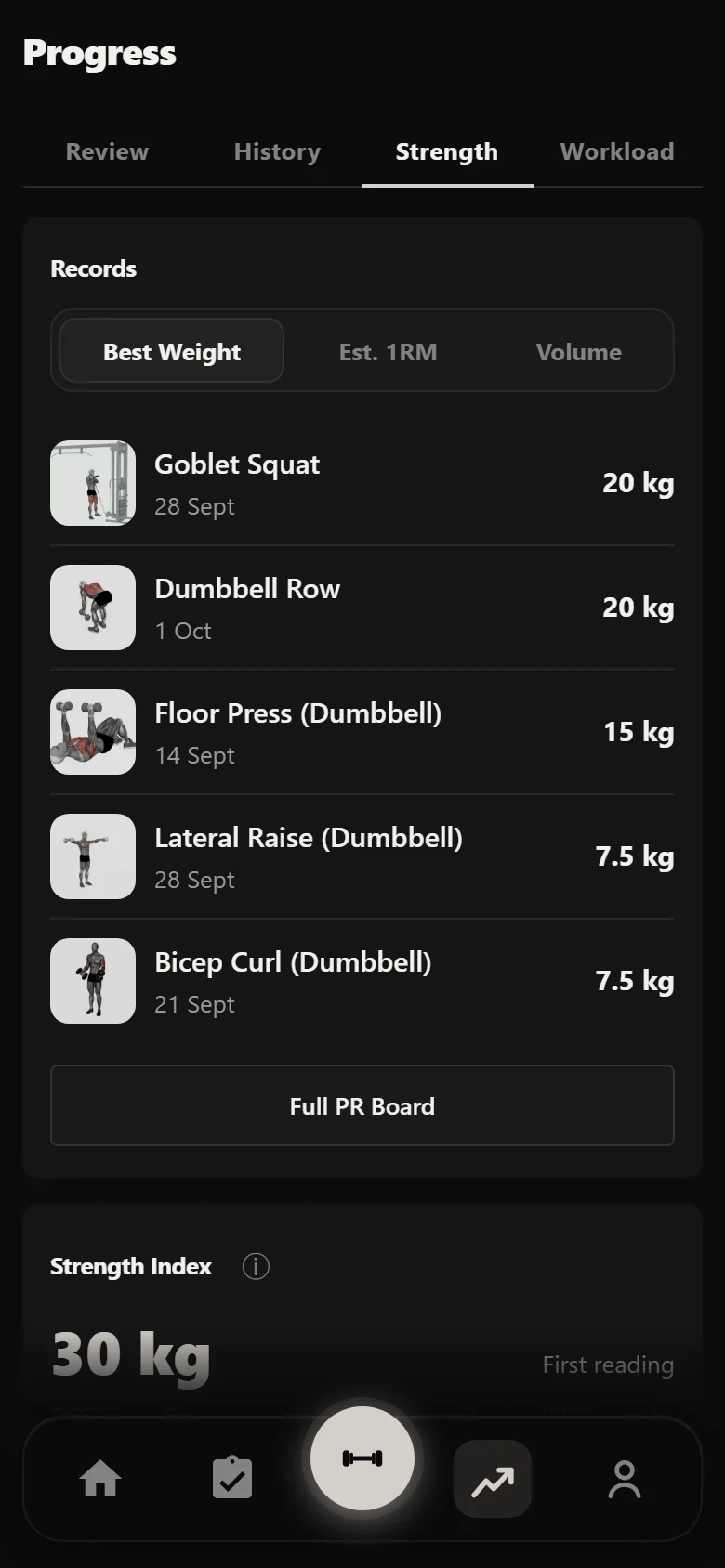
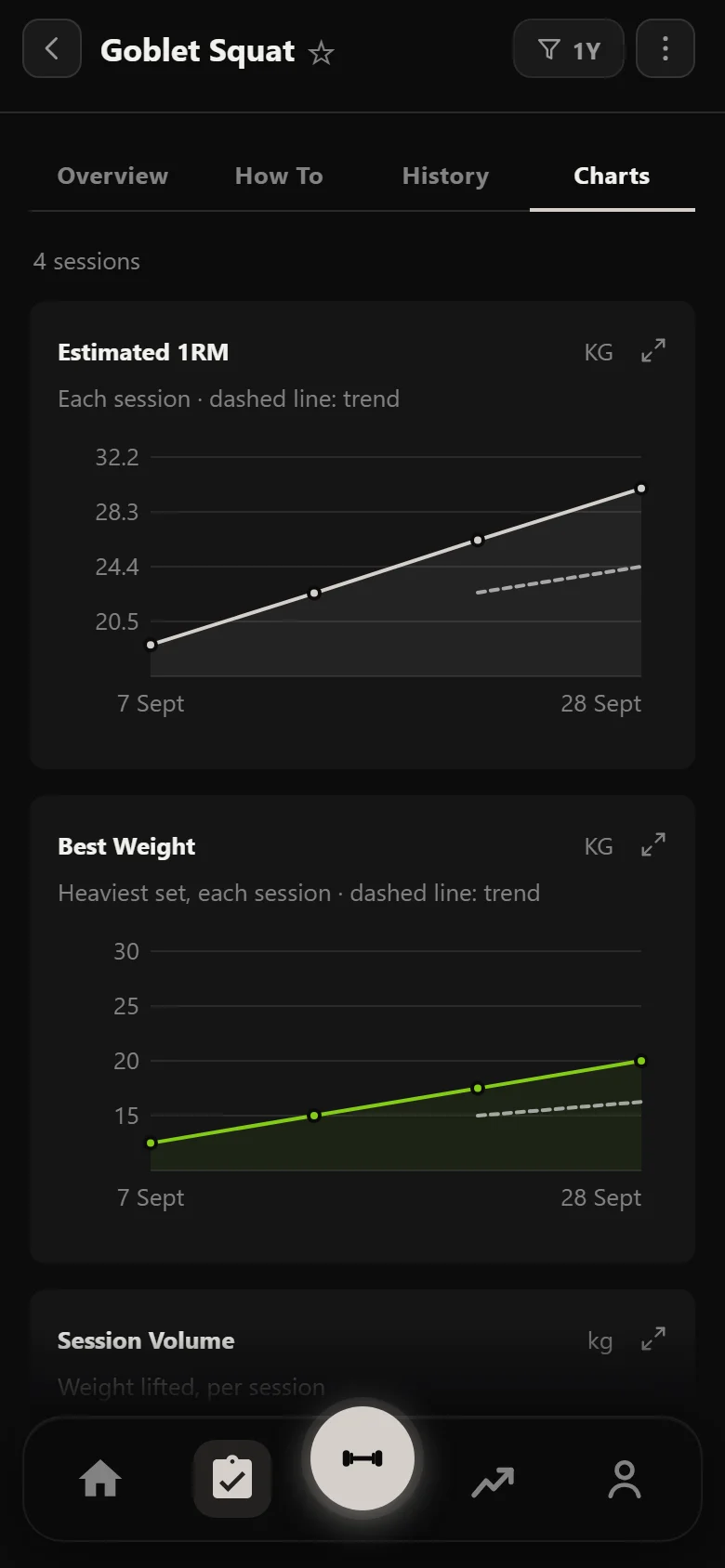
On this run it took all four. Fifteen reps on all three sets at 12.5 kg, so the next appearance came up at 15 kg, then 17.5 kg, then 20 kg, with 22.5 kg queued for the session after the block ends. The last session put 900 kg of goblet squats in the log, against 563 kg on the first.
It is a real climb and it also has a ceiling coming. A goblet squat is limited by what you can hold against your chest rather than by what your legs can lift, which is why the program puts reverse lunges on the other day instead of leaning on the goblet squat twice.
Goblet Squat: dumbbell weight, session by session
- 12.5S1 Session 1 — session 1
- 15S3 Session 3
- 17.5S5 Session 5
- 20S7 Session 7 — session 7
Two rows, same weight, opposite endings
This is the detail that makes the case for letting the app keep the record rather than a notebook. The program has two rowing movements. The bent-over row is on day A, the single-arm dumbbell row is on day B, and both of them opened the block at 17.5 kg with the same ten-to-twelve range and the same rule.
They finished in opposite directions. The single-arm row cleared its range and went up to 20 kg. The bent-over row fell short twice, so the app cut it by ten per cent and rounded it to 15 kg. Same starting weight, same rule, four weeks apart on the calendar, and a 5 kg gap between them by the end.
That is not an inconsistency to be fixed. Rowing both hands at once out of a hinge is a different demand from rowing one hand with the other braced, and one of them turned out to be harder at 17.5 kg than the other. What matters is that nobody had to notice. The engine judged each slot on its own sets and moved each one independently.
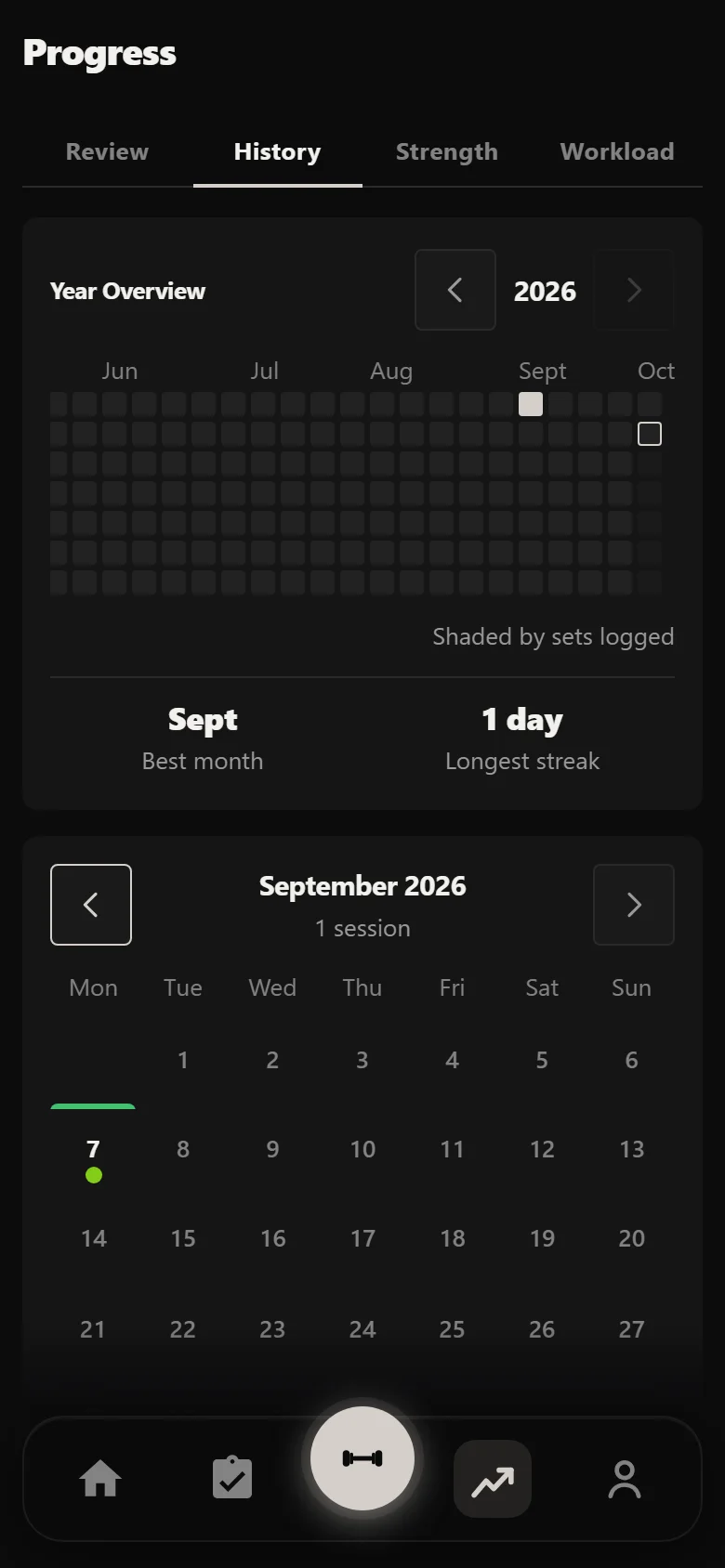
The rest of the block splits the same way. The floor press was the biggest mover, taking two steps from 12.5 kg to 17.5 kg. The lateral raise and the curl both went 5 kg to 7.5 kg, which is a fifty per cent jump earned rep by rep. Meanwhile both Romanian deadlift variants held at 27.5 kg, the reverse lunge and the overhead press held at 12.5 kg, and the rear-delt fly, triceps extension and calf raise all held at 5 kg. Roughly half the program moved and half held, which is what four weeks honestly produces.
Reading a two-day block afterwards
Eight sessions is not much data, and the charts are honest about that. The estimated one-rep max line has four points on it for any once-a-week lift, so it shows a direction rather than a shape. Trends on this program are things you read across several blocks, not inside one.
What a two-day week does give you is density. Each session carries six or seven exercises and the day-B total came to 181 reps, so these are not short workouts even though there are only two of them. If the constraint you are training around is days rather than time, that trade is the whole point of the program.
The other thing worth watching over time is the gap between the lifts that keep moving and the ones that have stopped. A lift that has held for three blocks is telling you it needs either a rep-range change or a heavier pair of bells, and the per-lift strength index is where that shows up first.
The payoff: 12.5 kg to 20 kg on two days a week
Two screenshots of the same goblet squat, six sessions apart. It opened at 12.5 kg and finished at 20 kg with 22.5 kg queued for next time, and every step was decided by the engine from the reps that were logged.
The program around it did what a program should: it moved the floor press two steps, took the lateral raise and the curl up a bell each, held the Romanian deadlifts where they were, and cut the bent-over row when it stopped clearing. Four weeks, eight sessions, one pair of dumbbells and no bench. The only thing asked of you is the reps.
Four appearances apart. Fifteen reps on all three sets every time, so the bells went up 2.5 kg on each of them.
Common questions
What equipment does Dumbbell Only Full Body need?
One pair of dumbbells. No bench, no barbell, no rack. Chest work is a floor press rather than a bench press, which is why it fits in a bedroom or a hotel room, and the two sessions a week still cover legs, a press, a pull, a hinge and arms.
Is two days a week enough?
It is enough to progress on, which is what this block shows. A lift's frequency comes from how many days it sits on rather than how many days a week you train, so a once-a-week lift on a two-day program gets exactly as many attempts in a month as it would on a five-day one. The trade is density: six or seven exercises per session, and one of the days here came to 181 reps.
Does this program use linear progression?
No. Every loaded lift runs double progression. You keep the same bells until every prescribed set reaches the top of its rep range, and only then does the weight go up 2.5 kg. The program is explicit that reps come first, because dumbbells cannot be micro-loaded and the reps are what carry you between the jumps.
Why did one of my rows go up and the other go down?
Because the app judges every slot on its own sets. On the block in this walkthrough the bent-over row and the single-arm dumbbell row both started at 17.5 kg, and the single-arm row cleared its range up to 20 kg while the bent-over row fell short twice and was cut to 15 kg. Two rows are not the same demand, and you do not have to notice which is harder for you.
What happens when a lift stops moving?
It holds, which is the rule working rather than failing. If a lift has held for several blocks, that is the signal to change something you control: a wider rep range, a slower tempo, or a heavier pair of bells. The per-lift strength index is where a long hold becomes visible.
Is Durata free?
Yes. Durata is free to use, with the full program catalogue, automatic progression maths, rest timers and PR tracking. Everything in this walkthrough is in the app.
Put it into practice
Durata is free to use — 50 proven programs, automatic progression, rest timers and PR tracking, all on your phone.