


Twice-A-Day in Durata: eight sessions a week on four calendar days
Every other program in this series puts one session on one day. Twice-A-Day puts two. Four training days a week, each carrying a short heavy barbell session in the morning and a long pump session for the same region in the evening, which comes to eight sessions a week.
That is an unusual amount of training and the program says so on the tin: it is aimed at advanced lifters with the time and the recovery for it. What makes it interesting to walk through is not the volume, though. It is that the two halves of a training day progress by different rules, so the morning and the evening ask you to watch different numbers.
Finding the program
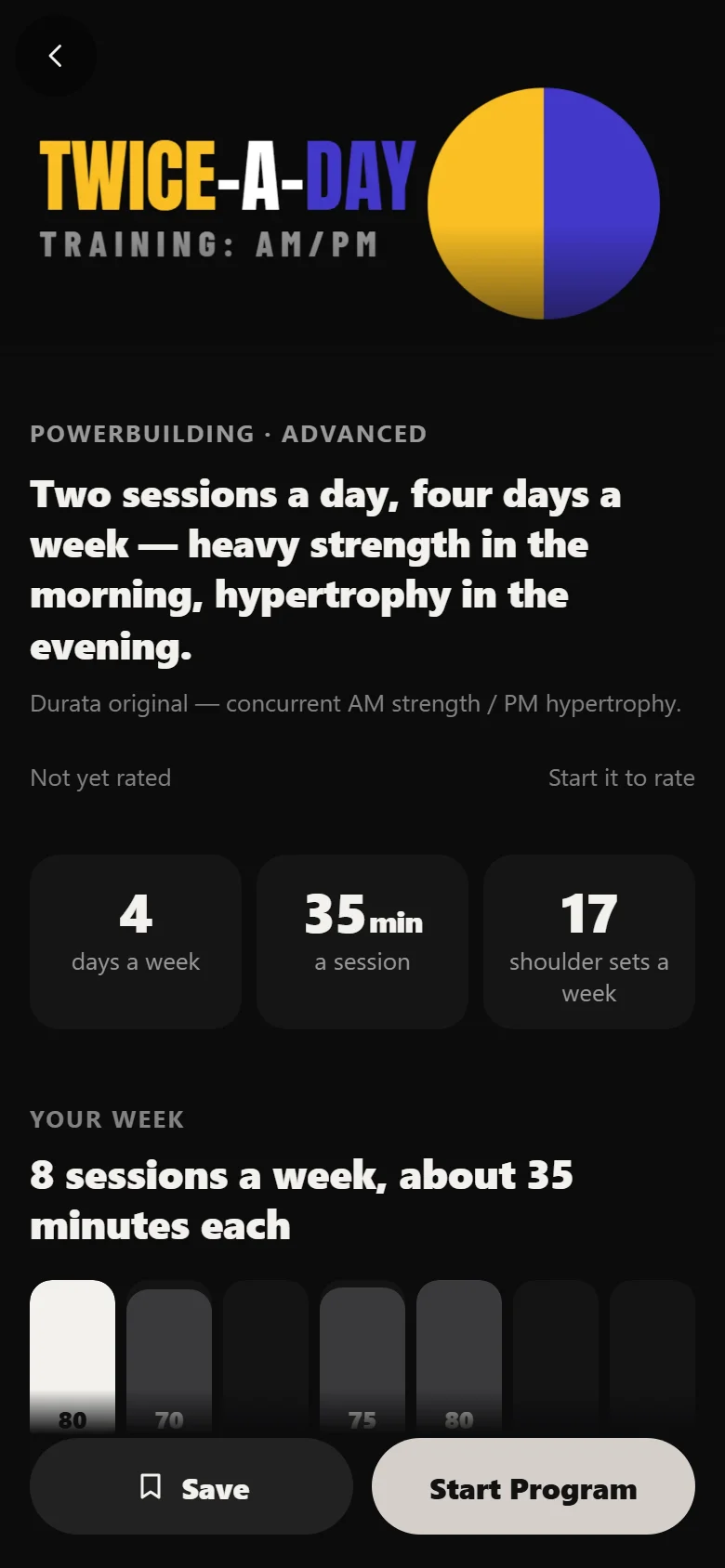
In Discover, Twice-A-Day sits on the Powerbuilding shelf, marked Advanced, at four days a week. Search finds it by name, or Filter narrows the shelves by level and days a week. Tap the cover for a quick look, then View Program for the full page.
The program page shows the shape before you commit. Monday is squat, Tuesday is bench, Thursday is deadlift, Friday is overhead press, and each of those days carries an AM strength session and a PM pump session for the same region.
Setting the openers
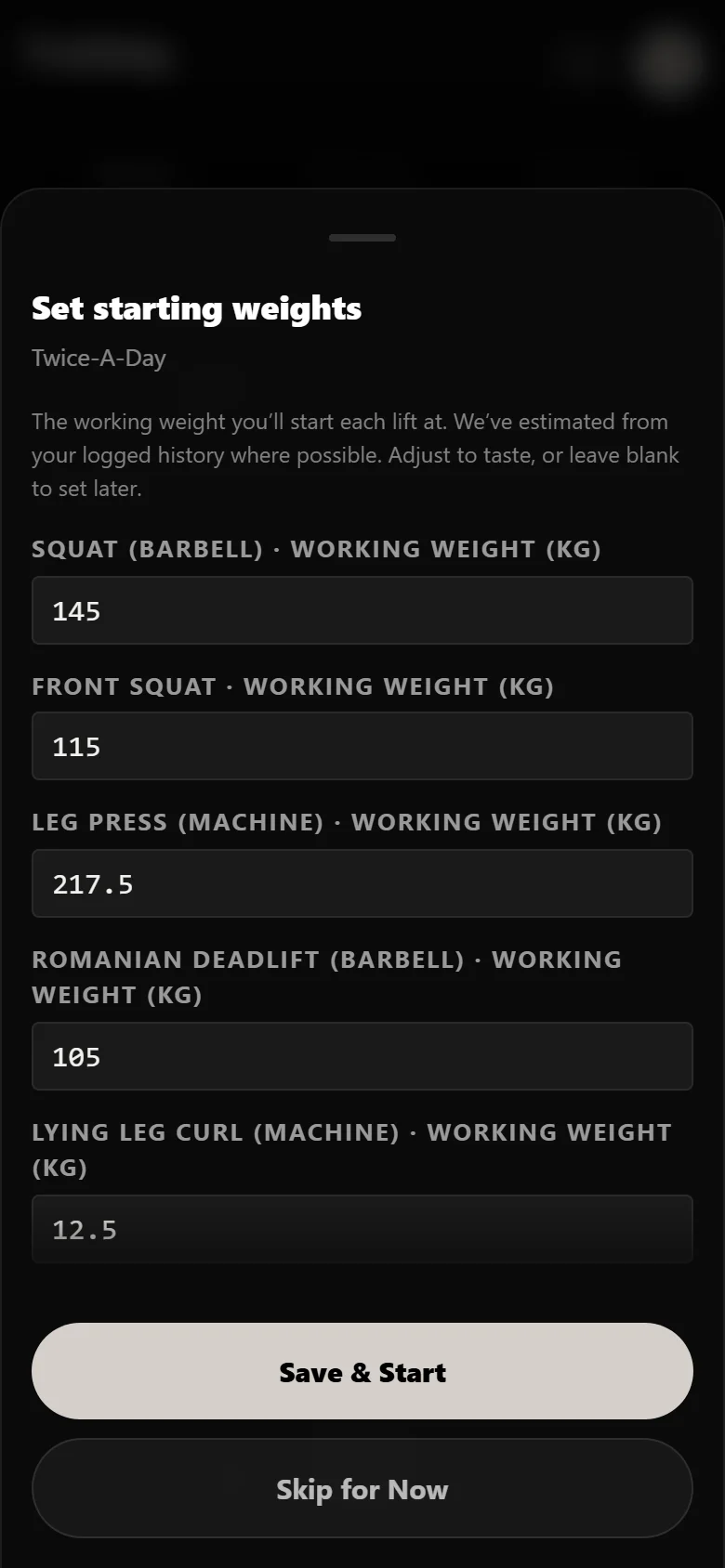
There are no training maxes and no percentages anywhere. The setup sheet asks for a working weight per lift, and this run opened with 145 kg on the squat, 115 kg on the front squat, 105 kg on the bench and the Romanian deadlift, and 12.5 kg on most of the evening isolation work. The deadlift opened at 175 kg.
Two openers matter more than the rest. The morning barbell lifts add weight every time you clear them, so an ambitious opener there gets expensive quickly. The evening weights matter less than they look, for reasons the next section covers.
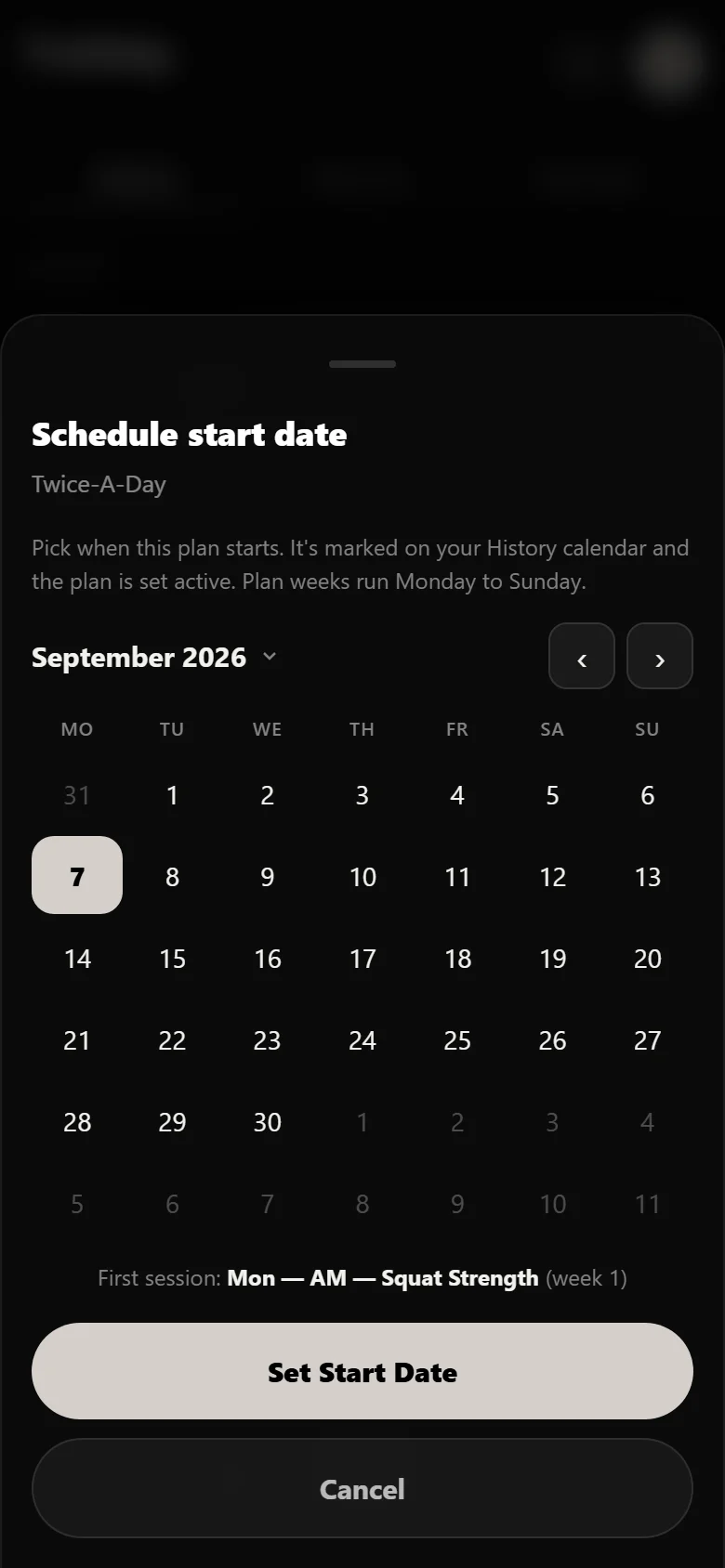
A start date lays the pattern out. Four days a week, two sessions on each.
The morning: short, heavy, linear
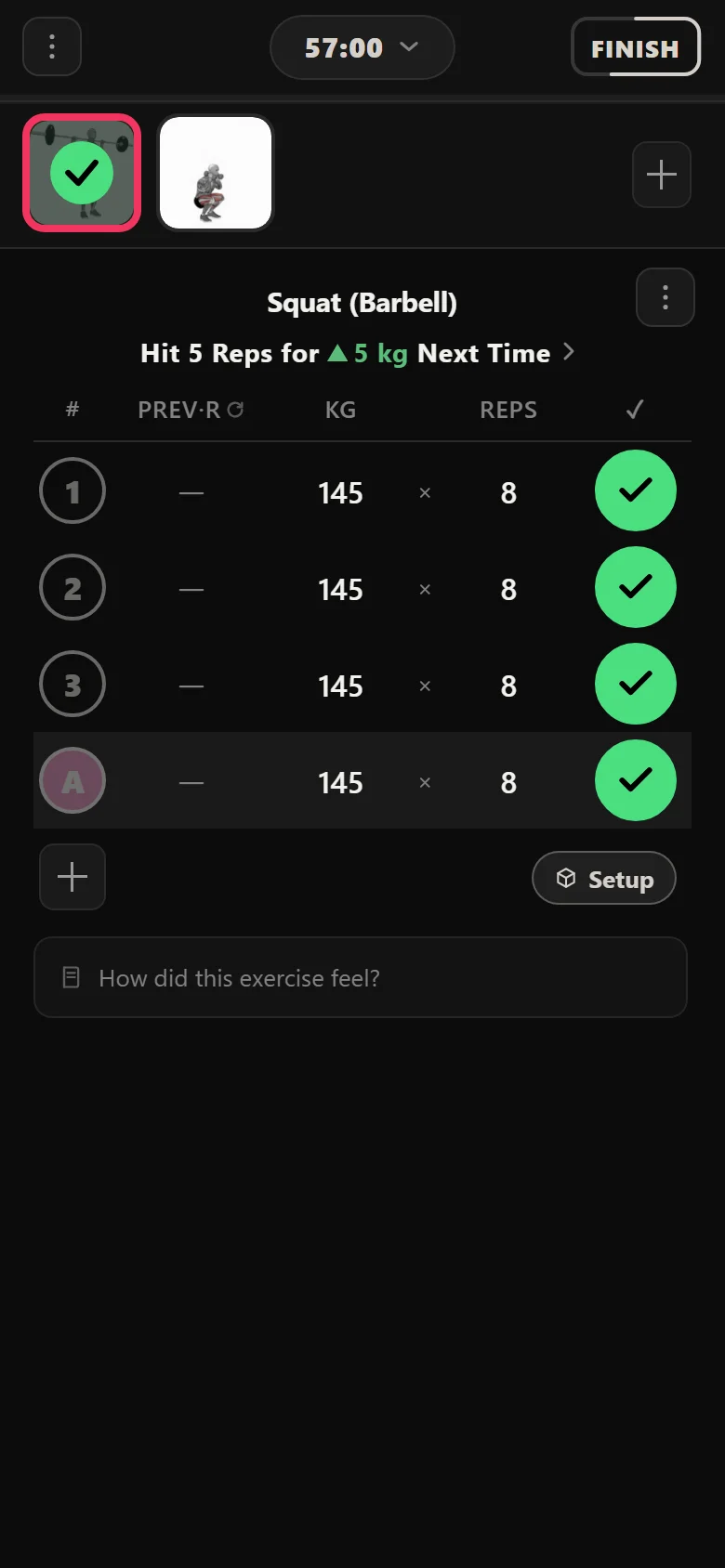
An AM session is two exercises. The squat opens at 145 kg for four sets of five, the last of them an AMRAP, and a front squat follows it. That is the whole morning.
The rule on it is plain linear progression. Clear the sets and the app adds 5 kg next time, with no rep range to climb first. It is the fastest-moving rule in the catalogue and it is put on the fewest exercises, which is the trade the program is making: a small number of lifts advancing quickly, trained fresh.
One detail worth knowing. The morning lifts allow three failed sessions at a weight before the rule cuts them, where most programs in the app allow two. Heavy barbell work fresh in the morning is variable enough that a single bad session says less than it does elsewhere, so the rule waits longer before acting.
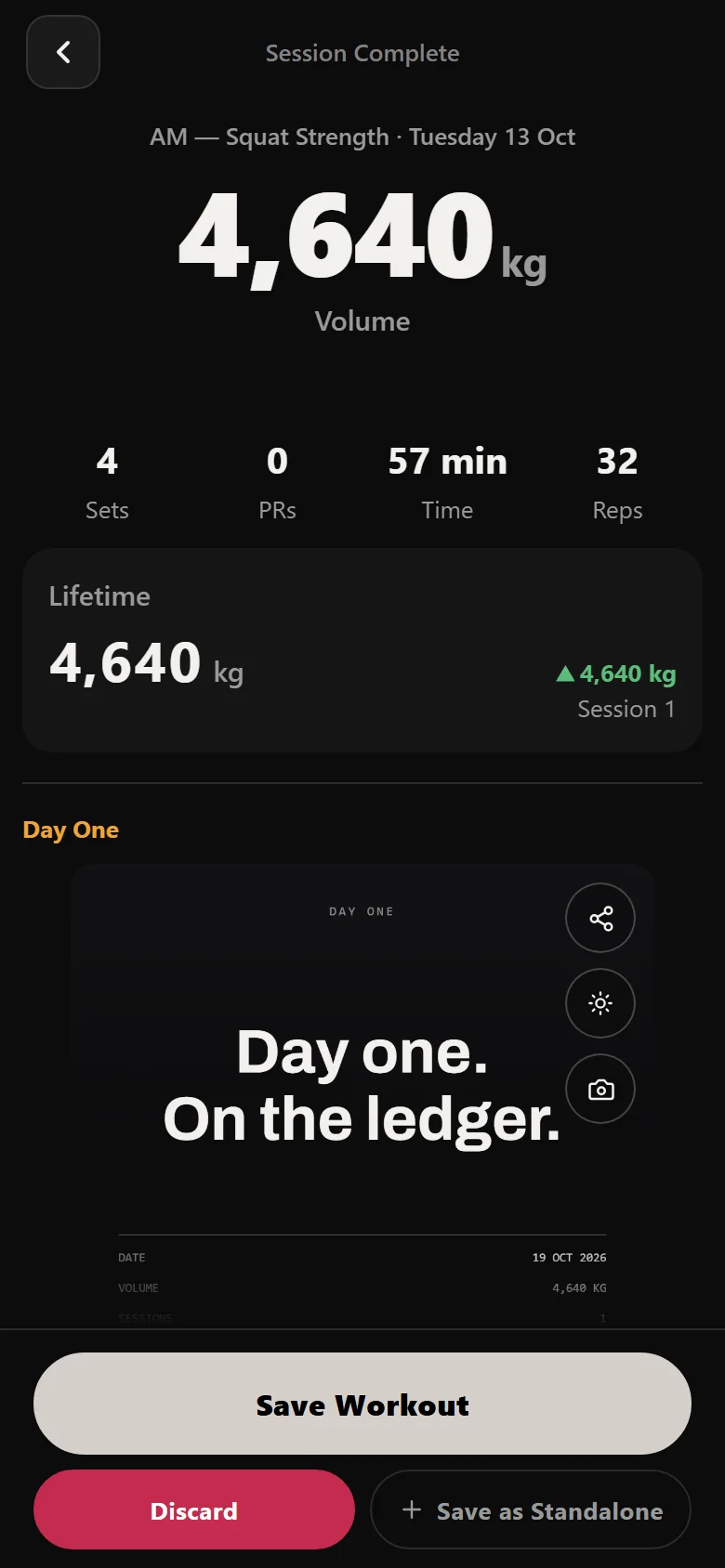
A morning session tallies at 4640 kg over four sets. Short is the point. You are in and out, and the volume arrives twelve hours later.
The evening: long, light, double progression
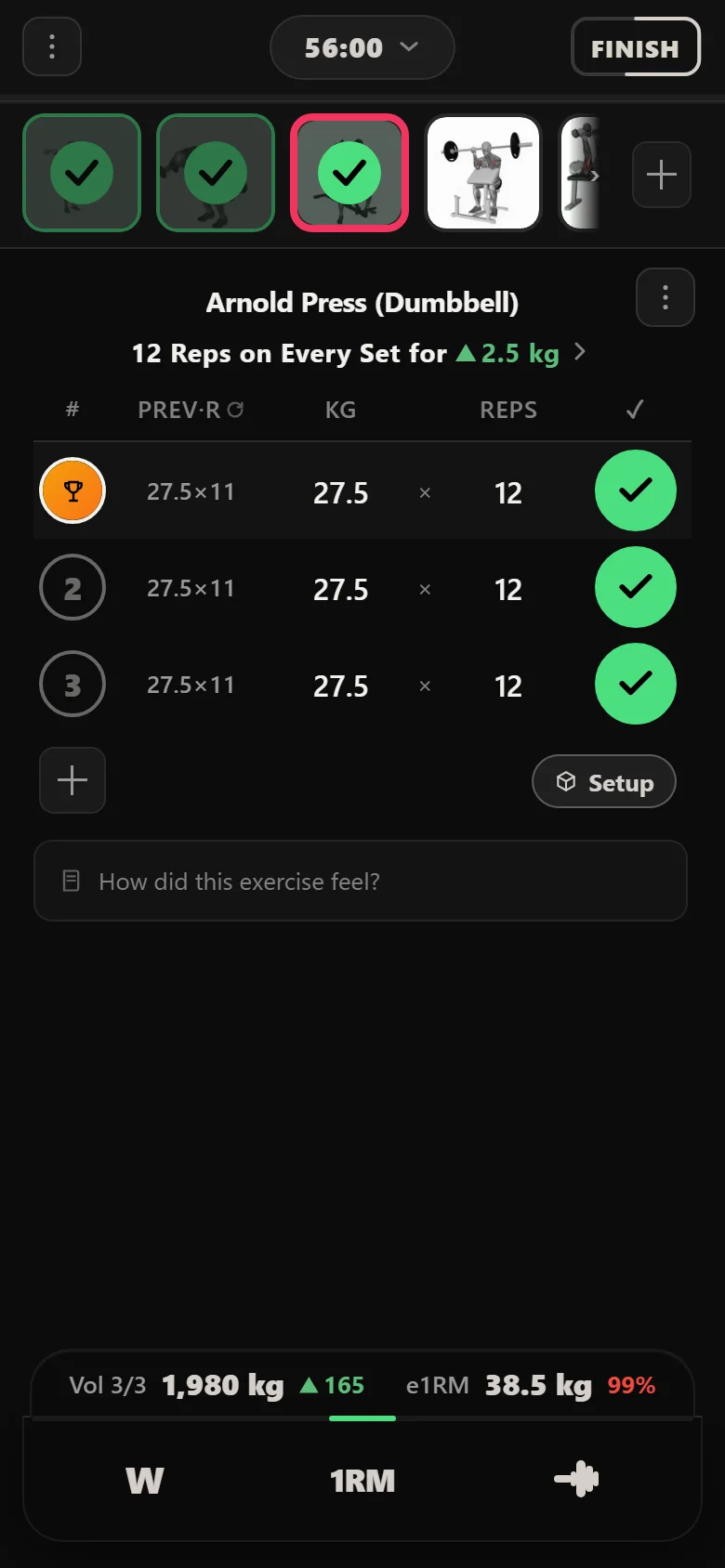
The PM session for the same region runs five exercises of pump work, and every one of them carries double progression instead. You climb the rep range at a fixed weight, and only when every set tops out does the load move by 2.5 kg and the reps reset to the bottom.
That difference is the whole design. In the morning you watch the weight, because it moves every session. In the evening you watch the reps, because the weight is supposed to sit still while you add work to it. A PM lift that has not changed weight in a fortnight is not stuck; it is doing its job while the rep count climbs underneath it.
It also means the evening openers are forgiving. Start the pump work lighter than feels impressive. The rule will find the right weight from your reps, and starting light costs you a week where starting heavy costs you the ability to finish the session.
Eight sessions a week, counted two ways
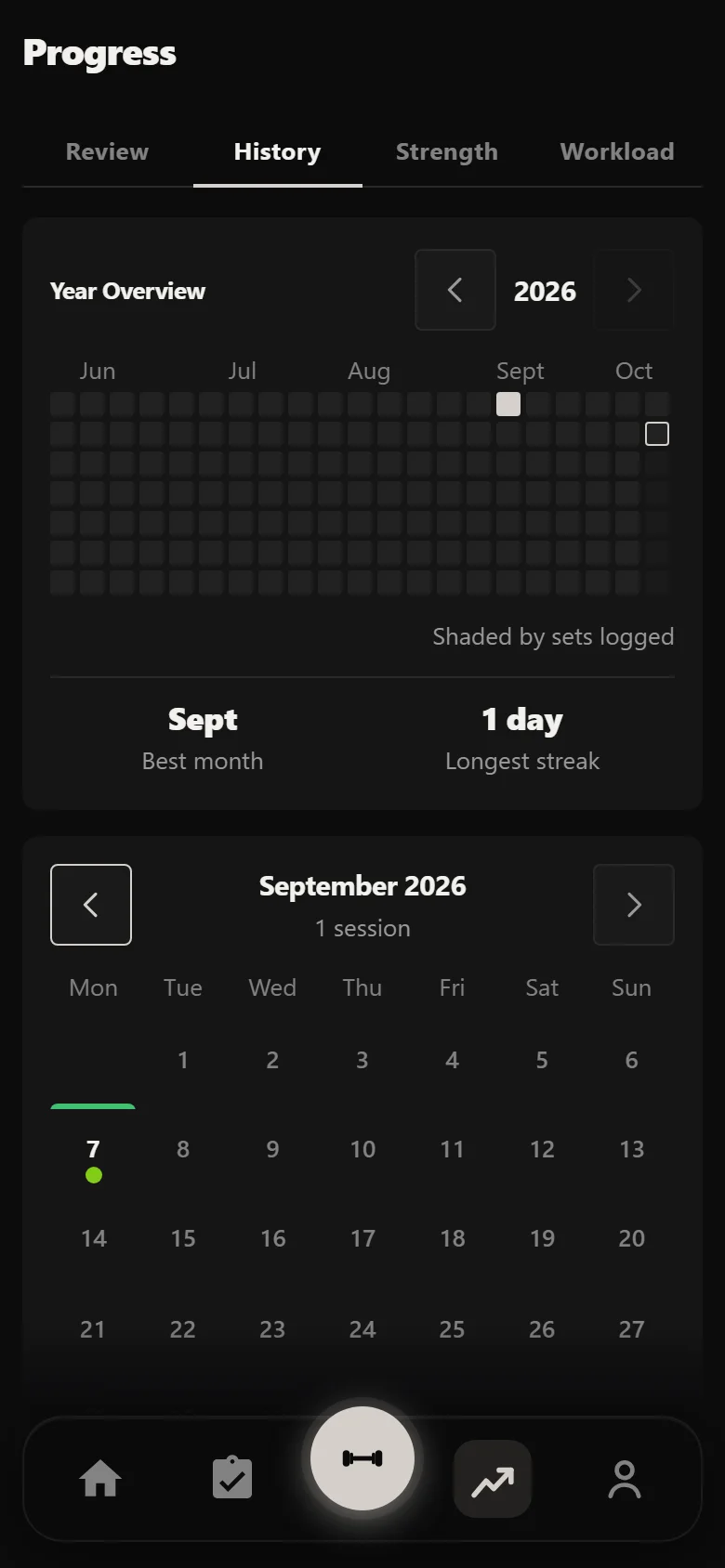
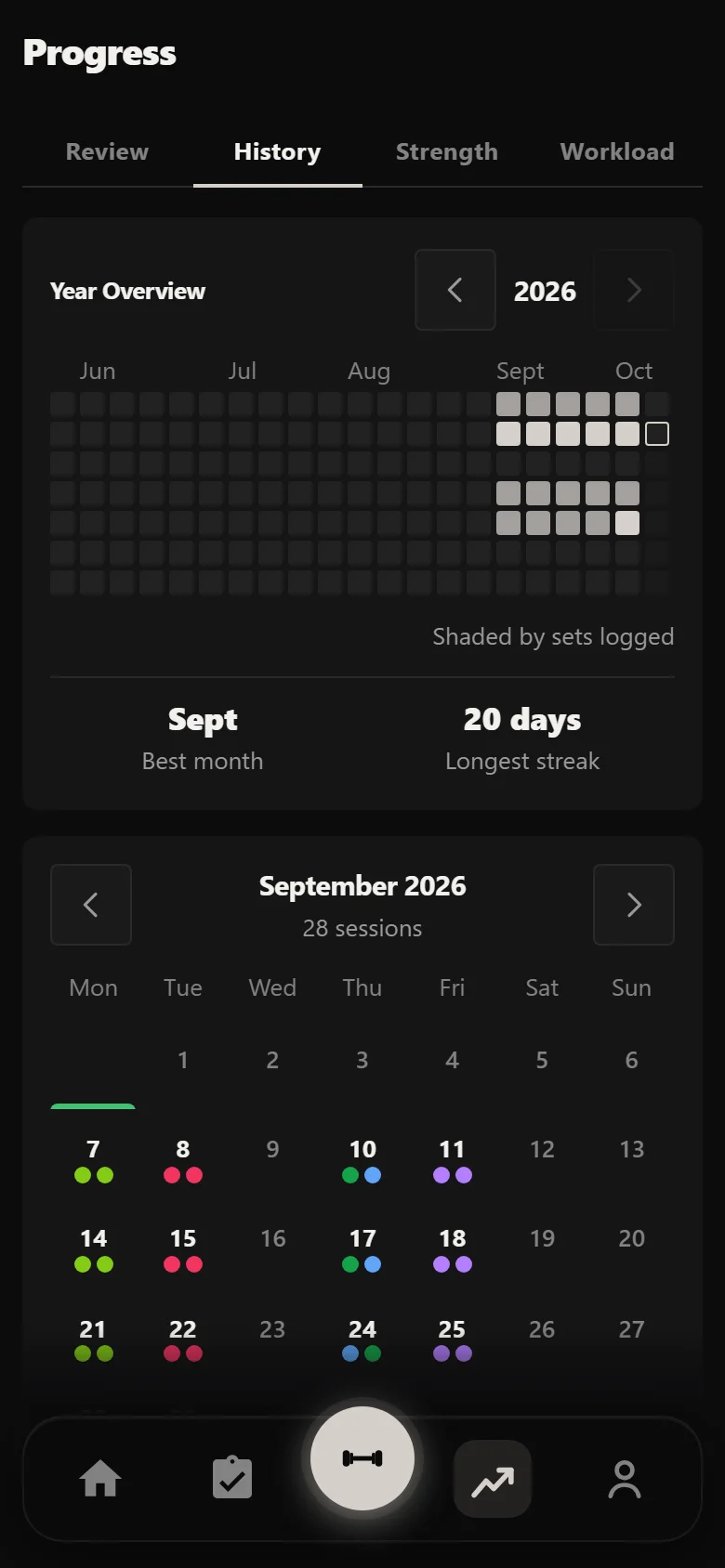
The history calendar is where the structure becomes obvious. Each training day carries two entries rather than one, with the AM session always listed above the PM session.
The numbers confirm it from two directions. Across the block the app recorded 34 sessions over 17 training days, which is exactly two a day. And the squat, which appears once a week, turns up at sessions 1, 9, 17, 25 and 33 in the log. Eight sessions between appearances, not four.
This is the practical thing to check before starting. Eight sessions a week is not four days of training with extra sets bolted on. It is eight separate occasions on which you have to get to a gym, warm up and train, and the program is honest that it is built for people whose weeks have room for that.
Five weeks without a missed session
The squat went 145, 150, 155, 160, 165 kg on its five appearances and never failed one of them. The ledger carried it out of the block at 170 kg.
There is no stall in this walkthrough, no rule chip opened in anger and no deload, which makes it the odd one out among these program walkthroughs. It is worth saying plainly that this is not the normal case. A linear rule that never misses is a linear rule that has not yet found your ceiling, and on 5 kg a week it will find it. What the program buys with its structure is that the morning lift arrives fresh rather than at the end of a long session, which pushes that meeting further out than it would otherwise be.
The strip below is the squat across the block.
Squat (Barbell) across five appearances
- 145S1 Session 1 — start
- 150S9 Session 9
- 155S17 Session 17
- 160S25 Session 25
- 165S33 Session 33 — no missed session all block
What each half of the day actually did
The three morning barbell lifts all climbed hard: squat 145 kg to 170 kg, bench 105 kg to 117.5 kg, deadlift 175 kg to 200 kg. Those are the numbers the program is designed to move, and they moved on a plain rule at one session a week each.
The evening work mostly held its weight. The leg press went from 30 kg to 42.5 kg and the cable flyes from 12.5 kg to 17.5 kg, but the pushdowns, lateral raises, face pulls and most of the rest finished where they started. Under a rep-range rule that is the expected result over five weeks, and it is not the same thing as a lift being stuck.
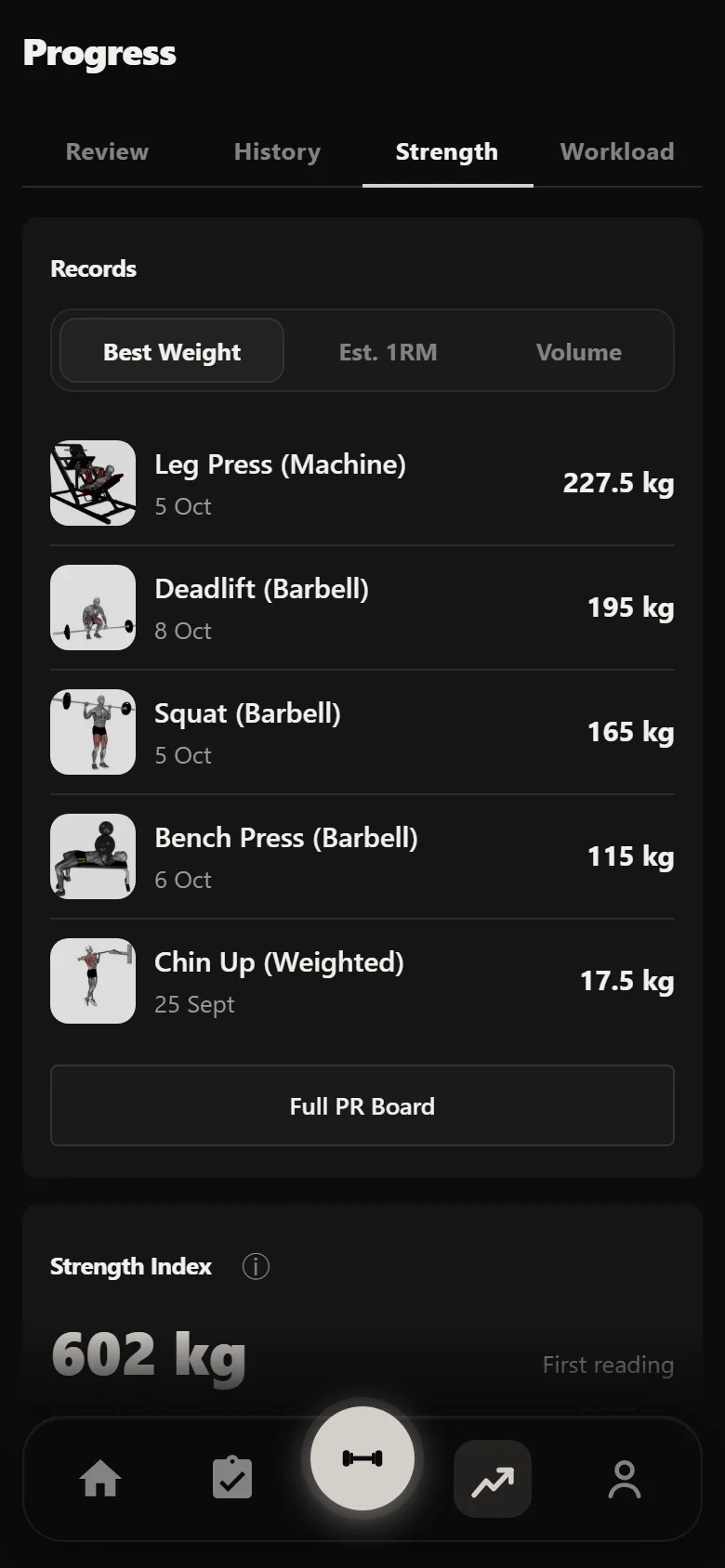
The Strength tab puts the block in order. Records by best weight run deadlift 195 kg, squat 165 kg, bench 115 kg, and the Strength Index adds the main lifts' estimates up to 602 kg: 247 kg on the deadlift, 209 kg on the squat, 145.7 kg on the bench. The gap between the top two and everything else is the AM and PM halves of the program showing up as a shape.
What five weeks of it adds up to
The Review tab reads a month at a time, and September alone came to 84,743 kg: 28 sessions on 14 days, 104 sets and 1,006 reps. Split that by half of the program and the picture is clearer than the total: the mornings contributed a small number of very heavy sets and the evenings contributed most of the reps.
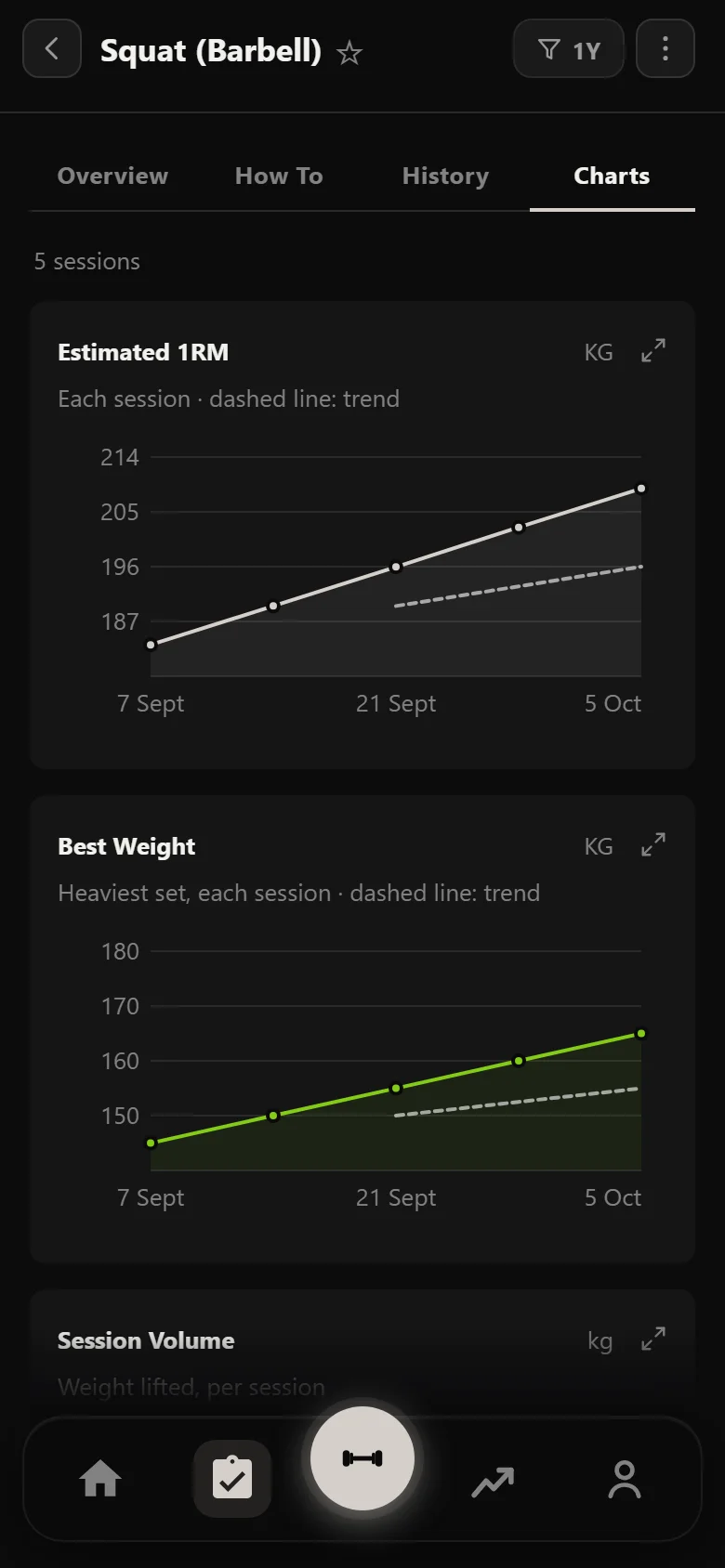
The estimate chart for the squat is a straight line, which is what an unbroken linear run looks like and is not what most blocks look like. Enjoy it while it lasts, and expect the first stall to arrive somewhere the week after this walkthrough ends.
Where it ended
165 kg on the bar at the last appearance, with the estimate at 209 kg, and 170 kg already queued for the session after. Every step of it was set by the reps that were logged in the morning, while a second progression ran independently every evening on the same muscles.
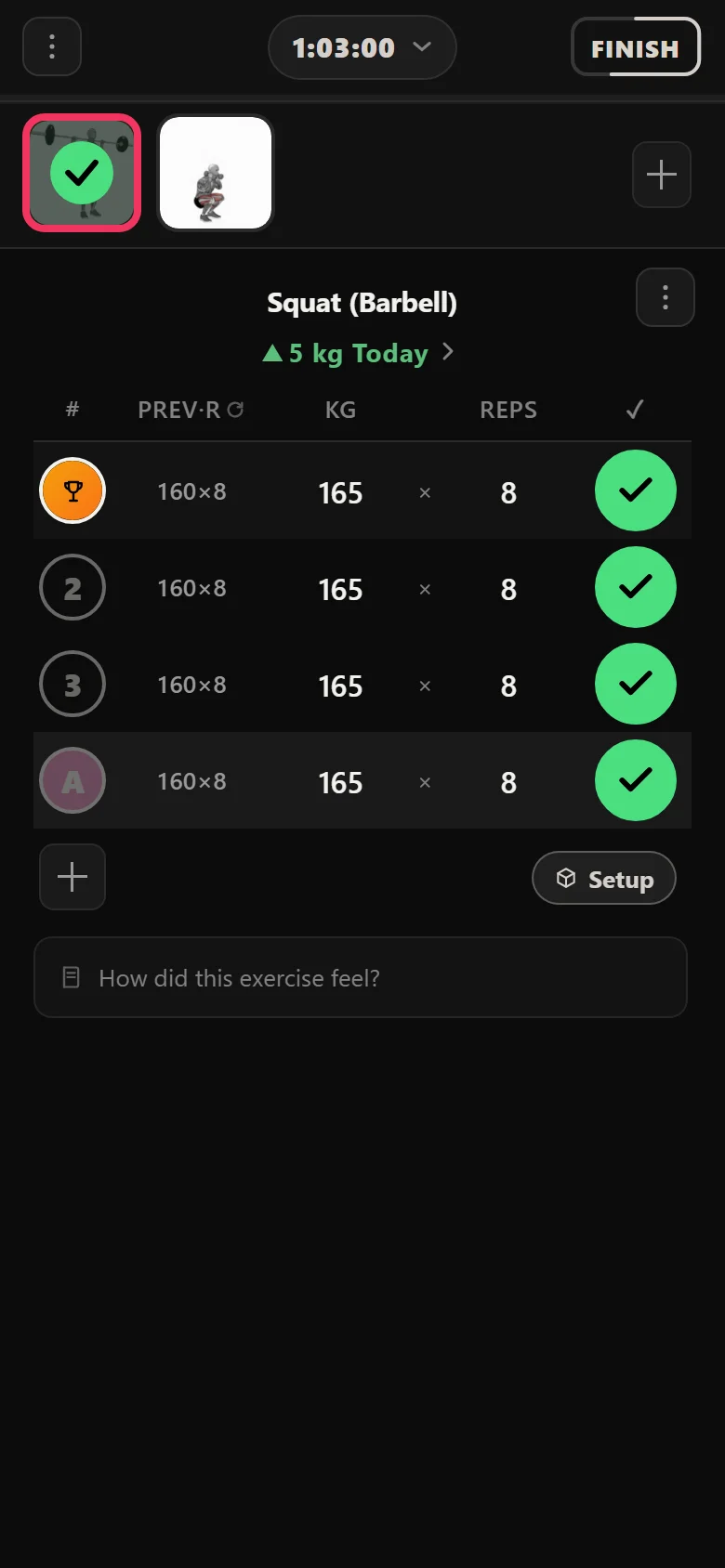
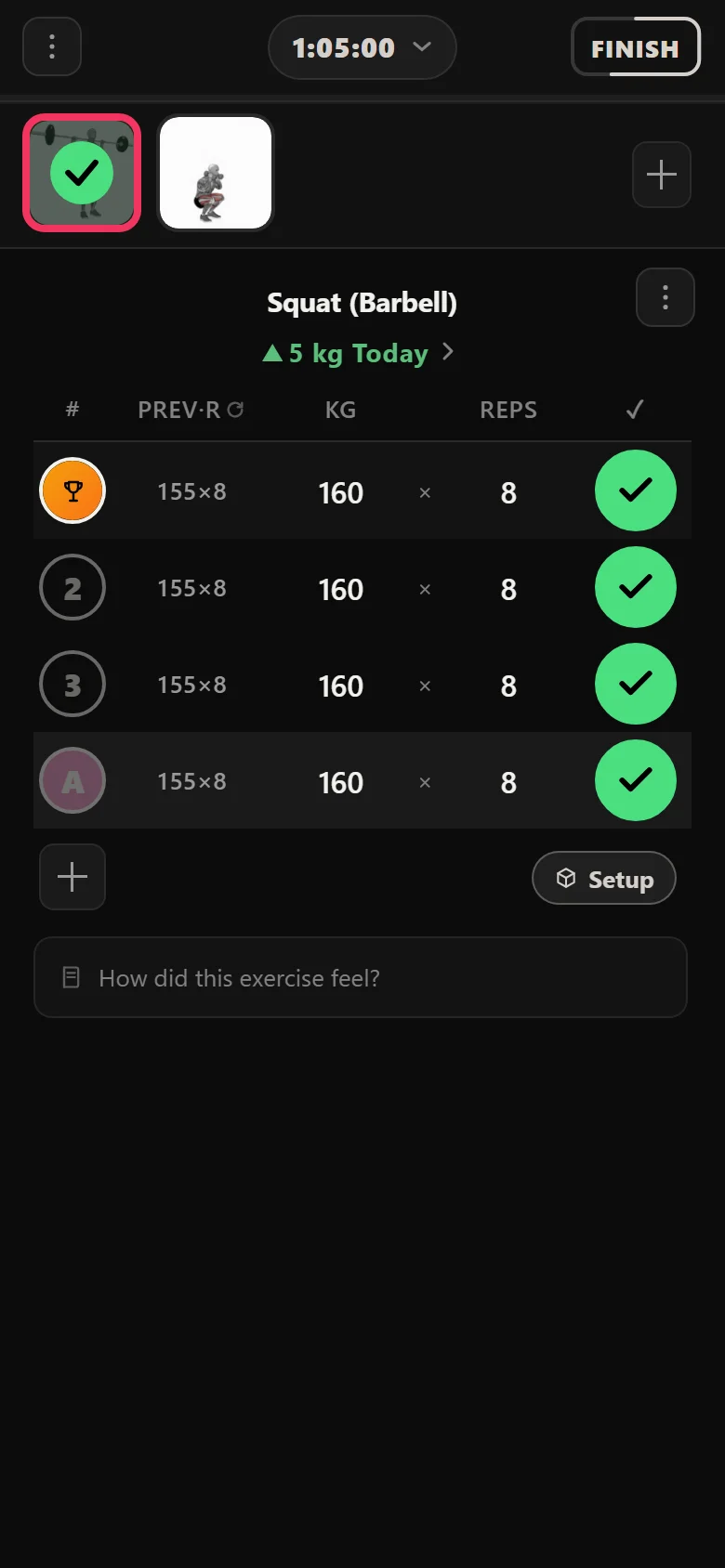
The payoff: first morning against last
The same lift, the same four working sets, five weeks apart. Not one missed session in between, and not one decision made by hand.
One session a week on this lift, and a second session the same evening working the same muscles under a different rule.
Common questions
What is Twice-A-Day?
A Durata original for advanced lifters: four training days a week, each carrying two sessions. The morning is a short heavy barbell session working up to a top set of five, and the evening is a high-volume pump session for the same region. Eight sessions a week in total.
Why do the morning and evening lifts progress differently?
Because they are doing different jobs. The AM main lifts run plain linear progression: clear the sets and the weight goes up next session, 5 kg on lower-body lifts and 2.5 kg on upper; the morning's second compound runs double progression like the evening work. The PM lifts run double progression: the weight sits still while you climb the rep range, and only moves once every set tops out. Watch the weight in the morning and the reps in the evening.
My evening weights have not moved in two weeks. Is something wrong?
Probably not. Double progression holds a weight until every set reaches the top of its range, so a PM lift can sit at the same load for a fortnight while the reps climb under it. That is progress, and it is what the rule is for. If the reps are not climbing either, drop the weight and rebuild.
How many failed sessions before a weight gets cut?
Three on the morning barbell lifts, which is more patient than most programs in the app. Heavy work done fresh varies enough day to day that one bad session says little, so the rule waits. After the third failure at a weight it cuts that lift by 10% and the climb restarts.
Can I run it on fewer days?
You can combine an AM and PM session into one longer workout, but you lose the reason the program is built this way. Splitting them lets you hit the heavy work fresh and the volume work fresh, twelve hours apart. If your week cannot hold eight sessions, a four-day upper/lower program will serve you better than a compressed version of this one.
Is Durata free?
Yes. Durata is free to use, with the full program catalogue, rest timers, rule chips and PR tracking. Everything in this walkthrough is in the app.
Put it into practice
Durata is free to use — 50 proven programs, automatic progression, rest timers and PR tracking, all on your phone.