


Dorian Yates HIT in Durata: one set per exercise, and nowhere to hide
Every other program in the catalogue gives you more than one chance. Five sets, or ten, or three cycles of waves, and a bad first attempt gets absorbed by the ones after it. Dorian Yates' Blood & Guts training does not. You warm up, you take one set to the point where the bar stops moving, and that set is the exercise. There is no second attempt and nothing to average it against.
That makes it the shortest program here to log and the hardest to log honestly. This run drove twelve sessions across three weeks, four days a week, and the whole block records 14,863 kg over 30 sets and 340 reps. A single German Volume Training session moves more tonnage than a week of this. The work is somewhere else entirely.
Finding the program
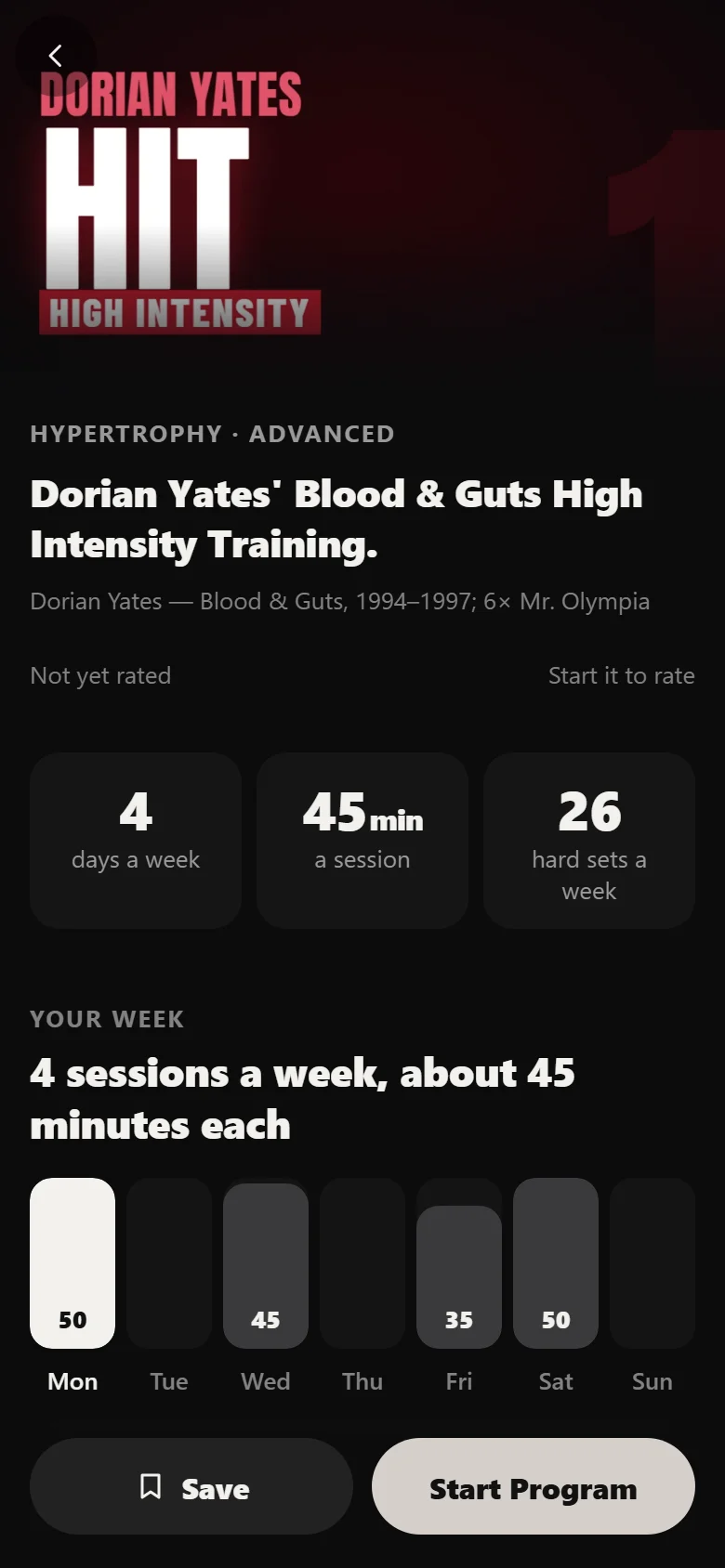
In Discover, Dorian Yates HIT sits on the Hypertrophy shelf, marked Advanced, at four days a week. Search finds it by name, or Filter narrows the shelves by level and days a week. Tap the cover for a quick look, then View Program for the full page.
It is marked Advanced, which is not gatekeeping. A program built on taking sets past the point where technique wants to fall apart assumes you already know what your technique looks like when it does.
The program page shows the four-day split before you commit: back with rear delts and biceps, chest with triceps and abs, shoulders and traps, then legs. Under each exercise the same shape repeats — warm-up sets, then one working set flagged at RPE 10, then a long rest before the next movement.
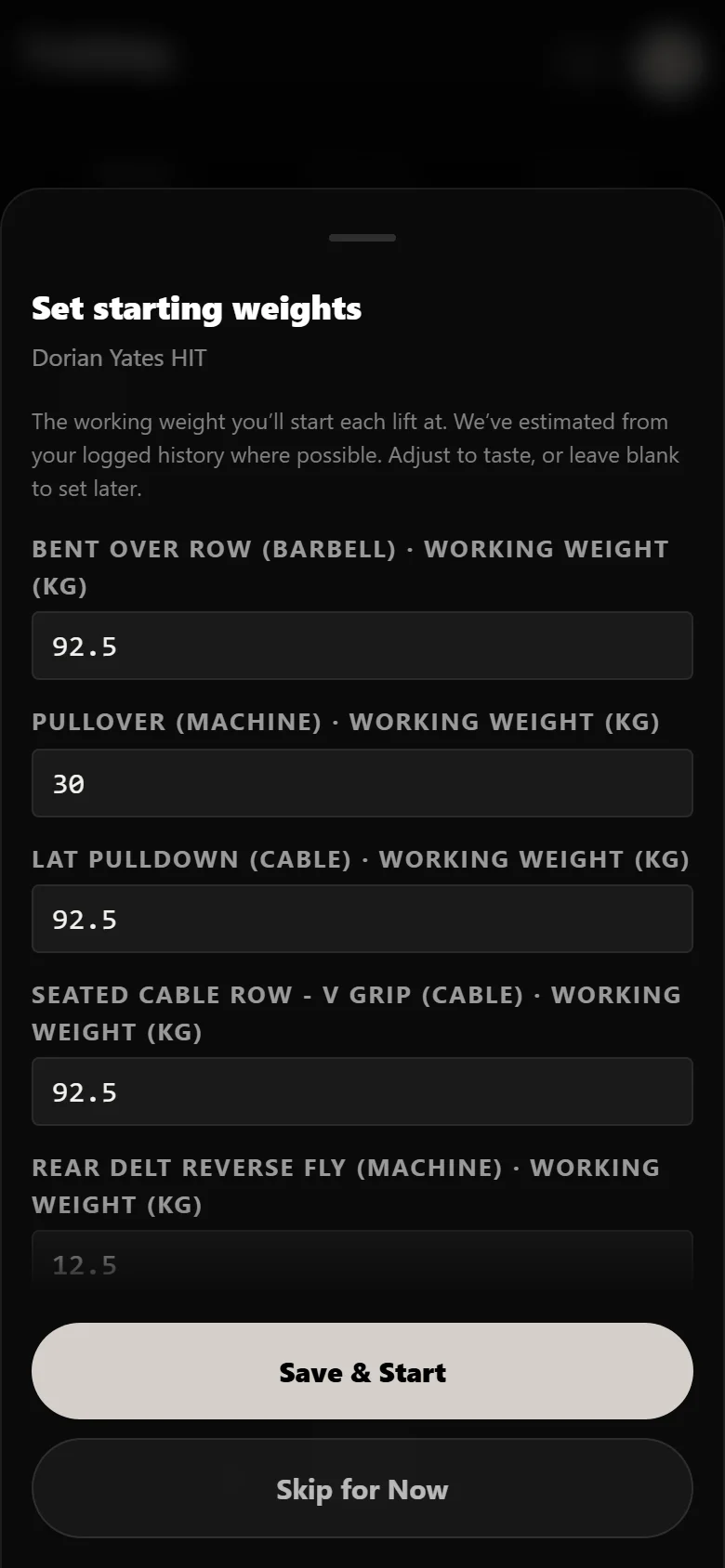
A weight per exercise, and the warm-ups take care of themselves
There are no training maxes and no percentages to enter. Setup asks for a working weight on each exercise and that is all: the bent-over row went in at 92.5 kg, the machine chest press at 30 kg.
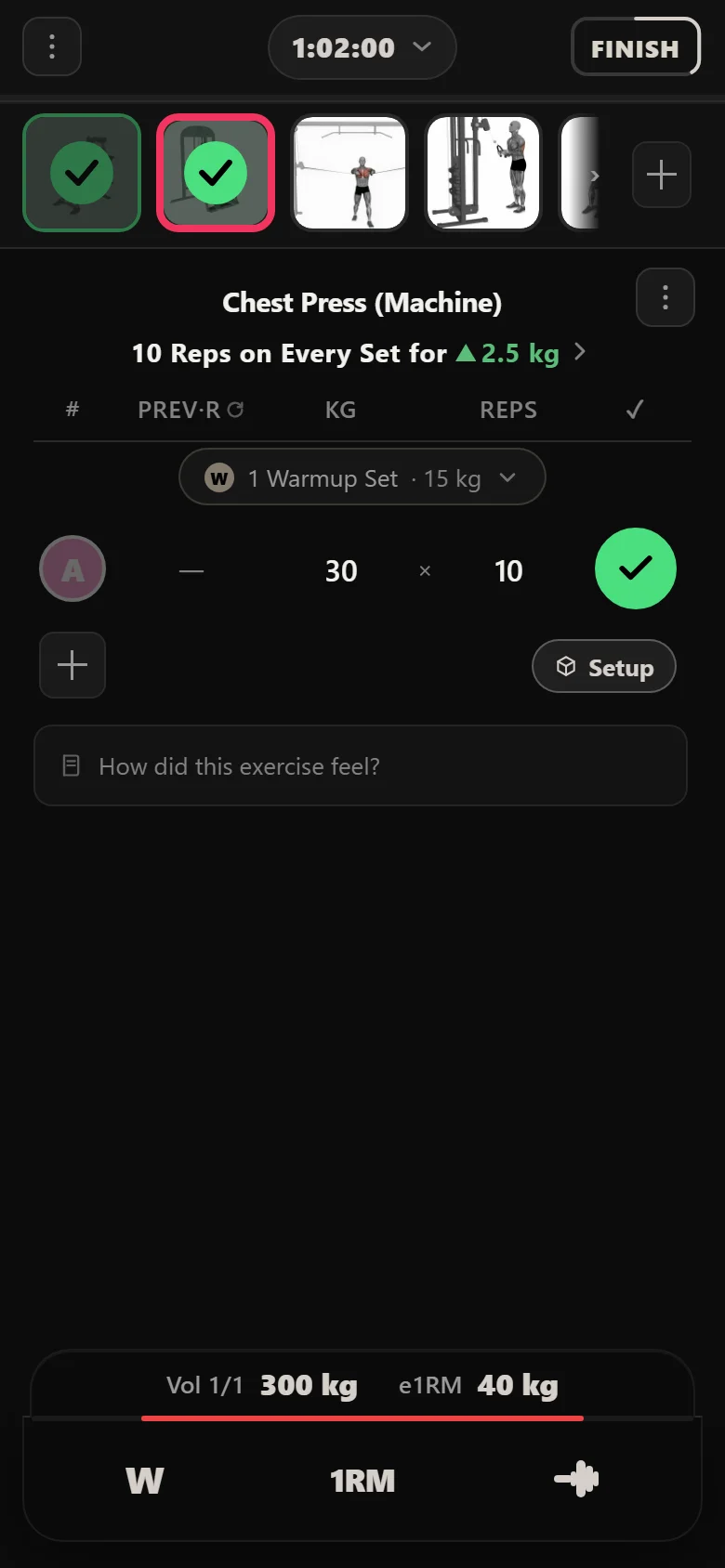
The warm-ups are then derived from that number rather than typed. On the chest press the app prescribes a set at 15 kg before the working set at 30 kg, which is the fifty percent Yates used to groove the movement. Warm-ups carry no rep target you have to chase and no bearing on whether the weight goes up, and Durata marks them as warm-ups so they stay out of the numbers that matter.
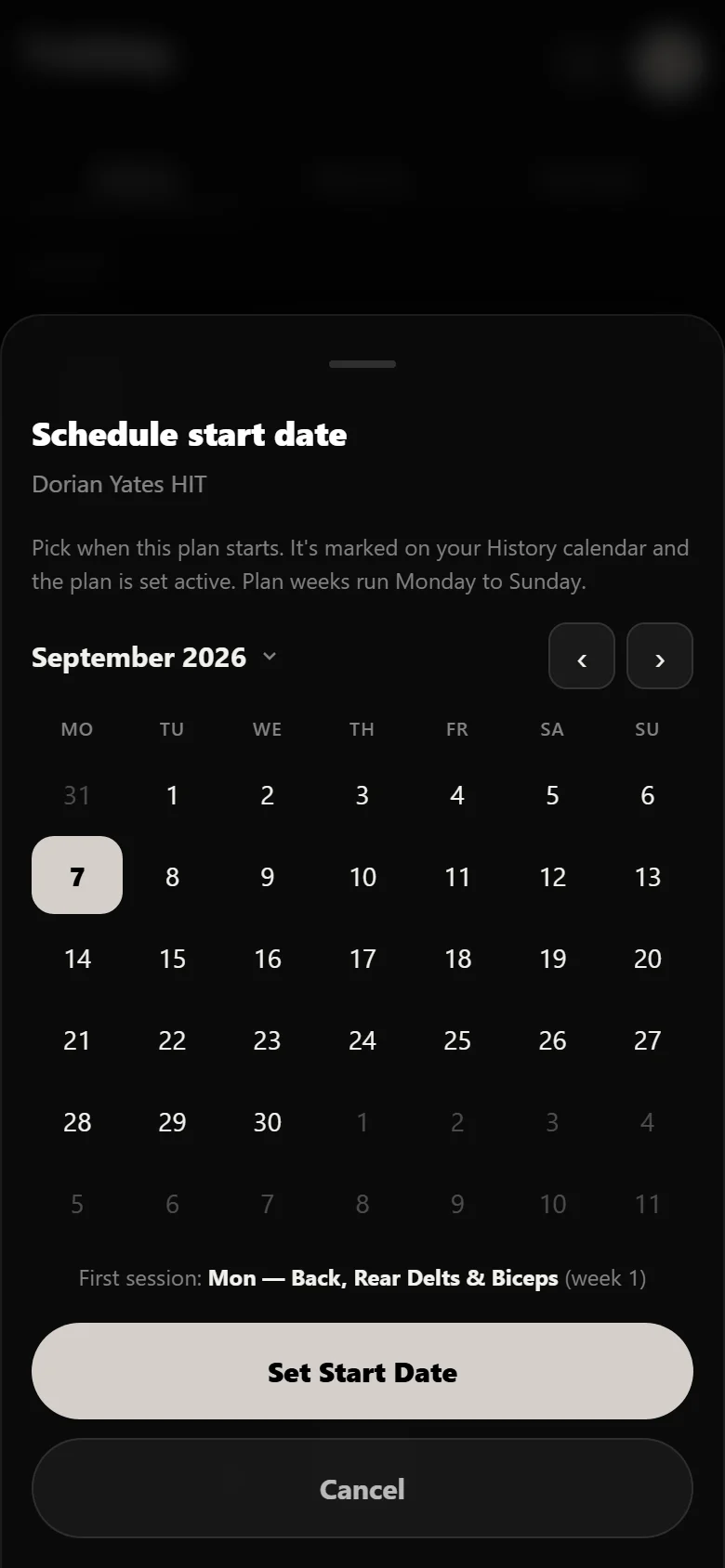
A start date puts three weeks on the calendar, four sessions a week. Twelve sessions in total, each body part trained once, which is why the chest press below appears three times and not twelve.
The working set is the session
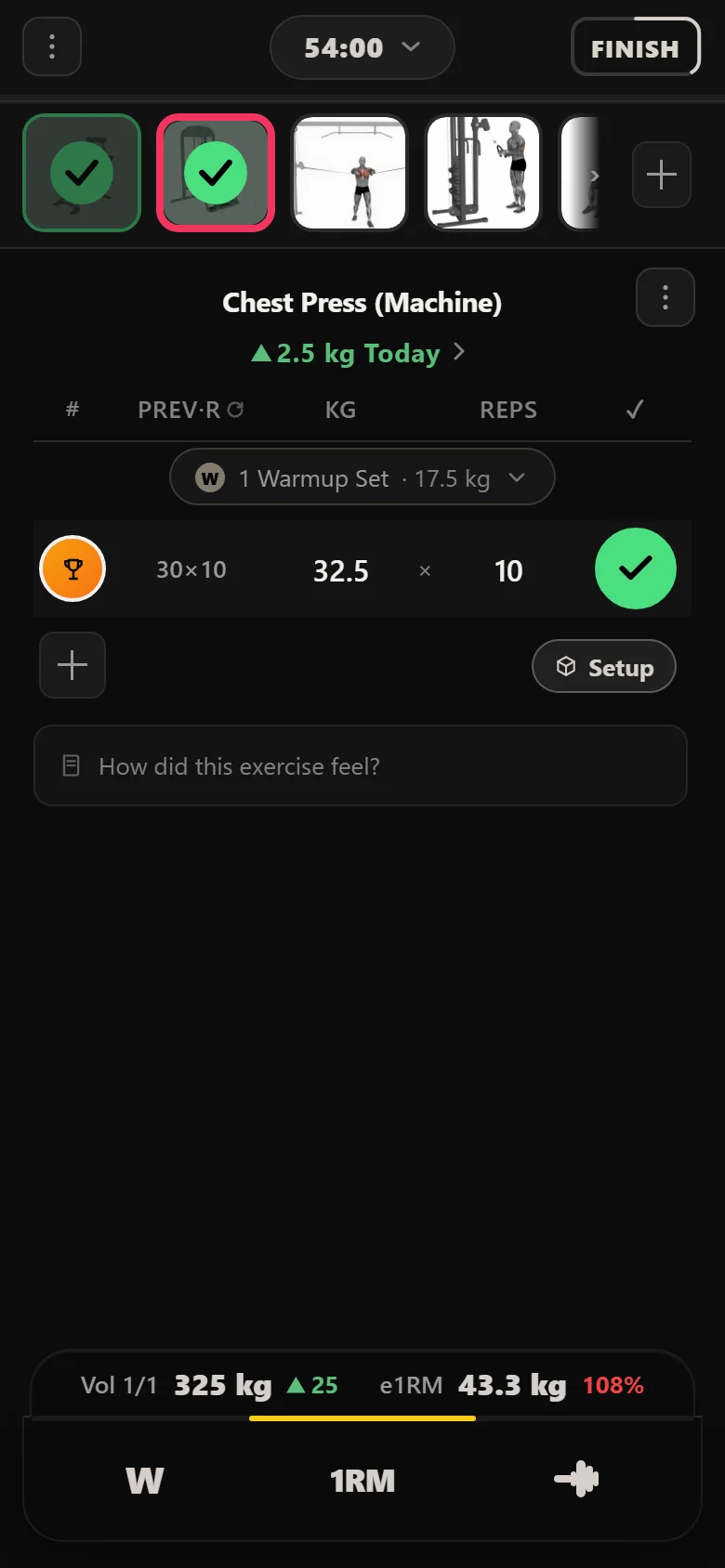
The chest press opens at 30 kg with one warm-up at 15 kg above it and an RPE 10 flag on the set that counts. The rep target is a range rather than a number, and the instruction is to keep going until you cannot, then find two or three more if someone is there to help.
The chip on the lift shows the rule while you train: reach the top of the range on the working set and the app adds 2.5 kg for next time. That is the whole progression system, and it hangs entirely on one set per exercise being taken to the same place every session. If your idea of failure drifts week to week, so does the program, and no amount of careful logging will catch it.
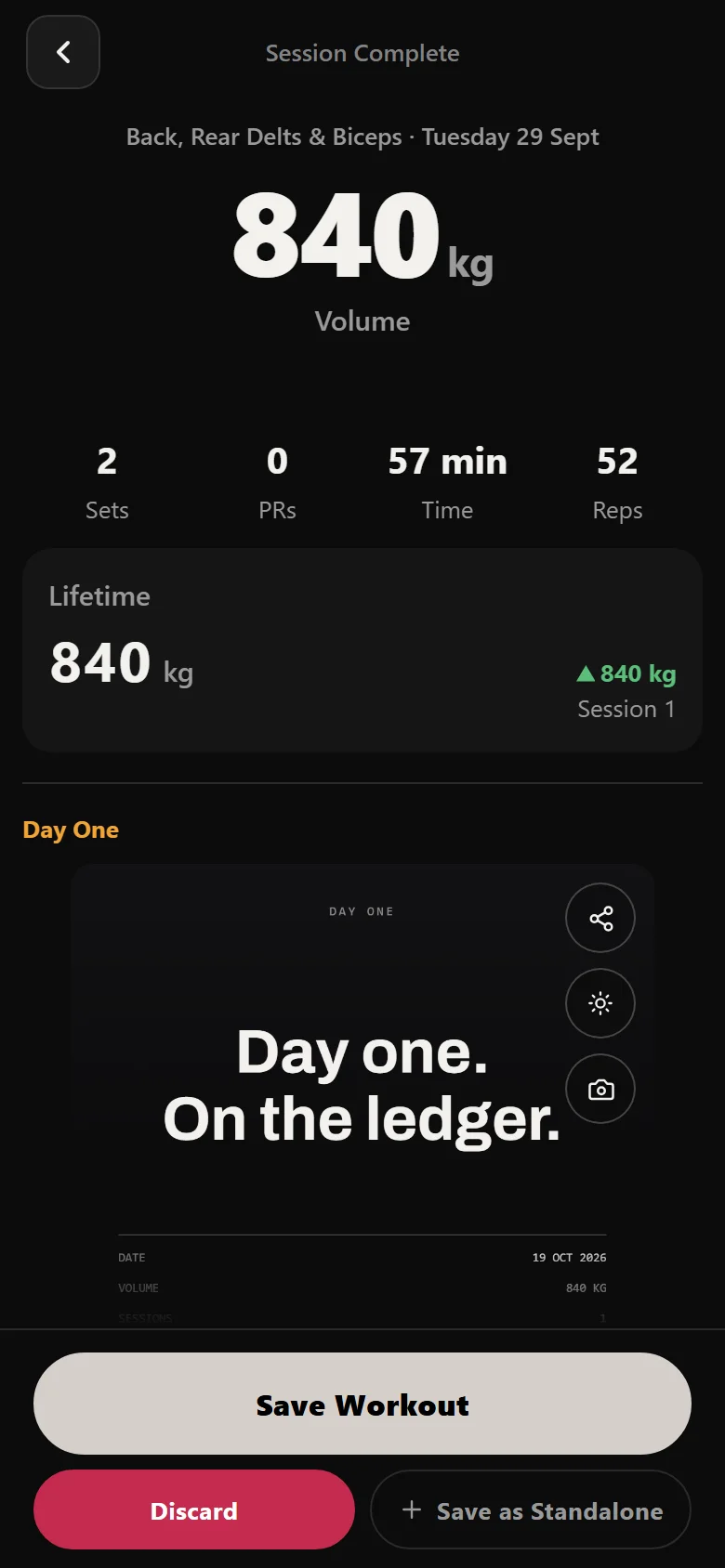
The session recap is startling if you have come from a volume program: 840 kg across 6 sets and 52 reps for an entire training day. There is very little here, and everything that is here was maximal.
Three appearances, three increases
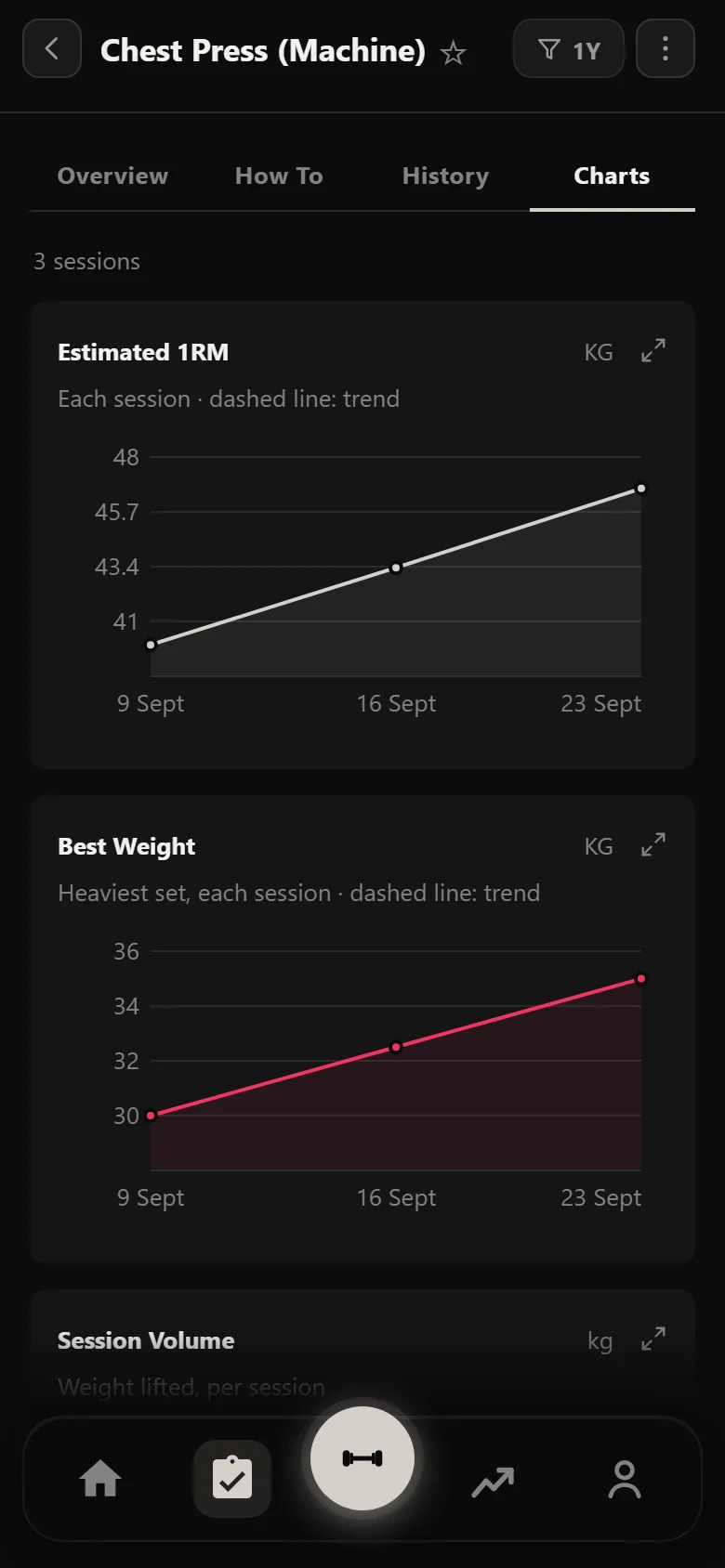
The chest press is trained once a week, so it has three appearances in this block, and it took the increase on all of them: 30 kg, then 32.5 kg, then 35 kg. The estimate the app derives from those single sets moved with it, from 40 kg to 43.3 kg to 46.7 kg.
What makes that climb unusual is how little it is built on. Three sets of work, spread across three weeks, moved the bar 5 kg and took the estimate from 40 kg to 46.7 kg. Yates' argument was always that this is enough, and that everything past the one hard set is recovery you are spending rather than stimulus you are earning.
The strip below is every chest press in the block. It is a short strip, and the shortness is the honest picture of the program rather than a gap in the record.
Chest Press (Machine): working set, week by week
- 30S2 Session 2 — start
- 32.5S6 Session 6
- 35S10 Session 10 — last session
What three weeks of one-set training actually moved
Twenty-four lifts were logged across the block and seven of them earned an increase. The chest press finished at 37.5 kg, the dumbbell overhead press went 27.5 kg to 35 kg, the cable crunch 12.5 kg to 20 kg, the hack squat 145 kg to 150 kg, the bent-over row 92.5 kg to 95 kg, and the barbell curl and cable fly both went 12.5 kg to 15 kg.
The other seventeen held where they started. The lat pulldown stayed at 92.5 kg, the cable row at 92.5 kg, the incline dumbbell press at 42.5 kg, the Romanian deadlift at 105 kg, and a long tail of smaller movements at 12.5 kg. Nothing was cut back and nothing went missing; those single sets simply did not reach the top of their range.
That ratio is the thing to sit with before you start this program. On a linear-progression block you can expect movement almost everywhere, almost every week, because there is enough volume that some of it will land. Here, one set decides, and most weeks most exercises will decide against you. Whether that reads as brutal honesty or as a slow start is the actual question of whether HIT suits you.
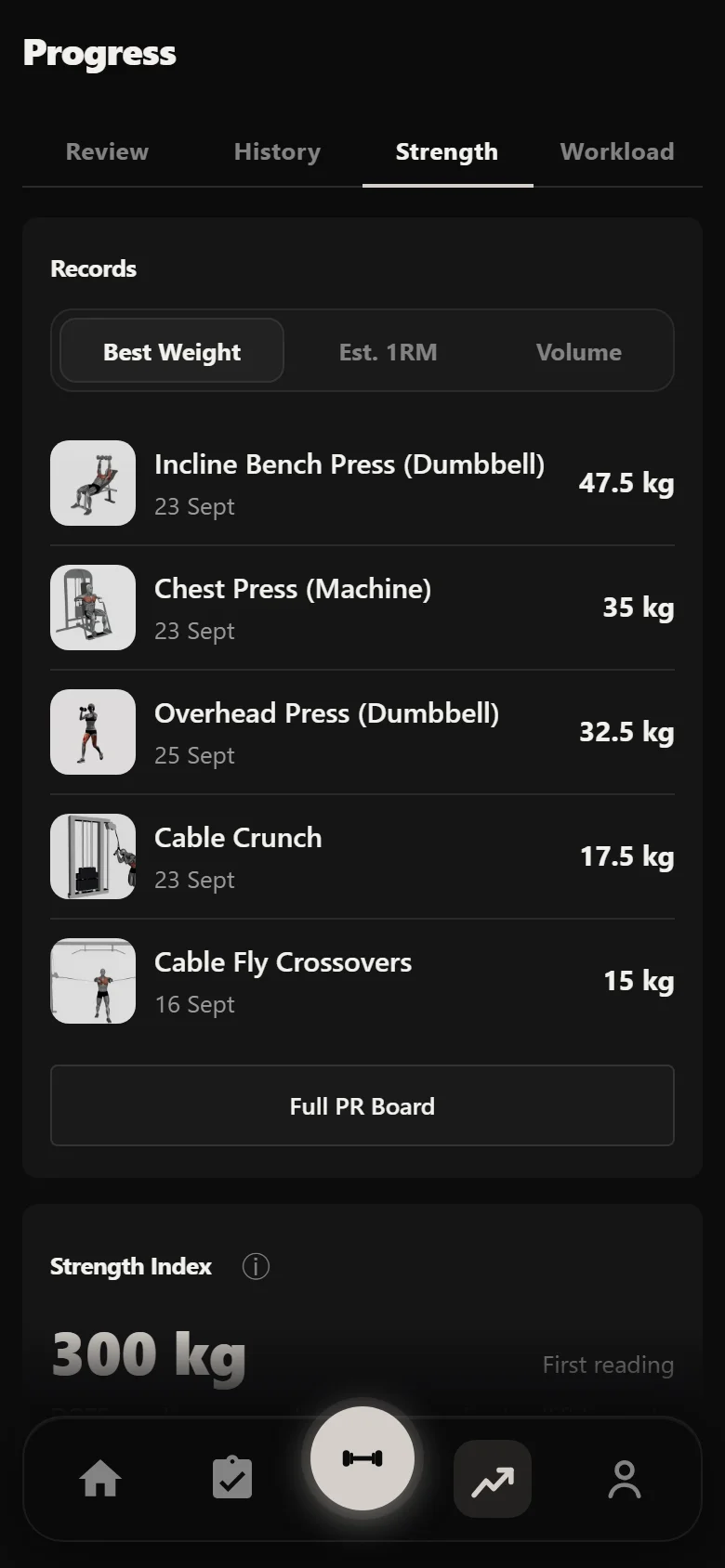
The Strength tab puts the same block in record terms: the incline dumbbell press at 47.5 kg, the chest press at 35 kg, the dumbbell overhead press at 32.5 kg, the cable crunch at 17.5 kg and the cable fly at 15 kg, each one a best weight beaten inside the three weeks. Below them the Strength Index reads 300 kg, most of it the hack squat's 193.3 kg estimate, and says plainly what it is missing: the full DOTS score needs a squat, a bench press and a deadlift, and this program has none of the three.
Three weeks, seen from the outside
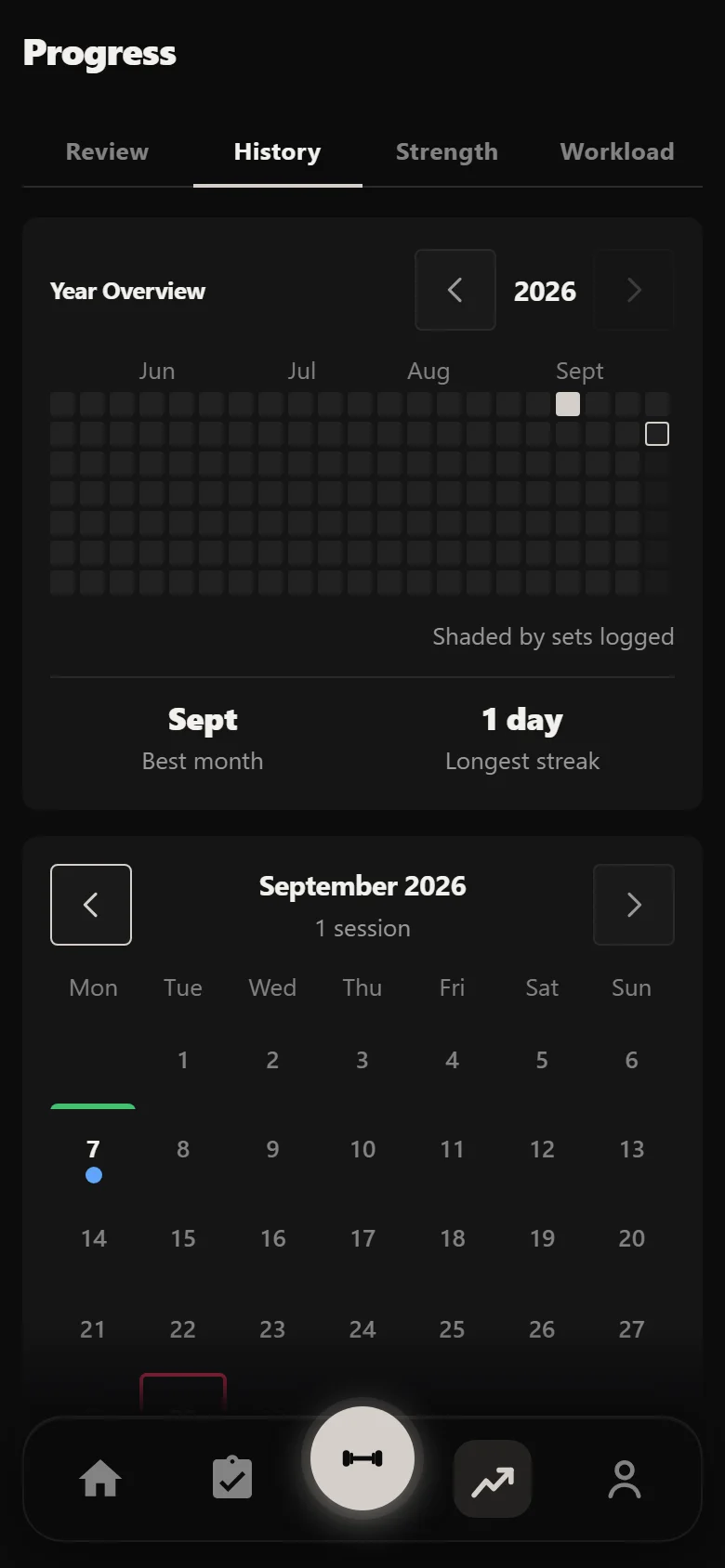
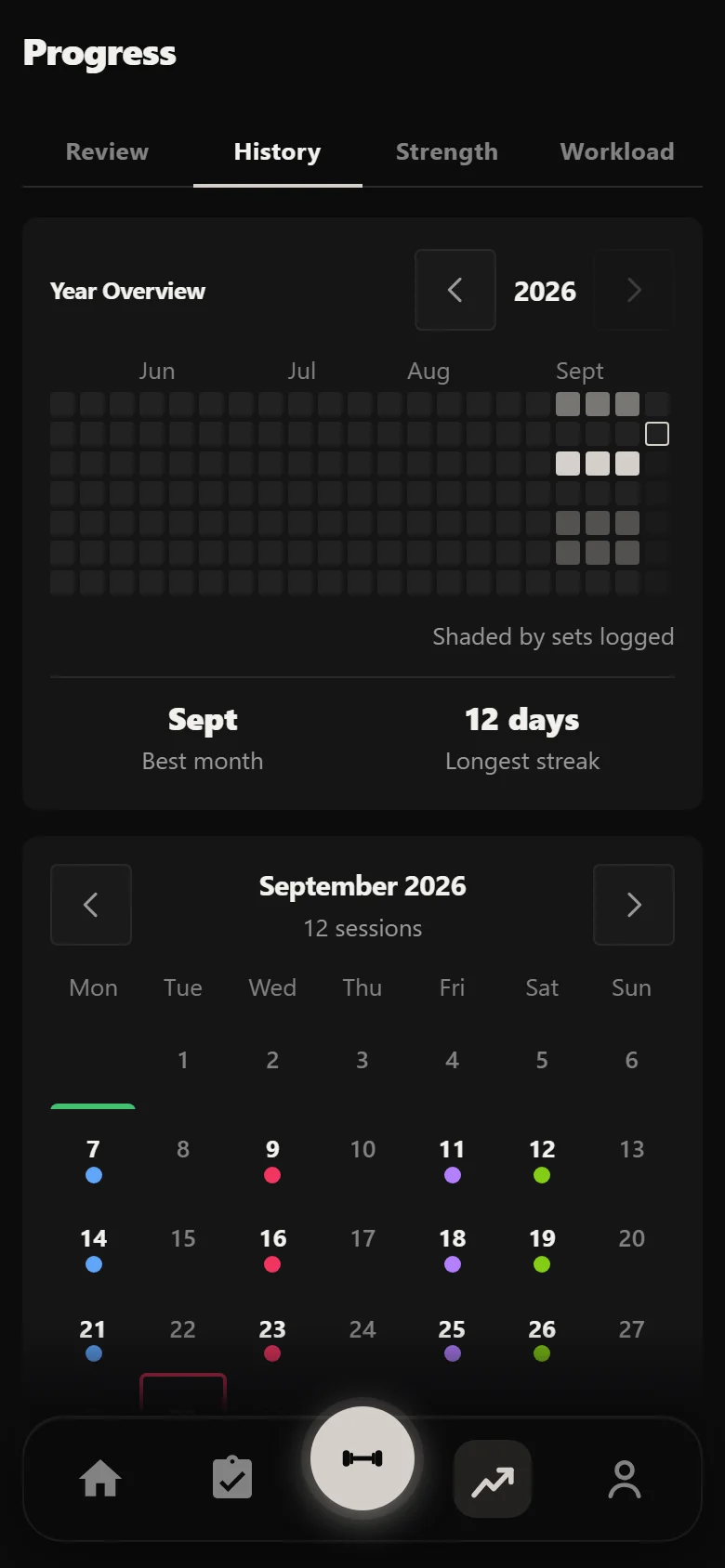
The History calendar holds all twelve sessions, four a week, each one a short entry. Read as volume this is the emptiest three weeks in the catalogue, and read as effort it is not. The record cannot tell those apart, which is exactly why the program asks you to be strict about what failure means.
The chest press's estimated one-rep max chart is three points and a straight line between them. There is no wave to interpret, no stall and no deload week, because HIT has none of those structures. It adds weight whenever the last set said it could and holds when it did not.
The payoff: the same exercise, three weeks apart
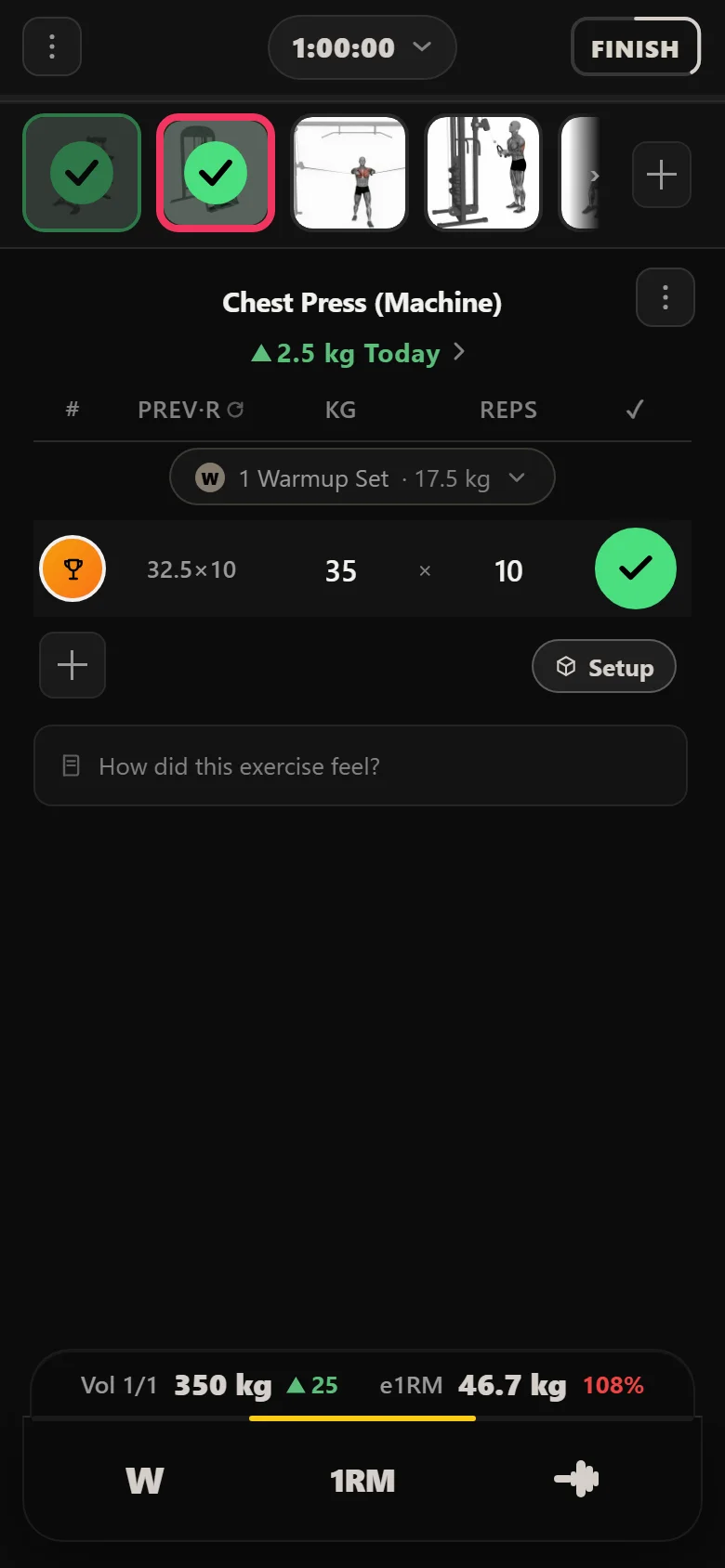
Two screenshots of the same lift on the same screen: week one and the last session of the block. One warm-up and one working set in both, and 5 kg more on the machine in the second, because three sets in a row went to the top of the range.
Three working sets, three increases, and 37.5 kg already prescribed for the session after this one.
Common questions
What is Dorian Yates HIT?
The Blood & Guts training Dorian Yates used through his six Mr Olympia titles. One or two warm-up sets per exercise to groove the movement, then a single working set taken to absolute muscular failure, with two or three forced reps beyond it if a partner is available. Four sessions a week: back, chest, shoulders, legs.
How do I know when to add weight?
When the working set reaches the top of its prescribed rep range. Durata shows the range and the rule on the lift while you train, and adds 2.5 kg for the next session automatically when you hit it. Fall short and the weight holds, which in this run happened to seventeen of the twenty-four lifts across three weeks.
Do the warm-up sets count?
Not for progression. They are prescribed from your working weight, marked as warm-ups in the logger, and kept out of the decision about whether the weight goes up. They are there to prepare the joint, not to accumulate work — on the chest press that means one set at 15 kg before the set that matters at 30 kg.
Is one set really enough?
That is the argument the program makes, and this block is a fair test of it: three working sets on the chest press across three weeks moved the estimate from 40 kg to 46.7 kg. The catch is that it only works if every one of those sets genuinely goes to failure. One set held back is a wasted week, where on a five-set program it is a rounding error.
Why is my logged volume so low?
Because there is almost nothing to log. This block recorded 14,863 kg across twelve sessions, and a single session came to 840 kg. Volume is the wrong measure for HIT, which is worth remembering before comparing these numbers with a program that has you doing ten sets of ten.
Is Durata free?
Yes. Durata is free to use, with the full program catalogue, automatic progression, rest timers and PR tracking. Everything in this walkthrough is in the app.
Put it into practice
Durata is free to use — 50 proven programs, automatic progression, rest timers and PR tracking, all on your phone.