


The 28-Day Shred in Durata: four weeks, screen by screen
A four-week cut is not a strength program, and pretending otherwise is how fat-loss plans lie to you. You are eating in a deficit, so you are not going to add much to the bar, and you do not need to. The job of the barbell work is to hold onto the muscle you already have while a calorie deficit strips fat. So this walkthrough follows the part that actually changes over four weeks: the cardio.
The 28-Day Shred trains five days a week (three full-body barbell sessions and two cardio sessions) for four weeks. The barbell lifts run double progression and tick up gently. The cardio ramps hard: the HIIT intervals get longer and the rests get shorter every week, and the steady run adds five minutes each week. Every screen below is the live app, and every weight, rep and interval is what the engine prescribed on the drive. The fat loss itself comes from the kitchen. The app's role is to make the training progress on its own so you only have to turn up.
Starting the cut
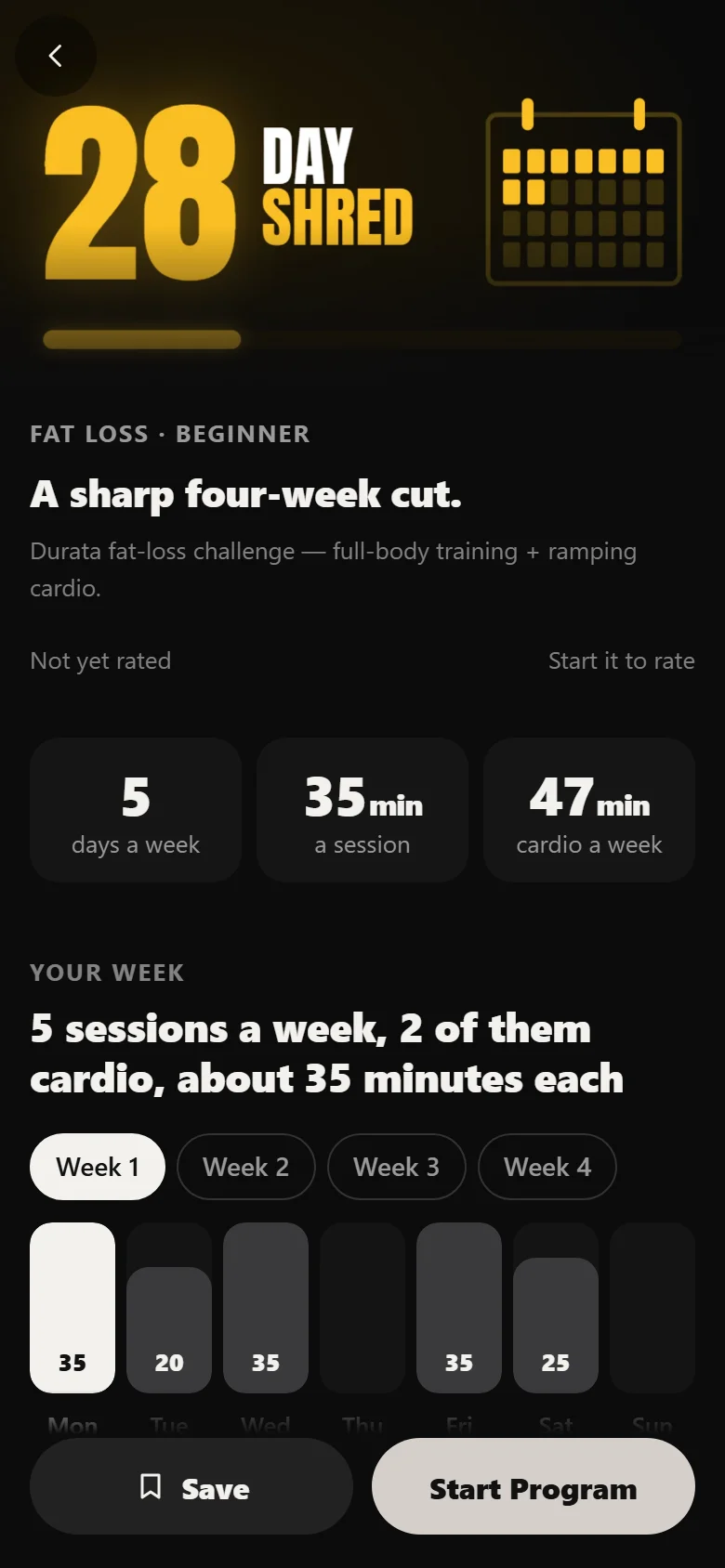
In Discover, the 28-Day Shred sits on the Fat Loss shelf, marked Beginner, at five days a week. Search finds it by name, or Filter narrows the shelves by level and days a week. Tap the cover for a quick look, then View Program for the full page.
The Fat Loss shelf holds the challenge cuts. The 28-Day Shred is the four-week one: three full-body barbell days to keep muscle, two cardio days that ramp up to burn.
There are no training maxes here. The compound lifts run double progression off a working weight, so the app asks what you can currently handle for the prescribed sets and starts there, 100 kg on the squat in this run. Start honest rather than heavy: in a deficit the weight is there to keep the muscle, not to be chased, and the app nudges it up on its own when your reps say you're ready.
The program page lays out the split before you commit: three full-body sessions (one squat-led, one deadlift-led, one front-squat-led) plus a steady Zone-2 run and a HIIT interval session. The cardio days are draggable in the planner, so you can put the run and the intervals wherever they fit your week.
The barbell work holds the line: double progression
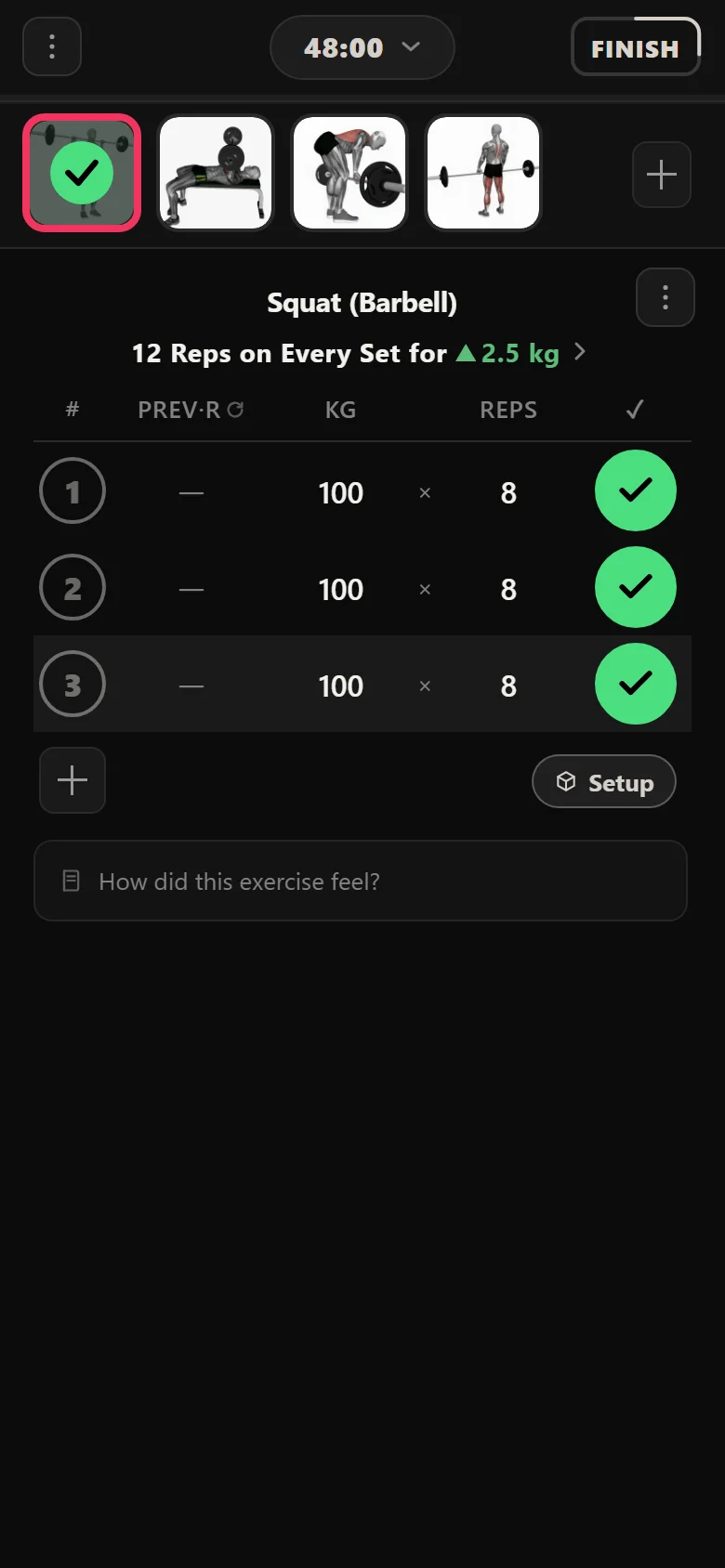
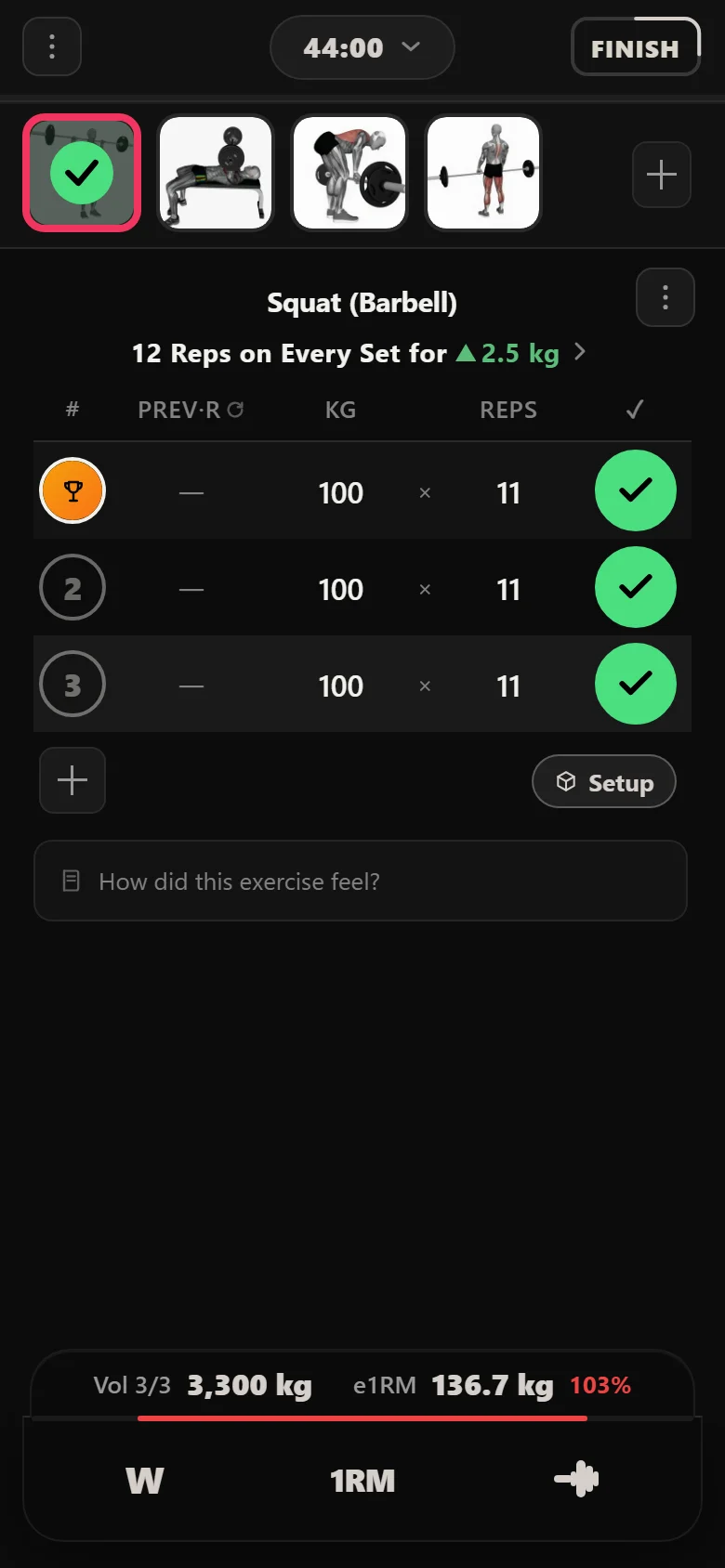
Open the first full-body session and the squat is 3 sets of 8 to 12 reps at 100 kg. The chip under the exercise name reads "12 Reps on Every Set for ▲2.5 kg", so the rule governing the lift is on screen while you train. That's double progression: the weight is fixed and you chase reps inside the range first. Only when all three sets reach the top of the range (12 here) does the weight go up, 2.5 kg at a time.
This is the right rule for a cut. Linear progression assumes you can add weight every session, and you can't while you're eating in a deficit. Double progression lets you make progress by adding a rep at the same weight, which is exactly what holding muscle looks like, and only moves the load when you've genuinely earned it. Nothing is configured; every lift carries its own range and increment.
Each full-body day trains different patterns so the whole body gets worked across the week. Day one is squat, bench, row and Romanian deadlift; day two is deadlift, overhead press, pulldown and leg press; day three is front squat, incline bench, Pendlay row and leg curl. The heavier compounds sit in an 8–12 range; the machine accessories run higher, 10–15 or 12–20, because that's where they do their work.
The cardio is the part that climbs
Here is what actually changes over four weeks. The two cardio sessions ramp on a schedule, and the app builds the whole ramp for you. You never edit an interval or set a minute count.
The HIIT session starts at 30 seconds of work and 30 seconds of rest for 12 rounds. Every week it hardens: the work interval gets longer, the rest gets shorter, and the round count goes up. The steps are clean: five seconds onto the work interval and five seconds off the rest, every week. By week four it's 45 seconds on, 15 seconds off, for 18 rounds. That is half again as long per effort, six extra rounds, and a work-to-rest ratio that has gone from 1:1 to 3:1. A genuinely harder session, prescribed for you, arriving automatically each week.
The steady Zone-2 run climbs the simple way: 20 minutes in week one, then 25, 30, and 35. Five more minutes of easy aerobic work each week. Between the two, the conditioning load rises every single week while the barbell work holds steady, which is the whole design of a cut. The training gets harder where it should, and the app is the thing scheduling it.
Cardio that hardens week by week: prescribed for you
HIIT Intervals work / rest, per week
- W1 30s / 30s 12 rounds Week 1: 30 second work intervals, 30 second rest, 12 rounds
- W2 35s / 25s 14 rounds Week 2: 35 second work intervals, 25 second rest, 14 rounds — harder than the week before
- W3 40s / 20s 16 rounds Week 3: 40 second work intervals, 20 second rest, 16 rounds — harder than the week before
- W4 45s / 15s 18 rounds Week 4: 45 second work intervals, 15 second rest, 18 rounds — harder than the week before
- Zone 2 Run20 → 25 → 30 → 35 min
The squat holds 100 kg while the reps climb
Four weeks is too short for the squat to move, and that is the right answer. The squat comes round once a week and this run adds one rep each time: eight, nine, ten, eleven. Twelve on every set is what moves the weight, so the bar stays at 100 kg for the whole block. The app is not stalled; it is waiting for the condition it told you about on day one.
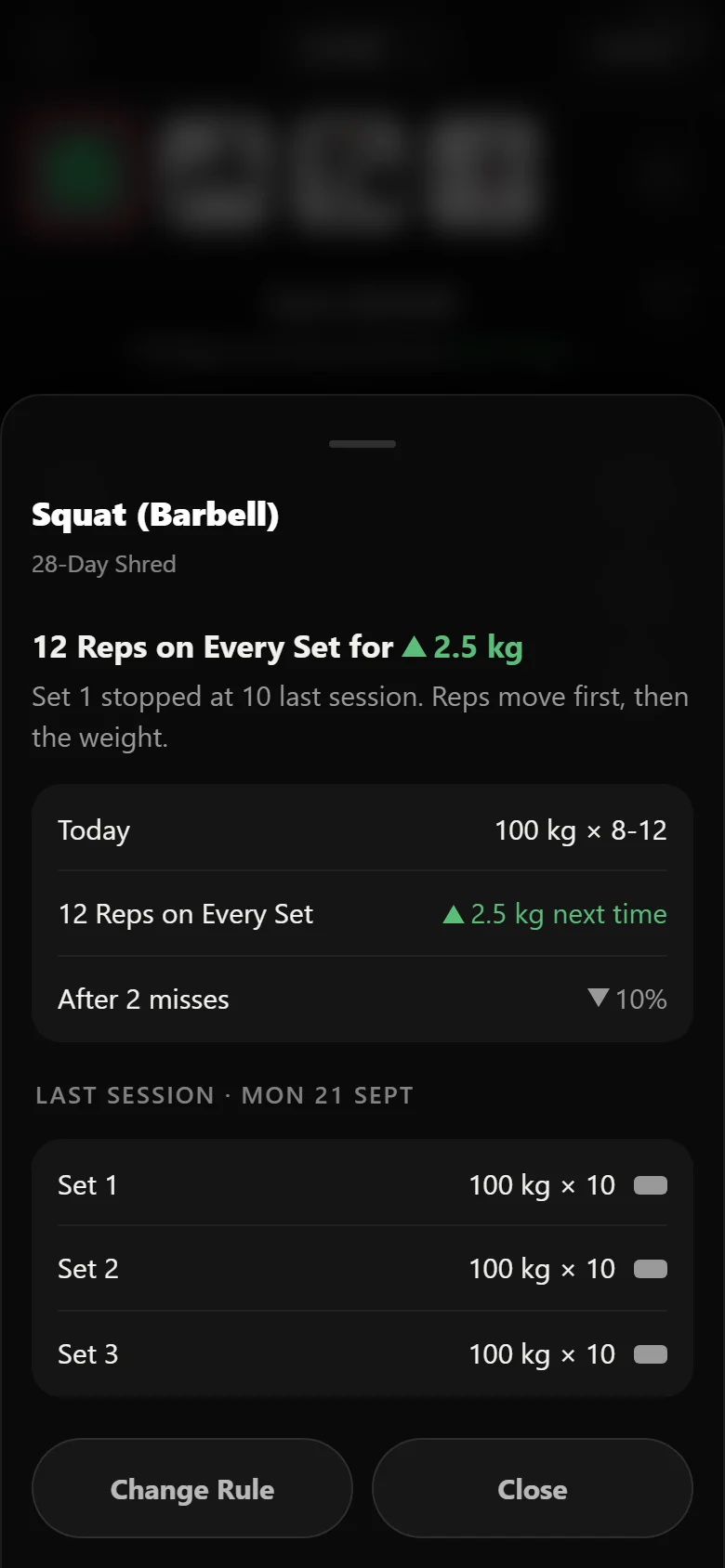
Tap the chip and it shows its working: last session stopped at ten on every set, so today is 100 kg again, and twelve on every set earns the next 2.5 kg. Across the whole program only the deadlift crossed its line, 130 kg to 132.5. Everything else held, which in a four-week deficit is exactly what the lifting is for.
Squat (Barbell): reps at 100 kg, per weekly appearance
- 100S1 Session 1 — 8 reps
- 100S2 Session 2 — 9 reps
- 100S3 Session 3 — 10 reps
- 100S4 Session 4 — 11 reps
What four weeks looks like afterwards
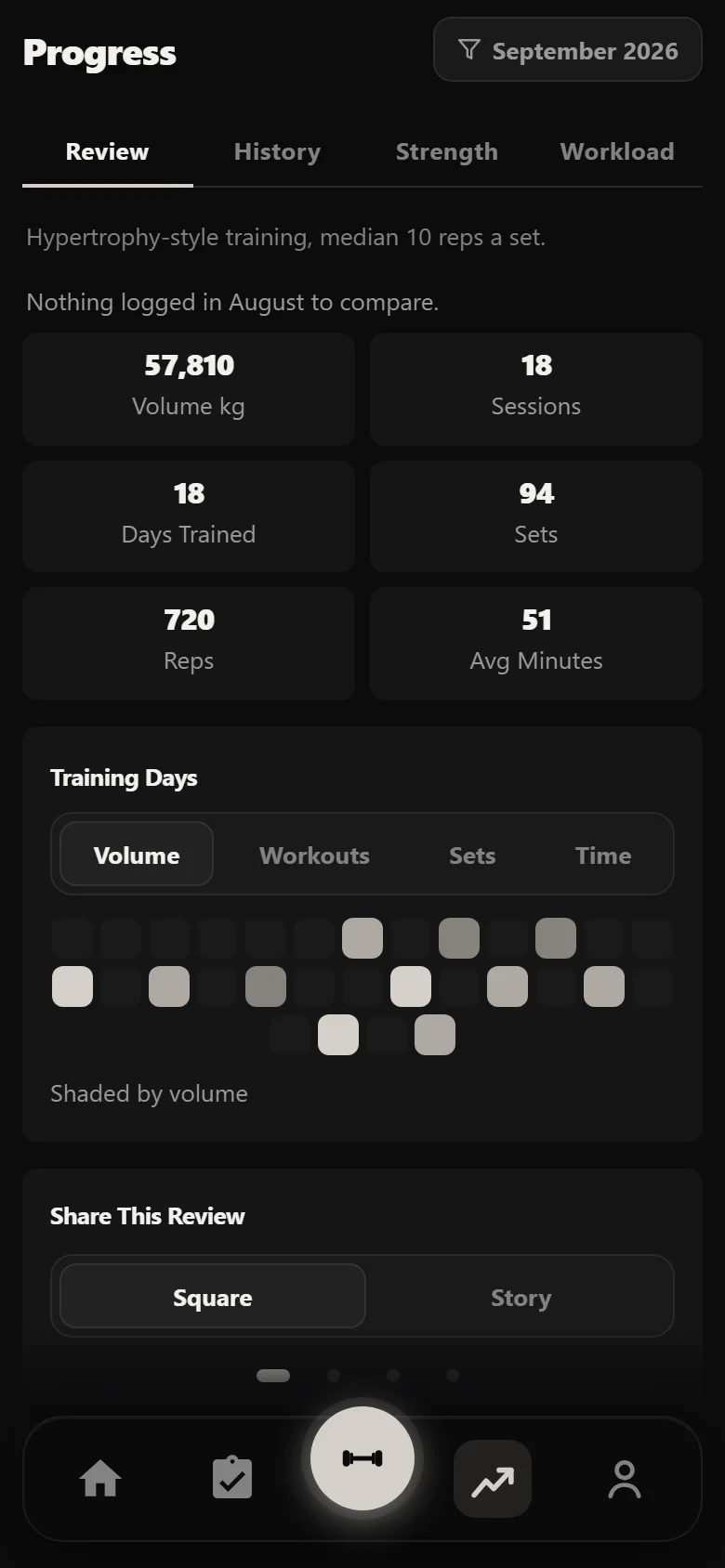
Three full-body days and two cardio days a week fill the History calendar from the start date.
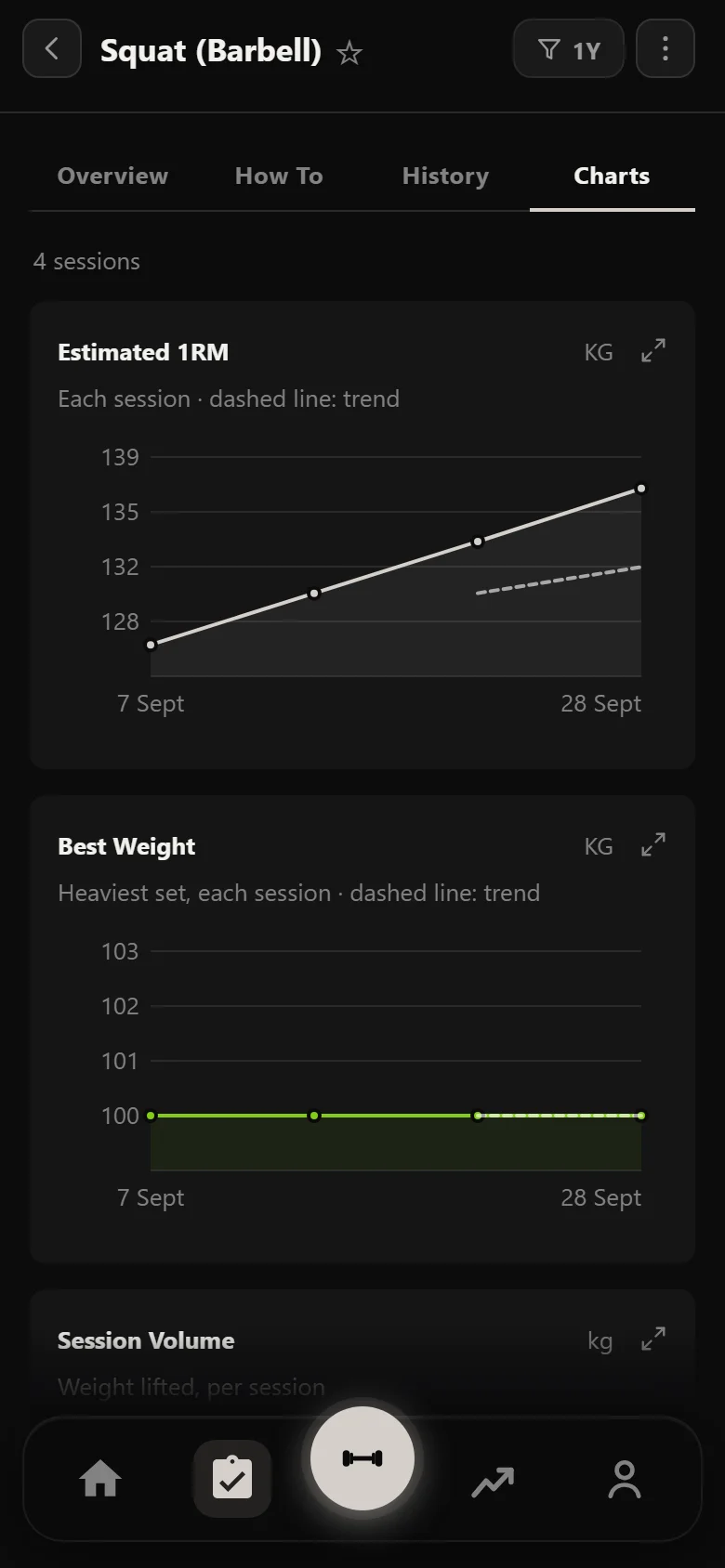
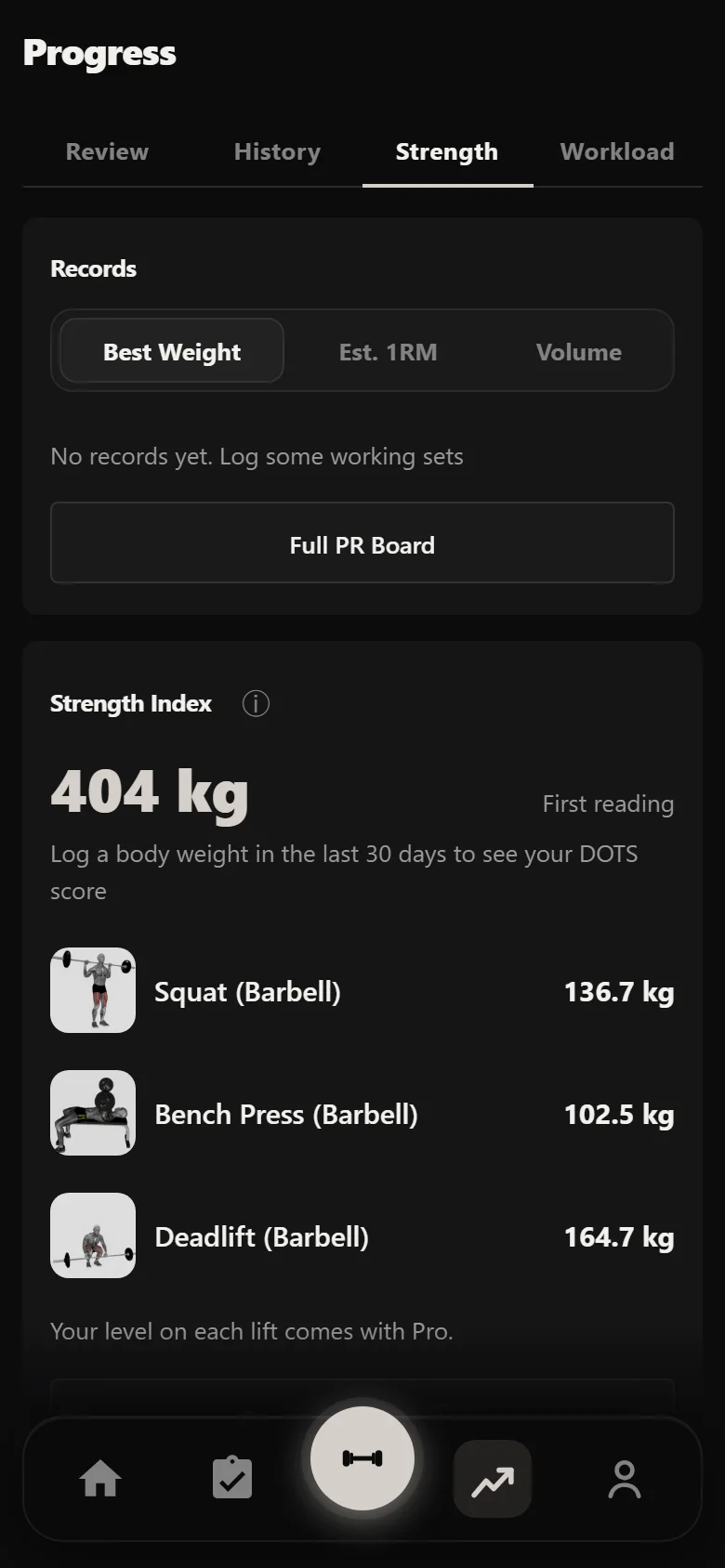
The squat's own charts tell the cut's story plainly. The estimated 1RM line rises every week, because the same weight moved for more reps; the best-weight line beneath it is flat at 100 kg. Strength held, a little more capacity at the same load, and the conditioning doing the work.

The payoff: what four weeks of cardio bought you
The squat held its weight and added reps, on purpose. That is double progression holding the line through a deficit. The number that actually tells the story is the conditioning: the HIIT session went from 12 rounds of 30-on/30-off to 18 rounds of 45-on/15-off, and the steady run added 15 minutes. Nothing here was typed in; the app built and scheduled the whole ramp. The fat loss came from the deficit. The cardio capacity is what four weeks of training actually bought you.
The HIIT session, week 1 against week 4: same exercise, same screen, longer work and shorter rest every week in between.
- Zone 2 Run20 min → 35 min
Common questions
Does the 28-Day Shred burn fat on its own?
No, and no program does. Fat loss comes from a calorie deficit. The training's job is to hold onto your muscle while the deficit strips fat, and to add a conditioning stimulus that burns more. Run a modest deficit with high protein (roughly 1.6–2.2 g per kg of bodyweight) alongside the program; the training preserves muscle and the kitchen does the fat loss.
Why does the strength barely go up?
Because you're eating in a deficit. In a cut you're recovering less, so the barbell work is there to keep the muscle you have, not to set records. Double progression lets you still make progress, an extra rep at the same weight, without needing the recovery that adding load every session would demand. On this run the squat held 100 kg for four weeks and went from eight reps to eleven, which is a good outcome for a cut.
What is double progression?
A rule for work prescribed in a rep range, like 8–12. The weight stays fixed while you add reps session to session; once every set reaches the top of the range, the weight goes up, 2.5 kg on the squat here, and you start again at the bottom. The range itself never changes, only the load. It's the right rule for a cut because you progress by reps first and only add weight when you've earned it.
How does the cardio get harder?
The program bakes the ramp in and the app prescribes it. The HIIT session starts at 30 seconds work / 30 seconds rest for 12 rounds and tightens by five seconds each way every week, reaching 45 / 15 for 18 rounds by week four: longer work, shorter rest, more rounds. The steady Zone-2 run climbs from 20 to 35 minutes, five minutes a week. You don't set any of it; it arrives ready each week.
Can I move the cardio to different days?
Yes. The two cardio sessions are draggable in the planner, so you can put the run and the HIIT wherever they fit around the three full-body days and the rest of your week. The ramp travels with them.
Is four weeks long enough to see a difference?
For conditioning and for the scale, yes. A well-run four-week cut with a real deficit visibly changes both. It is not long enough to add much strength, which is why this program holds the bar steady rather than chasing it. If you want to keep going, the catalogue has a longer eight-week cut that runs a fresh set of exercises so nothing feels stale back to back.
Is Durata free?
Yes. Durata is free to use, with the full program catalogue, automatic progression maths, rest timers, cardio interval timing and PR tracking. Everything in this walkthrough is in the app.
Put it into practice
Durata is free to use — 50 proven programs, automatic progression, rest timers and PR tracking, all on your phone.