


High Frequency PPL in Durata: the same barbell, twice a week, tracked twice
Six days a week, Push Pull Legs run twice over. It is the split most evidence-based lifters have settled on, for the ordinary reason that hitting each muscle twice beats hitting it once, and the sets have to go somewhere.
The part that trips up a paper logbook is what happens to the big lifts. The bench press is on Push A as the heavy anchor and again on Push B as volume work, in a different rep range, chasing a different target, at a different weight. Same bar, same exercise name, two entirely separate progressions. This drive ran thirty-six sessions across six weeks, and how the app keeps those two apart is the most useful thing in it.
Finding the program
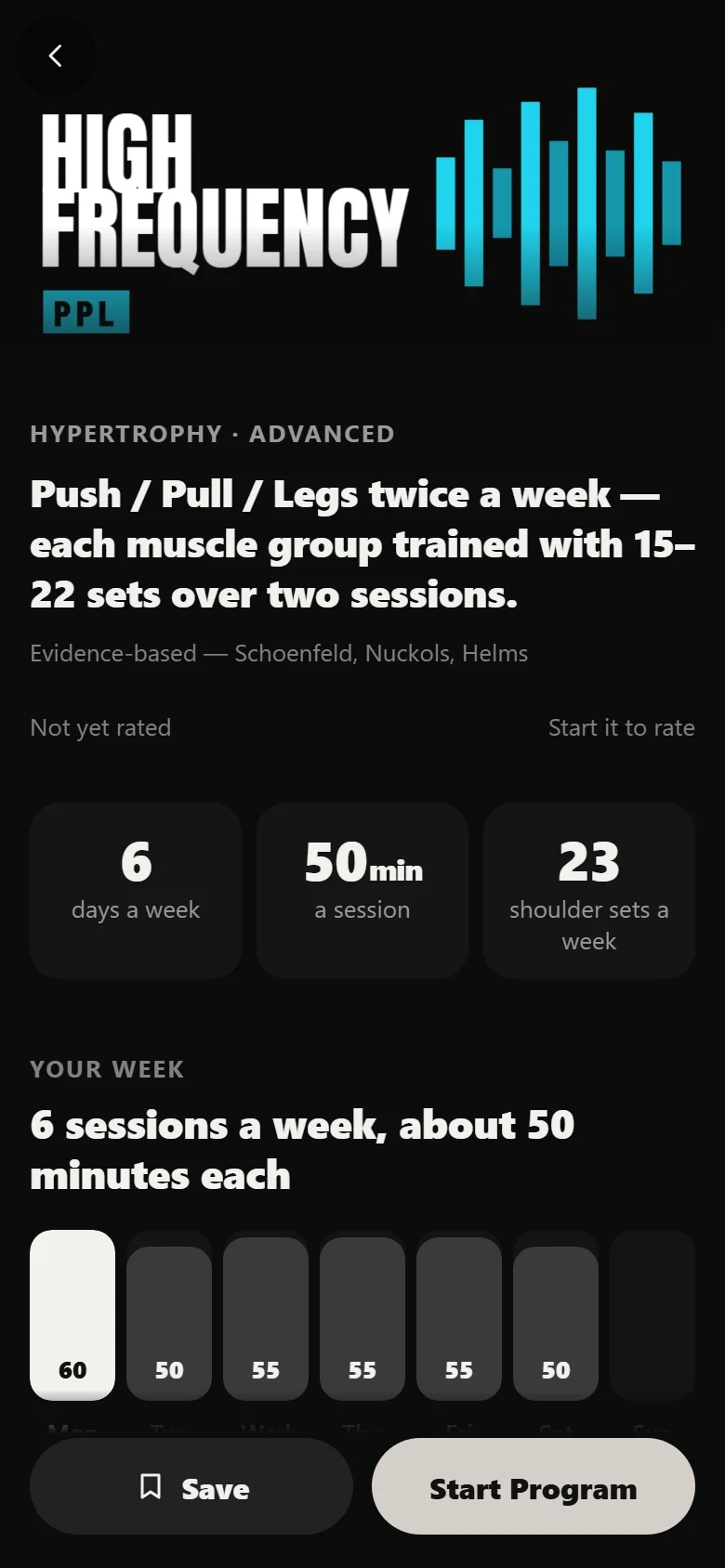
In Discover, High Frequency PPL sits on the Hypertrophy shelf, marked Advanced, at six days a week. Search finds it by name, or Filter narrows the shelves by level and days a week. Tap the cover for a quick look, then View Program for the full page.
Six days is the number that matters. This program does not compress into five, because the second push, pull and legs day is the entire premise.
The program page shows the shape before you commit: fifteen to twenty-two sets per muscle group spread across two sessions, with a compound strength lift anchoring each day and accessories filling the rest.
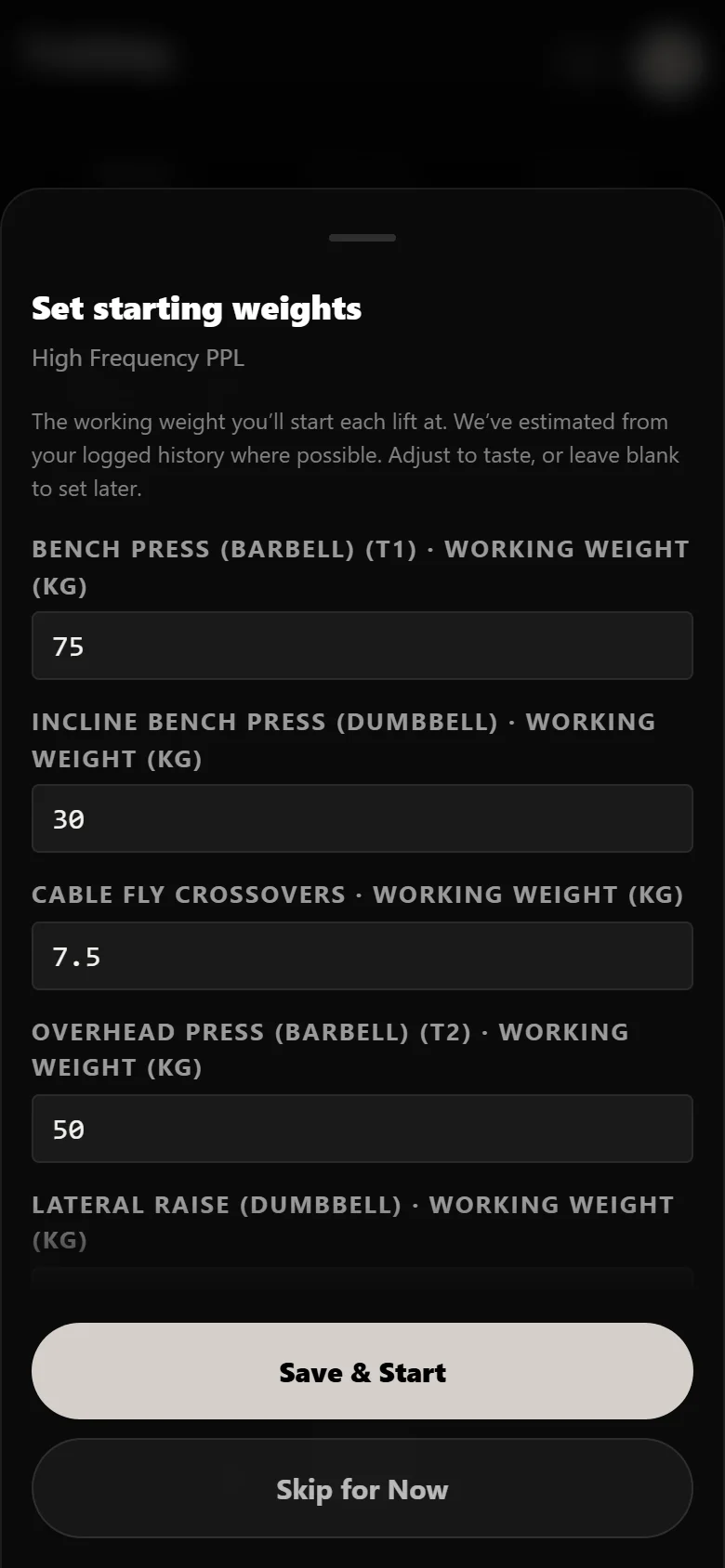
Sixteen lifts and not one training max
The setup sheet asks for a working weight on each lift and nothing else: 75 kg on the bench, 50 kg overhead, 65 kg on the rows, 30 kg on the dumbbell incline, 7.5 kg on the small isolation work. No percentages, no training maxes, no test week to sit through before you start.
That is the right shape for a hypertrophy program. Percentages exist to keep intensity honest across a peaking block, and this is not one. Here the honest measure is whether you beat the reps you got last time, which the app can read out of your log without you nominating a max at all.
It also makes the sheet long. Sixteen entries is a lot of first-session bookkeeping, and it is worth being unhurried about it, because every weight in the six weeks that follow grows out of the number you put in here.
The bench that is two lifts
Push A opens with the bench press for four sets in a six to eight range, advancing 2.5 kg every time the top of that range is met. Push B, three days later, has the bench again for three sets of ten to twelve on double progression: reach twelve on every set and only then does the weight go up.
Those are not the same lift as far as the program is concerned, and they are not the same lift as far as the app is concerned either. Each carries its own weight, its own rep target, its own rule and its own miss count. A stall on the heavy day does nothing at all to the volume day, which is exactly right, because they fail for different reasons.
The overhead press runs the mirror image: volume work on Push A, the heavy anchor on Push B. Over six weeks both bench entries went from 75 kg to 80 kg and both press entries from 50 kg to 55 kg, arriving at the same numbers by two different routes.
The lifts that do not need separating are not separated. The seated cable row turns up on both pull days and the face pull on both as well, but each is one weight, one history and one rule, because both appearances ask for the same thing. Splitting those would only make you enter the same number twice. This is worth knowing if you write your own routines: the app can hold two versions of one exercise, and it only does it where the program says the two are genuinely different jobs.
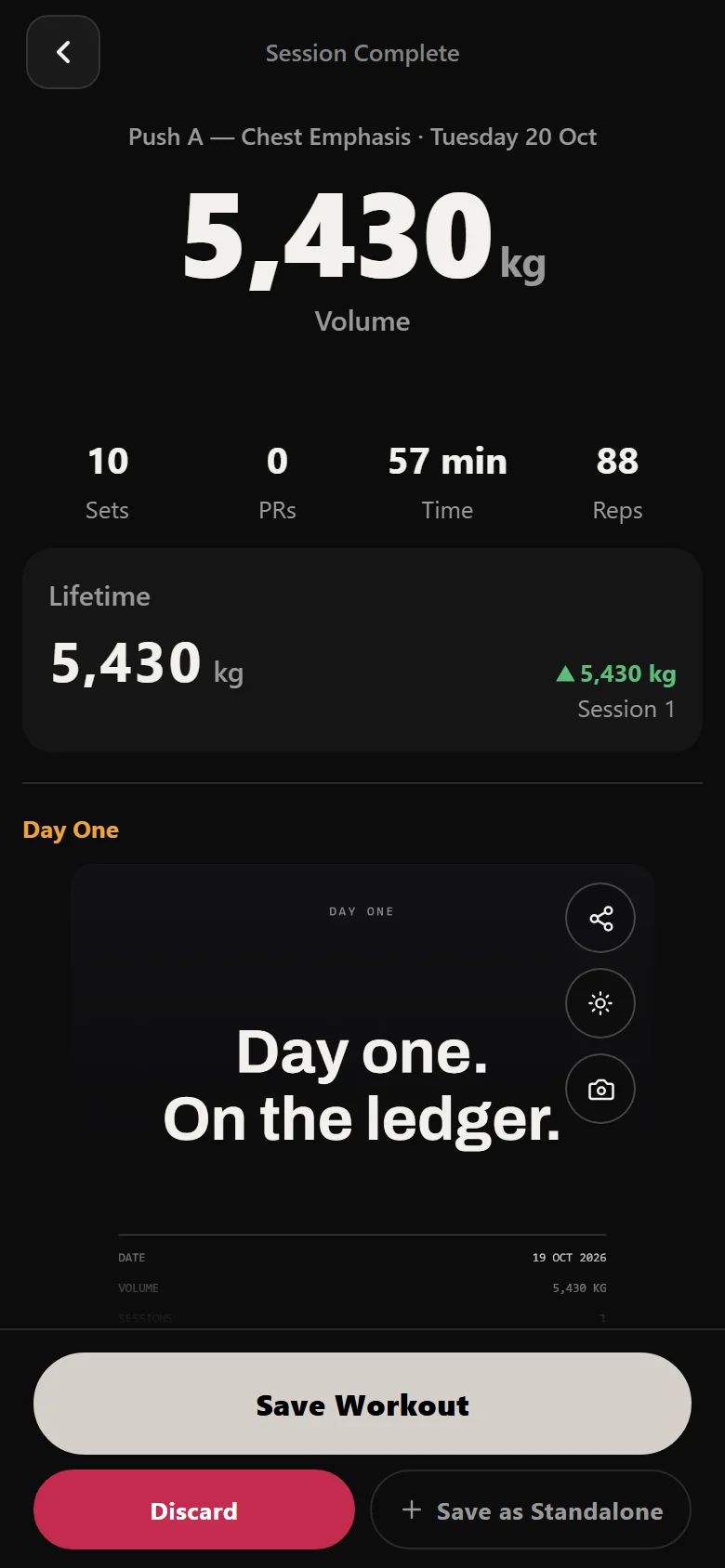
The practical effect is that a session summary on this program is dense. Ten working sets, 88 reps and 5430 kg in one push day, all of it read back to you before it saves.
The squat, which only comes round once
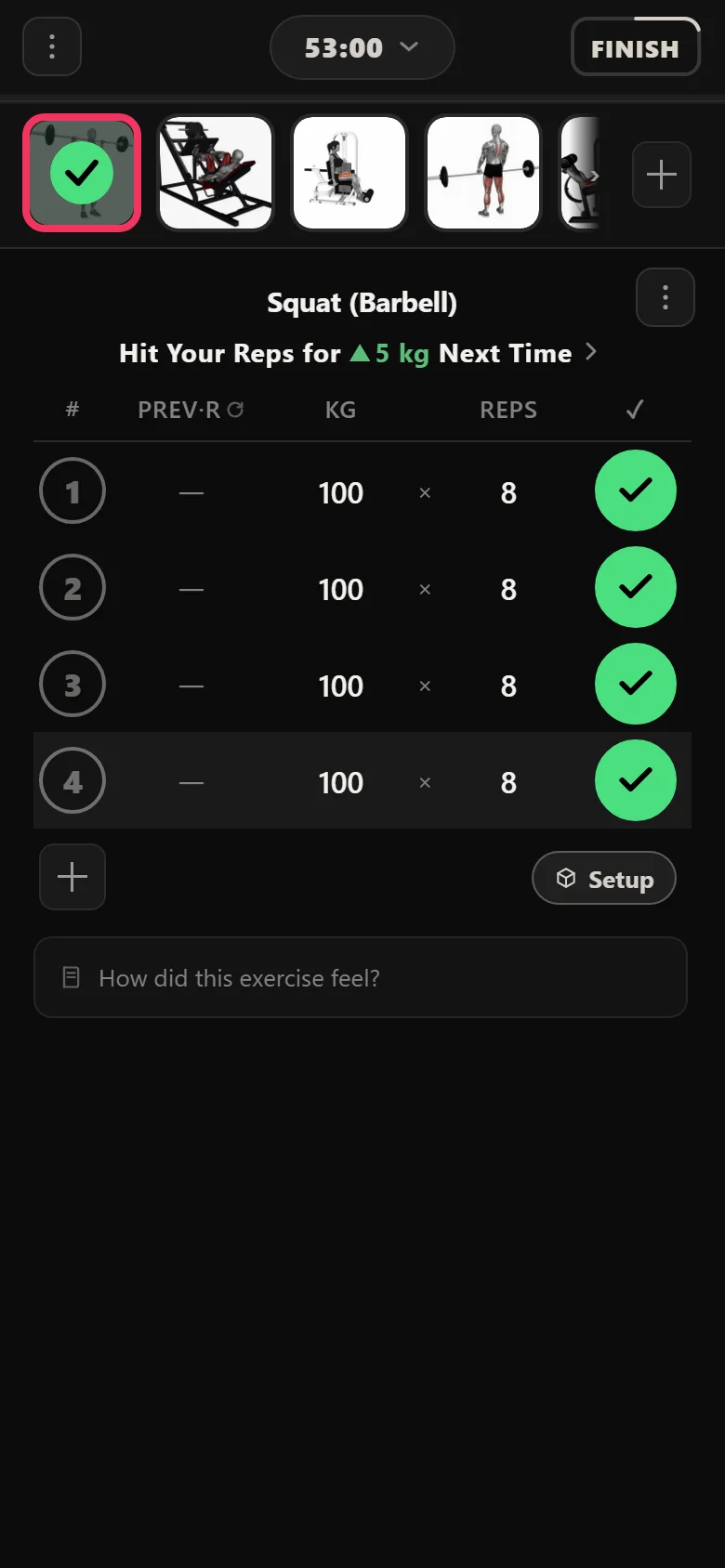
Legs A opens with the back squat, four sets of six to eight, adding 5 kg whenever the top of the range is hit. It is the heaviest thing in the week and, unlike the bench, it appears once, so it moves on a slower clock than everything around it.
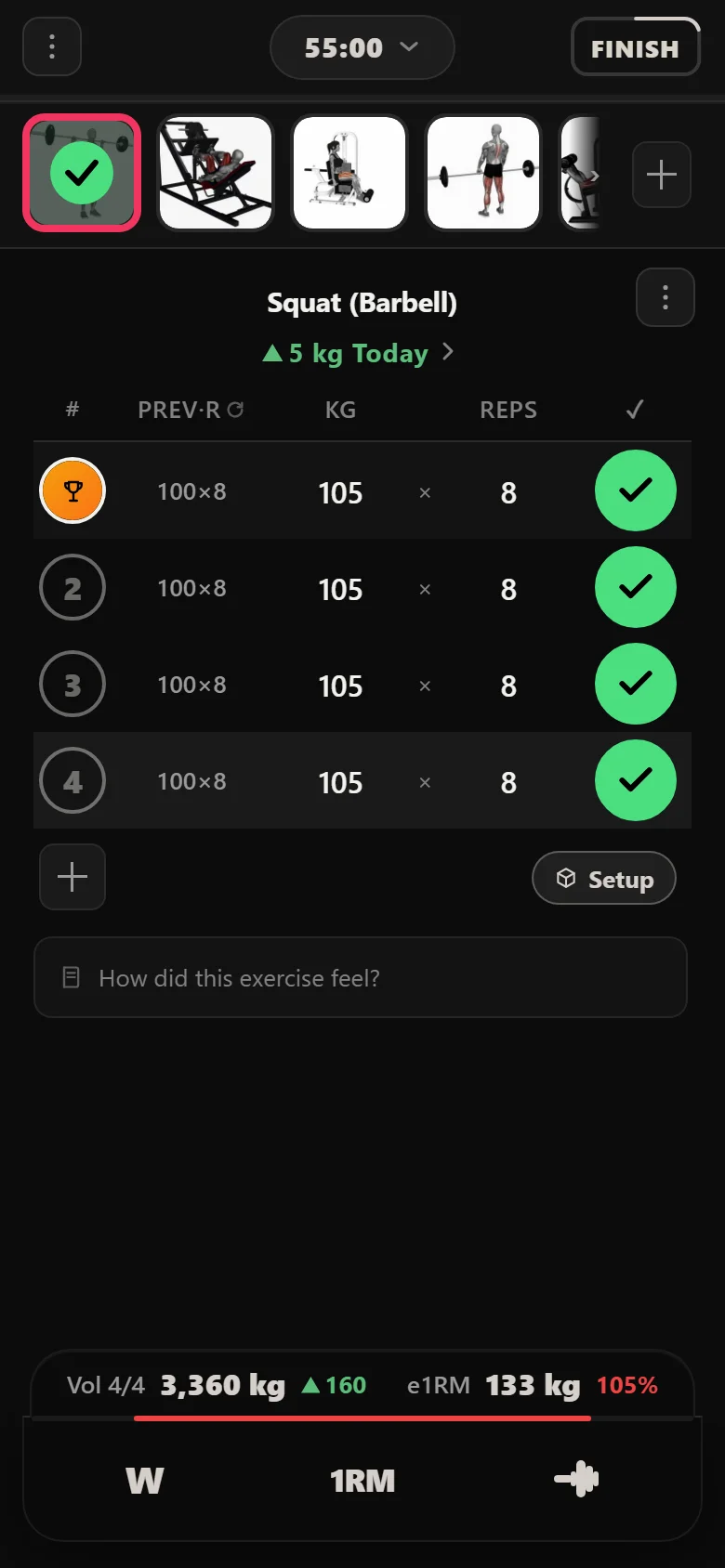
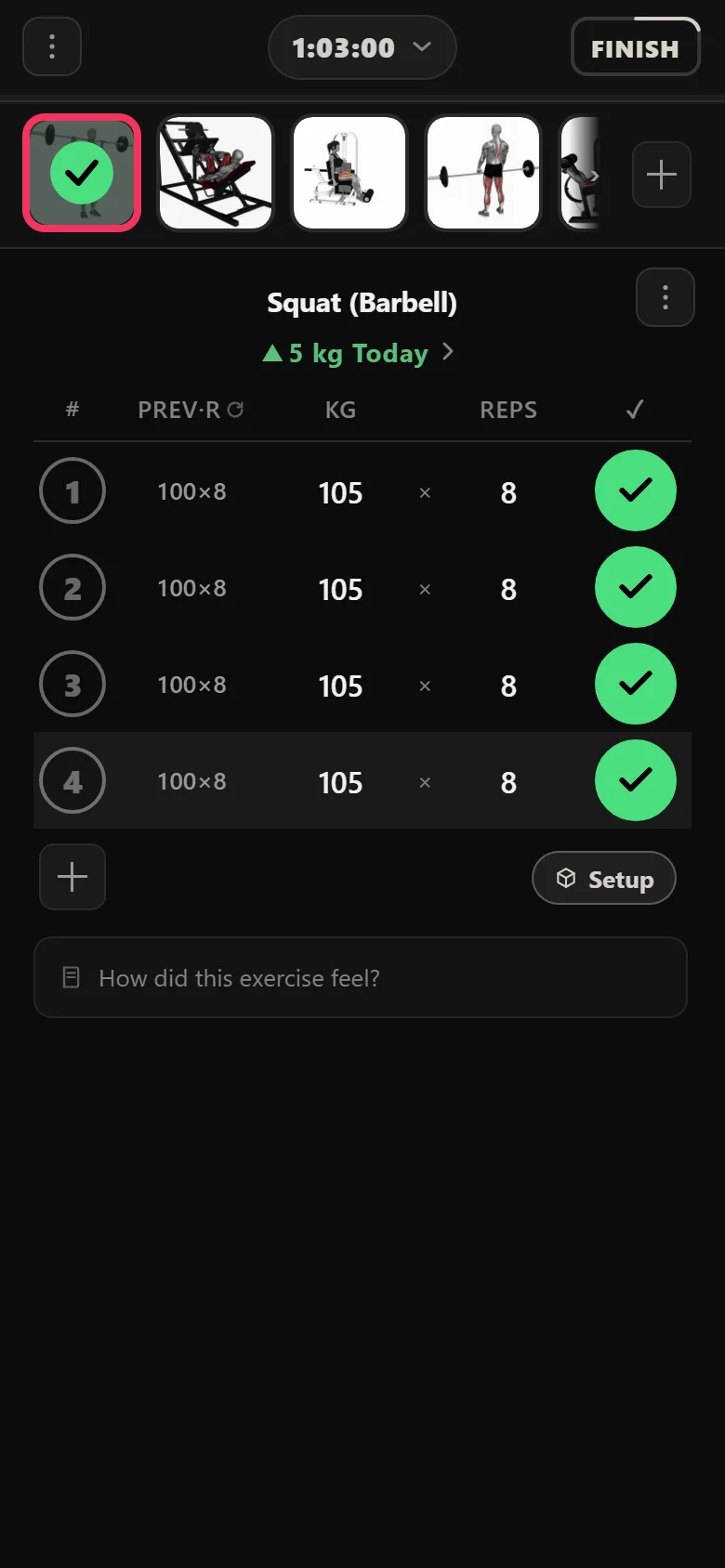
It opened at 100 kg for four sets of eight. Nine sessions later the bar was at 105 kg. On a six-day program that is only the squat's second appearance, which is worth holding onto when the accessory weights seem to be climbing faster: they are getting more chances.
You do not decide any of it. Open the app on a legs day and the number is already there, along with the rule that put it there.
110 kg, twice
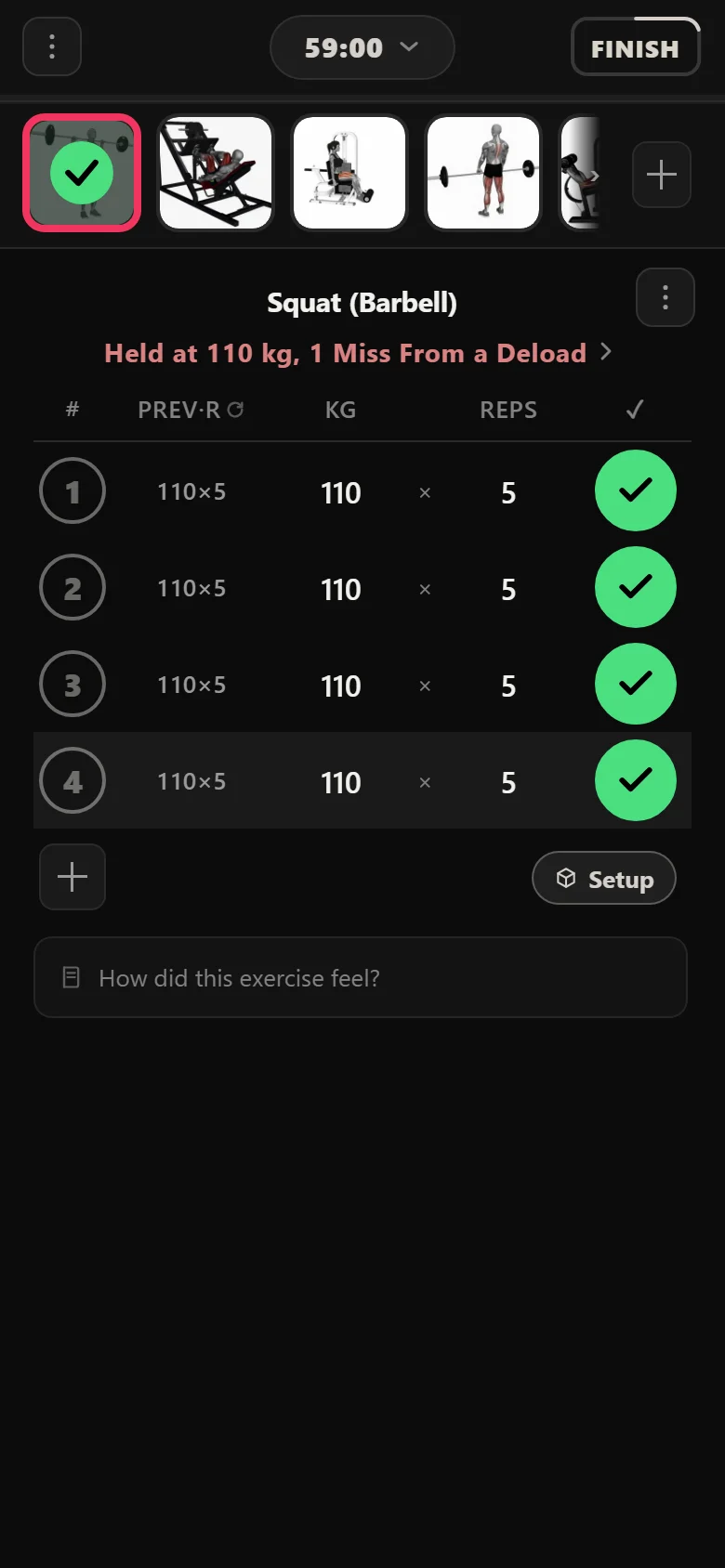
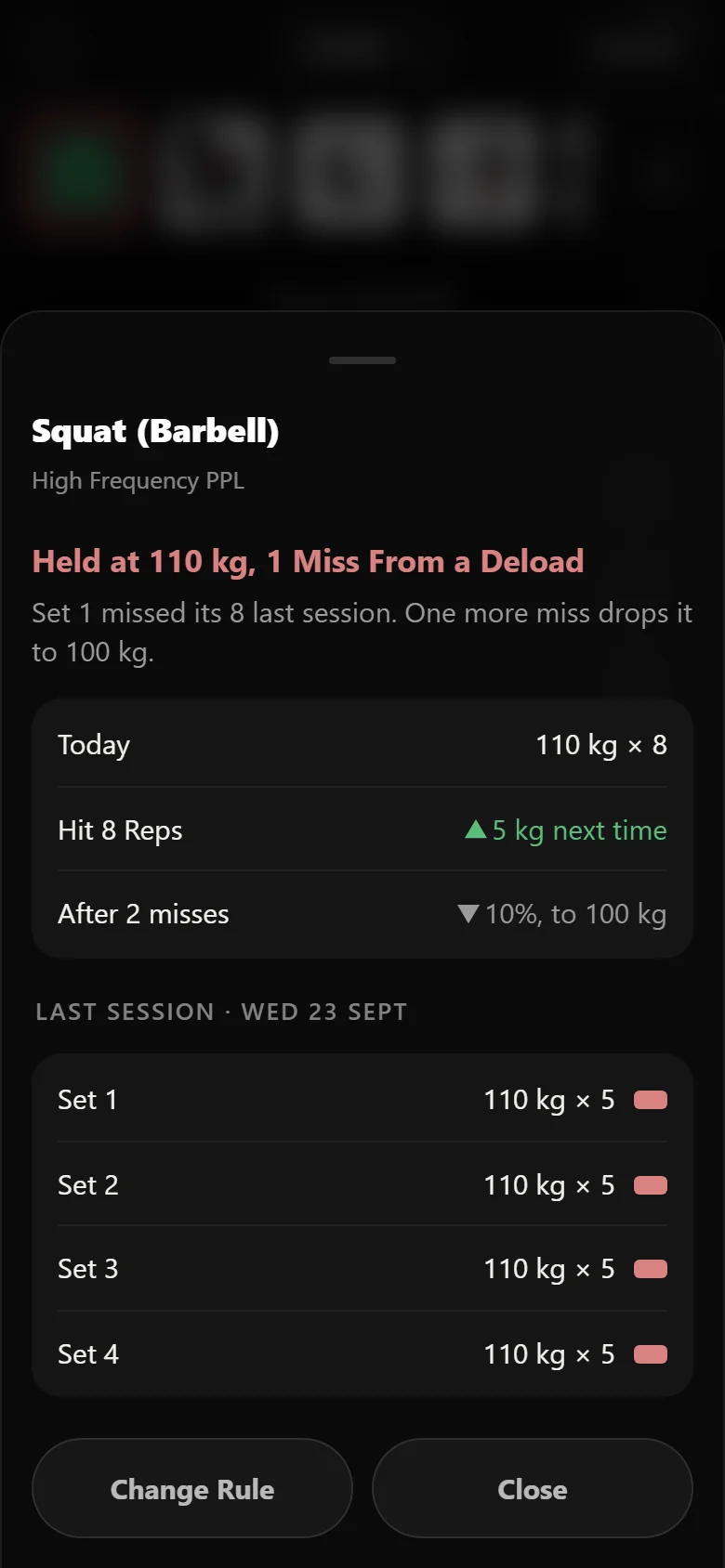
110 kg is where it stopped. The first attempt produced 5 reps against a target of eight, which is a miss, and a miss on any working set is a miss on the session, so the weight was held rather than advanced.
The rule chip is a button, and tapping it is the fastest way to know where you stand. It laid out the evidence from this lift's own history: 110 kg attempted, 100 kg the last weight cleared, one miss banked, and a 10% cut waiting if the next attempt failed too.
The next attempt failed too. That is not a disaster and it is not a judgement about you, it is a program with a squat appearing once a week running into the ceiling that a once-a-week squat eventually finds.
The strip below is the squat across all thirty-six sessions, misses and cut included.
Squat (Barbell) across thirty-six sessions
- 100S3 Session 3 — start
- 105S9 Session 9
- 110S15 Session 15
- 110S21 Session 21 — second miss
- 100S27 Session 27 — cut 10%
- 105S33 Session 33 — rebuilding
The cut, and why it is a feature
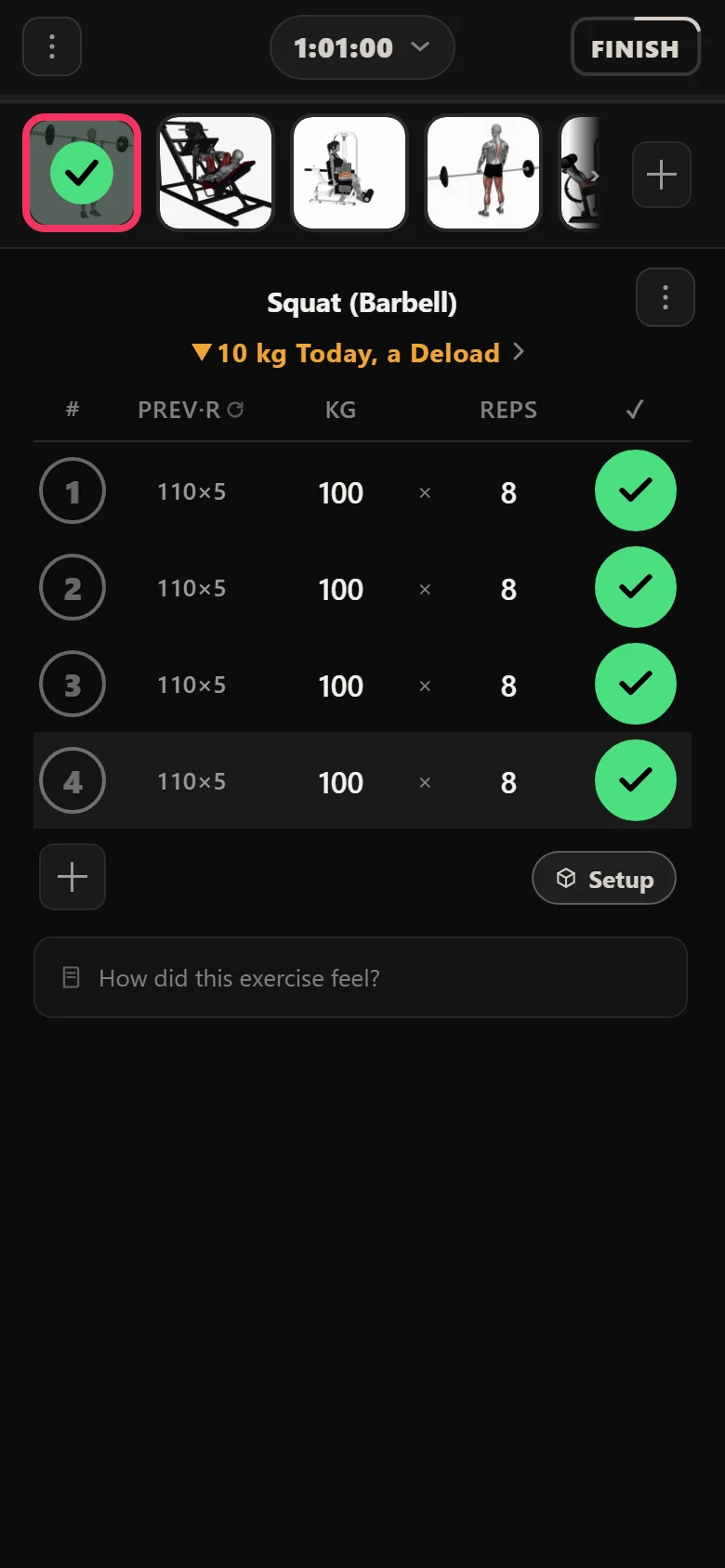
The second miss tripped the rule and the app cut the squat 10%, from 110 kg back to 100 kg, then restarted the climb from there. Nothing was calculated by hand and nothing was decided in the moment.
The instinct at this moment is to argue with it. You were close, the second miss was a bad day, you could take 110 kg next week. Sometimes that is true. What the cut buys you is three or four clean sessions of reps at a weight you can actually complete, and on a program where the squat appears once a week, three clean sessions is most of a month of not spinning your wheels.
The rebuild reached 105 kg by the end of the block. Below where the stall happened, ahead of where the block started, and every step of it decided from logged sets rather than from how the warm-ups felt.
Where most of the volume actually lives
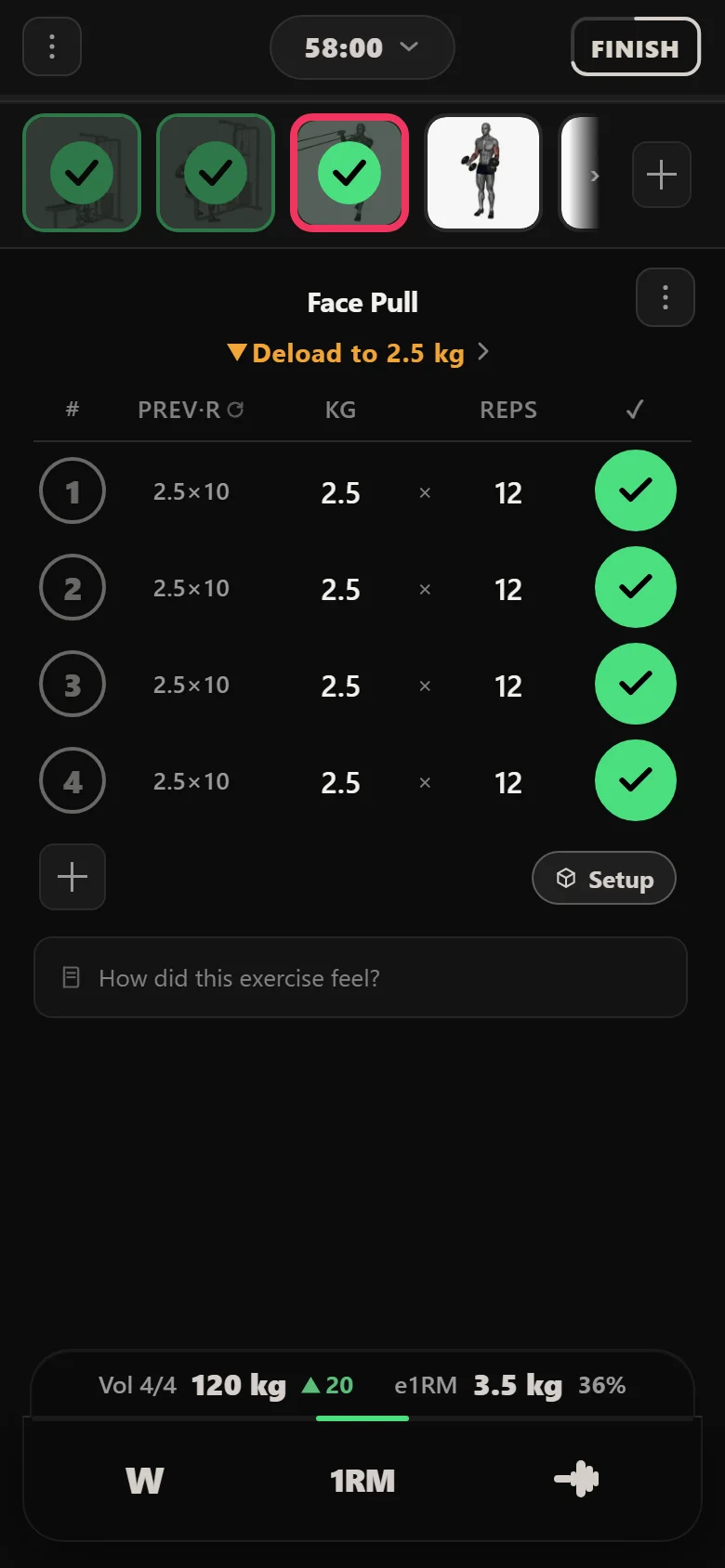
The anchors get the attention, but the majority of the sets on this program are accessories running double progression: climb the rep range session by session, and once every set reaches the top of it, take the small jump in weight and start again at the bottom.
The chip states the rule rather than making you remember which of sixteen lifts is chasing which range. On the high-rep isolation work that means fifteen to twenty reps, then 2.5 kg.
This is why a hypertrophy program can look stagnant in the weight column and not be. A lateral raise sitting at the same load for a fortnight while the reps climb from fifteen towards twenty is doing exactly what it was asked. Across six weeks the incline dumbbell press went from 30 kg to 40 kg and the Romanian deadlift from 77.5 kg to 87.5 kg on this mechanism alone.
Six days a week, seen from above
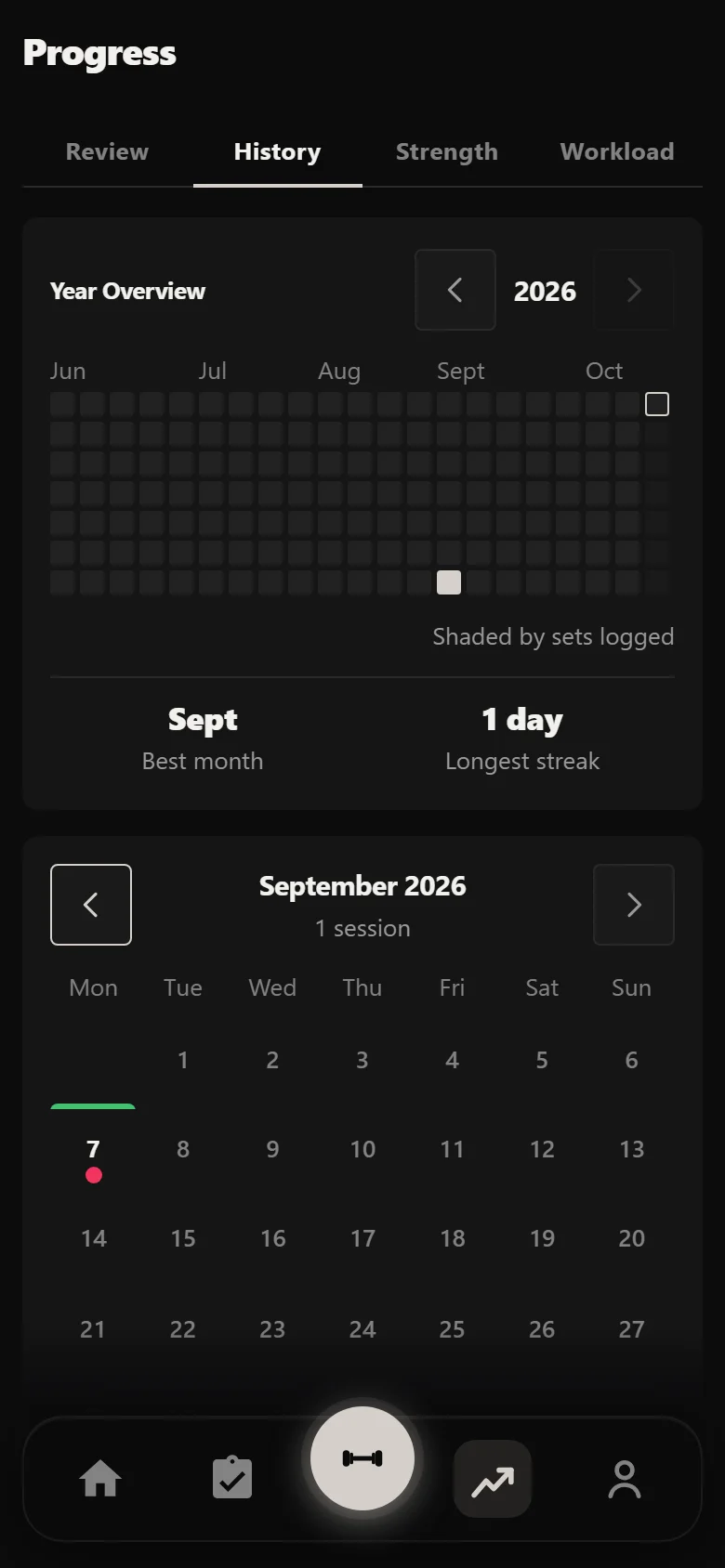
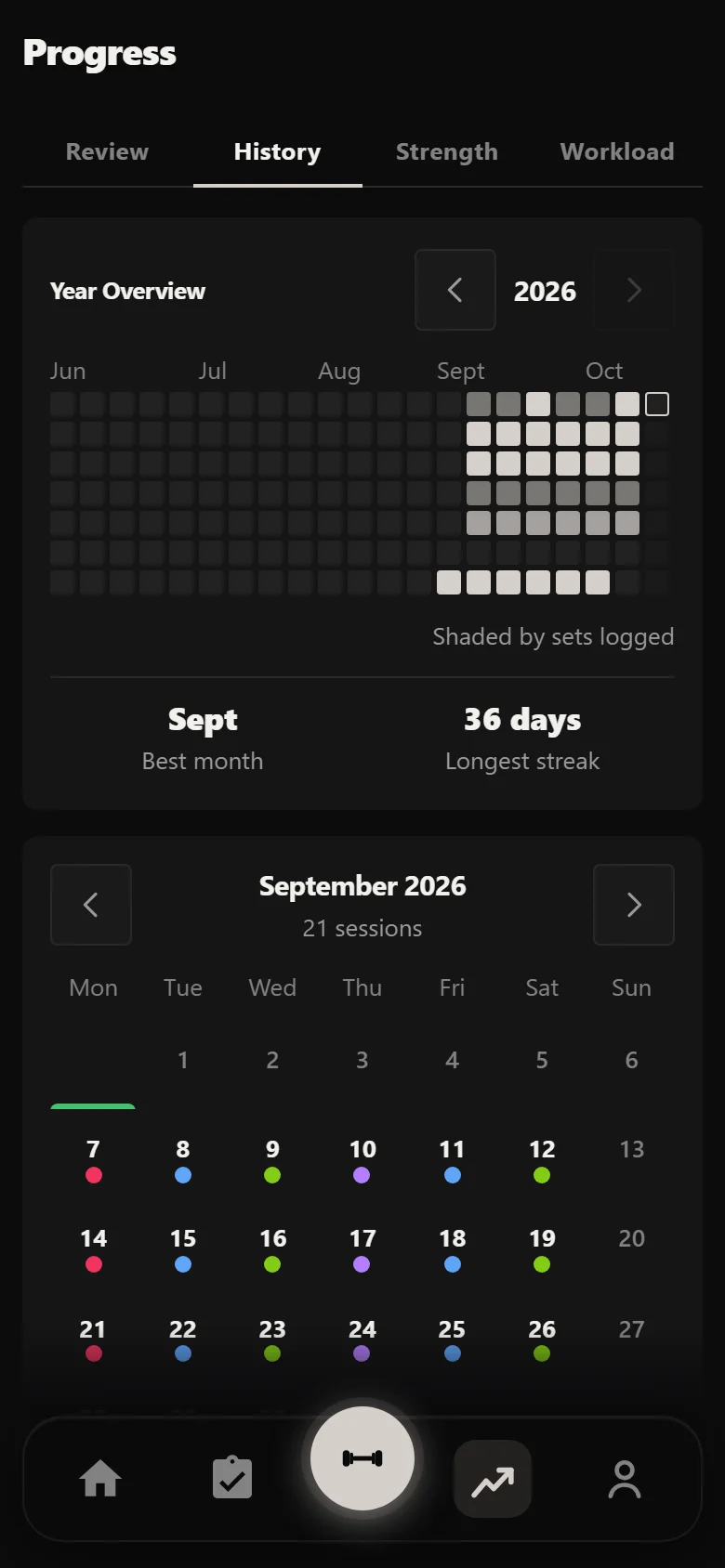
Thirty-six sessions over six weeks fills the History calendar almost solid, and the shape of a six-day program becomes obvious at a glance: there is one rest day, and it is not optional.
The per-session totals sit in a narrow band. There are no peak weeks and no easy weeks in this block, just the same load repeatedly with the weights creeping up underneath it.
What six weeks of doubles adds up to
The Review tab reads a month at a time, and September alone came to 79,198 kg across 21 sessions, 166 sets and 1,618 reps. That is a large number for one month and it is the honest cost of the split. Six sessions a week is not a schedule you drift into; it is one you build a life around.
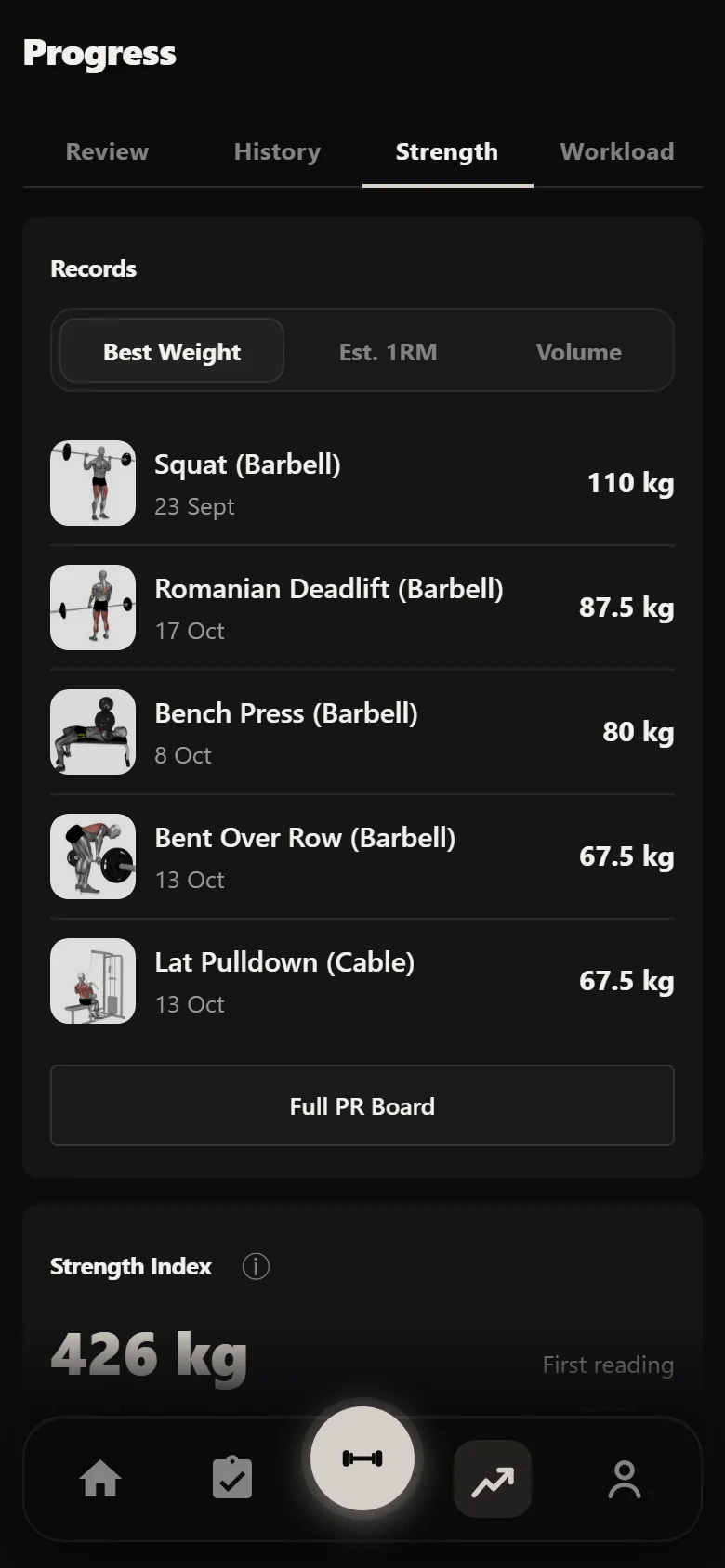
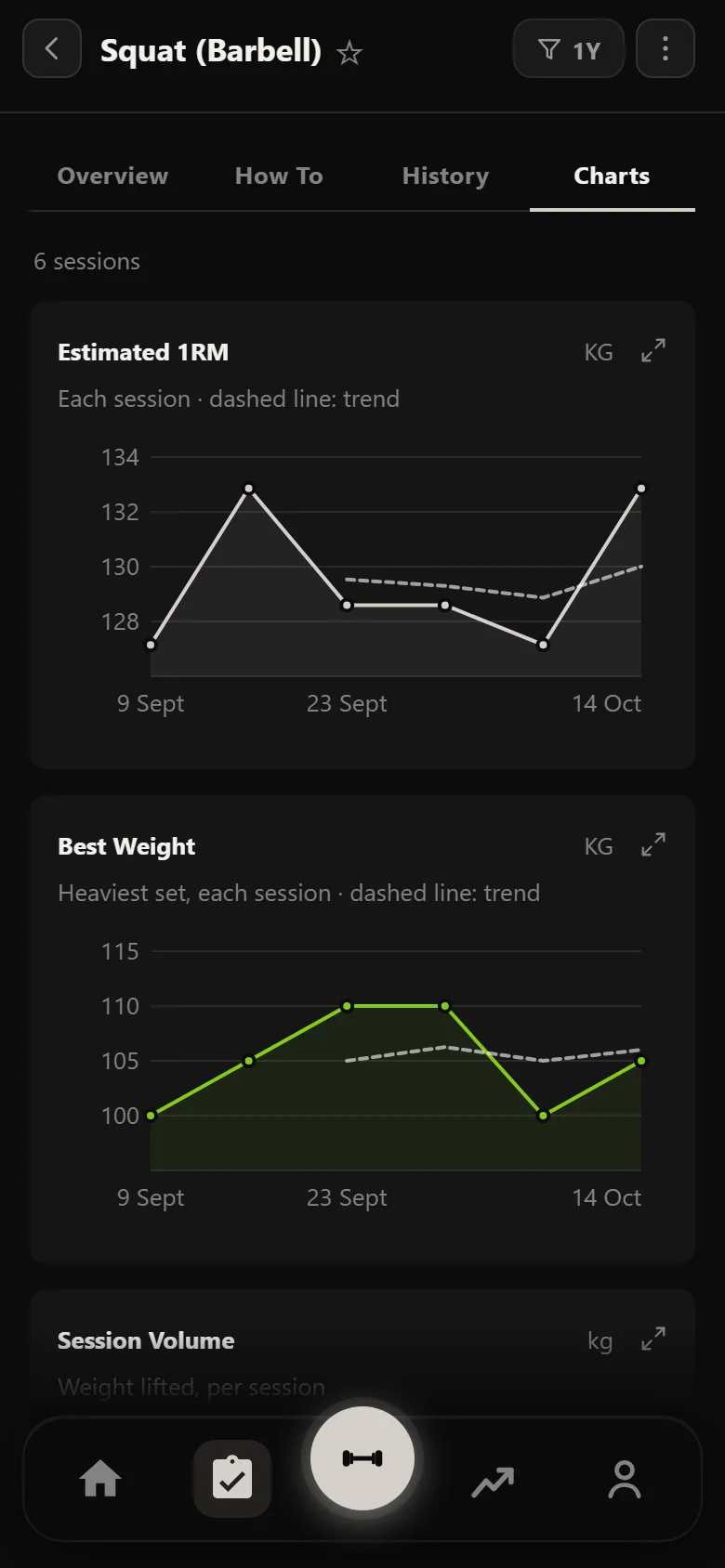
The Strength tab lists the records by best weight, the squat at 110 kg, the Romanian deadlift at 87.5 kg, the bench at 80 kg, and the row and the lat pulldown at 67.5 kg each, over a Strength Index of 426 kg. The estimate chart for the squat shows the shape of the block properly: a climb, a flat stretch through the two misses, the dip where the cut landed, and a rebuild that ends above where it began.
That dip is the part worth looking at. It is the only place in six weeks where the number went down, and the program put it there on purpose.
The payoff: session three against session thirty-three
The same lift, the same four working sets, six weeks apart, with a stall and a cut in between. The block did not end at its highest weight, and it still ended ahead.
It touched 110 kg twice, missed both, took the cut and rebuilt past its starting weight.
Common questions
What is High Frequency PPL?
Push, Pull and Legs run twice a week, six sessions in total, with each muscle group getting fifteen to twenty-two sets spread across two days. A heavy compound lift anchors every session and accessories carry the rest of the volume. It is the split most evidence-based hypertrophy coaching has converged on for intermediates who can train six days.
Why does the bench press have two different weights?
Because it is doing two different jobs. On Push A it is the heavy anchor, four sets of six to eight, advancing when you hit the top of the range. On Push B it is volume work, three sets of ten to twelve on double progression. Durata tracks those as separate progressions with separate weights and separate miss counts, so a stall on one does not touch the other. The overhead press works the same way in reverse.
Why do some lifts that appear twice only have one weight?
Because both appearances are asking for the same thing. The seated cable row and the face pull turn up on both pull days in the same rep range under the same rule, so they share one weight and one history. Only the lifts the program treats differently on the two days get split.
Can I run it on five days?
Not really, and not in a way that leaves it the same program. The second push, pull and legs day is where half the volume lives and where the second weekly exposure comes from. If you have five days, a five-day split built for five days will serve you better than this one with a session removed.
My squat deloaded. Did I do something wrong?
No. Two missed sessions at the same weight trips the rule and the app cuts it 10%, which is the mechanism working rather than failing. In this run the squat missed 110 kg twice, dropped to 100 kg, and rebuilt to 105 kg by the end of the block. On a program where the squat appears once a week, taking the cut early is faster than arguing with it for a month.
Is Durata free?
Yes. Durata is free to use, with the full program catalogue, per-slot progression tracking, rest timers and PR detection. Everything in this walkthrough is in the app.
Put it into practice
Durata is free to use — 50 proven programs, automatic progression, rest timers and PR tracking, all on your phone.