


nSuns LP in Durata: the rep count picks the jump
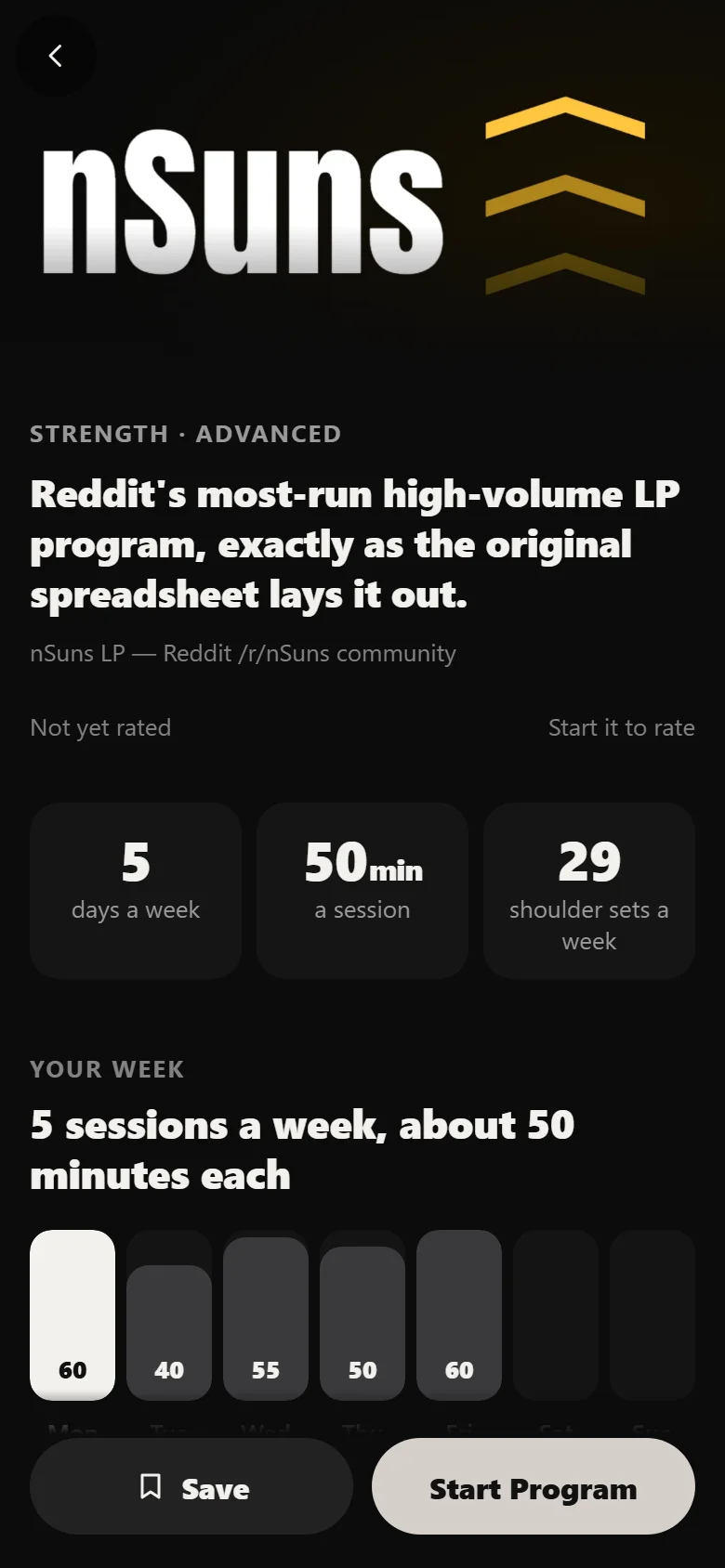
nSuns LP is the high-volume linear program that made the leap from a spreadsheet to something most people run off their phone. Five days a week, four main lifts, and each of them gets one session built as a pyramid: nine sets climbing to a single all-out set at 95% of the training max, then working back down. That one set decides everything. It is not pass or fail, it is graded, and the number of reps you get picks how far the training max moves.
Every weight, rep and estimate below was computed by the real engine on a live drive: six weeks, thirty sessions, four training maxes. The squat opens off a 140 kg max.
Starting the program
In Discover, nSuns LP sits on the Strength shelf, marked Advanced, at five days a week. Search finds it by name, or Filter narrows the shelves by level and days a week. Tap the cover for a quick look, then View Program for the full page.
It suits a lifter with five days who wants a lot of volume and a program that keeps adding weight until it genuinely stops working.
Setup asks for four training maxes: bench press, squat, overhead press and deadlift. Nothing else in the program is given a weight, because nothing else needs one. Every prescribed set on every day is a percentage of one of those four numbers.
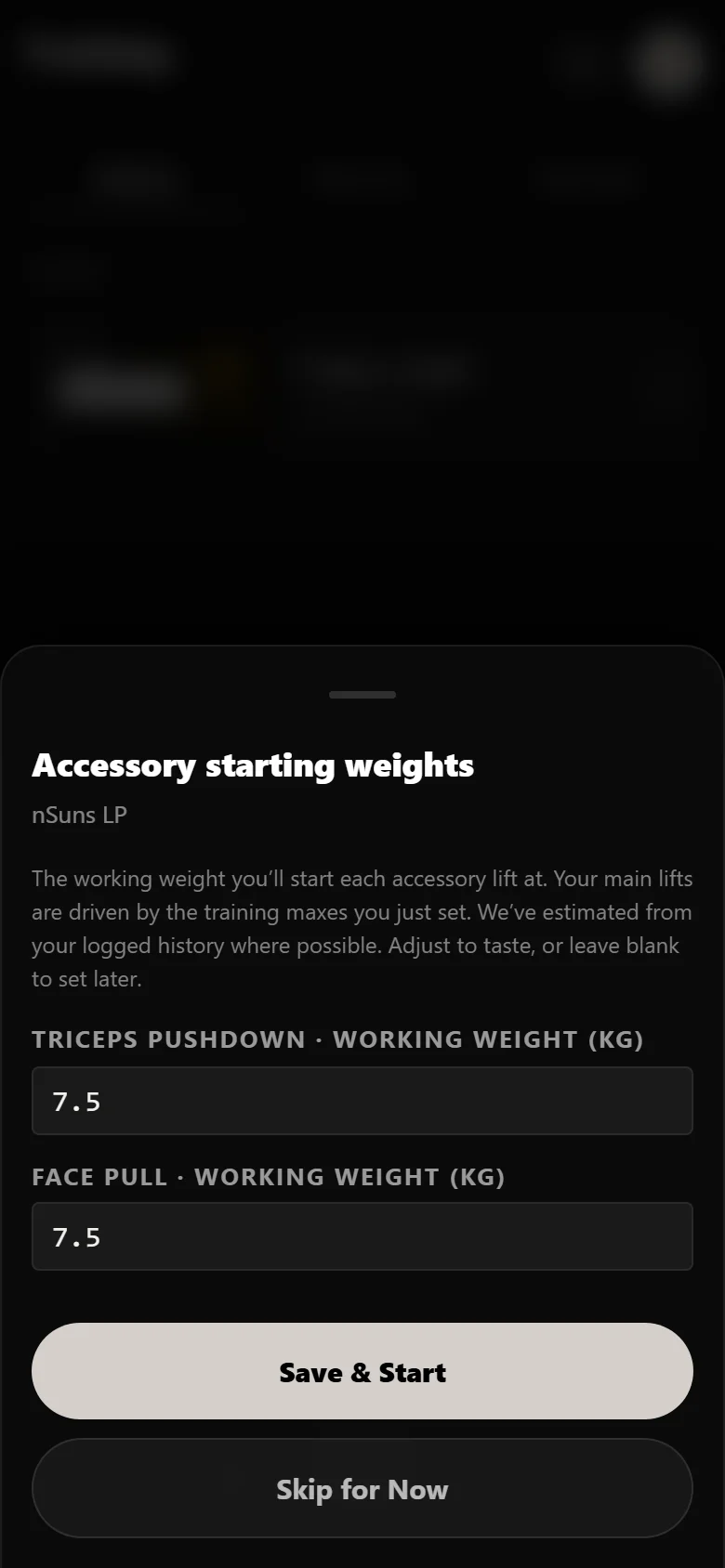
That includes the second lift on each day. The front squat is a percentage of the squat's max, sumo deadlift a percentage of the deadlift's, and the incline and close-grip benches percentages of the bench's. They climb when the parent lift climbs, without a number of their own to keep track of. Only the accessories fall outside the system, and they get a plain working weight on a separate sheet.
Nine sets, one that counts
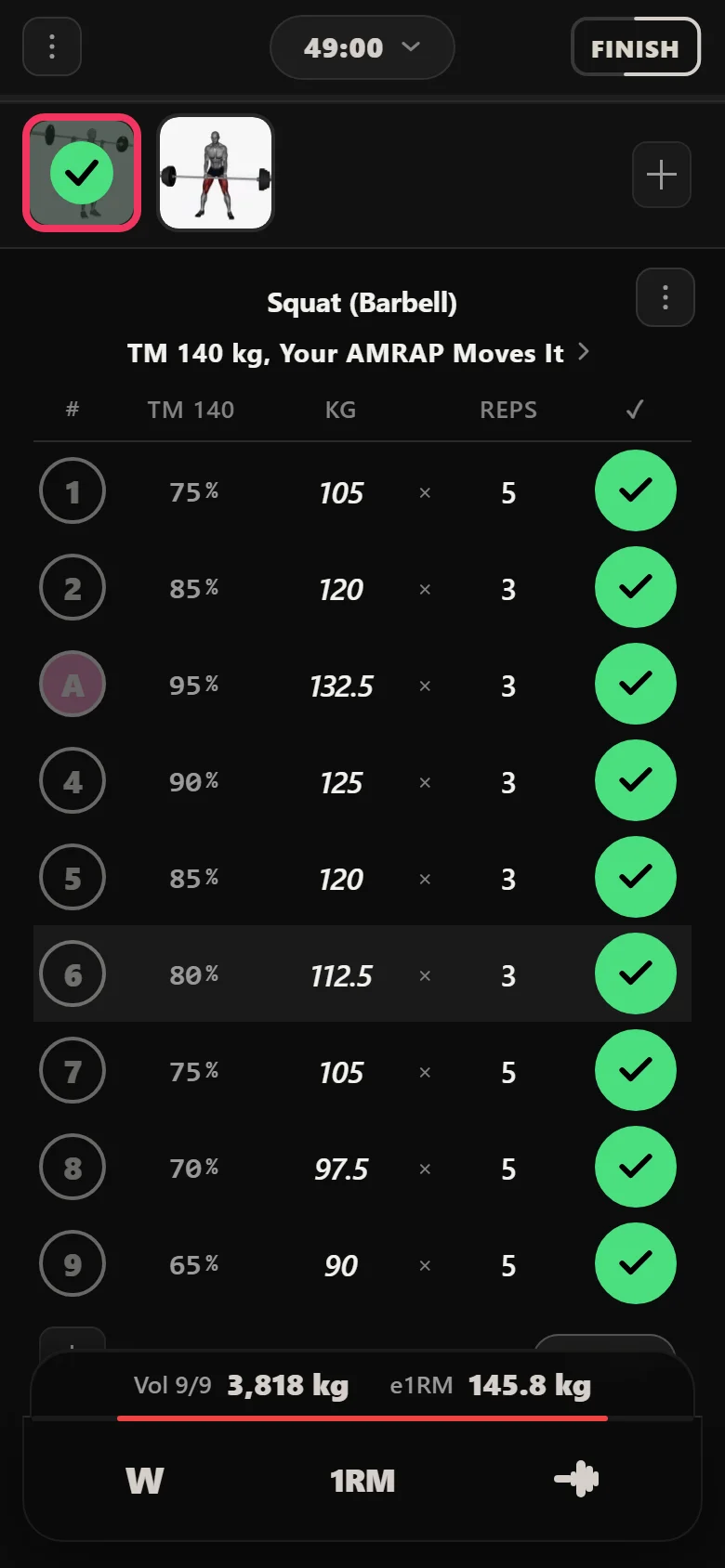
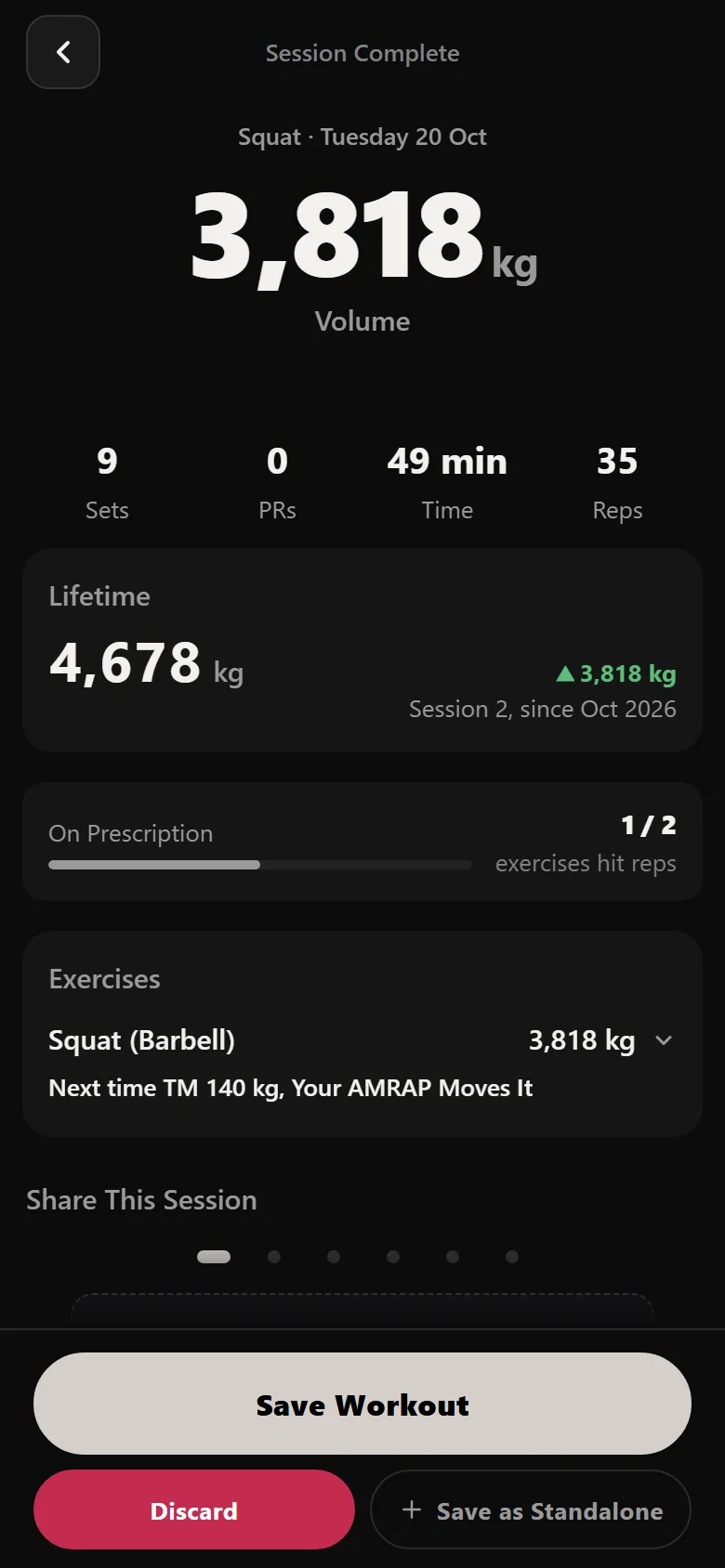
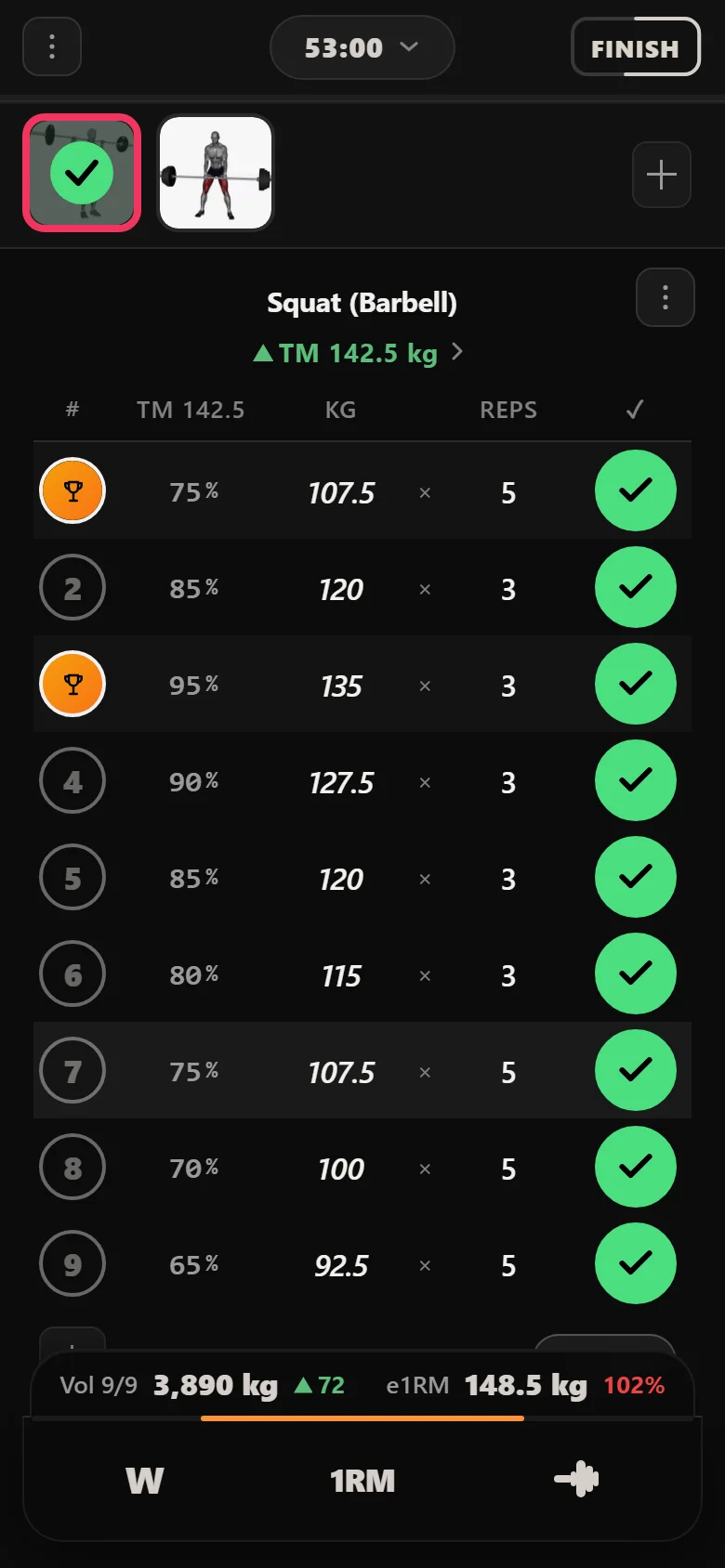
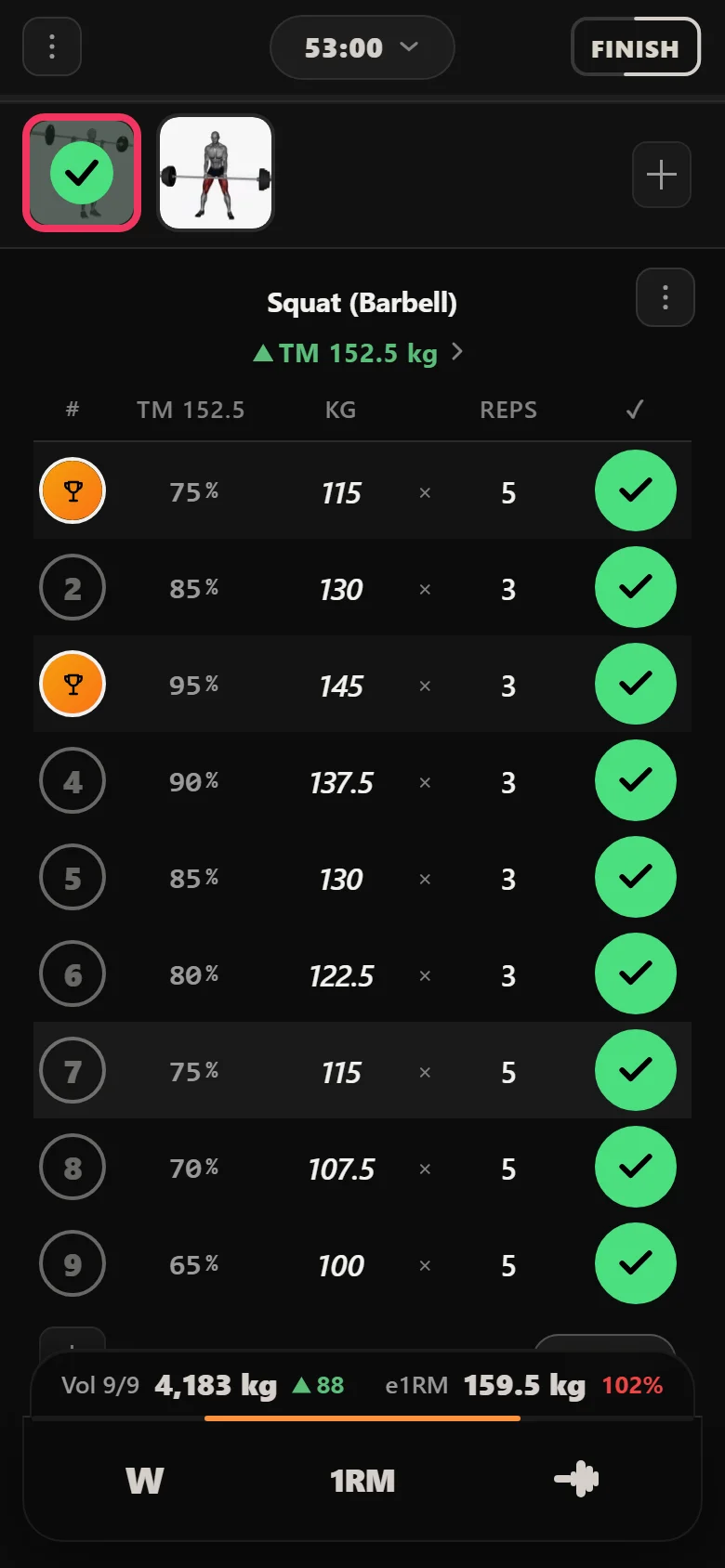
Squat day runs nine sets of squats. Five reps at 75% of the max, three at 85%, then the set the whole day is built around: one rep at 95%, taken for as many as you have. After that the weight comes back down through six more sets, so most of the session's volume arrives after the hard part is over.
On a 140 kg training max, that top set is 132.5 kg. None of the nine weights was chosen. They are percentages, resolved by the app, and the session came to 9 sets, 35 reps and 3818 kg of work.
The second lift on the day is a sumo deadlift for eight sets, and it takes its percentages from the deadlift's training max rather than its own. It is one of four lifts in the program set up that way, which is why the setup sheet only asked for four numbers to run eight lifts.
The increase is graded, not pass or fail
Most linear programs treat the top set as a threshold: clear it and add a fixed amount, miss it and hold. nSuns grades it instead. On the squat and deadlift, two reps or more on the 1+ set adds 2.5 kg to the training max, four or more adds 5 kg, and six or more adds 7.5 kg. Bench and press take smaller steps: 2.5 kg for two to five reps, 5 kg for six or more. The better the set, the bigger the step.
This run hit three reps every week, which lands in the first band, so the squat's max went up 2.5 kg at a time. The next session's top set moves with it, from 132.5 kg to 135 kg, and so does every other weight on the day.
The practical effect is that a good day is worth more than a good day usually is. A week where the reps came easily is not just a session logged, it changes the size of the next jump. All four main lifts finished up 15 kg over the block: squat 140 kg to 155 kg, bench 100 kg to 115 kg, overhead press 60 kg to 75 kg, deadlift 180 kg to 195 kg.
Six weeks of it
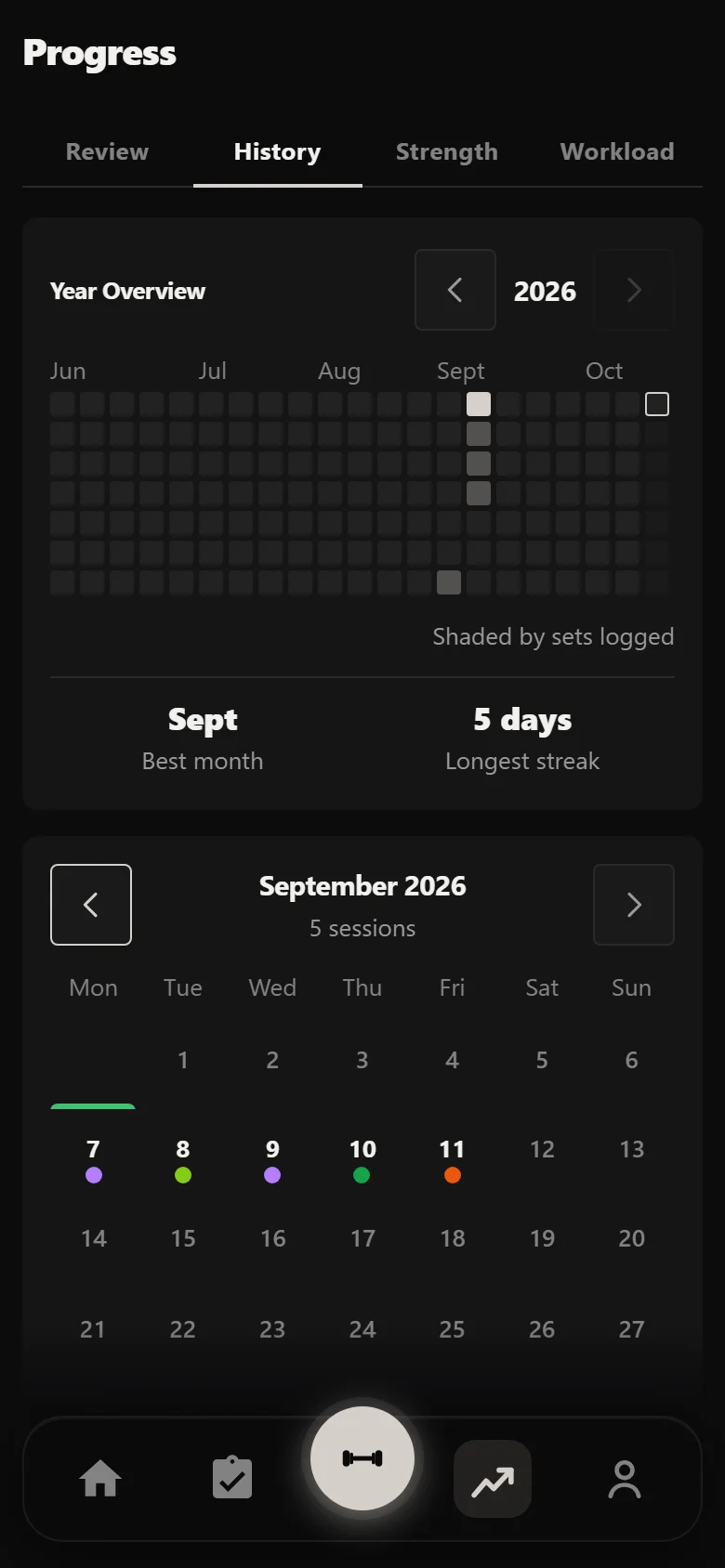
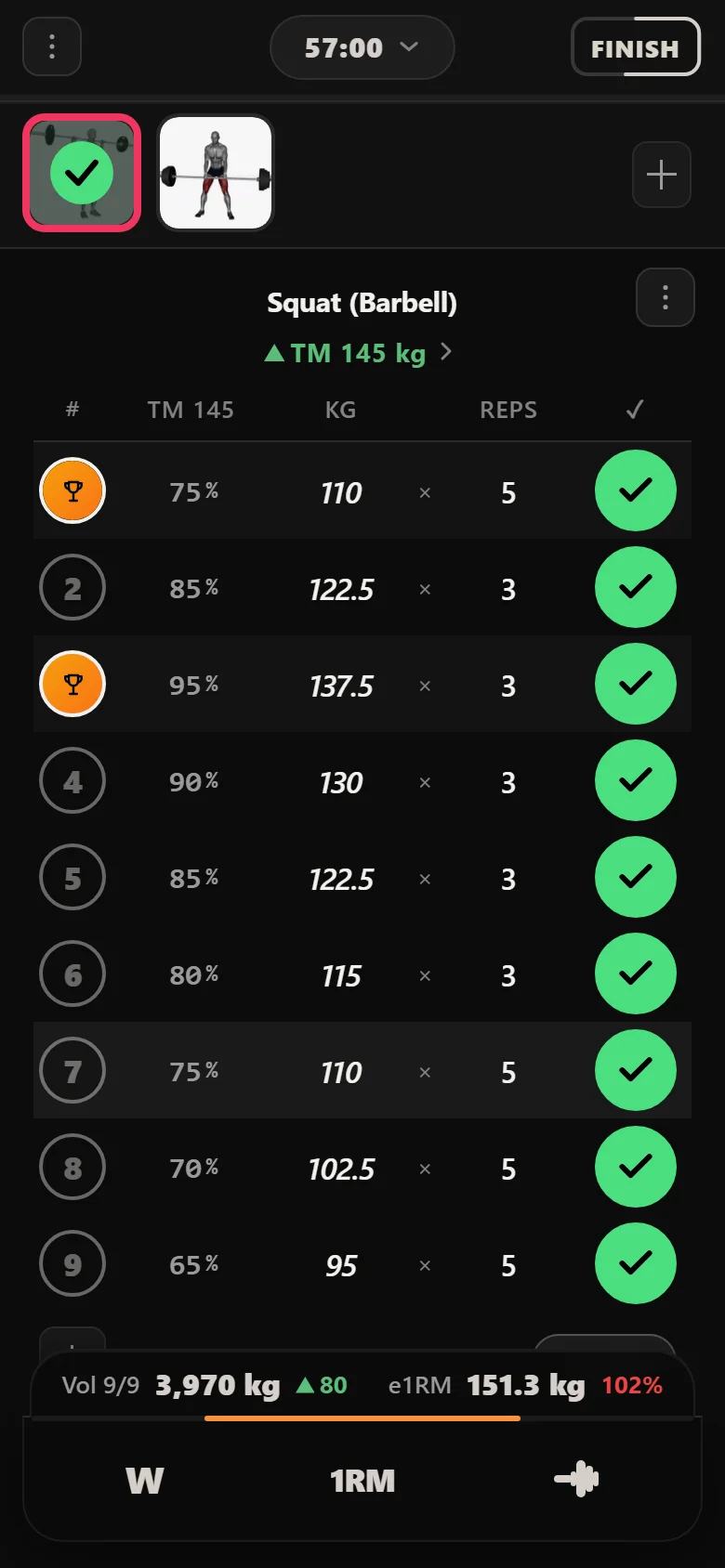
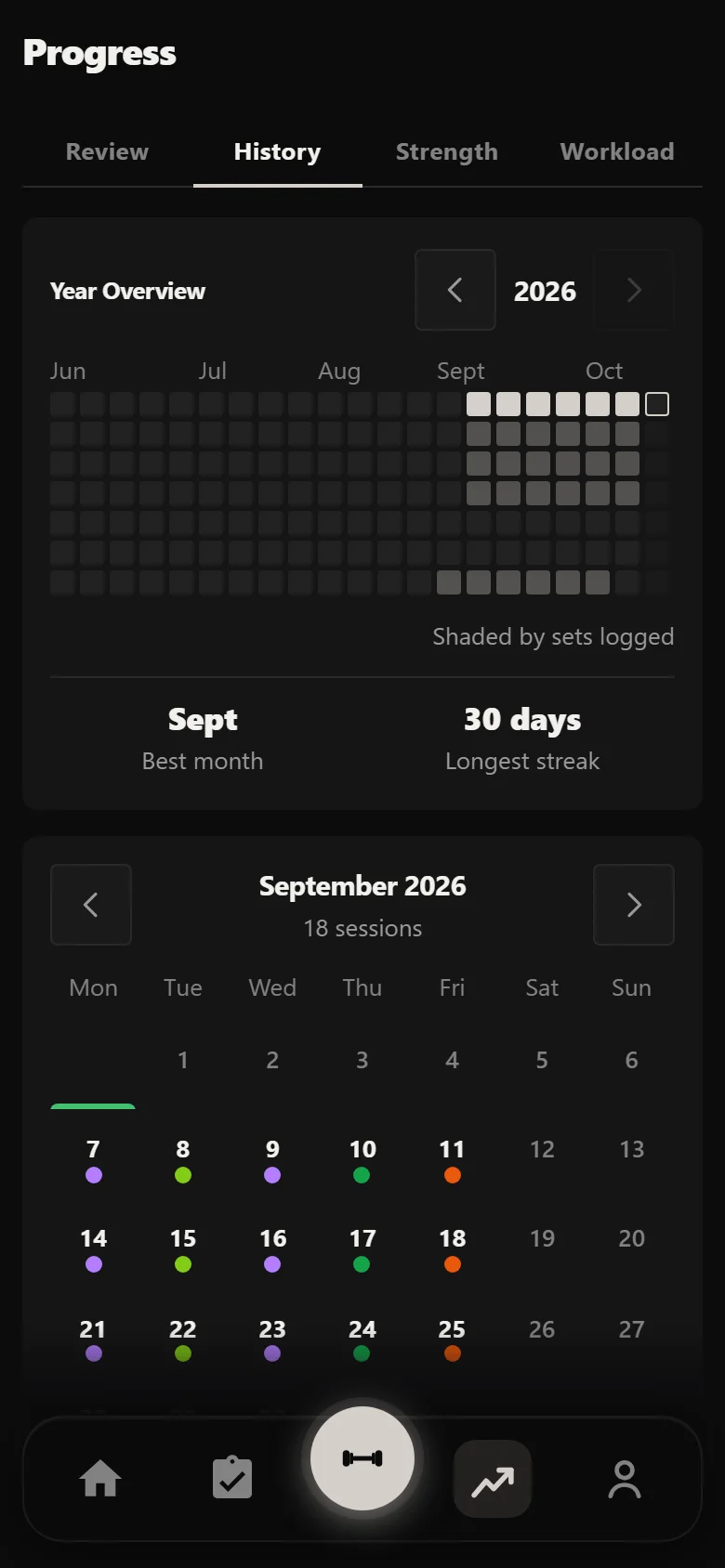
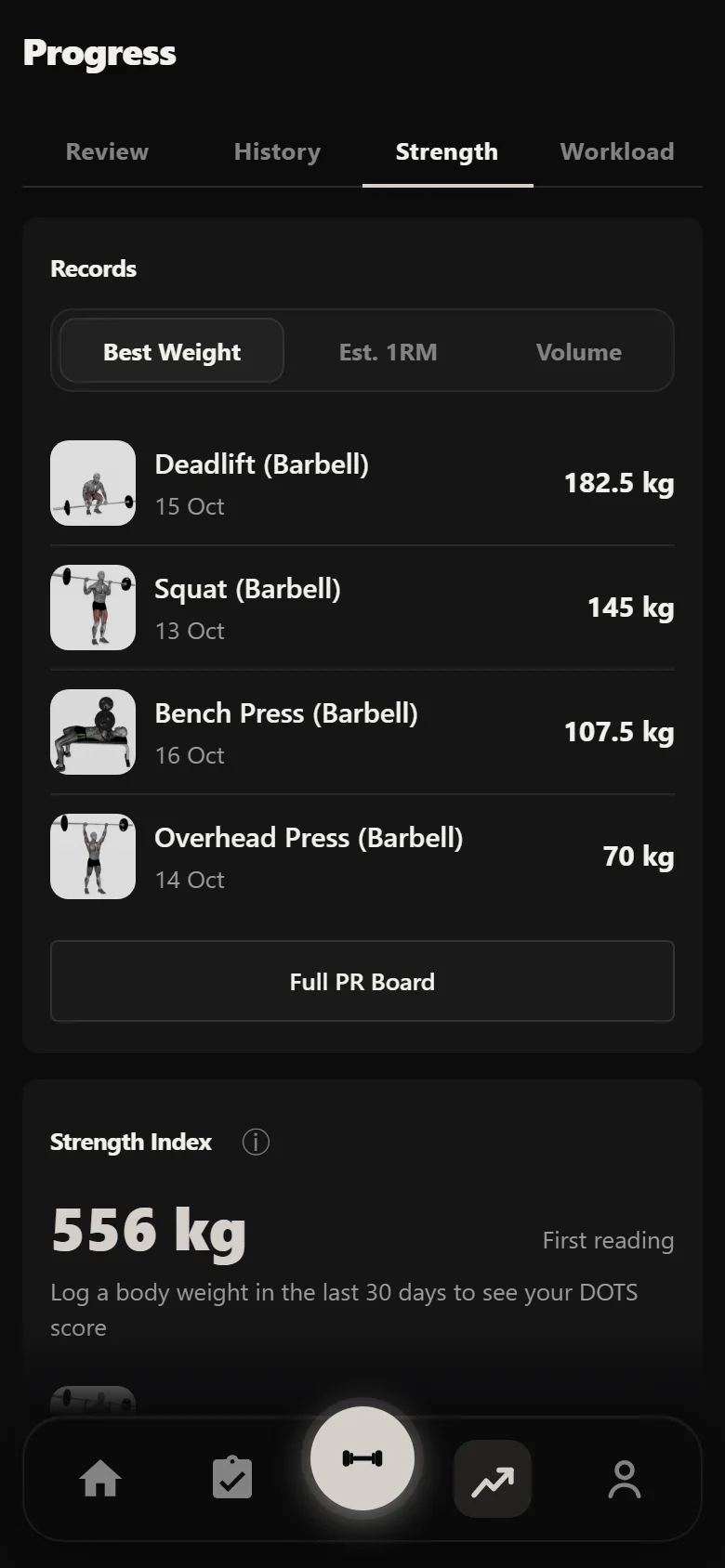
Thirty sessions later the squat's training max has gone from 140 kg to 155 kg, and the top set on the last squat day is 145 kg, above where the training max itself started.
The estimated one-rep max chart shows the shape: a stair, not a slope. It holds flat through the week's other four sessions, then steps after each squat day, because that is the only session where the squat's number changed.
nSuns is meant to be run exactly like this until it stops. The graded increase is what keeps it going longer than a flat one would, because a good week buys a bigger jump and a merely adequate one still buys a small step forward.
Squat (Barbell): the 1+ top set, week by week
- 132.5S1 Session 1 — wk 1, 3 reps
- 135S2 Session 2
- 137.5S3 Session 3
- 140S4 Session 4 — now at the opening max
- 142.5S5 Session 5
- 145S6 Session 6 — wk 6
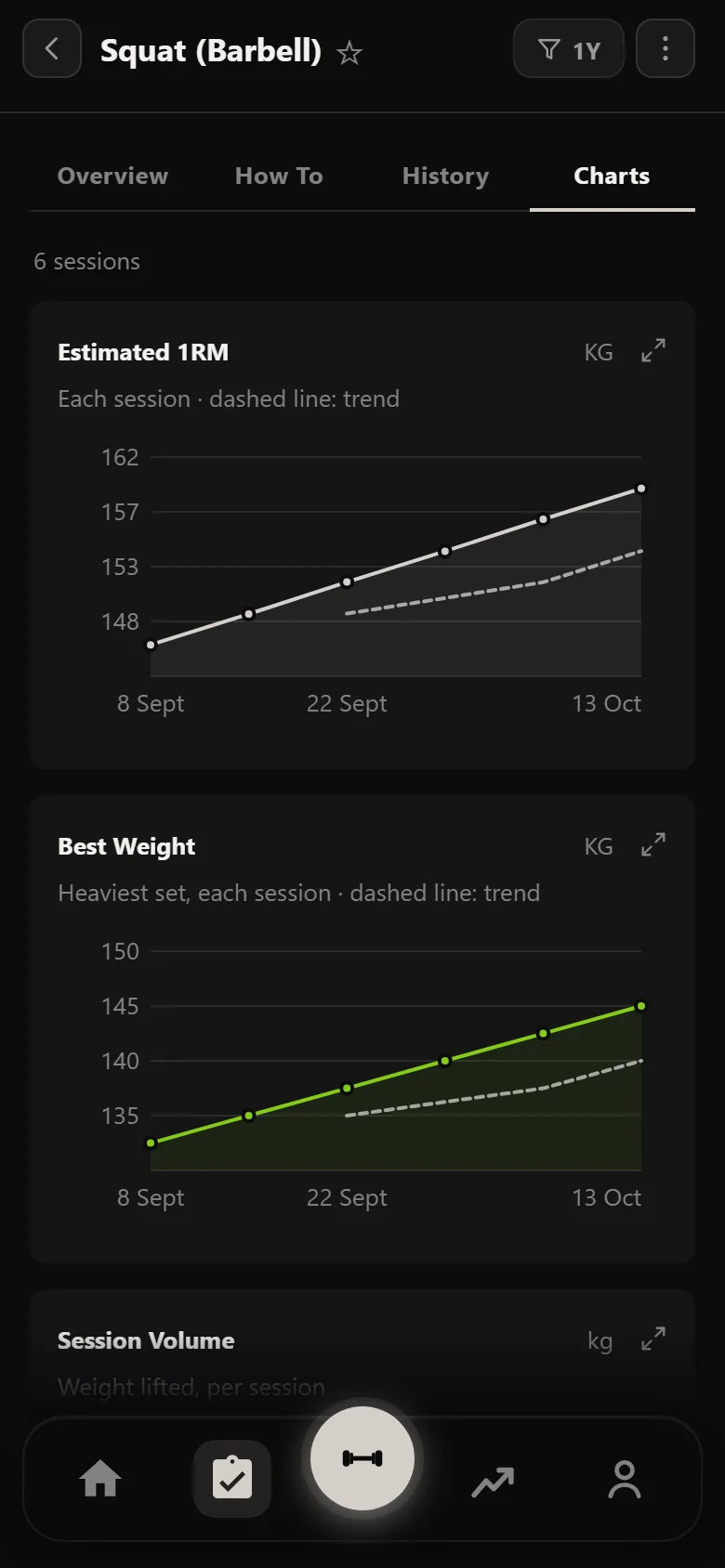
The same 1+ set six weeks apart, with every step in between earned on the reps of the set before it.
Common questions
What is nSuns LP?
A high-volume linear-progression program that started as a Reddit spreadsheet and became one of the most-run intermediate routines around. Five days a week, two bench sessions, and each main lift gets a nine-set day peaking at a single all-out set at 95% of its training max. The weekly increase is graded on that set rather than being a fixed amount.
What does the 1+ set mean?
One rep prescribed, more if you have them. It is the only set in the session that changes anything: the reps you get are read against a table that decides how far the training max moves. On squat and deadlift, two or more adds 2.5 kg, four or more 5 kg, six or more 7.5 kg; on bench and press, two to five adds 2.5 kg and six or more 5 kg.
Why does the setup only ask for four weights?
Because eight lifts run off four numbers. Bench, squat, overhead press and deadlift each have their own training max. The second lift on each day takes its percentages from one of those four rather than from a max of its own, so the front squat rides the squat and the sumo deadlift rides the deadlift. They climb automatically when the parent lift does.
What happens when I stop hitting reps?
The training max holds and the week repeats at the same weights. nSuns is designed to be run until that happens rather than for a fixed number of weeks, and the usual next step is a program that cycles its intensity instead of climbing every week.
Is nine sets of one lift too much?
It is a lot, and it is the reason the program is described as high volume. Six of the nine sets come after the hard one, at lighter percentages, so the session is front-loaded on effort rather than spread evenly across it. The app resolves all nine weights, so the volume is the only thing you have to bring.
Is Durata free?
Yes. Durata is free to use, with the full program catalogue, automatic progression maths, rest timers and PR tracking. Everything in this walkthrough is in the app.
Put it into practice
Durata is free to use — 50 proven programs, automatic progression, rest timers and PR tracking, all on your phone.