


PPL/Upper Lower in Durata: six weeks, five days, no stalls
Push, Pull, Legs, Upper, Lower. Five days, and every muscle group trained somewhere between one and a half and two times a week, which is about the most training most people can actually recover from. It is the most popular intermediate split there is, and it asks more bookkeeping of you than any beginner program: three heavy barbell lifts climbing on one rule, and more than two dozen accessories climbing on a different one.
This walkthrough follows six weeks of it in the app, thirty sessions. The squat carries the story because it opens Legs day and appears once a week, so its climb is easy to read. Every weight, rep and estimate below is engine output from that run. Nothing was typed in, and nothing that went wrong has been tidied up, because on this run nothing did.
Finding it
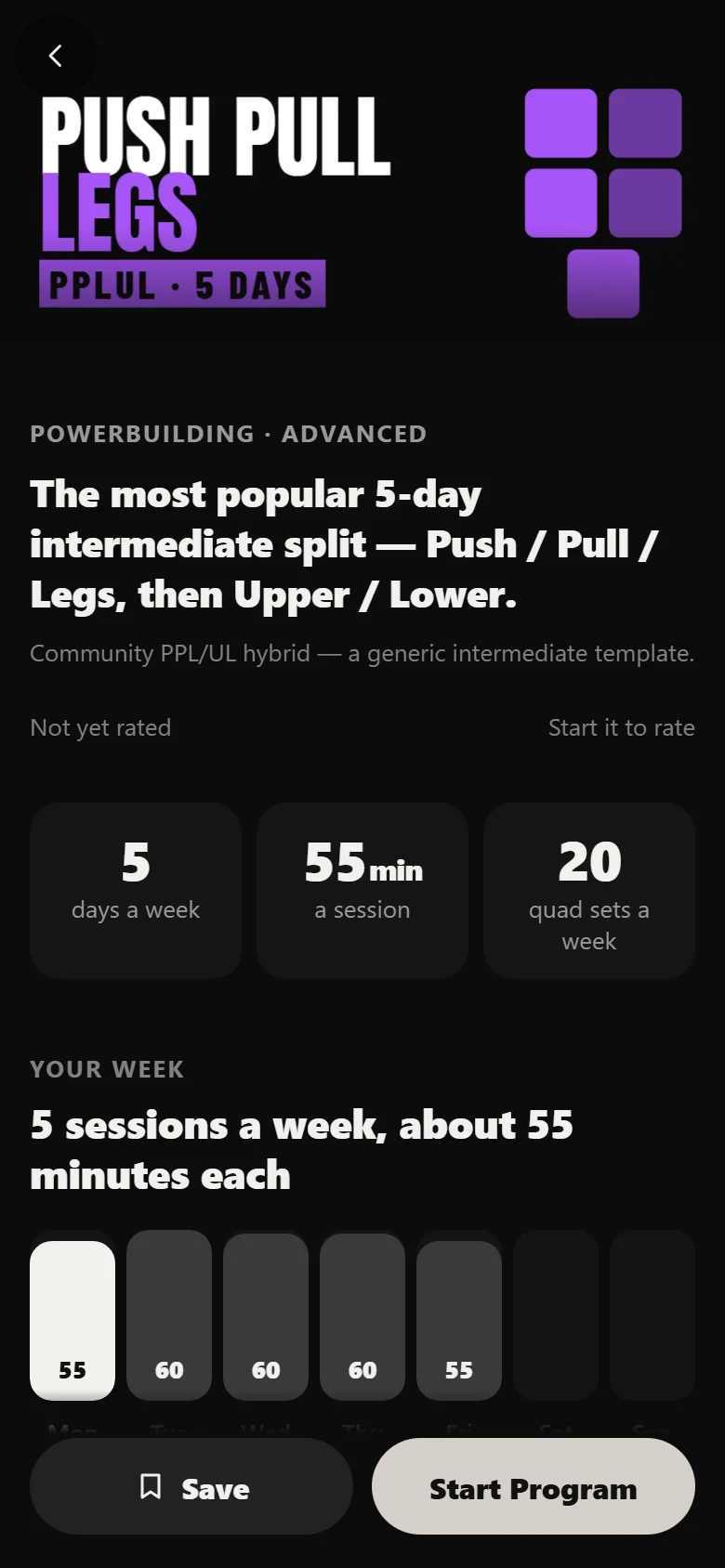
In Discover, Push Pull Legs · Upper Lower sits on the Powerbuilding shelf, marked Advanced, at five days a week. Search finds it by name, or Filter narrows the shelves by level and days a week. Tap the cover for a quick look, then View Program for the full page.
Five days is the part that matters. A five-day split squeezed into three sessions is not the same program with less of it.
The program page shows you the whole week before you agree to anything: the five days, the exercises in each, and the progression rule attached to every single lift.
Five days, and no lift trained twice
Push opens with the barbell bench, then dumbbell pressing, flyes, lateral raises and pushdowns. Pull opens with the deadlift, then pull-ups, barbell rows, cable rows, face pulls and curls. Legs opens with the squat, then Romanian deadlifts, leg press, curls, extensions and calves.
Then Upper and Lower come round and deliberately do not repeat any of it. Upper runs the incline barbell bench, chin-ups, seated dumbbell pressing, dumbbell rows, cable laterals and arms. Lower runs the front squat, hip thrusts, split squats, hack squats, seated leg curls and calves. Same muscles, different movements, which is the whole reason the split works at five days: the second pass hits the tissue without re-running the same joint stress.
That also means every lift in the week is its own slot with its own weight and its own progress. Nothing has to be reconciled between days, and adding weight on one lift never quietly moves another.
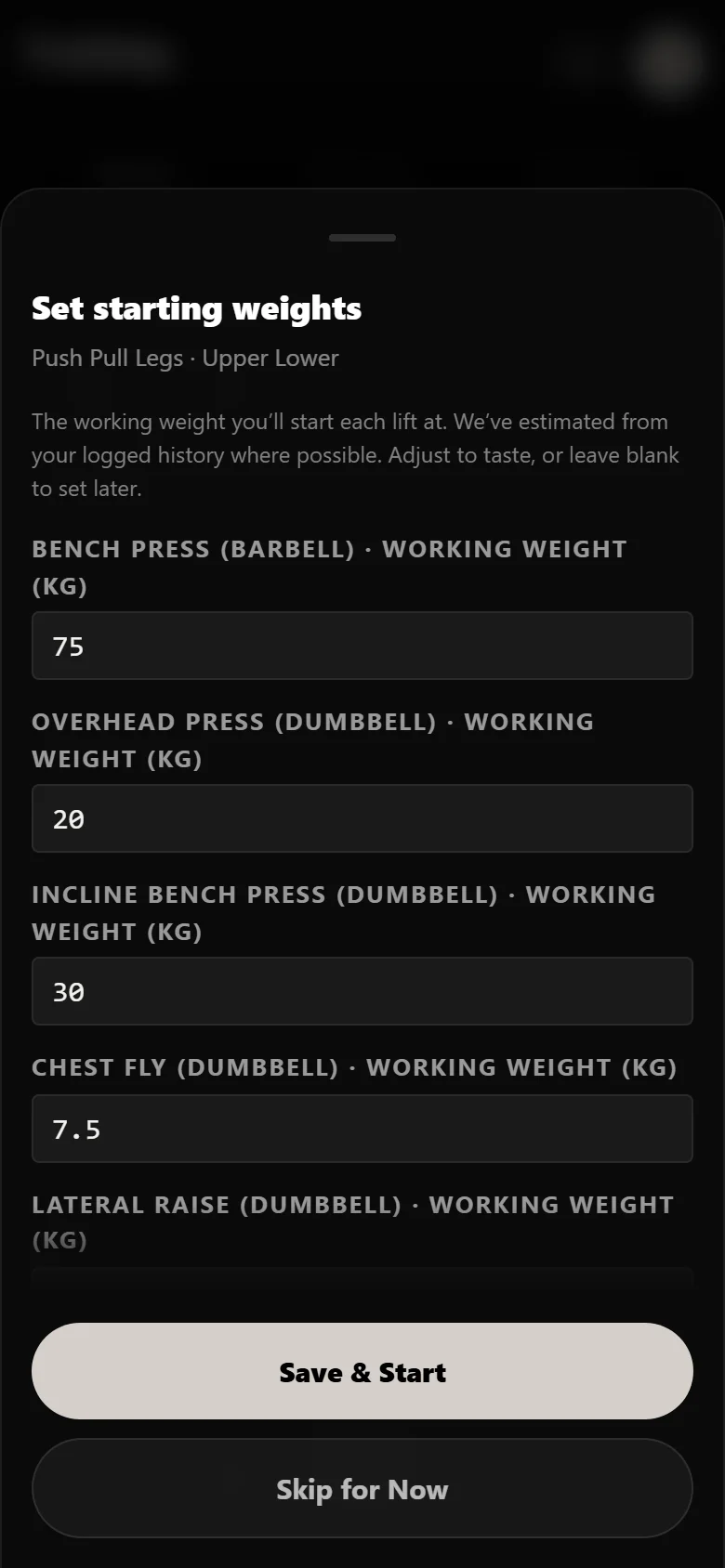
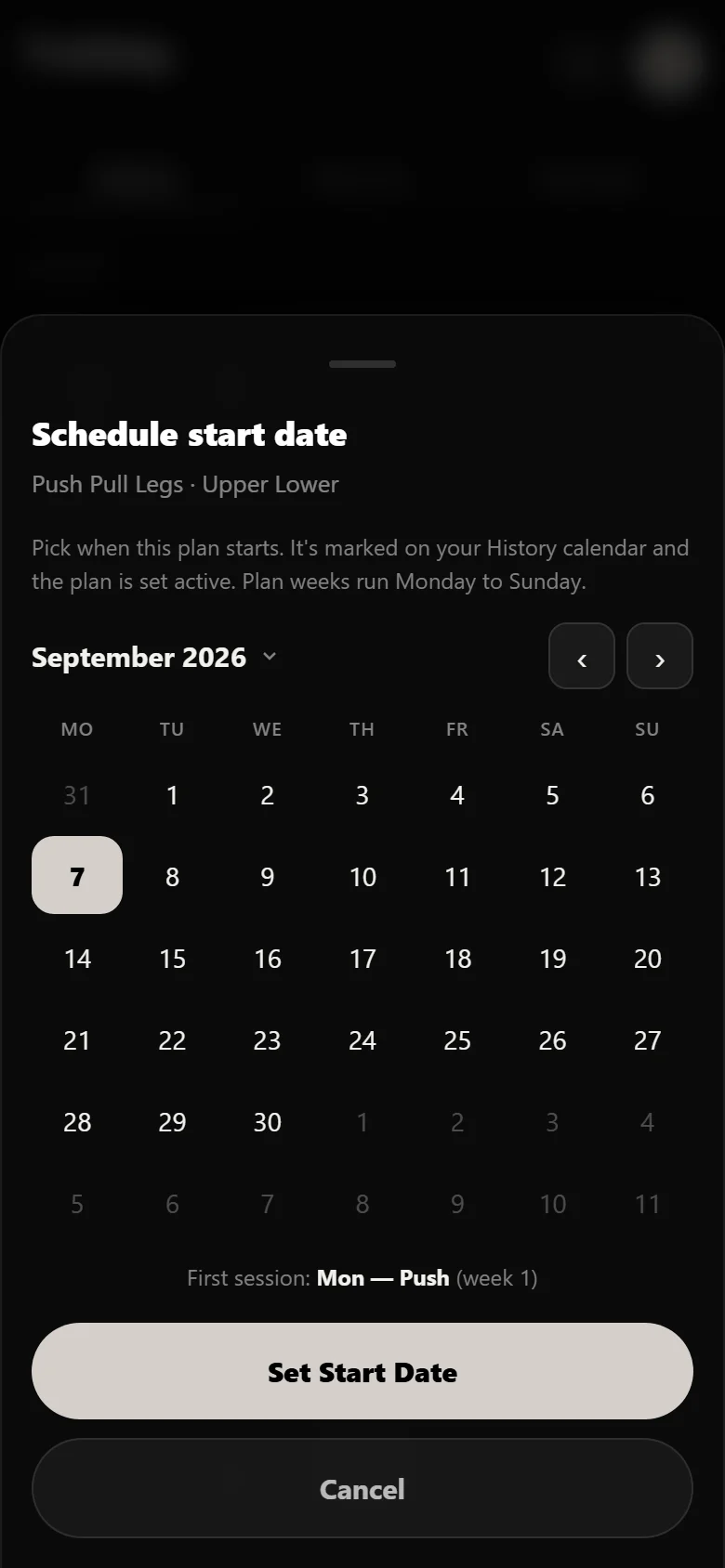
There are no training maxes and no percentages to work out. Setup asks for one number per lift, the weight you can currently handle for the prescribed sets, 75 kg on the bench and 130 kg on the deadlift on this run. Pick a start date and the session dates flow onto the History calendar from there. The program is a repeating weekly template rather than a fixed-length block, so it runs until you stop it.
Two rules, thirty-two lifts
This is the part that makes the split genuinely annoying to run on paper. Three lifts progress one way and everything else progresses another, and both need tracking week to week.
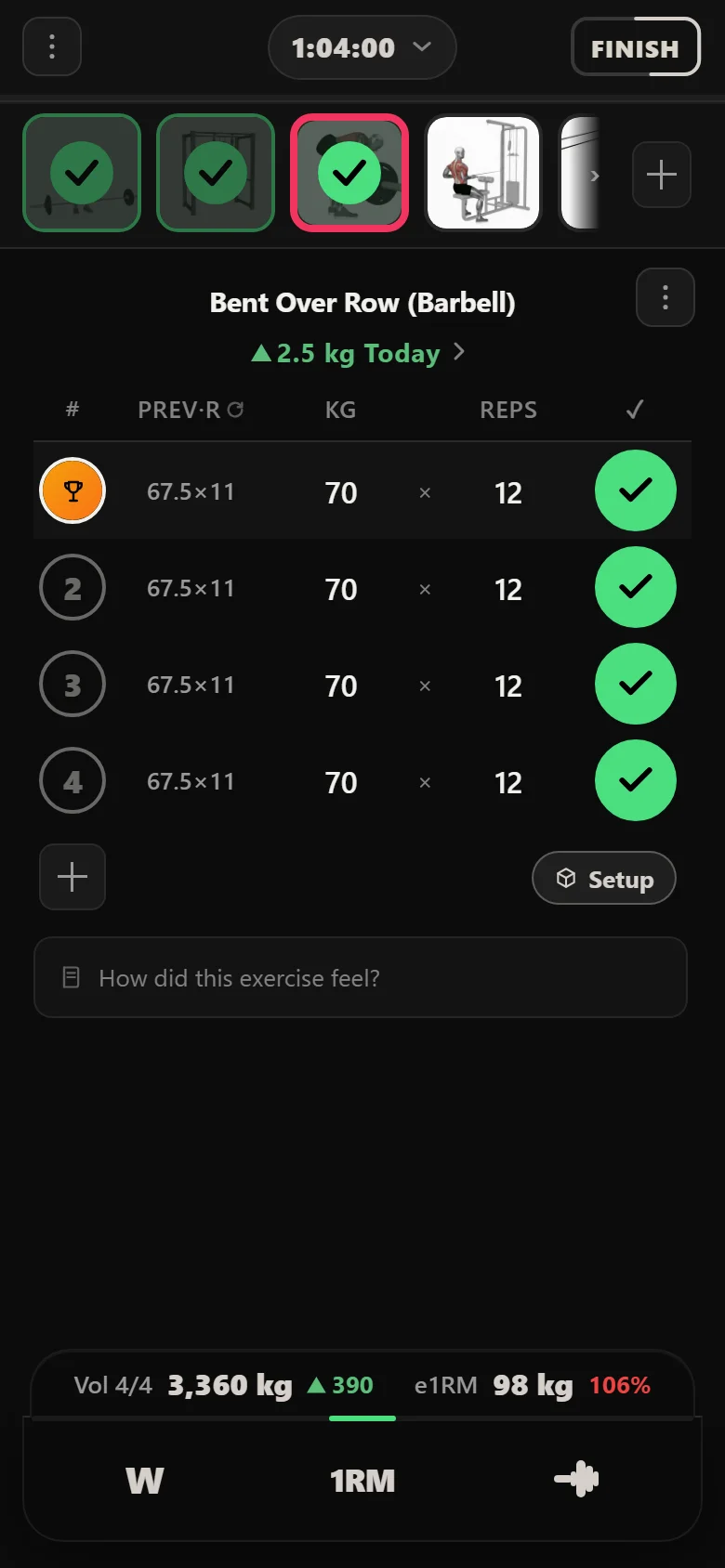
The three openers are linear. Bench, deadlift and squat run sets of five, and when you hit the target on all of them the weight goes up next time it comes round: 2.5 kg on the bench, 5 kg on the squat and deadlift. Each of them finishes with an AMRAP top set, the last set taken past five for as many good reps as you have, which is what feeds the estimate without adding a heavier working weight.
Everything else runs double progression, and the rule chip on the exercise says so in plain language: hit the top of the rep range on every set and it adds 2.5 kg, then the reps reset to the bottom. The ranges are staggered by movement, 8–10 on the compound accessories, 10–12 in the middle, 12–15 and 15–20 on isolation, so the lighter the movement the more reps it earns before the weight moves.
You do not have to remember which lift is on which rule, because the chip is on the exercise while you train, and it is a button. Tap it and the app shows the rule and the evidence from that slot's own history that it is judging against.
Six weeks of the weight just going up
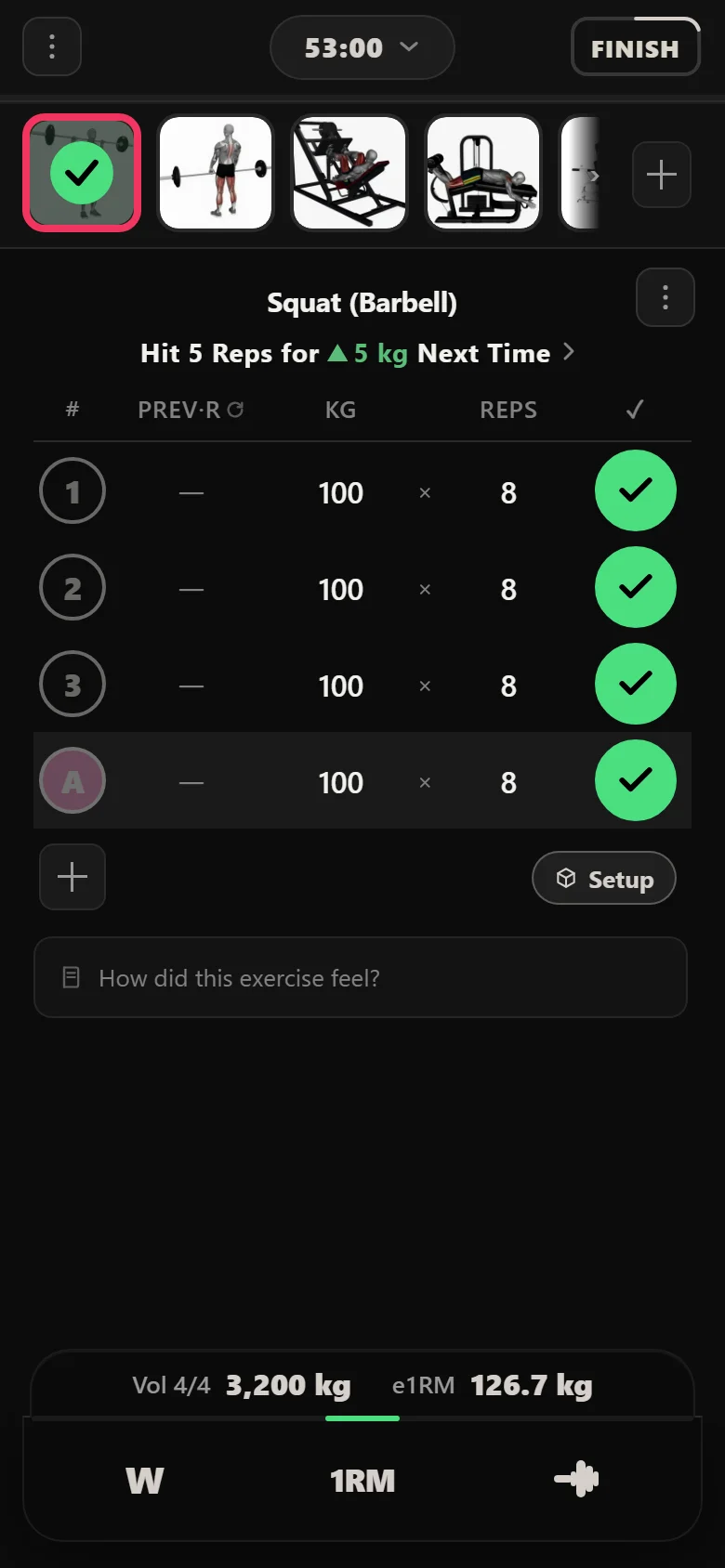
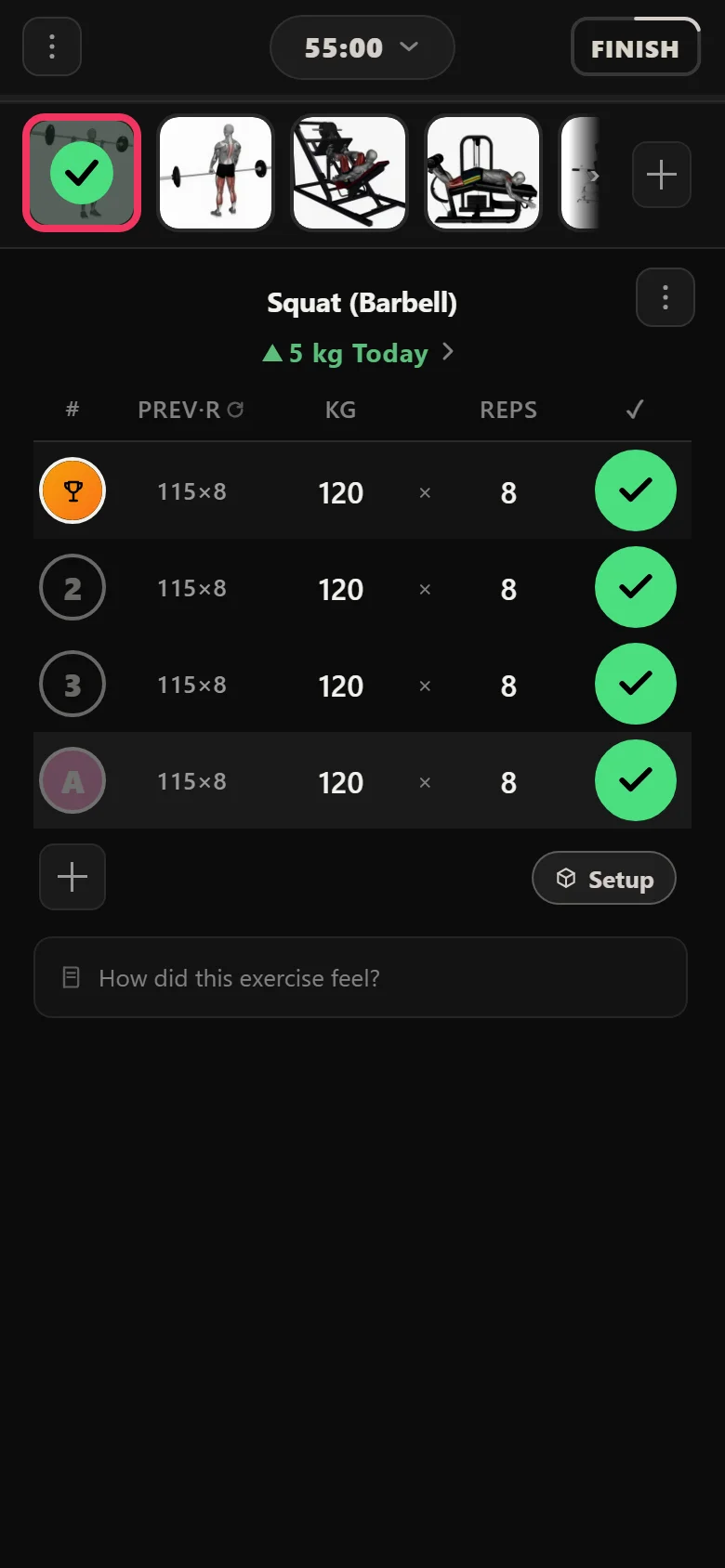
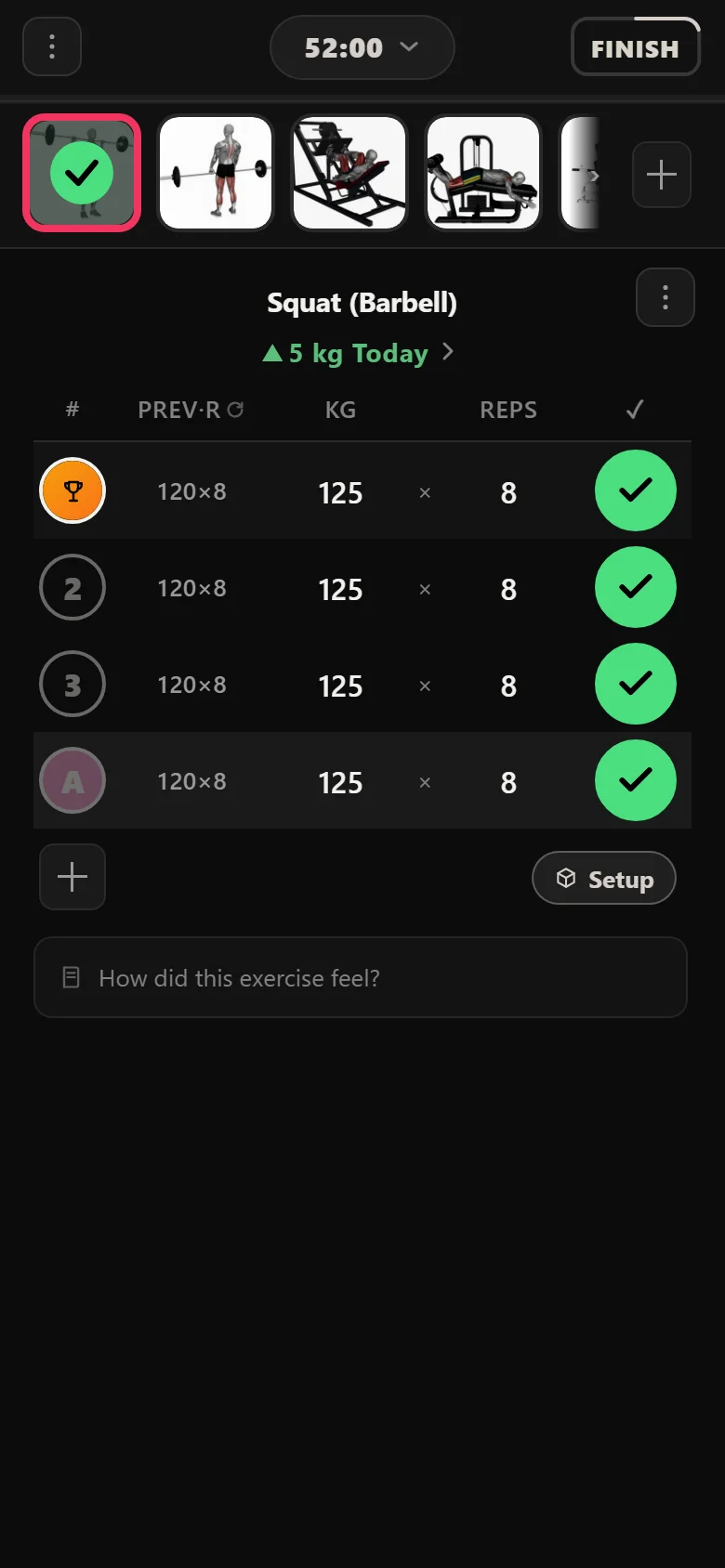
The squat comes round once a week, so its climb is weekly and it is a straight line: 100, 105, 110, 115, 120, 125. Five kilos a week, six weeks, no missed session and therefore no held weight and no deload. Every week the chip reads the same: 5 kg up today.
That is worth saying plainly, because journeys through this kind of program usually get written up around the drama. There was none. A linear program with a starting weight chosen a long way below your limit does exactly this for a couple of months, and the correct thing for the app to do is get out of the way and keep adding weight. What it saves you is not the arithmetic, it is the remembering: thirty sessions, thirty-two separate lifts, each with its own weight, its own rep target and its own rule.
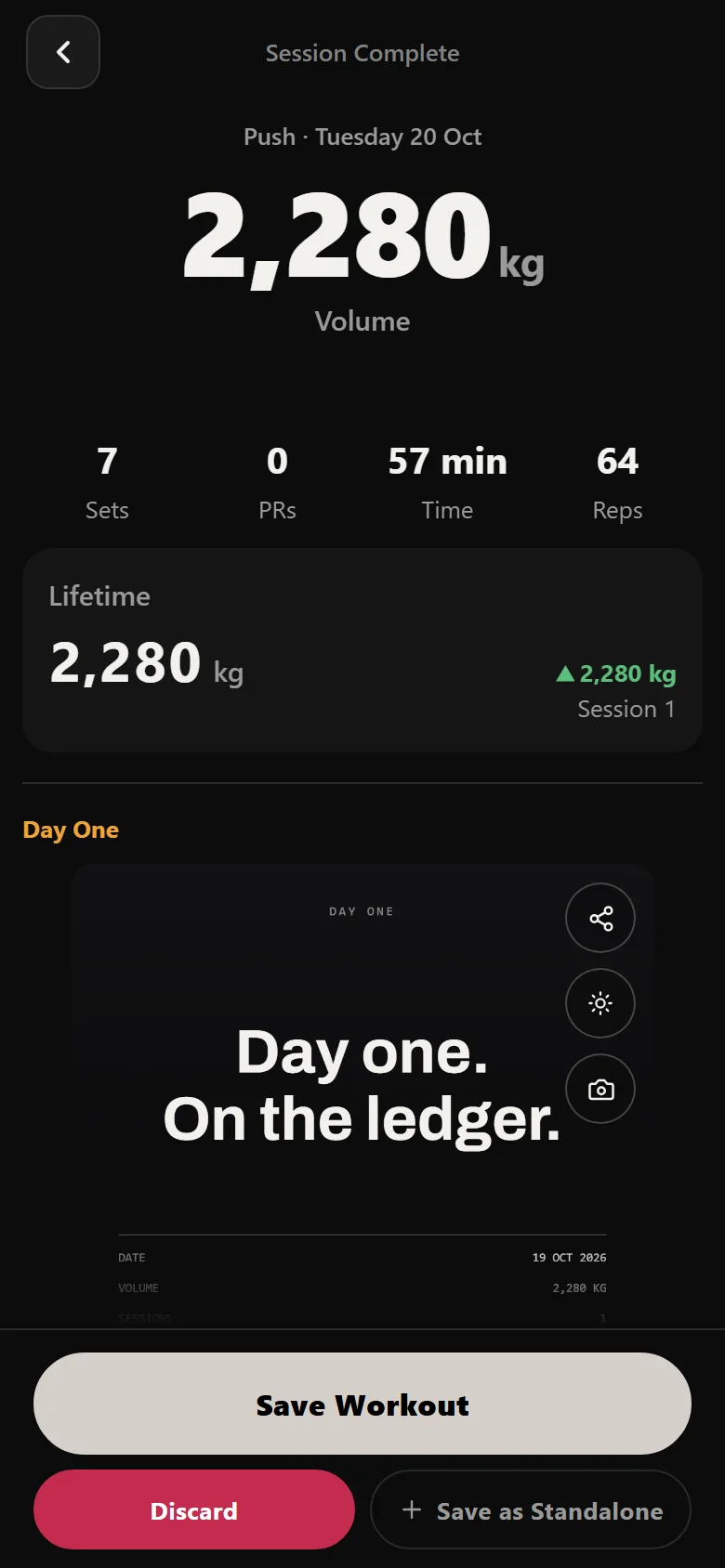
The session tallies itself when you finish. Seven sets, sixty-four reps, 2280 kg moved on the day, worked out from what you logged rather than from what was planned.
Squat (Barbell): weight on the bar, per weekly Legs session
- 100S3 Session 3
- 105S8 Session 8
- 110S13 Session 13
- 115S18 Session 18
- 120S23 Session 23
- 125S28 Session 28
What moved, and what sat still
The three linear lifts did what linear lifts do. The squat went 100 kg to 130 kg, counting the weight waiting for the next session. The bench went 75 kg to 90 kg, six sessions at 2.5 kg a time. The deadlift held at 130 kg the whole way, which is ordinary for a lift trained heavy once a week off a starting number that was already honest.
The double-progression lifts moved more slowly, because the weight only goes up once every set has topped out the range. Over six weeks the barbell row went 65 kg to 72.5 kg, the dumbbell curl 7.5 kg to 12.5 kg, the split squat 20 kg to 25 kg, and the barbell curl and dumbbell flye both to 10 kg.
Plenty of lifts did not move at all, and the app is straightforward about that too. Nothing is nudged along for the sake of a chart, so a lift that never finished every set at the top of its range still shows the weight it started with. On a five-day split with thirty-two slots that is normal, and it is more useful than a program that pretends everything grew.
Six weeks from above
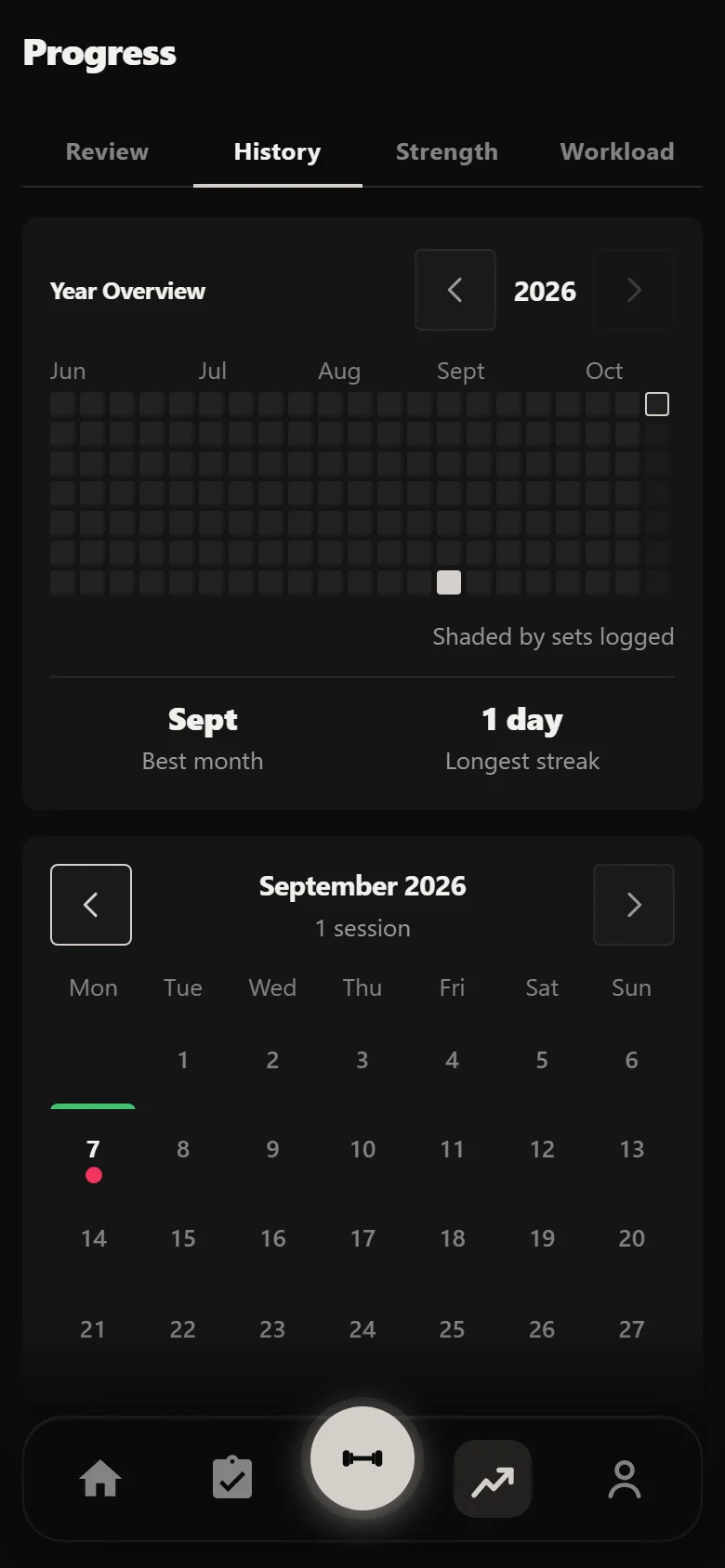
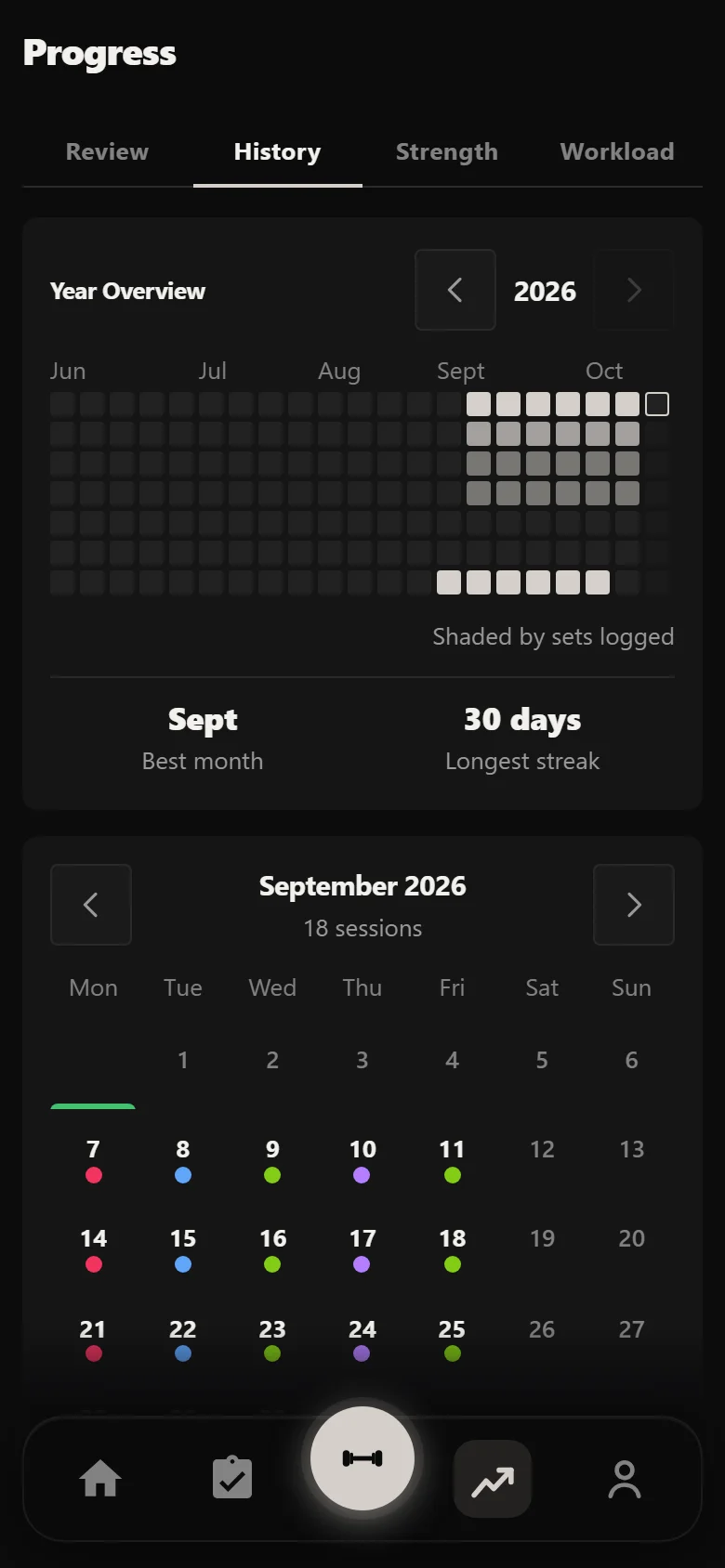
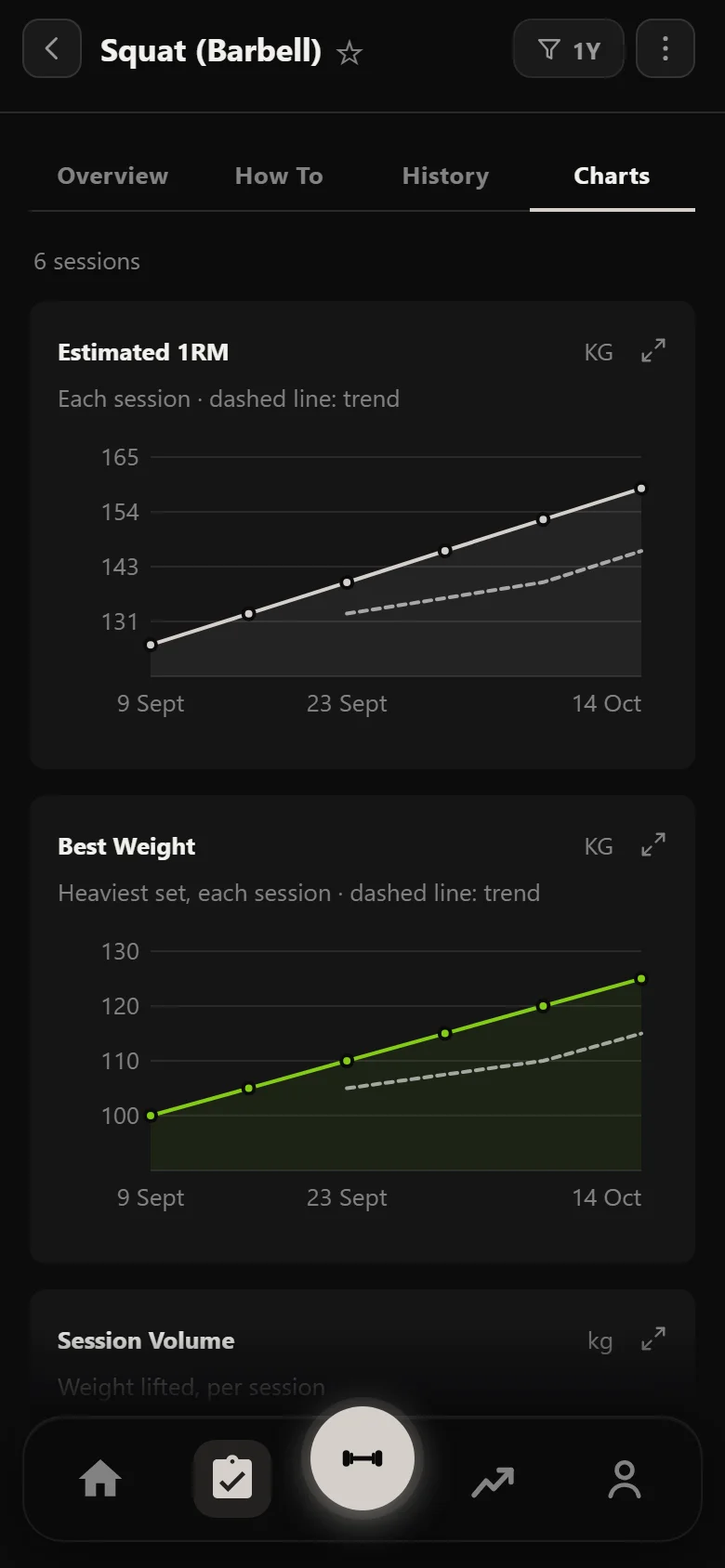
Thirty sessions across six weeks fill the History calendar, five days a week with the two rotations alternating. The squat's own estimated 1RM chart is a clean upward line rather than the sawtooth you get out of a program with a stall in it, drawn session by session.
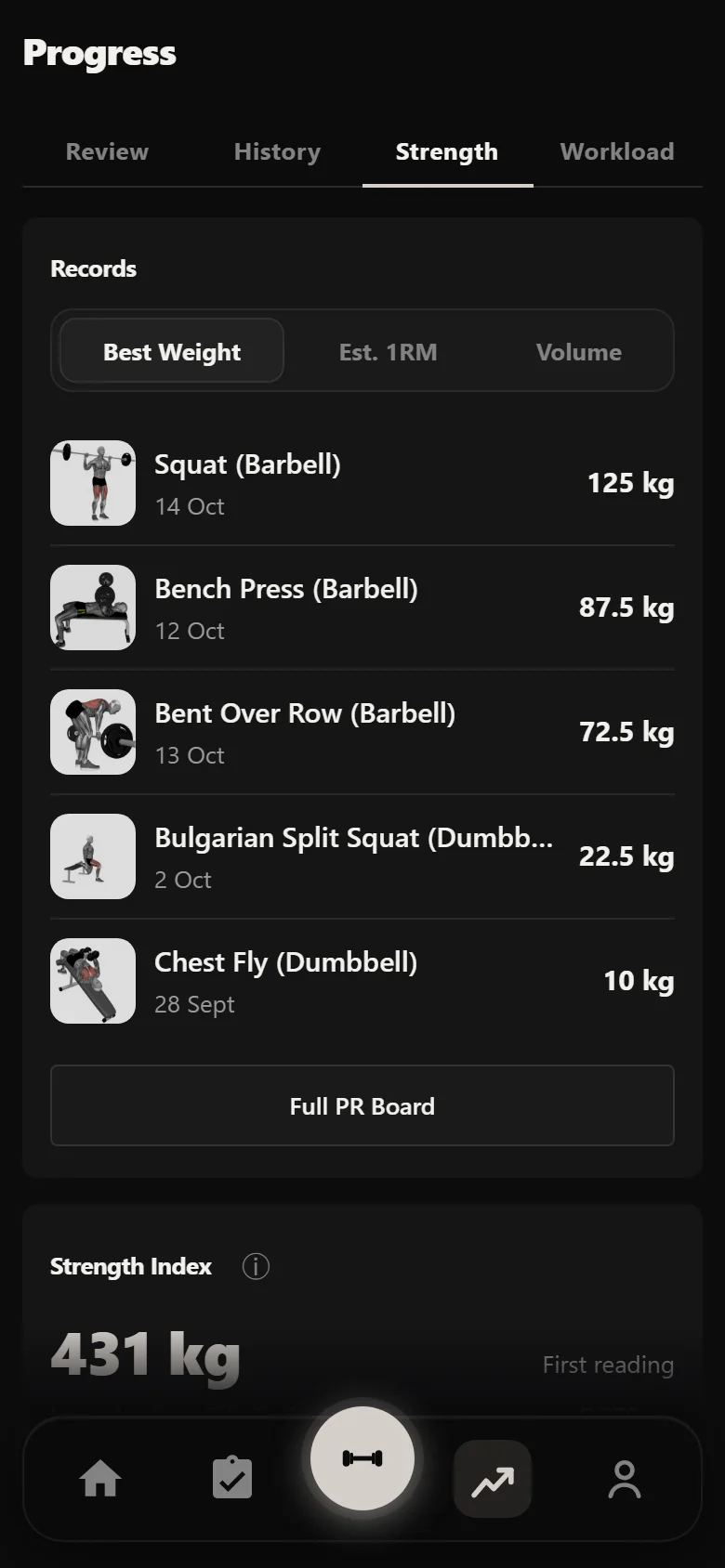
The Strength tab lists the records by best weight, the squat at 125 kg on top, then the bench at 87.5 kg and the row at 72.5 kg, and the Strength Index underneath reads 431 kg on its first reading.
The payoff: 25 kg on the squat and nothing to remember
Six weeks in, the squat that opened at 100 kg is doing 125 kg for the same working sets, with 130 kg loaded for next week and an estimated max of 158.3 kg. The bench is 15 kg heavier. Neither of those needed a single decision from you at the point where decisions are hardest to make well, which is standing over a bar at the end of a session.
That is what the app is for on a split this size. Thirty-two lifts, two progression rules, thirty sessions, and the only thing you had to bring was the effort.
The squat, start to finish: 100 kg to 125 kg in six weekly sessions, with 130 kg on the card for next time and the estimate at 158.3 kg. No missed session, and no weight worked out by hand.
Common questions
What is the PPL/Upper Lower split?
A five-day intermediate split that runs two rotations in one week. Push, Pull and Legs each open with a heavy barbell lift and then pile on hypertrophy volume; Upper and Lower come back to the same muscles with different movements. Every muscle group gets trained roughly one and a half to two times a week.
How do the two progression rules work together?
Bench, squat and deadlift run linear progression: hit the target reps on all your sets and the weight goes up next session, 2.5 kg on the bench and 5 kg on the squat and deadlift. Every other lift runs double progression: climb the rep range, and once every set reaches the top of it the weight goes up and the reps reset. Durata runs both at once and shows the rule on each exercise, so there is nothing to track.
Why don't Upper and Lower repeat the Push, Pull and Legs exercises?
By design. Lower day opens with a front squat rather than the back squat, Upper day with an incline barbell bench rather than the flat one. The second pass trains the same muscles through different movements, which is what makes five days a week recoverable. It also means every lift is its own slot in the app, with its own weight and its own progress.
What is the AMRAP top set for?
The three barbell openers finish with a last set taken past the target for as many good reps as you have. It feeds the estimated one-rep max and tells you how much room is left in the weight, without pushing the working weight up faster than the rule intends.
What happens if I stall?
The weight is held rather than pushed. Miss the same lift three sessions running and Durata cuts it by 10% and restarts the climb from there. Nothing stalled in the six weeks shown here, which is what a starting weight chosen well below your limit buys you: a couple of months where the program simply works.
Is Durata free?
Yes. Durata is free to use, with the full program catalogue, automatic progression maths, deload rules, rest timers and PR tracking. Everything in this walkthrough is in the app.
Put it into practice
Durata is free to use — 50 proven programs, automatic progression, rest timers and PR tracking, all on your phone.