


Lyle McDonald's GBR in Durata: one rule, and what it does when you stall
Most programs in the catalogue are interesting because of their machinery. Percentages of a training max, waves that change shape every week, top sets that set the weight for everything after them. The Generic Bulking Routine has none of that. It is an upper/lower split run four days a week, and every exercise in it advances by the same plain rule: clear the top of the rep range on every set, and the weight goes up.
That makes it a good program to watch when things go wrong, because there is only one mechanism to watch. This run put sixteen sessions through it, and in the middle of them the squat stopped moving for a fortnight. What the app did about that is the whole article.
Finding the program
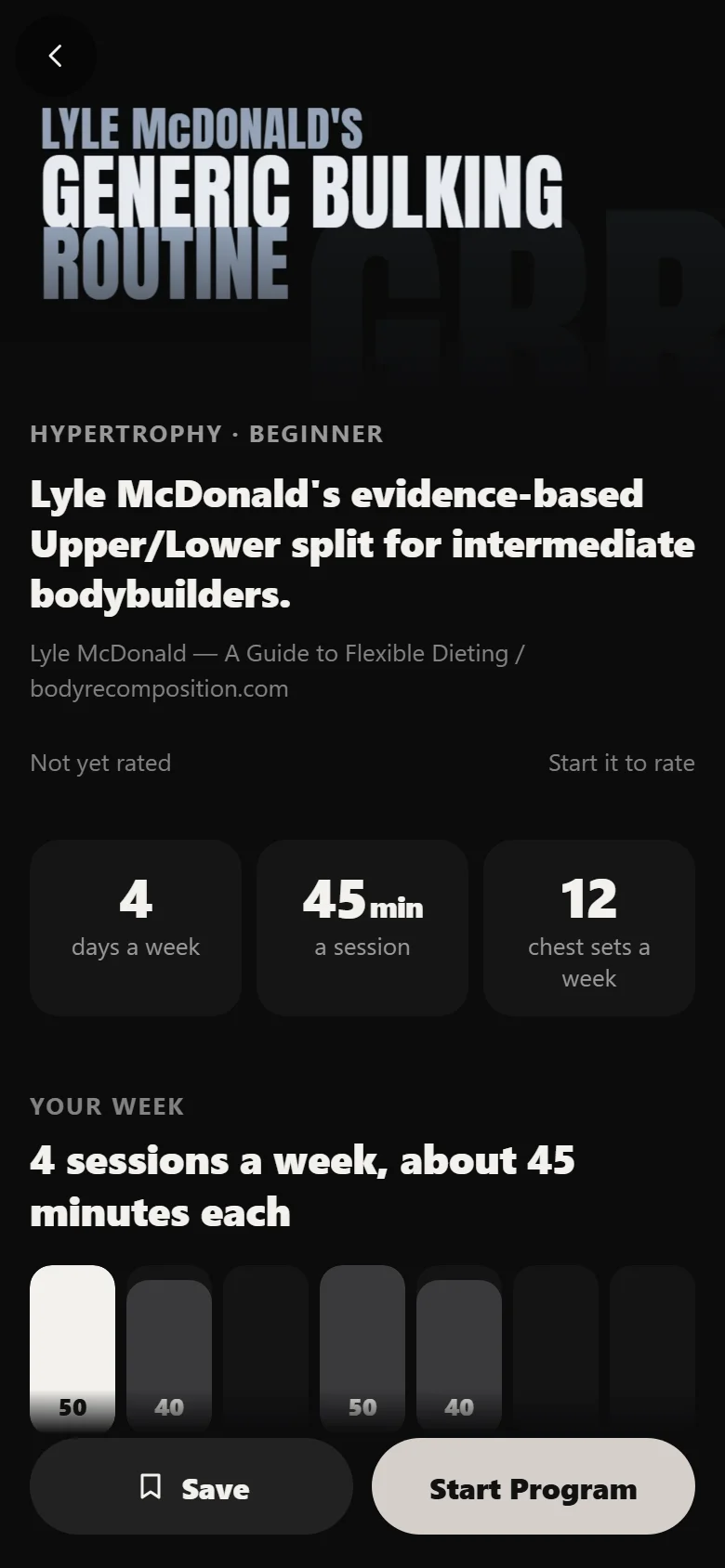
In Discover, Lyle McDonald's Generic Bulking Routine sits on the Hypertrophy shelf, marked Beginner, at four days a week. Search finds it by name, or Filter narrows the shelves by level and days a week. Tap the cover for a quick look, then View Program for the full page.
The program page shows the shape before you commit. Upper, Lower, Upper, Lower, with the two Upper days identical to each other and the two Lower days identical to each other. Each session opens with heavy compound work in a 6-8 range and finishes with supplemental work at 10-12 reps and arms at 12-15.
Twelve weights and nothing else
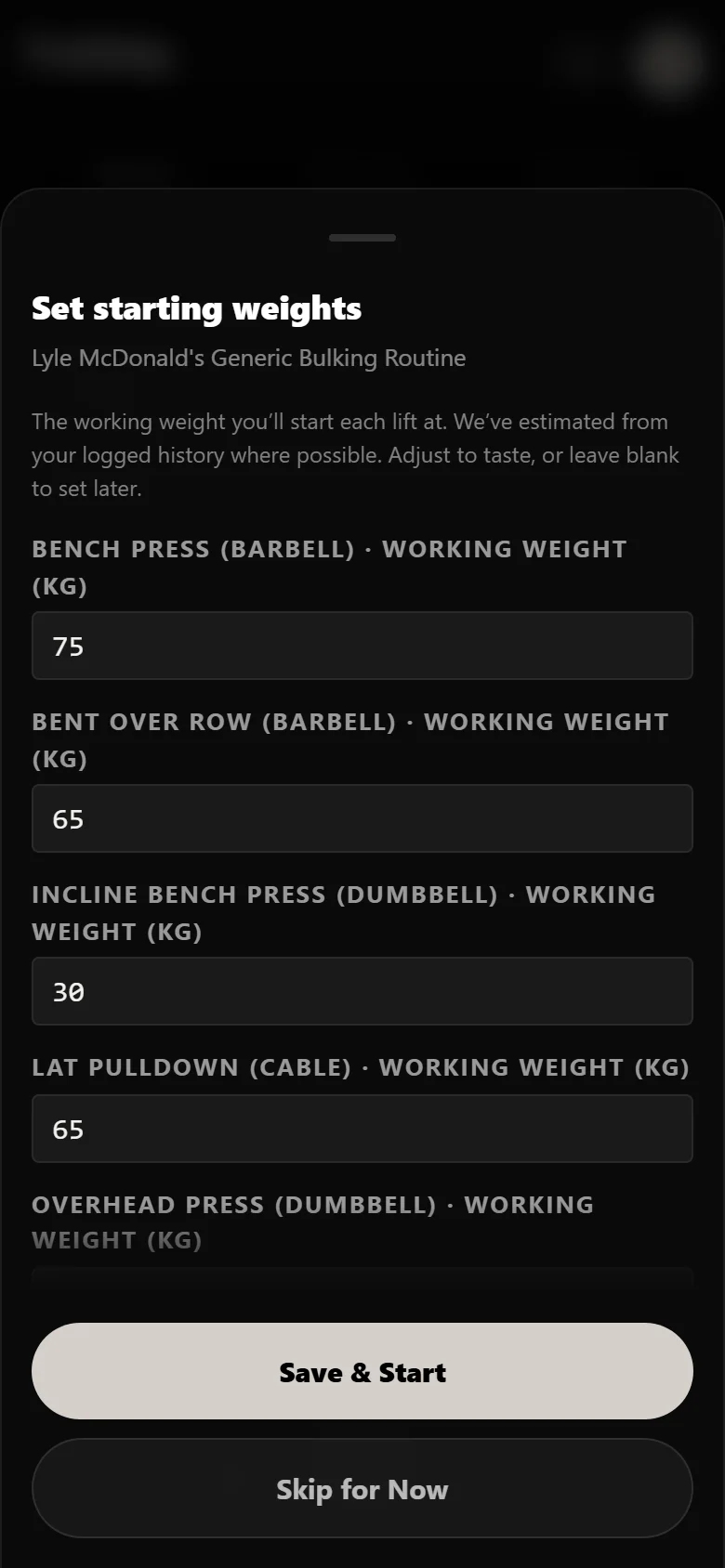
The setup sheet asks for a working weight per exercise and nothing more. No training max, no one-rep max, no test session, no percentages. This run opened with 100 kg on the squat, 75 kg on the bench, 65 kg on the row and 7.5 kg on the smallest accessories.
Start conservatively. On a program that adds weight every time you clear the range, the difference between a good opening weight and an ambitious one is about a fortnight, and the ambitious one costs you more than it buys.
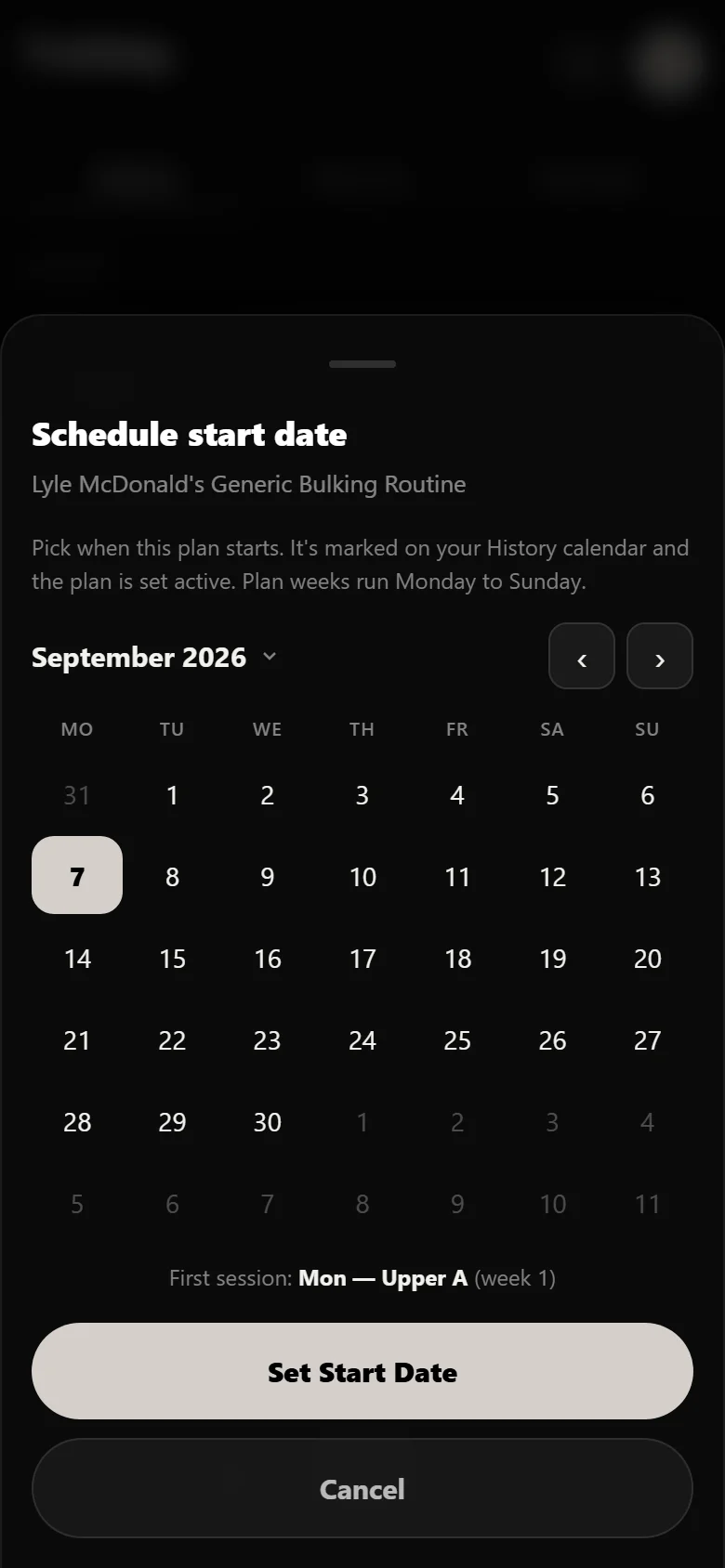
A start date lays the four-a-week rhythm out on the calendar. Everything after this is decided by what gets logged.
One rule, three jobs
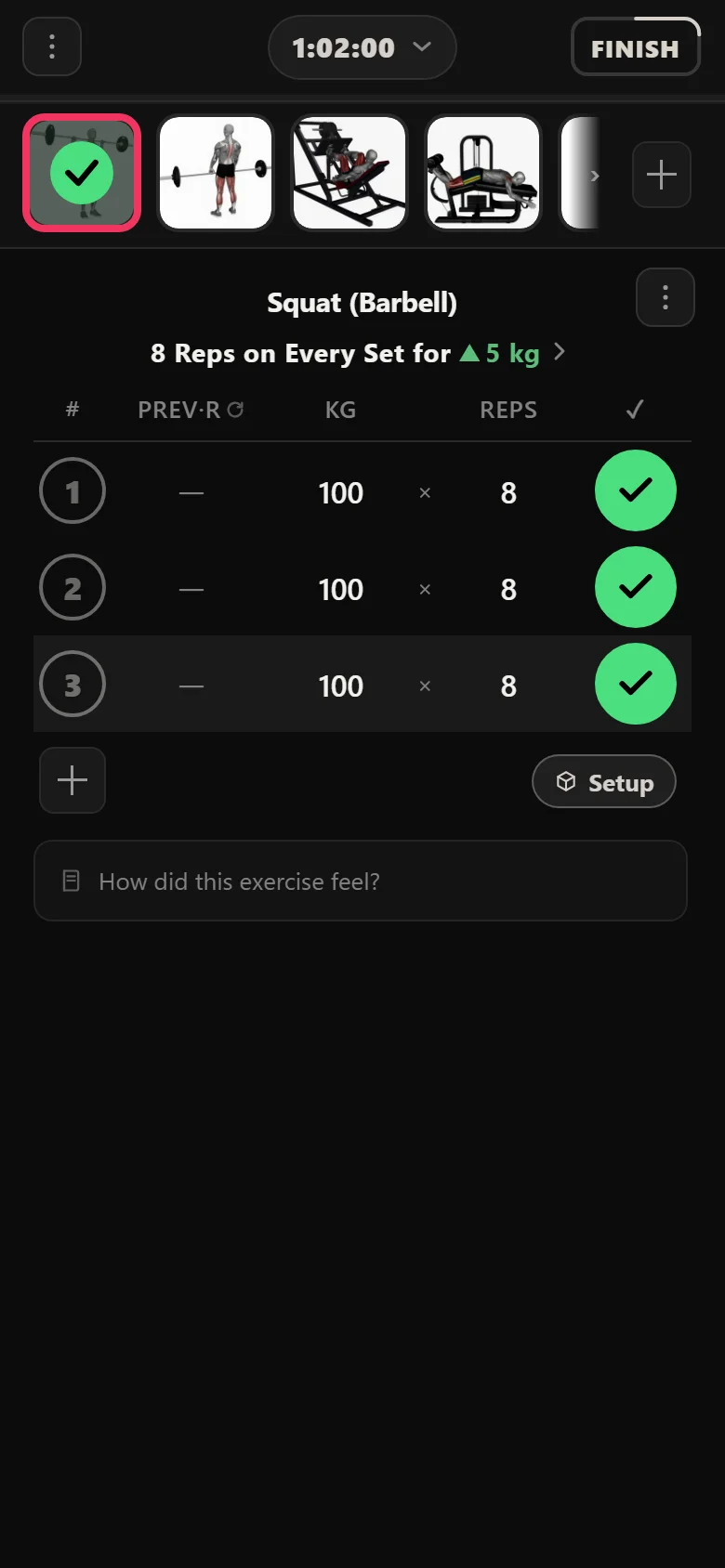
The squat opens at 100 kg for three sets of 6-8, with the chip underneath it stating the rule: clear every set at the top of the range and the app adds 5 kg next time.
Every other exercise in the program carries the same rule. What changes is the range it is stretched over, and that is how the program says what each lift is for. Six to eight reps is a strength range, so the compounds live there. Ten to twelve is supplemental volume. Twelve to fifteen is where the curls and pushdowns sit. The mechanism is identical in all three places and the training effect is not.
The accessories therefore feel like a different rule even though they are not. You climb the range session by session at the same weight, and only when every set tops out does the load move by 2.5 kg and the reps reset to the bottom of the range. On the heavy lifts that reset happens fast enough to look like linear progression. On a 12-15 range it can take weeks, which is correct.
The squat and the bench each appear twice a week, and both times they feed the same ledger. There is no separate Monday squat and Thursday squat here. One record, twice the opportunities to advance it, which is most of why the numbers on those two lifts move faster than anything else in the block.
The first fortnight
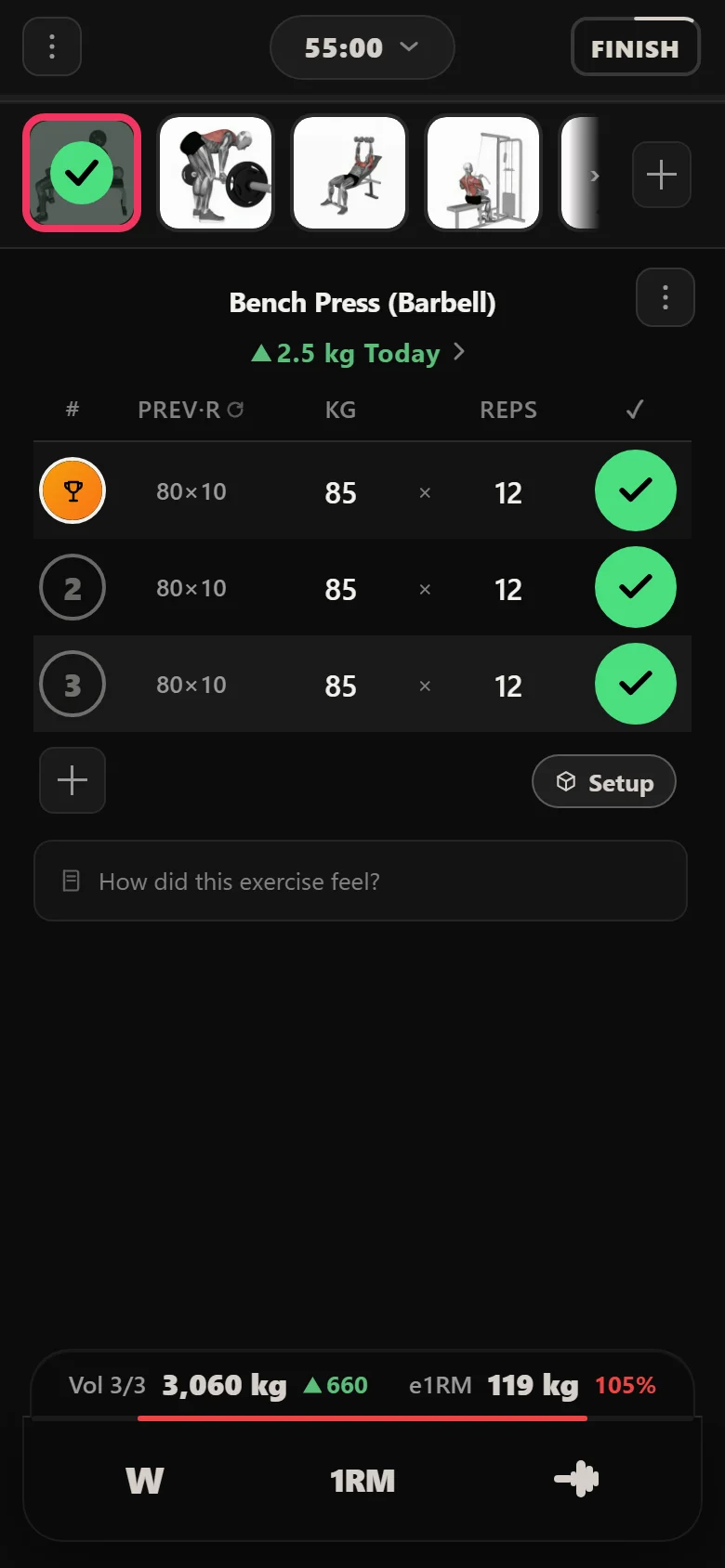
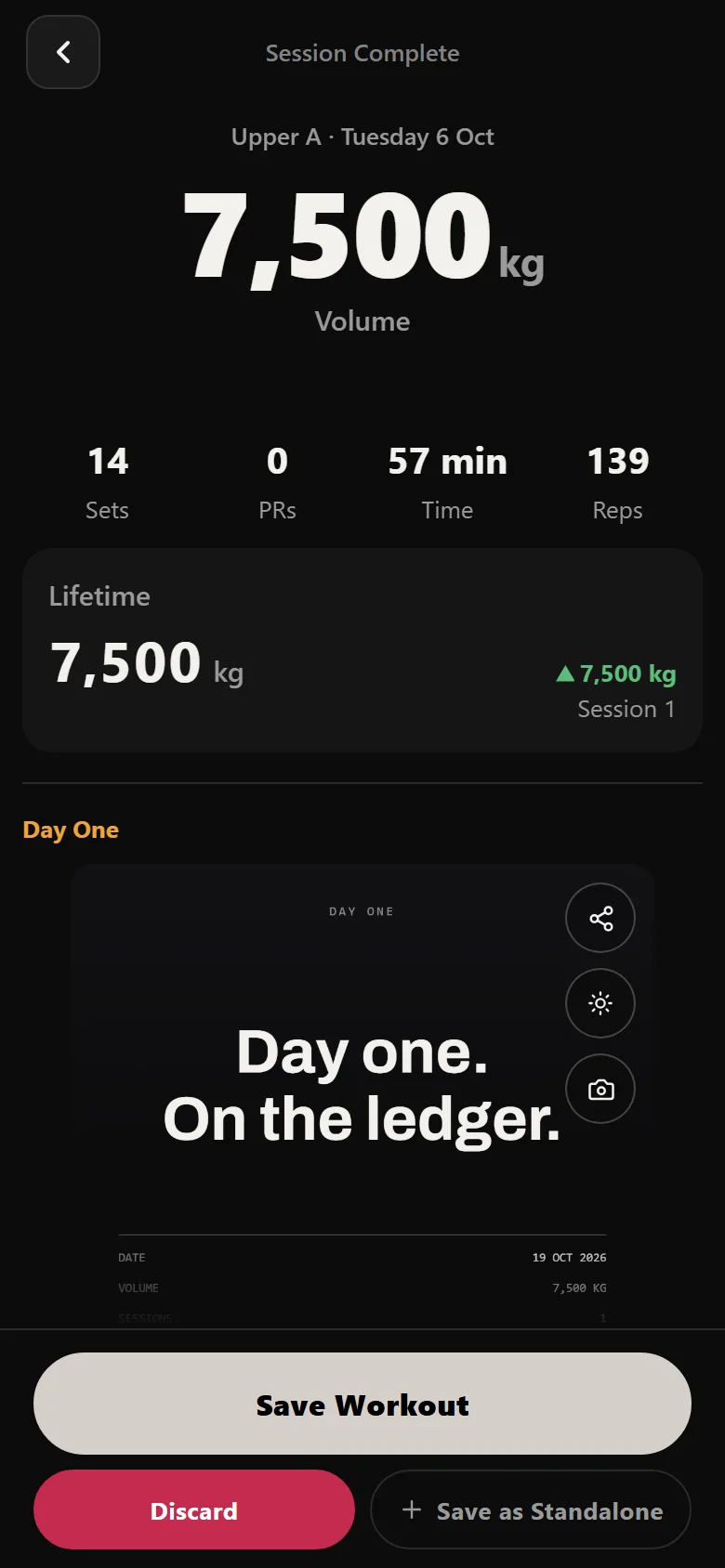
An Upper day is seven exercises deep: two heavy compounds, then supplemental work down to curls and pushdowns. This drive logged the heavy end of it, and even that partial tally runs to 7500 kg. A full session is longer, and four of them a week is a fair warning about what week three feels like.
The early sessions did what early sessions do. Everything cleared, so everything advanced. The squat went from 100 kg to 105 kg without argument and the bench started the run that eventually took it from 75 kg to 95 kg.
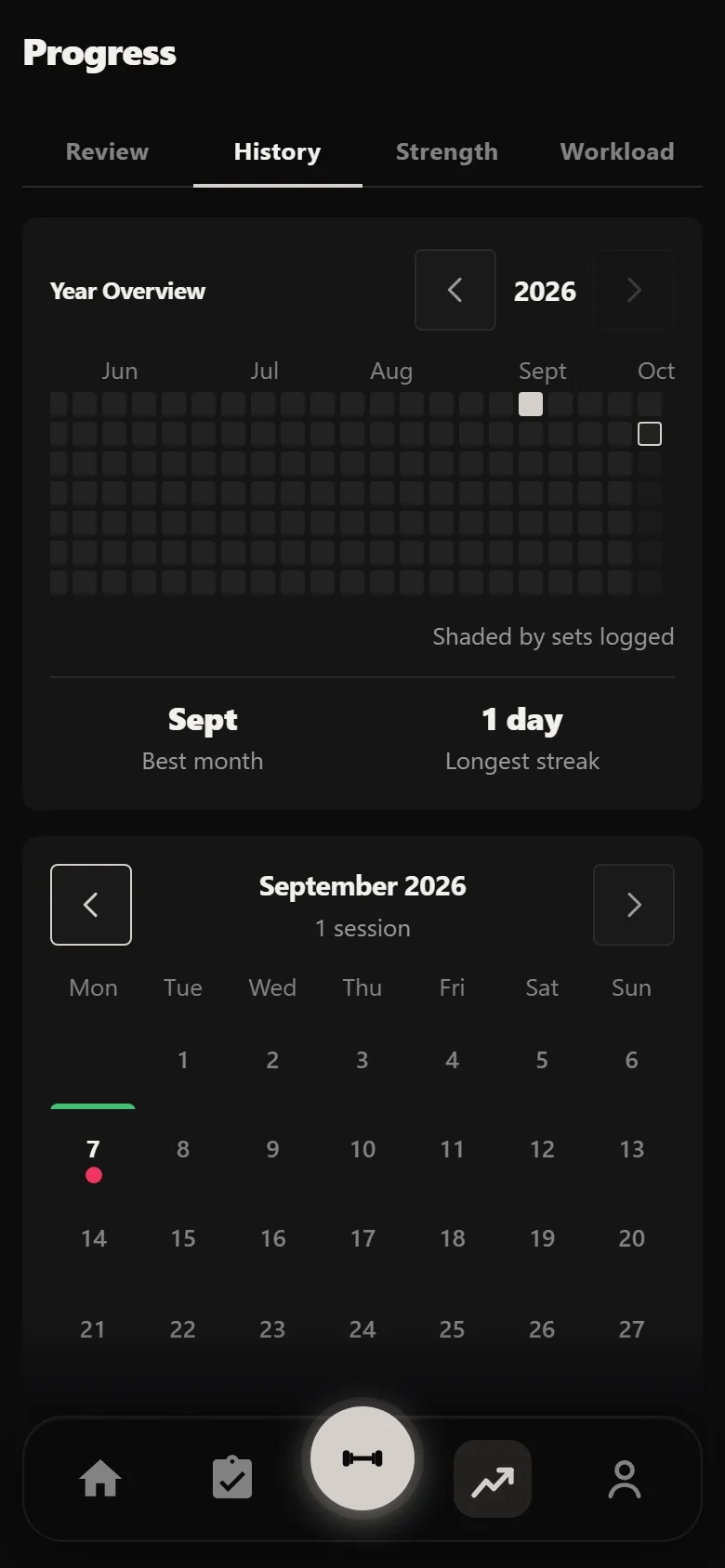
The calendar fills quickly at four days a week, which is the first thing worth checking against your actual life before you start. Sixteen sessions is four weeks only if all four happen every week.
105 kg, and the last easy session
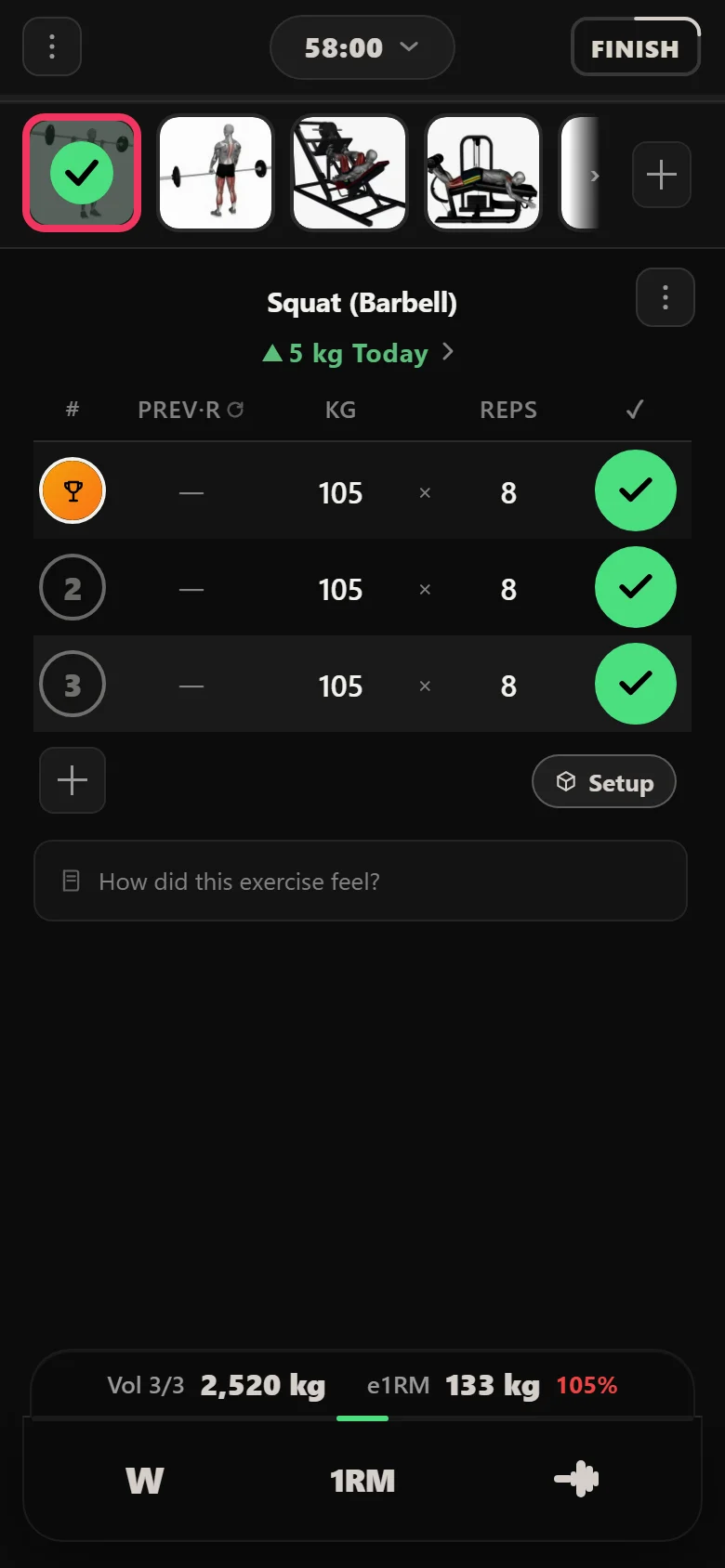
Four sessions in the squat was at 105 kg. Nothing here required a decision from the lifter. The weight was on screen when the session opened, because the previous session's reps had already settled the argument.
This is the part of a program that gives people a false read on how it works. Two clean jumps in a row feel like the program, and they are not. They are the runway.
110 kg, twice
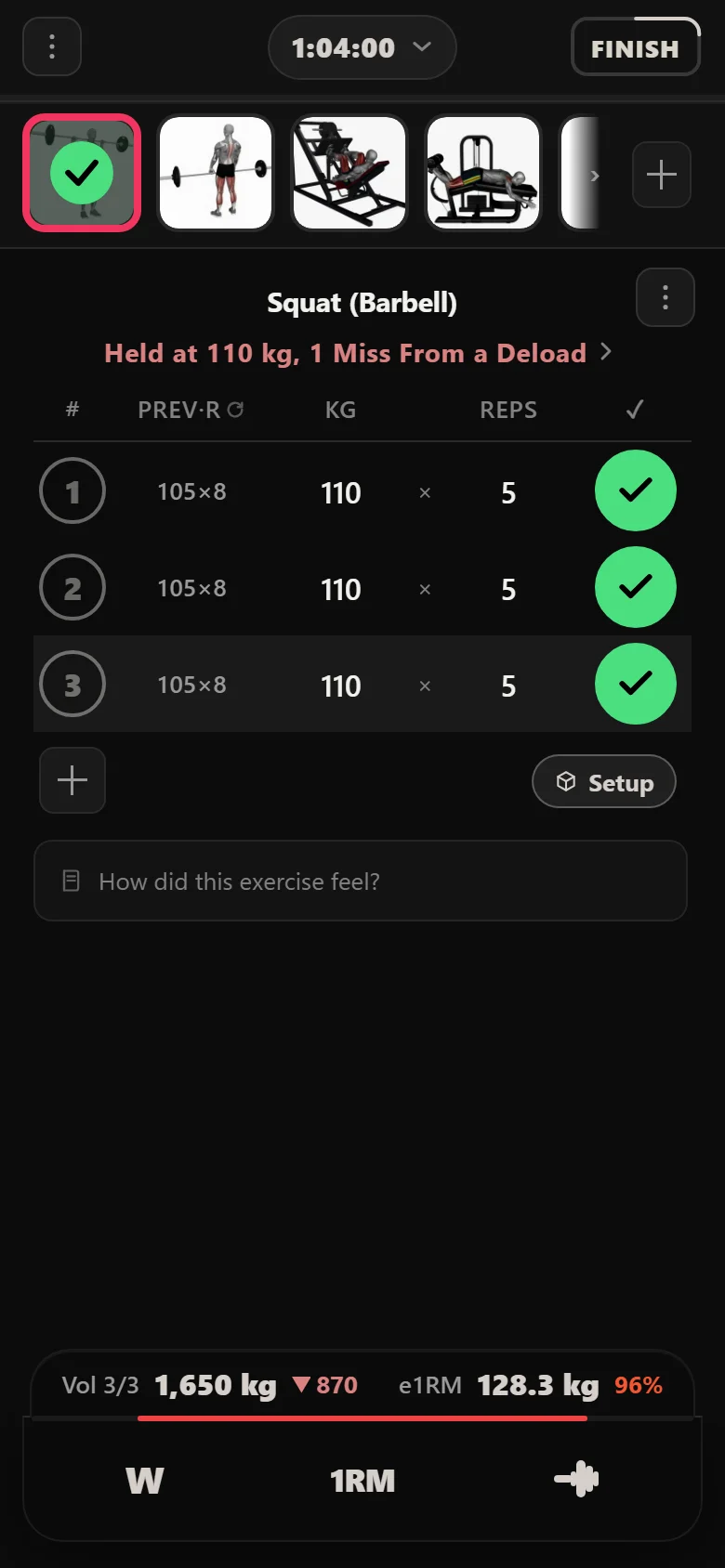
110 kg stopped it. The first attempt produced 5 reps against a target of eight, which fails the rule, so the weight was held rather than advanced. The second attempt at 110 kg failed too.
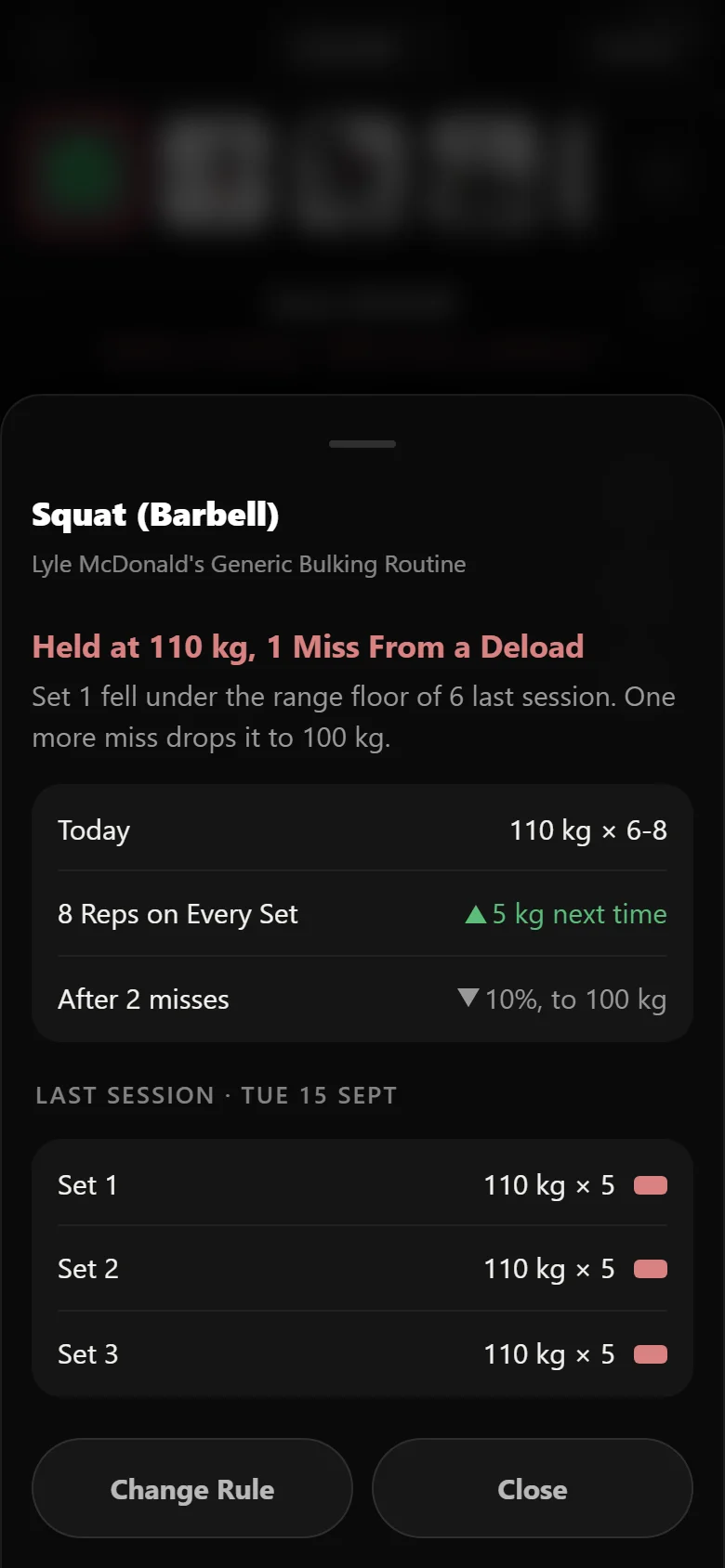
Between the two, the rule chip is worth opening. It is a button, and it shows the case: the evidence out of this lift's own history at this weight, and the rule being applied to it. After the first failure it said one more miss would cut the weight, with the new number spelled out. Two misses at the same weight and the rule cuts it by 10%.
That is a genuinely useful thing to see before it happens rather than after. You know, walking into the second attempt, exactly what is riding on it, and you also know that the program has a plan for losing it.
The strip below is the squat across all sixteen sessions, including both misses and what came after them.
Squat (Barbell) across sixteen sessions
- 100S2 Session 2 — start
- 105S4 Session 4
- 110S6 Session 6 — 5 reps of 8
- 110S8 Session 8 — second miss, rule trips
- 100S10 Session 10 — deload, 10% cut
- 105S12 Session 12
- 110S14 Session 14 — back to the ceiling
- 115S16 Session 16 — past it
The cut, taken for you
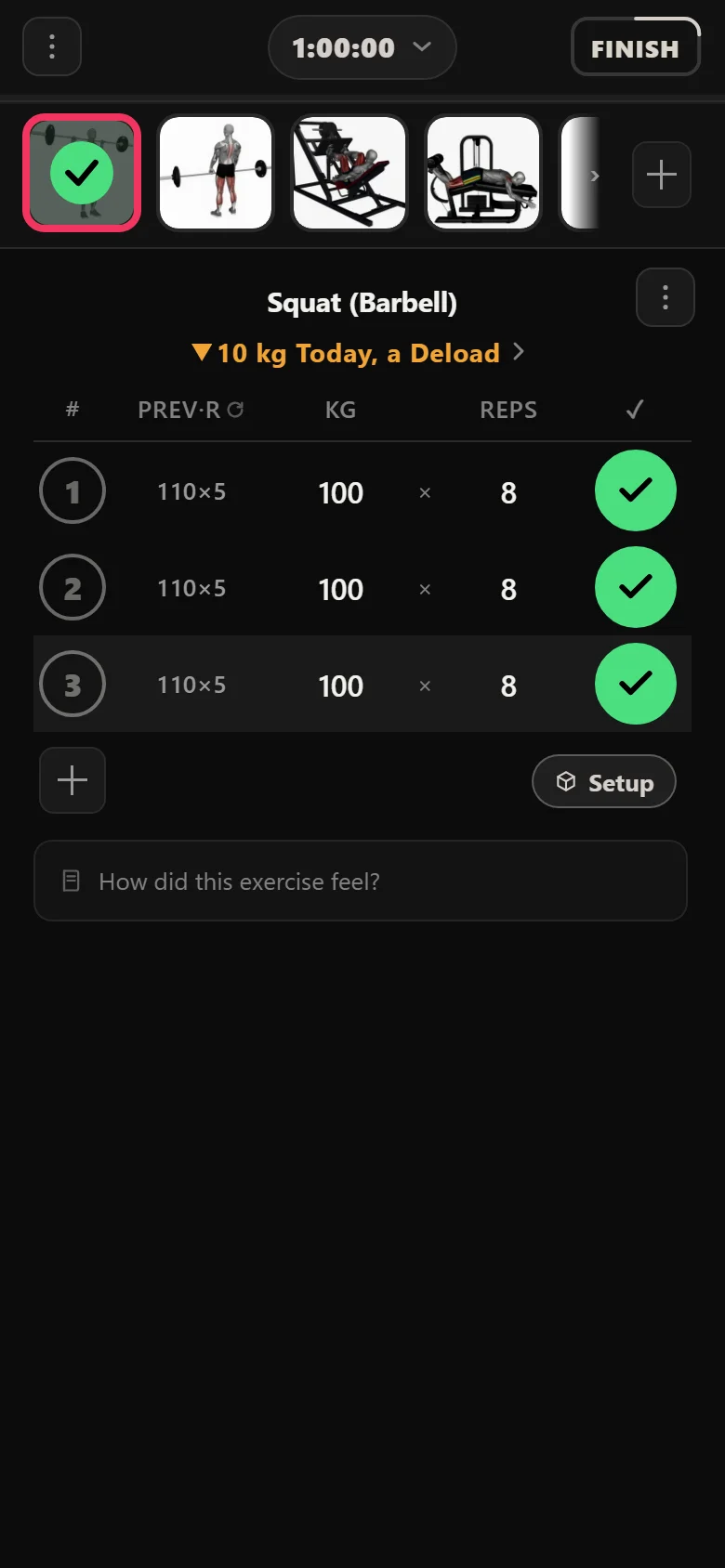
On the second miss the rule tripped and the squat came down 10%, from 110 kg to 100 kg. Nobody calculated it and nobody had to decide whether this week was the week to back off. Two failed sessions at one weight is the trigger, the trigger fired, and the next session opened lighter.
This is the single most valuable thing a progression engine does and it is the thing people are worst at doing for themselves. Backing off requires admitting the last two sessions went badly, and the honest lifter and the stubborn lifter reach opposite conclusions from identical data. Writing the rule down in advance takes the argument away.
It is also worth noticing what the deload is not. It is not a week off, not a change of exercise, and not a reduction in sets. The next session was a normal session at a weight that had already been cleared once.
Back through it
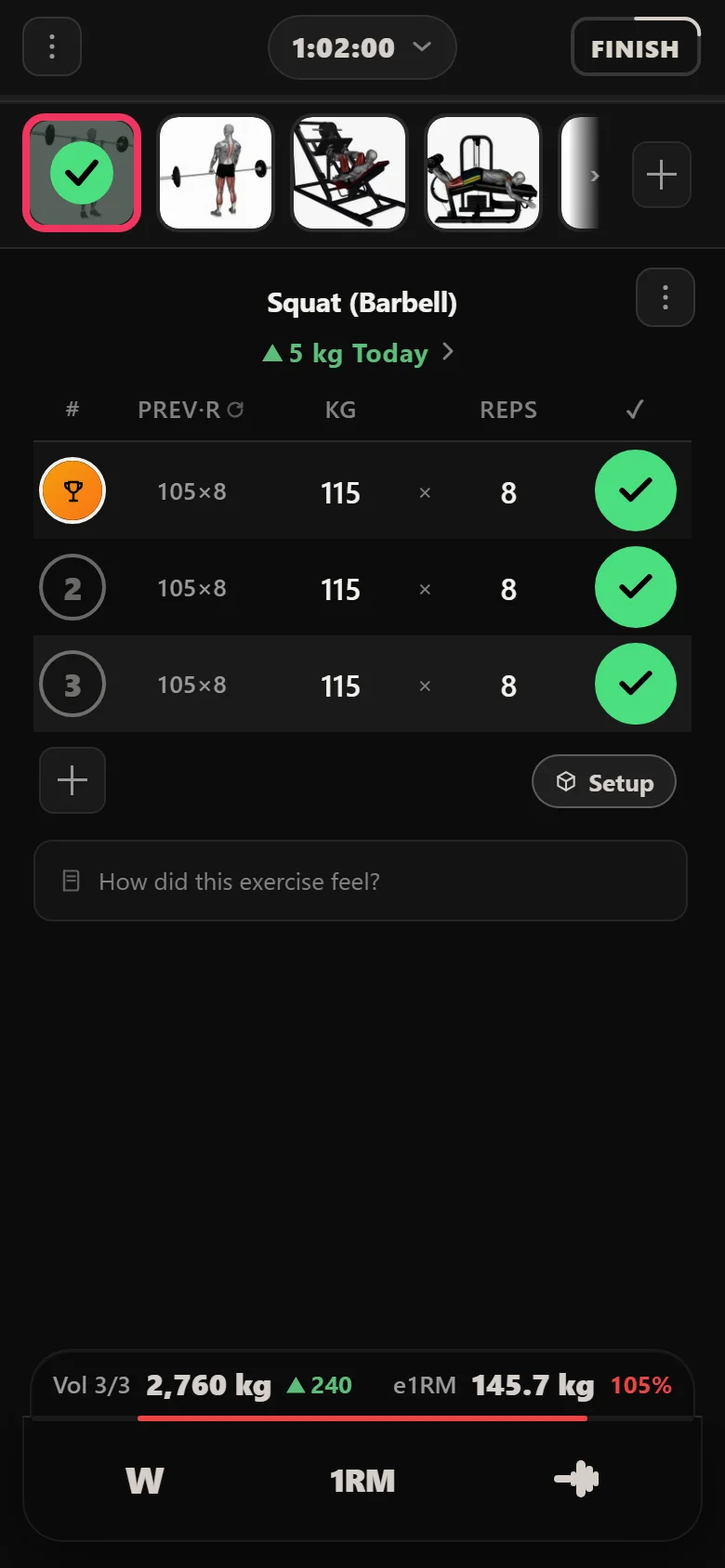
From 100 kg the squat went 105 kg, then 110 kg, then 115 kg. It cleared the weight that had beaten it twice, and then went past it, in the four sessions after the cut. The ledger carried it out of the block at 120 kg.
Six weeks of hindsight makes that look inevitable. It was not. What made it work is that the cut was small, arrived early, and landed on a weight recent enough to still be easy. A deload that waits until the fourth failed session has to give back much more ground to achieve the same thing.
Seven lifts moved and five did not
Sixteen sessions under one rule produced twelve different verdicts, and it is worth printing all of them rather than only the flattering ones.
The movers: squat 100 kg to 120 kg, bench 75 kg to 95 kg, incline dumbbell press 30 kg to 37.5 kg, leg press 150 kg to 157.5 kg, barbell curl 7.5 kg to 12.5 kg, and both the row and the lat pulldown 65 kg to 70 kg.
The lifts that did not move at all: overhead press stayed at 20 kg, Romanian deadlift at 77.5 kg, and the pushdown, leg curl and calf raise all sat where they started. Nothing failed and nothing deloaded on any of them. They simply never had a session where every set reached the top of the range.
That is double progression reporting honestly. A lift stuck at the same weight for four weeks is telling you either that the opening weight was too ambitious or that it is the fifth thing you do on a day when you are already tired. Both are worth knowing, and neither shows up on a program that just adds weight to everything on a schedule.
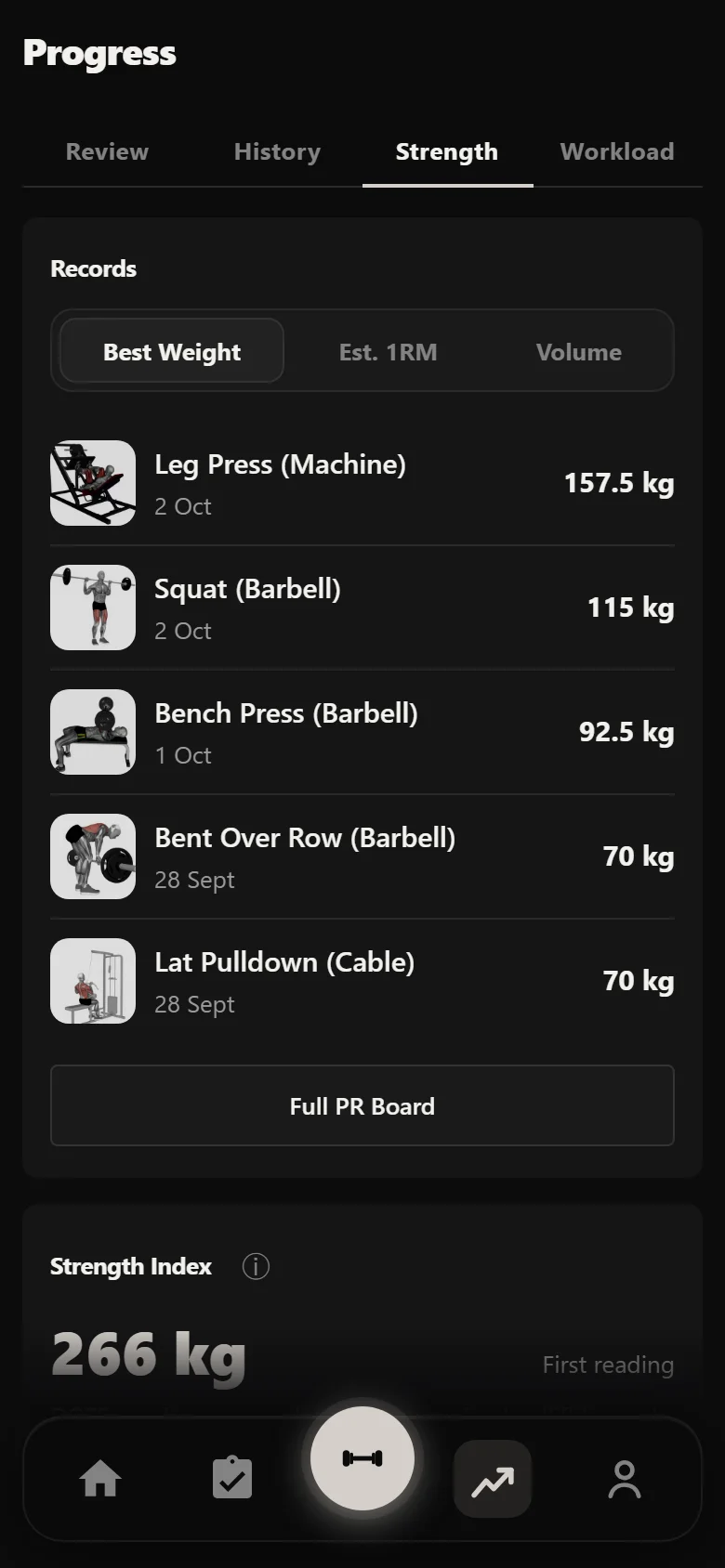
The Strength tab puts the block in order by best weight: the leg press at 157.5 kg, the squat at 115 kg, the bench at 92.5 kg, the row and the pulldown at 70 kg, over a 266 kg Strength Index.
What four weeks of it adds up to
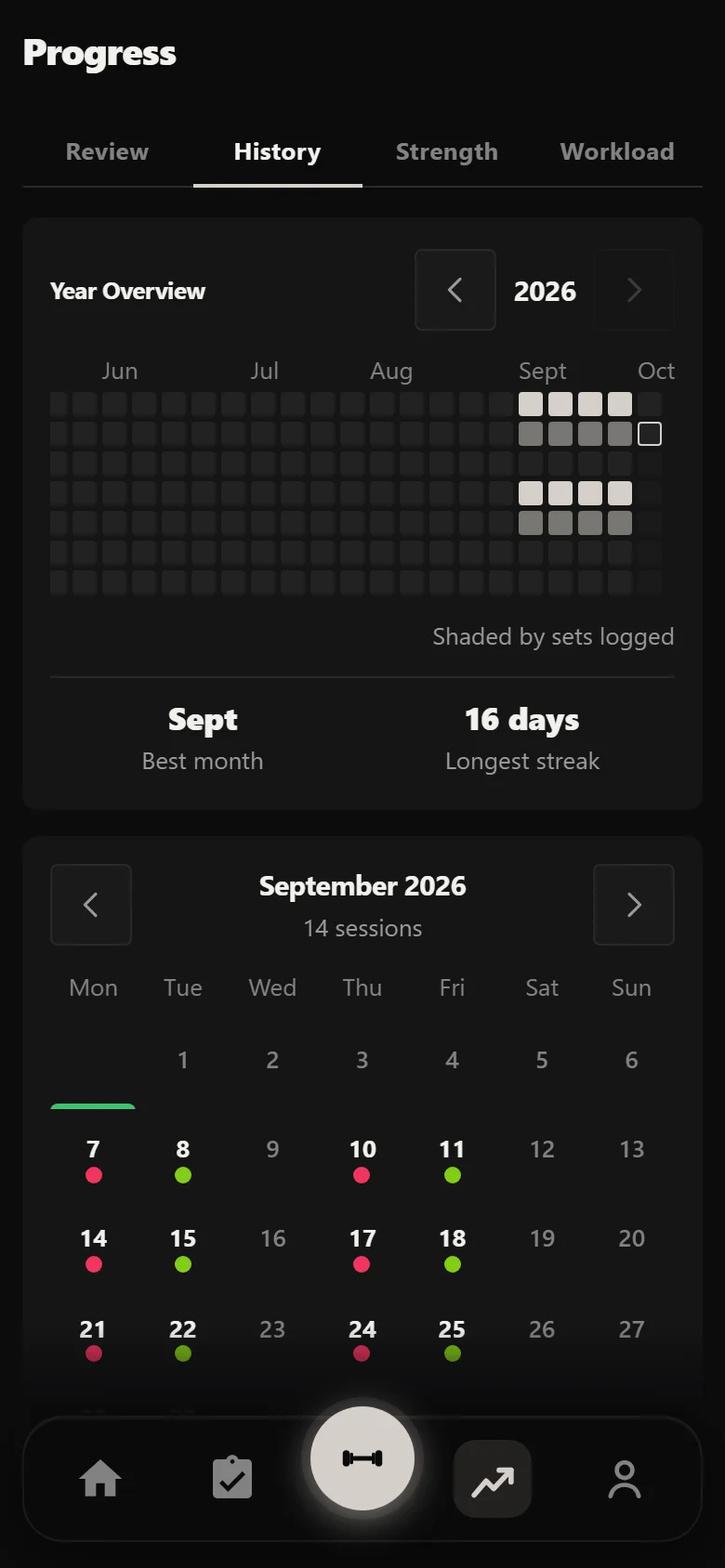
The Review tab reads a month at a time, and September alone came to 99,840 kg across 14 sessions, 133 sets and 1,335 reps. Four upper/lower days a week is a lot of tonnage for an intermediate program, and it is the reason GBR is described as a bulking routine rather than a general one. It assumes you are eating for it.
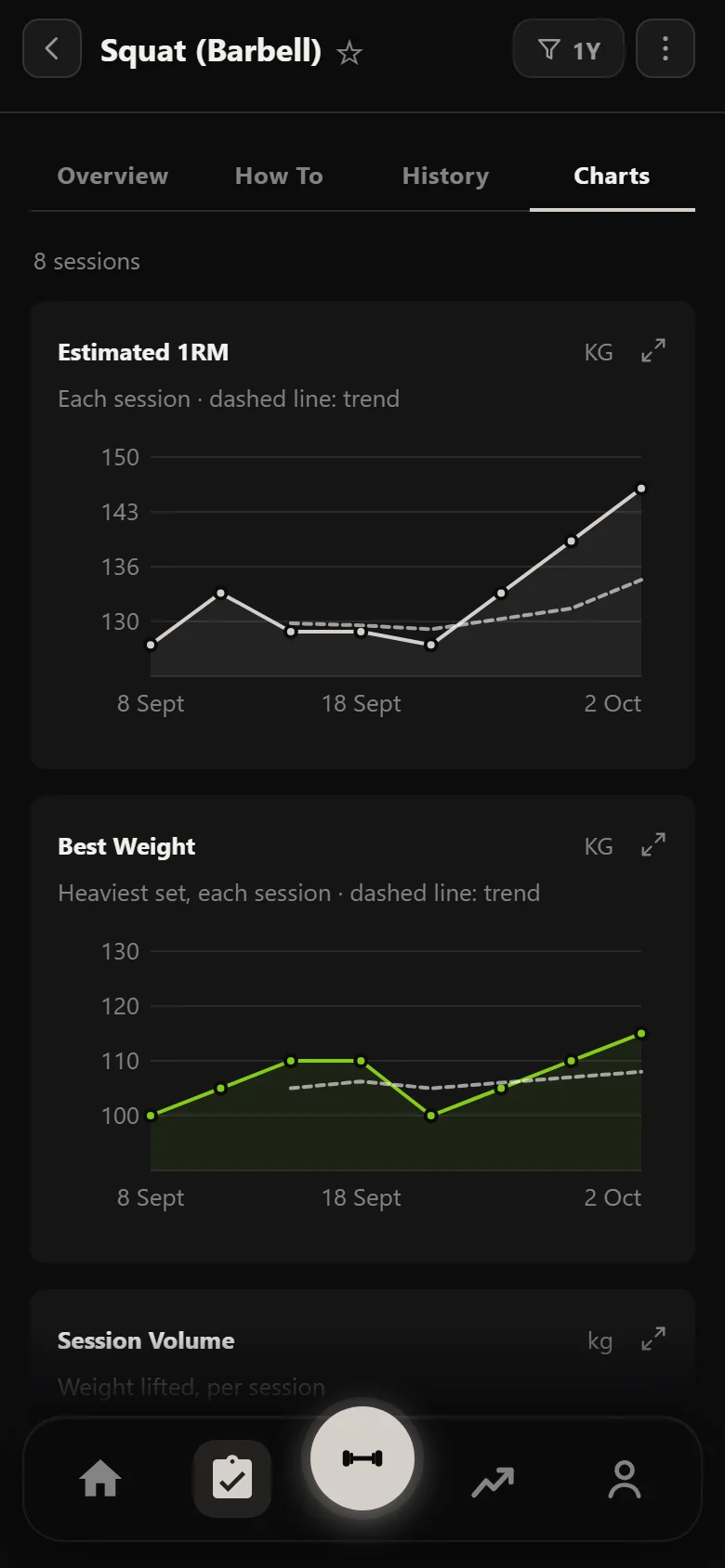
The estimate chart shows the shape better than any single number does: a climb, a flat fortnight, a visible dip where the cut landed, then a line that finishes above where the stall happened. That dip is not damage. It is the shape of a program that reacted to a bad fortnight two sessions after it started rather than two months later.
The payoff: session two against session sixteen
The same lift, the same three working sets, four weeks and one deload apart. Two failed sessions in the middle, and not one decision made by hand.
The route was not straight. It went up, stalled twice, came down 10%, and finished above the weight that stopped it.
Common questions
What is the Generic Bulking Routine?
Lyle McDonald's four-day upper/lower split for intermediate lifters. Each session pairs heavy compound work in a 6-8 rep range with supplemental volume at 10-12 and arms at 12-15. Both Upper days are identical and both Lower days are identical, and every exercise advances by double progression: clear the top of the range on every set and the weight goes up.
What happens when I stall?
The weight is held, not advanced, and the app counts it. Two failed sessions at the same weight and the rule cuts that lift by 10% and restarts the climb from there. In this run the squat stalled twice at 110 kg, was cut to 100 kg, and was back above 110 kg four sessions later. You do not have to notice the stall or decide on the cut; both are handled from the sets you logged.
Why did some of my lifts never move?
Because double progression only advances a lift when every set reaches the top of its range, and a lift that never manages that never moves. In this four-week run seven lifts advanced and five did not. It usually means the opening weight was too ambitious, or that the lift sits late in a session where you are already fatigued. Lower the weight or move the exercise earlier in the day.
The squat and bench appear twice a week. Do they progress twice as fast?
In calendar terms, close to it. Both Upper days are the same session and both Lower days are the same session, and there is no separate record for each: one ledger per lift, with two chances a week to advance it. That is why the squat and bench moved further than anything else in this block.
Do I need to know my one-rep max?
No. There are no percentages anywhere in this program and no training maxes. The setup sheet asks for a working weight per exercise and everything after that is decided by the reps you log.
Is Durata free?
Yes. Durata is free to use, with the full program catalogue, rest timers, rule chips and PR tracking. Everything in this walkthrough is in the app.
Put it into practice
Durata is free to use — 50 proven programs, automatic progression, rest timers and PR tracking, all on your phone.