


Bullmastiff in Durata: twenty weeks, three tiers, three different clocks
Most programs have one progression rule and apply it everywhere. Bullmastiff has three, running at once. The main lift waves through percentages of a max you set on day one. The variation underneath it has no percentage at all and is built by feel. The accessories keep the same weight and add a set every week. Same session, three clocks.
That is a lot to keep straight on paper, which is why Bromley's block has a reputation for being hard to run rather than hard to do. This drive covers all twenty weeks of it: nine building volume, nine intensifying, one deload, and one week that exists only to find out what the previous nineteen were worth.
Finding the program
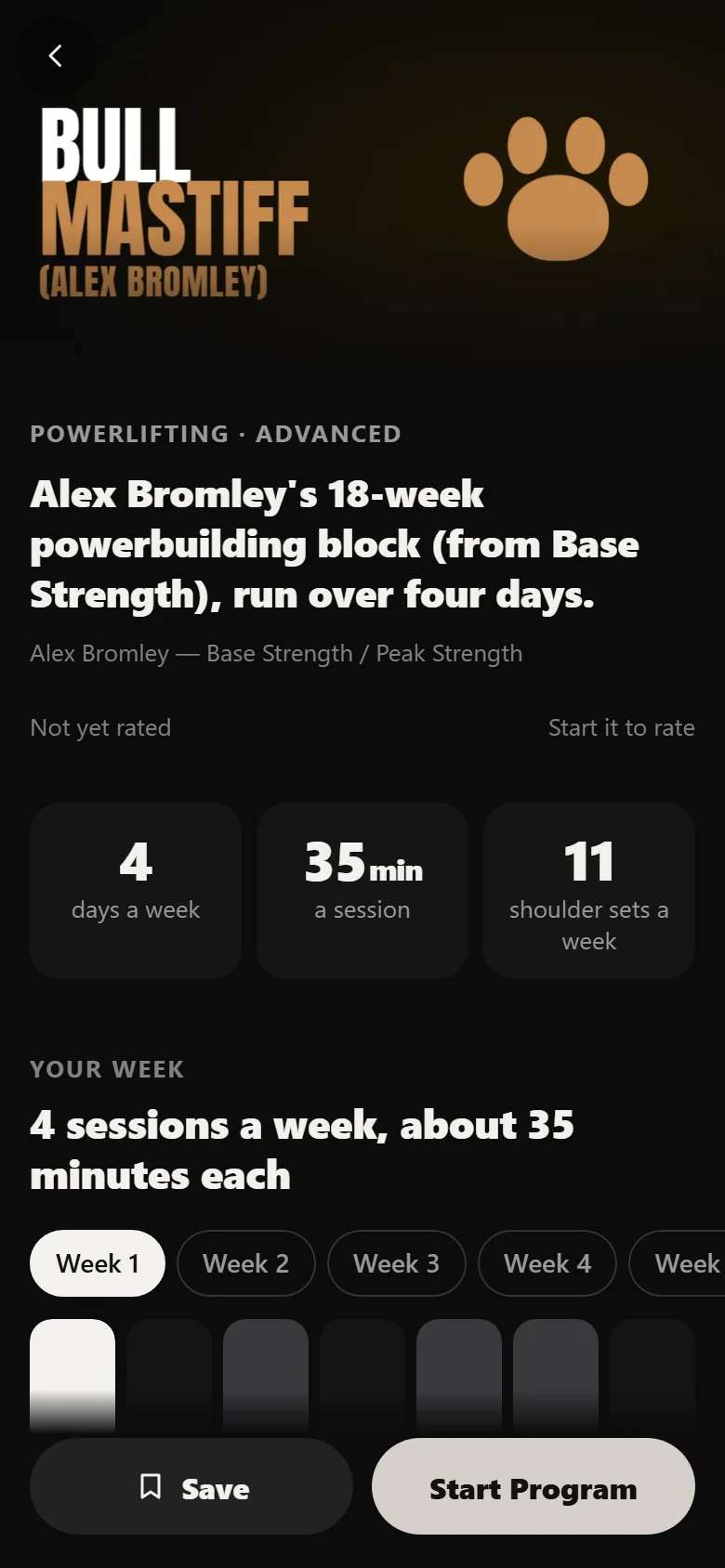
In Discover, Bullmastiff sits on the Powerlifting shelf, marked Advanced, at four days a week. Search finds it by name, or Filter narrows the shelves by level and days a week. Tap the cover for a quick look, then View Program for the full page.
The program page is worth reading properly before you commit, because this is a twenty-week commitment rather than a four-week experiment. It lays out the two phases, the four training days and the tier structure underneath each one. It also notes something the internet gets wrong constantly: Bullmastiff is Alex Bromley's program, from Base Strength, and is not a GZCL block.
Four numbers, and they are meant to be true
Setup asks for a training max on the squat, bench, deadlift and overhead press, and this program wants them set to your actual one-rep max rather than to the ninety percent that 5/3/1 asks for. This run entered 150 kg, 110 kg, 200 kg and 70 kg.
Those four numbers then resolve every percentage in the T1 tier for the next twenty weeks, and they never change. The training maxes this block finished on are the ones it started with, which is not the app declining to progress you. It is the design: the block is a single ramp toward one test, and moving the number the ramp is calculated from partway up would defeat the point.
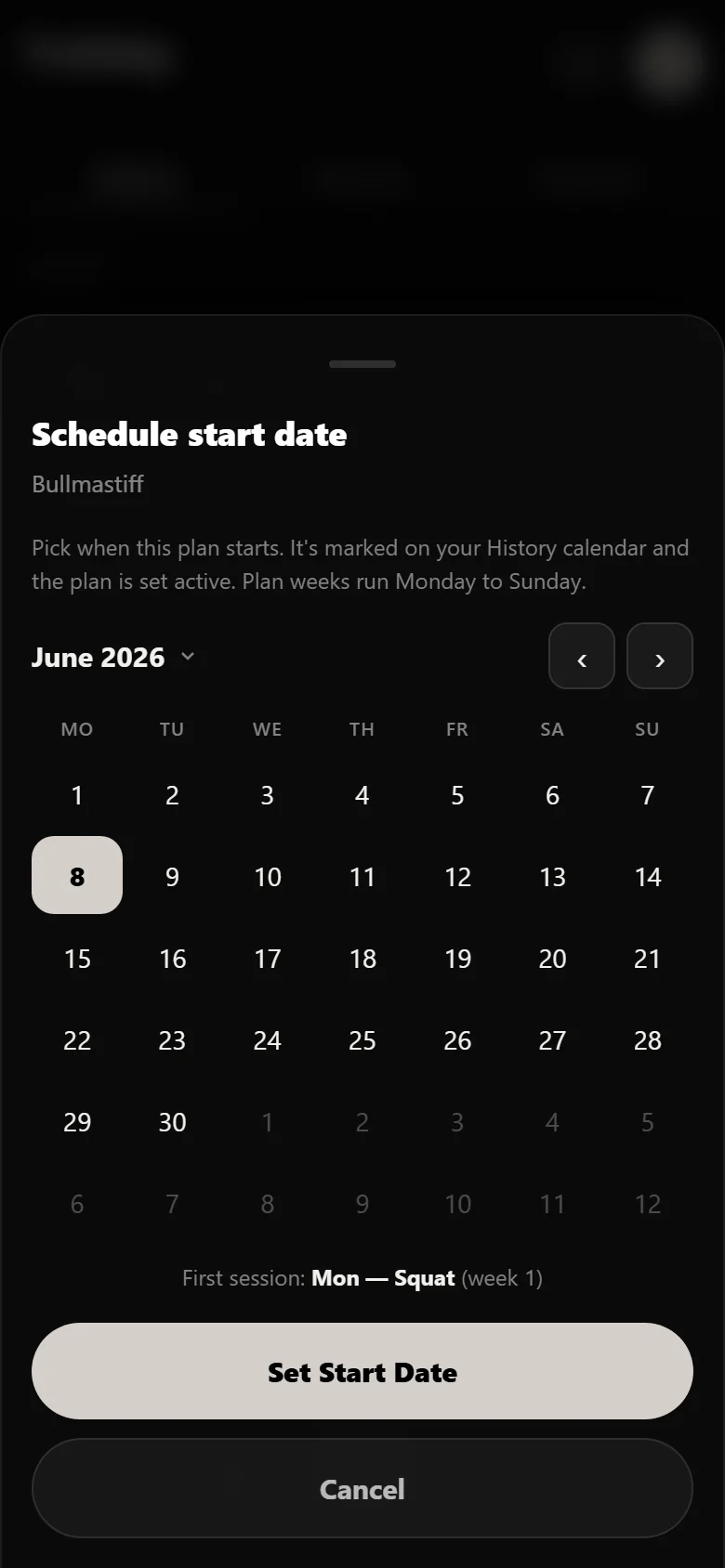
A start date puts the whole twenty weeks on the calendar, four sessions a week. What appears is not a repeating pattern but a shape, and you can see the end of it from the beginning.
Three tiers, three rules, one session
Every session stacks the same three layers, and the reason Durata is a good fit for this program is that it tracks each of them on its own terms rather than flattening them into a list of exercises.
T1 is the main lift, on a strict percentage of the max you entered, with the last set repped out. It is the only tier that involves arithmetic and it is the only one you never do arithmetic for.
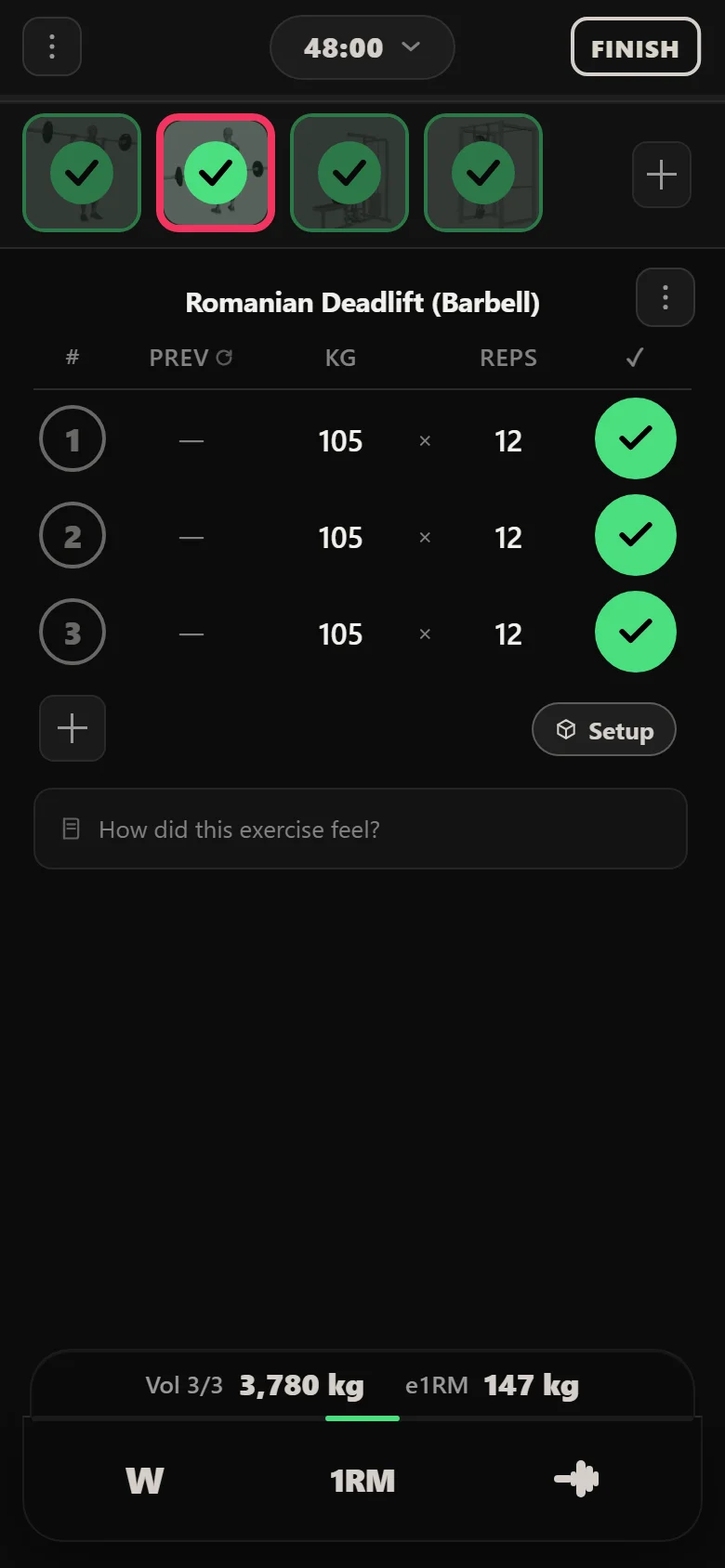
T2 is a variation of the opposite movement pattern. On squat day that is a Romanian deadlift, and it carries no percentage at all. It is built by feel, logged by RPE, and it moves when you decide it moves. If you have ever wondered why an app insists on prescribing a weight for everything, this tier is the counter-example: some work genuinely should not be prescribed.
T3 is the accessory tier, and it has the strangest rule of the three. The weight stays where it is and the program adds a set every week. Week one is a handful of sets; by the end of a phase the same exercise at the same weight has become a serious piece of work. It is progressive overload with the weight held constant, which is the mechanism most lifters forget exists.
Base: nine weeks of not being impressed
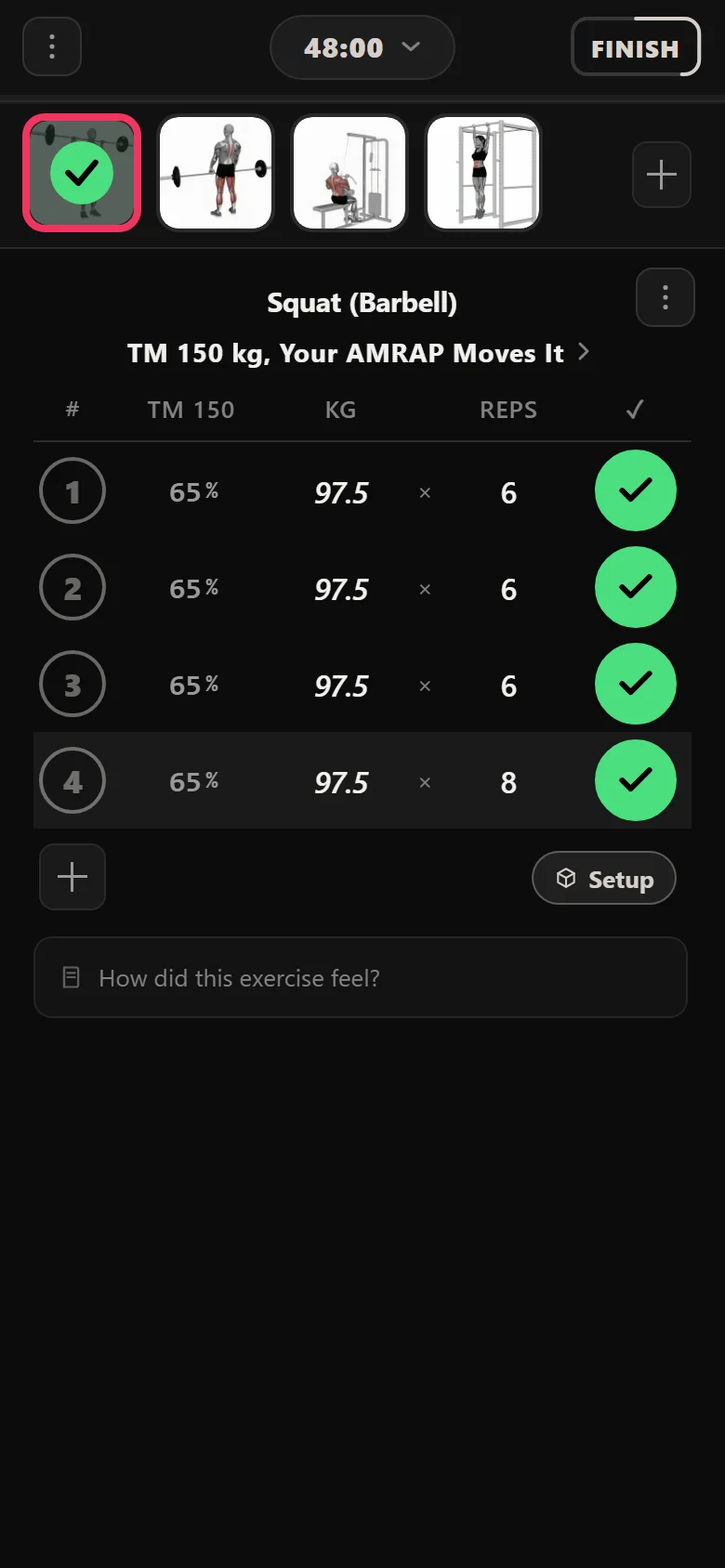
Week one opens the Base phase with four sets of six at sixty-five percent, the last one repped out. On a 150 kg max that is 97.5 kg, and it is supposed to feel comfortable, because there are eight more weeks of this and the third week of each block is not comfortable at all.
The Base wave steps every three weeks rather than every session: three weeks at 97.5 kg, three at 105 kg, three at 112.5 kg. Nine weeks, three steps, and the whole phase spent under seventy-five percent. Nothing here is testing you. The phase exists to make the second half survivable.
This is the point where most people abandon the program, and it is worth naming. Nine weeks is a long time to train without a heavy session, and the temptation to add a top set is constant. The Peak phase is the reason not to.
Peak: the same wave, aimed at a number
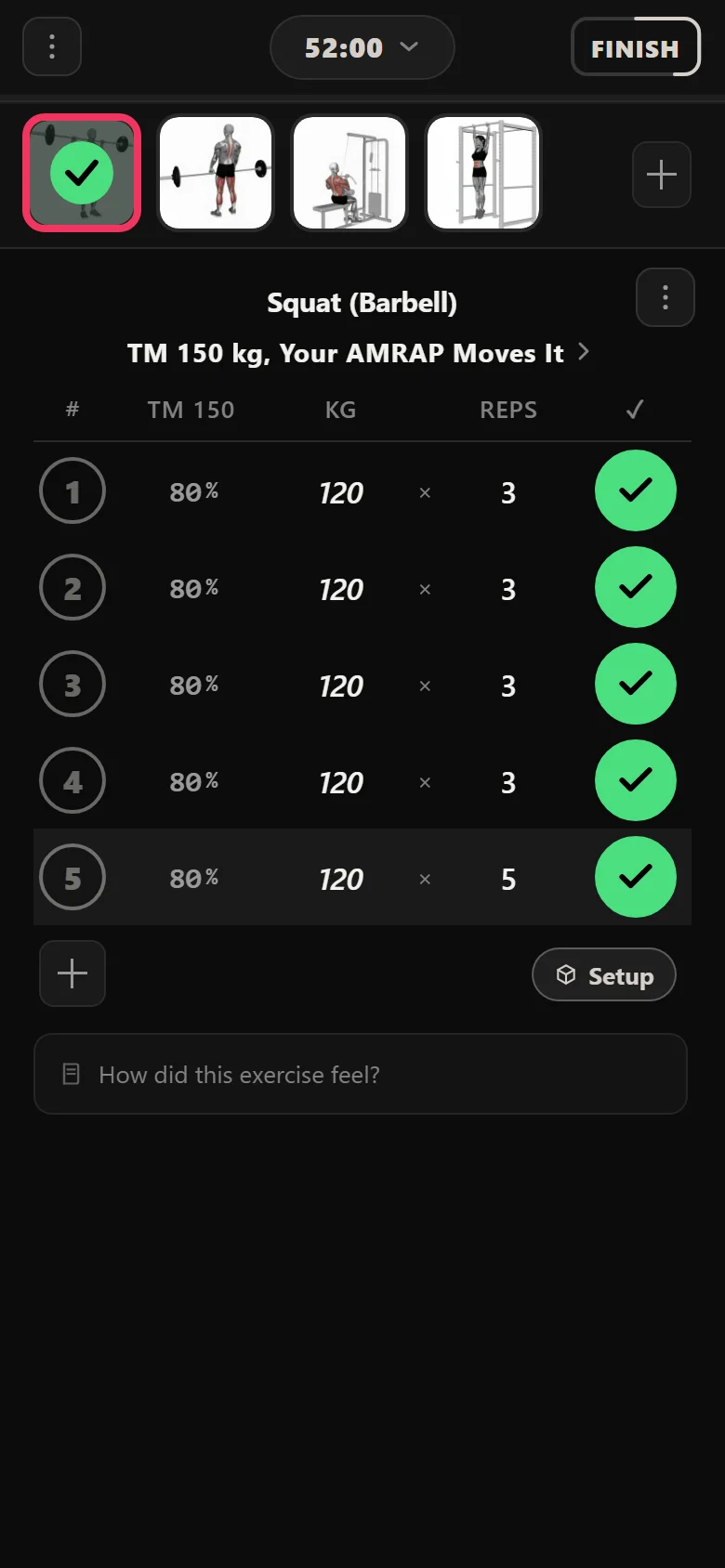
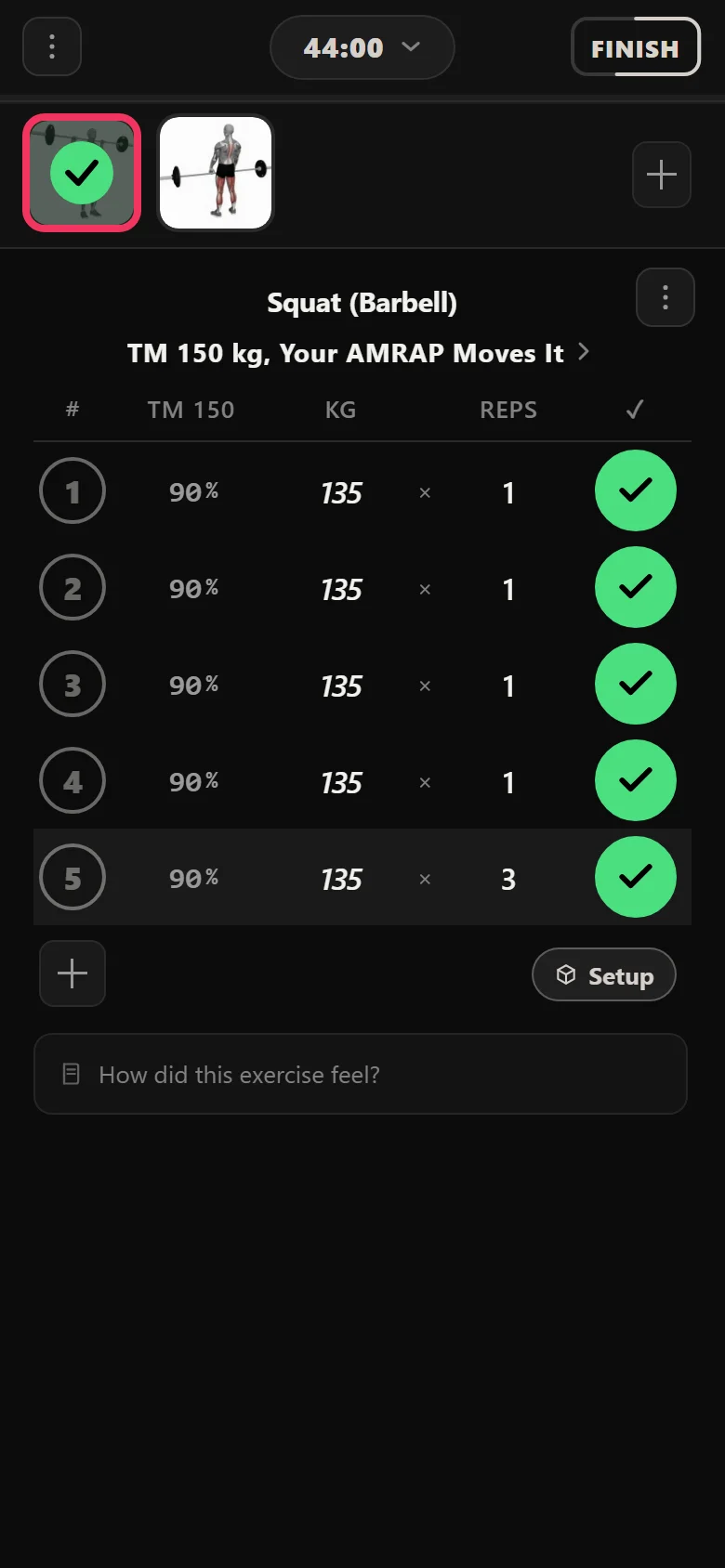
Week ten resets everything. The rep scheme drops to triples, the percentage jumps to eighty, and the squat goes to 120 kg. Base is over and the second nine weeks climb from there in the same three-week steps: 120 kg, then 127.5 kg, then 135 kg.
By week sixteen the wave is at ninety percent and the sets have become singles, with the set count tapering across the last three-week block. That taper is the part people leave out when they write this program down by hand. The intensity holds and the volume falls, which is what lets a heavy week be heavy rather than just long.
The tiers underneath are still running their own rules the whole time. T2 is still being decided by feel, T3 is still adding a set a week, and none of that stops because the main lift got heavy.
A deload, and then the only week that asks a question
Week nineteen takes the bar down to 90 kg and does nothing else. It is a full week of deliberately easy training after eighteen weeks of ramping, and skipping it makes week twenty worse rather than better.
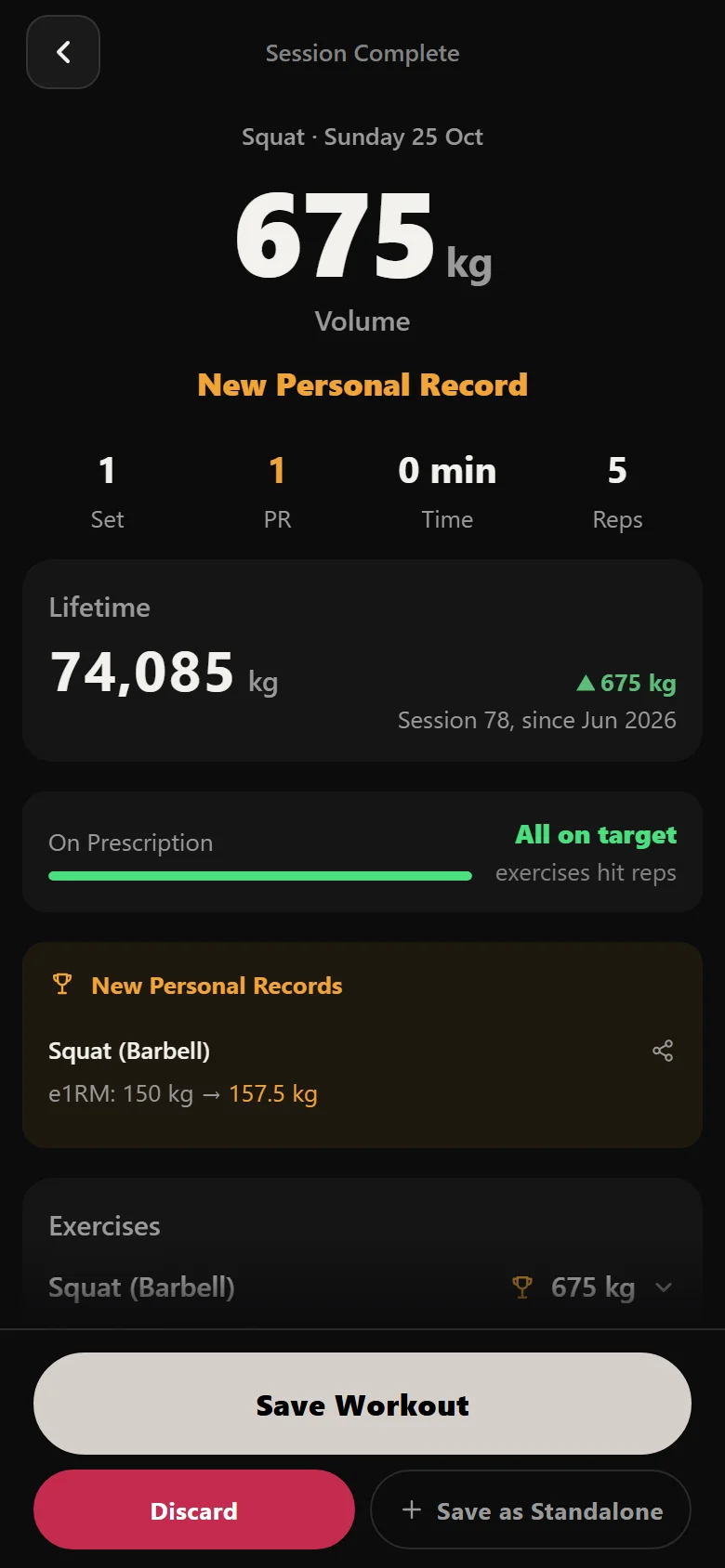
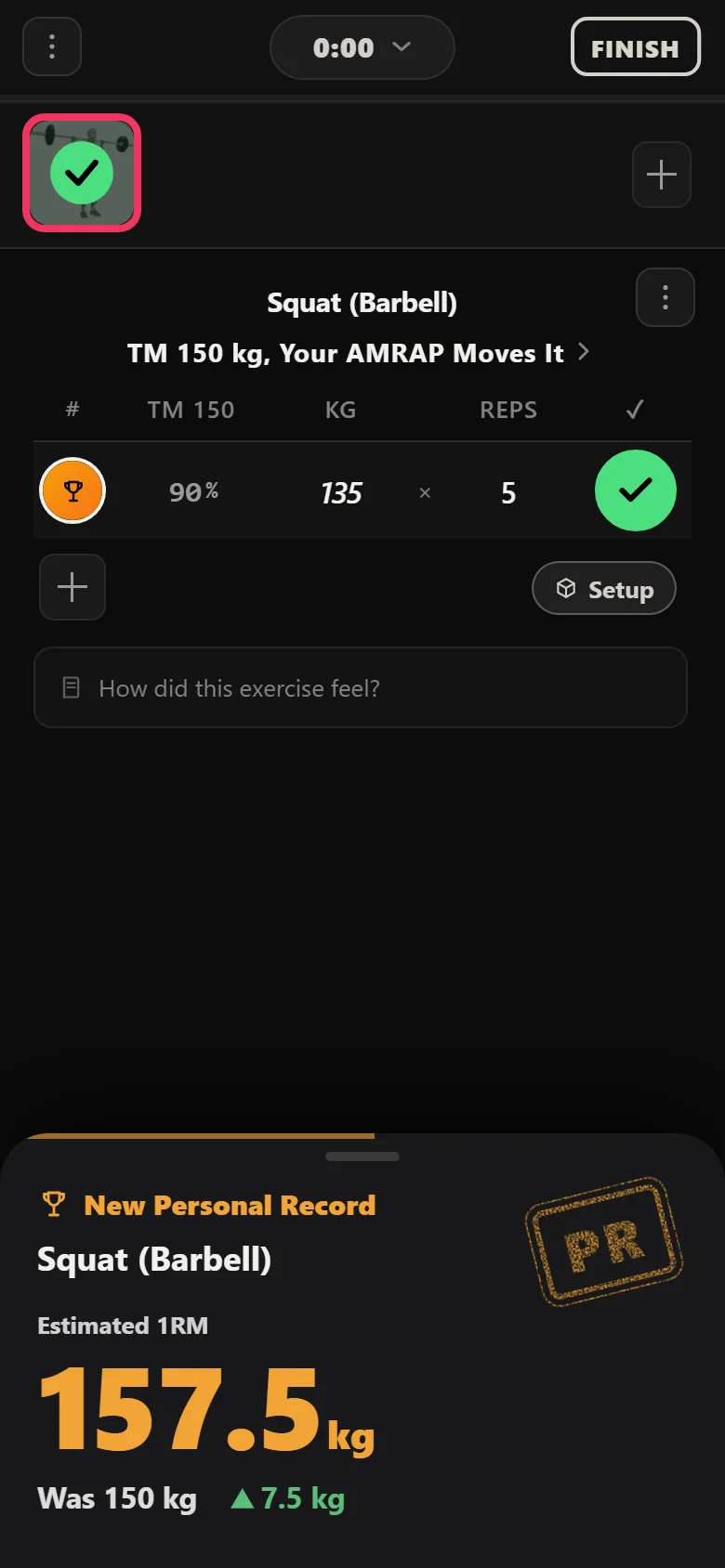
Week twenty is the test. A single at ninety percent, repped out for as many as you have, and the estimate the app derives from that set is the answer to what the block was worth. The squat came out at 157.5 kg off a max entered as 150 kg on day one, and the session logged it as a new estimated one-rep max.
That is the honest version of what a twenty-week block delivers, and it is worth saying plainly: 7.5 kg on a squat, earned across roughly a hundred sessions. Bromley's argument is that the alternative, chasing a heavy single every few weeks, produces a bigger number sooner and a smaller one a year later.
The strip below is the whole squat, week by week, deload included.
Squat (Barbell): prescribed weight, week by week
- 97.5S1 Session 1 — Base opens
- 97.5S2 Session 2
- 97.5S3 Session 3
- 105S4 Session 4
- 105S5 Session 5
- 105S6 Session 6
- 112.5S7 Session 7
- 112.5S8 Session 8
- 112.5S9 Session 9 — Base ends
- 120S10 Session 10 — Peak opens
- 120S11 Session 11
- 120S12 Session 12
- 127.5S13 Session 13
- 127.5S14 Session 14
- 127.5S15 Session 15
- 135S16 Session 16
- 135S17 Session 17
- 135S18 Session 18
- 90S19 Session 19 — deload
- 135S20 Session 20 — test
What twenty weeks looks like in the numbers
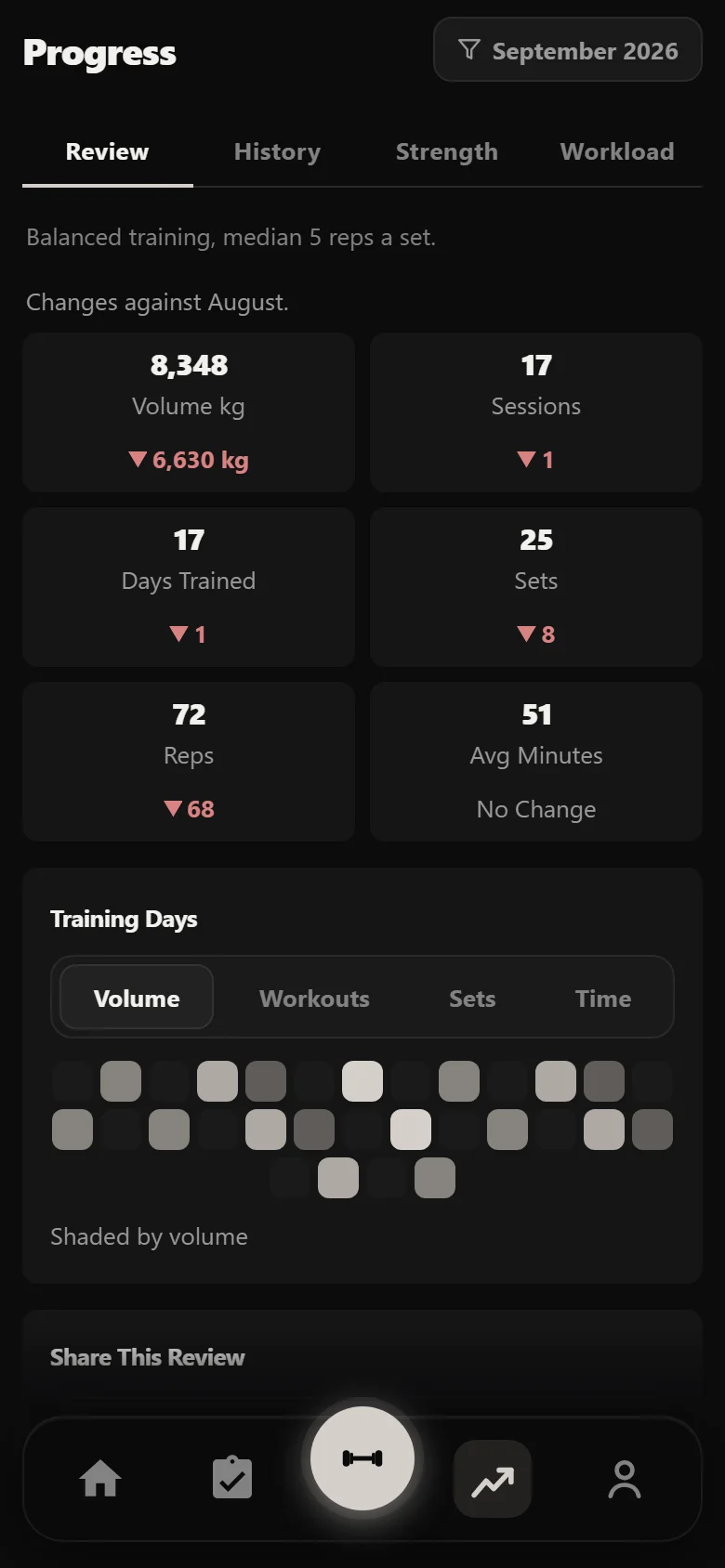
The Review tab reads the block a month at a time. September came to 8,348 kg across 17 sessions, 6,630 kg less than August. The volume is the T3 tier as much as the T1: an accessory that gains a set a week for nine weeks moves a great deal of weight by the end without the number on it ever changing.
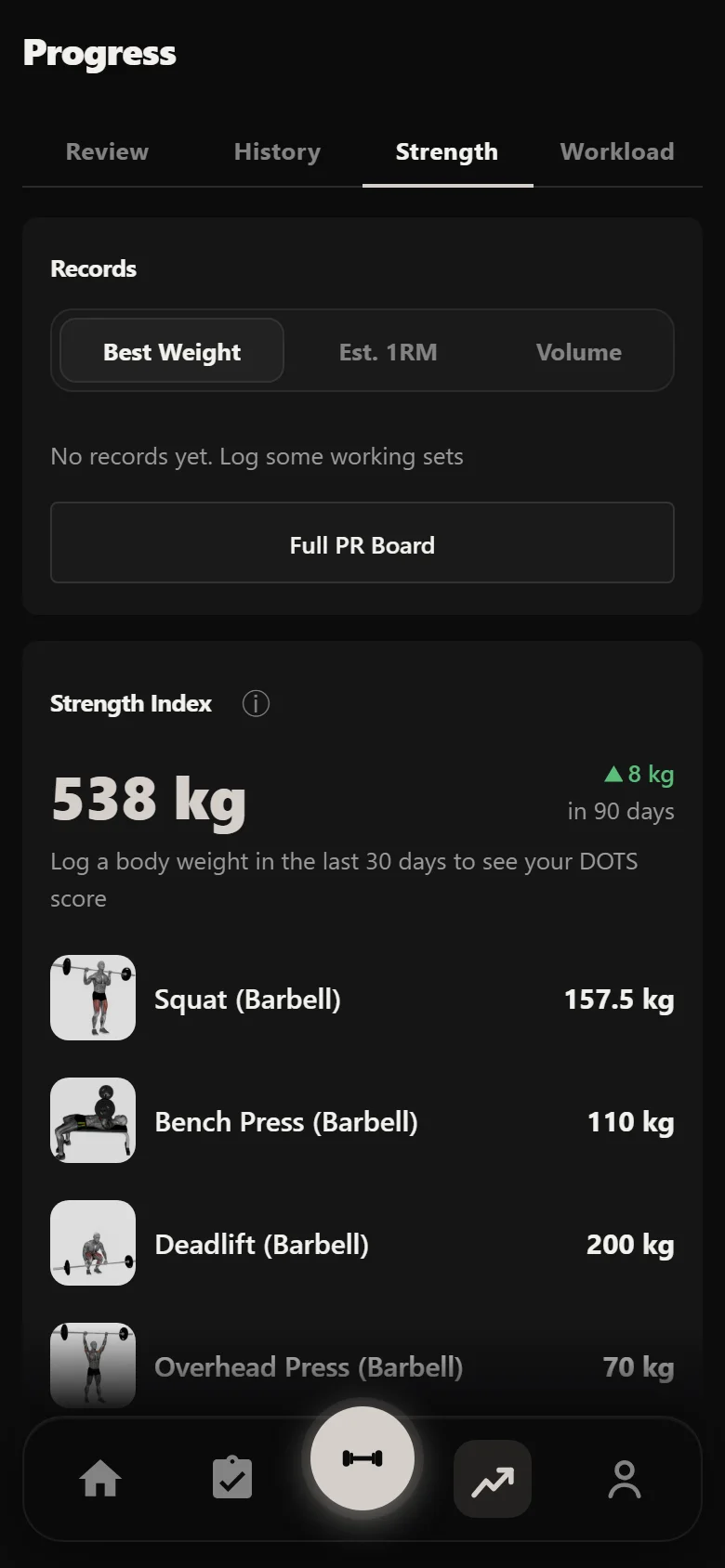
The Strength tab adds the four lifts into one Strength Index, 538 kg and up 8 kg in 90 days: the squat's estimate at 157.5 kg, the deadlift at 200 kg, the bench at 110 kg and the press at 70 kg. The Records card above it stays empty, and that is the fixed max showing: the wave keeps coming back to the same top weights, and a weight you only match is not a record. The estimates are where a block like this shows its gains. The lines undulate through the wave rather than climbing steadily, which is what a percentage block looks like from the outside, and then the test week puts a spike on the end of the squat.
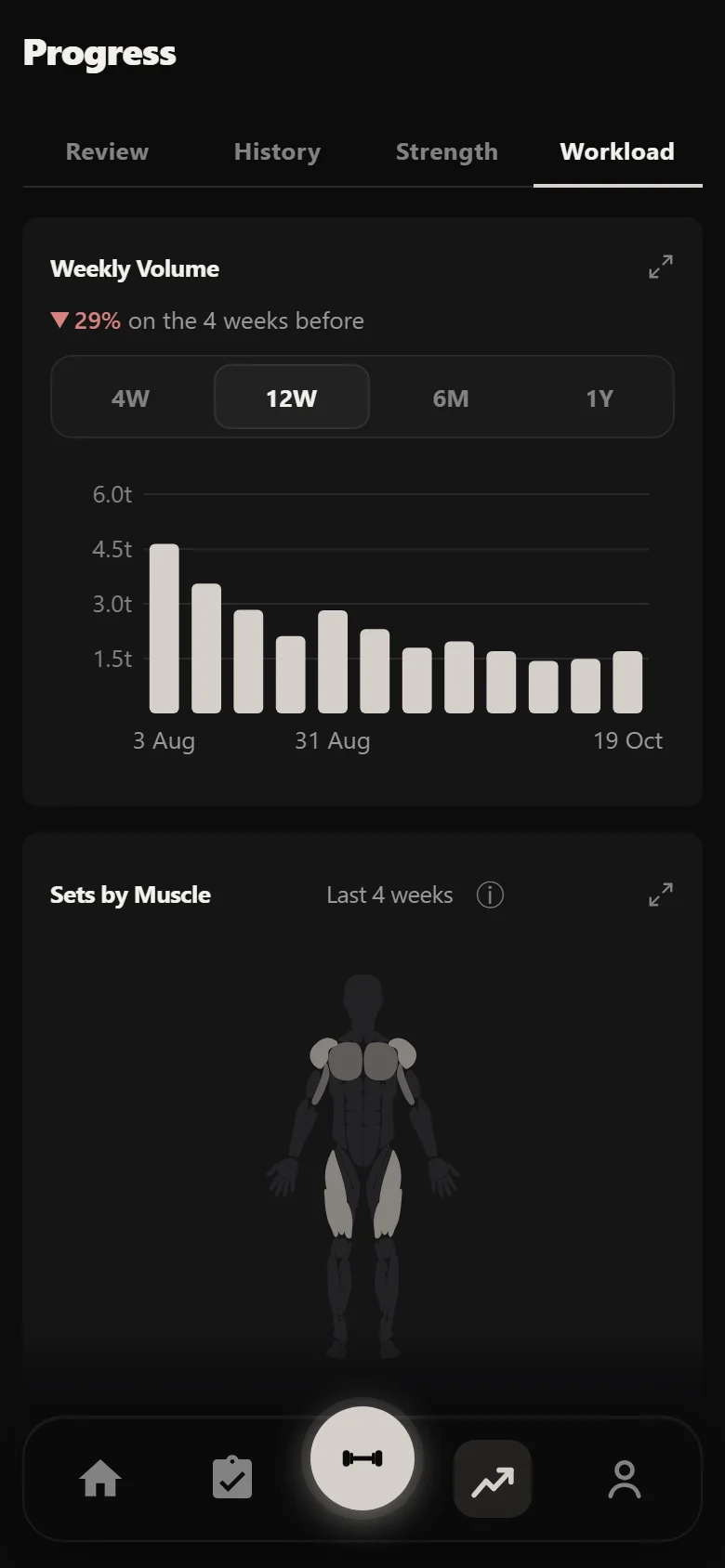
The workload view is where the tier structure becomes visible without reading a single session. Weekly volume climbs through Base, and the muscle-group landmarks fill in as the accessory sets accumulate. Then Peak arrives, volume comes down, and intensity takes over. You can read the shape of Bromley's whole argument off that one chart.
Twenty weeks, seen from the outside
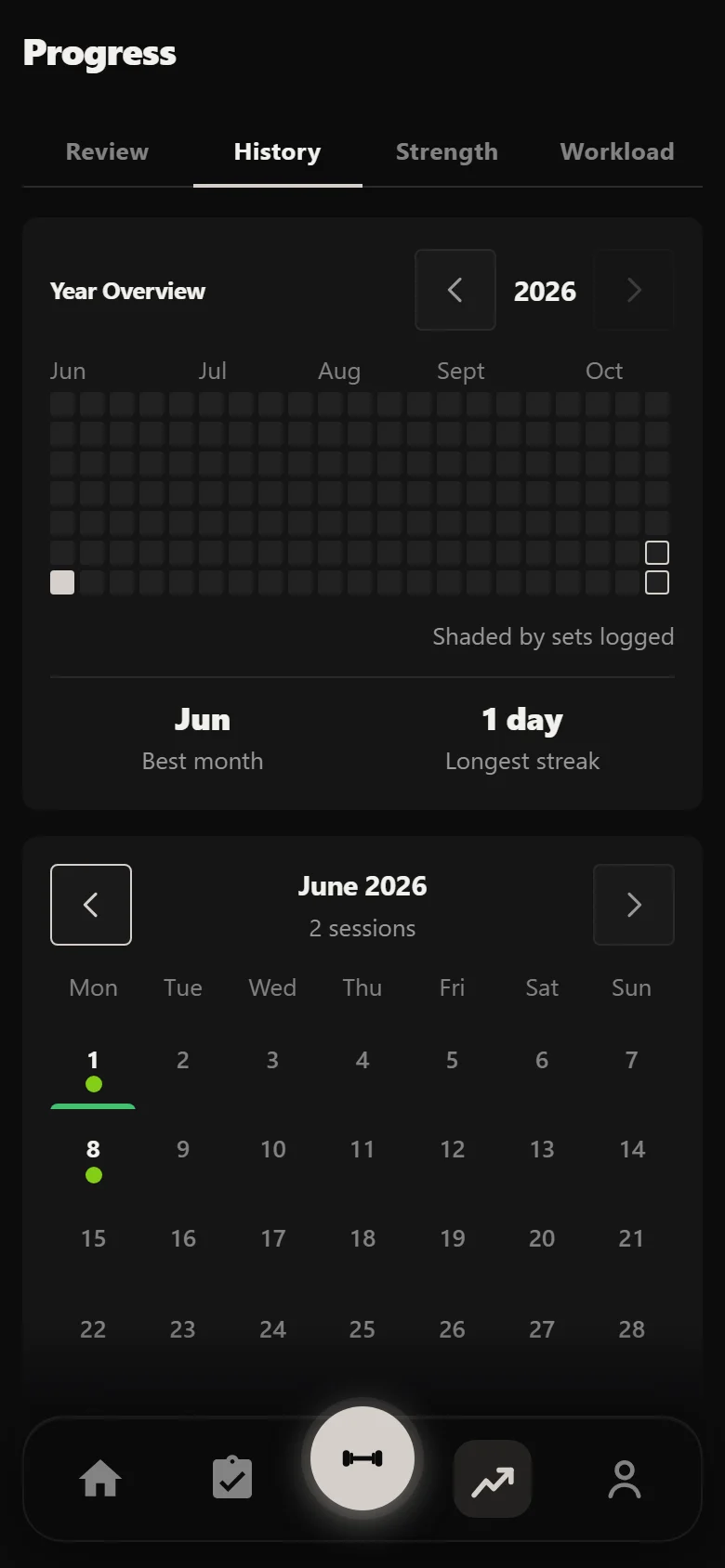
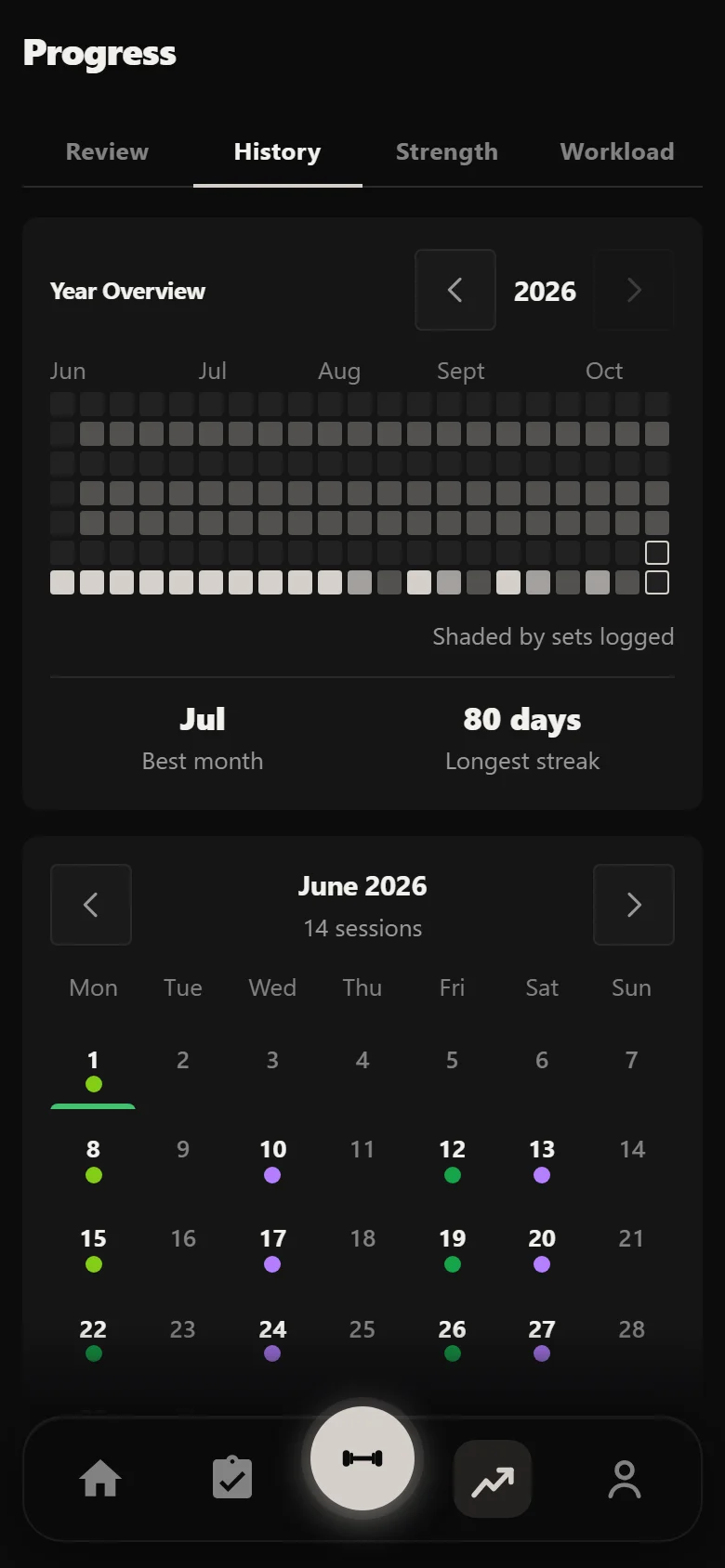
The History calendar holds the whole block, four days a week, five months of it. There is no repeating cycle to lose your place in and no point at which the program asks you to make a decision about what comes next.
That is the strongest practical argument for running a long block inside an app rather than off a spreadsheet. Bullmastiff has four training days, two phases, three tiers with three different progression rules and a taper inside the final block. Getting week fourteen right on paper means remembering all of it. Here it is just the next session.
The payoff: week one against the test
Two screenshots of the same lift on the same screen: the first session of Base and the last session of the block. Four sets of six at sixty-five percent, and a single at ninety percent taken for as many as it had.
Nineteen weeks between them, a fixed 150 kg max underneath both, and a 157.5 kg estimate off the final rep-out.
Common questions
What is Bullmastiff?
Alex Bromley's powerbuilding block from Base Strength, run here over four days a week and twenty weeks. A nine-week Base phase accumulates volume on the main lifts, a nine-week Peak phase intensifies toward a max, and a deload and test week close it out. Every session carries three tiers: a percentage-based main lift, an RPE-driven variation of the opposite pattern, and accessories that add a set each week.
Is Bullmastiff a GZCL program?
No, though it is constantly described as one. The T1, T2 and T3 tier language is shared with Cody Lefever's GZCL method, which is where the confusion comes from, but Bullmastiff is Bromley's own block with its own Base-then-Peak structure.
What should I set my training maxes to?
Your true one-rep max, not ninety percent of it. All the percentages in this program are calculated from a real max, so entering a conservative number makes the whole twenty weeks lighter than intended. This run entered 150 kg, 110 kg, 200 kg and 70 kg, and those numbers stayed fixed for the entire block.
Why do my training maxes never go up?
Because the block is a single ramp toward one test rather than a repeating cycle. The percentages need a stable number underneath them, so the maxes hold for all twenty weeks. You retest in week twenty, re-load your maxes with what the test produced, and start the next block from there.
Can I skip the Base phase and go straight to Peak?
You can, and it is the most common way to get a disappointing result from this program. Nine weeks under seventy-five percent looks like wasted time while you are in it. The Peak phase spends what Base accumulated, and starting a peak with nothing accumulated leaves you testing the same max you started with.
Is Durata free?
Yes. Durata is free to use, with the full program catalogue, automatic percentage maths, rest timers and PR tracking. Everything in this walkthrough is in the app.
Put it into practice
Durata is free to use — 50 proven programs, automatic progression, rest timers and PR tracking, all on your phone.