


Mountain Dog PPL in Durata: six days a week, and a weight column that barely moves
Mountain Dog runs backwards. Every other program in the catalogue opens a session with its heaviest compound and finishes with the small stuff. John Meadows put the small stuff first: cable lateral raises before any pressing, leg extensions before the hack squat, on the theory that a pre-fatigued muscle does more of the work when the compound arrives.
It runs six days a week, and it contains no barbell squat, no barbell bench and no deadlift. The only barbells in it are a landmine row and a Romanian deadlift. Much of the work sits in rep ranges of 15-20 and 20-25, and almost none of it below ten.
That combination produces the most unusual four weeks in this whole series of walkthroughs. Twenty-four sessions in, one lift had climbed steadily, one had been cut, and seventeen were sitting exactly where they started. This article is about why that is the program behaving correctly rather than the app failing to notice anything.
Finding the program
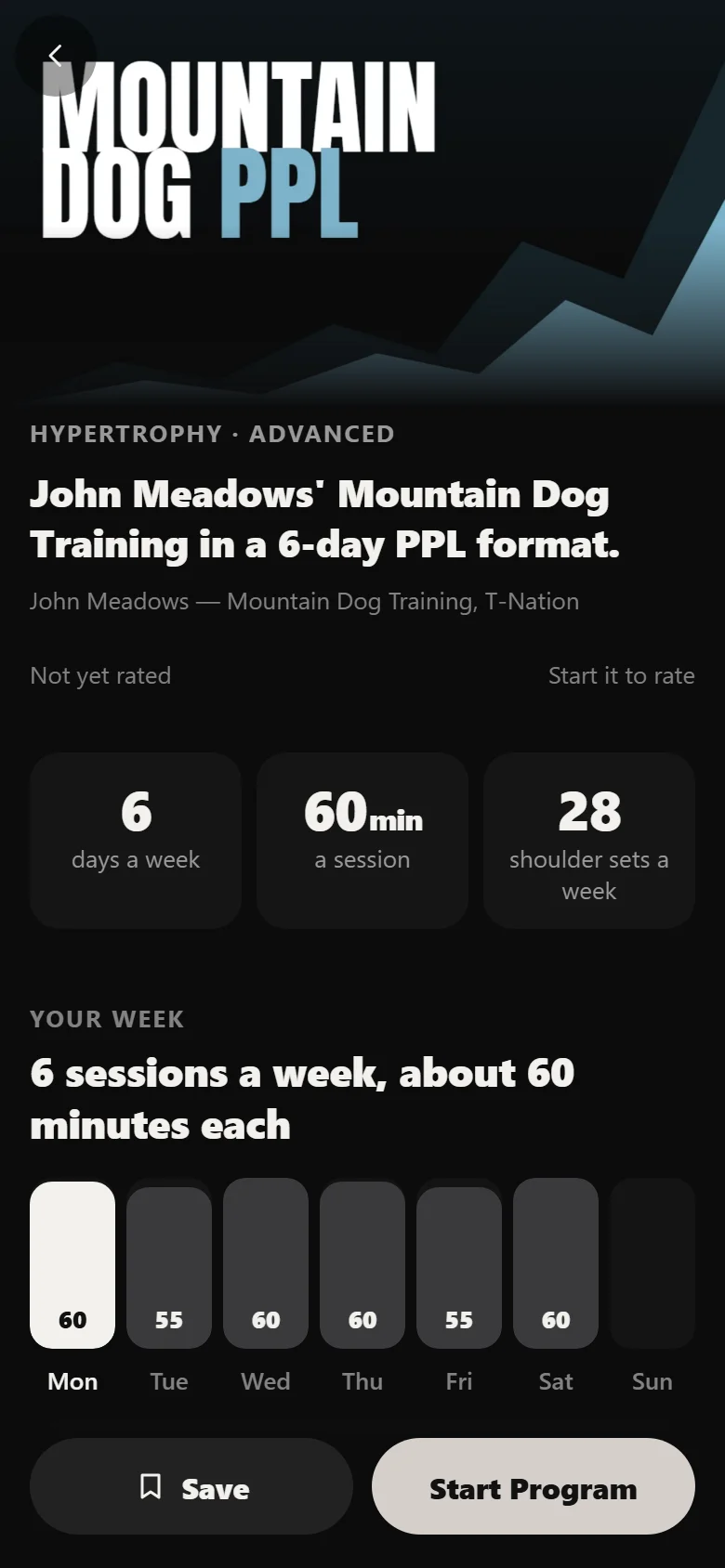
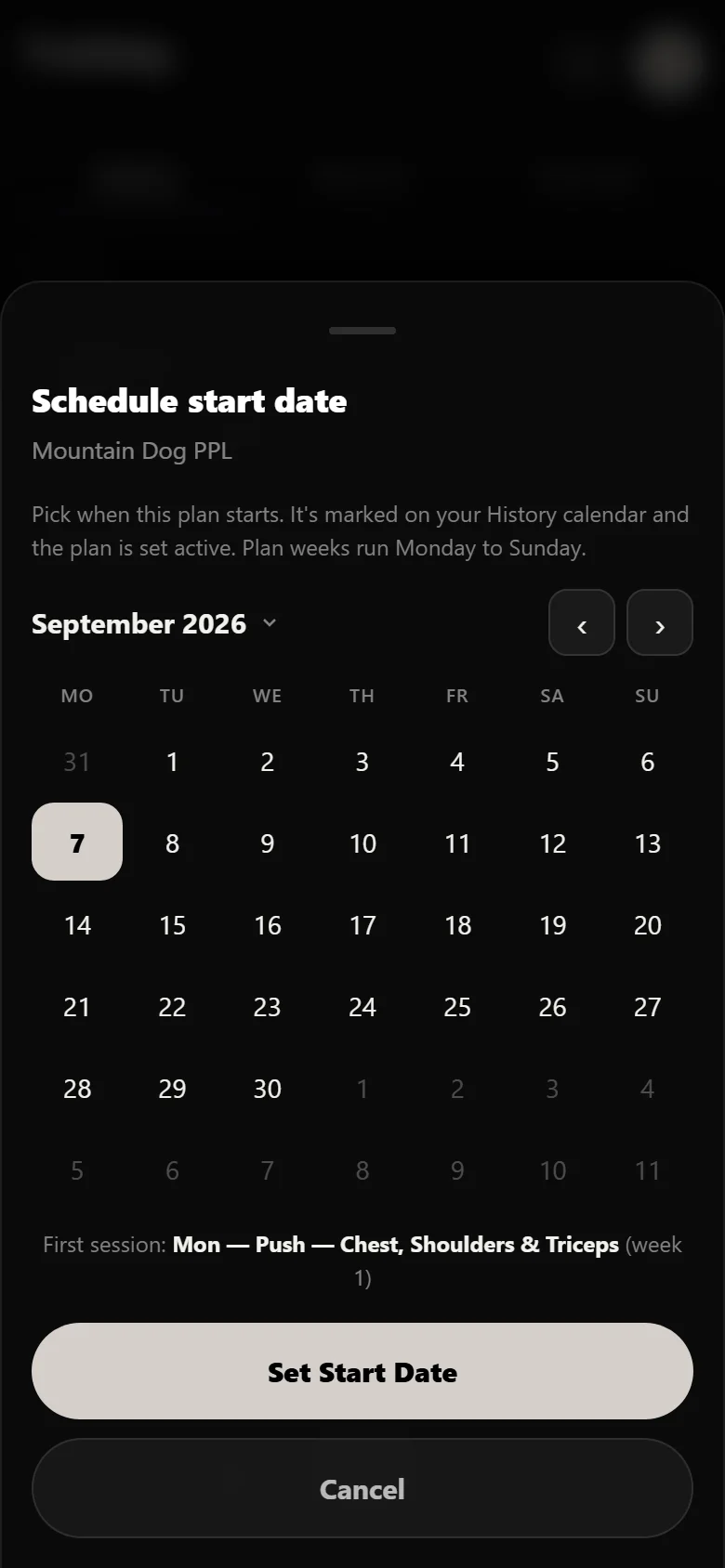
In Discover, Mountain Dog PPL sits on the Hypertrophy shelf, marked Advanced, at six days a week. Search finds it by name, or Filter narrows the shelves by level and days a week. Tap the cover for a quick look, then View Program for the full page.
The program page shows the shape before you commit: Push, Pull, Legs, twice through. Both Push days are identical, both Pull days are identical, both Leg days are identical. Six sessions, three templates.
No maxes, and a long list
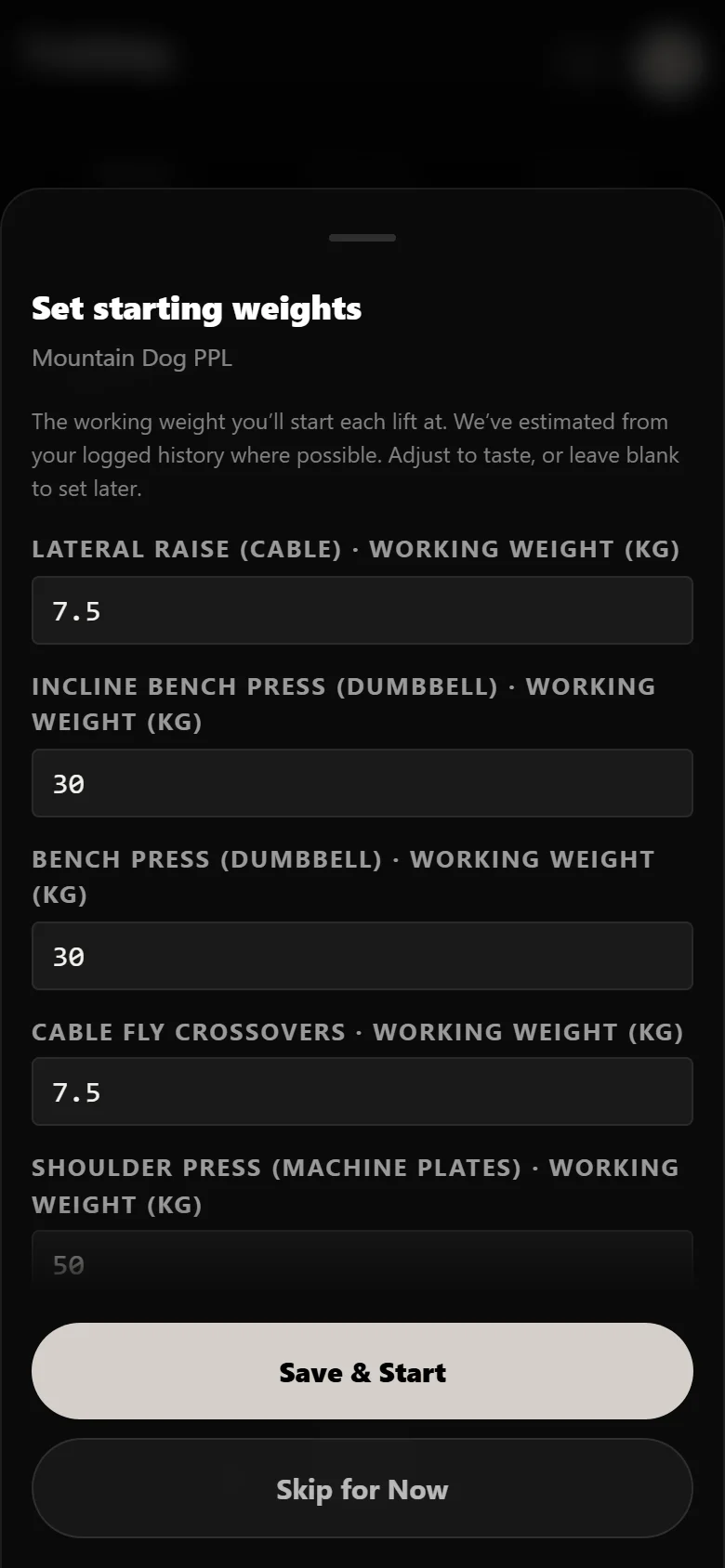
There are no training maxes and no percentages. The setup sheet asks for a working weight per exercise, and on a six-day program built from three templates that is a long list to fill in.
Most of it starts small. This run opened with 7.5 kg on the cable laterals, the pushdowns, the face pulls and the curls, 30 kg on the dumbbell presses and 50 kg on the shoulder press machine. The hack squat opened at 100 kg.
Be honest on the isolation work in particular. A weight you can grind for twelve reps is the wrong weight for a set of twenty-five, and getting that wrong at setup is what produces a lift that never advances for a month.
The small lift comes first
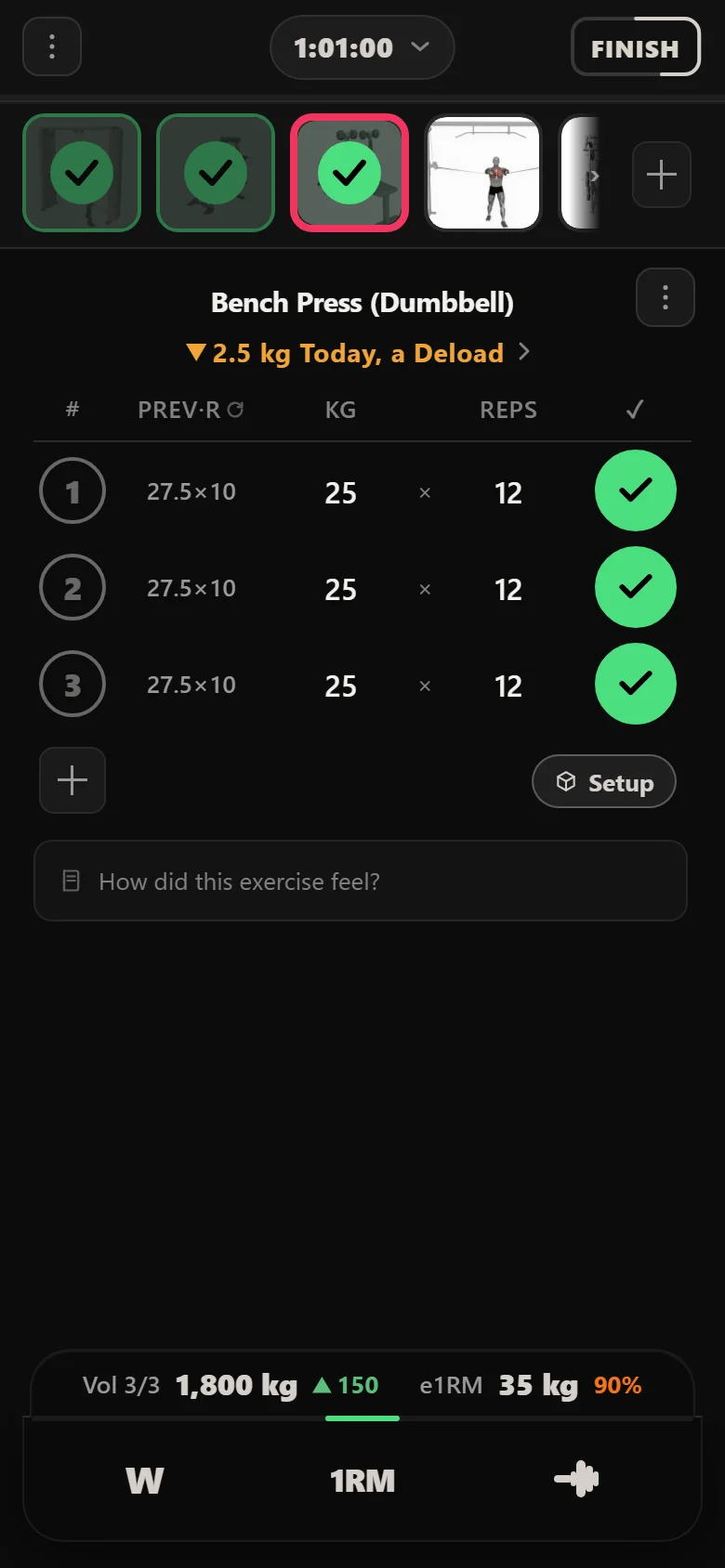
A Push day opens with four sets of cable lateral raises at 15-20 reps, and only then reaches the incline dumbbell press. A Leg day opens with four sets of leg extensions at 20-25 reps before the hack squat. That ordering is the signature of the method and it survives intact in the logger, because the app runs the session in the order the program defines.
It changes how the session feels more than it changes how you log it. The compound arrives with the target muscle already tired, which means the weight on it will be lower than you would use fresh, and it should be. Chasing the number you could hit fresh defeats the reason the laterals were placed in front of it.
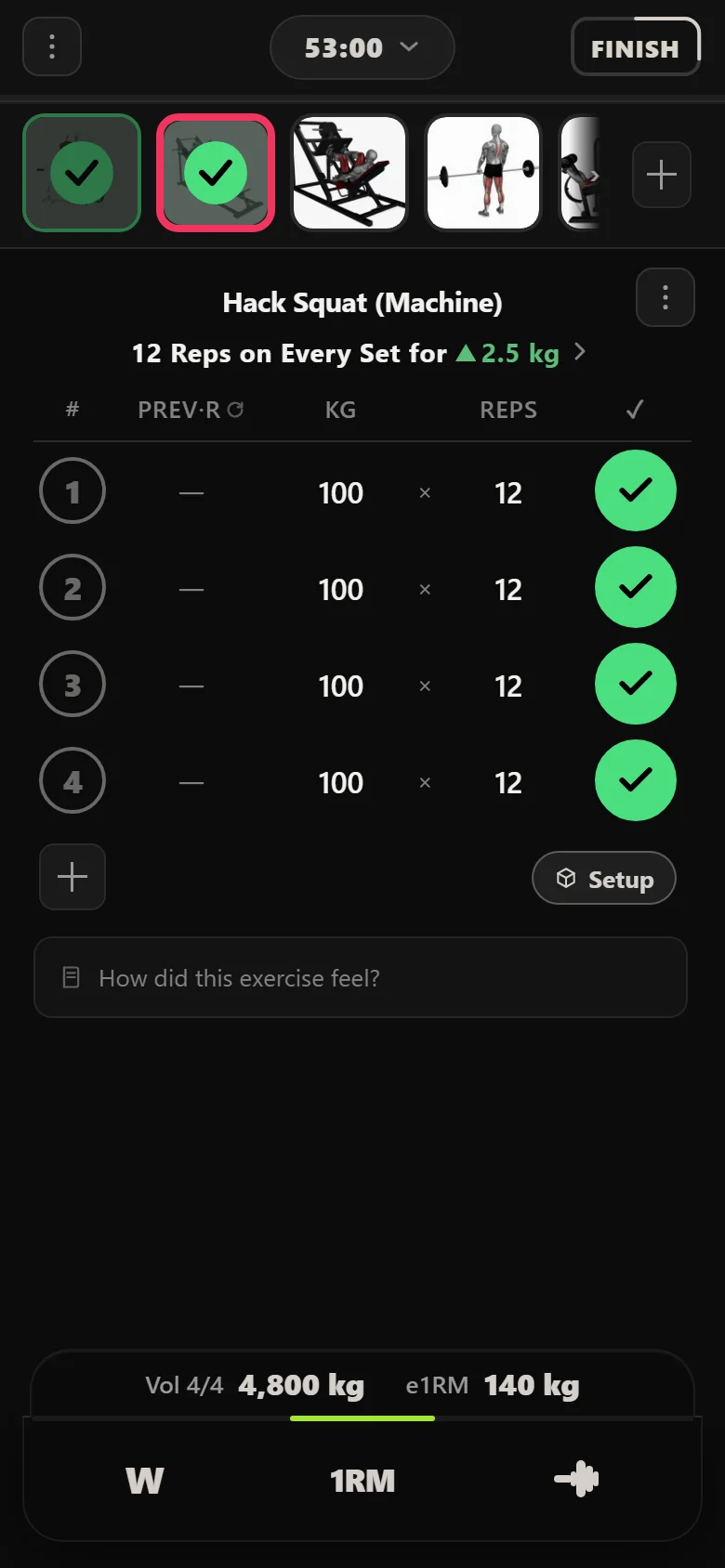
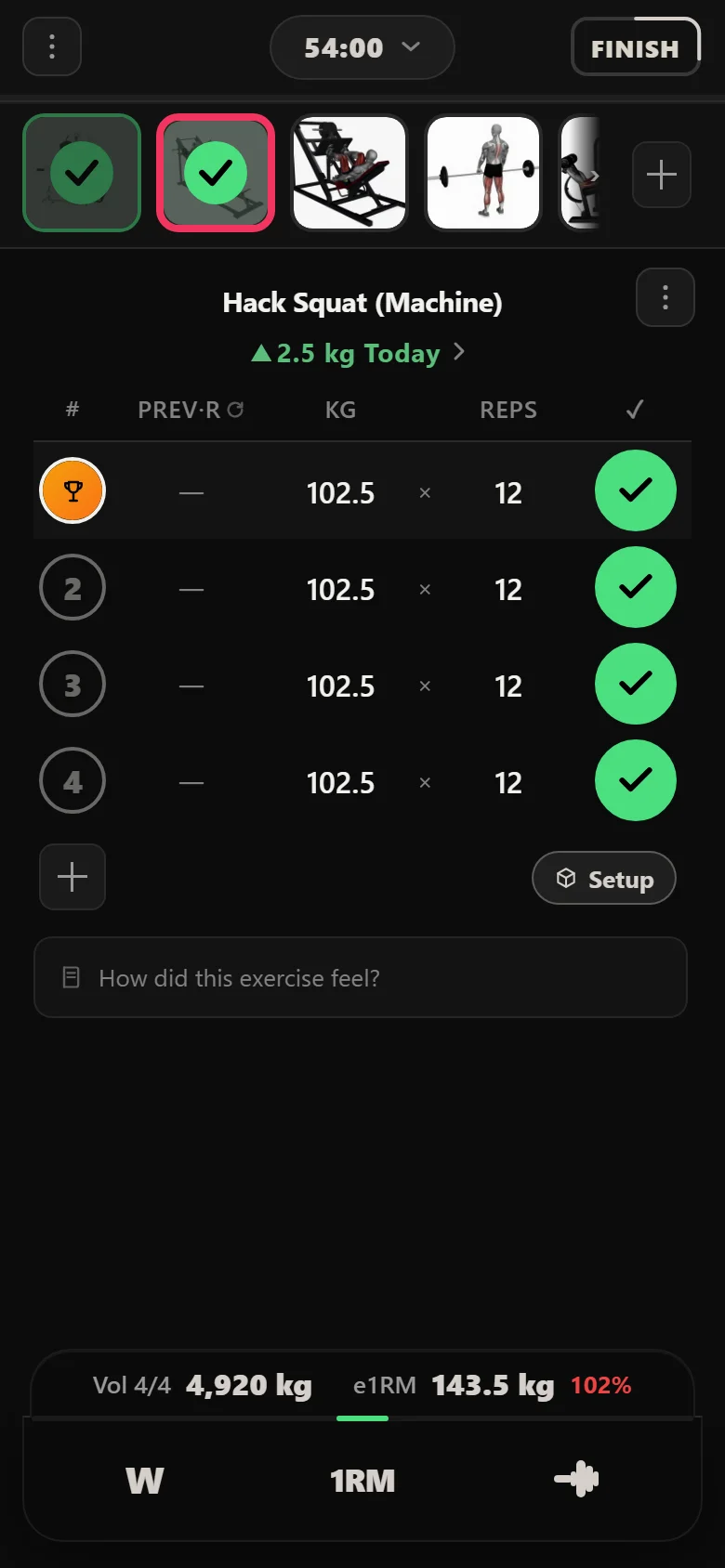
The hack squat is the exception that makes the rest legible. It sits in a 10-12 range, it is the heaviest thing in the program, and it is the one lift here that behaves the way a main lift behaves in any other program: clear every set and the app adds 2.5 kg next time.
The first fortnight
Six days a week is the real cost of this program, and it is worth being blunt about it. Three templates run twice each means every muscle group is trained twice a week with a great deal of volume, and there is one rest day. It is a good program and it is not a program you fit around a demanding month.
The early sessions climbed on the lifts that had room. The hack squat went from 100 kg to 102.5 kg, the chest-supported row from 25 kg to 30 kg, and the cable flyes, face pulls and dumbbell curls all crept from 7.5 kg to 12.5 kg over the block.
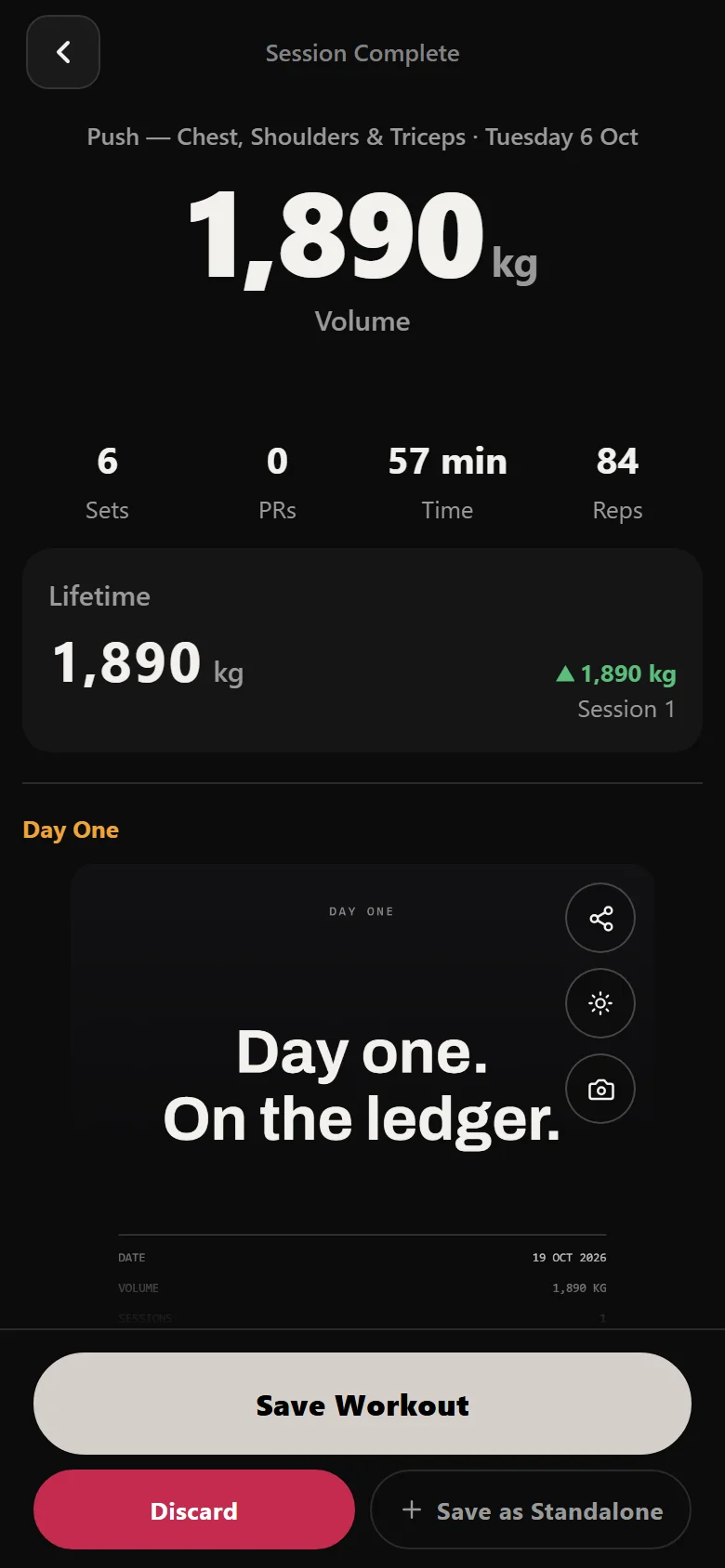
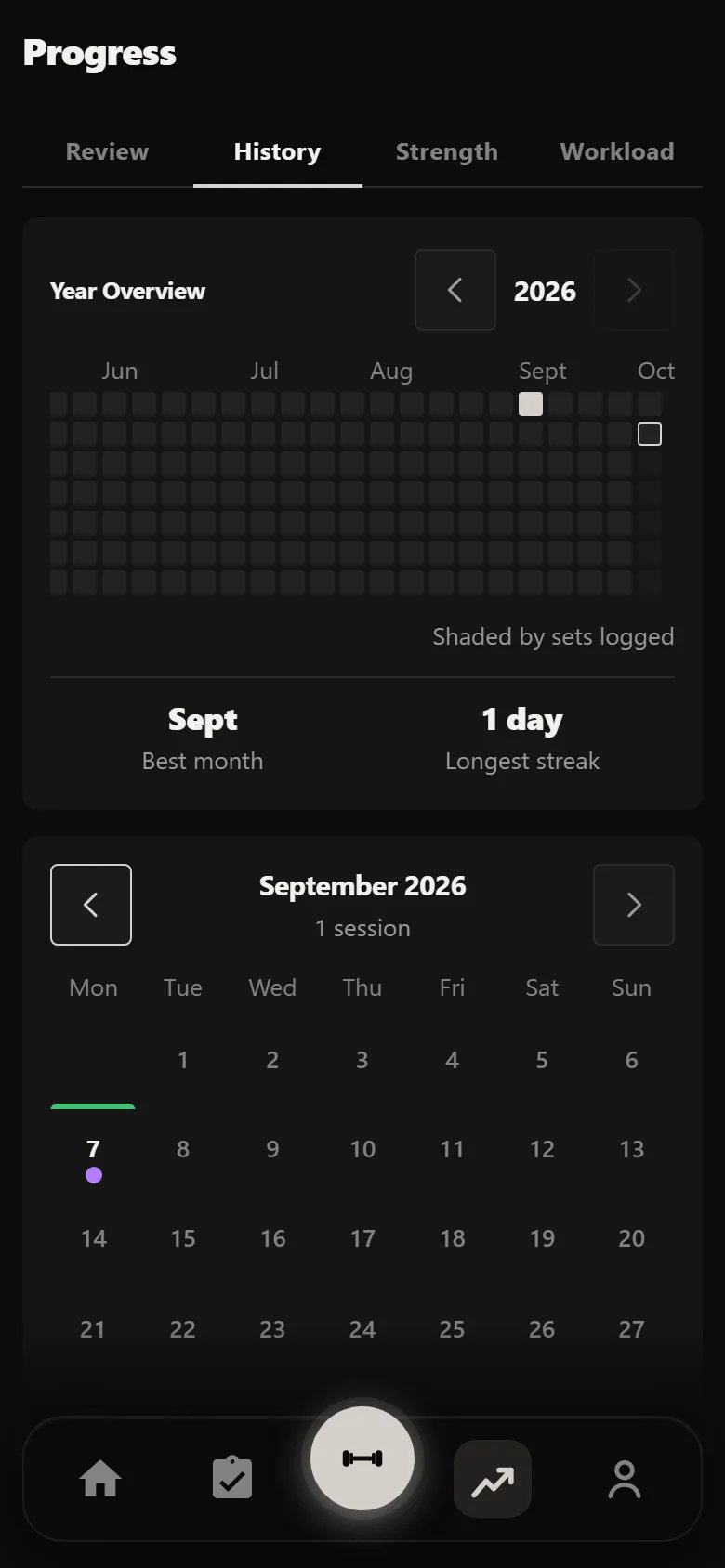
The calendar fills fast. Four weeks of this is twenty-four sessions.
The one lift that behaves
By its second appearance the hack squat was at 102.5 kg with an estimate of 143.5 kg, and it carried on in 2.5 kg steps for most of the block. It is worth following precisely because it is the outlier here, and because it shows the rule working normally in a program where most lifts will not trigger it.
The reason is the range. Four sets of 10-12 is a target you can top out on a good day. Four sets of 20-25 is not, most weeks, and that difference decides everything about what the weight column does over a month.
105 kg, held once
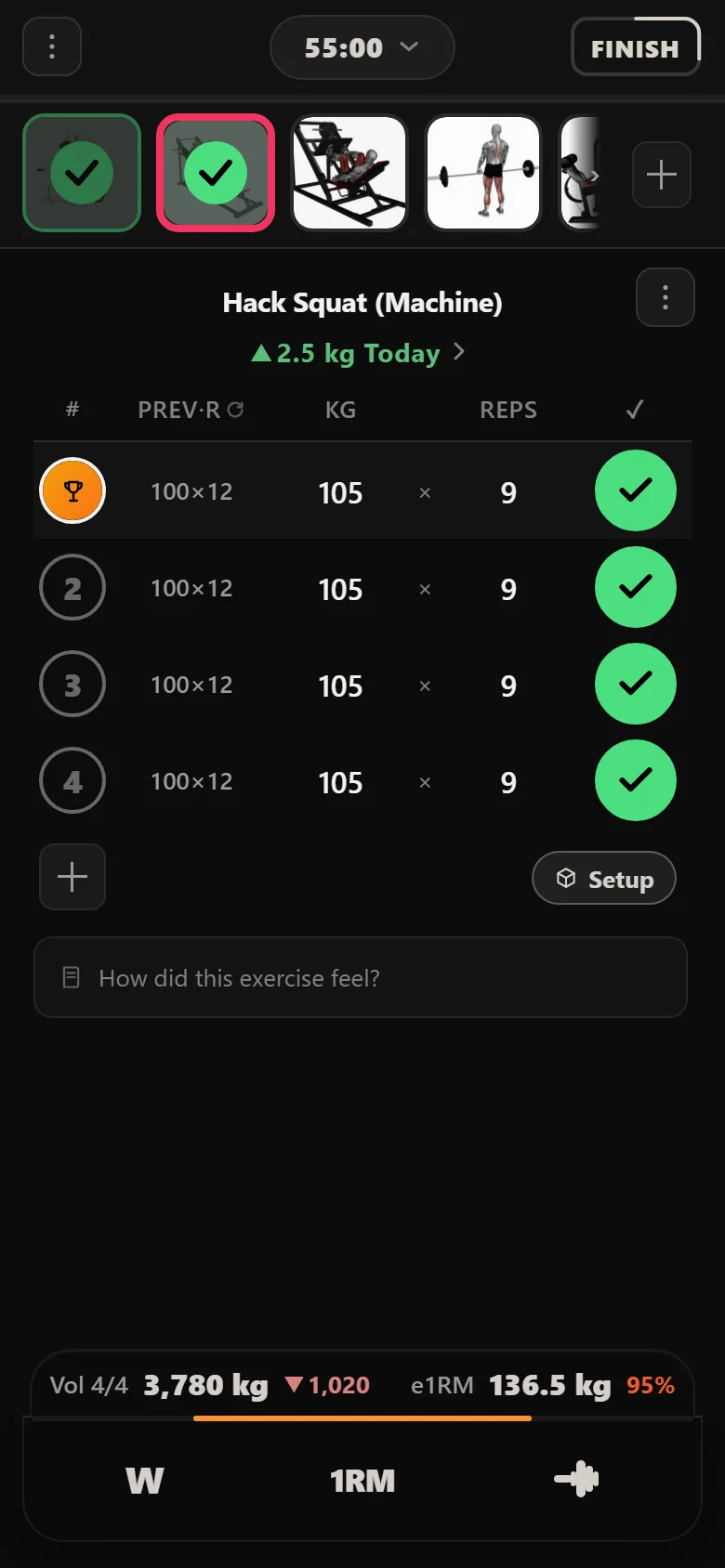
105 kg produced 9 reps against a target of twelve, which fails the rule, so the weight was held rather than advanced.
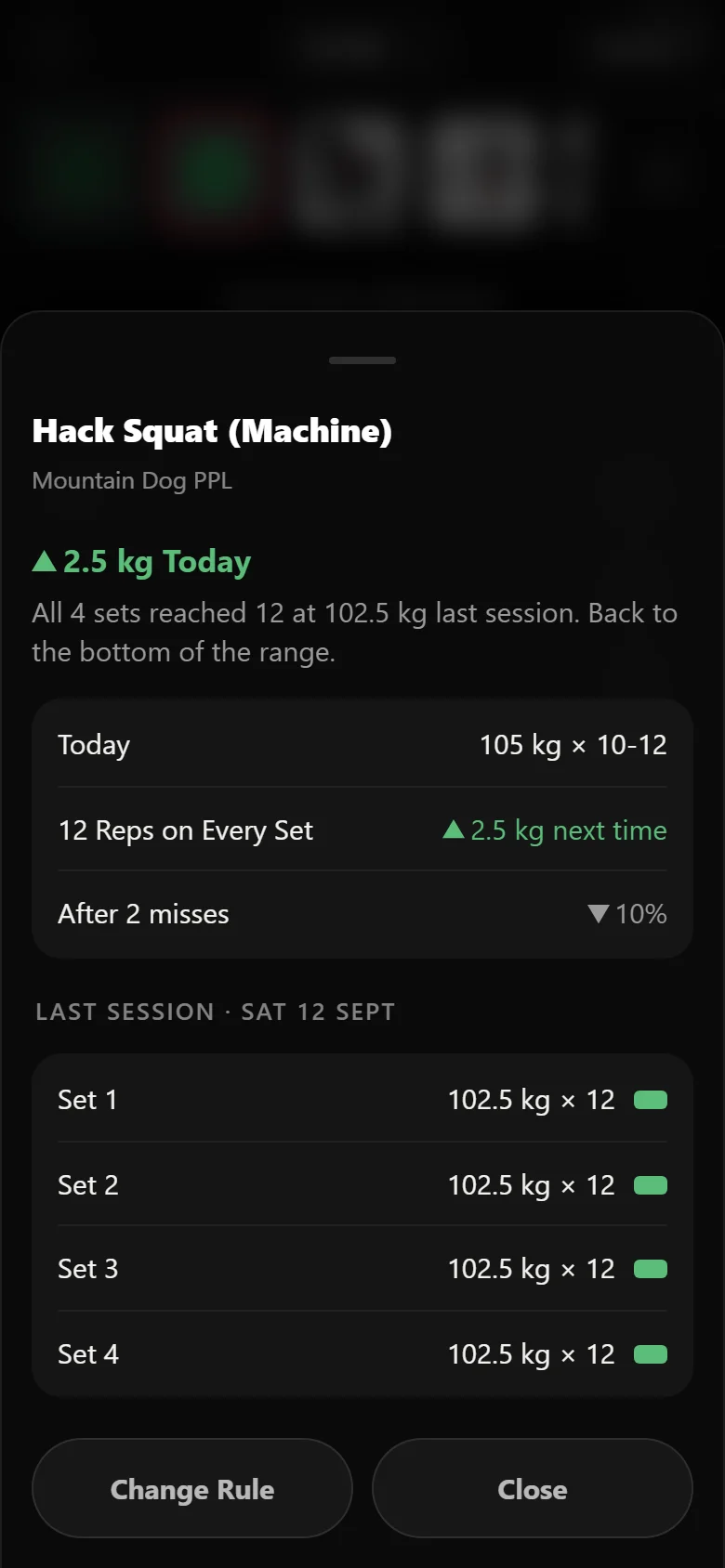
The rule chip is a button, and opened on the session that missed, it shows why the bar was at 105 kg at all: all four sets reached 12 at 102.5 kg the time before, so the weight went up 2.5 kg and the reps went back to the bottom of the range. Below that it states the rest of the rule: 12 on every set for the next 2.5 kg, and 10% off after two misses. One miss holds. Two misses at one weight cut the lift by 10%.
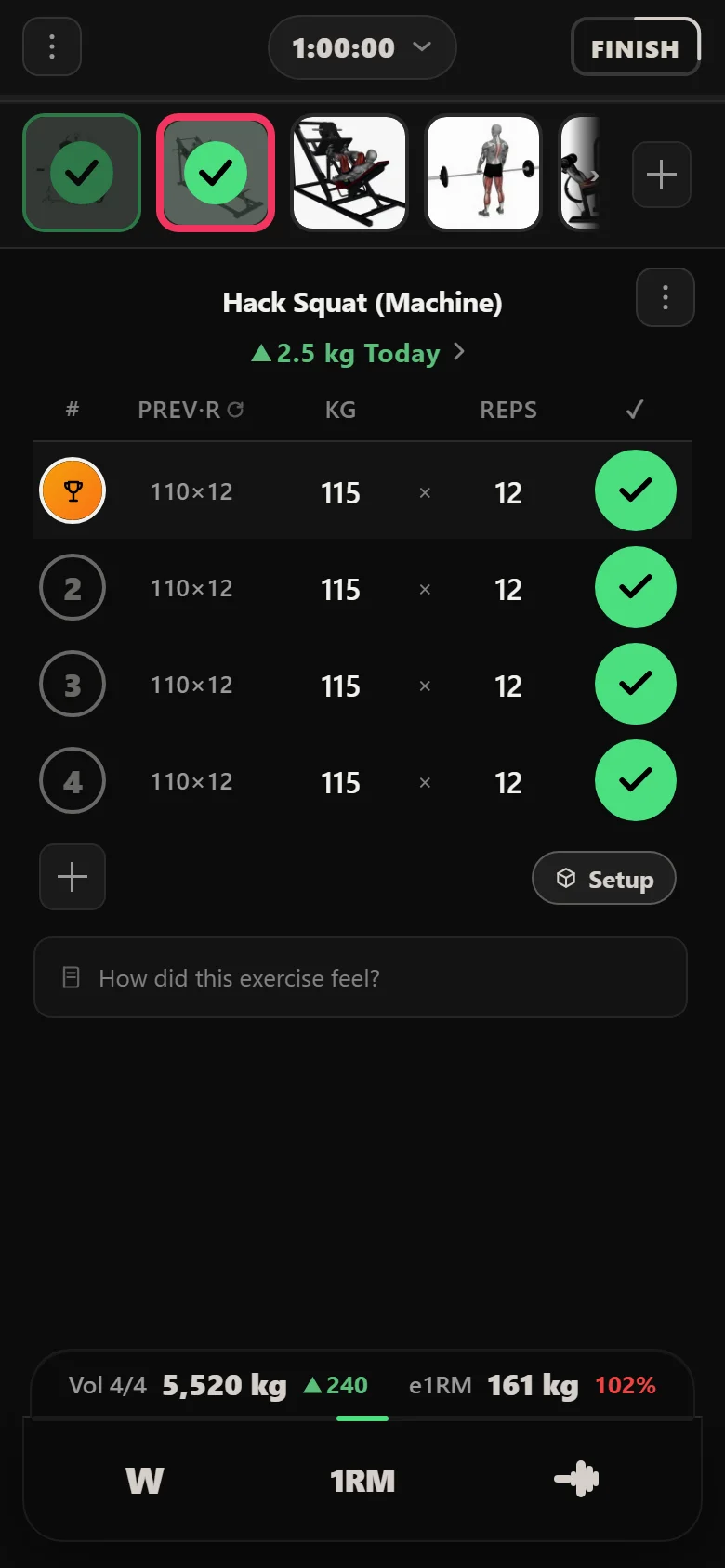
The second miss did not come. The next appearance cleared 105 kg and the climb resumed through 107.5 kg, 110 kg and 112.5 kg to finish at 115 kg, with the ledger carrying it out of the block at 117.5 kg.
The strip below is the hack squat across all twenty-four sessions.
Hack Squat (Machine) across twenty-four sessions
- 100S3 Session 3 — start
- 102.5S6 Session 6
- 105S9 Session 9 — 9 reps of 12
- 105S12 Session 12 — held, then cleared
- 107.5S15 Session 15
- 110S18 Session 18
- 112.5S21 Session 21
- 115S24 Session 24
Where it ended
115 kg on the hack squat, with the estimate at 161 kg, four weeks after opening at 100 kg. That lift alone did what a progression engine is supposed to do, and it did it without a single decision made by hand.
It is the exception in this block rather than the pattern, and the next section is about why.
Five lifts moved. Seventeen did not.
Across four weeks and twenty-two exercises, five added weight: the hack squat 100 kg to 117.5 kg, the chest-supported row 25 kg to 30 kg, and the cable flyes, face pulls and dumbbell curls each 7.5 kg to 12.5 kg. One went down: the dumbbell bench press was cut from 30 kg to 22.5 kg. Everything else finished where it started, including the Meadows row at 65 kg, the Romanian deadlift at 77.5 kg, the shoulder press machine at 50 kg and every one of the lateral raises, pushdowns and calf raises at 7.5 kg.
Read that as information rather than as failure. Double progression only advances a lift when every set reaches the top of its range. On a 10-12 range that is a normal good day. On the 20-25 sets that open both the Push and the Leg days, hitting 25 on all four sets is a rare session, so the weight stays put and the reps do the work instead.
This is also the honest limit of putting an automatic rule over Mountain Dog. The original method is autoregulated: Meadows had you add weight by feel when the reps came clean. Durata uses double progression here so the app can suggest and track a load, and on the high-rep work that rule is deliberately conservative. If a 20-25 set genuinely feels easy at the top of the range, put the weight up yourself. The app will carry your number forward from there.
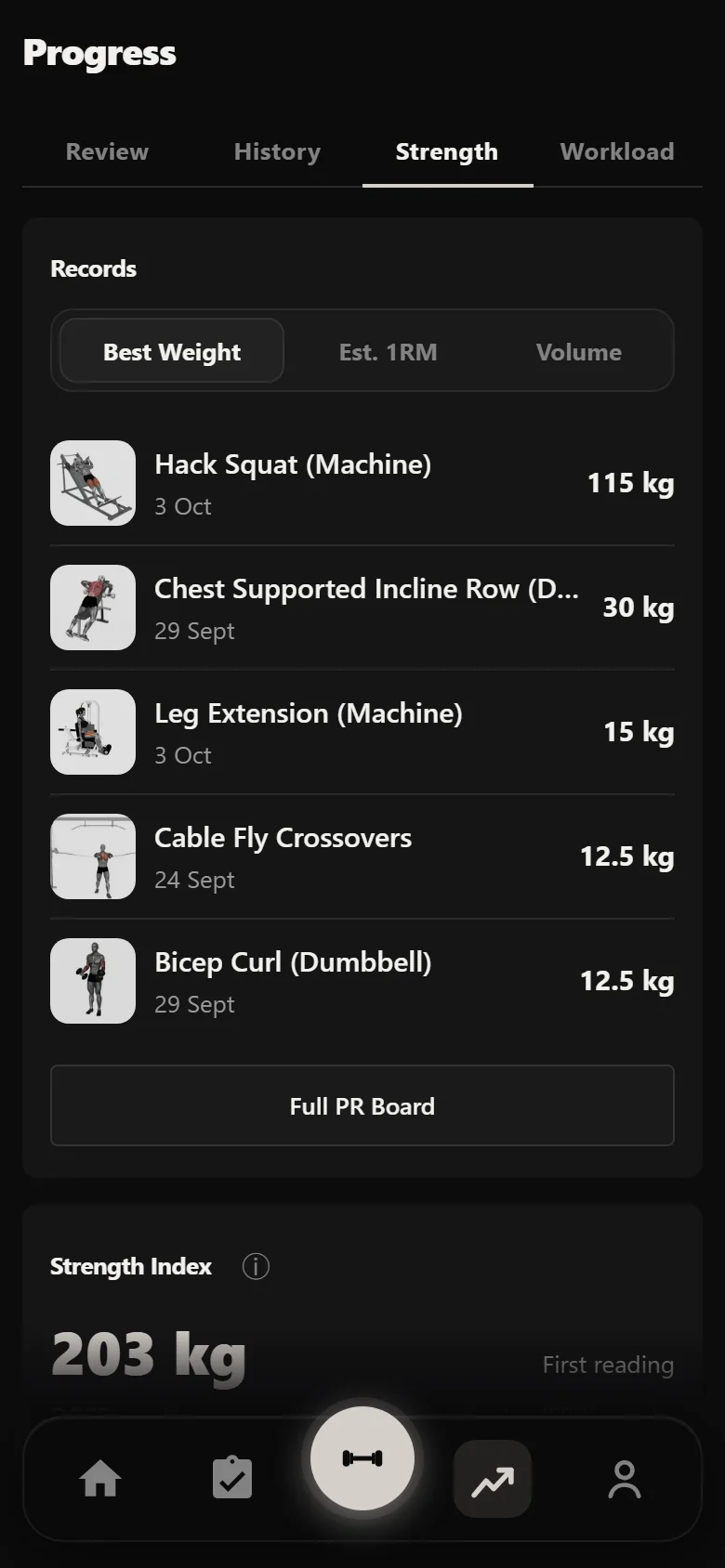
The Strength tab lists the records by best weight: the hack squat at 115 kg, then 30 kg on the chest-supported row, 15 kg on the leg extension, and 12.5 kg on the cable fly and the curl, with a 203 kg Strength Index underneath. That spread, one heavy machine lift and a long tail of small ones, is what a hypertrophy program looks like in numbers.
What four weeks of it adds up to
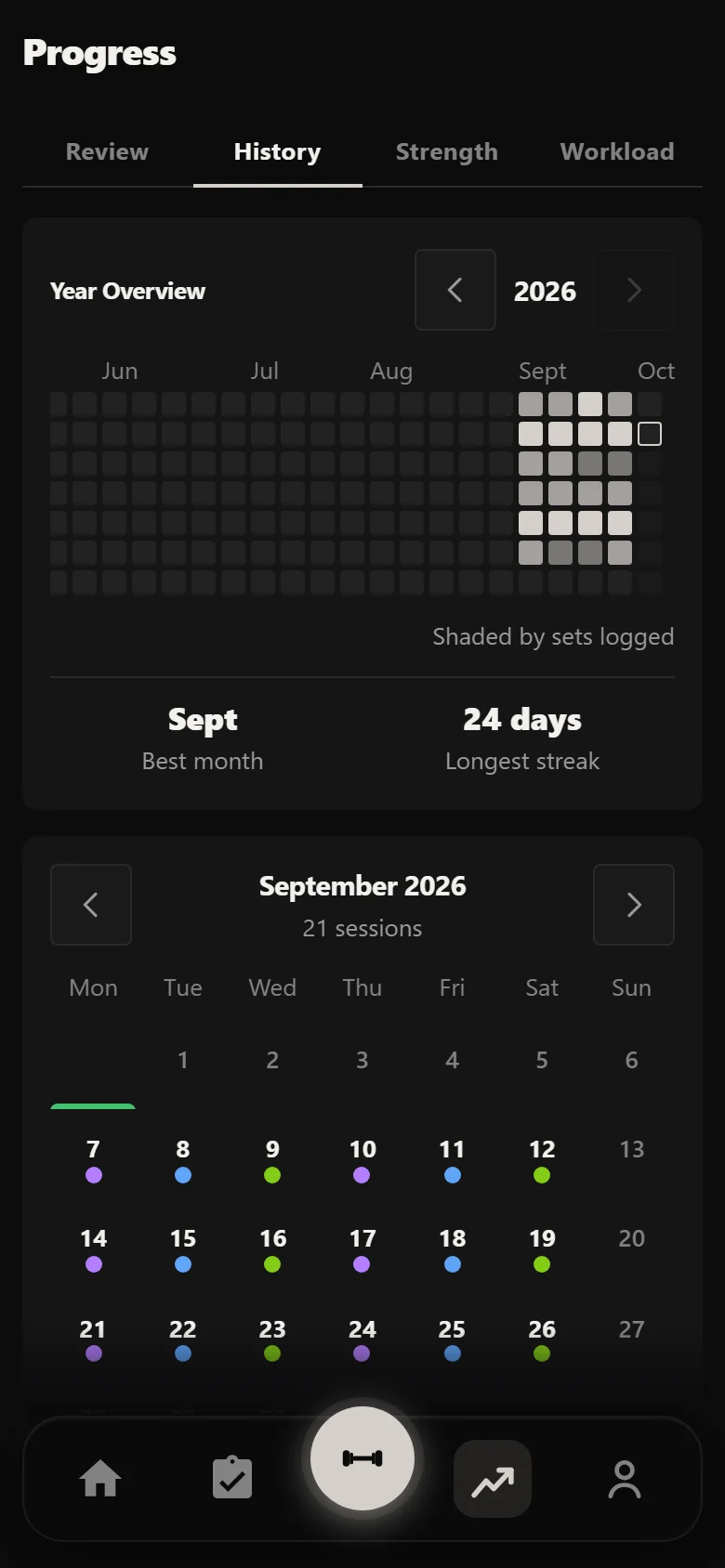
The Review tab reads a month at a time, and September alone came to 88,380 kg across 167 sets and 2,692 reps, a median of 14 reps a set. The rep count is the number to look at: well over two thousand reps in one month, which is what happens when most of your sets are fifteen to twenty-five reps long.
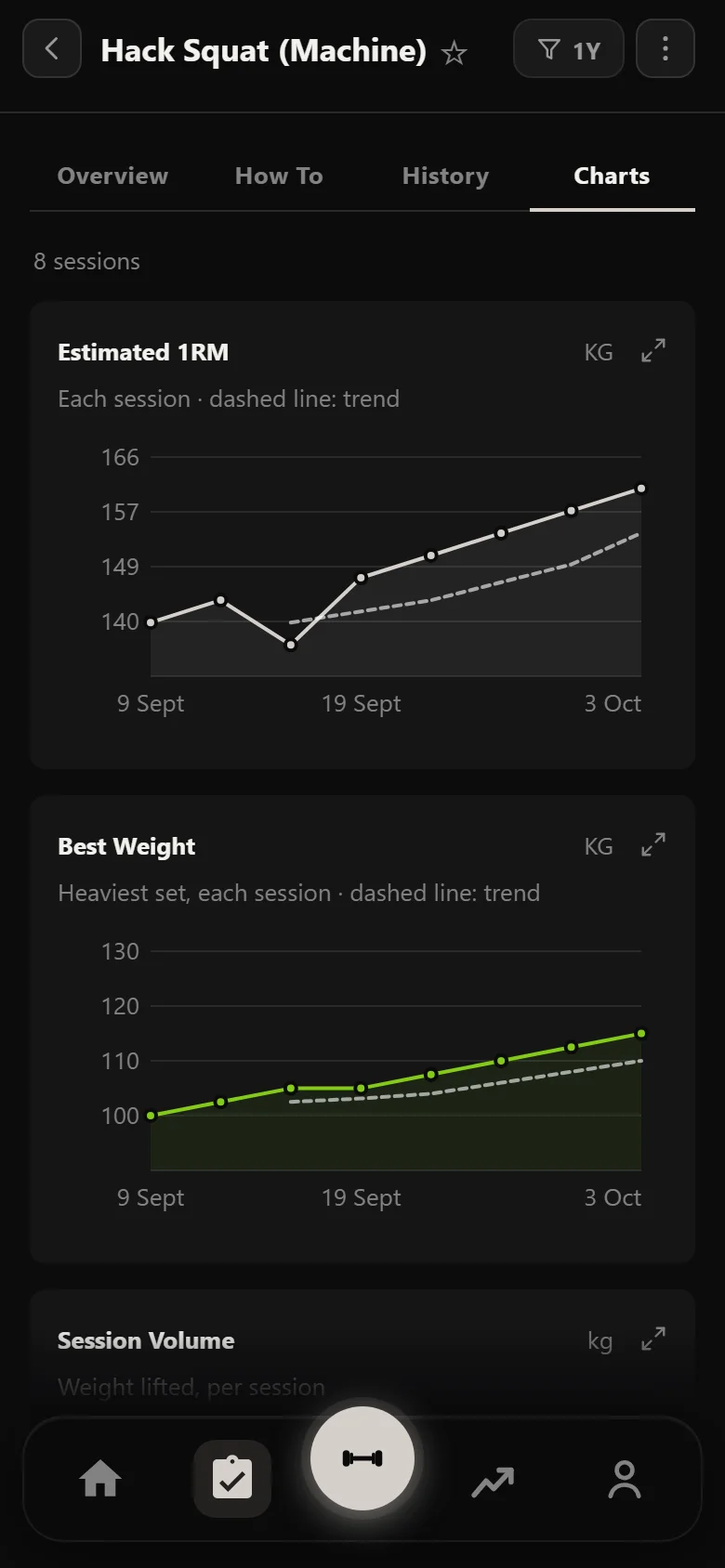
The estimate chart shows the hack squat's shape cleanly: a climb, a flat spot where 105 kg was held, then a resumption that finishes well above it. Almost nothing else in the program produces a chart like that, and on this program that is fine.
The payoff: session three against session twenty-four
The same lift, the same four working sets, four weeks apart. One held session in the middle, and nothing else decided by hand.
The one lift in this program sitting in a 10-12 range, and the only one whose weight column tells the whole story.
Common questions
What is Mountain Dog PPL?
John Meadows' Mountain Dog Training arranged as a six-day push/pull/legs split. Its signatures are pre-exhaust isolation placed before the compound work, cable and machine variations chosen for joint longevity, the Meadows row on pull days, and high-rep pump work to finish each muscle group. Both Push days are identical, as are both Pull days and both Leg days.
Why did almost none of my weights go up?
Because most of this program sits in 15-20 and 20-25 rep ranges, and double progression only adds weight when every set reaches the top of its range. Topping out four sets of 25 is a rare session, so the load stays put and the reps climb instead. In this four-week run five exercises added weight and seventeen did not. That is the rule being conservative on high-rep work, not the app missing something.
Can I add weight myself?
Yes, and on this program you sometimes should. The original method is autoregulated: Meadows had you add weight by feel once the reps came clean. Durata puts double progression over it so it can suggest and track a load. If a high-rep set is genuinely easy at the top of the range, log the heavier weight and the app carries your number forward from there.
Why does the isolation work come before the compound?
It is deliberate pre-exhaust. Cable laterals before pressing and leg extensions before the hack squat arrive at the compound with the target muscle already fatigued, so it does more of the work and the joints do less. Expect the compound weight to be lower than you would use fresh. Chasing your fresh number defeats the reason the isolation was placed in front of it.
One of my lifts got lighter. Why?
Two failed sessions at the same weight trip a 10% cut. In this run the dumbbell bench press went from 30 kg down to 22.5 kg that way. It is the same rule that holds a weight after one miss, applied a second time, and the climb restarts from the lower number.
Is Durata free?
Yes. Durata is free to use, with the full program catalogue, rest timers, rule chips and PR tracking. Everything in this walkthrough is in the app.
Put it into practice
Durata is free to use — 50 proven programs, automatic progression, rest timers and PR tracking, all on your phone.