German Volume Training (GVT)
Charles Poliquin's German Volume Training — the 3-day week of his classic 5-day rotation. Each session supersets two antagonist lifts for 10×10 at a constant weight (~60% 1RM, a load you could normally lift 20 times), 90 seconds rest, controlled tempo. Do not add weight until you complete all 100 reps — then add ~2.5 kg (Poliquin's 4–5%). Accessories: 3×12–15, 60s rest. Results typically arrive in 6–8 weeks.
Free to use · auto progression, rest timers & PR tracking built in
What is German Volume Training (GVT)?
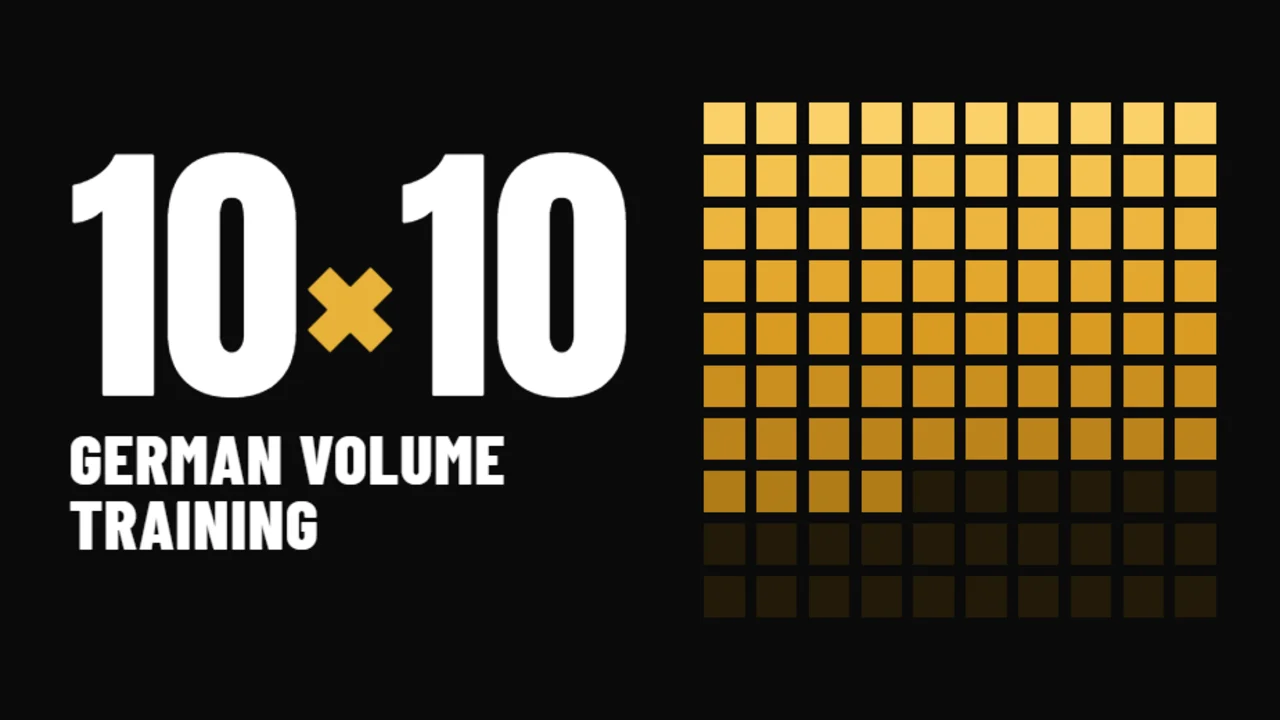
German Volume Training traces back to off-season programs used by German weightlifters in the 1970s, but it was Charles Poliquin's T-Nation article that turned 10×10 into one of the most-searched hypertrophy methods ever written down. The prescription is a single, uncompromising idea: ten sets of ten reps at 60% of your 1RM on two big antagonist exercises, supersetted A1/A2 with 90 seconds of rest after each. One hundred reps per movement, two hundred per pairing — a volume dose most muscles have simply never received.
This german volume training program runs Poliquin's classic three-workout rotation across the week. Monday is Chest & Back: bench press supersetted with weighted pull-ups, both 10×10, then incline dumbbell presses and cable rows at 3×12–15 with 60-second rests. Wednesday is Legs & Abs: squats paired with lying leg curls for the 10×10, then lunges and calf raises. Friday is Arms & Shoulders: weighted dips supersetted with weighted chin-ups for their own 10×10, finished with curls and dumbbell presses. Every muscle then gets days to recover, because there's no recovery left to spend.
Is German Volume Training (GVT) right for you?
GVT is for intermediate lifters who want size and are prepared to eat for it — running a 10×10 routine in a calorie deficit is a fast route to burnout. It shines as a focused 6–8 week block for someone whose progress on conventional 3–4 set training has flattened. It is the wrong choice for beginners, who grow faster on heavier, simpler work, and for anyone unwilling to superset in a busy gym: claiming two stations at once is part of the deal.
How progression works
The load stays fixed until you've earned the increase: complete all ten sets of ten — the full hundred reps — with the same weight and clean form, then add a small jump (2.5 kg is plenty) next session and rebuild. Early sets should feel almost insultingly submaximal; sets seven through ten are where the program lives. Never grind an early set to failure or the back half collapses. The 90-second rest is as much a part of the prescription as the 60% load — Durata times each rest and pairs the A1/A2 superset in the logger, so the structure survives contact with fatigue.
Durata runs this progression for you — there are no percentages to work out, so each session's target carries over from what you logged last time and the weight moves when you hit or miss the prescribed reps.
German Volume Training (GVT) — every set, every session
Day 1 — Chest & Back
| Exercise | Sets × Reps | Rest |
|---|---|---|
| Bench Press (Barbell)superset A | 1×10 9×10 | 1:30 |
| Pull Up (Weighted)superset A | 10×10 | 1:30 |
| Incline Bench Press (Dumbbell)superset B | 3×12–15 | 1:00 |
| Seated Cable Row - V Grip (Cable)superset B | 3×12–15 | 1:00 |
Day 2 — Legs & Abs
| Exercise | Sets × Reps | Rest |
|---|---|---|
| Squat (Barbell)superset A | 1×10 9×10 | 1:30 |
| Lying Leg Curl (Machine)superset A | 10×10 | 1:30 |
| Lunge (Barbell)superset B | 3×12–15 | 1:00 |
| Standing Calf Raisesuperset B | 3×12–15 | 1:00 |
Day 3 — Arms & Shoulders
| Exercise | Sets × Reps | Rest |
|---|---|---|
| Triceps Dip (Weighted)superset A | 1×10 9×10 | 1:30 |
| Chin Up (Weighted)superset A | 10×10 | 1:30 |
| Bicep Curl (Dumbbell)superset B | 3×12–15 | 1:00 |
| Overhead Press (Dumbbell)superset B | 3×12–15 | 1:00 |
German Volume Training (GVT) — common questions
What weight do I start 10×10 with?
60% of your 1RM — roughly a weight you could lift 20 times fresh. If you bench 100 kg, the 10×10 starts at 60 kg. It will feel too light for four sets; trust it. Lifters who start at 70% finish set six and quietly change the program.
Should any GVT sets go to failure?
No. The volume does the damage, not any single set. If a set is about to fail, cut it short, keep the weight, and keep the rests honest — arriving at set ten having left a rep in reserve on every set is exactly how the method is designed to feel until the last two sets.
How long should I run German Volume Training?
6–8 weeks, which Poliquin noted is about when results peak and staleness sets in. After the block, move to lower-volume, heavier training — the strength phase after GVT is often where the new muscle becomes obvious.
How long does a GVT session take?
About an hour. The 10×10 superset pairing takes around 40 minutes at strict 90-second rests, and the accessory supersets add 15 more. If your sessions run long, your rests are drifting.
Can I swap the exercises?
Keep the 10×10 slots as big compound movements in antagonist pairs — chest with back, quads with hamstrings. Incline bench for flat bench or front squat for back squat is fine; putting lateral raises in a 100-rep slot is not. The accessory slots are where variety belongs.
Source: Charles Poliquin — "German Volume Training", T-Nation
Durata is not affiliated with or endorsed by the program's author. The program structure (sets, reps, exercise selection) is presented as published methodology.
Run German Volume Training (GVT) in Durata
Automatic progression, plate calculator, rest timers and PR tracking — the whole program, ready to log.