
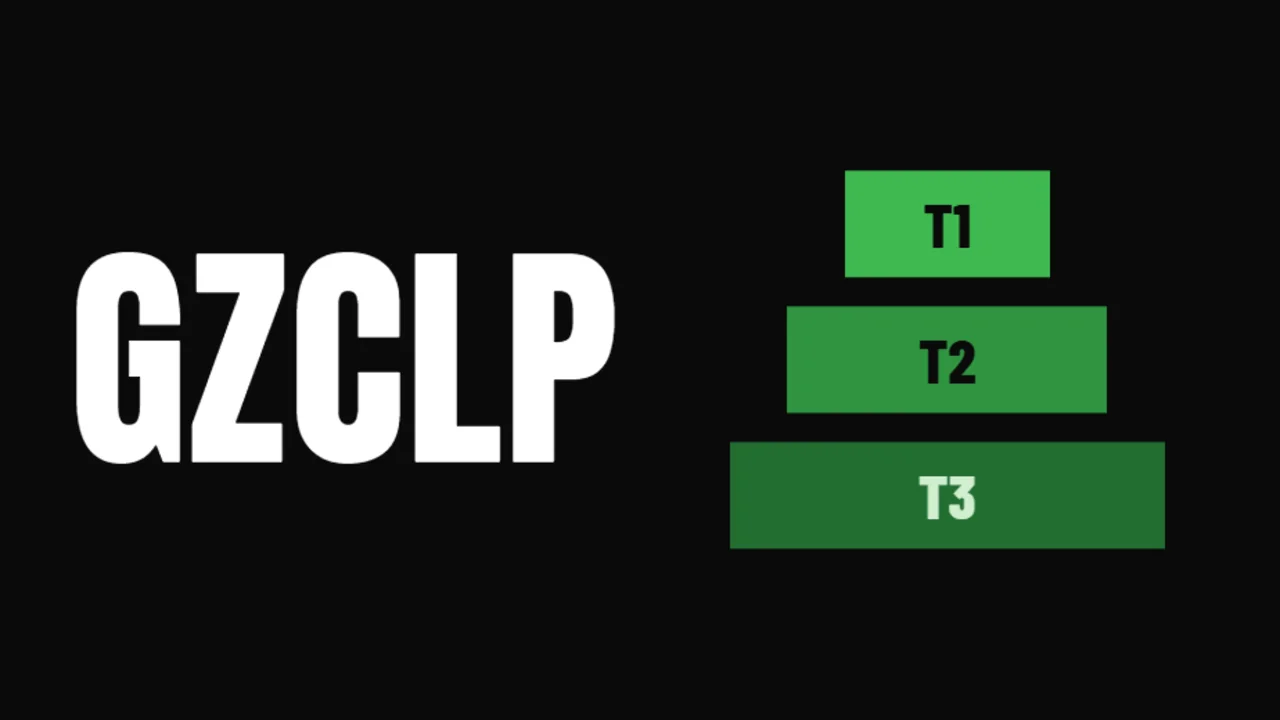
GZCLP 4 Day
By Cody Lefever · With Permission
Cody Lefever's linear progression for new lifters, built on his three tiers, four days a week. T1 is the day's main lift, 5 sets of 3 with the last set for as many reps as you can (5x3+). T2 is a second big lift for 3 sets of 10. T3 is a back exercise for 3 sets of 15, the last set for as many reps as you can. His four workouts run in order every week, so each main lift comes round twice: once heavy as a T1 and once as a T2. Weight goes on every session; a miss changes the sets and reps instead of the weight.
Free to use · auto progression, rest timers & PR tracking built in
Cody Lefever
Cody Lefever is the creator of the GZCL Method and General Gainz training frameworks: a World Championship caliber lifter and coach, and a Marine veteran. Owner of Alma's Gym, North America's highest gym, he works with clients in person in Alma, Colorado and online around the world.
What is GZCLP 4 Day?
GZCLP is Cody Lefever's linear progression for new lifters, written up in his 2016 post GZCL Applications & Adaptations. He offers it as an option for anyone who would otherwise run a novice program like Starting Strength or Greyskull, and as a way into his GZCL Method. Every exercise belongs to one of three tiers. T1 is the day's main lift, heavy: 5 sets of 3 with the last set for as many reps as you can (5x3+). T2 is a second big lift for 3 sets of 10. T3 is a back exercise, lat pulldowns or dumbbell rows, for 3 sets of 15 with the last set for as many reps as you can.
There are four workouts. A1 is squat (T1), bench (T2) and lat pulldowns. B1 is overhead press (T1), deadlift (T2) and dumbbell rows. A2 swaps the A1 lifts round, bench as T1 and squat as T2, and B2 swaps the B1 lifts round, deadlift as T1 and press as T2. GZCLP 4 Day trains four days a week, Monday, Tuesday, Thursday and Friday, and runs the four workouts in order: A1, B1, A2, B2. Each main lift comes round twice a week, once as a heavy T1 and once as a lighter T2. Cody's own example schedule is three days a week, with the workouts rotating over a month; that is GZCLP 3 Day.
Is GZCLP 4 Day right for you?
New lifters, or lifters coming off another linear progression who want more volume per workout. Cody's point is that new lifters need practice, and practice means reps: the T1 rep-out sets and the 10-rep T2 sets give far more of them than most novice programs. He warns that the extra volume and effort can mean starting lighter than you are used to, and that when you need more recovery you can leave more reps in the tank on the rep-out sets. Sessions take about 45–60 minutes.
How progression works
T1 adds weight every workout you make it: 10 lb (5 kg) on squat and deadlift, 5 lb (2.5 kg) on bench and press, the top of his advice of no more than 5 to 10 lb a workout. Every set is at the same weight; push the last one to within 1 or 2 reps of failure, but stop at 10. When you fail to make the 15 reps of 5x3+, keep the weight and move to 6 sets of 2 (6x2+, 12 reps), then 10 singles (10x1+, 10 reps), adding weight again each workout. When the ten singles fail, rest two or three days and test a five-rep max; the next cycle starts back on 5x3+ at 85% of it. Durata estimates that 5RM from your last session, and you can type over it if you tested.
T2 adds weight every workout at 3x10. When you miss the 30 reps, drop to 3x8 on the same weight, then to 3x6. When 3x6 fails, start again at 3x10, a little heavier than you started the last cycle and never more than 20 lb (9 kg) heavier. Durata suggests one step heavier and lets you choose up to that limit. T3 stays at the same weight until your last set reaches 25 reps, then goes up by one small step; Cody says to be modest here. Rest 3 to 5 minutes between T1 sets, 2 to 3 minutes for T2 and 60 to 90 seconds for T3.
Durata runs this progression for you — there are no percentages to work out, so each session's target carries over from what you logged last time and the weight moves when you hit or miss the prescribed reps.
GZCLP 4 Day — every set, every session
AMRAP = as many reps as possible on the final set.
A1 · T1 Squat
| Exercise | Sets × Reps | Rest |
|---|---|---|
| Squat (Barbell) | 4×3 1×3–10+ AMRAP | 5:00 |
| Bench Press (Barbell) | 3×10 | 3:00 |
| Lat Pulldown (Cable) | 2×15 1×15–25+ AMRAP | 1:30 |
B1 · T1 Press
| Exercise | Sets × Reps | Rest |
|---|---|---|
| Overhead Press (Barbell) | 4×3 1×3–10+ AMRAP | 5:00 |
| Deadlift (Barbell) | 3×10 | 3:00 |
| Dumbbell Row | 2×15 1×15–25+ AMRAP | 1:30 |
A2 · T1 Bench
| Exercise | Sets × Reps | Rest |
|---|---|---|
| Bench Press (Barbell) | 4×3 1×3–10+ AMRAP | 5:00 |
| Squat (Barbell) | 3×10 | 3:00 |
| Lat Pulldown (Cable) | 2×15 1×15–25+ AMRAP | 1:30 |
B2 · T1 Deadlift
| Exercise | Sets × Reps | Rest |
|---|---|---|
| Deadlift (Barbell) | 4×3 1×3–10+ AMRAP | 5:00 |
| Overhead Press (Barbell) | 3×10 | 3:00 |
| Dumbbell Row | 2×15 1×15–25+ AMRAP | 1:30 |
GZCLP 4 Day — common questions
What do T1, T2 and T3 mean?
They are Cody Lefever's three tiers. T1 is the main lift of the day, heaviest and most important. T2 is a second compound lift done lighter for more reps, which adds practice and muscle. T3 is lighter accessory work for high reps; in GZCLP that is a back exercise, lat pulldowns or dumbbell rows.
What weight should I start with?
Cody says to take the last weight you used on your previous linear progression, or to start with the bar if you are new. Coming from no training at all, he warns that the extra volume may mean a big cut in the weight on the bar at first.
What happens when I fail a lift?
The weight never drops. A missed T1 moves you from 5x3+ to 6x2+ to 10x1+ on the same weight, and only when the ten singles fail do you test a five-rep max and start again at 85% of it. A missed T2 moves you from 3x10 to 3x8 to 3x6, then back to 3x10 a little heavier than you last started it. A T3 that misses simply stays at its weight.
How many days a week is GZCLP 4 Day?
Four: Monday, Tuesday, Thursday and Friday, one workout each, A1, B1, A2 and B2. Cody's own example is three days a week, the four workouts rotating over a month; GZCLP 3 Day lays that out on Monday, Wednesday and Friday.
What comes after GZCLP?
Cody suggests running two or three cycles, then adding volume from the bottom up: a second T3 exercise for a set of 8 to 10, adding a set each time until it reaches 30 reps, up to three T3 exercises. From there you are running your own GZCL program. Durata's GZCL path continues with The Rippler, UHF and Jacked & Tan 2.0.
Is there an app that runs GZCLP 4 Day for you?
Yes. Durata runs GZCLP 4 Day as written, free: the 4-day-a-week schedule, every set and rep, and the progression built in. Log your sets and the next session's weights are worked out for you, with the stalls and deloads the program calls for; a tap on any lift shows why the weight moved. It is on iPhone and Android, works offline, and your history from Hevy or Strong imports free.
Source: GZCLP by Cody Lefever, from his GZCL Applications & Adaptations (swoleateveryheight, 2016)
With permission from Cody Lefever, who gave Durata permission to carry this program.
Run GZCLP 4 Day in Durata
AMRAP tracking, automatic progression, plate calculator, rest timers and PR tracking — the whole program, ready to log.