

Hidden features and shortcuts
Durata keeps its screens deliberately clean, which means a lot of its best tricks don't announce themselves. Most of them are gestures, a long-press here and a swipe there, plus a handful of automatic behaviours that quietly save you taps every session.
This page collects all of them in one place. None of these are required to use the app, but each one shaves seconds off something you do constantly, and that adds up over a training week.
Last reviewed 2026-09-15 · matches app v1.0.0.87
In the logger
The logger hides a full tool tray behind the workout header. Tap the session timer pill and it slides open with four tools: a Timer for intervals and HIIT, a Tempo metronome, live Session Stats, and quick Settings. Tap the pill again (or anywhere else) to tuck it away.
The Tempo button does double duty: a tap toggles the rep-tempo metronome on or off, while holding it for about half a second opens the tempo editor so you can set your own eccentric, pause and concentric timings. Until you've opened the editor once, a tap briefly flips the button's label to "Hold to edit", a one-time nudge so the long-press doesn't stay secret.
Long-press an exercise name to play its how-to video right there in the workout. A plain tap opens the full exercise details instead. 376+ exercises have videos.
To reorder exercises mid-workout, press and hold an exercise in the carousel until it lifts, then drag it into place.
Used a bench angle or a piece of kit on an exercise last session? Open Setup on that exercise and last time's choices are waiting as suggestions. One tap accepts one, and it becomes your saved default from then on.
The Setup button beside + Set is a read-out as well as a route: it shows the plate breakdown for the set you are about to do, "20 · 20 · 5 a side", so most of the time you never need to open it.
Pinned notes are one note per exercise, editable from four places: tap Edit on the amber note strip on a logger card, use the exercise's ⋮ menu, tap Edit on the note banner on the exercise's How To tab (it shows an Add a note prompt when empty), or the same strip in the routine editor. Long notes clamp to three lines, so tap the note body to expand one, and links in a note are tappable.
The session note under an exercise's last set remembers you too: if you left a note on that lift in a recent session, it reappears as a ready-made suggestion. Open it and hit Save to keep the same cue for today without retyping it.
The one-line progression chip under an exercise's name is a button: tap it and a sheet explains why today's weight is what it is: last session's sets with the decisive one marked, then the rule itself with its increment, deload trigger and cadence. A one-time "Tap to see why" hint marks it until your first open.
Faster set entry
You rarely need to type at all. Every set row shows last session's numbers as faded placeholders, and ticking off a set with empty inputs adopts those ghosted values automatically, so checking the box means "same as last time". You can also tap the previous-session column on any row to copy last time's weight and reps into the inputs before you edit them.
When you do type, every numeric field selects its contents the moment you focus it, so you overwrite the old value instantly instead of backspacing first.
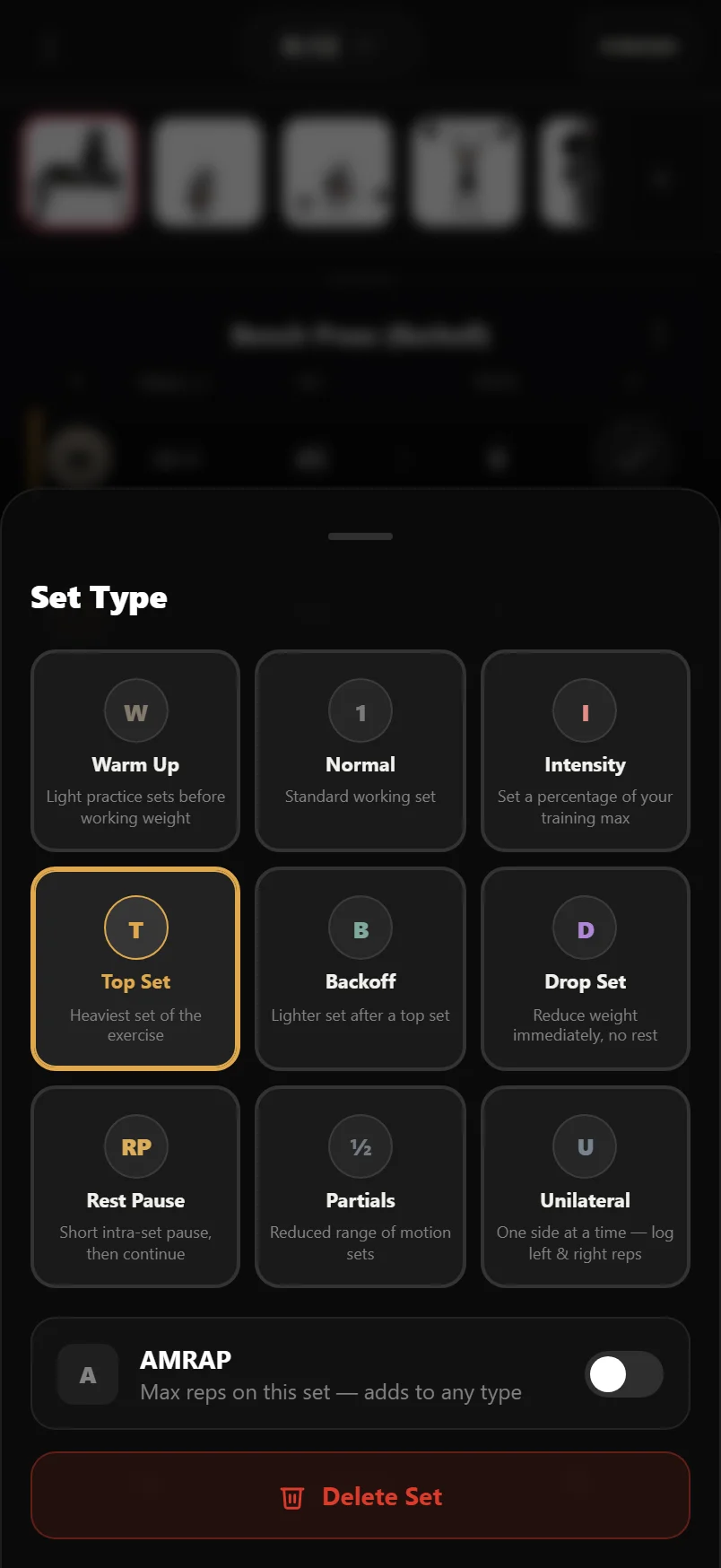
Tap a set's number badge to change its type. Durata has 10 set types, from warm-ups to drop sets.
Swipe a set row left to delete it. A short swipe rests the row open on a red Delete button; a long swipe all the way across deletes in one motion. Durata asks you to confirm the very first full swipe, then trusts you from there.
Tap the tick column header (the ✓ above the checkboxes) to complete every remaining set of the exercise in one go.
Type a + or * after your reps, like 8+, and the set flips to AMRAP on the spot, pink split badge and all. No need to open the type drawer.
Beat one of your records mid-workout and a trophy lands on that set's badge the moment you tick it. Tap it to see exactly which record you took.
Rest timer tricks
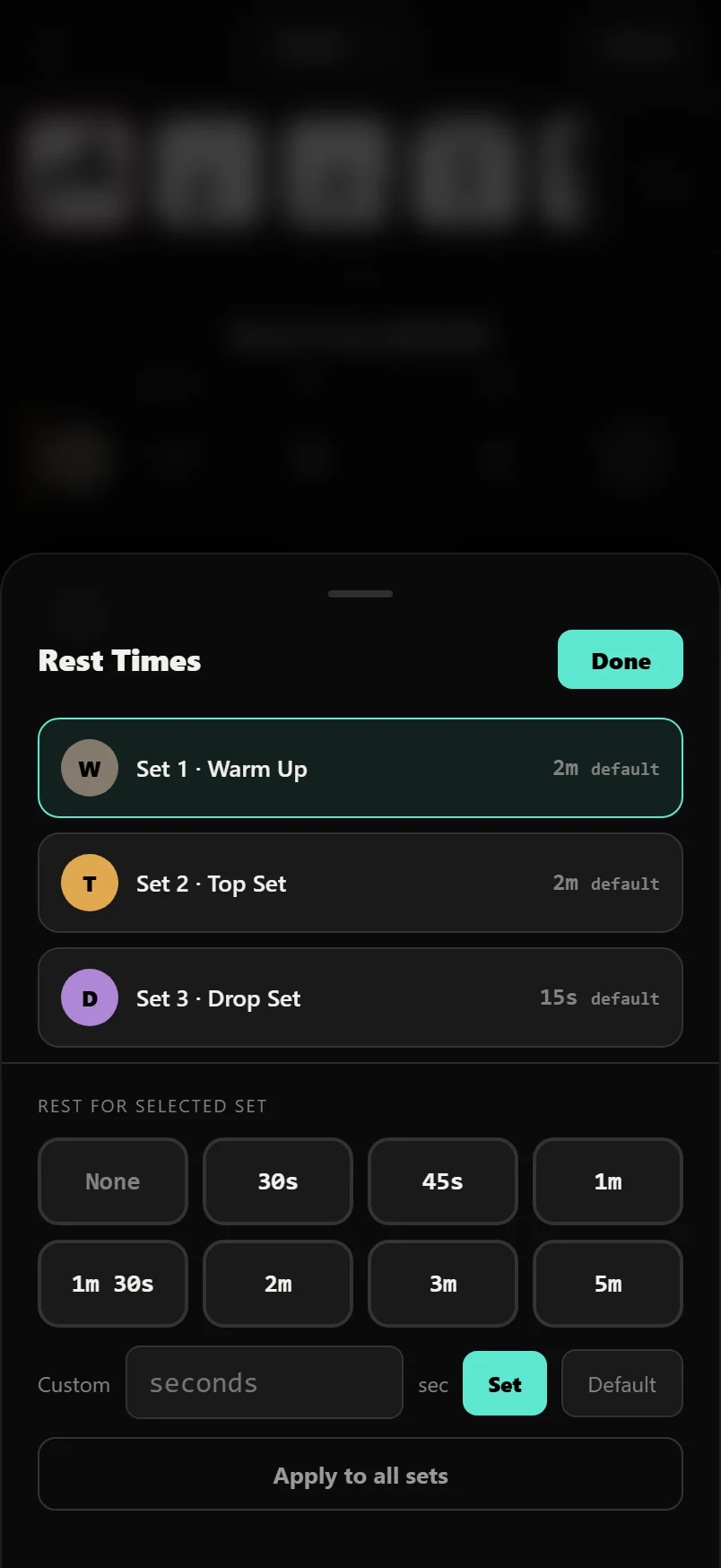
Open an exercise's ⋮ menu and tap Rest Times to get the rest drawer: a per-set list, one-tap presets from 30 seconds to 5 minutes, a custom field for anything else, and None, which skips the timer entirely and auto-advances to your next set, handy for supersets and circuits.
Set the right rest once, then hit Apply to all sets so every set of that exercise uses it. No need to edit rows one by one.
Prefer one setting for every exercise instead of setting rests one at a time? Settings > Rest Timer > Rest by Set Type gives warm-ups, top sets, drop sets and every other set type their own default, used whenever a set doesn't already carry a rest of its own - drop sets ship with 15 seconds baked in, everything else inherits your general default until you change it.
Resting before a new exercise? The countdown carries a Setup Next pill with the coming lift's plates already worked out. Tapping it opens Setup over the top and the rest keeps counting down underneath, so setting up costs you nothing.
The countdown doesn't have to take over the screen: in Settings you can swap the full-screen view for a floating mini-timer, or a slim colour-shifting bar in the workout header that counts down without covering a single set row.
Around the app
The dashboard responds to gestures too. Every day cell in the This Week strip is tappable: a trained day opens that session, a planned day previews it, an empty 'today' starts a workout. You can also swipe sideways on the PRs This Week, Training Load and Sets by Muscle widgets to flip between their metrics (volume, sets, reps and more). Sets by Muscle opens on Map, a body view of the muscles you've trained this week with the biggest first, and Front / Back buttons under it to turn the body around. It swipes across to Vol for the same week as volume bars.
In Progress, swipe left or right anywhere on the panel to move between the Review, History, Strength and Workload tabs. On an exercise's detail page, the same sideways swipe cycles Overview, How To, History and Charts.
Tap Customize Home at the bottom of the dashboard and the board edits in place, every widget still live: press-and-hold a widget to lift and drag it, tap the − badge to remove it, use the corner handle to cycle its sizes, and Add Widget for the gallery of everything else. You can also pin goals from the Goals panel to put them on the board itself.
Tap the Recovery Score card to open its full trend and deload breakdown on Progress → Workload, instead of just the dashboard summary.
Any finished workout can become a reusable session: tap Save as Standalone on the Session Complete screen, or open any past session in Progress → History and use Save as New Session.
Charts with an expand icon in their header open full-screen: every chart on an exercise's Charts tab, Compare Exercises on Progress, and the Weight, Body Fat and Lean Mass cards on Body Metrics. Full-screen draws more of your history than the card does, and rotating the phone redraws it wider.
Expanding the estimated 1RM chart is the exception - it opens the Strength story rather than a bigger chart: the bar weight underneath the e1RM line, every session coloured by what your program decided, records marked, and your program eras drawn as a rail under the axis. Drag across it to read any single session: its estimated 1RM and how far that moved, the top set, the volume, every working set, and why the weight moved. Open Session in that readout jumps straight to the workout in History.
In a program's planner, tap any session tile for quick options: edit that session, swap one of its exercises (across the whole program if you want), or open the plan on that week.
Press and hold a session tile on a phone and it lifts: slide it onto any other day of that week and let go. There is no handle to find, the whole tile is the grip, and a short swipe still scrolls the week rather than picking anything up.
A plan opens as its own screen with four segments, and Plan is the editor: press and hold a session to move it to another day (on a desktop just drag it), tap an empty day to add one, and use Copy Week → to take a week's shape across the rest of the block. Undo takes back the whole command in one tap.
Home's Week Plan widget is tappable. Tap the row for any week and the planner opens on that week; tap the header or footer and it opens on the week you are actually on.
Small but mighty
A few behaviours you never trigger deliberately, but benefit from constantly. When you sign in, the 6-digit email code submits itself the moment you enter the last digit, with no Verify tap needed. While you're typing in a set, the fixed bottom bar hides so the keyboard never buries your inputs, then returns when you're done.
On Android, the hardware back button is drawer-aware: each press closes the topmost sheet or drawer, one at a time, instead of throwing you out of the screen. If a screen is slow to react and you tap back several times in a row, only the first tap counts: the rest are ignored rather than stacking up and closing the app behind you. And if you press back during a live workout, Durata asks first. Your session stays active either way, so you can wander off to check a chart and resume exactly where you left off. Apple devices have no hardware back button, so sheets and drawers there close via their own Done, X or backdrop-tap controls. On the web dashboard, the Escape key does the same job: each press closes the topmost sheet, just like clicking outside it.
Adding several exercises in one go is a continuous type-tap-type: when you tap an exercise in the picker, what you searched for stays in the box but comes back selected, so the next name you type replaces it. No backspacing between adds, and the keyboard stays up with the Add button riding above it.
The List / Grid switch under the picker's search box is one setting for the whole app. Flip it while browsing Exercises and the picker you get mid-workout is already in grid too, and it syncs, so your other devices open the way this one did.
Tap the version number in Settings > About to open the full release notes and see what changed in every update.
The good moments feel like it: PRs, milestones and finishing a workout each land with a short celebratory haptic on your phone.
Common questions
Will I lose my workout if I press back or leave the logger?
No. Your session stays active in the background. Back during a live workout shows a quick confirm, and even if you leave, you resume exactly where you left off.
How do I watch an exercise video without leaving my workout?
Long-press the exercise name in the logger and the how-to video plays in place. A normal tap opens the exercise's full detail page instead.
Can I reorder exercises after a workout has started?
Yes. Press and hold an exercise in the logger carousel until it lifts, then drag it to its new position. The dashboard's Customize Home mode works the same way: hold a widget until it lifts, then drag.
What's the fastest way to log a set identical to last week's?
Just tick it off. Checking an empty set adopts the faded previous-session values shown in the inputs, so a repeat set is literally one tap.
Put it into practice
Durata is free to use — 50 proven programs, automatic progression, rest timers and PR tracking, all on your phone.