

Logging workouts
The logger is where you'll spend most of your time in Durata, so it's built around one idea: between sets you have ten seconds and one thumb. Everything - changing a set type, starting the rest timer, checking what you did last time - is one tap from the set row.
This page walks through a full workout, from starting one to the finish screen. Skim the headings for the part you need.
Last reviewed 2026-09-14 · matches app v1.0.0.87
Starting a workout
Tap the barbell Workout button and the Workout screen offers your ways in. The + button starts an empty workout; below it sit your program's next session and recent routine sessions — tap one to preview the full workout, set by set, and hit Start Workout from there. Sessions arrive pre-filled with their planned sets and your previous weights.
Your workout is saved on the device continuously. Close the app, take a call, or let the phone die - when you come back, Durata resumes exactly where you left off.
The exercise carousel
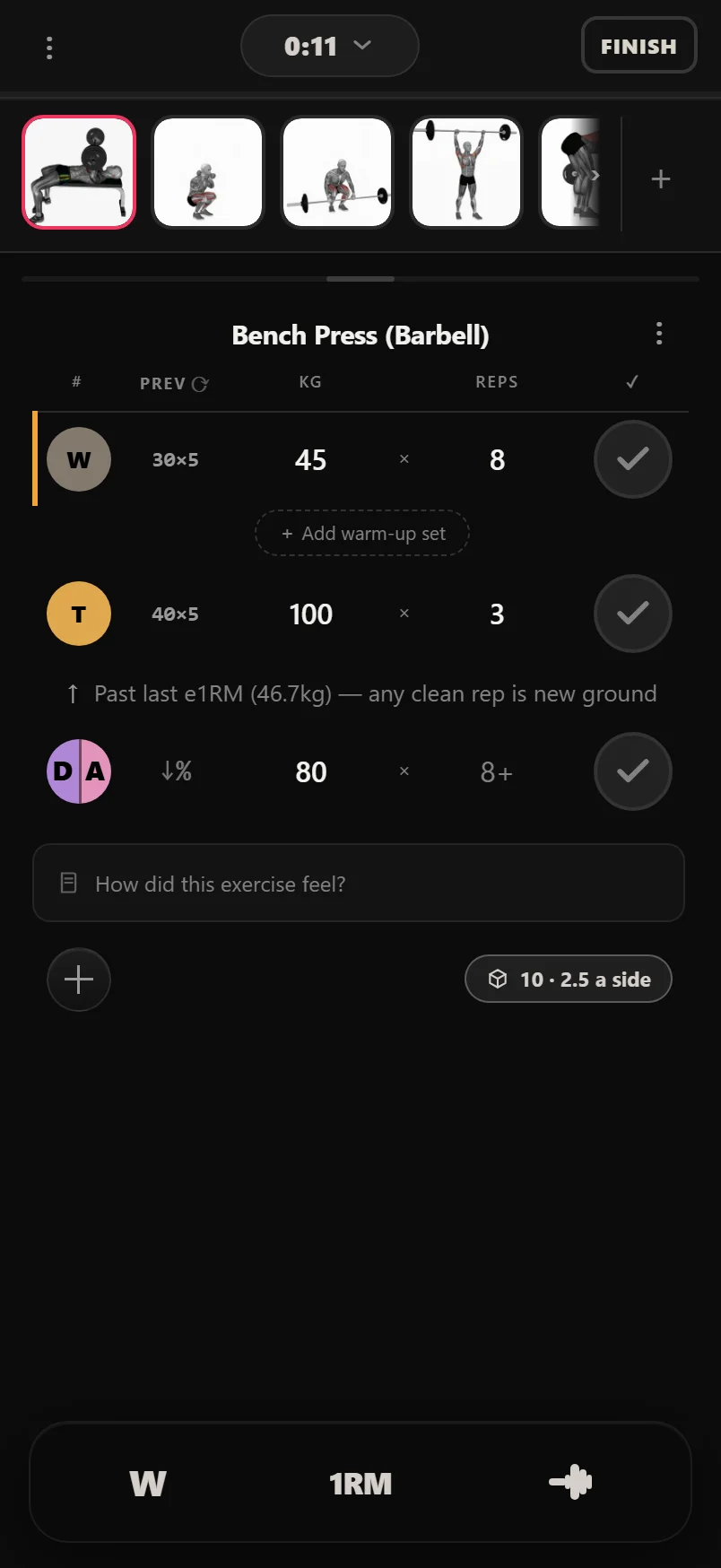
Across the top of a live workout sits a carousel with one cell per exercise. Tap a cell to jump to that exercise, or press and drag to reorder the session on the fly. A green tick marks each finished exercise, and the + cell at the end adds a new one.
The + opens the same exercise picker you get from the Exercises screen, so nothing about it is a mid-workout cut-down version: search, the body-part filter, favourites, the + for a custom exercise you invent on the spot, and the List / Grid switch under the search box. Grid shows each exercise as a card with its photo, which is worth the taps when you're adding something you don't train often. Recently Used sits at the top, drawn from your last few sessions, so the thing you're most likely reaching for is usually already on screen. Tap as many as you want - each one ticks, and the button at the bottom counts them - then add them in one go.
Long-press an exercise name to play its how-to video instantly; a normal tap opens its detail page.
Tap the tick column header to complete every remaining set of an exercise at once.
The set types
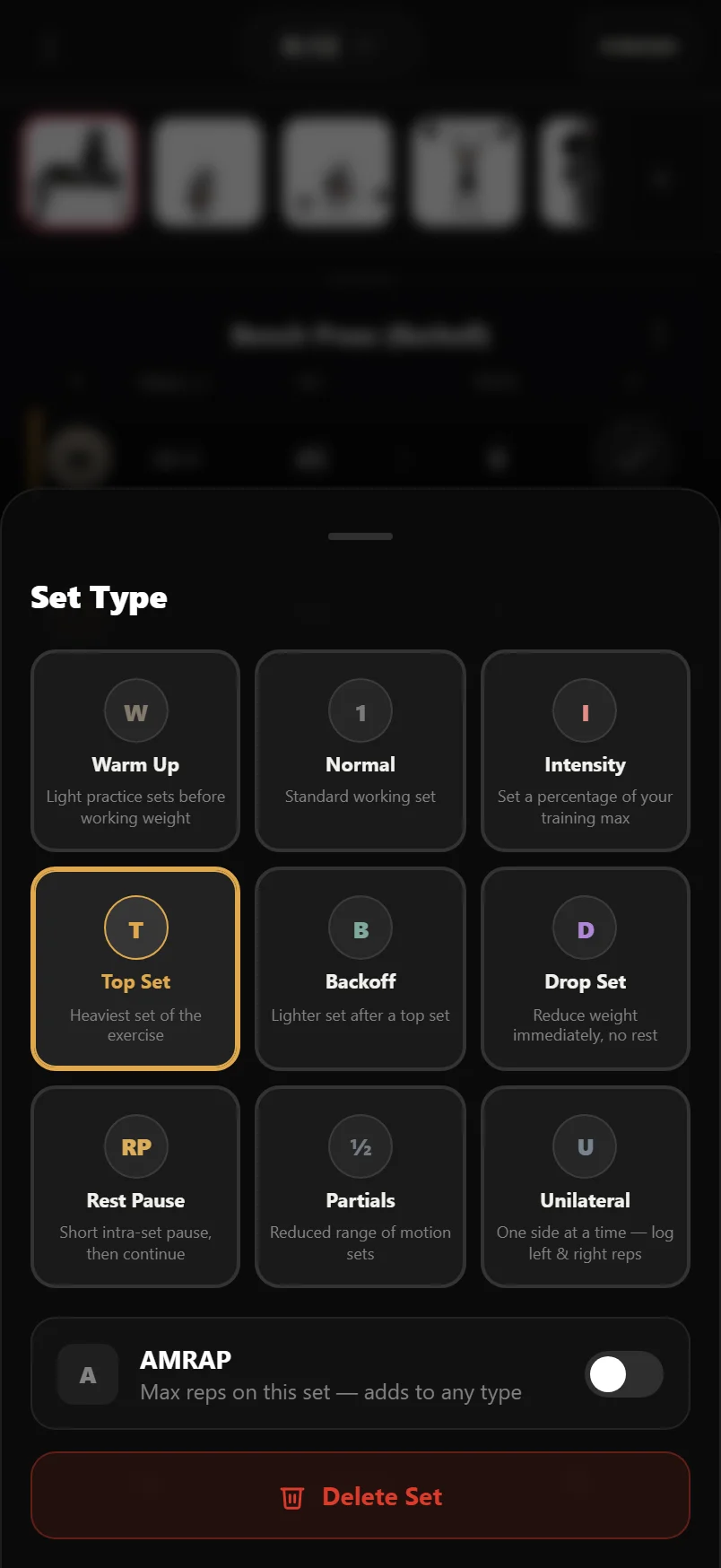
Tap a set's number badge to change its type. There are 10 to choose from: Warm Up, Normal, Top Set, Backoff, Drop Set, Intensity, AMRAP, Rest Pause, Partials and Unilateral. Each gets a colour-coded badge, so a glance down the rows shows the shape of the session.
AMRAP (as many reps as possible) is a modifier that can ride on top of any base type - a top set or a backoff can also be AMRAP, and the badge splits into two colours to show both. AMRAP sets get a live target: the reps at your entered weight that would beat your estimated 1RM. Quickest route of all: type a + or * after the reps - 8+ - and the set flips to AMRAP without opening the drawer.
Percentage-based sets do the maths for you: an Intensity set takes a percentage of your training max (or estimated 1RM) and fills in the weight; Drop and Backoff sets take a percentage reduction from the set before them.
Reading the exercise card
Each exercise's card leads with its name, centred, with the ⋮ menu on the right. Directly beneath, if the lift carries a progression rule, sits a one-line progression chip: "↑ LP · 62.5 kg · +2.5 on pass · 3 fails → deload". Every rule family gets its own template, covering linear and double progression, GZCLP-style stage ladders and 5/3/1-style training-max cycles, so the rule governing the lift is visible while you train instead of buried in a settings screen. The chip changes state with you: held at the same weight after a miss it reads ⏸ with your miss count, and on a deload session it turns red and says so.
The chip is also a button. Tap it and a sheet makes the case for today's weight in your own numbers: the last time this program had you do this lift, set by set, with the set the verdict hinged on marked. It then states the rule behind it, the same card the program's progression list shows, with its increment, deload trigger and cadence. Held at a weight, it counts your misses against the deload; just deloaded, it names the weight you came down from. The evidence is scoped the way the engine thinks: only this program's sessions count, never another program's history or lifting from before you started, and a lift the program runs on two days with separate weights shows each day its own trail. In your first week there's nothing to cite yet, so the sheet states where the program is starting you instead. Nothing on the sheet is editable, because it is the engine showing its working. Until you've opened it once, a small "Tap to see why" hint sits under the chip.
On percentage-based sets, the reference the maths runs off sits in the column header where the previous-session column normally is: "TM 107.5" when a training max is set, "1RM 84" when it's riding your estimated 1RM instead.
Beside the + Set button sits Setup, and it is rarely blank: it reads back how the lift is actually loaded, "20 · 20 · 5 a side · Bench 30°", so the bar you have to build is on the card before you open anything. On a dumbbell lift it reads "2 × 30 kg", on a pin-stack machine "Pin 7", and on a leg press "20 · 20 · 10 a side".
Tap it and one sheet holds everything about how you do this lift: the plate breakdown for today's working weight, your bar and rack settings, bench angle, how the machine is loaded, the kit you use and your pinned note. What you save is per exercise, so it comes back next session, and the button relabels itself the moment you change something. If you used a bench angle or a piece of kit last session, the sheet offers it back as a suggestion — one tap accepts it and it becomes your saved default.
On a lift that uses a bench, the Bench card draws the bench at the angle you set, so a 30° incline looks like an incline and a decline looks like a decline. It steps from a 15° decline through flat and up to 85°, and it reads in words rather than signs: Flat, 30°, Decline 15°. Under it sits Seat pad, for the notch the front pad is set to, because most benches number that one rather than marking it in degrees.
Replace, in the ⋮ menu, swaps the lift without touching the rest of the session. It opens that same picker again, already filtered to the muscle you're swapping away from and led by a Recommended shortlist of the lifts closest to it biomechanically - so a bench that's occupied offers you the dumbbell and machine presses first rather than making you go and find them. Your sets come with you, unticked and ready to log on the new lift. Anything already in the session is marked In Workout, and you can still pick it: some sessions want the same lift twice, and the mark is there so you know when you're doing that.
Under the last set sits the session note — a full-width field for how the exercise actually went. Tap it to write in the same editor the other notes use; if you left a note on this lift recently, it appears as a ready-made suggestion you can keep with one tap on Save. Notes only commit when you save them, and they're stored with the workout. Longer instructions live on the two pinned notes above the sets: your own note about the lift (shown everywhere it appears) and the plan's note from the routine.
Auto-fill and coaching hints
Every weight and rep field shows what you did last session as a faint placeholder. Ticking off a set you haven't typed into logs those values - a blank tick means "same as last time", which keeps repeat sessions down to one tap per set.
When a routine or program prescribes the reps, the prescription wins: a fixed rep count is pre-filled, and a rep range like 8-12 stays visible as the placeholder rather than being replaced by what you got last time - ticking a range set you haven't typed into logs the top of the range.
Above the next set, Durata shows a short coaching hint when it has something your row doesn't already say - "3+ reps beats last e1RM 93 kg". Hints read like a data line, not a pep talk, and anything that would just repeat the previous-session column stays silent. Turn off Progression Hints in Settings if you'd rather lift in silence.
On a program, the program wins. Where it fixed the reps - a 5/3/1 straight set, a StrongLifts-style working weight, a 10x10 volume block - the hint stays quiet rather than talking you into an extra rep the plan never asked for. Where the program deliberately leaves the top open it speaks up, and it scores you against the program's own target: an AMRAP set gets the reps that would beat your estimated 1RM, and a rep range gets the number that earns the next weight increase.
If you keep lifting heavier than a program lift's target for a few sessions in a row, Durata notices and shows a short prompt on that exercise: your working weight was probably set too low. Tap Adjust to open Working Weights and correct it, rather than waiting for the small automatic increases to catch up.
Numeric inputs select their contents on focus, so you type over old values instead of deleting them.
Both a comma and a period work as the decimal point, so 100,5 and 100.5 log the same weight.
The effort badge stays live after you tick a set. Rate it, or fix a rating you got wrong, without unticking the set and restarting your rest.
The header and bottom bars slide away while you type, so the keyboard never buries the row you're editing.
Ticked a program set with no weight? A one-line hint says progression can't advance and jumps you straight to the weight field.
Beat one of your records and the set's badge earns a trophy overlay the instant you tick it - tap it to see which record you took, and a share icon on that pop-up opens a card for it right away, no need to wait for the workout to finish. The same trophies mark the session in History and feed the PR board.
Supersets
Open an exercise's menu and choose Manage Superset to link it with other exercises in the session. Linked exercises share a colour-coded group: their carousel tiles are joined by a chain-link badge with a matching underline, an SS tag sits next to the exercise name, and when you finish a set the partner exercise shows as up next.
By default Durata also auto-advances, jumping to the partner exercise when the rest timer ends. Auto-Advance in Settings decides how far that goes: Off leaves you where you are, Supersets rotates the group, Last Set moves you on once an exercise has no sets left, and Both does the two together.
The rest timer
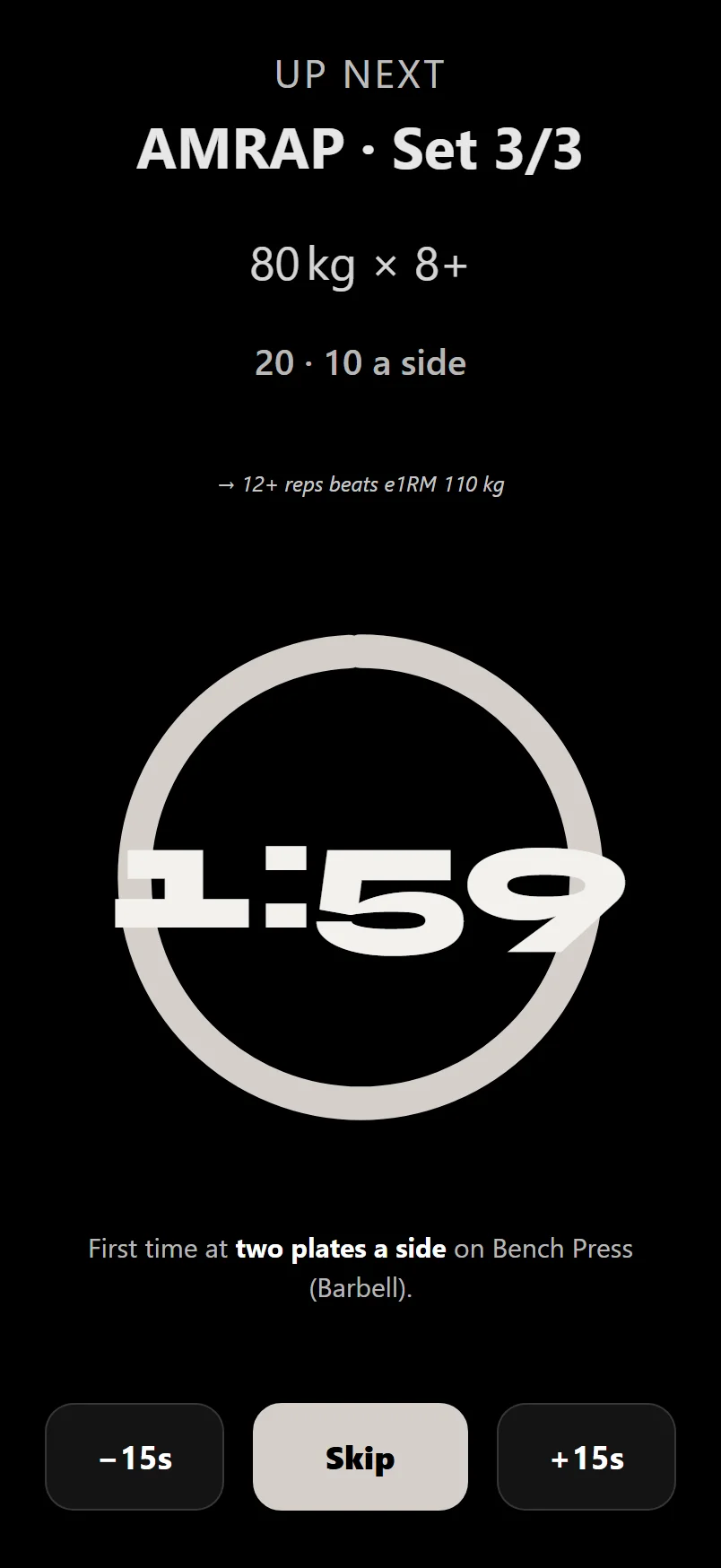
Tick off a set and the rest timer starts on its own. The full-screen view shows the countdown plus what's next - exercise, set number, target weight and reps, and any coaching hint - with -15s and +15s buttons to nudge the time. Prefer something quieter? In Settings you can swap it for a floating mini-timer, or a slim colour-shifting bar in the workout header so nothing ever covers your sets.
Every so often a line appears under the countdown with something true about the set you just finished - how long the record you beat had stood, the first time you load a plate a side, the anniversary of your first session on that lift, or that you're back after a fortnight off. It's rationed: at most twice a session, never twice in a row, and a milestone is only ever said once.
Between sets of the same lift the countdown adds a plate line whenever the next set's weight changes - what goes on the bar, and nothing you already know, because the bench and the pin were set before the first set. If the weight is not moving it stays quiet, so straight sets never see it and a drop set or a pyramid always does.
When the rest is the gap before a different exercise, the countdown carries a Setup Next pill under the exercise name, with the plate breakdown for the coming lift written on it. That is usually the whole job — you read it and walk to the rack. Tap it if you want the rest: the full Setup sheet opens over the countdown, and the countdown keeps running underneath, so nothing you change there costs you rest time.
You don't need to keep the screen on: when rest ends, Durata fires a notification telling you what's next, even with the phone locked - and its beeps briefly duck your music instead of pausing it. Each set can carry its own rest time, or None to skip the timer entirely.
Rather than one rest time for everything, Settings > Rest Timer > Rest by Set Type lets you set a default per kind of set - warm-ups, top sets, drop sets, backoffs and the rest each get their own row. It only fills in for a set with no rest of its own: anything a program or your own routine already prescribes keeps that number regardless, and a set you've set a rest on in the logger always wins.
The warm-up calculator
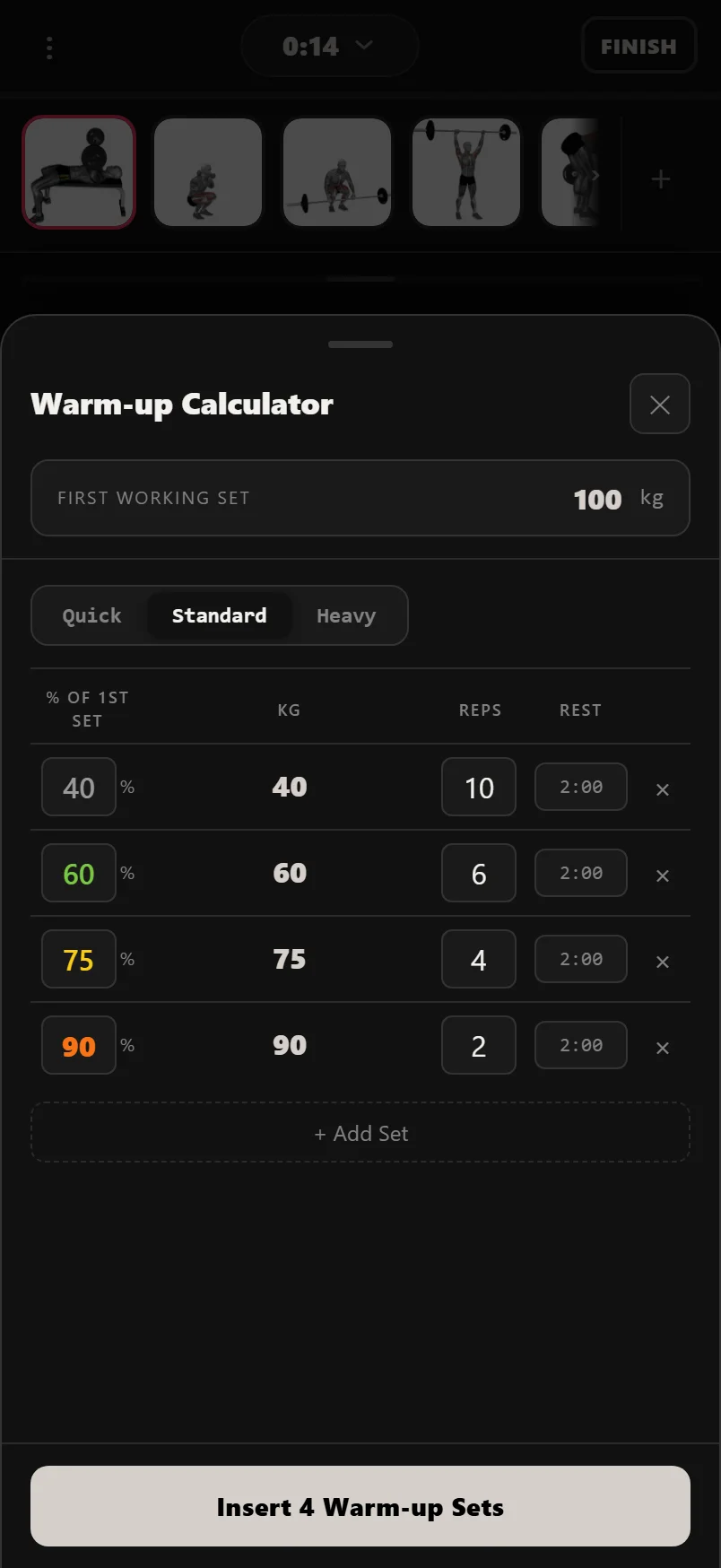
Tap the W button in the bottom bar and enter your first working-set weight; the calculator builds a ramp of warm-up sets, each a percentage of that weight with reps and a rest. Leave a rung's rest alone and it reads your Rest by Set Type default for warm-ups rather than a fixed number, in muted text to show it's inherited rather than chosen - set a rest on that rung yourself and it switches to solid and stays yours. Everything is editable, you can save your own profiles, and one tap inserts the whole ramp into the current exercise.
When the ramp is done
Once every warm-up is ticked off, the ramp folds away so your working sets sit at the top of the card - and leaves a W chip in its place: "4 warm-up sets - 32.5 → 75 kg". It tells you how many rungs you climbed and the range you climbed through, without keeping four finished rows in the way of the sets you still have to do.
Tap the chip and the ramp comes straight back, so a warm-up weight you mistyped, or a set you ticked by accident, is always one tap from being fixed. Tap it again to put them away. Untick a warm-up and the rows stay out on their own - the fold only happens when the whole ramp is done.
While the ramp is open, a + Add warm-up set button sits under the last rung. It adds one more, copying the rung above it - same weight, same reps - so you can take an extra step on a heavy day without rebuilding the ramp. Change the numbers on the new row and carry on; it works the same way as + Set does further down the card.
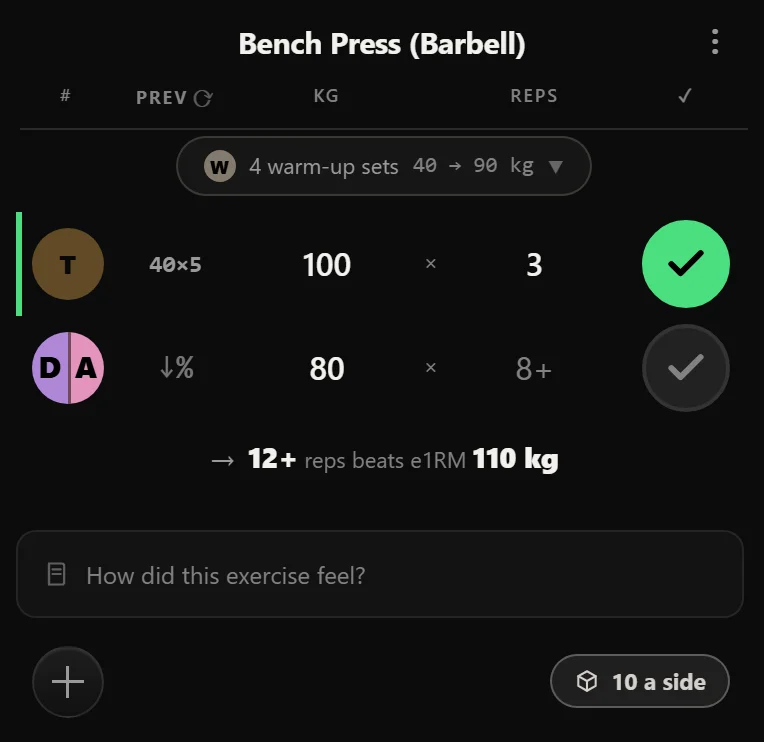
The chip counts your sets and reads their range off the live rows, so correcting a warm-up weight updates it while you're still typing.
The colour on a set row's left edge always shows its state before its type: a finished warm-up goes green like any other completed set, and amber only ever means "this is the set you're on".
The rep max calculator
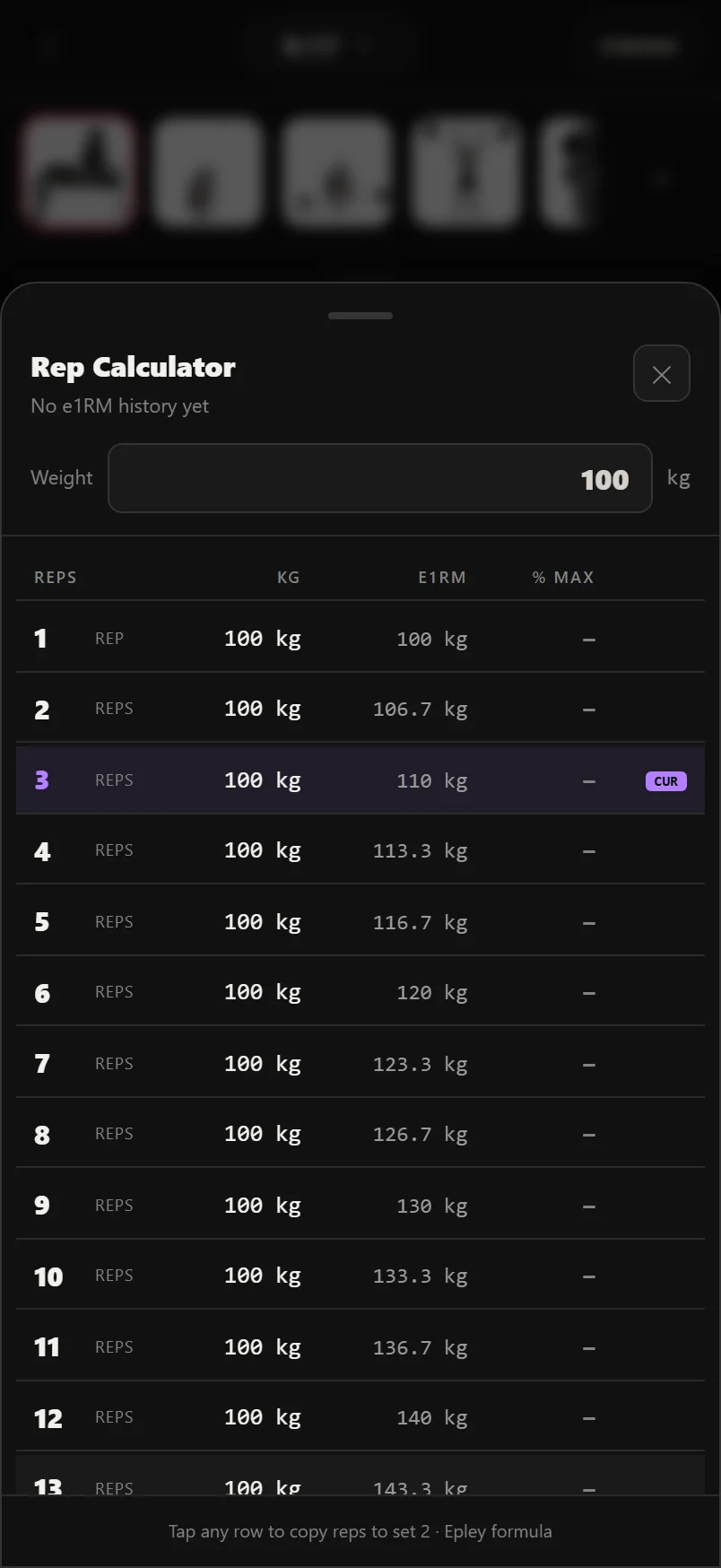
The 1RM button opens the rep max calculator: give it a weight and reps and it estimates your one-rep max with the Epley formula, plus a table of equivalent loads at every rep count. It uses the same estimate as the logger, the PR board and your goals.
The plate calculator
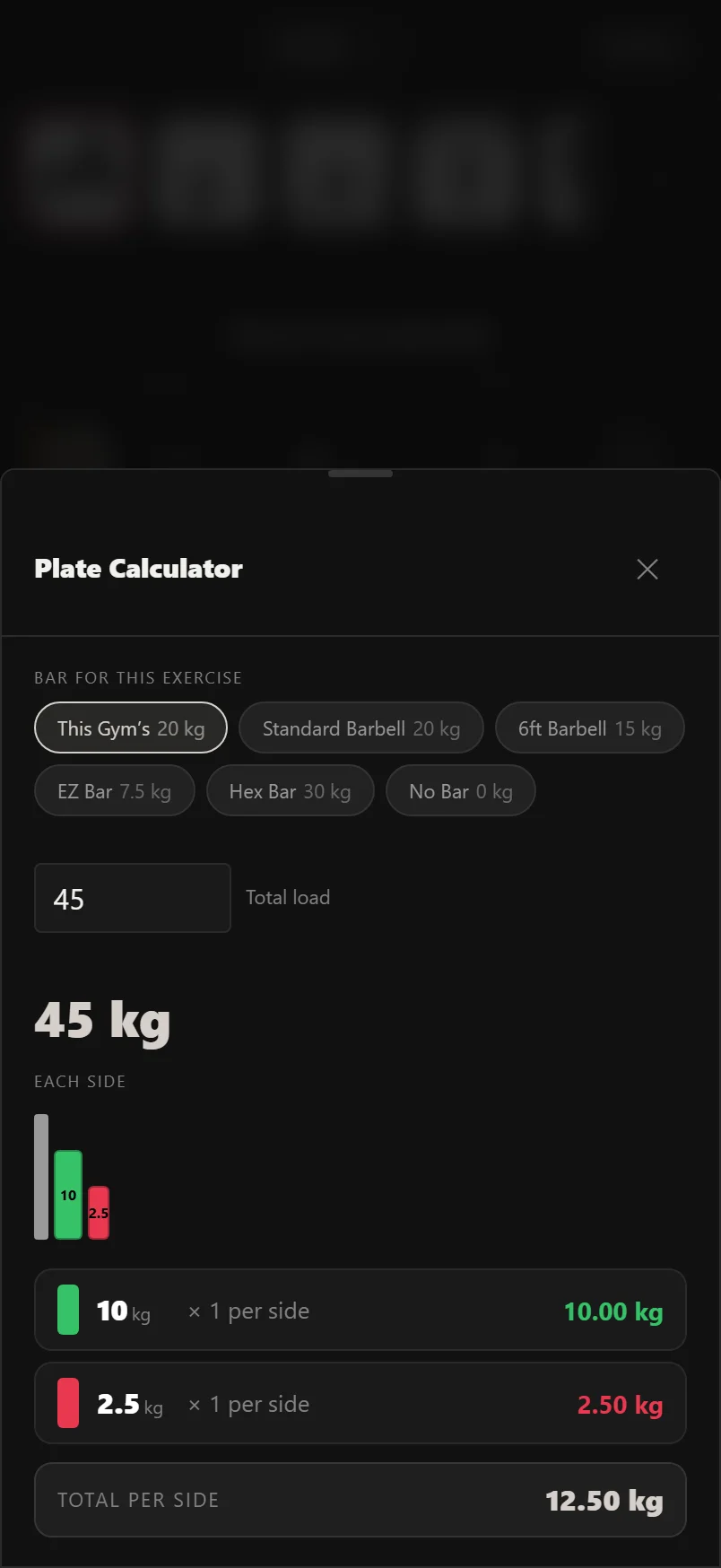
The plate calculator shows exactly which plates to load per side, drawn to scale and in the IWF competition colours you would see on a platform (red 25s, blue 20s, yellow 15s, green 10s, white 5s), in your own unit - kg and lbs are both fully supported, each with its own bar and plate setup. It respects the plates you've told Durata you own - including microplates, configured in Settings - so it never suggests a plate your gym doesn't have. The same colours run through the plate inventory in Settings and the bar that loads on the Session Complete screen, so a 20 is blue everywhere you see one.
The tool tray and session stats
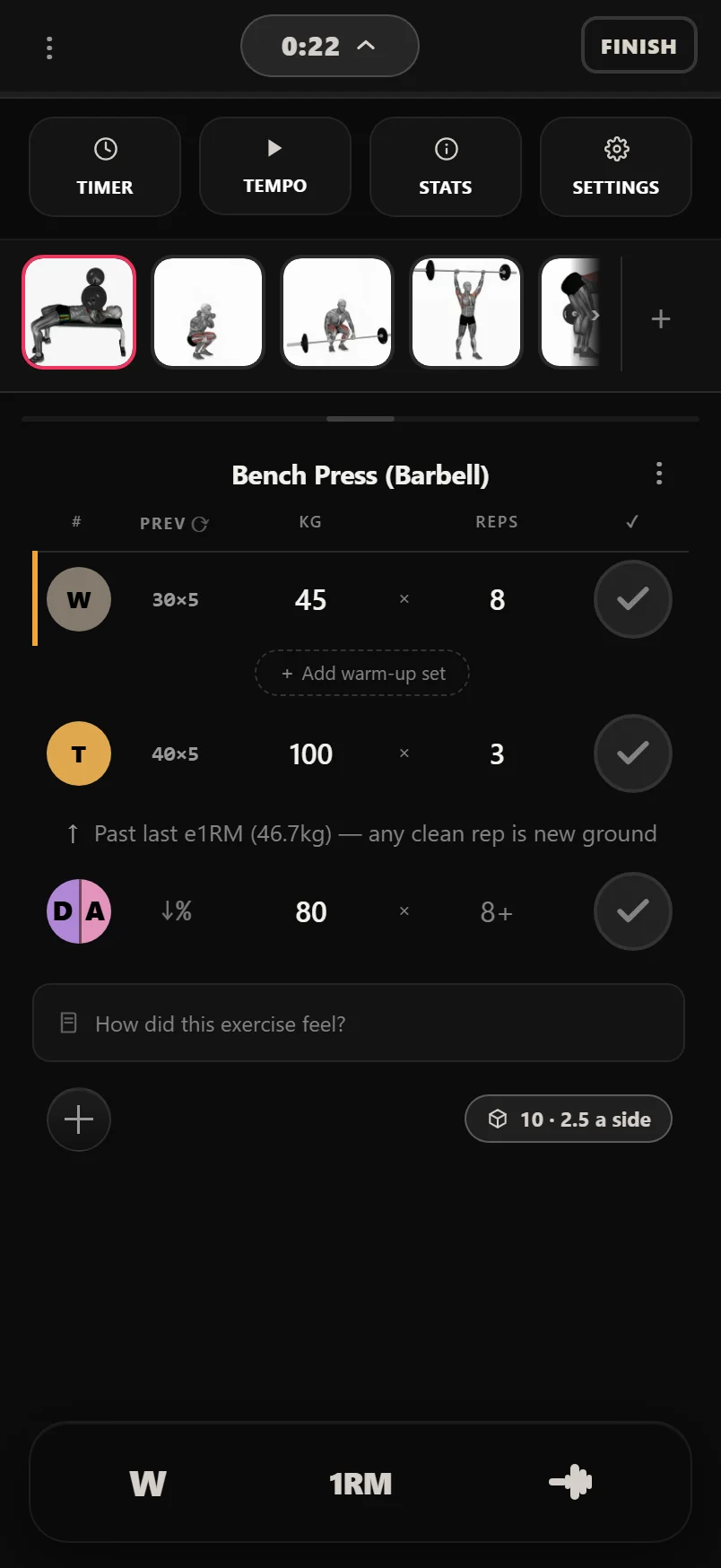
Tap the session timer pill in the workout header to open the tool tray: Timer (a manual countdown with presets and a custom mm:ss input), Tempo, Stats and Settings. Tempo is a rep-cadence metronome - tap to start it, long-press to edit the tempo. Until you've found the editor once, tapping the button briefly flips its label to "Hold to edit" so the long-press doesn't stay hidden. Stats shows live duration, sets and volume, and lets you rename the workout mid-session.
Stats also carries a Body Part Split: a body diagram that lights up muscle by muscle as you complete sets, so you can see the shape of the session while you're still in it. Only completed sets count, so the body fills as you tick them off rather than showing what you planned. Swipe the card sideways, or tap Front / Back beneath it, to flip between front and back - the set chart travels with the body, so it always lists the side you're looking at, while the volume bars underneath cover the whole session either way.
On dips, pull-ups, chin-ups and push-ups, volume counts you as well as the plates. Log a weighted dip as "+10 kg" and Durata values the set at your body weight plus 10; assisted variants count body weight minus the assistance instead, so using less assistance means more volume. It uses your most recent weigh-in from the last 30 days - a small "includes bodyweight" note appears under the volume figure whenever this is in effect, and without a recent weigh-in volume counts the added weight as before.
In Stats, swipe anywhere on the body card sideways - or tap Front / Back under it - to flip between the two sides. Tapping runs the same slide the swipe does, so the control shows you the gesture.
The session fatigue bar
A thin bar sits under the exercise carousel and fills as the session goes on. Green when you're fresh, then lime, yellow, orange, red and purple as fatigue builds. Tap it for the numbers behind the colour, or turn it off in Settings > Workout Defaults > Fatigue Bar.
It stays idle until you've done two working sets. Warm-ups don't count and cardio is left out. Signals it has no data for are dropped rather than guessed at: log no effort ratings and there's no RPE row, and a workout name you've never trained before has no baseline at all, so the bar runs on set count instead.
Green early on is normal. Green fifteen sets in usually means you left something in the tank. Yellow and orange through the back half is a decent session. Red or purple means several signals agree at once, which is worth knowing before you start another exercise.
Check the drawer before you read much into the colour. If rep drop-off is driving it you're genuinely running out; if it's rest drift you may have spent ten minutes on your phone. Either way the bar never stops a set or changes a weight, and the reading is saved with the workout, so you can pull it up from History later.
The drawer shows its working. Under the four bars, a "How this is measured" block names what each signal is comparing, for the signals this session actually has.
The four signals, each measured against your last workout with the same name:
- RPE drift. Are you rating sets harder than usual?
- Rest drift. Are your rests running longer than the ones those sets were meant to have?
- Rep drop-off. In any exercise of three sets or more, how far did the last set fall below the first?
- Volume pace. Have you lifted as much as you normally have by this point in the session?
The drawer names the state as well as colouring it: Feeling fresh, Settling in, Good effort, Fatigue building, High fatigue and Near limit.
Rename a session part-way through and the bar loses its baseline. It runs on set count until you've logged that name again.
Lifting to a tempo
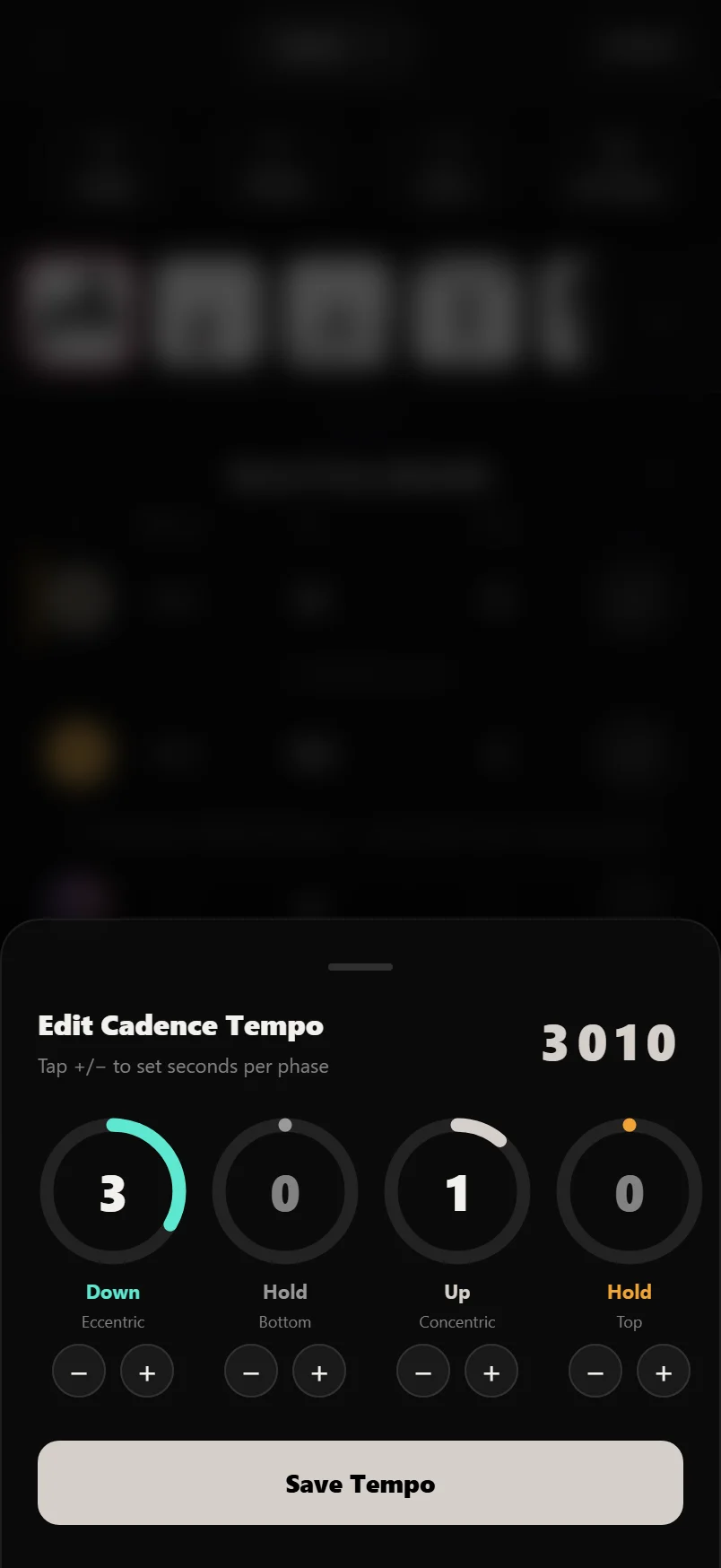
Tempo lifting, meaning controlling how long each phase of a rep takes, is how you make a weight harder without adding plates: more time under tension, stricter technique, no momentum. Coaches write it as four digits like 3-0-1-0: three seconds down, no pause, one second up, no pause at the top.
Durata's cadence metronome beats that rhythm out loud so you don't have to count. Tap Tempo in the tool tray to start it; long-press to open the tempo editor, where four dials set the eccentric, bottom hold, concentric and top hold — the metronome follows whatever you dial in.
Use it for paused bench and squats, slow-eccentric accessories, or any week where the plan says "3-1-1-0" and you'd otherwise be guessing at seconds mid-set.
Pausing, discarding and finishing
The Finish button carries a thin ring that fills as you tick sets off, clockwise from the top, so you can see how far through the session you are without opening anything. It counts every set in the workout, not just the exercise you're on. Add a set mid-exercise and the ring holds where it is rather than sliding backwards - it waits for you to catch up.
The three-dot menu in the header holds Pause Workout (stops the clock without losing anything) and Discard Workout. Finishing opens the Session Complete screen with a small ceremony: the weight you moved stands at the top in full, and a barbell loads up beneath it plate by plate - more plates the bigger the session was against your recent training - with the figure climbing a quarter at a time as each pair lands, before the bar drops with a thud and a puff of chalk. Below that, a lifetime odometer rolls up every kilo you've ever logged in Durata, with your session count under it. Then the summary proper: duration, sets and reps up top - the volume isn't repeated there, because the bar above already leads with it - a Muscles worked block that opens to front and back bodies side by side with a bar for each muscle, a notes field, and Save as Standalone - the fastest way to turn a good one-off session into a reusable one, filed loose in your Library rather than inside a plan. If you restructured a routine session mid-workout, a chip near the top asks whether to keep the changes; tapping Save Workout opens a drawer where you pick exactly which ones stick. Save lands you back on the dashboard - the Complete screen was already the summary, so the session itself is one tap away in History rather than opening straight to it.
The share reel always leads with a Photo card - tap it and it invites you to add your workout photo, straight from your phone's camera or your library. Behind it sit the rest: a Session card leading with volume, an Achievement card built around your biggest lift, a stark Ink statement, a Muscle Map - plus a Receipt, a PR certificate or a lift trend when the session earns them. Each card sets its own square-post or 9:16-story format and flips light or dark on its own; the Photo card also lets you toggle which stats sit on it. See the share-cards guide for the full set.
The finish celebration follows your settings: set Celebration Sound to None to land in silence, and if your device asks for reduced motion the plates and odometer appear settled, with no animation.
The switch on the keep-changes chip is a shortcut: flick it off and Save Workout saves without asking, leaving the routine exactly as it was.
Swipe left or right on the share-card preview to flick through the styles, or tap a dot in the row above the reel to jump straight to a card.
The camera button on any card offers Take Photo, Use Workout Photo (reuse the one you just took without shooting again) and Photo Library; once a card has a photo, the same button adds Remove Photo to clear it.
Common questions
Where did my warm-up sets go?
They folded away when you ticked the last one, so your working sets sit at the top of the card. The W chip in their place tells you how many there were and the range you ramped through - tap it and the rows come back, ready to edit or untick.
What happens if I close the app mid-workout?
Nothing is lost. The workout is saved on your device as you go, and reopening the app resumes it exactly where you left off.
Does the rest timer work with the screen locked?
Yes. When rest ends Durata fires a notification telling you what's next, even with the phone locked or the app in the background - and its sounds duck your music rather than pausing it.
How does Durata estimate my 1RM?
With the Epley formula (weight x (1 + reps/30)), calculated from your best genuine straight sets. The same formula is used everywhere - logger hints, the rep max calculator and your records.
Can I turn off the coaching hints?
Yes - toggle Progression Hints in Settings. Auto-started rest timers, the fatigue bar and Auto-Advance can each be adjusted there too. You shouldn't need it to stop the app arguing with a program, though - on a program the prescription already silences the hint.
What does checking off a set I haven't filled in do?
It logs last session's values for that set. The faint placeholder numbers are what you did last time, and ticking the set means "same again".
What does the fatigue bar actually measure?
Four things, all against your last workout with the same name: your effort ratings, how long your rests are running, whether reps are falling off inside an exercise, and whether your volume is behind its usual pace. It uses whichever of those it has data for, plus how many sets you've done. Tap the bar to see which one is driving the colour.
How do I log an assisted pull-up or dip?
Log the assistance as a positive number, not a negative one. On assisted pull-ups, chin-ups, chest dips and triceps dips the weight column is labelled ASSIST, and 30 there means 30 kg taken off your body weight. Volume counts what you actually lifted, so less assistance is a stronger set.
Why is my dip volume so much bigger than weight x reps?
Dips, pull-ups, chin-ups and push-ups count your body weight in volume - a +10 kg dip at 85 kg body weight is a 95 kg set. Weight and e1RM records still use the added weight, which is the number lifters quote, and your program's prescriptions are always in added weight too.
Put it into practice
Durata is free to use — 50 proven programs, automatic progression, rest timers and PR tracking, all on your phone.