

Getting started with Durata
Durata is a gym log and program planner for Android and Apple. You log your sets in the gym, the app calculates what you should lift next, and everything syncs to the cloud so your training history is never lost.
This guide takes you from a fresh install to your first look around: creating an account, what a first launch looks like, what everything on the dashboard means, and how to bring years of history with you from another app. It takes about five minutes.
Last reviewed 2026-09-15 · matches app v1.0.0.87
Install the app and create your account
Durata is on the Google Play Store for Android, and on TestFlight for iPhone while the App Store release waits on Apple. Account creation happens in the mobile app only. The web dashboard is for logging into an account you already have.
There are no passwords. You sign in with your email address and a 6-digit code. Durata emails you the code, and the moment you type or paste the sixth digit it submits itself. No verify button, no password to forget.
Right after your first sign-in, a one-time 'Before You Train' sheet asks you to accept Durata's health and liability terms. Durata is training-log software rather than medical advice, and you confirm you're training at your own risk before the sheet lets you through. It only appears once (it carries across your devices), and it reappears only if the terms materially change. When it does, it opens with a short summary of what's new, so you're never re-accepting blind.
Install it from getdurata.app and sign in right away, with no invite needed. The app is free, and Pro is an optional upgrade you buy in the app.
- Install Durata from the Google Play Store, or join the TestFlight beta on iPhone.
- Open the app and enter your email address.
- Check your inbox for the 6-digit code and type it in. It submits automatically on the sixth digit.
- Accept the one-time health & liability terms on the 'Before You Train' sheet.
- You're in. Everything you log from here syncs to your account.
Your first launch
A brand-new account doesn't open on a welcome pop-up. It opens on Home itself, led by a First Session hero. The big button is Start Your First Workout, and it drops you straight into the exercise picker rather than an empty screen. Beside it, Browse Programs opens the catalog of 50 built-in programs if you'd rather begin with a plan, and two quieter links cover the other first-day jobs: import your history from another app (Strong, Hevy, Loadline or a CSV) and set up your profile (sex, age and units, all optional).
Under the hero sit two previews drawn in outline, your top-lift chart and your week's volume, each priced 'After 1 session'. Log one workout, or land one import, and the hero is replaced by those charts with your own numbers in them.
A tour of the dashboard
Home is a board of widgets, and it builds itself. A widget that has nothing to show isn't on the board, and there are no empty tiles waiting for data, so a fresh account starts small and widgets join on their own as their data arrives: Last Workout and the charts after your first session, Cardio when you log cardio, Sleep and Nutrition once a health app is connected, Recovery after a couple of weeks of training. Along the top sits the This Week strip, the seven days of your week marked with what you've trained and what's planned, and above that the header with your streak chip and live sync status.
The full set of widgets starts with the training ones: Sessions (done vs planned this week), Up Next (your active program's next session), Last Workout, Week Volume, Sets by Muscle (the week's work painted onto a body map), Training Load, Recovery, PRs This Week and your Streak.
Health and nutrition add Cardio, Bodyweight, Sleep, Nutrition (with a bigger size that charts 30 days of calories against your bodyweight), Water (today's figure straight from your health app, with a 7-day average underneath), Fuel vs Training (your average calories on days you trained against days you didn't) and Protein per kg (your protein against your latest weigh-in).
The rest track your plan and your lifts. A Goal widget appears for every goal you pin. One Lift charts one exercise on one metric (estimated 1RM, top set or volume) and can be added as many times as you like. Lift Status gives every program lift's latest progression verdict, with a dot trail of recent calls; tap a lift for the full story. Program Progress shows week N of M on your active program, and how many of the sessions due so far you've logged. Week Plan lays your whole block out as a grid, one row per program week and seven cells per row, coloured by what each day trains, and tapping a row opens the planner on that week. Week Streak counts consecutive weeks hitting your planned sessions, Milestone counts down to your next session milestone, Month Calendar shows M for your last two weeks or L for the full month, with a trained day filled as a green disc and a PR day gaining an amber ring, Photo Pair puts then-and-now progress photos side by side, and an occasional On This Day rounds the list off.
The Up Next widget is the one you'll use most. It shows today's planned session from your active program. Tap a session to preview it, exercise by exercise with reps and working weights already resolved from your history, plus a Muscle Coverage map of what it trains, or hit its play button for a quick Start Workout confirmation. Running more than one program at once? Each session gets its own row, tap the card's background instead of a specific row to see all of today's sessions together. Expand a session there and its Muscle Coverage sits at the bottom, tucked behind a heading so the list of sessions stays scannable. Beneath the sessions, each program gets a status row of its own: its name, where you are in it ("Week 4 of 12", with "· repeats" on programs that cycle, or how many weeks a one-week template has been running), and, on multi-week programs, a thin progress bar that fills as the week's sessions get done. Tap the row to open that program at the current week. On rest days it looks ahead instead: the next scheduled session, where the same tap-to-preview works and a Start Early button lets you jump in ahead of schedule.
The Recovery widget is tappable too. Tap it for the full breakdown on Progress → Workload: the workload trend, deload guidance and what each fatigue factor (volume, RPE trend, frequency and sleep) actually means.
One widget deserves a special mention because most days it doesn't exist. On This Day appears only on a day genuinely worth looking back on: you trained a year (or two, or three) ago today and one of that day's lifts has meaningfully improved since, or you've just crossed a lifetime milestone like your 100th logged session. It then shows the then-and-now: the set you did then, the set you do now, and the gain between them, with a share button to mark the moment. It limits itself to a couple of appearances a month, and it will never show you a lift that went backwards.
The board is yours to shape. Tap Customize Home beneath it and editing happens right on the grid, with every widget still live and showing its real numbers: the − badge removes a widget, the corner handle cycles it through its available sizes (most have a compact stat form and a bigger charted form, and the body changes with the size rather than only the scale), and press-and-hold lifts a widget so you can drag it anywhere; the rest of the board flows around it. Add Widget opens a gallery of everything not on your board. Widgets whose data hasn't arrived yet wait there dimmed, each saying what brings it in. Reset restores the default layout, Done saves, and the layout syncs to your account, so it follows you across devices.
In the header you'll find your streak chip. Each day you log a workout adds one day. Up to 3 rest days are allowed before the streak breaks. The chip turns amber after 2 rest days and red after 3, when training today is the only way to keep it.
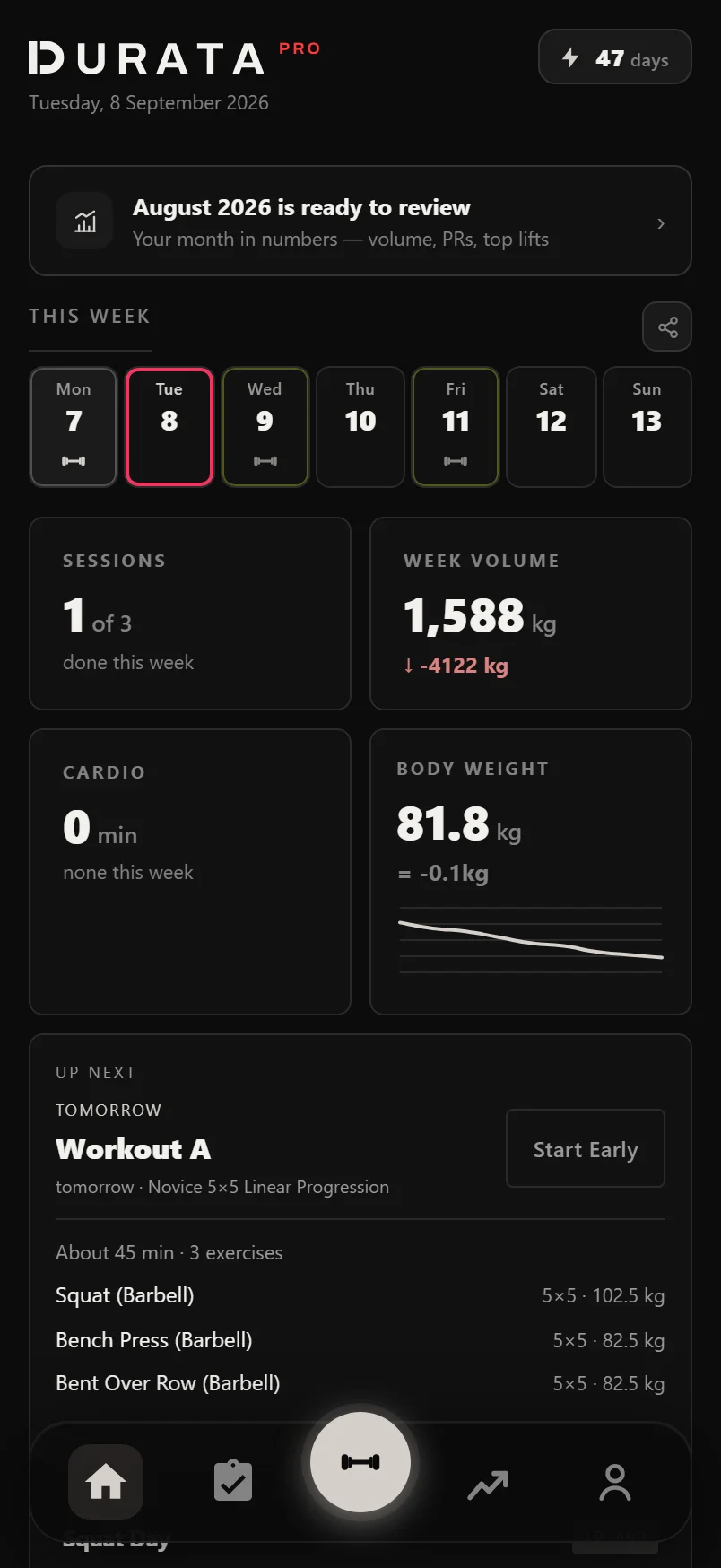
Every day cell in the This Week strip is a button: a trained day opens that session, a planned day previews it, and an empty 'today' starts a workout.
Tap the streak chip itself for a plain-English explainer of exactly how the streak and rest-day rules work.
The line under the date shows your live sync status. A green dot and 'Synced 2m ago' means everything is safely in the cloud.
One Lift can be added more than once, so you can pin bench, squat and deadlift as three separate widgets.
In Month Calendar, tapping a filled day opens that day's workout, and tapping today previews or starts what's planned.
Bring your training history with you
Years of logs in another app shouldn't keep you there. The first-run checklist offers Bring your training with you, and that one sheet offers both ways in: import a CSV export from Strong, Hevy or Loadline (plus Durata's own format), or connect Hevy with an API key. Neither is presented as the better route, because which one is right depends on whether you hold a Hevy Pro subscription, and each tile says plainly what it needs. Both options sit on that same sheet in Settings under Data & Export → Import, whenever you come back to it later.
Coming from Hevy with a Pro account? You can skip the file entirely, and you can do it without leaving the import: pick the Hevy option, paste your key, and Bring Everything Over connects, pulls your full history and fetches your actual routines, with their real names, folders and set targets, straight from Hevy's servers, finishing on the same Instant Insights reel a CSV file does. The identical card also sits in Settings → Integrations, which is where you turn on sending finished Durata workouts back the other way. The Switching from Hevy guide walks through the whole move.
The import is re-import safe: run the same file twice and nothing duplicates. New sessions are inserted, changed ones are updated, identical ones are skipped. Exercises Durata doesn't recognise aren't dropped. They're matched to the 415-exercise library where possible (even when the wording differs between apps), per-exercise notes come along with them, and anything genuinely unique is created as a custom exercise so your history stays complete.
Units take care of themselves: Hevy exports state their unit in the file (kg or lb) and Durata converts automatically, and Strong files are auto-detected the same way whenever the file says which unit it uses. The unit selector next to the import button only matters for Strong files that don't, so set it to match how that app was set up.
You get more than the history back, too. The reel's last screen spots the workouts you repeated and offers to rebuild them as ready-to-use routines, each built from your most recent performance with your latest weights, and, once you've created a few, to group them into a weekly plan with the training days set from when you actually trained. Those rebuilt sessions move into the plan rather than being copied into it, so you are never left with two of each, and the last button asks for a start date so the plan is running before you put the phone down.
Getting around the app
The bottom navigation has five buttons: Home, Training (the program and session hub, with Exercises as one of its tabs), Workout (the barbell button in the middle, which is your workout logger), Progress (Review, History, Strength and Workload in one place), and You.
You is everything that's about you rather than your training: a profile header with your training age and session count, then rows for Body Metrics, Cardio, Nutrition, Gallery and Goals, each showing a live value such as your current weight and trend, so you can read it without tapping. Settings sits on its own beneath them.
Tap the avatar disc on that profile header to add a photo. Frame it yourself with a drag-to-position, pinch-or-slide-to-zoom crop sheet before it saves, and it syncs to your account like everything else.
Durata works offline and syncs when you're back online, so a gym with no signal never costs you a set.
The barbell Workout button doubles as the sync indicator. A thin ring spins around it whenever Durata is saving to the cloud.
With a workout in progress, the dashboard shows a pulsing LIVE banner. Tap it to jump straight back into your session.
Common questions
Do I need to create a password?
No. Durata is passwordless. You sign in with your email and a 6-digit code that's emailed to you each time. The code submits itself as soon as you enter the sixth digit.
Can I sign up on the website?
No. Accounts are created in the mobile app (Android or iOS) only. The web dashboard is for logging into an existing account on a bigger screen.
Do I have to accept anything before I start training?
Yes. A one-time 'Before You Train' sheet appears right after your first sign-in with Durata's health and liability terms. It's non-dismissable, but it's quick, and it only reappears if the terms materially change. When it does, it tells you what changed before you accept.
Is Durata free?
The app is free and most of it is: logging, every program in Discover with its progression, history, PRs, cloud sync, backup and export, with no limit on workouts. Pro is an optional upgrade covering eight extras. Install the app and sign in, with no waitlist or invite required.
Will importing my Strong or Hevy history create duplicates?
No. Imports are re-import safe: identical sessions are skipped and changed ones are updated, so you can run the same export twice without doubling anything up. Unrecognised exercises are added as custom exercises rather than lost.
Does Durata work without signal at the gym?
Yes. Everything works offline and syncs automatically when you're back online. The spinning ring around the barbell Workout button shows when a sync is in flight.
Put it into practice
Durata is free to use — 50 proven programs, automatic progression, rest timers and PR tracking, all on your phone.