

Switching from Hevy
Your training history is yours, and switching apps shouldn't cost you it. Durata imports everything Hevy holds: every workout with its weights, reps, set types and notes, and every routine. It rebuilds them as native Durata data, with PRs recomputed, analytics populated and routines editable.
There are two routes in. If you have Hevy Pro, an API key moves everything automatically. If you don't, Hevy's free CSV export covers your full workout history. Both are safe to run as often as you like, and nothing is ever duplicated. And if you're not leaving Hevy behind entirely, Durata can keep sending your finished workouts back the other way.
Last reviewed 2026-09-14 · matches app v1.0.0.89
Two routes in: API key or CSV file
The API route (Hevy Pro required) is the complete move: it pulls your full workout history and your routines, folders included, directly from Hevy's servers, with exercises matched by Hevy's own identifiers, which is the most reliable matching there is.
The CSV route works for everyone, including free Hevy accounts: export your workout data from the Hevy app, then import the file into Durata. You get your full workout history this way; routines aren't in Hevy's CSV, but Durata can rebuild them from the history itself. More on that below.
Either way, exercise names are matched to Durata's 416-exercise library even when the wording differs, and anything unrecognised comes across as a custom exercise rather than being dropped. Imported workouts keep their original dates, so your charts and PR timeline read exactly as they happened.
Not from Hevy? The same import sheet accepts Strong and Loadline files too, and the format is detected automatically.
Connecting with an API key (Hevy Pro)
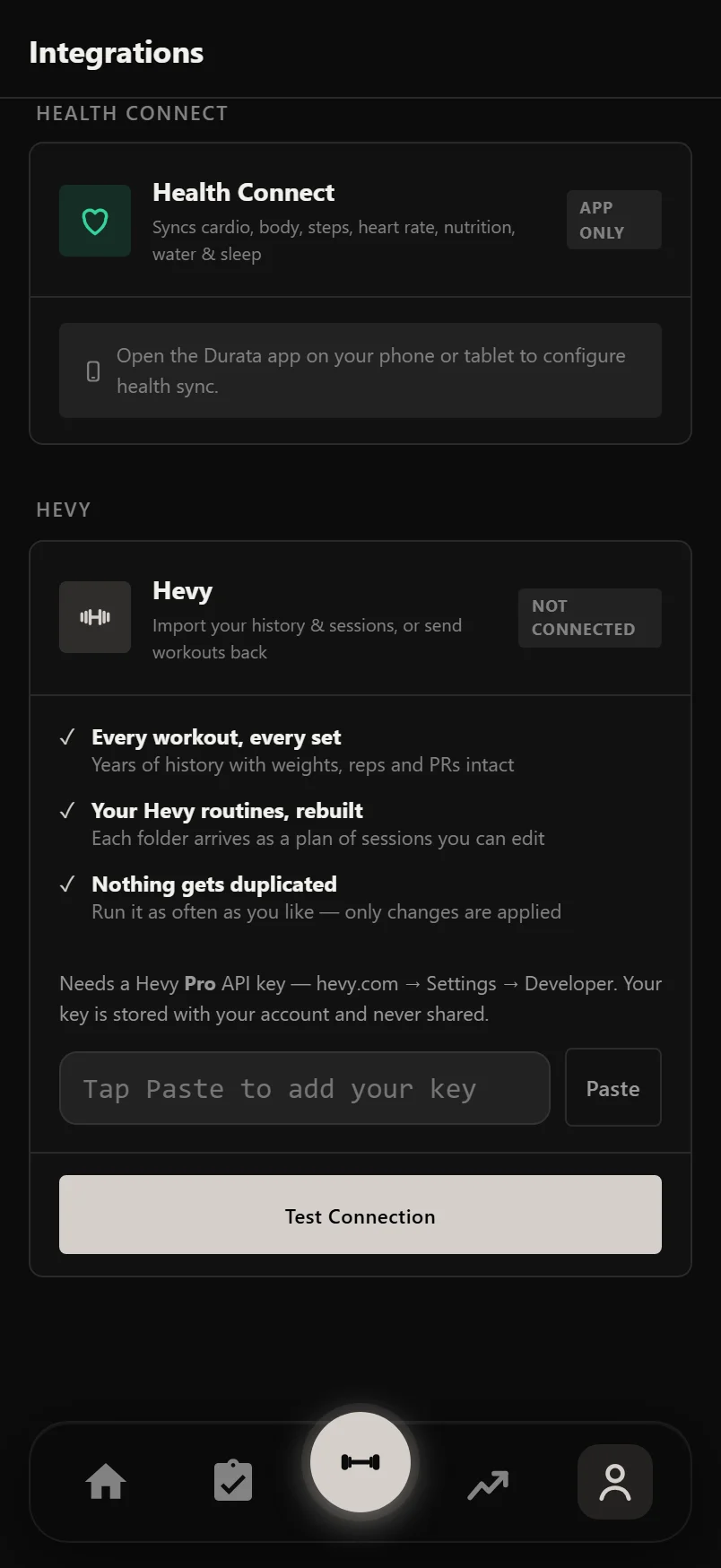
Get your key from Hevy's website: sign in at hevy.com, then Settings → Developer, and generate an API key. It's available on Hevy Pro accounts. Copy it, then paste it into Durata in either of the two places that card appears: Settings → Integrations, or the Hevy option inside the import sheet, which the first-run hero opens and which Settings → Data & Export → Import opens later. It is the same card in both, so there is one key field and one place the key is stored. Inside the import it collapses to a single Bring Everything Over, which connects, pulls your history and fetches your routines in one go, then hands you the same Instant Insights reel a CSV import ends on. There's nothing to type: a 36-character key is not something anyone should be re-keying on a phone, so the field takes it straight from your clipboard. The key is stored with your account and never shared.
Tap Test Connection and Durata validates the key and matches Hevy's exercise database against its own library, showing you exactly how many exercises matched before you import anything. Durata's built-in library covers the Hevy catalogue almost name-for-name, so coverage is essentially complete. Nothing is kept until it works: a key Hevy rejects is never stored, and if you already had a working key it stays exactly as it was.
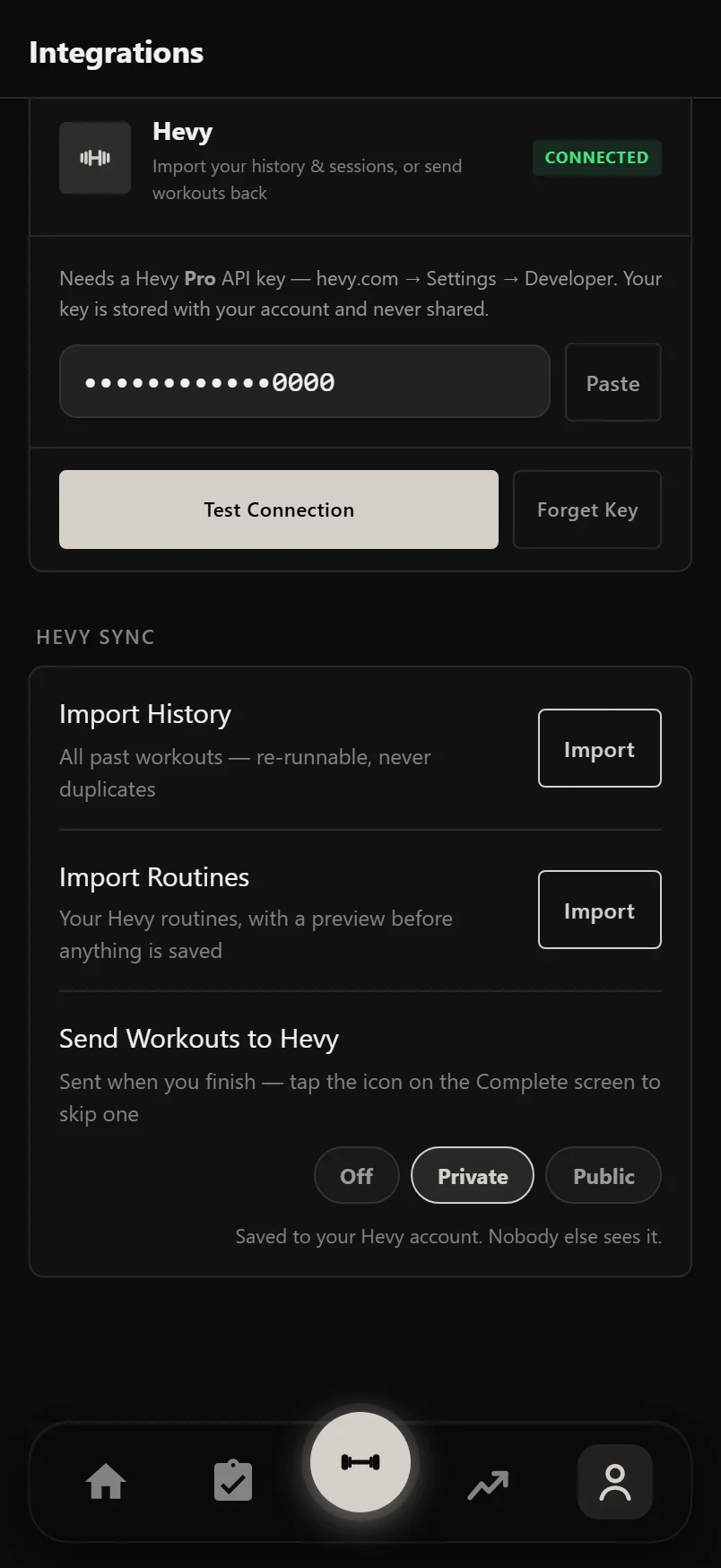
Once a key is stored, the field shows only its last four characters, enough to tell one key from another without leaving it readable over your shoulder, and the Hevy Sync tools appear below the card: Import History, Import Routines, and Send Workouts to Hevy. Forget Key removes it any time.
Importing your workout history
Import History pulls every past workout through the API, oldest to newest, with a progress bar. A long history takes a couple of minutes and can be cancelled and resumed any time, because the import is idempotent: every session is fingerprinted, so re-running it adds nothing twice. Unchanged sessions are skipped, edited ones are updated.
Each workout arrives with its sets, weights, reps, set types, per-exercise notes and workout description. If Durata is new to you and you haven't logged anything yet, it takes the unit from your Hevy log rather than leaving you on its own default. A CSV states which unit it was exported in, and over the API, where every weight is sent as kilograms whoever you are, Durata reads it back off the numbers themselves: 102.06 is nothing in kilos and exactly 225 in pounds. Your weights then land as the numbers you actually pressed, not as conversions of them, and the reel says so and points at the setting. Once you have training of your own, your unit is your decision and nothing but Settings changes it, and an import converts into it as before. When it finishes, a summary shows what was added, matched and created.
Imported history powers everything the same way logged history does: PRs, e1RM trends, muscle analytics, the PREV column in the logger. The one deliberate exception: imported sessions don't count toward streaks and logged-session milestones, so those stay an honest record of what you logged in Durata.
Importing your routines and folders
Import Routines fetches your Hevy routines and folders and shows a preview before anything is saved. Nothing is guessed silently. Exercises, set prescriptions, rest times, supersets and notes all come across.
Folders come across like for like: each Hevy folder arrives as a plan carrying the folder's exact name, holding the same sessions in the same order. You keep the two levels you had in Hevy, the folder and then the routine inside it, under Durata's names for them. Nothing starts running until you say so: tap Start on the plan and it picks up a week counter, a run report and any progression you add. Import again later and those sessions are updated in place, with anything new filed alongside them.
Routines that were loose in Hevy, meaning not in any folder, come across too, as standalone sessions you tick individually in the preview. When the import lands, Durata asks where you want to start rather than leaving you on a settings screen: every plan it just built is offered a Start, and any loose sessions can be grouped into a weekly plan on the spot. A plan you already have running is named but left alone.
Imported routines arrive as plain, fully editable routines with no progression rules attached. Progression in Durata belongs to programs rather than standalone routines, so to put your imported training on autopilot, group the routines into a weekly program with the program builder. The program's own screen then lets you assign a progression rule per lift, and Durata advances the weights from there.
The CSV route (no Pro required)
In the Hevy app: Profile → settings → Export & Import Data → Export Data, and Hevy sends you a CSV of your workouts. In Durata: Settings → Data & Export → Import, pick the CSV option, choose the file, and the Hevy format is detected automatically, including which unit the weights are in.
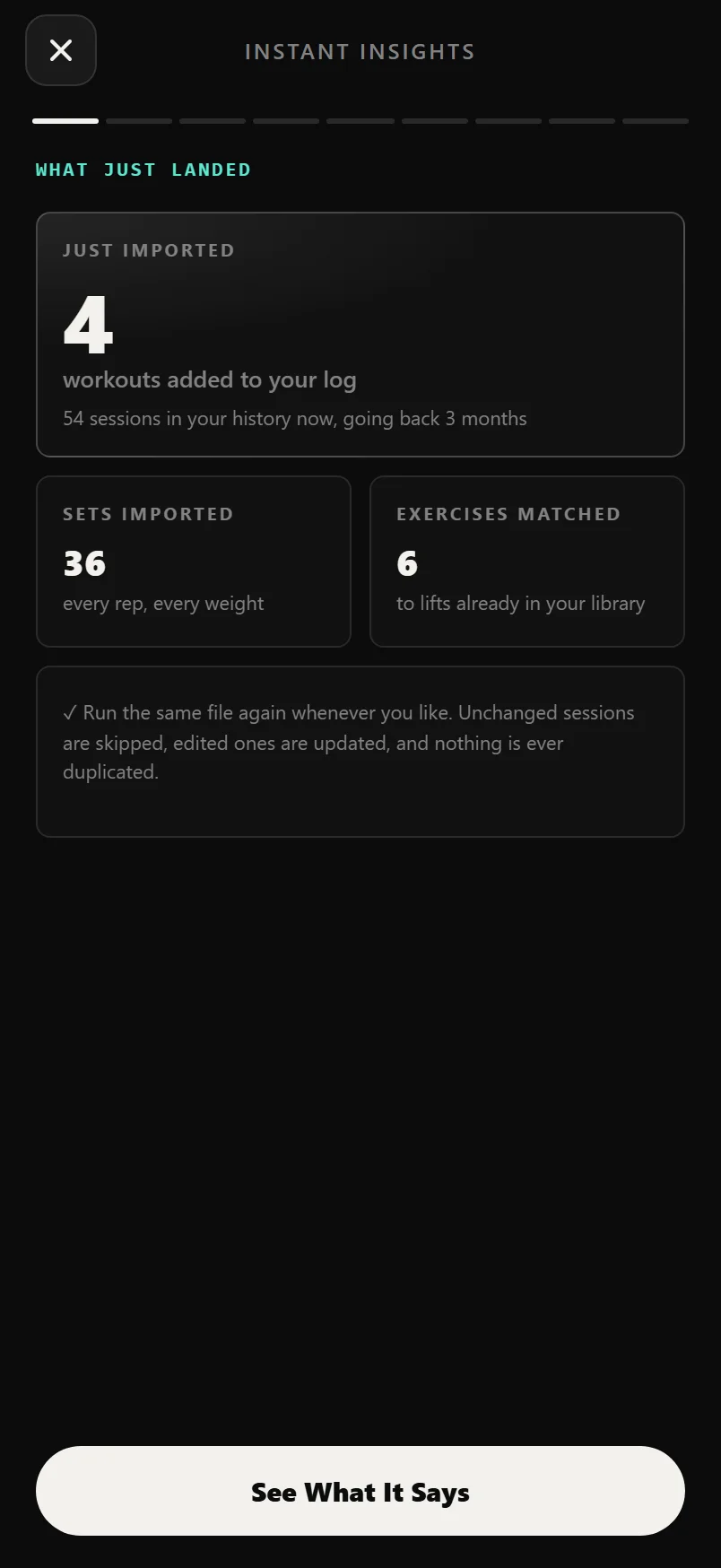
The import opens straight onto the Instant Insights reel, and its first screen is what just landed: workouts added, sets imported, exercises matched, sessions updated, and how far back your history now goes. Rows the file could not state cleanly are counted there too, behind a tap, listed one by one with the reason. Fix them in the source file and re-import, which never duplicates anything.
Your routines are dealt with at the other end of the reel, on its last screen, once you have seen what you actually have. No API key stored? You get Rebuild Your Sessions: the workouts you repeated, each ready to become an editable session built from your most recent performance, with a one-tap Group Into a Weekly Plan handoff to the plan builder. Those sessions move into the plan rather than being copied into it, so rebuilding and then grouping leaves you with one of each and not two, and the builder's last button reads Create & Start: it asks for a start date, and you come out of the import with a plan already running. Hevy's auto-named "Morning Workout"-style sessions are grouped by their exercise mix rather than their title.
If a Hevy API key is stored, that screen skips the guesswork and points you at Import Routines instead. Your actual routines, with their real names and folders, beat any reconstruction from history. Strong and Loadline files always get the rebuild offer; those apps have no routine API to ask.
Run the CSV import even if you plan to connect the API later. Re-importing never duplicates, so there's no harm in starting with the file you already have.
Instant Insights: your history, reflected back
When an import actually adds workouts, Durata opens a full-screen reel built from the history you now have, and that reel is the whole of what an import ends on. There is no separate receipt sheet to get past first. It runs after any import that brings training in, whichever route you took and whichever app wrote the file, including Durata's own export. Re-importing a file you have already loaded adds nothing, so the reel stays shut and you get a short note saying why nothing moved.
Nine screens on a first import, all built from your data and nobody else's. First, what just landed. Then lifetime totals with a strip of every month you trained; a record book of your best heavy sets and when the records landed; the estimated-1RM curve for your most-logged lift across your whole history; a lift race putting your ten fastest-climbing lifts in order of the percentage each one gained; a muscle map showing where the volume actually went; your rhythm, meaning longest streak, most-trained weekday, best month, longest gap and typical session length; and the milestone clubs you are already in plus the next one within reach.
The last screen is where it leaves you, and it is the only place the import’s next steps live: rebuild the sessions you repeated, group them into a weekly plan, pull your Hevy routines across, or explore programs. Whichever you take, the reel closes and hands you straight to it. Done closes it and nothing else happens.
Numbers count up as each screen arrives, bars fill and the trend line draws itself in, the same motion the session-complete screen uses. Turn on Reduce Motion on your phone and every figure is there already, final from the start.
If you have watched the reel before, it gains a screen rather than swapping one out. After what just landed comes a Since Last Time card, showing new sessions, new records, volume added and the lift that has moved most since you last looked. Your lifetime totals follow it, where they have always been. Nothing behind that card is a rerun of what you saw last time either: every screen is rebuilt from your whole logbook on each play, so the sessions counted on the new card are already inside the record book, the trend chart and the muscle map by the time you reach them.
The reel is not single-use, and it is not only for people who arrived by import. Play it any time from Progress → Workload → Play, and it redraws against everything you have logged since, each time opening on what has changed since you last watched it.
On a wide browser window the reel lays its cards out across the full width rather than a phone-shaped column, and its charts redraw if you resize the window.
Sending workouts back to Hevy
Not everyone leaves outright. Maybe your coach reads Hevy, or your training partners follow you there. Send Workouts to Hevy has three settings: Off (the default, and nothing is sent), Private (each finished workout is saved to your Hevy account, visible to nobody else), and Public (posted to your Hevy followers' feed). Public is never a default and can only be chosen deliberately, in Settings.
With sending on, every workout you finish in Durata is posted to Hevy automatically, with sets, weights, reps, notes and supersets included and Durata's richer set types translated to Hevy's (an AMRAP set becomes a Hevy failure set). The Complete screen shows a sync icon per workout; tap it to skip sending just that one.
Edit a workout later and History flags it: that session's Hevy badge reads “Hevy · edited”, so you can tell at a glance that Hevy's copy is behind. Resend to Hevy from the ⋮ menu sends the corrected version. Hevy has no update API, so it lands as a fresh copy rather than replacing the old one, which is yours to delete in Hevy. Workouts you imported from Hevy are never sent back, so nothing can loop.
The Settings row under the visibility pills tells you in plain terms what the current choice does before the first workout goes out.
Common questions
Do I need Hevy Pro to switch?
No. The API route needs a Pro key, but the CSV route covers free accounts: export your data from the Hevy app and import the file. You get your full workout history either way; the API additionally brings routines and folders across automatically.
Will running the import twice duplicate my workouts?
No. Every session is fingerprinted, so re-running an import, by API or CSV, skips unchanged sessions and updates edited ones. You can re-run it as often as you like.
What happens to exercises Durata doesn't recognise?
They're imported as custom exercises rather than dropped, and the summary tells you which ones. Everything else is matched to Durata's built-in library, which covers the Hevy catalogue almost name-for-name.
Do imported workouts count toward my streaks and PRs?
They count everywhere it's about your lifting: PRs, e1RM trends, analytics, the PREV column. They deliberately don't count toward streaks and logged-session milestones, which only ever count workouts logged in Durata.
Can I keep using Hevy alongside Durata?
Yes. Turn Send Workouts to Hevy to Private or Public and every workout you finish in Durata is posted to your Hevy account automatically. If you edit one later, Resend from History sends the corrected version (Hevy has no update API, so it lands as a new copy rather than overwriting the old one).
Is my Hevy API key safe?
The key is stored with your Durata account settings, used only to talk to Hevy's official public API over HTTPS, and you can remove it any time with Forget Key. Hevy lets you revoke a key from their side too.
What is the Instant Insights reel?
A full-screen swipe-through of your own numbers that opens as soon as an import brings workouts in: what just landed, then lifetime totals, a record book, a full-history trend chart, a lift race, a muscle map, your training rhythm and milestone clubs. It opens on what just landed, listing workouts added, sets imported and exercises matched, and finishes on the things that import made possible, which is where rebuilding your sessions and grouping them into a plan now live. It is the only screen an import ends on: there is no receipt sheet in front of it. Play it any time from Progress → Workload → Play, whether you imported anything or not.
Put it into practice
Durata is free to use — 50 proven programs, automatic progression, rest timers and PR tracking, all on your phone.