

Build your own program
Durata ships 50 ready-made programs, but you're never limited to them. The program builder lets you create your own from scratch, with your split, your exercises and your set and rep schemes, and attach automatic progression so the app works out the next weight for you exactly as it does for a built-in program. Once it's built, a custom program behaves identically to any in the catalog: it schedules your sessions, tracks your progress and puts the weight on the bar.
This guide walks through creating one end to end: setting it up, filling in your training days, and turning on the progression that makes it run itself, plus the shortcut that builds a program straight from routines you've already saved.
Last reviewed 2026-09-15 · matches app v1.0.0.87
Starting a new program
Open Training, tap + in the header and choose Plan. If you've saved any sessions, Durata first asks which way you want to build: Start From Scratch, or From My Sessions, which turns the sessions you already have into a weekly plan. With no saved sessions it skips the question and goes straight to the from-scratch setup.
Start From Scratch opens a short setup sheet that defines the shape of the plan before you add any exercises. Nothing here is permanent; you can change all of it later, so don't overthink the first pass. The two required fields are a program name and at least one training day, and everything else has a sensible default. Give it a name you'll recognise (for example 'My Push / Pull / Legs'), and the builder does the rest of the scaffolding for you.
From My Sessions: a plan from sessions you already have
If your training already lives in a handful of saved sessions, you don't need to rebuild them day by day. Choose From My Sessions and one sheet does the whole job: name the plan, tap the sessions to include, and pick each one's training day, or several days if a session should repeat across the week (a cardio session on Wednesday and Friday, say). Durata defaults to the day the session usually runs where it can, and the next free day otherwise. Set the cycle length in weeks and whether it repeats, then hit Create Plan.
The plan is built from copies of your sessions, so the originals stay untouched in your Library, so editing the plan later never rewrites the session you started from. Cycles longer than a week start as copies of week 1. You land straight in the builder afterwards, where you can tweak individual weeks, add progression or move days around like any other plan you built.
Sessions Durata has just rebuilt from an import are the exception: those <strong>move</strong> into the plan rather than being copied into it. They were reconstructed from your own history moments earlier and exist nowhere else, so copying them would hand you two of everything on your first day in the app. The sheet says which it is about to do, and counts the sessions it names, before you commit to anything. Tick something from your existing Library on that same screen and that one is still copied.
The same picker works on a plan you already have: open the plan, tap Add Session on its Plan segment and choose From My Sessions, and you can bulk-add saved sessions into the week you're viewing, each with its own training day or days. The button reads Add to Plan there rather than Create Plan, and it is the one route for filing a standalone session, since a session's own menu does not copy it anywhere.
Imported your history from another app? After the import rebuilds your sessions, Durata offers to group them into a weekly plan with the training days already inferred from when you actually trained. That route finishes on Create & Start rather than Create Plan: it asks for a start date, so you come out of an import with a plan that is already running.
A session with no day yet is listed under Not placed yet, in a tray under the Plan segment's grid. Tap it to pick a day and it moves up into the grid. Nothing you add silently disappears.
Setting it up
The setup sheet has five things to set. Plan name is how it appears in your Library. Experience level, either Beginner, Intermediate or Advanced, is a label that helps you and others place the program later. Goal picks the training bias: Strength, Powerbuilding, Hypertrophy, Aesthetic, Athletic, Powerlifting or Fat Loss. Training days are the days of the week you'll train in week one. Pick as many as your split needs, and the builder creates one session for each. Length in weeks sets how long a cycle runs before it repeats or ends.
There's also a Recurring toggle. Leave it on for an ongoing program that loops week after week (most strength and hypertrophy plans), or turn it off for a fixed-length block that finishes after its final week, which suits a set peaking or fat-loss phase. Tap Create Plan and the builder opens with an empty session for each training day you chose.
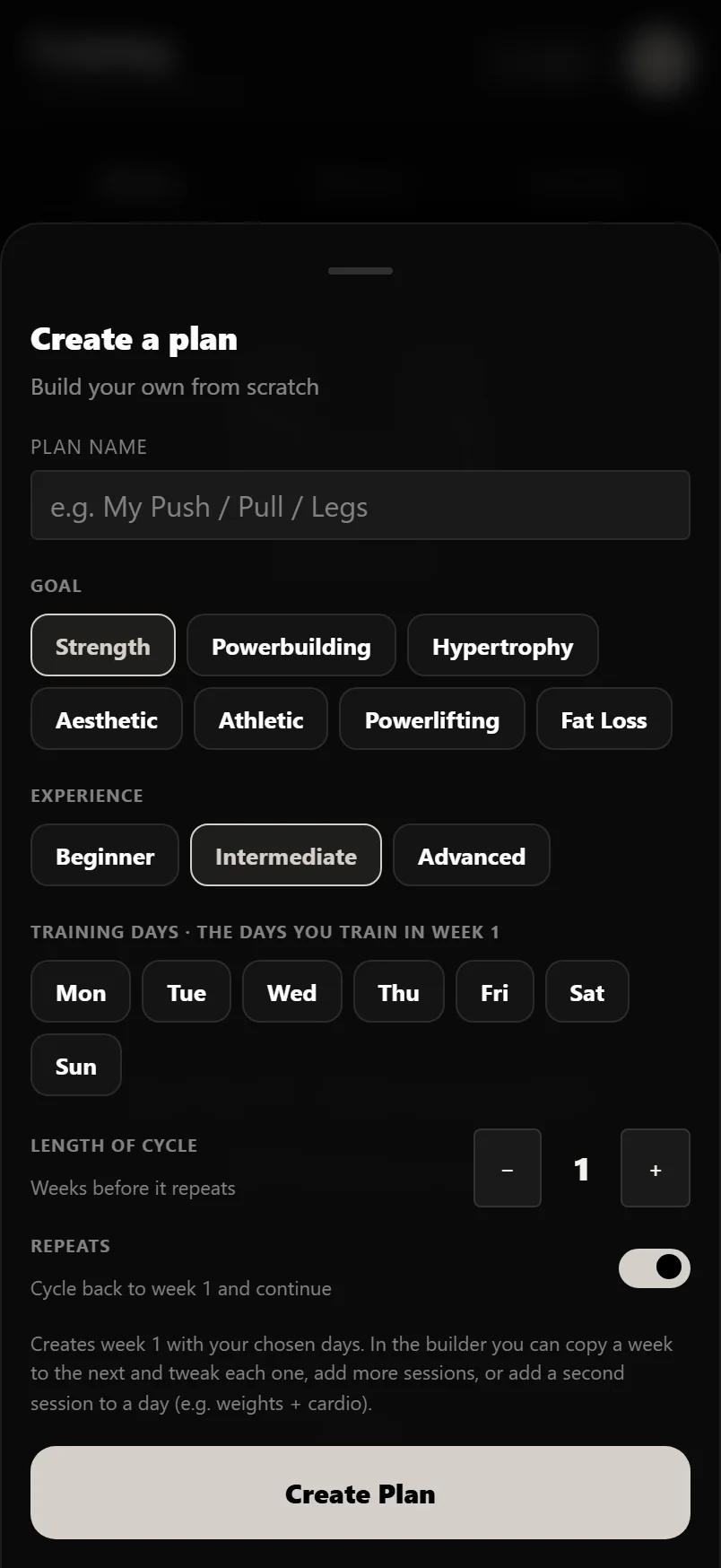
Training days are only the week-one schedule, and you can move sessions around afterwards. Start with the split you know you'll keep (see our guide on choosing a program) rather than the most ambitious one.
Adding exercises to each day
Create Plan lands you on the new plan's screen, with its Plan segment showing a week of empty days. Each training day starts as an empty session. Open a day and add exercises from the full library. Search by name, and every exercise brings its how-to video and form notes with it. For each exercise you set the number of sets and the target reps, just as you would in the logger. Order them how you'll actually perform them: compounds first, accessories after.
As you build, the plan's Volume segment shows how much work each muscle group is getting across the program, so you can spot an over- or under-trained area before you ever run it, so a push-heavy week with no pulling shows up immediately. A volume strip under the week grid moves as you move things, so you get the same signal without leaving the editor. Add, remove and reorder freely until each day looks right; nothing is logged yet, so this is a safe space to experiment.
Turning on automatic progression
This is what separates a program from a plain list of exercises. For each exercise you can attach a progression rule, and Durata then works out the next target for you every session. Linear progression adds a set amount each session, the classic beginner driver. Double progression has you add reps within a range first, then increase the weight and drop the reps back down, which suits accessory and hypertrophy work. Training-max percentage runs the exercise off a percentage of a training max, the model behind percentage-based strength programs. Or leave an exercise on no progression if you'd rather drive it by feel. (These four rules are for programs you build yourself. The richer rules built-in programs ship with, like GZCLP's stage ladders, are shown read-only there so they can't be accidentally overwritten.)
Setting a rule on a plan you built or imported is part of Pro. Programs you start from Discover set their own rules free, and a rule that is already running keeps running: on a free account its button reads View and opens the rule read-only.
Once progression is set, running your program feels exactly like running a built-in one: you open the session, the weights are already filled in based on last time and the rule, you lift, and next session's targets update automatically. You built the plan; the app handles the arithmetic of getting stronger at it.
Match the rule to the lift: linear on your main compounds while you can still add weight each session, double progression on accessories. See our progressive overload guide for why.
Running and editing it
When the program is ready, start it. It becomes your active program, schedules its sessions and shows up on your dashboard like any catalog plan. From there you train: open each day's session, log your sets, and Durata advances the weights for the next time according to the rules you set. Your logged history is kept whatever you change.
Nothing is locked in, and there is one place to change it: tap the plan and its Plan segment is the editor. Press and hold a session to move it to another day (on a desktop just drag it), tap a day to add one, use Copy Week → to take a week's shape across the rest of the block, add or delete weeks, and undo the last command in one tap. You can edit any day, swap exercises, adjust sets, reps or progression, add or remove training days, or change the length at any point, and the program updates without losing your progress. Build a rough first version, run it for a few weeks, and refine it as you learn what fits.
Common questions
How do I create a custom plan in Durata?
Open Training, tap + and choose Plan, then Start From Scratch ('Build your own from scratch'). Set a name and your training days, add exercises to each day and attach a progression rule. Start it and it runs like any program from Discover, with the weights worked out for you.
Can I set automatic progression on my own program?
Yes. Each exercise can use linear progression, double progression, or training-max percentages, and the app then calculates your next target every session automatically.
Can I edit a custom program after I've started it?
Any time, and in one place: tap the plan in your Library and its Plan segment is the editor. Drag sessions between days, add or delete weeks, copy a week across the block, and undo the last command. Change exercises, sets, reps, progression, training days or the program length whenever you like, and your logged history is kept so progress isn't lost. Build a rough version first and refine it as you go.
What's the difference between a routine and a program?
A routine is a single workout (one day). A program is a structured collection of routines across a week or cycle, with progression and scheduling. The builder creates a program and one routine for each training day you choose.
Do I have to build from scratch, or can I copy a built-in program?
Both work. You can build entirely from scratch, or start a built-in program from the catalogue and edit it to taste, swapping exercises and adjusting sets, reps or progression. Either way you end up with a program that's yours.
Can I turn my saved sessions into a plan?
Yes. Tap +, choose Plan, then From My Sessions. Name the plan, tick the sessions to include, give each one or more training days and set the cycle length. The plan is built from copies, so your original sessions stay exactly as they were in your Library.
Can I add a saved session to a plan I already have?
Yes. Open the plan, tap Add Session on its Plan segment and choose From My Sessions, and you can bulk-add saved sessions into that week, picking each one's day or days. That is the one route, since a session's own menu no longer copies it into a plan. The session is copied in, so the original stays standalone in your Library.
Can the same session run on more than one day a week?
Yes. Every day picker in the builder is multi-select, so tap all the days the session should run and confirm. That covers a new session, moving an existing one, and copying routines in, which helps for cardio or conditioning you repeat across the week.
Put it into practice
Durata is free to use — 50 proven programs, automatic progression, rest timers and PR tracking, all on your phone.