

Plans and sessions
A program decides your exercises, sets, reps and weights in advance, so every session builds on the last. Durata ships 50 proven programs with the progression built in. Pick one, set your starting numbers once, and the app calculates every workout from then on.
Prefer to train your own way? The session editor builds any workout from scratch, down to individual set types and percentages. This guide covers both.
Last reviewed 2026-09-15 · matches app v1.0.0.87
Program, plan, session, run
Four words do most of the work in Durata, and they are worth thirty seconds because they are not interchangeable.
A <strong>program</strong> is something we wrote: 5/3/1, GZCLP, PHUL. It lives in Discover, it is the same for everyone, and you cannot edit it. A <strong>plan</strong> is your copy of one. Starting a program copies its whole structure, progression rules included, into your Library, and from that moment the copy is yours: change a lift, move a day, add a week, and nothing about the original moves. It also means a fix we ship to a program reaches people who start it next, not people already running it.
A <strong>session</strong> is one workout: Upper A, Push Day, Legs. A session can stand alone in your Library, or belong to a plan. A <strong>run</strong> is one pass through a plan from start to finish. Run the same plan twice and that is two runs, each with its own report, and both are kept.
Not every plan comes from Discover. Anything you build yourself is a plan too, with the same weeks, progression rules and repeats available to it. That is the whole idea: one kind of thing, whether we wrote it or you did.
Discover says "program" and your Library says "plan" for the same object. Discover lists the published version; your Library holds your copy of it, with your weeks and your weights on it.
The Training hub
The Training hub has three tabs: Library, Discover and Exercises. Library is everything of your own: your plans and your standalone sessions in one list, as one kind of card. Discover is the curated catalog. Exercises is the full exercise library, searchable and filterable.
Library groups your plans under Active, Plans, Saved and Archived, with your standalone sessions under Sessions below them. A plan card carries the verb: Start <next session> when a plan is running, Resume when it is paused, Start Plan when it has never been run, Start Again when it is finished, and Set Your Week when its sessions have no days on them yet. A session card carries what it is: exercise count, set count, a time estimate and, if it belongs to a plan, that plan's name, with when you last ran it underneath. Everything else is on the ⋯ menu, or on inline buttons where the screen is wide enough. Hold any card and drag to arrange the list yourself.
Finishing a plan does not remove it. Its card stays in the list, badged Completed with the date, and the verb becomes Start Again — run the same plan five times and it is still the one card, showing the most recent run. What lives in Progress → History is the runs: one entry and one report each, alongside the rest of your training record.
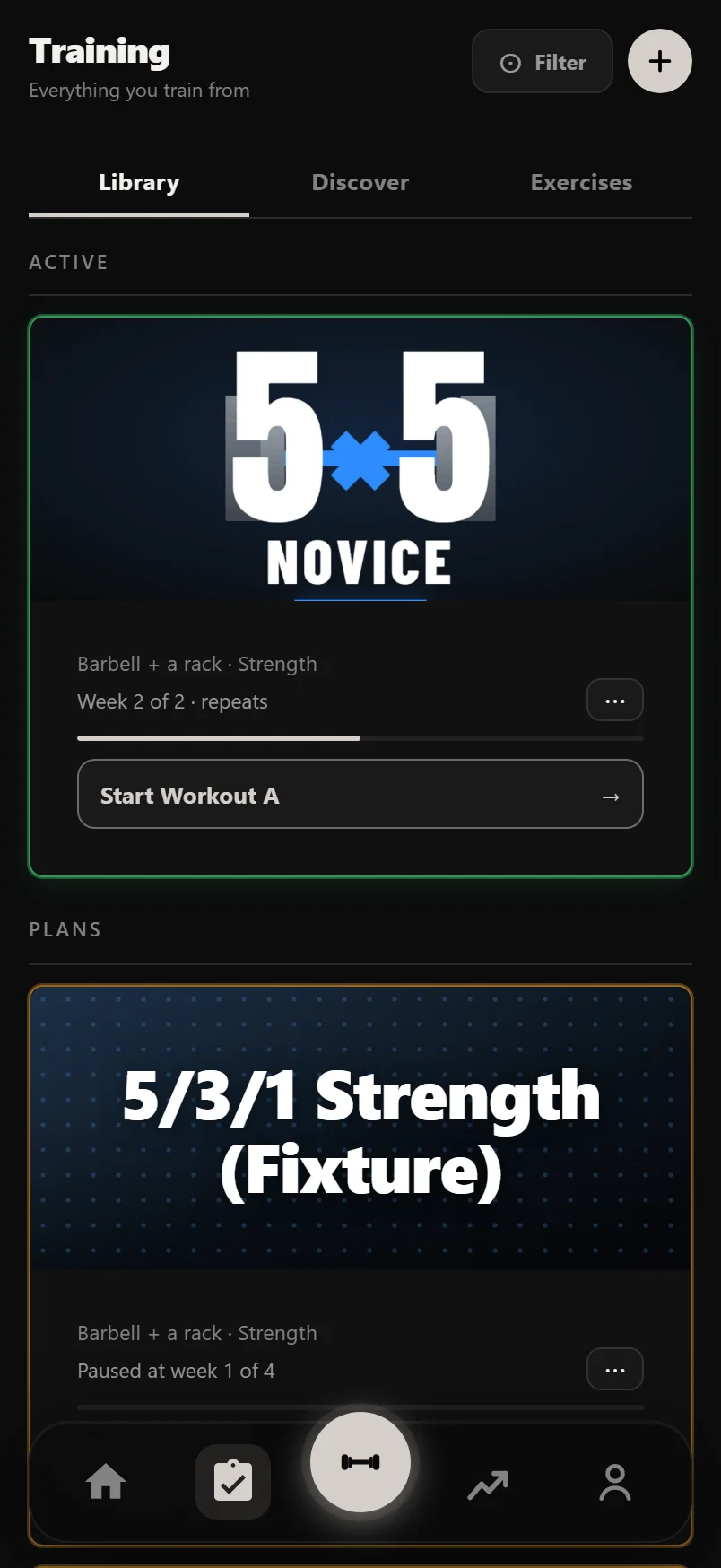
Swipe left or right anywhere in the hub to move between the three tabs, the same gesture as the Progress screen.
The plan screen: one question at a time
Tap a plan and it opens as a screen of its own, the whole window on a desktop and the whole panel on a phone, with a row of segments across the top. They are questions, and you are usually only asking one: <strong>Plan</strong> (what am I doing, and when), <strong>Volume</strong> (what does it actually train), <strong>Progression</strong> (what happens to the weights) and <strong>About</strong> (what is this). Plan is always there; the other three appear only when the plan has something to say through them, so a plan with no progression rules on it gets no Progression segment rather than a tab that says "none" eight times. The segment you pick sticks while you work on that plan, whether you page its weeks, edit its sessions or come back to it later. Every plan you open starts on Plan, with its own week in front of you.
Plan is where you build the block. On a desktop it draws the whole thing, one row per week with seven day columns, and on a phone one week at a time. There the W1 / W2 / W3 chip row is the first thing on the screen, in the same place Volume keeps its own. A dot marks the week you are actually on, and a D marks a deload. Either way the grid is live: move a session to another day of the same week (press and hold it anywhere on a phone; on a desktop just drag it, from anywhere on the tile), tap a day to add a session there, and tap any session for its options. A line above the grid tells you how to move one, and it retires the first time you do: it is a tip, not furniture. Every session reads the same way wherever it is drawn: its name, how many exercises it holds and roughly how long it takes, where the time is your own logged average for that session once you have run it a few times. On a desktop those two facts take a line each under the name; on a phone, where the tile has the width, they share one. On a phone each day is a small ruled header with its sessions beneath it, so a day you train twice reads as one day with two sessions. A day with nothing on it says Rest, with a + to fill it, and a run of rest days shares a single lane with its own + for each day — a rest day reads as a decision rather than as missing data, without costing a row each. Today is marked in the week you are on: the desktop grid tints today's cell, and a phone puts a TODAY chip on the day's header, or on the rest lane if nothing is planned there. Open a plan on a desktop and today's session is already selected, with its details in the panel alongside the grid, so "what am I doing today" is answered before you touch anything. And a session that has no exercises in it yet wears a small Empty badge on its tile, so an unbuilt session and a rest day never read as the same thing.
On a phone the three week commands are icons sitting to the right of the chip row, because that is what they act on: copy this week across the block, remove this week, add a week. Under them is one button, Add Session, and Undo once you have run a command worth taking back. A desktop keeps them as a row of buttons above the block: Add Session, Copy Week → , Add Week, Delete Week once the plan has more than one, and Undo. Each week there has its own column with its own copy and ×. Undo is one level and covers the whole command, so a copy across four weeks comes back in one tap. Repeats, meaning whether the block loops when it reaches the end, lives under Plan Settings on the About segment, with the rest of what the plan is.
Copy Week is the cross-week move, deliberately in place of dragging a session from one week to another: a block is one week repeated with the load moving underneath it, so the useful command is "make the other weeks look like this one". It offers three ways to do that: Day layout (put each week’s own sessions on the same days as this one, changing nothing inside them), Fill empty days only, and Sessions and layout (replace the target weeks with copies of this one). A week with nothing in it always takes a full copy, since there is no layout to apply to no sessions.
A plan with sessions but no days on them gets a pattern chooser instead of an empty grid. Pick a shape, whether evenly spread, weekdays, a back-to-back block, or the shape you used on your last block, and every week of the plan takes it in one tap. An entirely empty plan gets one button instead, Add a Session, and it asks the question that used to be a second button: Start From Scratch, or From My Sessions. If you have no saved sessions to bring across there is nothing to ask, so it goes straight to the new session.
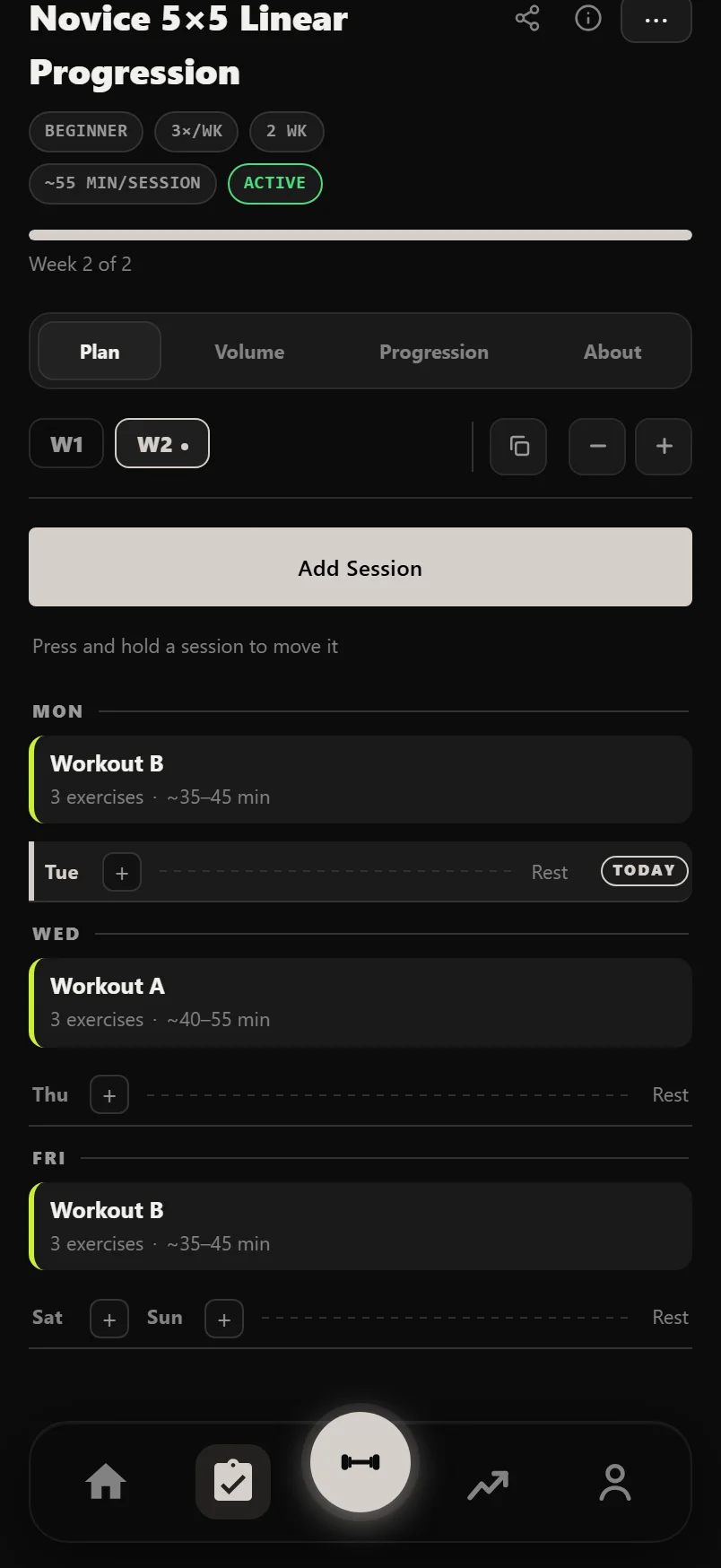
There is one way to edit a plan. The Week builder drawer that used to open over the top of the grid is gone, and everything it did happens on the grid you are looking at.
On a desktop, tapping a session tile selects it and puts its detail in the side panel; tap the same tile again to put the panel back on the week's own numbers. In this session lists what the session actually holds, every exercise in order with its sets, reps and weights, so you can read a session without opening the editor to do it, and it reads the same for a bodyweight or cardio session as for a loaded one. The panel stays with you as you scroll a long block rather than sliding off the top with the first week. A phone has no side panel, so the same reading is on the session's own options under Preview Session. The About segment uses that panel too, for the rating, the program's place on its track, its attribution and the plan's settings, so the description keeps the main column to itself.
Moving a session is within a week by design. To move work between weeks, use Copy Week → : it is the operation a block actually wants, and it undoes in one step.
Discover: the program catalog
Discover holds 50 curated programs: classics like 5/3/1 For Beginners, Boring But Big, nSuns LP, GZCLP, Metallicadpa PPL, PHUL, Texas Method and Madcow 5x5, plus home dumbbell plans, glute specialisation and time-boxed fat-loss challenges. Every card shows cover art, level, days per week, goal and a session time estimate (like "~45-60 min/session"), computed from the program's volume and then replaced with your real average once you've logged enough sessions.
Discover is one list, ranked, whatever you do to it. Left at its default of Recommended, beginner programs come first, then intermediate, then advanced; inside a level the ones asking fewest days a week lead, and names break any remaining tie. Every card carries its own level badge, so you can see where one band ends and the next starts without a heading saying so, and nothing is ever grouped out of view.
A community star rating appears once enough people have rated a program. Search matches names and common aliases, so typing "stronglifts" or "madcow" finds the right program even where the listed name differs. The Filter drawer narrows by level, days per week, goal and equipment (Full gym, Barbell + rack, Barbell + dumbbells, Dumbbells only, Bodyweight or Kettlebells, read off what the program's exercises actually need, so it can't drift out of sync with the programming). Sort adds Days per week, Shortest session, Cycle length and A–Z alongside Recommended (beginner first, then fewest days) and Highest rated, which ranks on a weighted average so one 5-star vote can't outrank a heavily-rated 4.6.
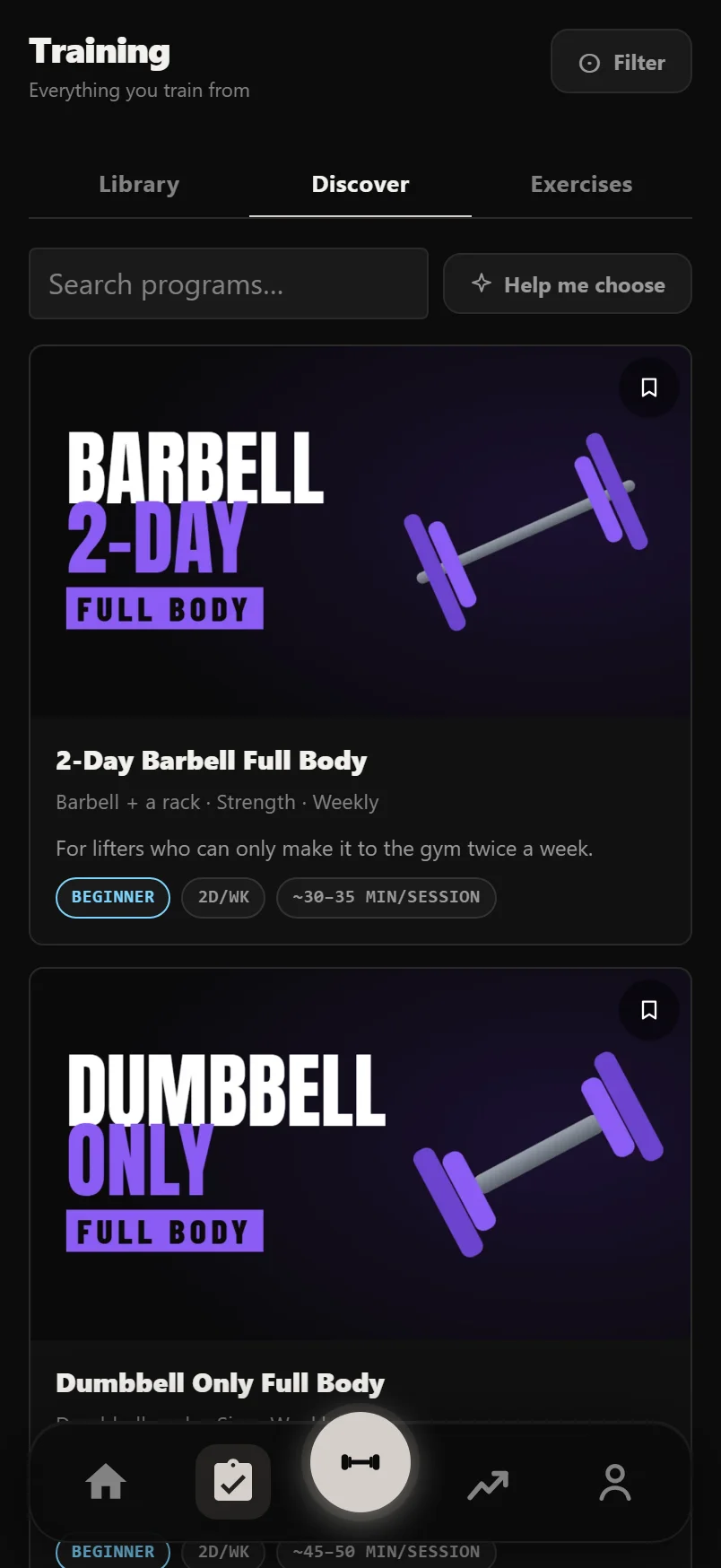
Every star comes from someone who ran the plan, because you can only rate a program you've started.
A program's page carries the same four segments a plan does: About (the facts, your estimated starting weights and a twelve-week projection), Plan (the typical week, then every session), Volume (sets per muscle, and how it compares with your own last four weeks) and Progression (every rule, read-only). See Starting a program for what the two numbers on About mean.
Not sure? Use the Program Finder
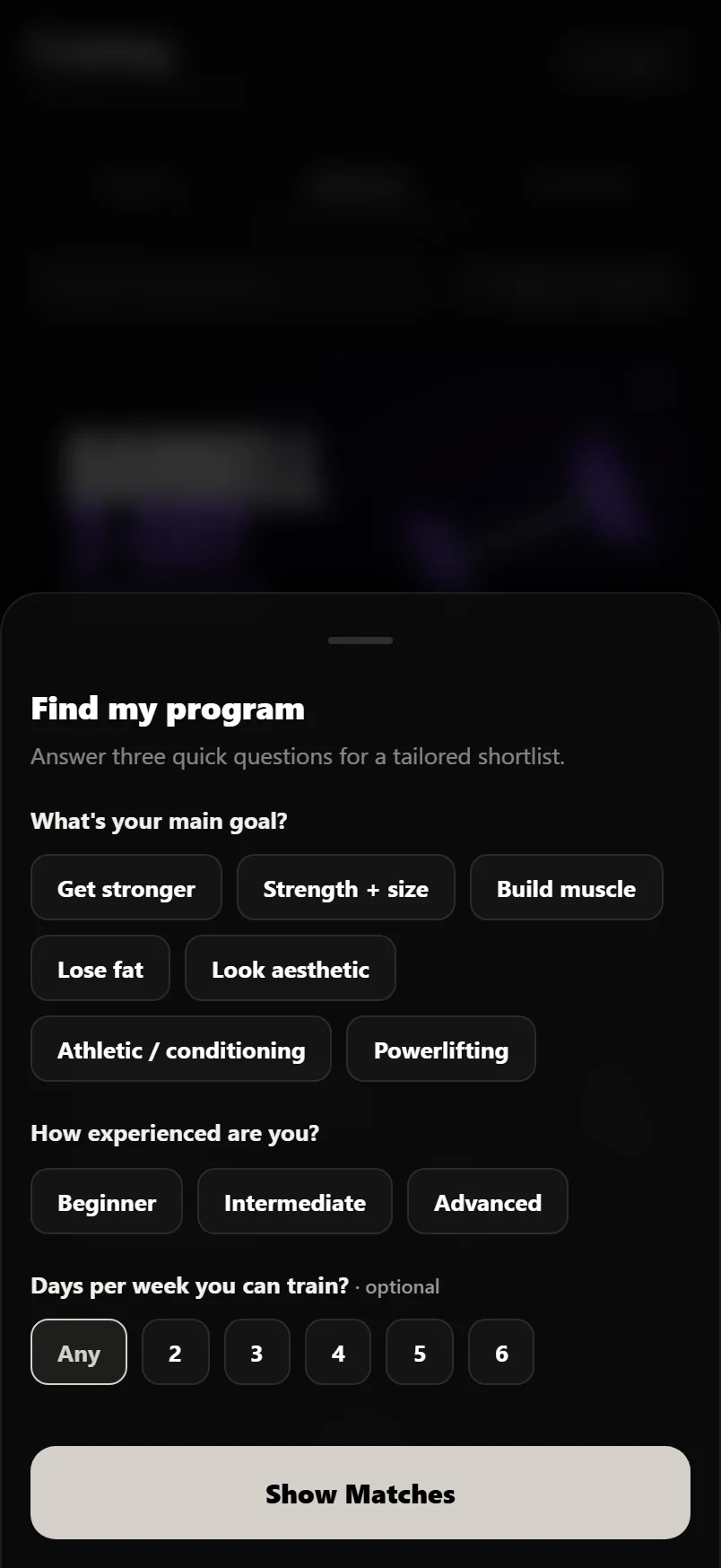
Tap "Help me choose" in Discover and answer three quick questions: your main goal, your experience, and the days per week you can train. The finder scores the catalog against your answers and returns a shortlist, best match badged as Top pick, and it re-ranks instantly if you change an answer. Tap any result to open its detail page and start it there.
How progression works
You never work out the weights yourself. When a program uses training maxes, the app asks for them once at the start, suggesting values from your logged history at 90% of your best estimated 1RM. From then on, every session's targets are computed for you.
There are four main models. Linear progression adds a fixed amount, typically +2.5 kg upper body and +5 kg lower, every time you hit your reps, and drops the weight around 10% after repeated misses so you never stay stuck. Training-max programs like 5/3/1, nSuns and Texas Method work off a percentage of your TM and only bump it when you beat the AMRAP set's target, some per cycle and some per week. Double progression holds the weight until you reach the top of the rep range on every set, then adds. Stage programs like GZCLP don't cut the weight at all: miss your reps and you drop to the next rep scheme on the same bar, so 5×3 becomes 6×2, then 10×1. Only when you run out of stages does that lift start a fresh cycle. Deload weeks are built in where the program prescribes them, and each detail page describes its rule in plain language.
Deloads always move the bar. On a light accessory, 10% can be less than the smallest plate you own, so when the percentage wouldn't change the weight at all, Durata drops it by one full step of your Weight Rounding instead of handing you back the weight you just failed. It won't go below the empty bar on a barbell lift, and it never rounds a lift up: dumbbells, cables and machines keep stepping down.
Progression judges the weight you actually lifted as well as your reps. Log a session noticeably lighter than prescribed and it counts as a miss. Repeat it and the deload steps in, exactly as if you'd missed the reps. Go heavier than prescribed on a working day (within reason) and the app adopts your weight as the new working weight instead of dragging you back. Light days, back-off sets and deload weeks are judged against their own prescribed weights, so a prescribed light day never counts against you.
You can read any lift's rule inside the app, too. Open the plan and choose its Progression segment: it leads with what changes next, the actual weight each lift moves to, off the same engine that will decide it, and folds the rule reference underneath. Every rule row is its own control, so the lift whose rule you want to change is the row you tap. Durata explains each rule in plain language: the stage ladder and what a miss does, the AMRAP target an accessory has to beat, or the percentage wave a fixed-TM block runs. Rules that belong to a built-in program are shown read-only, so you can't accidentally overwrite the programming you started the program for; simple rules on your own custom programs stay fully editable.
The same segment draws the block at a glance: one small chart per lift, a bar per week, the decisive set of each week as a percentage of your training max or as the weight itself. The week you are on is outlined. On a long block there isn't room under every bar for a number, so it prints the ones that fit — always week one, the week you are on, and the last week — and every bar keeps its own figure on its tooltip.
Some linear programs carry a double-jump rule: smash the AMRAP set hard enough (Greyskull-style) and you earn a double-size weight increase that session.
On a long block the week-by-week chart can't label every column. Hold or hover any bar and it names the week, its number, and whether it's a deload.
Curious what happens if you miss? Open the plan's Progression segment. The rule row spells out the success, miss and restart behaviour before you ever have to find out mid-workout.
Skipped the starting-weights step? Progression picks up your working weight from the first session you log, so the lift starts climbing from what you actually lifted.
Need to correct a working weight later, one that drifted or was never set? Open the program's ⋯ menu and choose Working Weights to adjust any lift's starting weight at any time, the same way Training Maxes works for percentage programs.
The block sideways, and days without moving anything
Tap Rotate on the plan screen and the block redraws as a table: Mon–Sun across the top, one row per week, every session in the block on screen at once. It is the same grid a desktop draws, and it is the view for reading a block rather than editing one day of it. Sessions still move between days of their own week: drag one from anywhere on its tile. Dropping onto a day that already has a session asks whether to add both to that day or swap the two days' contents. Moving days never touches exercises or progression.
A session can also get its day without being moved. Anything with no day sits under Not placed yet, below the grid: tap it, pick the day or days it runs on, and it drops into the week. The picker is multi-select, so a conditioning session can sit on Wednesday and Friday at once. Nothing silently disappears, and a plan whose sessions all lack days gets a pattern chooser instead, which gives the whole block a shape in one tap.
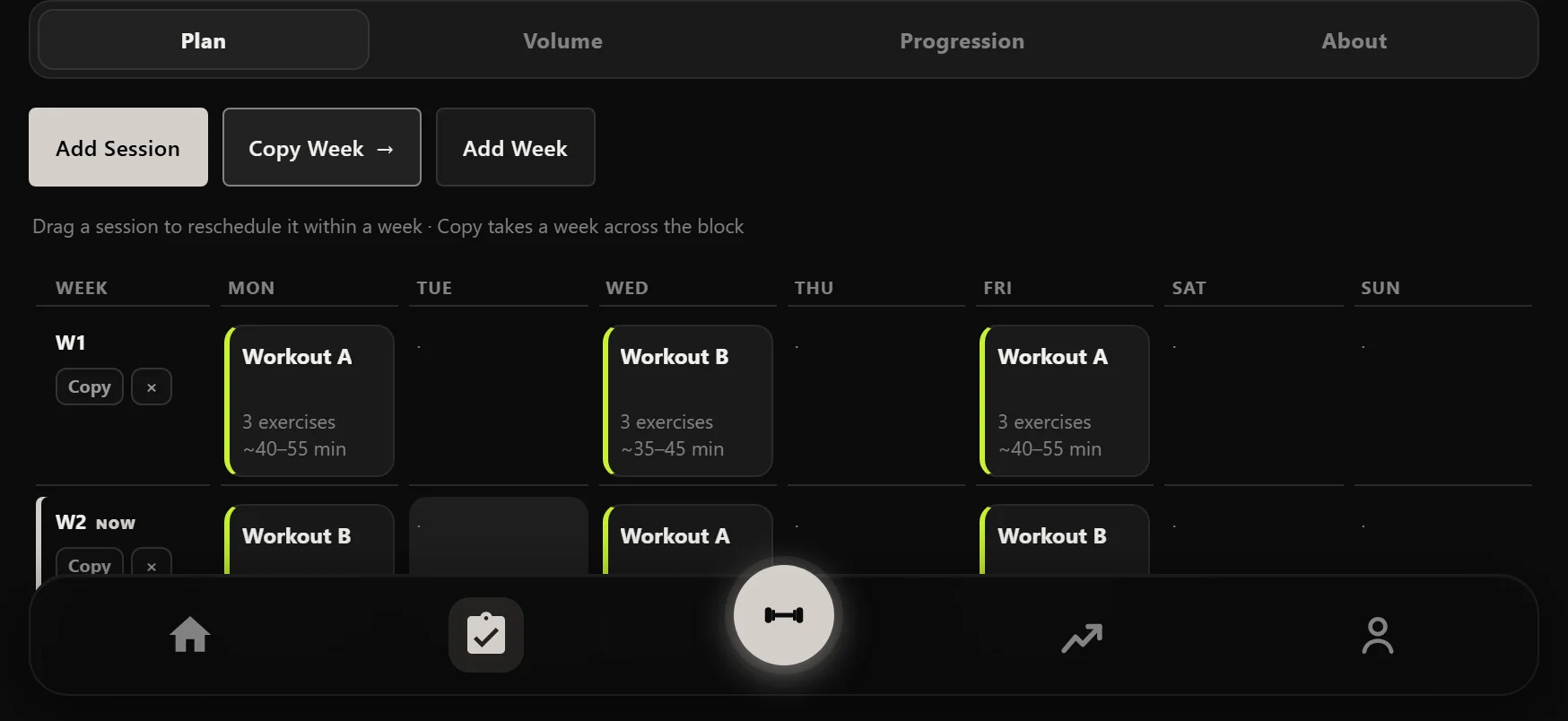
Rotate lives in the plan screen's header, next to the plan's name. It turns the plan you were editing one week at a time into the whole block, weeks as rows, and turning the phone back puts you where you were.
Tap any session for its options: edit it, swap one of its exercises, or move it. Press and hold is the other gesture, and it moves the session itself.
The Report Card
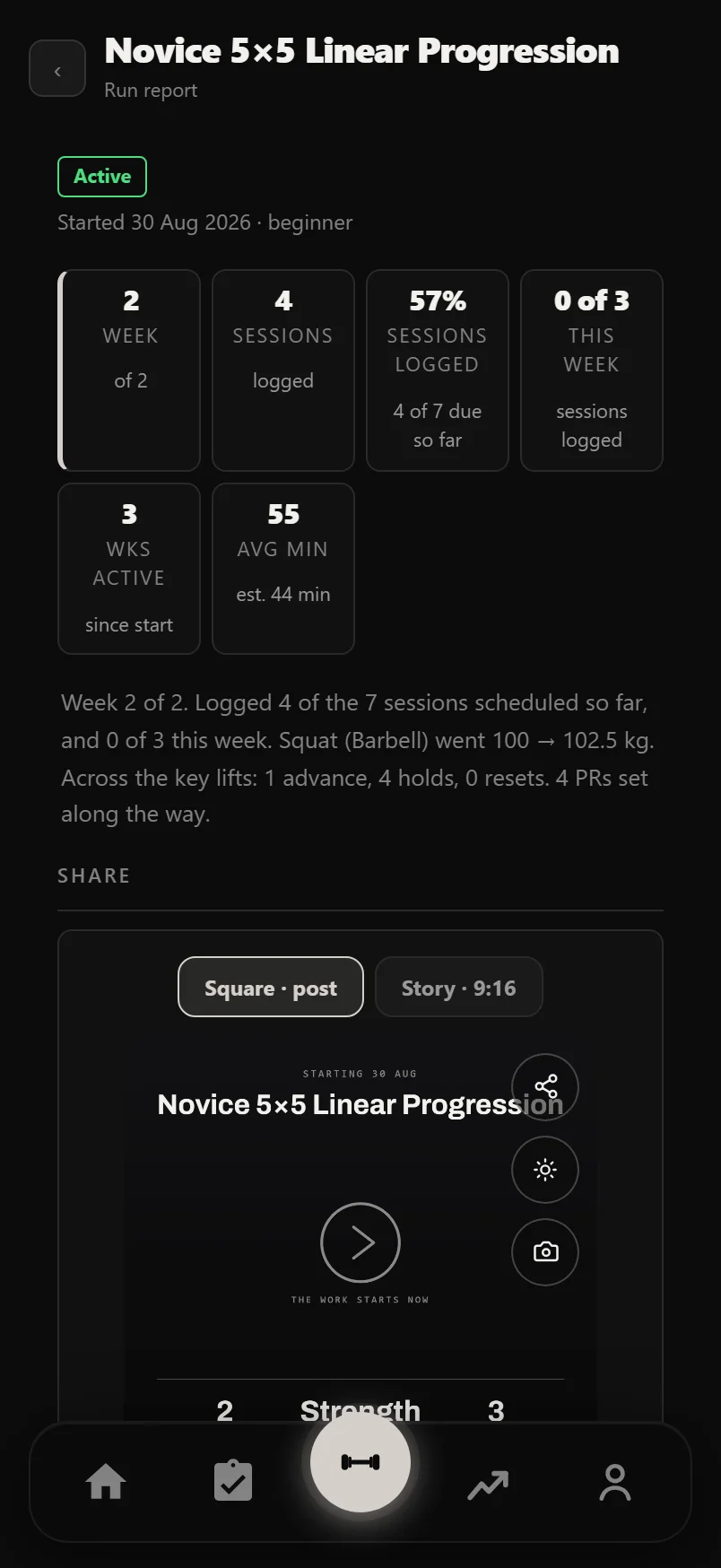
Open a started program's ⋯ menu and choose Report Card: the week you're on, how many of the sessions due so far you've logged (as a percentage with the fraction under it, so 100% on day one means one of one), this week's sessions logged against the week's plan, total volume and completed sets, current training maxes, and a Training Max Progression chart showing each lift climb over the run. A session only falls due once its day is over, so a morning glance never reads as a miss before you've trained. A Sessions Logged by Week chart draws every week's plan as a bar, logged sessions filled in, missed ones greyed, and the running week's remaining days dashed. A short written summary leads the report, and every key lift's trend chart marks each session as an advance, a hold or a reset, so you can see the shape of the run at a glance. The report stays available from History after a program ends.
Further down, PRs During This Run lists every personal record you set inside the run, and Working Weights — First to Last shows each progressed lift's opening and closing weight side by side. If your session times ran long or short against the catalogue's own estimate, that shows up in the top stats too. Finish the program and a What's Next card suggests the next step on its track, when the catalogue has one.
Swapping exercises
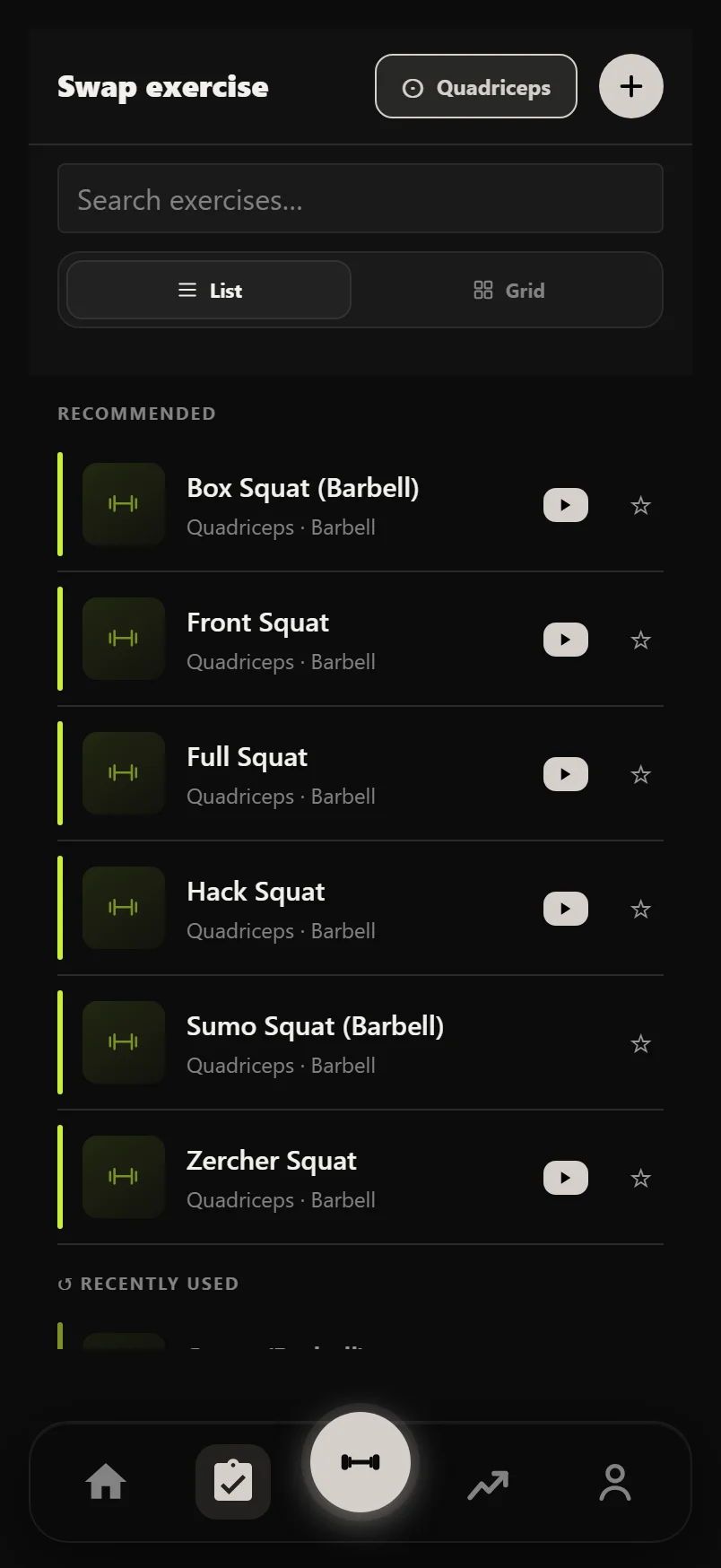
Squat rack taken, or no cable row at your gym? Every exercise line in a program preview has a swap button. It opens the exercise picker with a Recommended section on top, ranking alternatives by how closely they match the original's muscles, movement pattern and equipment, so the substitute still does the same job. The same picker is reachable from the planner (tap a session tile, then Swap an Exercise) and from the routine editor's per-exercise Swap.
Programs repeat their lifts, so after you pick the replacement Durata asks how far the swap should reach: if the exercise appears in several sessions across the program's weeks, an Apply Swap sheet offers This Session Only or All Weeks of This Program. Replace an exercise in the routine editor and the same question appears as an Apply to All Weeks? offer once you've made the change. Either way, any progression or working-weight state the old exercise had carries over to the new one automatically, so the program keeps computing your weights without missing a session.
Start, pause, archive
Starting a program asks for training maxes (if it uses them) and a start date, then it goes live on your dashboard and logger. Program weeks run Monday to Sunday, so the date picker suggests the next Monday for a clean week 1. You can still start today, and it shows exactly which session you'd begin with.
Status reads at a glance from the card itself: an active program's card glows with a green outline, a paused one with amber, and a not-yet-started program keeps the plain border. Multi-week programs show which week you're in with a progress bar; a started single-week plan shows its next session instead, as in 'Tomorrow — Full Body A', so the card always tells you what's coming. The round button over the cover's corner is a one-tap shortcut, with ▶ to start or resume and ⏸ to pause, and the card's progress bar fills with the work you've actually completed rather than the week you're on. When a fixed-length program finishes its final week it completes itself: you get the trophy screen, the run is filed under Progress → History, and the plan stays in your Library as a Completed card you can run again. The ⋯ menu keeps one route per action: Rename Plan and Change Cover (plans you built), Plan Overview (the workout preview), About This Program (ratings and description, for catalog plans), Report Card once it's started, Edit Week (the same Plan segment again, for when the card itself is not the one on screen), Training Maxes or Working Weights depending on how the lift progresses, Start Again once it is finished, End Plan while it is still running, archive or delete. Deleting a plan you have run more than once says so and takes every run with it; the reports in History are kept. Editing the sessions themselves is not on it, because the plan screen you reach by tapping the card is that editor. Archiving a program that's in progress asks first, and archived programs can always be restored.
Building your own sessions
Library holds the sessions you design yourself, listed under Sessions below your plans. Before you have saved any, three starter samples sit at the bottom of the screen, Full Body, Upper and Lower. Tap one to preview it, including the Muscle Coverage map, and one tap on Use This Session makes it yours to edit and run. Start a session of your own from the + button: New offers Session, Plan, Import a Session or Browse Discover. Import a Session reads one workout out of a photo, a PDF page or pasted text, and has a guide of its own. The session editor works like the logger: add exercises, then set each set's type (Warm Up, Normal, Top Set, Backoff, Drop Set, Intensity, AMRAP, Rest Pause, Partials and Unilateral) with reps, rest and weight. Sets can use an intensity percentage of your training max instead of a fixed weight, and cardio sets get a Steady/HIIT tag per interval. Timed holds such as dead hangs, wall sits and side planks swap the weight × reps columns for a single mm:ss duration field.
You don't have to start from a blank page: open any past workout in Progress → History and choose Save as Session to turn a workout you actually did into a template.
A free account builds up to four sessions of its own, and the New Session sheet shows a small counter of how many you have used. Only sessions you build from scratch count: sessions you import, and anything you start from Discover, never do, and deleting a session frees its slot. Pro takes the limit off.
Tap a session card to preview the whole workout before you commit: every set with its type, weight, rest and effort targets, with supersetted exercises joined by colour-coded SS chips. Then hit Start Workout or Edit straight from the preview. Every exercise row carries a Setup button: it opens the same sheet the logger uses, already quoting the weight that row is prescribed, so you can settle the bench angle, the pin and the plates the night before. A row you have already dealt with shows the button filled in, so the preview tells you what is left to decide. Below the sets, Muscle Coverage shows what the session actually trains: a body map with the worked muscles lit, and a bar for each one counting its planned sets. Warm-ups don't count, and a muscle worked as a secondary counts half. Share as Text on the session's ⋯ menu exports it for a training partner.
Sessions don't have to stay standalone. Build a plan from the + button and you can gather the sessions you've already saved into a week that repeats and progresses, and any session can be copied into a plan you already run. You pick its training day (or several) as part of the flow, and the original stays in your Library. See the Build your own program guide for how both work.
In the reps field, type a range like "8-12" for a rep range, or add a star, as in "5*", to mark the set as AMRAP.
Swipe a set row left to delete it, the same gesture as in the logger. Tapping the set's type badge opens the set-type picker.
On the Muscle Coverage map, swipe the card sideways or tap Front / Back under it to flip between the two sides. The bars travel with the body, so they always match what you're looking at.
Arranging your library
Coming from Strong or Hevy, where you file sessions into folders? Durata has no separate folder: a folder here IS a plan. Anything you would have made a folder for, whether a block of work or a coach's set of days, is a plan holding those sessions, with weeks, repeats and progression available to it if you ever want them. Import from Hevy and your folders arrive as plans, recreated by name with every session filed where you left it.
Moving things works like your home screen: hold a card until it lifts, then drag. This works on plans and on sessions, the same gesture for both, because they are one kind of card. Drop a card where you want it and the order flips to My order so the position sticks. Order plans in the Filter sheet switches between By status, the default, which groups Active, Plans, Saved and Archived, and My order, which is the arrangement you made.
The Filter sheet in the header runs the whole list from one place: search plans and sessions by name, Show plans or standalone sessions or both, switch the View between Active and Archived, narrow plans by state (Active, Paused, Not Started), set Order plans to By status or My order, and sort your standalone sessions. Reset to Defaults at the bottom puts every one of those back.
A session that belongs to a plan is not loose in the list. It is filed under that plan, and its card wears the plan's name as a badge. Only sessions with no plan appear under Sessions.
Hold for a beat to lift, then drag. A quick flick still scrolls the list.
Archive a plan from its ⋯ menu and it takes its sessions with it. Set View to Archived in the Filter sheet to see what is in there, and restore it from the same ⋯ menu. A session you archived on its own stays archived either way.
Duplicate a session from its ⋯ menu to build a variation without touching the original, and Share as Text copies the whole thing out as plain text.
Assigned days, weeks and progression rules are things a plan gives a session. A standalone session has none of them. Put it in a plan with the plan builder's "+ From My Sessions" and it keeps its history when it moves.
Common questions
What is the difference between a program and a plan?
A program is one we wrote, it lives in Discover, and it is the same for everyone. A plan is your copy of it. Starting a program copies its structure and its progression rules into your Library, and the copy is yours to change: swap a lift, move a day, add a week. The original is untouched, and so is everyone else's copy. Anything you build from scratch is a plan too, with the same weeks and progression rules available to it.
What counts as a session, and what counts as a run?
A session is one workout, like Upper A or Push Day. A run is one pass through a plan from beginning to end. A session can stand alone in your Library or belong to a plan; a plan you run twice gives you two runs, each with its own report, and both are kept in Progress > History.
What is a standalone session?
A session that does not belong to a plan. You can build one, start it any time from Workout, and it is logged exactly like any other workout. What it does not get is the things a plan gives a session: assigned days, a place in a rotation, weeks, and progression rules that raise the weight for you. That is the whole difference. If you want any of those, put the session in a plan with the plan's Add Session button, which offers From My Sessions, and it keeps its history when it moves.
Durata used to call these routines and programs. What changed?
The names, not your data. What was a routine is now a session, and a folder of routines is now a plan, which means it can carry weeks, repeats and progression rules the way a plan from Discover does. Nothing moved and nothing was rebuilt: the same sessions are in the same places, under clearer words.
Where do I edit a plan?
On the plan itself. Tap the plan’s card and it opens as a screen with four segments (Plan, About, Volume and Progression), and the Plan segment is the editor: press and hold a session to move it to another day (on a desktop just drag it), tap a day to add one, use Copy Week to take a week across the block, add or delete weeks, and undo the last command in one tap. There is no separate builder drawer any more; the grid you are looking at is the thing you change.
Do I have to calculate my own weights?
No. Set your training maxes once when you start a program (Durata suggests them from your logged history) and every session's target weights are computed automatically from the program's progression rule.
What happens when I miss my reps?
Nothing dramatic, and it depends on the program. Linear programs hold the weight and deload 10-15% (whatever the program prescribes) only after repeated misses. Training-max programs hold your TM until you beat the AMRAP target. Stage programs like GZCLP never cut the weight. You drop to the next rep scheme on the same bar, and only after the last stage does that one lift restart its cycle on a fresh weight the app works out for you. Accessory work judges the whole session: get close to the target reps and the weight stays put, fall well short and it drops one plate. Lowering the bar well below the prescription counts as a miss too, because hitting easy reps at a lighter weight never earns an increase.
Can I move my training days around?
Yes. Open the Weekly Planner from any program card and drag sessions between days of the week, or tap a session's day chip in the program builder to move it directly. If the target day is taken, Durata asks whether to stack both sessions or swap the days.
If I delete a program, do I lose my workout history?
No. Deleting a program removes the plan and its scheduled sessions, but every workout you logged stays in your history and analytics.
Can I change an exercise in a built-in program?
Yes. Use the swap button next to any exercise (in the preview, the planner or the routine editor) to pick a replacement. The picker recommends alternatives that match the original's muscles, movement and equipment. If the lift appears in several sessions, Durata asks whether to swap it in that session only or across all weeks of the program, and its progression state follows the new exercise either way.
Can I organise my sessions into folders like Strong or Hevy?
You get the same result without a separate folder, because in Durata a folder IS a plan. Group the sessions you'd have foldered into a plan and they live together, in order, under one card in your Library, with weeks, repeats and progression there if you ever want them. Importing from Hevy recreates your Hevy folders as plans by name, so your library arrives organised the way you left it. Sessions can also carry type tags (push, pull, legs and so on): the plan says where a session belongs, tags say what it trains.
Put it into practice
Durata is free to use — 50 proven programs, automatic progression, rest timers and PR tracking, all on your phone.