

Share cards
Durata turns almost anything you log into a share card: a clean, branded image built for a phone screen. Finish a workout, set a record, complete a program, hit a goal, close out a month, or open a progress photo, and there's a card waiting, drawn from your real numbers, ready to save or post.
Every card is rendered on your device, so nothing leaves your phone until you send it. Most come in a square post format and a tall story format, and most can flip between a dark and a light look. This page walks through the whole set and where each one turns up.
Last reviewed 2026-09-15 · matches app v1.0.0.87
One card system, everywhere
A share card is a picture of a moment in your training. Under the hood there's a single card engine, and every screen that offers a card draws from it, so the wordmark, the typography and the way numbers are laid out stay identical on a single set and on a whole year.
Two controls show up on almost every card. A format toggle swaps between Square (1080×1080, sized for a feed post) and Story (1080×1920, sized for a full-screen story). A light toggle flips the card between the default dark look and a bright paper look, so it sits well against whatever you're posting to. Where a card can carry a progress photo, the photo becomes the background and the numbers sit over a gradient so they stay readable.
Wherever you see a stack of cards, you're choosing between different treatments of the same moment: the same workout as a bold volume figure, a stark statement, a printed receipt or a muscle map. Swipe the stack, pick the one you like, then Save it to your device or Share it straight to another app.
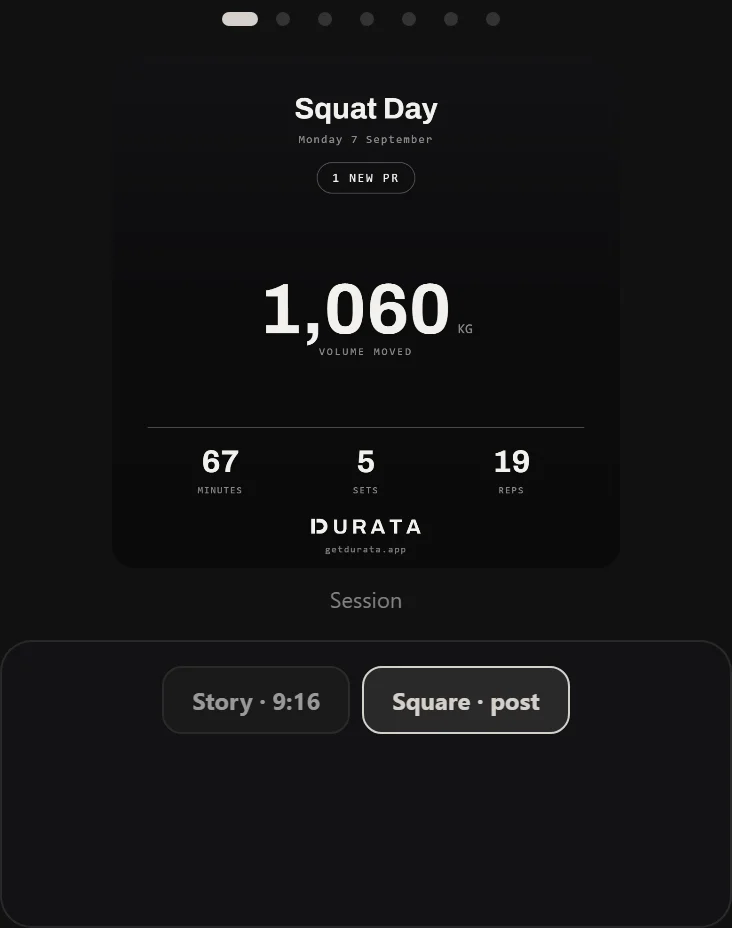
Save writes the finished card to your device gallery; Share hands the same image to your phone's share sheet for any app.
The numbers on every card come from the same engine as the rest of Durata, so a card never disagrees with what History or the PR board shows.
On the web dashboard a shelf browses with the mouse: scroll the wheel over the cards or use the arrows at either edge. Sharing still works best on your phone, where your apps are — the desktop shelf is for looking through what you've earned.
Workout cards
Finish a workout and the Complete screen offers a shelf of cards for that session; the same shelf is one tap away from every past workout too, in Progress → History via the share icon in the header. On the Complete screen the shelf opens on the Photo card: tap it to take today's shot and it fills that card straight away. Behind it sits the core set, always there: a Session card leading with total volume moved, an Achievement card built around your biggest lift, a stark Ink statement, and a Muscle Map that paints the session's work onto a heat body, with harder-worked muscles shown hotter. It shows front and back views, or a single body when everything you hit sits on one side.
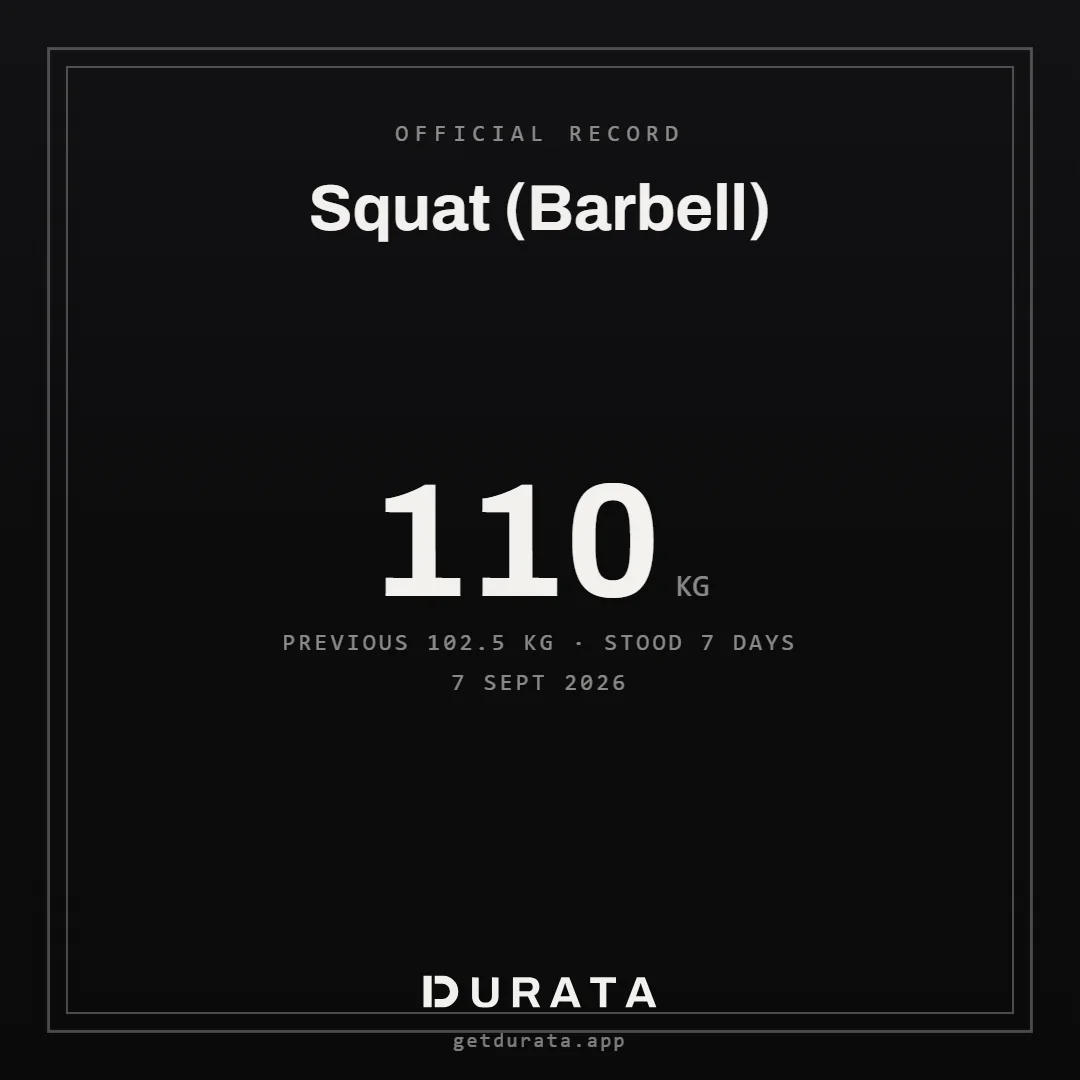
Three more appear only when the session earns them. A Receipt itemises the workout like a till slip, line by line, with a barcode. A Record certificate is minted when you set a personal best, whether heaviest weight, best estimated 1RM or most volume in a session, and it shows the new mark, the one it beat and how long that old record had stood. And a Trend card draws one lift's estimated-1RM curve from your first session to now, with the gain called out.
Every record a session earns gets its own card — a set that beats its weight, e1RM and volume best all at once still gets three separate cards, one per record, not one merged card. Each has a style toggle so you can flip it between a straight Achievement figure and the old-to-new Record certificate framing before you share.
Each card in the shelf has its own light toggle and a camera button to attach or swap a photo. On a card that already has one, that same button also offers Remove — and once the Photo card is holding today's shot, every other card's drawer offers Use Workout Photo, so one capture can ride on any card.
The dots above the shelf show where you are in the set — tap one to jump straight to that card.
Format is per card: the Photo card opens tall as a Story, the rest open Square, and the toggle under the shelf switches whichever card you're on. The stat pills next to it belong to the Photo card alone — swipe to it once it's holding a photo and you can choose which numbers ride along; the other cards have a fixed layout, so there's nothing else to tune on them.
A record doesn't wait for the Complete screen, and it doesn't expire either: the trophy pop-up you get mid-workout, every card on the PR Board, and every Personal Records row inside a past session under Progress → History all carry the same share icon, opening this same gallery scoped to just that record.
Long exercise names get two lines on the Achievement and Record cards rather than being cut short, so a full name like Barbell Bulgarian Split Squat reads in one piece.
Starting a program
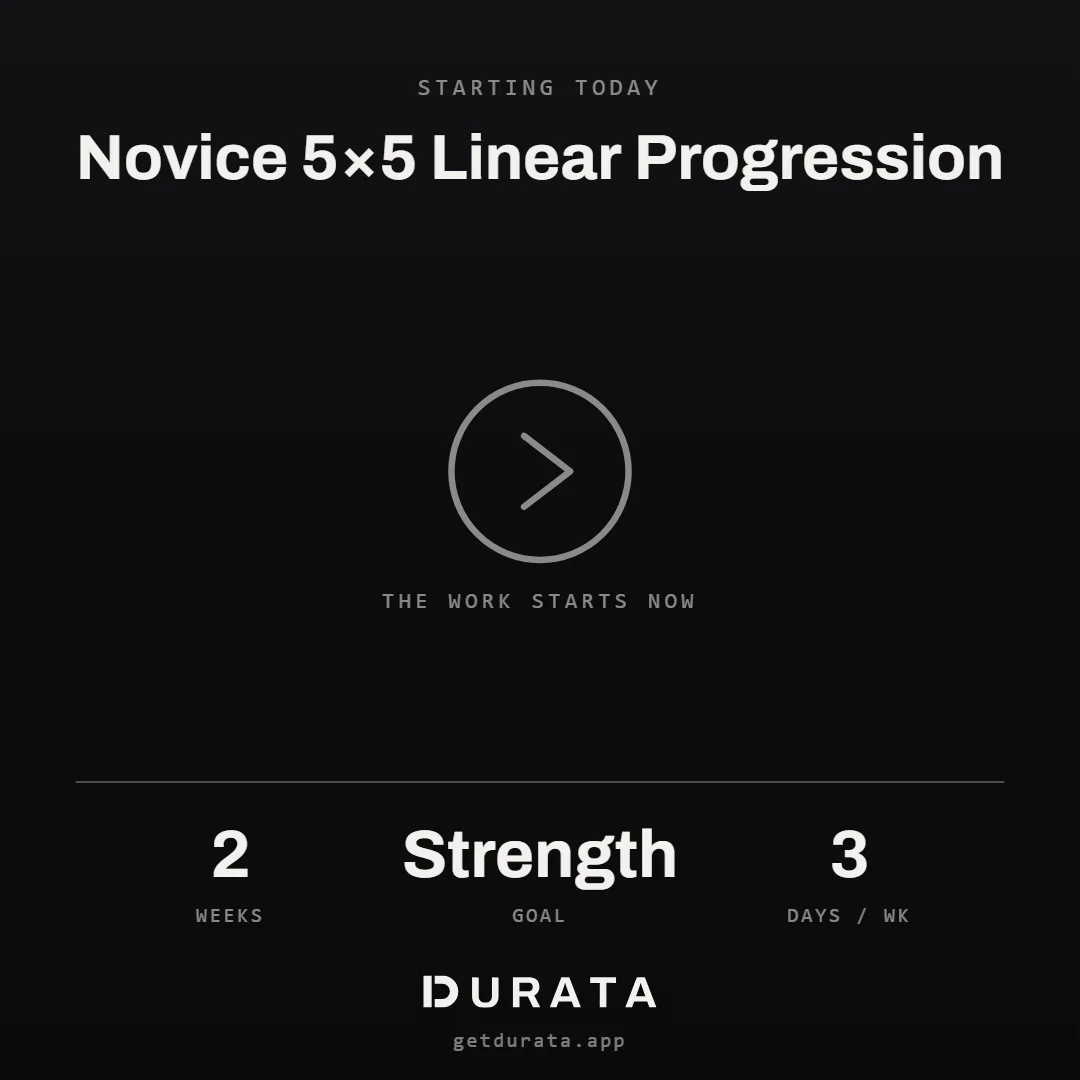
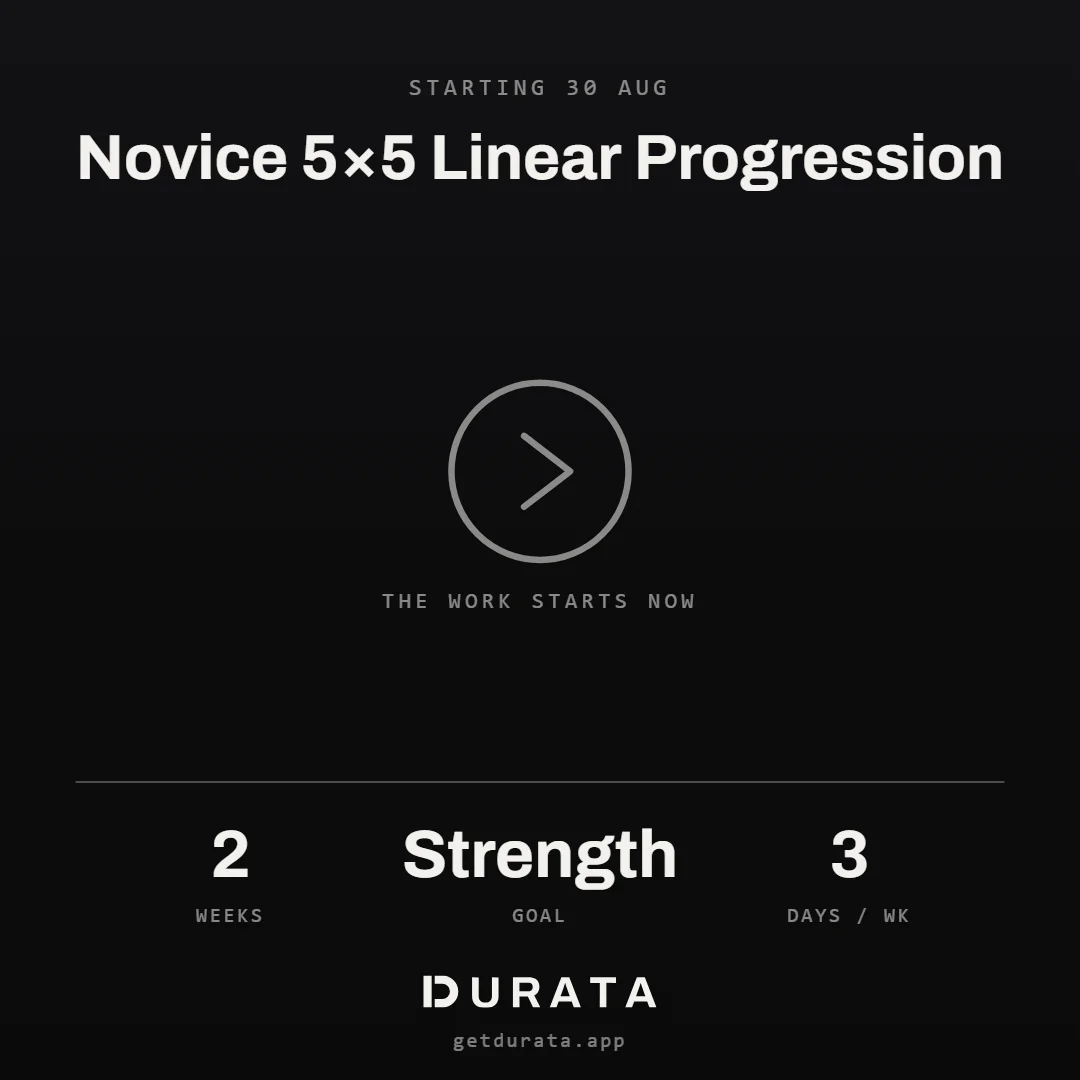
You don't have to wait until the end to share a program. The moment you set a start date, Durata offers a commitment card: the program's name, how long it runs, how many days a week, and what it's for, under a plain "Starting today". It carries no stats, because there aren't any yet. It's a statement of intent, and telling people you've started is one of the simplest ways to stay on it.
The offer appears once when you start, and there's a share icon next to the program's name on its page so you can share the start any time in the first weeks. While the program is still running, its report leads with this same commitment card, and it only swaps to a completion card once you actually finish. This card is not kept in Your Cards, which collects finished achievements rather than sessions you have only begun.
Restarting a finished program - Start Again, on its card in Training → Library - carries your old working weights forward and offers this same commitment card again, the same as starting fresh.
Milestone moments
Some cards show up because of when you trained, not what you lifted. Log your very first session and a Day One card appears on the Complete screen: the date, your volume, one session on the ledger. Come back after three weeks or more away and it's a Comeback card instead - how many days you were off, and that you're back. Both count only sessions you've actually logged in Durata.
Hit a round number of training days in a row - day 50, 100 or 365 - and a streak card joins the Complete screen the same way. Cross a different streak milestone away from a workout, on a rest day, and the dashboard offers the same kind of card in a pop-up of its own, so a streak never goes unmarked just because you didn't just finish a session.
The dashboard mints one more occasional card of its own. On a day worth looking back on, meaning you trained a year (or two, or three) ago today and one of that day's lifts has come up meaningfully since, or you've just crossed a lifetime milestone like your 100th logged session, an On This Day card appears on the board, and its share button opens a then-and-now lookback: the set you did then, the set you do now, the gain between them and the estimated-1RM pair. It exists only when the moment earns it, and it never shows a lift that went backwards.
Like every other card here, each one can carry a photo and flips between dark and light.
Program and goal cards
Complete a program and Durata builds a Program card: the program's name, how many weeks and sessions it took, how many of the scheduled sessions you hit (as a fraction, so the card explains itself), and the total volume you moved across the whole run. If the program tracked its main lifts, a Key Lifts card lists where each one started and where it finished, so a twelve-week block reads as a set of before-and-after numbers. Both wait on the finished program's report, ready to re-share any time.
Reach a goal you've set and a Goal card marks it: the goal, the target, and the day you hit it. It appears the moment a pinned goal crosses the line, and it's waiting on the goal itself whenever you want to share it later.
Monthly and yearly recaps
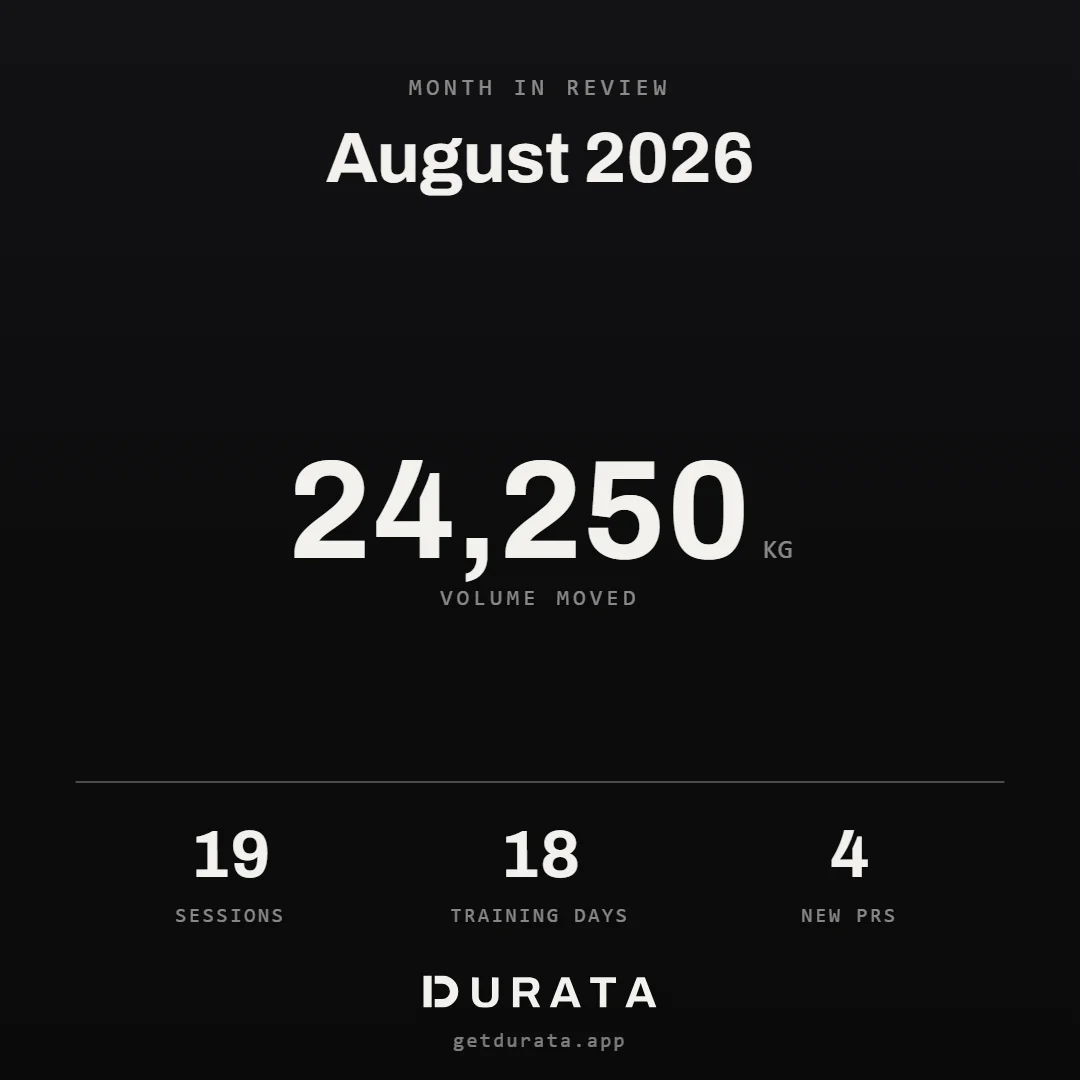
Review, the first tab of Progress, turns any month or year you trained into a report, and every report opens with a Recap card. It leads with the volume you moved over the period, with sessions, training days and PRs beneath. There's a stark Ink version of the same recap for a different feel, and on a month you also get a Calendar card: the month drawn as a grid with every trained day inked in.
A yearly review can add a Top Lifts card for the whole year - every tracked lift's estimated 1RM from January to December. Once your logbook spans more than one calendar year, the All Time view builds its own set: a recap labelled with your actual span, a lifetime iron card with your total volume as the headline, Top Lifts running first to last across your whole history, and a muscle map of everywhere those sets went. Every other report gets a Milestone card: your current streak if it's a week or longer, or your lifetime sessions and longest streak if it isn't. Recaps and milestones only count workouts you logged in Durata; imported history still adds to your volume, but it never mints a badge.
You don't have to open Review to share the week just gone. The This Week strip at the top of your dashboard has a small share icon next to its heading: tap it and the week's recap card opens in the same sheet, ready to post, with a stark Ink version alongside it. It's the quickest way to share a week without leaving the home screen.
The dashboard's week-share icon sits at the top-right of the This Week strip, next to the heading.
Progress-photo cards
Open any photo in the Gallery and it becomes its own share card, full screen. Leave it clean and it's a Ledger: your photo with a tidy line of stats underneath. Turn on a headline number, whether your weight, body fat, or a workout stat if the photo is tied to a session, and it becomes a Hero, leading with that figure at full size over the shot. Flip between story and square, and toggle exactly which numbers ride along. The weight it prints is the one you logged around the time of the photo, not just your latest, so an old shot never wears this week's number.
On the photo viewer, Share sends the finished branded card, while Save keeps the clean original photo (the bare shot with no wordmark or stats) so you get both the shareable version and the untouched picture.
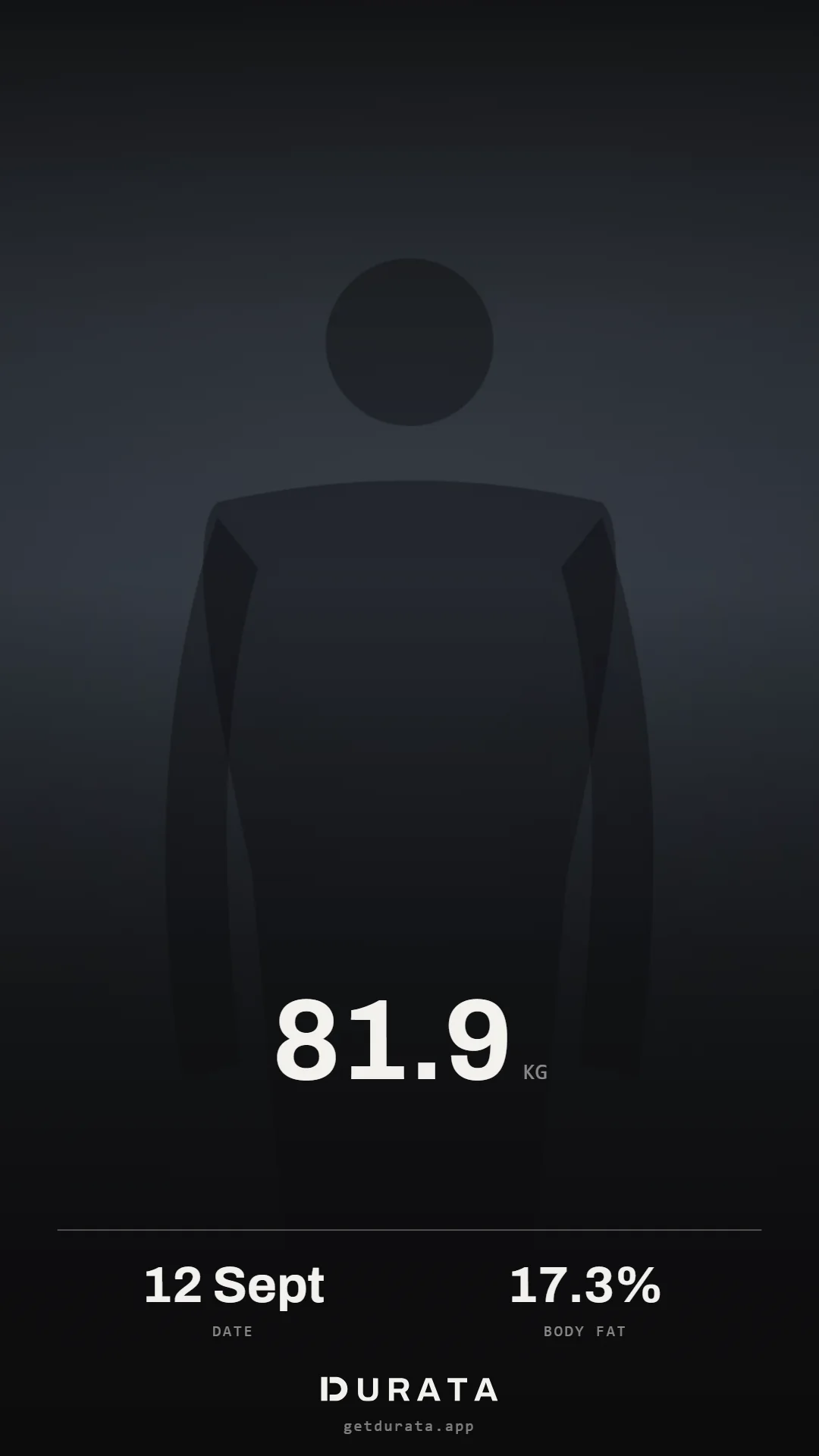
Weight and body-fat remember whether you had them on the last time; the rest reset for each new photo, since not every photo has the same stats to show.
Compare cards
Pick two photos and Durata puts them side by side on one card, oldest on the left, in the same branded language as everything else. It reads out the days between the two shots and, if you weighed in near each one, how your weight changed over that stretch. A Swap control flips which photo is the before and which is the after, and the weight change flips with it.
Both photos are always fitted whole, never cropped or stretched to fill. Save writes the finished compare card to your device gallery, and Share hands it to any app.
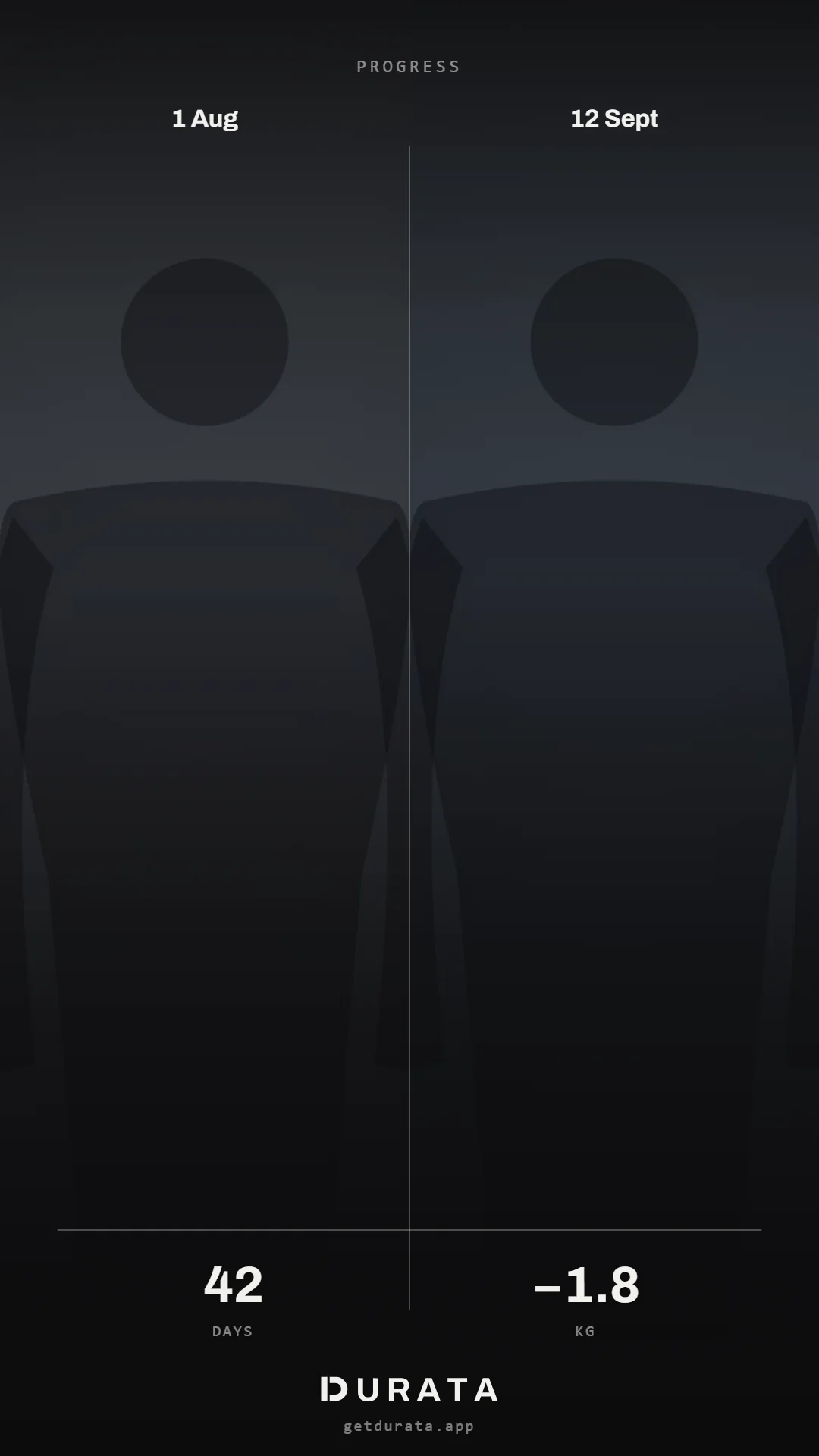
Long-press any thumbnail in the Gallery grid to start a compare, then pick a second photo and the card opens itself.
Time-lapse video
With three or more photos, the Time Lapse button builds a moving one: a crossfading, date-stamped, Durata-branded video of your transformation, framed at 4:5 portrait for social feeds. Drag the trimmer to pick the exact stretch, and a live label shows how many photos and weeks are in range.
Download or Share exports a real video file. On a device that can't encode video, Durata falls back to a branded before-and-after still, so you always get something worth posting.
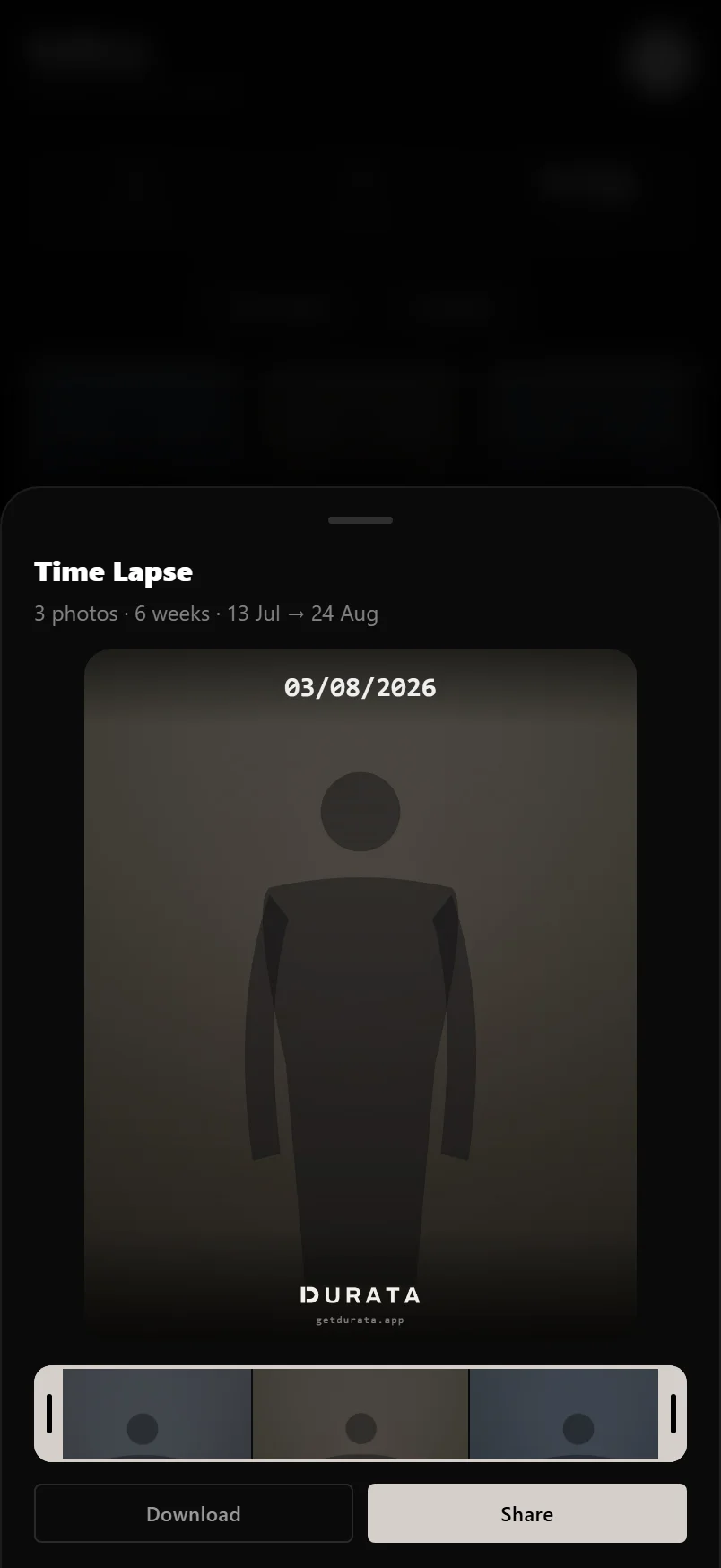
Tap the small preview to play the time-lapse full screen; tap again to return to the trimmer.
Common questions
Do my share cards get uploaded anywhere?
No. Every card is drawn on your device from data that already lives there. Nothing is sent until you choose Share, and even then it goes straight to the app you pick. Durata has no card server.
What's the difference between Save and Share?
Share hands the finished card to your phone's share sheet for any app. Save writes it to your device gallery, with one deliberate exception: on the single-photo viewer, Save keeps the clean original photo rather than the card, so you always have the untouched shot too. The compare card's Save writes the card.
Why do some card styles only appear sometimes?
A card only shows up when the moment earns it. The Record certificate needs a personal best, the Trend card needs enough history to draw a curve, the yearly Top Lifts card needs a program's lift data, and Day One, Comeback and the streak cards only show up on the session (or the dashboard visit) that actually earns them. If a style is missing, that session didn't produce what it needs. The Photo card is the exception on the Complete screen: it always leads the shelf, waiting for today's shot.
Do imported workouts show up on recap and milestone cards?
Imported history counts toward your total volume, but it never mints a PR, a streak or a milestone badge. Recap cards and milestones are built from workouts you actually logged in Durata, so a badge always reflects real logged training.
Can I change how a card looks before sharing?
Yes. Every card flips between a square post format and a tall story format, each remembering its own choice, with the Photo card opening as a Story and the rest as Squares, and most flip between a dark and a light look. Any workout card can carry a photo. Choosing which stats appear is the Photo card's own control, and the one on a progress photo in the Gallery, because those are the cards built around a picture; the rest have a fixed layout. The card redraws instantly each time.
Can I share that I've started a program, not just finished one?
Yes. When you set a program's start date, Durata offers a commitment card straight away, and a share icon next to the program's name reopens it any time in the first weeks. The card shows the program, its length and its goal, with no stats, because nothing's been logged yet.
Put it into practice
Durata is free to use — 50 proven programs, automatic progression, rest timers and PR tracking, all on your phone.