

Review
Review is the first tab in Progress, and the one it opens on. It turns any month or year you trained into a full report. It opens on your most recent completed month, leads with a shareable recap card, then breaks the whole period down: how much you moved, how that compares to last time, every record you set, and where your main lifts actually went.
Everything on the report is drawn from the same engine as the rest of Durata, over the training you already logged. Nothing is estimated for show, and the recap card you share is built from the identical numbers, so what you post always matches what the report says.
Last reviewed 2026-09-14 · matches app v1.0.0.87
One report per period
Open Progress and Review is already showing — it is the default tab, ahead of History, Strength and Workload. It lands on the month just gone, and the Change Period button lists every year and month you have data for, so you can pull up any block of training, not just the latest.
You don't have to go looking for it, though. When a month you trained in finishes, a card appears near the top of your dashboard, the home screen, reading that the month is ready to review with a one-line preview of volume, PRs and top lifts. Tap it and it takes you straight into that month's report. It shows the first time you open the app in the new month and clears itself once you've seen the report.
Reviewing the month in progress is fine too. It's labelled 'so far' and fills in as you train, so you can watch the current period take shape rather than waiting for it to close.
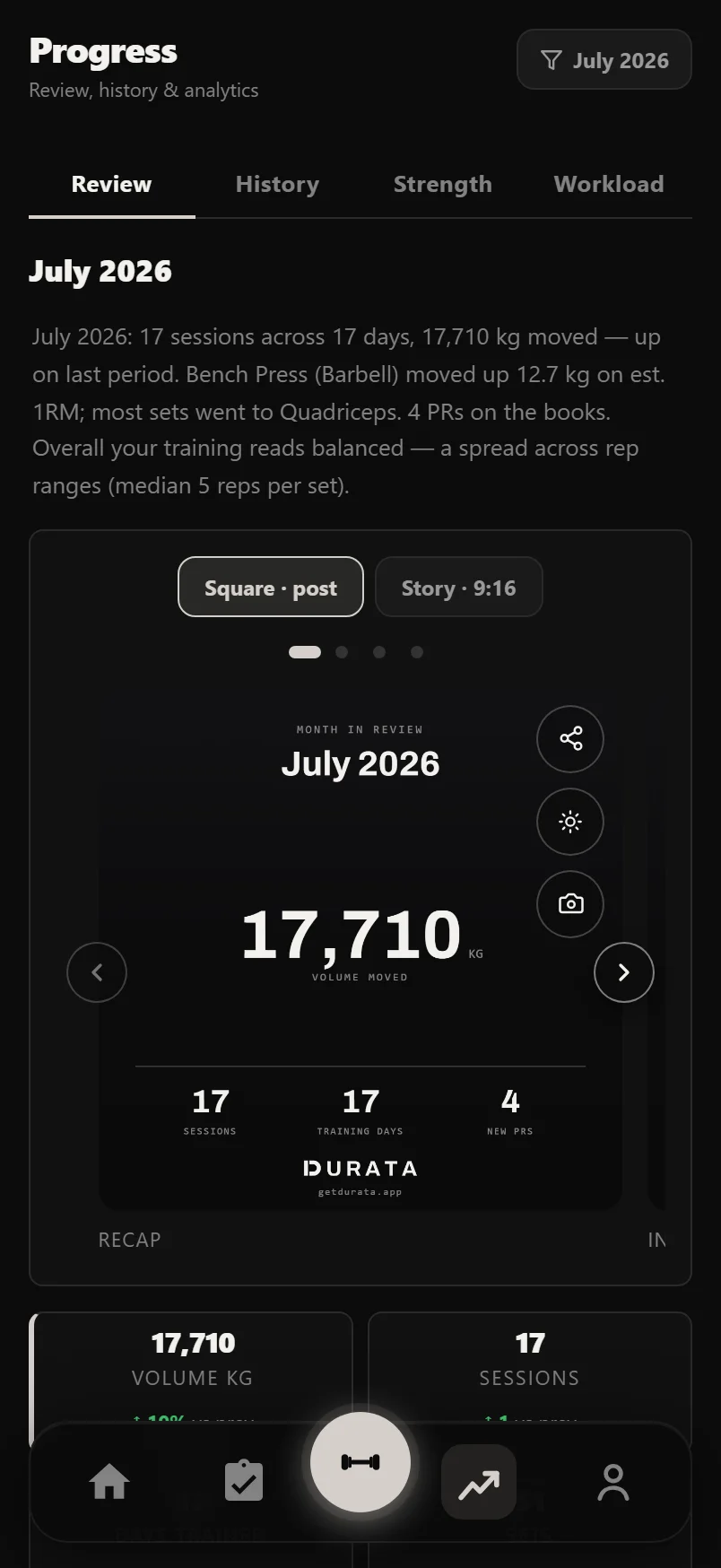
The dashboard's 'ready to review' card only appears when a completed month has training you haven't opened yet, so it never nags you about a report you've already read.
Change Period only lists years and months that actually have logged training, so there are no empty reports to scroll past.
Progress's four tabs swipe as well as tap — a horizontal swipe on the report moves you to History, Strength or Workload without reaching for the tab bar.
The recap card
Every report opens with a recap card, the same branded card you can share from anywhere else in Durata. It leads with the volume you moved over the period, with sessions, training days and PRs beneath. A Recap and Milestone toggle sits above it: Recap is the period's numbers, Milestone marks streaks and lifetime totals as you pass them.
Share This Review hands that card straight to your phone's share sheet, rendered with the period's real numbers. Nothing is uploaded to build it. The card is drawn on your device from the same figures the report below it shows.
Once your logbook spans more than one calendar year, the All Time view gets a shelf of its own. Its recap carries your actual span, Mar 2018 – Sep 2026 for example, and next to the usual cards it adds a lifetime iron card with your total volume as the headline, a Top Lifts card running first to last across your whole history, and a muscle map of everywhere those sets went. While all your training still sits inside one year, All Time skips the shelf, because that year's own report already builds the identical cards.
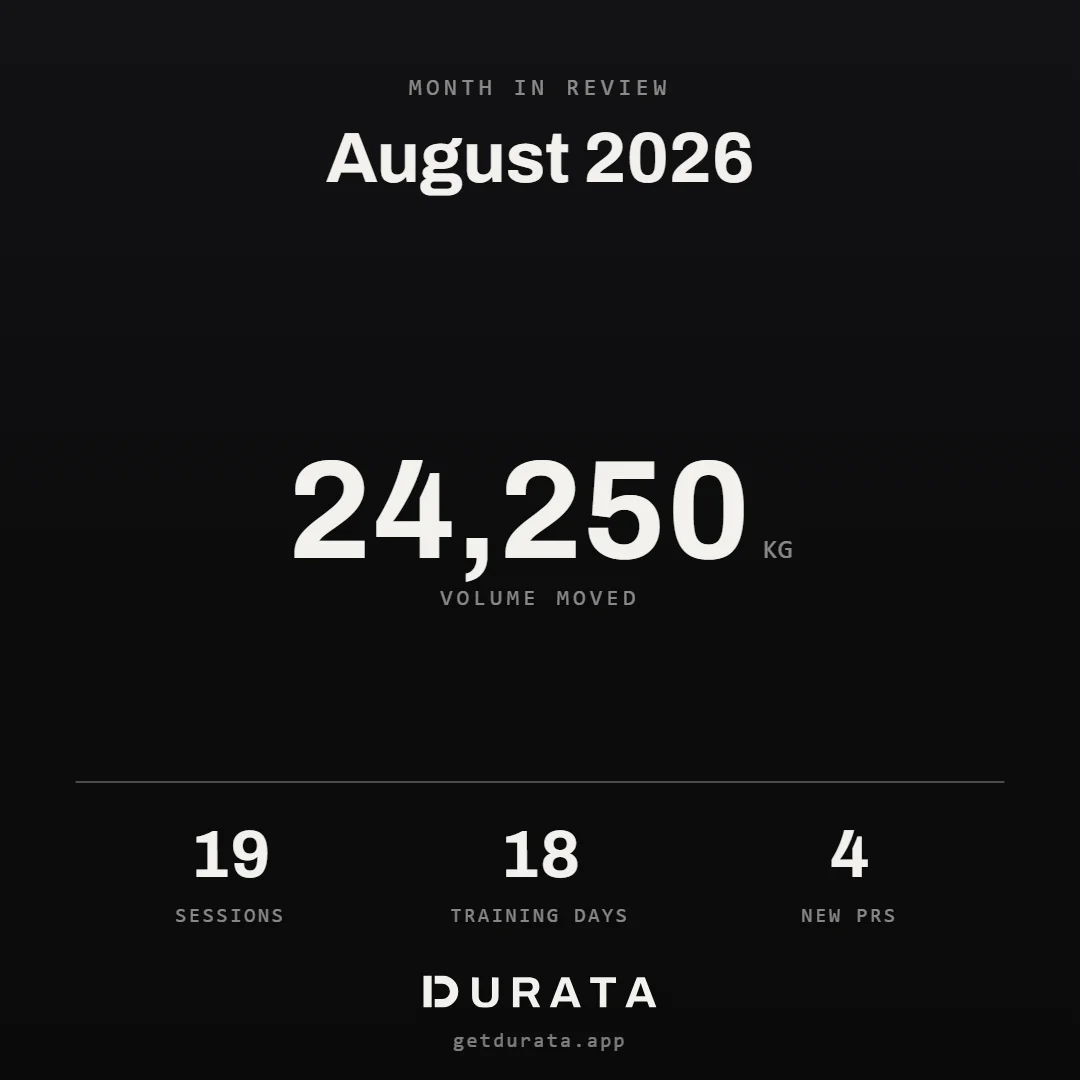
On a year, the toggle can also offer a Top Lifts card: every tracked lift's estimated 1RM from January to December.
The lifetime iron card counts workouts you logged in Durata, the same rule as milestones, so imported history never inflates it.
What the period actually did
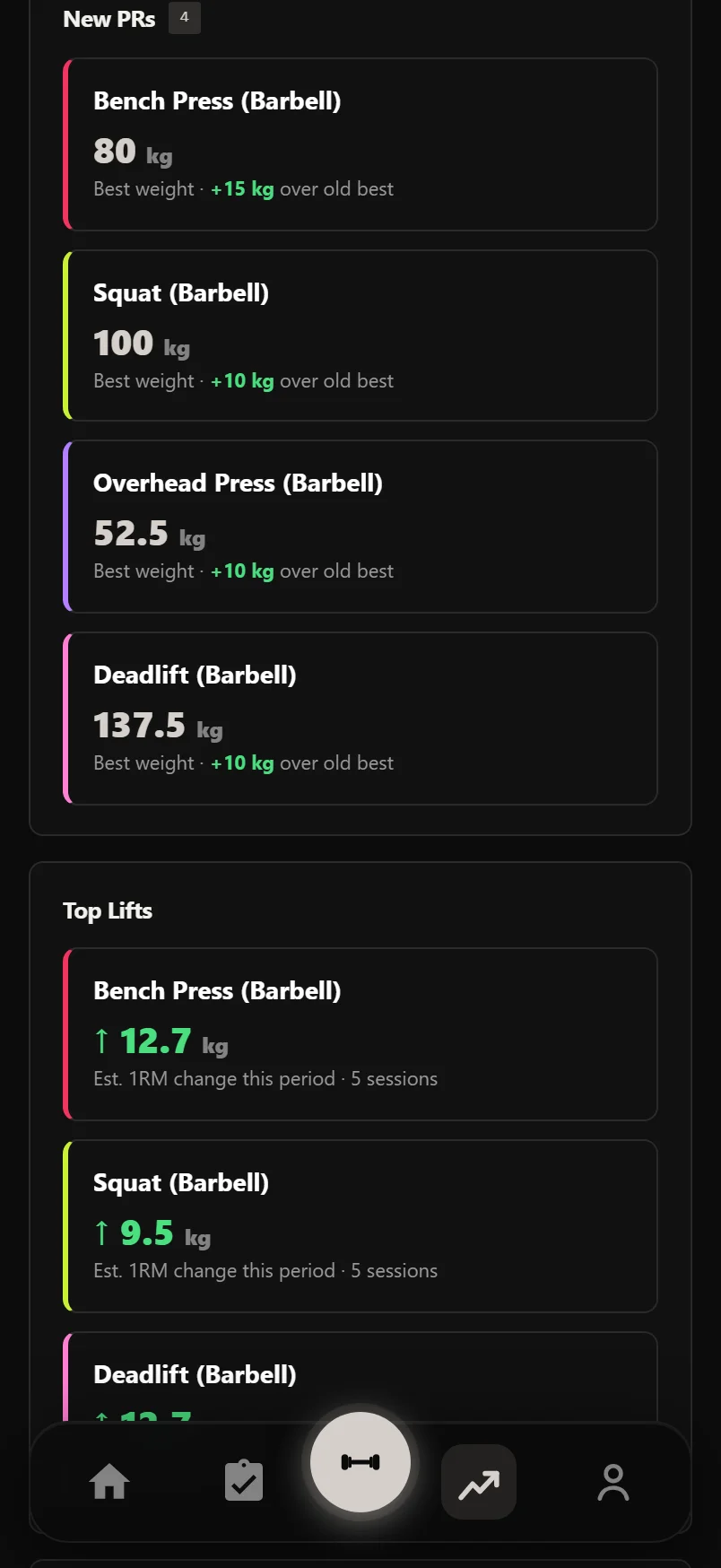
Below the card, the report lays the period out in full. A day-by-day training strip shades every day you trained, so a heavy block and a light one look different at a glance. Volume shows the total moved with a comparison against the previous period, so you can see which way it has gone. New PRs lists every record you set with the mark it beat, and Top Lifts shows your most-trained exercises with how their estimated 1RM moved across the period, which is where real progress shows up.
Muscle Split shows where the sets went, as a pair of body maps - front and back side by side, worked muscles lit - with a ranked bar under them for every muscle the period trained. Nothing to flip: the whole body is on screen at once. Sets count the way they do everywhere else in the app: warm-ups and sets you never completed are ignored, a muscle worked as the primary counts a full set, and one worked as a secondary counts half - so a half set can show as 2.5. If you logged a bodyweight during the period, a Body block shows your start and latest weight and the change between them. A notables block picks out the rest: your biggest single day, your longest session, exercises you trained for the first time, your current streak, lifetime totals, and - when the period has that kind of training - your cardio minutes and your push-to-pull set balance. On a month, any plan you ran is listed too, each showing its real status (Active, Paused, Archived, or Completed), and tapping it opens that plan's own Report Card, the same full breakdown Training's own History gives it.
Pick a year or All Time instead of a month and the Plans list becomes a Timeline: every month with data and every plan you've run, interleaved and newest first, since a year has too many plans to fit a short list. Tap a month row and the report reopens on that month; tap a plan row and its Report Card opens, same as from a month view. On a year the Timeline scopes to that year's own months plus any plan that trained in it; on All Time it runs your whole logbook.
The training-day strip can be shaded by volume or by session count, so you can read either intensity or frequency.
A lift with no estimated 1RM, like a bodyweight or timed movement, shows what was logged instead: total reps or total time.
On the Muscle Split body map, the shading scales to the period's own hardest-worked muscle, so a light month and a heavy year both read clearly instead of coming out all-dark or all-lit.
The Muscle Split bars keep one scale across both bodies - the period's hardest-worked muscle overall - so a light back reads light next to a heavy front instead of filling the row on its own.
The Timeline only shows the 30 most recent rows; older training says how much further back it goes rather than listing it all.
Your Cards: every earned card, all time
Under the report sits Your Cards, a shelf that ignores the period you're viewing and collects every card you've earned across your whole history. Every program you've finished becomes a card here, so does every goal you've reached, and so do the milestone moments — your first workout, streak milestones, a comeback after time away. When Durata pops a card up to celebrate one of these, it saves that exact card at the same moment; this shelf is where it lives forever, so a moment you swiped past months ago is never lost, even if the goal behind it is later edited or deleted.
Each card carries the same share, theme and photo controls as a recap card, so you can re-share any achievement at any time, long after the month it happened in has scrolled away. Your Cards is deliberately not tied to the period: change the period above and the report changes, but Your Cards keeps showing your whole history.
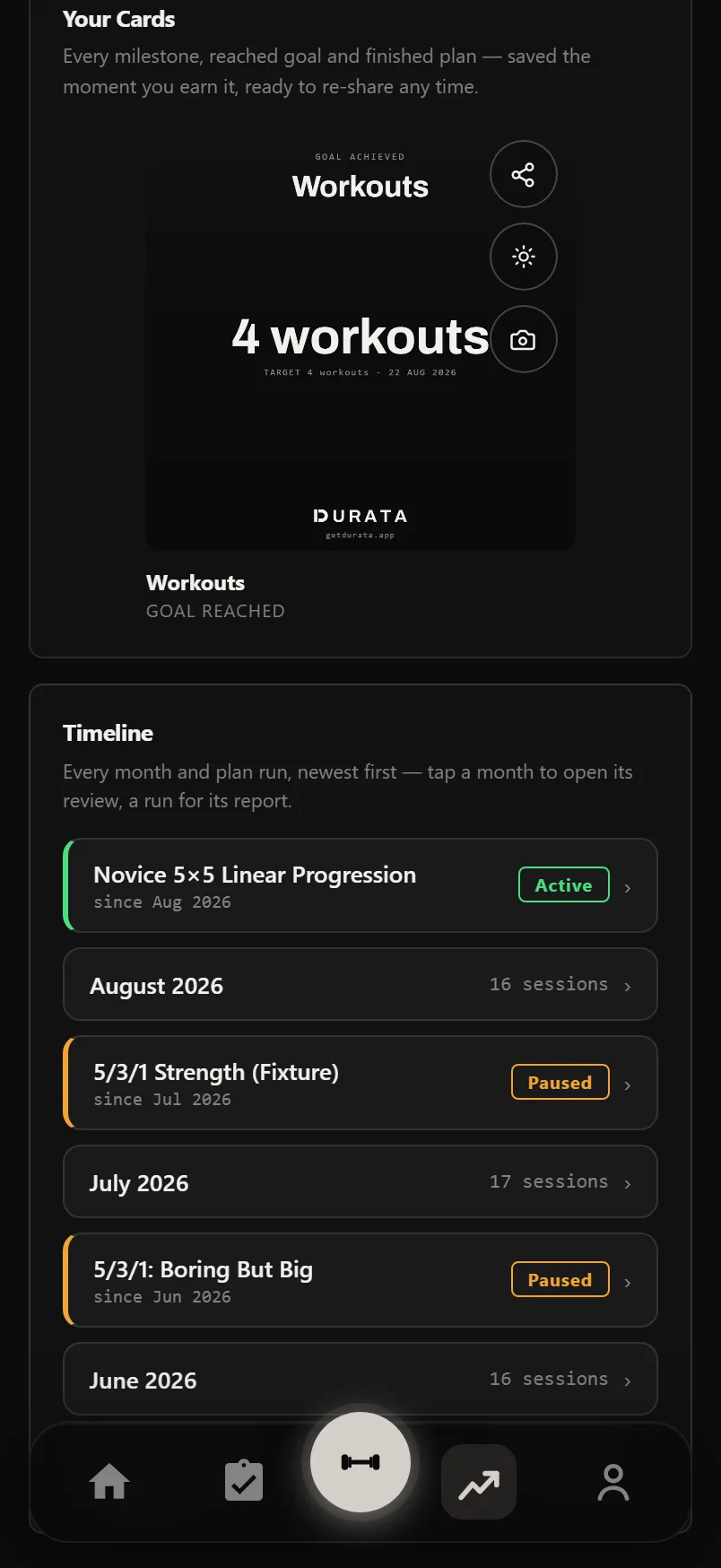
A goal shows up here the moment it hits its target, whether or not you pinned it to your dashboard. Reaching it is what earns the card.
Swipe the shelf sideways, or use the arrows on the web, to move through your cards. Each one shares independently.
The numbers are the real ones
The report uses the same calculation as everywhere else in Durata. Volume counts body weight on dips and pull-ups, two-dumbbell lifts count both hands, warm-up sets stay out, and imported history counts toward your volume but can never mint a PR. Because the report and the share card come from one calculation, they never disagree.
That means the comparison against the previous period is honest: it's your logged training this period against your logged training last period, not a rounded-up highlight reel. A down month reads as a down month, which is what makes an up month worth sharing.
Common questions
Where do I find Review?
It's the first tab in Progress, and the one that opens by default. It opens on your most recent completed month, and the Change Period button lets you pick any year or month you have logged training for. The other three Progress tabs, History, Strength and Workload, are a swipe away as well as a tap.
Can I review the current month before it's over?
Yes. The current period is labelled 'so far' and fills in as you train, so you can watch this month take shape instead of waiting for it to finish.
Do imported workouts count in a review?
Imported history counts toward your total volume, so it shows up in the volume figure and the comparison. It never mints a PR, a streak or a milestone, though. Those are built only from workouts you actually logged in Durata.
How is the volume comparison worked out?
It's this period's logged volume against the previous calendar period's, using the same engine as the rest of the app. A month compares to the month before and a year to the year before, so the up-or-down arrow reflects real training, not a projection.
Is anything uploaded when I share a review?
No. The recap card is drawn on your device from figures that already live there. Nothing leaves your phone until you choose Share, and even then the image goes straight to the app you pick.
What's the Timeline, and how is it different from the Plans list on a month?
A month's report lists the plans you ran that period. Switch to a year or All Time and that list becomes a Timeline instead: every month with data and every plan you've run, interleaved newest first, since a whole year has too many plans for a short list. Tap a month to reopen the report on it, or a plan for its Report Card — the same full breakdown you'd get from a month view.
What is the Your Cards shelf, and what shows up there?
It's an all-time collection at the bottom of the report, separate from the period you're viewing. It holds a card for every program you've finished, every goal you've reached and every milestone moment Durata has celebrated — your first workout, streak milestones, comebacks. Each card is saved the moment it's earned, so it stays here even if the goal behind it is later deleted. A goal appears the moment it hits its target, whether or not it was pinned.
Put it into practice
Durata is free to use — 50 proven programs, automatic progression, rest timers and PR tracking, all on your phone.