
GZCL P-Zero · Back
By Cody Lefever · With Permission
GZCL P-Zero with more back and fewer leg exercises. Cody Lefever's own update to his GZCL method, from his book P-Zero: four workouts in turn, a rest day after each. A barbell row is a T2. Every lift climbs three stages on its own. T1 is the day's main lift, 4 sets of 4 with the last for as many reps as you can, then 4x3+ and 4x2+. T2 is a second big lift, 4x12, 4x10, then 4x8. Four T3s finish each workout: 60 reps, then 45, then 30, in 2 to 4 sets. Add weight every session you make it; a miss moves that lift to its next stage.
Free to use · auto progression, rest timers & PR tracking built in
Cody Lefever
Cody Lefever is the creator of the GZCL Method and General Gainz training frameworks: a World Championship caliber lifter and coach, and a Marine veteran. Owner of Alma's Gym, North America's highest gym, he works with clients in person in Alma, Colorado and online around the world.
What is GZCL P-Zero · Back?
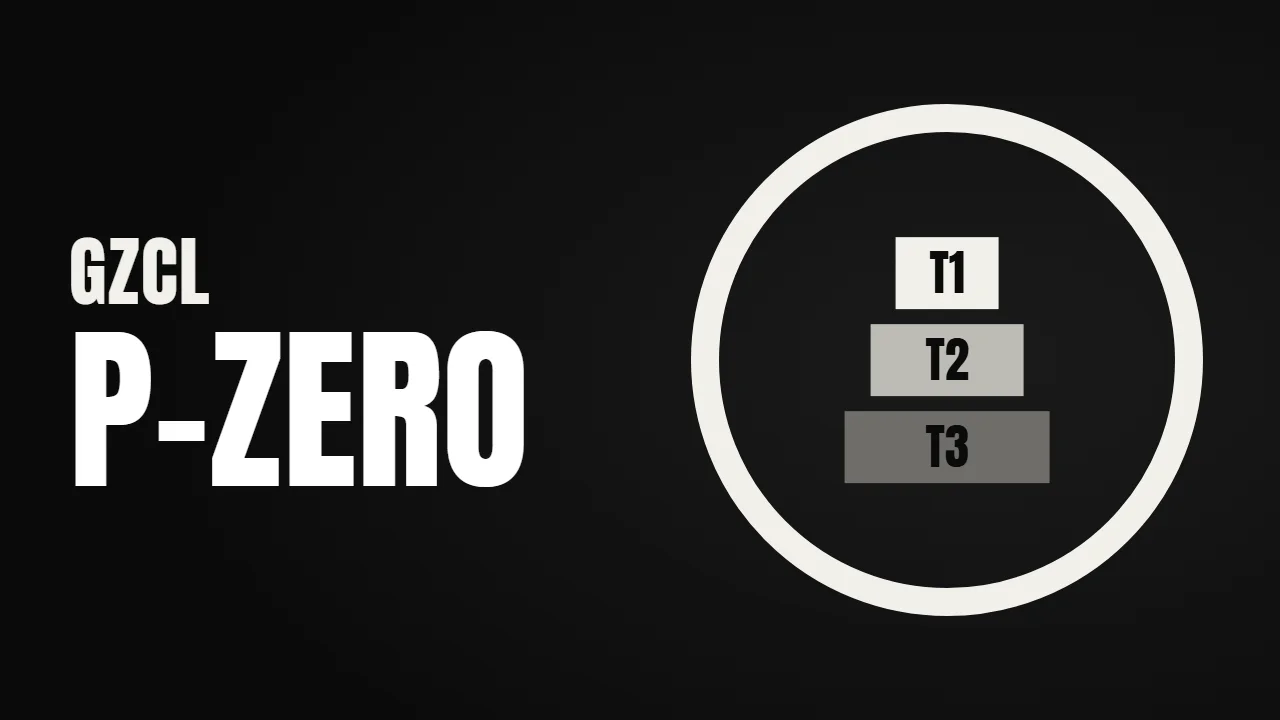
P-Zero is Cody Lefever's own update to his GZCL Method, from his 2025 book P-Zero: Revisiting the GZCL Method. This is its full body version, the one that balances training across every muscle, open-ended. Every exercise belongs to one of three tiers. T1 is the day's main lift, heaviest with the least volume. T2 is a second big lift, lighter and with more reps. Four T3 lifts finish each workout, lightest and highest in volume: isolation and compound exercises, machines and cables encouraged, for the muscles that support the big lifts.
There are four workouts, run in turn with a rest day after each: A1, B1, A2, B2. A1 is deadlift (T1) and bench (T2), then a chest supported row, leg press, dips and weighted decline sit-ups. B1 is overhead press (T1) and squat (T2), then pull-ups, incline dumbbell bench, leg curls and barbell curls. A2 is bench (T1) and deadlift (T2), then an underhand cable row, seated dumbbell press, leg extensions and dumbbell side bends with shrugs. B2 is squat (T1) and press (T2), then Romanian deadlifts, dumbbell bench, cable lateral raises and lying leg raises. Each main lift comes round twice in the four workouts, once as a T1 and once as a T2.
Is GZCL P-Zero · Back right for you?
Cody wrote P-Zero as a starting point to build your own training plan, and this full body version as the one that balances training across every muscle with a wide variety of exercises. Every T1 and T2 starts at 80% of a training max: 90% of a recent one-rep max for T1, 90% of a recent ten-rep max for T2, so you need a recent idea of both. Each workout has two big lifts and four T3s; a session takes about 50–70 minutes.
How progression works
Every lift moves on its own through three stages. T1 is 4 sets of 4 at one weight, the last set for as many reps as you can (4x4+), then 4x3+, then 4x2+. A workout counts when that last set beats its reps by at least one, and then the weight goes up next time: 5 lb (2.5 kg) on bench and press, 10 lb (5 kg) on squat and deadlift. If you don't get the extra rep, the next workout moves you to the next stage, a step heavier. T2 is 4x12, then 4x10, then 4x8, with no extra reps on the last set: make every rep and add weight; miss one and move to the next stage, a step heavier. When the last stage fails, the lift starts again at its first stage, a little heavier than it started that cycle. Cody's example is a squat that started at 315 lb restarting at 325 lb or more; Durata suggests one step up and lets you type any weight.
T3 stages are totals: 60 reps, then 45, then 30, in 2 to 4 sets, the first set the biggest. Make the total and the weight goes up a small step, 2.5 kg (5 lb); fall short and you move to the next total at the same weight; fall short of 30 and the lift starts again at 60 reps, a step heavier. Cody's tips for the total: get about three quarters of it in the first 2 or 3 sets and use the 4th to finish, with myo-reps (short 10 to 15 second pauses) when you need them. Pull-ups and dips start at bodyweight; lying leg raises carry the 60 reps in their note with no weight. Rests are the top of Cody's ranges: 3 minutes for T1, 2 for T2 and 90 seconds for T3.
Durata runs this progression for you — there are no percentages to work out, so each session's target carries over from what you logged last time and the weight moves when you hit or miss the prescribed reps.
GZCL P-Zero · Back — every set, every session
AMRAP = as many reps as possible on the final set.
A1 · T1 Squat
| Exercise | Sets × Reps | Rest |
|---|---|---|
| Squat (Barbell) | 3×4 1×4+ AMRAP | 3:00 |
| Romanian Deadlift (Barbell) | 4×12 | 2:00 |
| Dumbbell Row | 4×15 | 1:30 |
| Rear Delt Reverse Fly (Dumbbell) | 4×15 | 1:30 |
| Lying Leg Curl (Machine) | 4×15 | 1:30 |
| Leg Extension (Machine) | 4×15 | 1:30 |
B1 · T1 Press
| Exercise | Sets × Reps | Rest |
|---|---|---|
| Overhead Press (Barbell) | 3×4 1×4+ AMRAP | 3:00 |
| Bench Press (Barbell) | 4×12 | 2:00 |
| Triceps Dip (Weighted) | 4×15 | 1:30 |
| Bicep Curl (Cable) | 4×15 | 1:30 |
| Decline Sit Up (Weighted) | 4×15 | 1:30 |
| Hanging Leg Raise | 4×15 | 1:30 |
A2 · T1 Deadlift
| Exercise | Sets × Reps | Rest |
|---|---|---|
| Deadlift (Barbell) | 3×4 1×4+ AMRAP | 3:00 |
| Bent Over Row (Barbell) | 4×12 | 2:00 |
| Chin Up (Weighted) | 4×15 | 1:30 |
| Lat Pulldown - Wide Grip (Cable) | 4×15 | 1:30 |
| Shrug (Dumbbell) | 4×15 | 1:30 |
| Back Extension (Hyperextension) | 4×15 | 1:30 |
B2 · T1 Bench
| Exercise | Sets × Reps | Rest |
|---|---|---|
| Bench Press (Barbell) | 3×4 1×4+ AMRAP | 3:00 |
| Overhead Press (Barbell) | 4×12 | 2:00 |
| Incline Bench Press (Dumbbell) | 4×15 | 1:30 |
| Bicep Curl (Dumbbell) | 4×15 | 1:30 |
| Overhead Triceps Extension (Cable) | 4×15 | 1:30 |
| EZ Bar Biceps Curl | 4×15 | 1:30 |
GZCL P-Zero · Back — common questions
How is P-Zero different from GZCLP?
GZCLP has one T3 a workout and its stages change the set count (5x3+, 6x2+, 10x1+). P-Zero keeps 4 sets at every T1 and T2 stage, moves to the next stage a step heavier instead of on the same weight, needs an extra rep on the T1 rep-out set to count it, and finishes every workout with four T3s judged on their total reps.
What weight should I start with?
80% of the lift's training max. For T1 that training max is 90% of a recent, technically sound one-rep max; for T2 it is 90% of a recent ten-rep max. Durata doesn't ask up front: the first weight you log on each lift becomes its starting weight.
How many days a week is it?
Cody's full body version runs the four workouts in turn with a rest day after each, a day on and a day off, so most weeks have three or four workouts. Durata runs it as a rotation: the next workout is always the one after your last, whatever day you train.
What happens when I fail a lift?
That lift moves to its next stage, fewer reps a set: T1 from 4x4+ to 4x3+ to 4x2+, T2 from 4x12 to 4x10 to 4x8, both a step heavier, and T3 from 60 to 45 to 30 total reps at the same weight. Only that lift moves; every other lift carries on. When the last stage fails, the lift restarts at its first stage, a little heavier than it began.
Are the other P-Zero versions in Durata?
Yes. Cody's Shoulders, Legs, Arms and Back versions from the book are on the same program page in the app: pick one under Your version. Each keeps the same tiers, stages and order of workouts and changes the lifts, and Cody runs one for 3 to 12 weeks before moving to the next.
Is there an app that runs GZCL P-Zero · Back for you?
Yes. Durata runs GZCL P-Zero · Back as written, free: the 4-day-a-week schedule, every set and rep, and the progression built in. Log your sets and the next session's weights are worked out for you, with the stalls and deloads the program calls for; a tap on any lift shows why the weight moved. It is on iPhone and Android, works offline, and your history from Hevy or Strong imports free.
Source: P-Zero by Cody Lefever, from his book P-Zero: Revisiting the GZCL Method (2025)
With permission from Cody Lefever, who gave Durata permission to carry this program.
Run GZCL P-Zero · Back in Durata
AMRAP tracking, automatic progression, plate calculator, rest timers and PR tracking — the whole program, ready to log.