

Starting a program: training maxes and schedule
When you start a program, Durata runs a short one-time setup so it can put the right weight on the bar from your very first session. For a percentage-based program like 5/3/1 that means asking for your training maxes; for its accessory lifts it asks the weight you want to start at; and for any program it offers to schedule a start date. It takes under a minute, and this guide explains each step so none of it is a surprise.
If a program uses only simple linear progression, meaning it adds a bit each session, you'll see just the starting-weights step and the start date. The training-max step only appears for programs that are actually driven by training maxes.
Last reviewed 2026-09-14 · matches app v1.0.0.87
What the program page tells you first
Before any of the setup runs, a program's page in Discover answers the two questions that decide whether you start it at all. It opens on About. First a fact grid: days a week, how long the block runs, how long a session takes, how long a <em>week</em> takes, level, split, equipment, goal and the progression model. Then the description, then the two numbers below.
<strong>Where your lifts start</strong> is the setup you have not run yet, worked out early. It lists each lift the program progresses and the weight it would open at: a training max where the program is driven by one, a working weight where it is not, taken from your logged history using exactly the maths the setup sheets use. Nothing is saved by looking. It is a preview, and you can still change every number when you actually start. A lift you have never logged shows a dash rather than a guess borrowed from a neighbouring lift.
Under it, <strong>If every session goes to plan</strong> plots those same lifts twelve weeks forward, driven through the real progression engine rather than a formula, the same code that will decide your weights session by session. Read it as the program's shape rather than a promise: it assumes every prescribed lift is met, so it is the ceiling rather than the forecast, and the app says so under the chart. Both only appear if you have history for the app to work from; a brand-new account sees neither rather than a chart of invented numbers.
Three more segments sit beside About. Plan is the week and then every session of every week, written out. Volume is planned hard sets per muscle and the push/pull/legs balance. Once you have four weeks of your own training behind you, it also compares the program's volume with what you have actually been doing, muscle by muscle. Progression is every rule the program ships with, in plain language, read-only: you cannot edit a program you have not started.
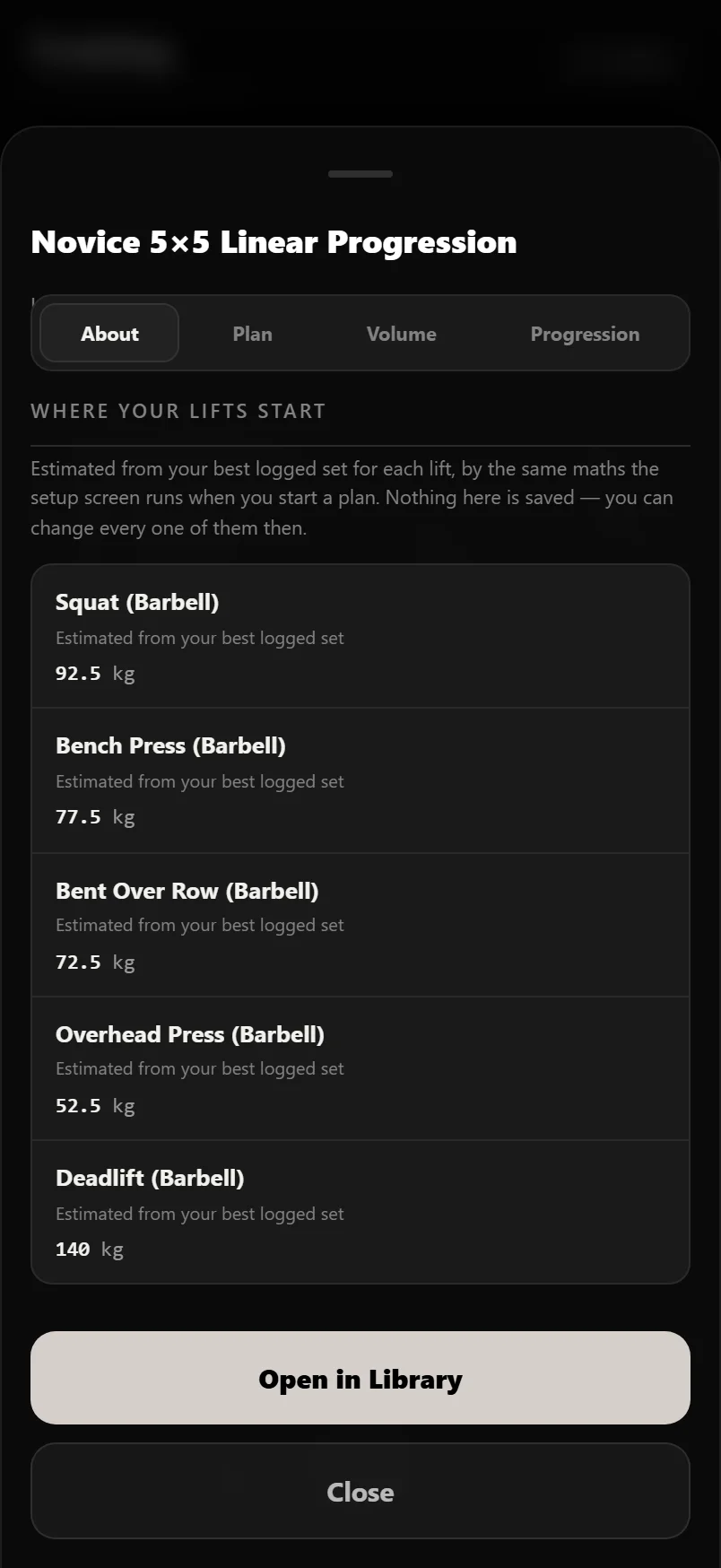
The projection is suppressed entirely when it would be flat. A program that holds a lift steady for twelve weeks draws no line at all, rather than a straight one.
Point at any week on the projection to read that week's numbers for every lift plotted, rather than squinting between two gridlines.
Setting your training maxes
A training max (TM) is a working number your program's percentages are calculated from. It sits a little below your true one-rep max, so the prescribed weights stay makeable week after week. Percentage programs are built around it: a set written as '85%' means 85% of your training max, not 85% of an all-out max. A conservative TM keeps the weights heavy enough to progress and light enough that you don't miss reps and stall.
When you start a TM-based program, Durata shows a sheet with a row for each main lift and suggests a training max for you, estimated from your logged history, typically around 90% of your best estimated one-rep max (a few programs use 100%, and Durata knows which). If you've no history for a lift, you enter the number yourself. Don't overthink it: err low. A TM that's too light costs you a week or two; one that's too heavy stalls the whole program.
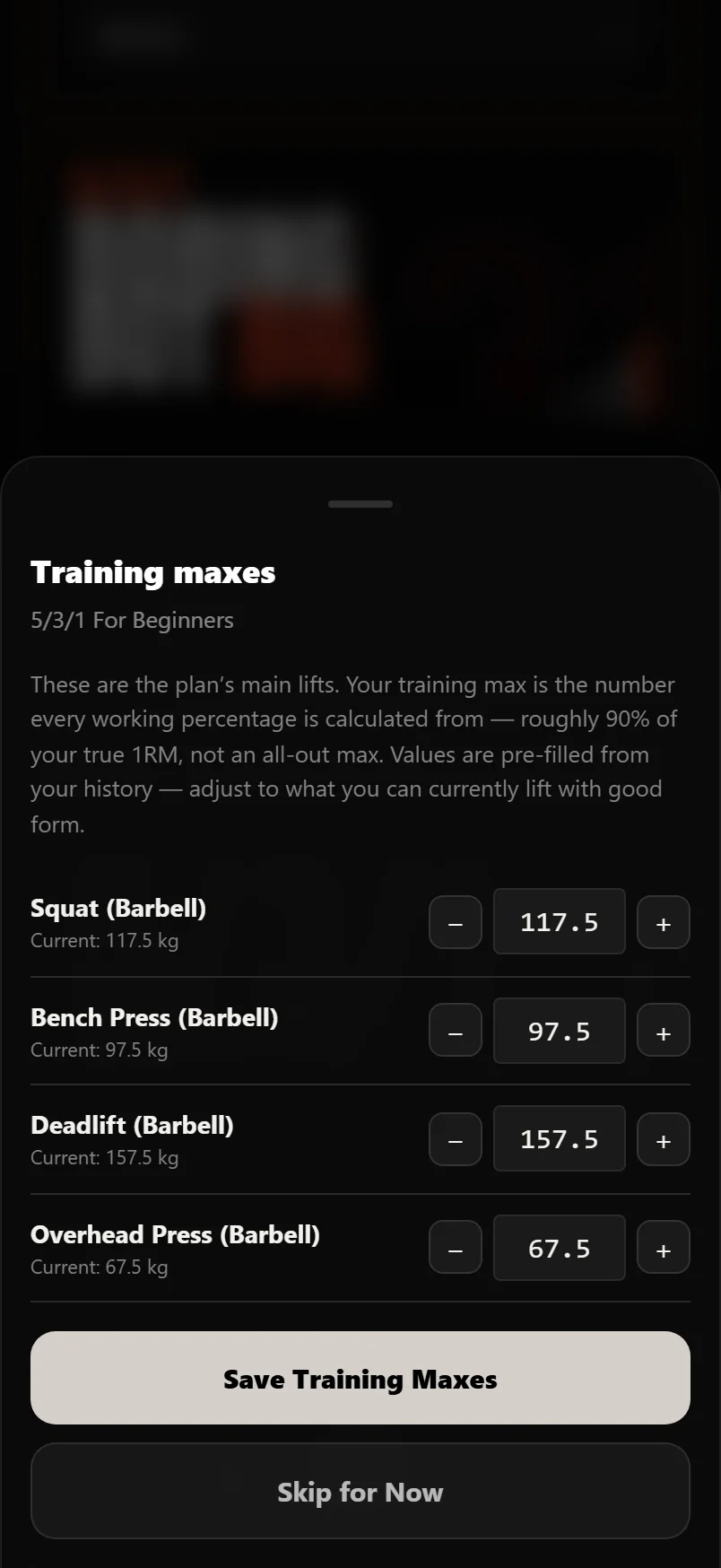
Your training max is not your one-rep max. If in doubt, set it to a weight you could do for a clean set of 5 today. The program should feel repeatable rather than maximal.
Choosing your accessory weights
Once you're training, each lift's rule travels with it: a one-line chip under the exercise name in the logger reads out the progression governing that lift: what it's at, what earns the next increase, and when it deloads. You never have to remember what the program decided.
After the training maxes, Durata asks for the weight you'll start each accessory lift at, meaning the supporting exercises that aren't driven by a training max. Where you have logged history, it estimates a sensible starting weight for the program's target reps; where you don't, you can enter one or leave it blank and set it on the day. The first weight you log for that lift becomes its working weight, and progression climbs from there. Your main lifts are already handled by the training maxes you just set, so this step is only about the accessories.
As with the training max, starting a touch conservative is the smart move. Accessories are there to add volume and build muscle rather than to be maxed out. Pick weights you can complete with good form for all the prescribed sets, and let them climb over the weeks.
AMRAP sets and how your training max grows
Many percentage programs finish a main lift with an AMRAP set, short for 'as many reps as possible'. It's the last set at the day's top weight, and instead of a fixed number you do as many good reps as you can. This does two jobs: it's the hard, productive set that drives the adaptation, and it's the test the program uses to decide whether you've earned more weight.
In Durata, hitting the AMRAP target is what raises your training max for the next cycle. Beat the minimum reps and the app bumps that lift's TM by a small automatic increase, so next cycle's percentages are calculated off a slightly heavier number. Miss it, and the TM holds so you can consolidate. That is how a TM program progresses: the AMRAP set earns the increase, and the training max carries it forward. You never work out the next jump yourself.
Leave a rep or two in reserve on AMRAP sets rather than grinding to absolute failure. You'll still trigger the progression and recover better for the next session. See our RPE and RIR guide.
Scheduling a start date
Finally, Durata offers to schedule when the program begins, and it recommends next Monday by default. Program weeks run Monday to Sunday, so starting on a Monday lines your training week up cleanly with the program's, which is why it's the suggested option, one tap away. You can take that recommendation, start today instead, or pick any date on the calendar. Whatever you choose is marked on your History calendar, and the sheet shows you exactly which session you'll begin with.
Pick a date in the future and the program waits for it. It's scheduled rather than running: your Library card reads <em>Starts Mon 14 Sep</em>, the date is pinned on your History calendar, and nothing else moves. No sessions appear on the This Week strip, Up Next carries on showing whatever it showed before, and no session reminders fire. Your first session appears on the morning of your start date, not before.
A date partway through a week splits it rather than skipping it. Start on a Saturday and Saturday and Sunday fill in while Monday to Friday stay empty, which is why the sheet names the session you'll open with and counts the ones you're passing on by joining the week late.
The start date isn't set in stone either. Need to re-time a program later? End it and start it again with a fresh date. Your training maxes and logged history are kept, so nothing is lost. Either way, your first session appears on the date you picked.
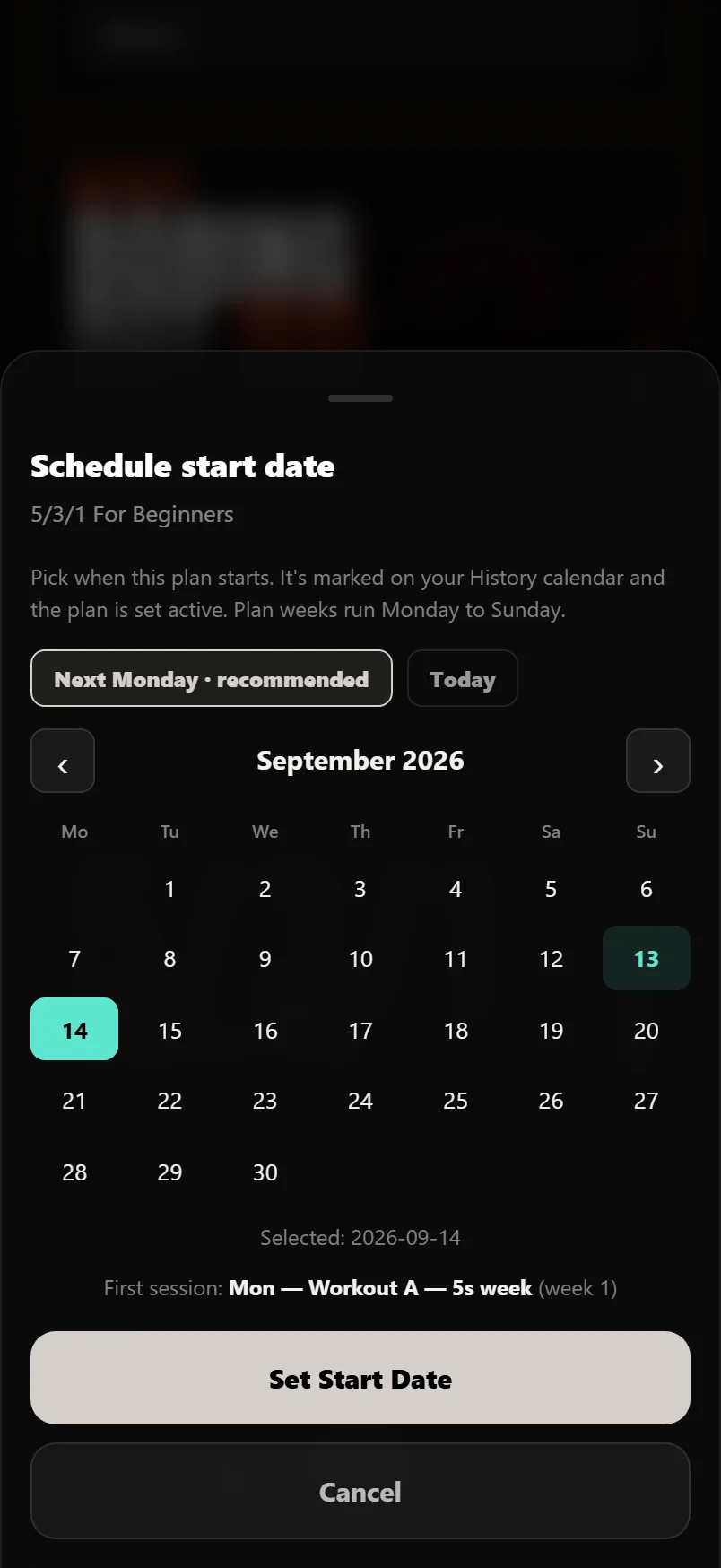
Scheduling a program doesn't stop you training in the meantime. A session you start before the date is logged normally, it just doesn't count towards the program's first week.
Common questions
Can I see what weights a program would give me before I start it?
Yes. Open the program in Discover and its About segment shows Where your lifts start, listing each progressing lift with the training max or working weight it would open at, estimated from your logged history with the same maths the setup sheets use. Nothing is saved, and you can change every number when you actually start. Underneath, a twelve-week projection plots where those lifts would go if every prescribed lift is met. Both need some logged history to work from, so a brand-new account sees neither.
What is a training max?
A working number your program's percentages are calculated from, set a little below your true one-rep max so the prescribed weights stay makeable every week. A set written as '85%' means 85% of your training max. Keeping it slightly conservative is what stops you stalling.
How does Durata set my training max?
When you start a training-max program it suggests one per lift, estimated from your logged history, usually around 90% of your best estimated one-rep max (some programs use 100%, and Durata knows which). If you have no history for a lift, you enter it yourself. When in doubt, set it low.
What does AMRAP mean?
'As many reps as possible'. It is the last set at the day's top weight, where you do as many good reps as you can instead of a fixed number. In a training-max program, beating the AMRAP target is what earns an automatic increase to that lift's training max for the next cycle.
Do I have to set my weights when I start a program?
Only briefly. Training-max programs ask for your training maxes and accessory starting weights up front so the first session is ready to go; simpler programs just ask a starting weight. Durata estimates from your history where it can, and you can leave anything blank. The first weight you log for that lift becomes its working weight and progression takes over from there.
Can I change my program's start date?
The start date is chosen as part of starting the program. To re-time one you've already started, end it and start it again with a new date. Your training maxes and logged history are kept, so you don't lose progress.
I scheduled my program for next week. Why would it show sessions this week?
It won't. A program scheduled for a future date is scheduled, not running: its card reads Starts followed by the date, and nothing lands on the This Week strip, in Up Next or in your reminders until that day arrives. If you want to begin sooner, end the program and start it again with an earlier date, or pick Today on the start-date sheet.
Can I run a program again after I finish it?
Yes, and you don't have to go looking for it. A finished program keeps its place in Training → Library: the card stays where it was, badged Completed with the date you finished, and its button becomes Start Again. That spins up a fresh run from week one and pre-fills your starting weights from where the last run left off, so you don't start cold. You can adjust any of them before you begin, then pick a new start date. If you changed the plan itself — swapped a lift, edited a session, added or removed sessions or weeks, changed a progression rule — the new run keeps your version. A catalog plan you left as it came is rebuilt from the current catalog copy, so any fixes shipped since your first run come with it; setting your training days, renaming a session or moving one to another day does not count as changing it. Run the same program several times and it is still one card — the newest run is the one it shows — while every run keeps its own report under Progress → History.
Put it into practice
Durata is free to use — 50 proven programs, automatic progression, rest timers and PR tracking, all on your phone.