

The exercise library
Durata ships with 415 built-in exercises covering barbells, dumbbells, machines, cables, kettlebells, bands and bodyweight work. 376+ of them have how-to demo videos, and every single one comes with step-by-step instructions and form tips. Photos and videos update themselves too — improved media arrives with a normal content refresh, no app update needed.
Every exercise in the library is also a record of you: tap into any one and you get your personal records, progression charts and every set you've ever logged on it. This page covers finding exercises, reading the detail view, and making the library your own with custom exercises and preferences.
Last reviewed 2026-09-14 · matches app v1.0.0.87
Finding an exercise
Open Exercises from the You tab (or tap an exercise name anywhere in the app). Each row carries a colour-coded edge for its main muscle, so you can scan the list by colour before you even read a name. A search box matches on name and muscle - typing "db press" finds every dumbbell press - and a Filter button narrows the list to one muscle group, from chest and back down to forearms and calves, or to just your favourites.
If you've used the exercise before, check Recently Used at the top of the list first - it shows your last three lifts for whatever muscle group you've got selected (or across everything, with no filter), so your regulars are usually one tap away with no scrolling or typing. It hides while you're typing a search.
Star an exercise as a favourite on its detail page or straight from the picker, then pick Favourites from the Filter button to see only the lifts you've starred - handy for a lift you like but haven't trained in a while, which Recently Used won't surface. Favouriting also sends it to the very top of the list on the Exercise Analysis page.
Under the search box is a List / Grid switch. List is what you get to begin with: compact rows, a lot of names on screen at once, best when you know what you're looking for. Grid turns each exercise into a card with its photo, which is the better way round when you're browsing a muscle group you don't train often, or when a name like "Iso-Lateral Row" doesn't tell you what the machine actually looks like. Everything else is the same either way - the same sections in the same order, the same star, the same play button, the same tap to open.
Whichever you pick sticks. It's one setting for the whole app, not one per screen, so switching to grid here also switches the picker you get mid-workout, and it syncs to your account and follows you to your other devices.
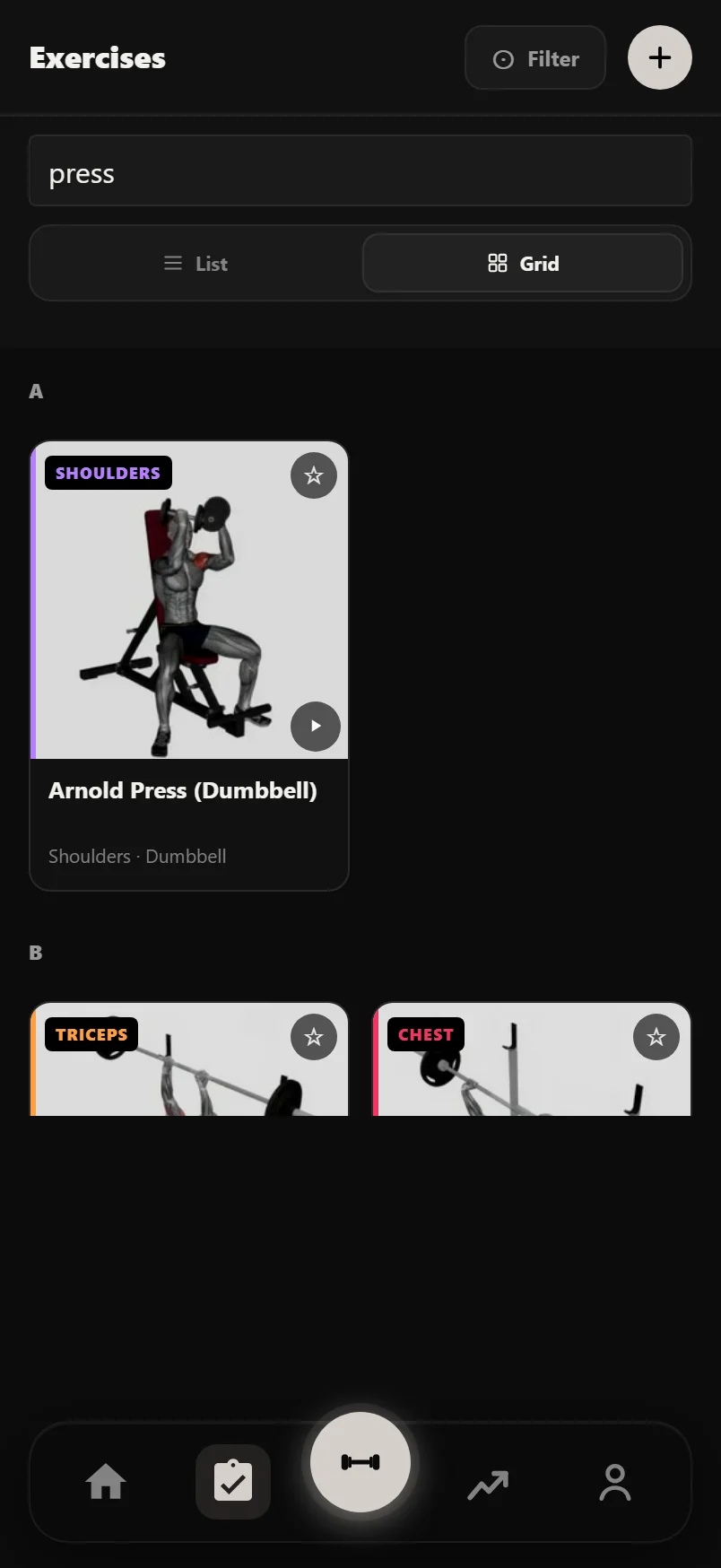
Exercises with a video show a small play button in the picker - tap it to watch the demo without leaving the list. In grid view it sits in the corner of the photo.
In the logger, long-press an exercise name to play its how-to video instantly. A normal tap opens the full detail page.
There's no A-Z rail on the edge of the list anymore - search and the muscle filter do that jumping now, and the sticky letter headers keep you oriented as you scroll.
An exercise with no photo yet still gets the same mark in either view: a dumbbell on a tile tinted with its muscle colour, or a heart-rate trace if it's cardio, so neither the list nor the grid breaks into gaps.
Switching between List and Grid keeps your place. Whatever exercise was at the top of the screen is at the top again after the switch, so a long scroll into the S section isn't thrown away. It only lasts as long as you're on the screen - leave and come back and you start at the top again.
The exercise detail view
Each exercise page has four tabs. Overview shows your records - best weight, best estimated 1RM and best single-set volume - each with a sparkline of your last 90 days and a dashed line marking your all-time record, so you can see at a glance how close you are to it. Below that sits your Training Max (used by percentage-based programs), which warns you when it's more than six weeks old.
On bodyweight movements - dips, pull-ups, chin-ups and push-ups - volume figures always include your body weight, marked with an "includes bodyweight" note wherever it applies. To log added weight or assistance, use the exercise's dedicated "(Weighted)" or "(Assisted)" variant - the base exercise itself is reps only. Best Weight and Best E1RM on those weighted/assisted variants stay in added weight, the number you'd actually quote.
How To holds the demo video, step-by-step instructions and form tips. History lists every set you've ever logged, grouped by session and month, with set-type badges and a trophy on record-setting sets. Charts adds full progression graphs: estimated 1RM, session volume, average reps, best weight, RPE trend, set-type distribution and training frequency - plus an Exercise Trends read on your volume trend, strength rate, consistency and session spacing. If you're running a program on that lift, Exercise Trends reports rather than instructs: it still shows every number, but it won't tell you to add sets or train more often when your program already decides that, and a flat stretch or a long gap stops being flagged as a problem when it's the plan. The charts are free; Exercise Trends is part of Pro, and on a free account its card blurs behind one Unlock with Pro pill once it has a reading.
Bodyweight moves like the ab wheel switch to rep records instead: best set, best session and lifetime reps on the Overview, with rep progression charts in place of the 1RM and load graphs. Timed holds - planks, dead hangs, wall sits - do the same with time: best hold, total time under tension and hold progression charts, with your history shown as a hold-per-set table. Any exercise you've only ever logged unweighted gets the matching view automatically, and returns to the weight charts the moment you log a weighted set.
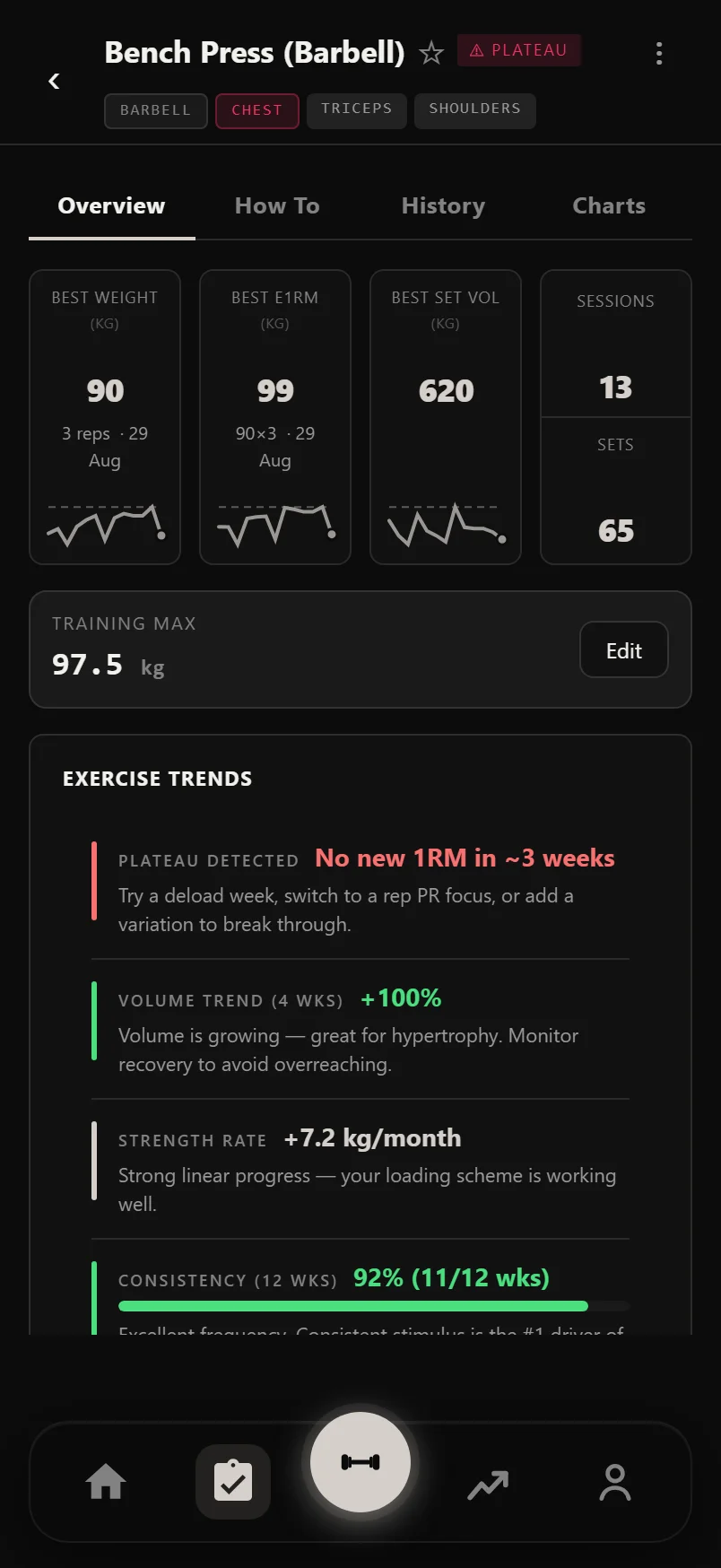
Tap the three-dot menu on any exercise for quick actions: Setup, duplicate and compare.
Every progression chart on the Charts tab has an expand icon in its header. Tap it for a full-screen version of that one chart, showing more of your history than fits in the card. Turn the phone sideways for a wider view, and use back or the X to return to exactly where you were.
One chart expands into something more than a bigger copy of itself. The estimated 1RM card opens the Strength story: the e1RM line with the actual weight on the bar as faint dots beneath it, so a wave cycle that drops the bar every few weeks stops looking like a plateau. Each point is coloured by what your program decided that session - green for a move up, red for a miss or a deload - a caret marks every session that set a new estimated 1RM, and a colour-keyed rail under the axis splits your history into program eras, listed below the chart with the sessions, deloads and weight moved in each. Drag across the chart and the panel underneath fills with that session's sets and the reason the weight changed.
Setup: how you do this lift
Setup, in the three-dot menu, is one screen holding everything about how you personally do a lift: the bar you use and the rack settings that go with it, the bench angle on incline work, the pin or seat position on a machine, the kit you wear, and a note to yourself.
The note takes seat height, grip width, whatever you need to remember, and it shows up on the How To tab and in the logger. Paste a URL into it and it becomes a tappable link, handy for a technique video you keep coming back to.
Whatever you save shows as chips near the top of the exercise page - the angle first, then your kit. They are not just a read-out: tap any of them to go straight back into Setup. And it is the same screen you get from a planned session, from the logger and from the rest timer, so it never matters where you opened it from.
Favourites, training maxes and everything in Setup sync to your account, so they follow you across devices.
The Setup icon in the three-dot menu turns amber once you have saved anything for that exercise, so you can tell at a glance which lifts you have already dialled in.
Only the parts that apply show up. A squat is never offered a bench angle. A machine is asked how it is loaded rather than assumed: a pin stack draws the stack with your pin in it, a plate-loaded machine like a leg press or a hack squat draws the plates on each horn, and a weighted pull-up or dip draws the plate you hang on the belt. Durata guesses from the name and the Loaded By row under the drawing changes it in one tap. Where a bench does apply you get both of its adjustments: the back pad in degrees, drawn at the angle you pick, and the seat pad as a notch number.
A plate-loaded machine doesn't always load both ends - a leg extension or leg curl commonly takes plates on one horn, not two. A Loaded On row next to Loaded By lets you say which, and it changes how that machine's weight is read everywhere, from the Setup drawing to the plates the logger tells you to put on.
A single-arm dumbbell exercise draws one bell on its Setup screen, not a pair, so the weight shown is the weight you actually pick up rather than double it.
Pin up to four exercises in Exercise Analysis to get always-visible cards with e1RM and volume trends, plus a progressing / plateau / declining badge.
Custom exercises
Tap the + button in the exercise picker to create your own exercise. Give it a name, then tap each row to choose from a list: the primary muscle it trains, any secondary muscles it also works, an equipment category, and what to track - weight and reps, reps only, time, distance, and more. The tracking list shows the columns each option gives you in the logger, so you can see what you'll be filling in before you pick.
The + sits in the picker header wherever you add an exercise, including mid-workout. If you get to the gym and find a machine Durata doesn't have a name for, you can create it from inside the session rather than stopping to set it up first: the new exercise is created, ticked ready to add, and the search box and body-part filter clear so you can see it.
A name and a primary muscle are required, and the name has to be one you don't already have. If either is missing or the name is taken, the form tells you which field to fix instead of saving something half-finished.
Custom exercises sync to your account and are included in full JSON backups. When you import history from Strong or Hevy, any exercise Durata can't match to its library is created as a custom exercise automatically, so no data is dropped.
You can't edit a built-in exercise, but you can duplicate one - the copy is fully editable, so it's the fastest way to make a variation.
Picking a muscle as primary quietly removes it from your secondary list, so the same muscle can never be counted twice.
Default equipment for an exercise lives in the logger's Set Up sheet, not in this form.
Creating an exercise while swapping one out selects it straight away - there is no second tap to confirm.
Tidying up equipment tags
If your gym has no safety bar or trap bar, you don't need those tags cluttering every equipment list. In Settings under Equipment you can hide any built-in tag with a tap, add your own custom tags, and restore hidden ones later if your setup changes.
Common questions
How many exercises does Durata include?
415 built-in exercises, 376+ of them with how-to demo videos, plus any custom exercises you create yourself.
Can I watch an exercise video without opening its page?
Yes. Tap the play button next to it in the exercise picker, or long-press its name in the logger to play the video instantly.
Do my custom exercises transfer to a new phone?
Yes. Custom exercises sync to your account and are included in full JSON backups, so they come back when you sign in on a new device.
What happens to exercises I import from Strong or Hevy?
Durata matches imported names to its own library where it can. Anything it can't match is created as a custom exercise automatically, so your history stays intact.
Can I see exercise photos instead of a list of names?
Yes. The List / Grid switch under the search box turns the picker into a grid of photo cards. It's one setting for the whole app, so it applies to the picker you get mid-workout too, and it syncs to your other devices.
Can I edit a built-in exercise?
Not directly - built-ins are shared by everyone. Duplicate it instead: the copy is a custom exercise you can rename, re-categorise and change tracking on.
Put it into practice
Durata is free to use — 50 proven programs, automatic progression, rest timers and PR tracking, all on your phone.